Category: Podcasting and Media

  • Introducing Media Blaster: Turn Your WordPress Blog Into a Fully Produced Podcast — Automatically

    Introducing Media Blaster: Turn Your WordPress Blog Into a Fully Produced Podcast — Automatically

    There’s a moment in every creator’s journey where you feel the gap — the distance between the content you want to publish and the time you actually have.

    You write blog posts. You run a site. You have ideas. You have a voice.

    But somewhere between writing, editing, managing plugins, SEO, posting to social, and everything else that eats your day, one dream keeps slipping out of reach:

    “I should really turn this blog into a podcast.”

    Media Blaster exists to make that dream effortless.

    Not someday.

    Not “when you have more time.”

    Right now.

    What Media Blaster Really Does

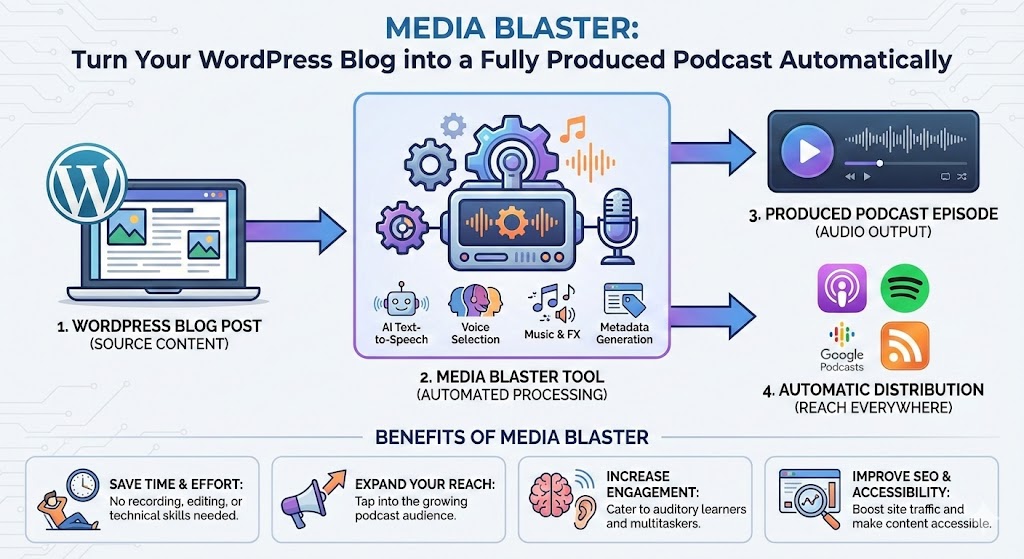
    At its core, Media Blaster takes your WordPress content — a single post or a whole collection — and transforms it into a complete, publish-ready podcast episode.

    Automatically.

    No microphone.

    No audio timeline.

    No learning curve.

    No “I’ll do it later.”

    You choose your posts, pick your host voice, click a button, and Media Blaster handles everything that usually eats hours of a creator’s life.

    The Experience We Designed for You

    Forget features for a second — let’s talk about what it feels like to use Media Blaster.

    You press “Generate Episode.”

    You get a clean, professional podcast episode narrated by a consistent AI host trained to match your tone.

    It sounds like something you’d expect from a well-funded studio — only you didn’t open a DAW, record anything, or fight with FFmpeg at 2 a.m.

    Media Blaster handles:

    • Script composition
    • Voiceover generation
    • Editing and mixing
    • Mastering
    • Metadata
    • And yes — direct publishing to Spreaker (or downloading to upload anywhere else)

    In other words:

    You write, Media Blaster broadcasts.

    Check out this fully produced podcast based of this blog post. Created by Media Blaster!

    The Dream We’re Actually Selling

    Creators don’t want more tools.

    They want more reach.

    Podcasts are one of the most powerful discovery channels on the internet… but historically, they’ve required time, gear, experience, or budget.

    That’s the bottleneck we wanted to destroy.

    1. Your blog becomes a multi-channel content engine.

    Every WordPress post becomes a podcast episode — not in theory, but in practice.

    Write once → publish as text and audio everywhere.

    Suddenly your site speaks. Literally.

    2. Your voice is always “on,” even when you’re not.

    Media Blaster doesn’t get tired.
    It doesn’t lose its tone.
    It doesn’t miss a publishing window.

    It gives your content a narrator that speaks your message with clarity and reliability.

    3. You stop choosing between quality and consistency.

    You can publish weekly, daily, or whenever inspiration hits — without sacrificing polish.

    Consistency is the thing most creators struggle with.
    Media Blaster makes it the thing you never have to worry about again.

    4. You unlock a new audience without lifting a finger.

    Some people read.

    Some people listen.

    Some people only consume content while driving, cooking, or commuting.

    Right now, your blog only reaches one of those groups.

    A podcast version means your ideas travel into moments where text can’t go.

    5. You get to think bigger again.

    When the production burden disappears, you start imagining:

    • A weekly commentary show
    • A narrated version of your entire blog archive
    • A branded podcast for your business
    • A daily voice digest for your community
    • Bonus audio content for subscribers
    • A niche show covering your industry or hobby

    All achievable without adding staff, learning audio engineering, or sacrificing your time.

    That’s the dream we wanted to unlock.

    You give Media Blaster one or more blog posts.
    The system:

    1. Reads and analyzes your content
    2. Builds a coherent, natural script based on your writing
    3. Generates consistent voice narration using a host persona you control
    4. Assembles and masters the audio automatically
    5. Publishes directly to Spreaker — or exports for any platform

    Everything happens inside a clean workflow powered by modern web technology.

    You don’t have to understand a single line of it.

    You just hit publish.

    Who Media Blaster Is For

    This early edition is built for creators who want their written content to go further, including:

    • Bloggers who want audio versions of their posts
    • WordPress publishers with large archives
    • Businesses wanting a branded podcast
    • Newsletters and niche blogs expanding into audio
    • Agencies producing podcasts for clients
    • SEO-focused creators who want multi-format distribution
    • Anyone who thinks, “I could have a podcast… if I had more time”

    If your blog has a voice, Media Blaster gives it a microphone.

    The Bigger Vision

    This is only the beginning.

    Today, Media Blaster turns written content into studio-quality podcasts.

    But the roadmap leads to:

    • Automated video versions
    • Dynamic visual clips for social
    • Multi-voice productions
    • Multi-language translations
    • Story-to-podcast pipelines
    • True multi-brand media automation
    • And fully autonomous content networks

    This is just the foundation — the first layer of something much bigger.

    Early adopters won’t just use the platform.

    They’ll shape it.

    If You’ve Ever Wanted a Podcast but Never Had the Time… Now You Do

    You already have the content.

    You already have the audience.

    You already have the voice — even if you’ve never recorded a word.

    Media Blaster handles the hard part so you can focus on your ideas, your writing, and your business.

    This is the beginning of a new kind of content workflow — one where your blog doesn’t just sit on the page.

    It speaks.
    It narrates.
    It connects.
    It evolves with you.

    Your WordPress blog deserves to be a podcast. Now it finally can be — automatically.

    Welcome to Media Blaster. Let’s amplify your voice.

    Want to be one of the first users and get some really cool bonuses? Click here to get on our “Early Access” list.

  • Creating Long-Form Podcasts with AI: Benefits, Challenges, and Improvement Tips

    Creating Long-Form Podcasts with AI: Benefits, Challenges, and Improvement Tips

    Long-form podcasts have become a powerful medium for storytelling, education, and entertainment, captivating audiences with in-depth discussions and rich content. As technology evolves, AI is rapidly transforming how creators produce and enhance these extensive audio experiences, making the process faster and often more creative. For podcast creators, audio content producers, and tech-savvy storytellers, understanding the intersection of AI and podcasting unlocks exciting new potential.

    In this article, we dive into the world of long form podcasts with AI, exploring the benefits that AI-driven tools bring—from automating production tasks to synthesizing natural-sounding voices. We’ll also address common podcast AI challenges, such as maintaining authenticity and managing technical limitations. Most importantly, you’ll find practical tips for improving AI podcasts, helping you harness innovations like AI in audio storytelling without compromising quality.

    Whether you’re just starting with AI podcast creation or looking to optimize your existing workflow, this balanced, expert guide provides insights and actionable advice to elevate your long-form podcasting efforts. Discover how AI can enhance your creativity and production efficiency while navigating the obstacles along the way.

    What Are Long-Form Podcasts and How AI Fits In

    Long-form podcasts are audio programs that typically run beyond 30 minutes, often delving deeply into topics such as true crime, history, culture, or expert interviews. Popular examples include shows like the “Joe Rogan Experience” and “New Heights Podcast,” which offer extended discussions and nuanced storytelling, providing listeners with a comprehensive understanding of each subject. These podcasts cater to audiences seeking immersive content that goes beyond surface-level information.

    Traditionally, podcast production involved manual recording, editing, sound mixing, and distribution—processes that could be time-consuming and required specialized skills. In contrast, AI-assisted workflows simplify many of these steps through automation, improving efficiency and enabling creators to focus more on content. For example, AI can assist with tasks like voice synthesis, transcription, automated editing, and even content generation, reducing the production timeline significantly.

    Several types of AI technologies are instrumental in the new podcasting landscape. Voice synthesis technology creates lifelike AI-generated hosts or narrators, while transcription tools convert speech into text, facilitating editing and accessibility. Editing automation handles tasks such as removing filler words, breaths, or long pauses to polish audio quality quickly. Content generation AI helps in scriptwriting or repurposing existing text into engaging spoken word formats. Tools like Wondercraft.ai offer AI-powered scriptwriting and voice cloning, while platforms such as NoteGPT and Monica AI convert text or other media into fully produced podcasts within minutes.

    Creators are increasingly adopting AI for longer episodes because it streamlines time-intensive production aspects, lowers barriers to entry, and allows experimentation with new formats. AI also makes podcasting more scalable and accessible for individuals or small teams, enabling the production of rich, lengthy content without the need for extensive technical resources.

    References

    Advantages of Using AI in Long-Form Podcast Production

    One of the most significant benefits AI brings to long-form podcast production is time savings through automated editing and transcription. AI tools can quickly transcribe episodes, remove filler words, background noise, and long pauses, streamlining the post-production process. This automation frees creators from tedious manual tasks, allowing them to spend more time on content development and creative elements. According to Podkick, AI-driven podcast production can boost overall productivity by letting teams focus on the creative parts instead of repetitive technical work.

    Cost reduction is another key advantage. Traditional podcast production often requires hiring editors, transcribers, and sound engineers, which can be expensive and time-consuming. AI technologies reduce these labor needs, resulting in significant cost savings, especially for independent or small-scale creators. This affordability enables more podcasters to produce high-quality, long-form episodes without a large budget.

    AI also enhances accessibility features by generating accurate transcripts and enabling multi-language support. Transcripts make podcasts more inclusive for listeners who are deaf or hard of hearing and improve search engine discoverability. Additionally, AI-powered translation and dubbing tools allow creators to reach global audiences by producing episodes in multiple languages, broadening their listener base.

    Creatively, AI empowers experimentation with voices, scripts, and sound design. Podcasters can use AI voice synthesis to create new character voices or narrators, and AI content generation helps draft or refine scripts. Sound design tools driven by AI enable rapid iteration with different audio effects and atmospheres. These capabilities encourage innovation and diversity in podcast storytelling.

    To illustrate the impact, research highlights that AI adoption in podcast workflows can reduce production time by up to 50%, yielding both efficiency and quality improvements. Such gains make AI an invaluable tool for sustaining the growing demand for long-form, high-quality podcast content.

    References

    Common Challenges and Limitations of AI in Podcasting

    Despite its many benefits, AI integration in long-form podcast production faces several notable challenges. First, quality issues frequently arise from unnatural voice synthesis, where AI-generated voices may sound robotic, lacking the natural inflections and emotional nuances of human speech. This can reduce listener engagement and authenticity, as audiences often prefer the relatable tone of real hosts.

    Content authenticity is another concern. Over-reliance on AI-generated scripts risks producing generic or formulaic content that may lack the personal insights and spontaneity that human creators bring. This can impact the originality and depth of episodes, making them feel less genuine to listeners who value human connection and storytelling.

    Technical challenges such as AI errors in transcription or automated editing also persist. Misinterpretations or inaccurate transcriptions can affect the final product’s coherence, requiring manual intervention to correct. While AI tools speed up workflows, they are not yet flawless and sometimes fall short in understanding complex dialogue or diverse accents.

    Ethical questions loom large, especially concerning AI voice cloning. Using AI to mimic a person’s voice without clear consent raises privacy and copyright issues. Creators and listeners alike worry about misuse, including fake or misleading audio content that can damage reputations or deceive audiences.

    Lastly, audience perception plays a critical role. Some listeners may feel that AI-produced podcasts lose the personal touch, warmth, and spontaneity that make podcasts unique and engaging. The absence of human imperfections, off-the-cuff remarks, and emotional authenticity may make AI podcasts less compelling for many.

    References

    Tips to Improve Your AI-Generated Long-Form Podcasts

    To create engaging AI-generated long-form podcasts, combining AI-assisted editing with human review is essential. While AI excels at automating tasks like noise removal and transcription, human oversight ensures a natural flow and emotional authenticity. By blending AI’s speed and precision with the nuanced understanding of human editors, creators can produce polished episodes that still resonate personally with listeners.

    Hybrid approaches work best, where AI handles repetitive, technical tasks such as audio cleanup and filler word removal, while humans focus on scripting and hosting. This division leverages AI for efficiency but retains creative control and spontaneity that listeners expect. Using AI tools for accessibility enhancements—like automatically generating transcripts or multi-language captions—helps broaden audience reach, but maintaining originality in the podcast’s storytelling is crucial to stand out.

    Experimenting with different AI voices and adjusting parameters like pitch, speed, and emotion can improve realism and engagement. It’s important to test various synthetic voices to find one that complements your podcast’s tone and style. Gathering regular audience feedback is also valuable for refining the AI integration, ensuring the technology enhances rather than detracts from the listening experience.

    Balancing Automation with Human Touch

    Humans must remain integral to podcast production because AI, despite advances, lacks emotional intuition and creative judgment. Typically, AI excels in routine editing tasks—removing silences, background noise, and generating drafts—while humans contribute to nuanced scripting, storytelling, and hosting that require empathy and spontaneity. Strategies for collaboration include having humans review AI-generated transcripts and edits, then tweaking the content to sound more natural and engaging before publishing.

    Choosing the Right AI Tools

    Popular AI tools specialized in podcast production include Descript, Cleanvoice AI, and Adobe Podcast Studio. When selecting tools, consider voice quality, ease of use, customization options, and integration capabilities with your workflow. Some tools focus on realistic voice synthesis, while others emphasize automated editing and transcription. Cost considerations are important, and many offer free trials or tiered pricing to fit various budgets, making it easier for creators to find solutions tailored to their needs.

    References

    Future Outlook: AI’s Role in Podcasting Evolution

    Artificial intelligence is poised to dramatically transform long-form podcast creation through advancements in natural language processing (NLP). Improved AI scripts will better understand context, tone, and nuance, allowing for more coherent, engaging, and human-like dialogue generation. This will enable podcasters to create richer content with less manual scripting effort, opening new creative possibilities.

    The future also holds potential for real-time AI podcast generation and interactive episodes, where listeners can engage dynamically with content. Imagine AI-generated conversations adapting to listener input or questions during live streams, creating personalized and immersive experiences. Such interactivity could redefine how audiences consume podcasts.

    Integration of AI with other media formats like video and virtual reality (VR) is another emerging trend. Combining audio podcasts with AI-enhanced visual or VR elements could produce fully immersive storytelling environments, expanding the reach and appeal of podcasts beyond traditional audio.

    AI is also expected to revolutionize podcast monetization and personalized advertising. By analyzing listener behavior and preferences, AI can deliver highly targeted ads that blend seamlessly with content, enhancing revenue while respecting user experience. Industry experts predict this will become a dominant monetization model within the next decade.

    Leading voices in the podcasting industry foresee AI as a catalyst for both innovation and greater accessibility, while cautioning about challenges like maintaining authenticity and ethical use of AI voices. Overall, AI’s evolving role signals a dynamic future for podcast creators striving to engage diverse, demanding audiences through long-form content.

    References

    Case Studies: Successful Long-Form Podcasts Featuring AI

    Several long-form podcasts have effectively integrated AI technologies into their production workflows, resulting in notable productivity improvements, audience growth, and enhanced content quality. One example is the podcast “AI & I,” hosted by Dan Shipper, which explores AI tools like ChatGPT and MidJourney. Dan leverages AI not just for content ideation but also to streamline editing and transcription processes, reducing turnaround time while maintaining engaging storytelling. The use of AI has helped “AI & I” expand its listener base by consistently delivering insightful, well-crafted episodes faster.

    Another case is a nearly fully AI-generated radio play documented in a 2024 academic case study. This project used AI models for narrative writing, voice-over, and music generation, demonstrating how AI can automate much of the creative process. The creators found that a careful human-AI collaboration—where the human author continually guided the AI’s plot development and reviewed outputs—was key to overcoming challenges with maintaining narrative coherence and emotional depth.

    A third example comes from the podcast production industry using tools like Descript and Cleanvoice AI. These platforms enable podcasters to automate editing tasks such as removing filler words, correcting audio quality, and generating transcripts. The result is faster production cycles and enhanced audio clarity, allowing creators to focus more on content quality and audience engagement.

    Challenges faced by these podcasts often include ensuring the AI-generated parts sound natural and authentic, which they address by keeping humans in the loop for final review and creative decisions. Podcasters emphasize that combining AI efficiency with human creativity is essential to achieve the best results.

    References

    Case Studies: Successful Long-Form Podcasts Featuring AI

    Several long-form podcasts have effectively integrated AI tools into their workflows, achieving impressive results in productivity, audience engagement, and audio quality. For example, the podcast “AI & I,” hosted by Dan Shipper, uses AI-driven transcription and editing tools such as Descript and Cleanvoice AI. These tools automate the removal of filler words, background noise, and streamline editing, significantly reducing production time. Dan credits AI for enabling faster episode turnaround while maintaining a high level of authenticity and creativity.

    A notable academic case study highlights a nearly entirely AI-generated radio play where AI models were used for narrative writing, voice cloning, and music generation. The creators emphasized the importance of human collaboration, carefully guiding the AI to maintain story coherence and emotional impact. This hybrid approach overcame challenges with AI limitations in storytelling, proving that human oversight remains crucial despite advanced AI capabilities.

    Another podcast production team enhanced their workflow by combining AI script generation for initial content drafts with human hosts performing and refining dialogues. Tools like Adobe Podcast Studio and VibeVoice enabled realistic voice synthesis and rapid audio editing. The outcome was a scalable production where quality gains were coupled with audience growth due to timely releases and consistent sound quality.

    Challenges faced by these successful podcasts primarily involved ensuring that AI-generated segments sounded natural and engaging. The key lesson is to treat AI as an assistive tool rather than a replacement for human creativity, blending automation with human intuition to optimize both efficiency and listener connection.

    References

    FAQ

    What is a long-form podcast?

    A long-form podcast typically features episodes lasting 30 minutes or more, allowing for deep dives into topics with rich storytelling or thorough discussions. This format is ideal for listeners who enjoy detailed explorations rather than quick overviews. Popular long-form podcasts often cover a range of subjects, from true crime series to in-depth interviews, offering engaging content that keeps audiences hooked.

    How does AI help in creating podcasts?

    AI streamlines podcast production by automating time-consuming tasks like editing, transcription, and voice synthesis. This automation speeds up the workflow and reduces costs, making podcasting more accessible. Additionally, AI opens up new creative possibilities such as generating unique content or improving sound quality, helping creators produce polished episodes more efficiently.

    What are the downsides of using AI for podcasting?

    While AI can enhance podcasting, it sometimes results in unnatural or robotic voice qualities that can break listener immersion. There’s also a risk of losing the personal touch and authenticity that human hosts bring, which are crucial for audience connection. Moreover, technical glitches or errors may occur, often requiring human intervention to ensure a smooth final product.

    Can AI replace human hosts in podcasts?

    Currently, AI cannot fully replicate the spontaneity, emotional nuance, and relatability of human hosts. The most effective approach uses a hybrid model where AI tools support humans rather than replace them. Ethical concerns and audience trust also play significant roles, as listeners tend to value genuine human presence over entirely AI-driven content.

    What tips improve AI-generated podcast quality?

    To enhance AI-generated podcast quality, use AI mainly for repetitive or technical tasks while ensuring human review to maintain authenticity. Choosing high-quality AI voices and customizing parameters can make a big difference in naturalness. Also, actively collect listener feedback to understand how your audience feels and refine your AI approach accordingly.

    Conclusion

    Creating long form podcasts with AI offers a transformative way for podcast creators and audio content producers to enhance their storytelling while streamlining production. By leveraging AI tools, you can enjoy benefits like improved editing efficiency, richer content generation, and deeper audience engagement. However, it’s important to remain aware of common challenges such as maintaining authenticity and managing technical limitations to ensure your episodes resonate genuinely with listeners.

    This balanced exploration reveals practical tips to overcome obstacles, empowering tech-savvy storytellers to unlock the full potential of AI in long-form podcasting. Whether you’re just starting or looking to refine your process, embracing these smart strategies can elevate your audio projects to a new level of creativity and professionalism.

    We encourage you to experiment with AI tools in your own long-form podcast projects and share your experiences or questions. Your journey could inspire others navigating this exciting frontier of podcast production.
  • How YouTube’s 2025 Algorithm Shift Impacts Creators: Focus on Viewer Satisfaction and Engagement

    How YouTube’s 2025 Algorithm Shift Impacts Creators: Focus on Viewer Satisfaction and Engagement

    YouTube is about to change the game in 2025, shifting its algorithm to prioritize viewer satisfaction and long-term engagement over simple clicks and immediate views. For creators and digital marketers, understanding this transformation is crucial to stay ahead and grow their channels effectively.

    This article dives deep into the upcoming YouTube 2025 algorithm changes, revealing how the platform’s focus on metrics like viewer retention, session length, and personalized discovery will impact content strategies. You’ll discover actionable insights on adapting your videos for the YouTube recommendation engine, maximising watch time, and navigating the evolving YouTube Partner Program.

    Whether you’re crafting YouTube Shorts or planning your channel’s long-term growth, this guide will help you align with the new algorithm’s emphasis on genuine engagement. By embracing these shifts and leveraging AI-driven recommendations, creators can unlock new opportunities for success in the competitive YouTube landscape of 2025 and beyond.

    Overview: What Changed in YouTube’s 2025 Algorithm

    In 2025, YouTube’s recommendation algorithm underwent significant refinements that shifted its core priorities from traditional metrics like views and click-through rates (CTR) to a more nuanced focus on viewer satisfaction and long-term engagement. Rather than emphasizing viral spikes or raw view counts, the new system increasingly values metrics such as watch time, viewer retention, and overall session length. This change means that videos which hold viewers’ attention over time and encourage them to stay longer on the platform are ranked more favorably.

    The updated algorithm encourages creators to foster consistent, ongoing relationships with their audience instead of aiming for one-time viral hits. It rewards content that delivers genuine value by analyzing detailed engagement signals, including likes, comments, shares, and user feedback from post-view surveys, which serve as indicators of real viewer satisfaction. This approach better aligns recommendations with individual user preferences and viewing patterns.

    Artificial intelligence and machine learning now play an essential role in evaluating a wider variety of content formats and contextual signals. The algorithm interprets diverse data points—from short-form videos and full-length uploads to user behavior across sessions—to tailor recommendations uniquely for each viewer. Notably, YouTube has moved away from the traditional Trending tab, replacing it with a personalized discovery experience that highlights content most relevant to individual tastes and habits.

    One of the most empowering aspects of the 2025 algorithm update is the opportunity it creates for small and niche channels. Because recommendations prioritize relevance and engagement over pure popularity, creators focused on specific audiences can now gain traction more effectively. This represents a strategic shift toward democratizing visibility on the platform, allowing diverse voices and specialized content to thrive through stable viewer relationships and targeted discovery.

    References

    Key Metrics Driving Recommendations in 2025

    In 2025, YouTube’s algorithm focuses on several refined metrics to measure viewer satisfaction and engagement more accurately than raw view counts alone. One critical metric is watch time, which records the total amount of time users spend watching a video. Unlike simple views, watch time emphasizes the depth of viewer interest, rewarding videos that keep audiences watching longer, signaling higher value to the recommendation system. This shift recognizes that longer engagement typically indicates more satisfying content.

    Closely related is the metric of viewer retention rates, which measures the percentage of a video watched by each viewer. Higher retention rates mean that viewers remain interested throughout the video, positively influencing rankings. Videos that maintain a retention rate of 50-60% are seen as strong performers, while those achieving near 70% retention are prioritized for suggested videos, as they more effectively hold audience attention.

    Session length is another important metric, tracking how long users stay on YouTube after watching a video. This encourages creators to link videos through thematic playlists or end screens, guiding viewers to continue watching related content, thereby extending their overall platform usage. This metric helps the algorithm value creators who contribute to longer viewing sessions rather than isolated video views.

    Beyond video-specific metrics, YouTube’s AI analyzes a broad range of behavioral signals including language preferences, regional data, and individual viewing history. These contextual signals enable the algorithm to tailor recommendations uniquely to each user’s tastes, enhancing personalized discovery across formats.

    Content creators are leveraging these insights strategically. For example, many combine formats by producing YouTube Shorts to attract immediate engagement, long-form videos for in-depth content and high watch time, and live streams for real-time interaction and longer session durations. Each format is treated differently by the algorithm but contributes to growth when used strategically within a channel’s content mix.

    References

    AI and Machine Learning’s Role in Shaping Recommendations

    YouTube’s refined recommendation system in 2025 heavily relies on advanced AI and machine learning models that analyze vast behavior patterns at scale. These models continuously process millions of data points to understand viewer preferences, adapting to changes in real-time. By examining patterns such as watch habits, interaction types, and content sequencing, the AI predicts which videos will maintain or increase viewer satisfaction, ensuring users receive the most relevant content for their interests.

    Contextual signals play a crucial role in AI-driven recommendations. The system factors in a user’s language, geographic region, and detailed viewing history to tailor suggestions with higher personalization. For example, it can recognize preferred content formats or topics popular in specific regions, enabling the algorithm to dynamically prioritize video types that best suit diverse audiences globally.

    AI models also differentiate content formats such as Shorts, long-form videos, and livestreams, adjusting recommendations dynamically to balance engagement types and viewing session lengths. This allows for a rich, varied user experience, where each content format serves a strategic role based on individual preferences and consumption habits.

    This AI-driven approach is notably beneficial for smaller or niche channels, as the algorithm surfaces their content to targeted, interested viewers rather than relying solely on broad popularity. As a result, these creators gain better visibility and can grow sustainably by connecting deeply with engaged audiences.

    Continuous feedback loops are integral to improving recommendations over time. User interactions feed back into the system, allowing it to refine its understanding and personalization capabilities continually. However, creators face some challenges due to limited transparency regarding how AI weighs different signals, making content planning more complex but also encouraging ongoing adaptation and optimization.

    References

    Implications for Creators: Moving Beyond Viral Hits

    The shift in YouTube’s 2025 algorithm marks a clear transition for creators from chasing viral hits to cultivating long-term viewer retention and consistent engagement. Instead of relying on sudden spikes in views, success now depends on building a loyal audience that regularly interacts with content over time. This approach helps creators maintain steady growth and favorable algorithmic support by demonstrating ongoing viewer satisfaction.

    Creators must be cautious of producing repetitive or low-effort uploads, especially content generated by AI without meaningful originality. YouTube’s updated policies actively demote such videos, viewing them as low-value or manipulative. This aligns with new Partner Program rules introduced in 2025, which enforce stricter standards for monetization. Channels relying on template-based videos, text-to-speech narration, or faceless content risk demonetization or reduced recommendation visibility.

    Authenticity, substance, and a distinctive creator voice have become essential for channel survival and growth. Successful creators in 2025 emphasize original storytelling and meaningful audience connections, often blending various formats from Shorts to long-form videos in cohesive ways. For example, seasoned creators who adapted their strategies by focusing on consistent quality and viewer engagement have seen sustained channel growth despite the evolving landscape.

    This evolving ecosystem requires creators to adopt a mindset shift—prioritizing thoughtful content planning, audience building, and community interaction over quick wins. Embracing these principles not only safeguards monetization but also positions creators for long-term success by meeting the algorithm’s demand for viewer satisfaction and deeper connections.

    References

    Practical Strategies to Boost Viewer Retention and Engagement

    Captivating storytelling is a powerful way to boost viewer retention on YouTube in 2025. Creators should focus on compelling openings that immediately hook the audience by teasing the value or emotion their video delivers. Strong pacing throughout the video—balancing moments of suspense, information delivery, and visual engagement—keeps viewers emotionally connected and encourages them to watch longer. Using classic narrative structures, such as the hero’s journey or building tension and resolution, can significantly improve watch time and overall engagement vidIQ.

    Cultivating longer session lengths involves creating video series or curated playlists that logically link related content. This strategy encourages viewers to continue watching more videos within the same channel, which signals to the algorithm that your content sustains interest. Thoughtful sequencing also guides viewers through your niche or topic area and increases overall channel engagement metrics.

    Understanding your audience deeply is critical. Creators should tailor content formats and topics based on viewer habits, such as preferred video length, typical watch times, and content style preferences. This insight helps create content that resonates and keeps audiences coming back. Combining diverse formats effectively—including Shorts for quick engagement, livestreams for real-time interaction, and long-form videos for in-depth coverage—caters to various viewer preferences and keeps content fresh Backlinko.

    Tracking retention and engagement metrics with specialized tools can guide ongoing optimization. YouTube Studio offers detailed audience retention graphs, while third-party tools like TubeBuddy and Hootsuite Analytics provide deeper insights into watch patterns and content performance. Regularly monitoring these metrics enables creators to spot drop-off points and adapt content accordingly for better viewer satisfaction and algorithmic favorability Hootsuite Blog.

    Lastly, balance is key. While frequent uploads help maintain channel activity, prioritizing content quality over quantity helps avoid viewer fatigue. Consistently delivering well-crafted, engaging videos maintains long-term viewer interest and grows a loyal audience aligned with YouTube’s evolving algorithm priorities.

    References

    The Future of YouTube Discovery and Growth Opportunities

    YouTube’s 2025 algorithm replaces the traditional Trending tab with a highly personalized discovery mechanism that curates content specifically tailored to individual viewer preferences. This hyper-personalization means no two users see the same recommendations, opening new avenues for creators to reach niche audiences more effectively. By focusing on user behavior, language, and region, the platform connects viewers with content that resonates deeply on a personal level Metricool.

    Niche channels stand to benefit significantly from this evolution. The algorithm leverages audience clusters—groups of viewers with similar interests—to surface specialized content, enabling smaller creators to gain traction without competing solely for mass appeal. This approach encourages diversity in content creation by allowing niche creators to build engaged, loyal communities around specific topics or cultures.

    Alongside well-established niches, new content areas are emerging driven by regional and language-based tailoring. Creators producing content in various languages or focused on local cultures see increased visibility, which reflects YouTube’s expanding global reach. Multi-language support and localized recommendations help these channels connect with audiences worldwide, fueling distinct growth opportunities across multiple markets.

    Looking ahead, content monetization will increasingly align with viewer value and engagement rather than sheer view counts. This means creators who prioritize building meaningful connections and sustained viewer satisfaction are more likely to benefit financially. Concurrently, the evolution of AI-powered recommendations implies continuous algorithm updates, making it essential for creators to remain agile and adaptive in their content strategies.

    The rising trend of multi-format creator ecosystems—combining Shorts, livestreams, and traditional videos—offers creators versatile tools to engage diverse audience segments. Employing these formats cohesively can maximize reach, interaction, and session length, positioning channels for sustained growth amid YouTube’s dynamic recommendation environment.

    References

    FAQ

    How does YouTube’s 2025 algorithm differ from previous versions?

    YouTube’s 2025 algorithm places a greater emphasis on viewer satisfaction metrics such as watch time and retention, rather than just views or click-through rates. It uses advanced AI and machine learning to deliver highly personalized recommendations tailored to individual tastes. This new system replaces the traditional Trending tab with personalized discovery, ensuring users see content that truly interests them. Additionally, the algorithm treats different formats—like Shorts, livestreams, and long-form videos—uniquely, optimizing visibility based on viewer behavior for each format.

    What are the most important metrics creators should focus on in 2025?

    In 2025, creators should prioritize watch time as a key indicator of how well their content engages viewers. Viewer retention rates are equally important, showing how effectively videos hold attention throughout their duration. Session length matters too, as it measures how long viewers stay on YouTube across multiple videos. Beyond these, behavioral and contextual signals, such as viewer interaction patterns, influence content visibility, making it essential for creators to understand and optimize these metrics for better reach.

    How can small or niche channels benefit from the new YouTube recommendation system?

    Small or niche channels have a better chance to thrive thanks to YouTube’s personalized discovery, which surfaces content to audiences who are genuinely interested. Rather than rewarding raw popularity, the algorithm values consistent engagement and viewer loyalty, allowing niche creators to build meaningful communities. By focusing on authentic, targeted content that resonates deeply with a specific audience, these channels can enjoy steady growth and improved visibility within their unique spaces.

    What types of content risk being deprioritized or demonetized under the new Partner Program rules?

    Content that is repetitive, low-effort, or lacks originality is at risk of being deprioritized or demonetized under the new Partner Program rules. Similarly, heavily AI-generated videos without meaningful human input may not meet the guidelines. Additionally, content that fails to engage or keep viewers watching in a meaningful way is less likely to be rewarded, encouraging creators to invest time in producing quality, valuable material that resonates with their audience.

    What strategies can creators use to increase viewer retention on their videos?

    To boost viewer retention, creators should use strong storytelling techniques with compelling openings and well-paced content that keeps audiences hooked. Linking videos into playlists or series encourages longer watch sessions and continuous engagement. Understanding audience preferences is vital—creating authentic, valuable content tailored to their interests helps maintain focus. Additionally, mixing formats like Shorts and livestreams strategically can diversify the viewing experience and keep retention rates high.

    Conclusion

    The YouTube 2025 algorithm represents a transformative shift, emphasizing long-term viewer satisfaction and engagement rather than just immediate clicks. For creators, this means adapting content strategies to prioritize authentic storytelling, meaningful interactions, and viewer retention. Understanding these changes is crucial for YouTube content creators, digital marketers, and video strategists aiming to maintain and grow their audiences in an increasingly competitive landscape.

    By focusing on the core principles of the YouTube 2025 algorithm, creators can better align their videos with what truly matters—engaging viewers on a deeper level and encouraging consistent watch time. This shift ultimately benefits both the audience and creators, fostering a more sustainable and rewarding content ecosystem. Staying informed and proactive about these changes will ensure you remain competitive and successful.

    Start optimizing your channel today by focusing on authentic storytelling and retention strategies to thrive with YouTube’s 2025 algorithm.