Category: Space

  • Ancient Astronaut Claims Are Surging Again: Why Real Archaeology Keeps Getting Repackaged as Alien Evidence

    Ancient Astronaut Claims Are Surging Again: Why Real Archaeology Keeps Getting Repackaged as Alien Evidence

    The latest wave of ancient astronaut content is not being driven by a single discovery. It is being driven by a familiar online formula: take a real archaeological update, strip away its scientific context, and recast it as evidence that extraterrestrials once shaped human civilization. That formula is working again in April 2026, and it says as much about internet culture as it does about the enduring pull of ancient alien mythology.

    If you want the direct answer, here it is: there is no new mainstream archaeological evidence proving ancient astronauts visited Earth. What is happening instead is a fresh burst of viral reinterpretation, where legitimate finds, dating updates, and museum discoveries are being folded into a pre-existing story that many audiences already want to believe.

    That matters because real archaeology already offers enough wonder on its own. Research published through institutions like the Archaeological Institute of America and reporting aggregated by ScienceDaily’s archaeology coverage show how often legitimate discoveries are richer, stranger, and more human than viral alien retellings suggest.

    What This Story Actually Says

    Across late March and early April 2026, fringe creators and YouTube channels have been circulating new posts about so-called ancient astronaut evidence. The pattern is highly recognizable: a real discovery is announced or revisited, an unusual artifact or chronology detail is isolated, and then the explanation is stretched toward alien intervention.

    The underlying source material is often mundane by scientific standards. It might involve a revised excavation date, a misunderstood symbolic image, or an archaeological press release framed far beyond what researchers actually said. But once the item is edited into a short-form clip or dramatic thumbnail, the claim becomes less about evidence and more about narrative momentum.

    That distinction matters. The online version of the story is usually not “archaeologists found proof of extraterrestrials,” but rather “why aren’t experts admitting what this clearly means?” That framing turns uncertainty into suspicion and turns specialist caution into alleged suppression.

    Why Ancient Astronaut Content Spreads So Easily

    The ancient astronaut theory has always been built for virality. It offers a clean, dramatic explanation for complex historical questions. It replaces slow scholarship with a cinematic answer: ancient people did incredible things, therefore something non-human must have helped them.

    That logic spreads especially well online because it rewards pattern recognition over context. A carved figure, a strange alignment, or an engineering achievement can be presented as a mystery in seconds. The harder work—reading excavation reports, cultural histories, and peer-reviewed interpretations—does not travel nearly as fast.

    It also benefits from familiarity. Audiences have been trained by decades of television, documentaries, and internet culture to read archaeological ambiguity as a clue pointing toward aliens. Once that interpretive lens is in place, almost any surprising historical detail can be turned into “evidence.”

    What the Evidence Actually Supports

    The strongest evidence here supports something much less sensational: ancient societies were technically skilled, symbolically sophisticated, and often more capable than modern mythmakers give them credit for. Mainstream archaeology does not need extraterrestrials to explain architecture, ritual systems, trade networks, astronomy, or symbolic art.

    That does not mean every historical puzzle is solved. Archaeology is full of open questions, contested timelines, and evolving interpretations. But an open question is not the same thing as proof of alien contact. In practice, the ancient astronaut frame usually enters the conversation after the evidence, not before it. It is applied to material that already exists rather than discovered through rigorous investigation.

    Readers who want a grounded approach should pay attention to what archaeologists actually claim, how a find was documented, whether a sensational interpretation appeared only after the story hit social media, and whether the strongest version of the evidence really requires a non-human explanation. Good starting points include the public resources of Smithsonian history reporting and the more technical archive at Archaeology magazine.

    What Skeptics and Archaeologists Would Say

    Mainstream experts tend to push back on ancient astronaut claims for two reasons. First, the claims usually rely on selective reading. A dramatic detail is amplified while the surrounding cultural and technical context is ignored. Second, the theory often underestimates ancient people themselves, implying they could not have built, designed, or understood complex systems without outside intervention.

    That criticism is not just academic nitpicking. It goes to the heart of why many archaeologists find the ancient alien frame so frustrating. It can erase indigenous knowledge, flatten cultural complexity, and replace real human achievement with a pseudo-mythology dressed up as contrarian truth.

    There is also a media literacy problem here. Once an artifact is labeled “impossible” or “unexplained” in a viral clip, the burden shifts unfairly onto experts to debunk an interpretation that was never well-supported in the first place.

    Why This Story Still Matters in 2026

    The current surge matters because it shows how easily real science can be repackaged into speculative content ecosystems. When audiences are primed for cover-up narratives, even careful archaeological reporting can become raw material for conspiracy-minded storytelling.

    It also matters because the ancient astronaut myth is a gateway theory. It does not stay confined to archaeology. It often overlaps with broader claims about hidden histories, suppressed technology, elite secrecy, and institutional deception. In other words, it is part of a larger belief environment, not just a quirky theory about the past.

    For unexplained coverage, that makes it a valuable subject. The bigger question is not simply whether people believe in ancient aliens. It is why this frame continues to outperform more evidence-based explanations whenever a visually compelling discovery appears online.

    The Bigger Pattern Behind the Ancient Alien Revival

    What keeps this story alive is not proof. It is interpretive hunger. Audiences want a version of history that feels hidden, forbidden, and bigger than the official one. Ancient astronaut content satisfies that appetite while borrowing legitimacy from genuine archaeology.

    That is why these revivals keep happening in cycles. New artifacts are not required. A fresh clip, a dramatic voiceover, or a decontextualized quote can restart the entire machine. The result is a cultural loop in which scholarship generates wonder, social media reframes wonder as suspicion, and suspicion gets monetized as revelation.

    Final Assessment

    The April 2026 ancient astronaut surge does not reveal new proof of extraterrestrial contact. It reveals how durable the ancient alien narrative remains when real archaeology is fed into a high-speed attention economy. The strongest takeaway is not that experts are hiding alien evidence. It is that ambiguity still sells better than context, and that history becomes easiest to distort when wonder is stripped away from the people who actually created it.

    Frequently Asked Questions

    Is there any new proof of ancient astronauts in April 2026?

    No. The current surge is being driven by reinterpretations of real archaeological stories, not by new mainstream evidence proving extraterrestrial contact.

    Why do ancient alien claims keep going viral?

    Because they offer dramatic, easy-to-share explanations for complex historical questions and perform extremely well in visual, short-form media environments.

    What do archaeologists usually object to?

    They object to selective use of evidence, loss of cultural context, and the implication that ancient civilizations could not achieve remarkable things without non-human help.

    Why does this matter beyond archaeology?

    Because ancient astronaut content often feeds larger conspiracy ecosystems built around hidden history, elite secrecy, and distrust of mainstream institutions.

    Related Articles

    This article was created using Media Blaster – Your content production specialist. Visit www.mediablaster.io for more information.

  • Comet MAPS April Omen Watch: Why Sungrazers Still Trigger Prophecy Culture in 2026

    Comet MAPS April Omen Watch: Why Sungrazers Still Trigger Prophecy Culture in 2026

    A newly discovered sungrazing comet, C/2026 A1 (MAPS), is drawing attention not just because of its close solar pass, but because celestial events like this almost instantly become omen stories online. The moment a comet is described as dramatic, uncertain, or potentially short-lived, prophecy communities, astrology circles, and collapse-minded audiences begin attaching symbolic meaning to it. That is exactly what is happening now as interest builds around April 4 and the question of whether the comet will survive its passage near the Sun.

    This is why the current buzz matters. Even before the observational outcome is settled, the comet has already entered a familiar cultural machine where astronomy and apocalyptic imagination overlap. In practical terms, the event is scientific. In online culture, it is rapidly becoming an omen test.

    What Is Happening With Comet C/2026 A1 (MAPS)?

    The core of the story is straightforward: C/2026 A1 (MAPS) is a sungrazing comet expected to pass extremely close to the Sun, with April 4 marked as the key moment for whether it survives, partially disintegrates, or breaks apart completely. Coverage has emphasized that the comet’s nucleus may be small, which makes breakup a real possibility.

    That uncertainty is a major reason the story has traction. A comet that either survives gloriously or dies dramatically is much more narratively potent than a routine sky event. It creates suspense, and suspense is exactly what prophecy and symbolism communities thrive on.

    Once an astronomical event becomes suspenseful, it stops being just observational. It becomes interpretable.

    Why Comets Turn Into Omen Stories So Easily

    Historically, comets have almost always been vulnerable to symbolic interpretation. Across cultures, they have been framed as warnings, royal omens, signs of war, signs of change, or cosmic disturbances connected to earthly instability. That symbolic legacy still lingers even in modern secular societies.

    The internet has simply accelerated the process. Today, the symbolic transformation happens in real time. A comet appears in headlines, social media clips spread, and then multiple interpretive communities begin layering meaning onto it at once. Astronomers may see orbital dynamics and material behavior. Others see a message.

    This does not mean those symbolic readings are valid. It means the cultural reflex remains deeply active.

    Why the Timing Matters So Much

    The April 4 timing gives the story extra power because date-based celestial events are especially easy to plug into prophecy culture. A specific date creates a countdown. A countdown creates anticipation. And anticipation invites narrative escalation.

    That is one reason a comet like this can get pulled so quickly into broader “sign in the heavens” discourse. If the object brightens dramatically, it will be called a sign. If it disintegrates, that too will be called a sign. If the visual outcome is ambiguous, that ambiguity itself will fuel interpretation.

    In other words, omen discourse is almost impossible to falsify once it starts.

    What the Scientific Story Actually Is

    From a scientific standpoint, the event is important because sungrazing comets are physically fragile and visually dramatic. Their behavior near the Sun can reveal a great deal about composition, structure, and survivability. That is the legitimate observational interest here.

    But the scientific story is not the same as the viral story. The scientific question is whether the comet survives perihelion and how it behaves under extreme solar stress. The viral question is what the comet means.

    That split matters because many readers encounter the symbolic layer first and the astronomical explanation second.

    Why This Story Fits the Current Prophecy Environment

    The current online environment is especially favorable to comet-omen narratives because audiences are already primed by overlapping fear systems: war anxiety, economic uncertainty, apocalyptic timelines, spiritual content, and constant algorithmic pressure toward dramatic interpretation. In that environment, a sungrazer is not just a comet. It is raw symbolic material.

    This is very similar to the dynamics we have tracked in our April Prophecy analysis, in our rapture-panic coverage, and in our Baba Vanga / Chris Bledsoe convergence feature. Different subjects, same mechanism: uncertainty becomes meaning almost instantly.

    What Skeptics Would Say

    Skeptics would argue that comet-omen thinking is one of the oldest and most durable forms of symbolic overreach. Celestial objects do not need to predict anything to become culturally magnetic. Humans are exceptionally good at projecting significance onto rare or visually dramatic sky events, especially during unstable historical moments.

    That skeptical reading is important because it reminds us that interpretive hunger often says more about the audience than about the object itself. A comet can be astronomically ordinary and still become culturally extraordinary.

    That does not make the reaction meaningless. It makes it revealing.

    Why This Story Still Matters

    For The Unexplained Company, the real significance of the Comet MAPS omen watch is not whether prophecy communities are “right.” It is that celestial events continue to act as psychological mirrors during tense times. People look up and see not just a physical object, but a reflection of the fears, expectations, and symbolic systems they are already carrying.

    That is why comet stories remain so durable. They let science and myth coexist in the same cultural moment without fully resolving into one another.

    Final Assessment

    The current C/2026 A1 (MAPS) surge is best understood as both an astronomy story and an omen story — not because the comet is objectively prophetic, but because human culture keeps making dramatic sky events prophetic whenever uncertainty is high enough.

    If the comet survives, the spectacle will feed the myth. If it breaks apart, the collapse will feed the myth. And if it does something in between, ambiguity will feed it anyway. That may be the most important takeaway of all: the comet’s trajectory matters, but so does the interpretive machinery waiting below it.

    Frequently Asked Questions

    What is Comet C/2026 A1 (MAPS)?

    It is a sungrazing comet expected to pass extremely close to the Sun, drawing attention because it may either survive dramatically or break apart during the event.

    Why are people calling it an omen?

    Because comets have long been interpreted as signs of change, disaster, or prophecy, and online communities still apply that symbolic framework to dramatic sky events.

    Is there any scientific reason to treat the comet as prophetic?

    No. Scientifically, it is an astronomical object undergoing a close solar pass. The omen framing is cultural and symbolic, not evidence-based.

    Why is the April 4 timing important?

    The date creates a clear countdown point, which makes it much easier for prophecy, astrology, and doom-oriented audiences to attach narrative significance to the event.

    Related Articles:

    This article was created using Media Blaster – Your content production specialist. Visit www.mediablaster.io for more information.

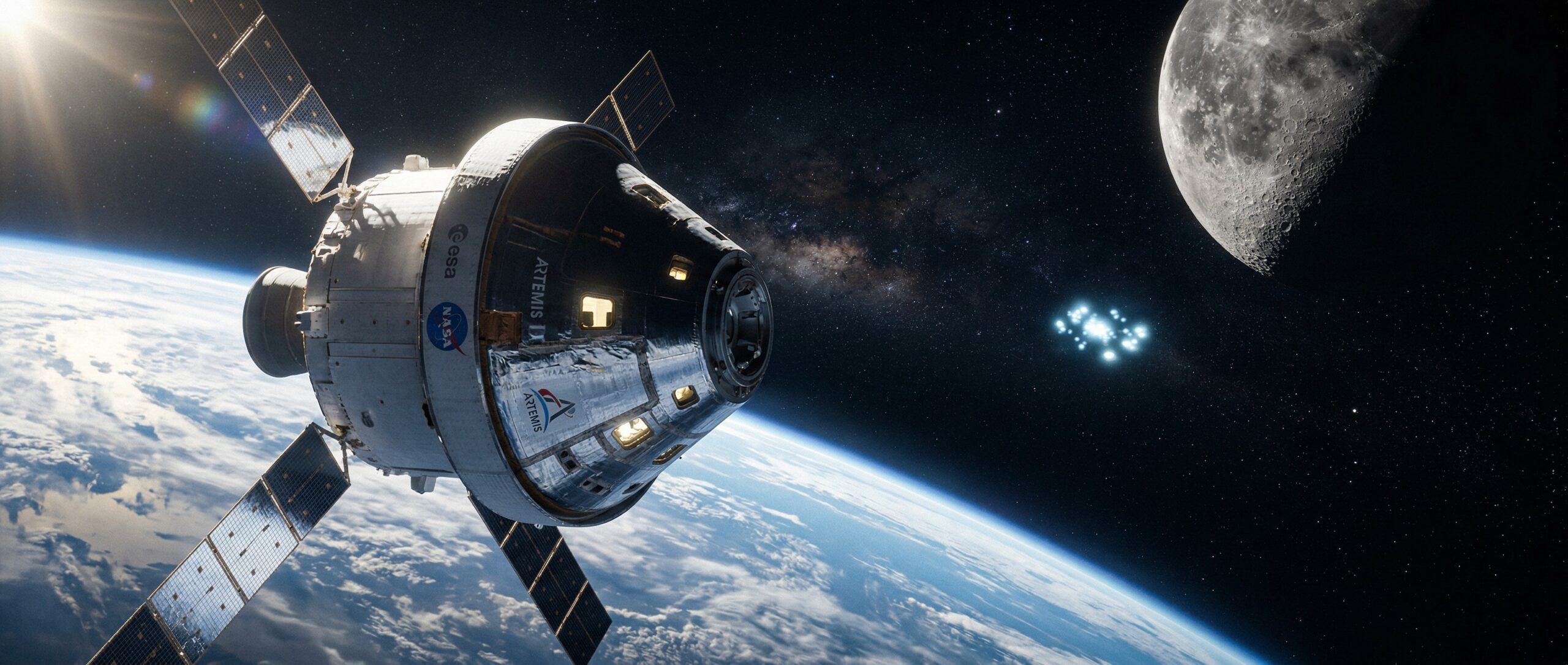
  • Artemis II Live Feed UFO Chatter: Why NASA Glitches Keep Turning Into Conspiracy Stories

    Artemis II Live Feed UFO Chatter: Why NASA Glitches Keep Turning Into Conspiracy Stories

    The UFO chatter around NASA’s Artemis II live coverage is a perfect example of how modern anomaly culture works. A mission experiences routine communication issues, viewers clip an ambiguous moment, social platforms pull it out of context, and suddenly a technical hiccup begins mutating into a cover-up story. That is exactly what happened with the latest burst of claims around the Artemis II live feed UFO discussion now circulating across Reddit, YouTube, and conspiracy-leaning communities.

    Here is the clearest answer: there is currently no verified evidence that NASA captured a genuine UFO during the Artemis II live feed. What exists is a fast-moving online interpretation cycle built on partial clips, viewer suspicion, space-program mystique, and the long-standing belief that NASA is one of the institutions most likely to hide something extraordinary if it ever appeared on camera.

    What Happened on the Artemis II Live Feed?

    The current wave of discussion appears to have been sparked by online posts claiming that something strange showed up during Artemis II mission coverage. Some of the conversation has centered on short clips and archived references shared across Reddit and other social platforms, where viewers argued that a visual anomaly or awkward feed shift looked suspicious enough to deserve closer inspection.

    At the same time, separate mission reporting documented multiple real technical issues and troubleshooting moments during the early mission period. That matters because real technical disruptions create the perfect environment for conspiracy interpretation. If a feed stutters, a signal drops, audio changes, or the presentation shifts unexpectedly, some viewers immediately begin asking whether they just witnessed censorship rather than routine engineering friction.

    This is why the story spread so quickly. It wasn’t just “something odd in space.” It was “something odd in space during a stream people already half-expect NASA to sanitize.”

    Why NASA Live Feeds Always Attract UFO Claims

    NASA has occupied a special place in UFO culture for decades. To believers, it sits at the intersection of elite scientific authority, secretive space operations, classified aerospace history, and global public trust. That combination makes the agency a magnet for anomaly claims.

    Whenever something unusual appears in NASA footage — even briefly — the event tends to trigger a familiar script:

    • a visual ambiguity appears
    • someone clips it
    • the clip detaches from its original context
    • viewers begin narrating intent into technical changes
    • the absence of proof becomes proof of concealment

    That pattern is one reason Artemis II was almost guaranteed to generate at least one UFO rumor cycle. Space missions produce high attention, high uncertainty, and lots of technically confusing visuals. Those are ideal conditions for anomaly culture.

    What the Strongest Skeptical Explanation Looks Like

    The most grounded interpretation is that the Artemis II UFO chatter reflects a mix of ordinary live-feed ambiguity, mission troubleshooting, and pattern recognition amplified by social media. Space footage is notoriously easy to misread. Reflections, lens flares, signal artifacts, compression oddities, drifting debris, camera movement, lighting changes, and partial context can all create the impression of something more exotic than what is actually on screen.

    That does not mean every viewer is acting in bad faith. It means live technical environments naturally produce moments that look uncanny when isolated.

    And once those moments are clipped and stripped of surrounding mission context, they become much easier to mythologize.

    Why This Story Still Matters Even Without Proof

    For The Unexplained Company, the real value of this story is not whether a UFO was captured on camera. It is what the reaction tells us about the current state of public trust, media consumption, and conspiracy psychology.

    People increasingly do not wait for institutions to interpret events for them. They watch, clip, speculate, remix, and distribute their own competing realities in real time. That means a NASA live feed is no longer just a technical broadcast. It is a battlefield of interpretation the moment anything unclear appears on screen.

    This also helps explain why even weak anomaly stories can perform so well online. They let audiences feel participatory. Viewers are not just watching a mission. They are hunting for hidden truths inside it.

    The Artemis II UFO Story in the Bigger Disclosure Context

    Another reason this micro-story gained traction is that it landed inside a broader disclosure-era environment already shaped by Pentagon UAP stories, congressional testimony, and years of public debate over whether official institutions are withholding the best evidence.

    That wider climate changes how viewers process ambiguity. In another era, a glitchy moment on a live space feed might simply have been dismissed as noise. Now, many audiences interpret ambiguity through a secrecy lens first.

    This is the same pattern we explored in The Mellon Leak and in our article on Eric Burlison’s secret UFO video comments. The details differ, but the cultural mechanism is the same: once people suspect the strongest evidence is hidden, unclear material becomes more potent, not less.

    Why Space-Conspiracy Stories Are So Durable

    Space missions occupy a near-perfect symbolic zone. They involve advanced technology, restricted environments, difficult visuals, and institutions most people cannot independently check. Add the emotional weight of exploration and the mystery of the cosmos, and even a brief anomaly can feel loaded with cosmic significance.

    That is why stories like this linger even when no hard evidence appears. They live in a symbolic ecosystem where uncertainty already feels meaningful.

    For many viewers, the possibility matters more than the proof.

    What Responsible Readers Should Do With Stories Like This

    The best way to approach an Artemis II live feed UFO claim is to ask a few simple questions:

    • Is the clip complete, or was it extracted from a longer technical sequence?
    • Are there mission-log explanations for any feed changes or glitches?
    • Does the anomaly still look unusual when viewed in full context?
    • Is the claim being strengthened by evidence, or by audience suspicion alone?

    Those questions do not kill the mystery. They simply separate curiosity from automatic escalation.

    Final Assessment

    The current Artemis II live feed UFO chatter is best understood as a modern media event rather than a confirmed space anomaly. The story spread because it had everything UFO audiences respond to: NASA, live video, technical confusion, rapid clipping, and an institution already surrounded by secrecy narratives.

    That combination is enough to create a viral mystery even when the evidence remains weak. And in 2026, that may be the real story: not whether a UFO crossed the frame, but how quickly the public is now prepared to believe that it might have.

    Frequently Asked Questions

    Was a UFO confirmed on the Artemis II live feed?

    No. There is currently no verified evidence showing that a genuine UFO appeared on the Artemis II live feed.

    Why are people talking about an Artemis II live feed UFO?

    Because viewers circulated clips and claims suggesting something unusual appeared during mission coverage, and those claims were amplified by real technical issues and online speculation.

    Why do NASA streams attract so many anomaly claims?

    NASA footage combines difficult visuals, institutional mystique, and public suspicion, making it easy for ambiguous moments to be reinterpreted as possible cover-up material.

    What is the most likely explanation?

    The most likely explanation is a combination of normal live-feed ambiguity, technical hiccups, and social-media amplification rather than a confirmed extraterrestrial event.

    Related Articles:

    This article was created using Media Blaster – Your content production specialist. Visit www.mediablaster.io for more information.

  • Cornwall’s UFO Hotspot Reputation Is Growing for a Reason

    Cornwall’s UFO Hotspot Reputation Is Growing for a Reason

    A UK tabloid-paranormal crossover story is gaining traction around the claim that Cornwall is currently one of Britain’s best places to spot UFOs, with commentators arguing that 2026 could be a breakout year for sightings. The hook is simple and irresistible: if you want to see something strange in the sky, head to the Cornish coast.

    That may sound like an easy clickbait premise, but the deeper story is more interesting. Cornwall is being mythologized in real time as a British “watch the skies” zone — a place where official-sounding data, local geography, old folklore, and modern UFO culture all begin reinforcing one another.

    What the Cornwall UFO Story Actually Claims

    The current buzz appears to be driven by Daily Star reporting that ties Cornwall’s growing UFO reputation to aviation incident records involving objects described as unidentified, unknown, unusual, or uncorrelated. The story also leans on commentary from paranormal investigator Robert Pulme, who suggests sightings are rising and that Cornwall’s visual conditions make it especially attractive for sky-watchers.

    That combination is exactly why this type of story travels so well. It offers just enough institutional language to feel grounded, but leaves enough open space for wonder, speculation, and local myth-building.

    Why Cornwall Works So Well as a UFO Stage

    Cornwall already has enormous narrative advantages before UFOs even enter the picture. It has coastline, weather, old folklore, wide skies, Atlantic mood, and a built-in sense of geographic edge. Those elements make almost any aerial anomaly feel more charged than it would over an ordinary urban sprawl.

    This matters because hotspot myths are rarely built from evidence alone. They are built from atmosphere, repetition, and setting. Cornwall is a visually perfect place for unexplained stories to stick.

    The Official-Data Effect

    Another reason the story is resonating is the use of aviation-report language. Once a UFO story includes phrases tied to flight safety, unidentified objects, or official logging categories, it becomes easier for mainstream audiences to treat it as more than pure fantasy.

    That does not mean the reports prove alien craft. It means the story is now wearing enough procedural clothing to travel farther than a normal tabloid ghost-light piece.

    The result is a hybrid story form the unexplained niche loves: part data, part folklore, part destination myth.

    Why This Matters Beyond Cornwall

    This story is useful because it localizes the UFO beat. Most UFO discourse gravitates toward the United States — Pentagon videos, Area 51 mythology, Nevada deserts, congressional hearings, and military secrecy. Cornwall offers the British version of a “living mystery landscape,” where the appeal is not just what was seen, but where it was seen.

    That creates strong hooks for tourism-style storytelling, on-location reporting, skywatching guides, and pieces exploring how ordinary places become paranormal brands.

    What’s Really Being Built Here

    The most important thing to understand is that hotspot status is often socially constructed. A place becomes a UFO destination when reports, media coverage, local identity, and audience expectation start feeding each other in a loop. Every new article reinforces the idea that the place is special. Every new sighting then lands in a context that makes it easier to believe.

    That is what may be happening in Cornwall now. Whether the sky itself is changing is one question. Whether the cultural framing around Cornwall is changing is much easier to answer: yes, clearly it is.

    As coverage of UK aviation incidents and unexplained aerial events continues to circulate through both tabloids and paranormal media, Cornwall is turning into a symbolic geography — not just a region, but a stage for mystery.

    The Better Takeaway

    The strongest reading of this story is not that aliens have chosen Cornwall. It is that Cornwall has become one of those rare modern locations where the unexplained can feel local, atmospheric, and almost travel-worthy.

    That matters because mystery culture is no longer just about sightings. It is about destinations, audience identity, and place-based fascination. Cornwall fits that emerging model almost perfectly.

    Related Articles:

    This article was created using Media Blaster – Your content production specialist. Visit www.mediablaster.io for more information.

  • NASA’s Unexplained Space Medical Emergency Raises a Bigger Mystery About Life in Orbit

    NASA’s Unexplained Space Medical Emergency Raises a Bigger Mystery About Life in Orbit

    An astronaut’s sudden medical crisis aboard the International Space Station is raising uncomfortable questions about how little we may still understand about the human body in deep and prolonged weightlessness. NASA astronaut Mike Fincke, whose January illness triggered the agency’s first in-space medical evacuation, says doctors still do not know what caused the event — and that uncertainty is exactly what makes the story so compelling.

    For conspiracy-minded audiences, the hook is obvious: a veteran astronaut suddenly loses the ability to speak, no heart attack is found, the episode vanishes almost as fast as it appeared, and the cause remains unresolved. For mainstream readers, the story is less sinister but no less fascinating: space can still do strange things to the body that medicine cannot immediately explain.

    What Happened to Mike Fincke on the ISS?

    According to CBC’s coverage of the Associated Press report, astronaut Mike Fincke said the episode happened on Jan. 7 while he was eating dinner after preparing for a spacewalk scheduled for the next day. He suddenly could not speak. He remembered no pain, and the crisis came on, in his words, like a “very, very fast lightning bolt.”

    Fincke said the event lasted roughly 20 minutes. His crewmates immediately recognized that something was wrong and called flight surgeons on the ground. The response was swift enough that the planned spacewalk was cancelled, and the incident ultimately contributed to an early return for multiple crew members.

    What makes the story especially striking is that doctors have already ruled out a heart attack. Fincke also said he was not choking. Beyond that, the cause remains uncertain.

    Why This Is Such a Big Deal

    This was not just a minor in-orbit health scare. The incident was serious enough to trigger NASA’s first medical evacuation from the International Space Station. That alone makes it more than a routine astronaut health story.

    It also lands at a moment when public interest in space medicine is growing. The longer humans stay in orbit — and the more serious talk becomes about Moon bases and Mars missions — the more important these unexplained medical events become.

    As CBC’s Quirks & Quarks analysis has noted, medical emergencies in space are uniquely difficult because diagnosis, intervention, evacuation, and privacy all operate under extreme limitations.

    Could Space Itself Be the Cause?

    Fincke suggested that the incident could be related to his cumulative time in weightlessness — more than 500 days across multiple missions. That possibility matters because weightlessness is known to alter circulation, fluid distribution, vision, cardiovascular regulation, and neurological function.

    NASA and its international partners have spent decades studying how zero gravity affects the body, but unexplained edge cases remain one of the biggest operational concerns in crewed spaceflight. A rare, hard-to-reproduce event is arguably more unnerving than a well-known risk, because it exposes the limits of existing models.

    That is where this story starts to drift from standard science reporting into genuine mystery. There is no evidence here of anything paranormal, but there is real uncertainty — and uncertainty in a closed environment like orbit always feels amplified.

    The Strange Power of an Unexplained Medical Event

    For The Unexplained Company, the reason this story works is not because it proves anything sensational. It works because it highlights a type of mystery people rarely think about: not a glowing light in the sky, but an event inside the body that modern science cannot yet neatly explain.

    That makes it a different kind of unexplained story — one rooted in institutional credibility rather than fringe testimony. The astronaut is real, the distress was real, the evacuation was real, and the diagnostic uncertainty is real.

    And that last part is what keeps the story sticky. If the cause had already been identified, this would be a technical health update. Because it has not, it becomes something else: a reminder that human beings are still improvising their understanding of what space can do to them.

    Why the Conspiracy Angle Will Linger

    Even without evidence of a cover-up, stories like this almost inevitably attract speculation. Some people will wonder whether NASA knows more than it is saying. Others will ask whether long-term orbital life carries hidden neurological or cardiovascular risks that agencies are reluctant to dramatize publicly. And because astronaut medical privacy is tightly protected, the gaps in public information naturally create room for narrative expansion.

    That does not mean the conspiracy angle is correct. But it does explain why this story will travel far beyond science desks and into the wider culture of mystery and suspicion.

    The Real Takeaway

    The most intriguing part of this case is not that something happened in space. It is that after all our satellites, stations, rockets, and biometric tools, something important happened in space and the answer is still: we do not know why.

    That is a powerful reminder that orbit may feel routine now, but for the human body, it is still an alien environment.

    For more stories where science, uncertainty, and high-strangeness overlap, read our coverage of the Wow! Signal mystery, the UFO metal that got a real lab test, and the Mellon leak and satellite UFO imagery claims.

    This article was created using Media Blaster – Your content production specialist. Visit www.mediablaster.io for more information.

  • SETI’s New Space Weather Theory Suggests We May Have Missed Alien Signals for Years

    SETI’s New Space Weather Theory Suggests We May Have Missed Alien Signals for Years

    One of the strongest science-meets-mystery stories circulating right now comes from the SETI world: researchers are arguing that we may have been searching for alien radio signals too narrowly. If they are right, some technosignatures might not be absent at all — they may simply be arriving in a distorted form that current search strategies are too strict to catch.

    That possibility gives the story real emotional power. It does not promise aliens. It does something more unsettling: it suggests that the silence of the cosmos might partly be an artifact of our assumptions. The universe may not be mute. It may be noisy, turbulent, and much harder to interpret than our filters allow.

    What the New SETI Argument Actually Says

    According to the SETI Institute’s explanation of the research, many SETI searches prioritize extremely narrow radio spikes because those are assumed to be strong candidates for artificial transmission. But this new work argues that stellar space weather — plasma turbulence, stellar winds, eruptions, and related activity — could distort a narrow transmission before it even exits its home star system.

    If that happens, the signal spreads over a wider range of frequencies. A signal that began as something “clean” and artificial might therefore arrive in a form that blends into the broader radio environment and falls below the detection criteria used by many search pipelines.

    The idea is not that we found aliens and missed the memo. It is that our search design may be better at finding idealized signals than realistic ones.

    Why This Matters More Than It Sounds

    At first glance, this looks like a narrow technical correction. In reality, it hits one of the deepest emotional nerves in the extraterrestrial question. Modern people have grown used to thinking of the Fermi paradox as a simple contrast between enormous cosmic opportunity and complete silence.

    This study complicates that dramatically.

    If real technosignatures are broadened by local stellar weather, then null results may not mean “nothing is there.” They may mean “we have been listening with the wrong expectations.”

    That is a very different psychological framework, and a much more hopeful one for those who think intelligence should be common in the galaxy.

    Why M-Dwarfs Matter So Much

    The space weather angle becomes even more important when you consider M-dwarf stars. These stars are abundant, long-lived, and central to many habitability discussions — but they are also often active and turbulent. If a civilization were transmitting from a planet around an active star, its signal might be far more scrambled than old-school SETI assumptions allow.

    This is where the story becomes especially useful for The Unexplained Company. It is not just a science note. It is a reframing of one of the biggest questions in the field: what if our models of “how aliens should sound” are too clean for reality?

    The underlying analysis, discussed in a study hosted on arXiv, makes the case that search strategies should adapt to the messier, broadened outcomes that real astrophysical environments may impose.

    A Better Mystery Than Simple Silence

    There is something deeply compelling about the possibility that the universe is not silent, only difficult. That is a much richer mystery than a simple binary of “they exist” versus “they do not.” It turns the search itself into a problem of interpretation, not just detection.

    That also makes the story ideal for readers who are tired of endless disclosure rumor but still want serious, wonder-driven content. This is not a blurry orb clip or recycled military leak. It is a scientifically respectable argument that our listening strategy may be narrowing the cosmos down too aggressively.

    Why This Matters for the Unexplained Niche

    Most unexplained coverage gravitates toward sightings, conspiracies, and state secrecy. This story widens the aperture. It reminds readers that one of the greatest mysteries in the world is not simply whether strange things visit Earth, but whether intelligence elsewhere has already tried to speak across space in a form we do not yet know how to recognize.

    That makes this one of the best kinds of mystery stories: rigorous enough for science readers, speculative enough for wonder-driven audiences, and meaningful enough to reopen one of humanity’s oldest questions.

    As Scientific American’s broader SETI coverage has often emphasized, signal-hunting is always shaped by assumptions about what intelligence would choose to do. If those assumptions are wrong, the silence we think we hear may be partly self-created.

    The Bigger Takeaway

    This research does not prove extraterrestrial contact. But it does challenge a quiet piece of certainty that many people carry without realizing it: the belief that “no signal” always means “no one there.”

    What if it means something else?

    What if the galaxy has been speaking through static, turbulence, and distortion all along — and we were simply too committed to the cleanest possible version of an alien hello?

    Related Articles:

    This article was created using Media Blaster – Your content production specialist. Visit www.mediablaster.io for more information.

  • Did Scientists Finally Solve the Wow! Signal?

    Did Scientists Finally Solve the Wow! Signal?

    One of the most iconic mysteries in extraterrestrial lore is back in the headlines. The 1977 Wow! signal — a 72-second radio burst that briefly looked like humanity’s best shot at hearing an alien transmission — is getting a fresh wave of attention after researchers proposed a new natural explanation based on similar signals found in archived Arecibo data.

    The new claim does not definitively close the case. But it does push the story into that perfect uncanny zone where scientific explanation and cosmic mystery overlap: maybe not aliens, but still strange enough to preserve the signal’s legendary status.

    What the New Wow! Signal Explanation Says

    The new attention comes from reporting on a study linked to the Arecibo Wow! project. According to Popular Mechanics, researchers revisiting signals near the 1420 MHz hydrogen line — the same general frequency region as the original Wow! signal — identified narrower, similar signals in archived observations from 2020.

    The authors propose that the original 1977 event may have been caused by a rare natural process: hydrogen clouds becoming suddenly brightened by an intense transient radiation source, possibly something like a magnetar flare or soft gamma repeater. If true, that would mean the famous signal was natural — but extraordinarily unusual.

    The underlying study, available as an arXiv preprint, does not read like a simple debunk. It is more of a plausible explanatory model for an event that has resisted easy categorization for decades.

    Why the Wow! Signal Still Has So Much Power

    The reason this story keeps resurfacing is simple: the Wow! signal is one of the few mysteries in radio astronomy that escaped the scientific archive and entered popular mythology.

    The basic narrative is irresistible:

    • a strange signal appears in 1977
    • it is strong, narrowband, and unusual enough to stand out dramatically
    • astronomer Jerry Ehman famously writes “Wow!” next to the printout
    • the signal is never repeated in exactly the same way
    • for decades, it becomes shorthand for “maybe we heard them”

    That emotional power is hard to erase, even when new science offers a non-alien explanation. The signal’s cultural legacy is not just about whether it came from intelligence. It is about what it felt like in the moment: a brief, electrifying crack in the ordinary noise of the universe.

    Natural Does Not Mean Uninteresting

    One reason the new explanation works so well as a story is that it preserves much of the awe. If a rare cosmic process involving hydrogen clouds and powerful transient radiation can mimic what once looked like a possible alien transmission, then the universe is still capable of producing events so uncanny they briefly feel intentional.

    That is part of why the Wow! signal remains such a powerful symbol. Even if it turns out not to be extraterrestrial communication, it still represents the moment when science touched something it did not yet understand — and the whole culture leaned forward.

    The Planetary Habitability Laboratory summary reinforces this tension: the proposed mechanism is plausible, but it does not strip the event of its mystery so much as relocate the mystery into astrophysics itself.

    How Mysteries Evolve

    The Wow! signal is also a textbook example of how unexplained phenomena mature over time. First there is the anomaly. Then the mythologizing. Then competing explanations. Then decades later, new data arrives and reframes the story — but rarely in a way that satisfies everyone emotionally.

    That is what is happening here. The signal may be moving from “possible extraterrestrial message” toward “rare and misunderstood natural event.” But those are not emotionally equivalent categories, which is why the debate remains alive.

    Why This Matters for The Unexplained World

    This story is ideal for The Unexplained Company because it sits right where wonder and evidence meet. It is science-forward, culturally familiar, and still sticky enough to spark debate.

    The better question is not just whether scientists solved the Wow! signal. It is why some mysteries remain powerful even after plausible explanations emerge.

    The answer may be that certain anomalies become symbols. The Wow! signal is one of them. It represents the possibility that the universe might speak once, briefly, and in a voice we almost recognize.

    For more evidence-based mystery coverage, read our stories on the Black Knight satellite myth, the 7910 kHz spy radio mystery, and the Mellon leak and high-def satellite UFO claims.

    This article was created using Media Blaster – Your content production specialist. Visit www.mediablaster.io for more information.

  • Why the Black Knight Satellite Myth Never Dies

    Why the Black Knight Satellite Myth Never Dies

    The Black Knight satellite conspiracy is trending again after fresh explainer coverage revived one of the most durable myths in UFO culture: the claim that an artificial object of extraterrestrial origin has been orbiting Earth for thousands of years. The theory ties together Nikola Tesla, mysterious radio signals, pre-space-age satellite rumors, delayed echoes, and NASA imagery into one long-running cosmic mystery.

    That is exactly why it keeps coming back. The Black Knight story is not a single event. It is a collage — a conspiracy built by stitching unrelated anomalies across more than a century into one seductive narrative about alien surveillance hiding in plain sight.

    What the Black Knight Satellite Theory Claims

    The basic claim is simple and irresistible: a dark, silent object of nonhuman origin has been circling Earth for thousands of years, quietly watching us from orbit. Depending on the version, it is described as an alien probe, an ancient monitoring device, or proof that humanity has been under observation long before the modern space age.

    As The Economic Times recently summarized, believers often tie the story to a 13,000-year-old orbital object, while mainstream explanations point instead to a chain of misunderstood events — especially debris and thermal insulation associated with NASA’s STS-88 mission.

    How the Myth Was Built

    The Black Knight legend survives because it pulls from multiple real incidents, each weird enough to sound meaningful when pulled out of context.

    • Nikola Tesla’s 1899 radio experiments: Tesla reported strange repeating signals, which later storytellers folded into alien-contact speculation.
    • Long-delayed radio echoes: unusual signal behavior in the early 20th century became fuel for theories about artificial objects in orbit.
    • Donald Keyhoe’s 1954 satellite claims: before the space age fully matured, public confusion about unidentified orbital objects fed the myth.
    • NASA’s 1998 STS-88 images: photographs showing a dark object above Earth became the most iconic “evidence” for the Black Knight theory.

    As Space.com explains, the object in the STS-88 imagery is widely understood to have been a thermal insulation blanket lost during a spacewalk, not extraterrestrial hardware.

    And yet the image still looks uncanny enough to keep the theory alive.

    Why Debunking Never Kills It

    This is what makes the Black Knight story such a perfect case study in conspiracy culture. It does not depend on one piece of evidence. It thrives by bundling ambiguity.

    That gives it three major advantages:

    • It stitches unrelated anomalies into a single grand narrative.
    • It weaponizes uncertainty. Old signals, poor-quality images, and misunderstood equipment all become proof-like fragments.
    • It survives debunking. In many cases, debunking gives it a fresh media cycle and introduces it to a new audience.

    That is why myths like this do not disappear. They mutate. Every new explainer, TikTok recap, Reddit thread, or UFO documentary gives the legend another generation of believers and skeptics to feed on.

    Tesla, NASA, and the Power of Pattern-Seeking

    The deeper appeal of the Black Knight myth is psychological as much as extraterrestrial. It gives people a way to connect scattered weirdness across time into one coherent, thrilling possibility.

    Tesla’s signal reports become prophetic. Delayed echoes become evidence of surveillance. A floating blanket becomes a silent alien machine. The result is less an argument than a mood: the sense that the truth has been visible for decades, if only you know how to connect the dots.

    As background summaries of the theory note, the Black Knight narrative is not based on one continuous line of evidence. It is a patchwork assembled after the fact. But for many people, that patchwork quality is part of the charm.

    Mystery, Mythmaking, and Media Literacy

    For The Unexplained Company, this story is valuable not just as a UFO article but as a media-literacy article. It lets us ask a better question than “is the Black Knight real?”

    The more interesting question is: why do some myths become effectively immortal?

    The answer may be that they balance wonder and plausibility in just the right way. The Black Knight is spooky but not absurd, debunked but not dead, familiar but still open enough to invite fresh speculation.

    That makes it the perfect evergreen conspiracy — one that keeps re-entering culture every time a new audience discovers the image, the Tesla story, or the idea that the most famous alien satellite in history may have been just a drifting space blanket.

    For a deeper dive, listen to our podcast episode: The Black Knight Satellite: Alien Probe or Space Myth?. You can also read related coverage on spy radio mysteries, aliens.gov and disclosure culture, and Bob Lazar and the return of classic UFO mythology.

    This article was created using Media Blaster – Your content production specialist. Visit www.mediablaster.io for more information.