Category: Unexplained Investigations

  • Is Tariel Kapanadze’s Free Energy Generator the Internet’s Most Persistent Impossible Machine?

    Is Tariel Kapanadze’s Free Energy Generator the Internet’s Most Persistent Impossible Machine?

    It usually begins with a box, a coil, a few cables, and the electric feeling that somebody is about to insult the laws of physics on camera. That is the enduring charge around the tariel kapanadze free energy generator: the claim that a rough-looking apparatus associated with Georgian inventor Tariel Kapanadze can produce more power than it takes in, running like an outlaw machine hidden just outside the limits of accepted science.

    That promise is why the legend refuses to die. The Kapanadze device is not merely another fringe gadget. In online culture, it occupies a special category reserved for machines that seem to threaten the whole architecture of modern scarcity. If one black-box generator could really output usable energy from nowhere obvious, then utility grids, fuel dependence, research gatekeeping, and a century of “impossible” might all start to look less solid than advertised.

    So what is the Tariel Kapanadze generator supposed to be? In the language searchers actually use, it is the famous alleged overunity machine said to deliver more energy than it consumes. That is the core claim, and it is exactly why the device keeps resurfacing in forums, replication groups, and endless video dives. A recent Reddit discussion in r/HighStrangeness captures the familiar mood perfectly: maybe it is a hoax, maybe it is staged, maybe it is hidden-input trickery, or maybe it is one of those suppressed breakthroughs that never gets a fair hearing because the consequences would be too large.

    That last possibility is the real rabbit hole. Free-energy legends do not survive on engineering alone. They survive on distrust. They survive because many people already suspect that if a machine ever threatened the energy order, it would not be welcomed into the world like a new smartphone. It would be buried, ridiculed, litigated, bought, or quietly disappeared.

    Why the Kapanadze generator never stops coming back

    Most viral mysteries fade when the footage gets old. The Kapanadze machine does the opposite.

    Part of that is visual. The demonstrations look just scrappy enough to feel authentic and just opaque enough to stay unresolved. The apparatus does not usually appear in the polished language of a major laboratory. It appears like forbidden workshop knowledge: boxes, wires, grounding stakes, humming components, and the suggestion that the real principle is being shown only halfway. That aesthetic is powerful. It implies discovery before institutional capture.

    It is the same emotional logic that keeps people staring at things that seem too heavy, too precise, or too advanced for their official setting. Readers who are drawn to stones that look impossible to move or to the uncanny design tension of the Sabu Disk mystery already understand the pattern. The object does not have to be proved beyond doubt to become magnetic. It only has to appear to violate the accepted limit in a way that feels physically vivid.

    Kapanadze’s machine also benefits from a perfect internet property: it is never fully dead because it is never fully settled. There are always old forum archives, translated claims, alleged patents, rough schematics, partial replications, and new viewers discovering the story as if it had just happened yesterday.

    What the machine is supposed to do

    At the center of the mythology is a simple, explosive claim: the device can output more power than it draws from any visible input source.

    That is why Kapanadze is usually discussed in the same breath as “overunity,” a term commonly used for systems claimed to exceed conventional energy-conservation expectations. General references such as Wikipedia’s overview of overunity explain why the term has such a charged reputation. It sits in the borderland between fringe invention culture, misunderstood measurement, deliberate fraud, and the dream that mainstream physics has missed something enormous.

    The broader family tree is older than the internet. Alleged self-powering machines have been pursued for centuries, usually under the shadow of the perpetual-motion dream. That is why even a mainstream summary like Wikipedia’s page on perpetual motion matters here. It reminds us that impossible-machine culture did not begin with YouTube. Kapanadze is simply one of the most persistent modern avatars of an old obsession: a device that beats the meter.

    But believers do not experience the machine as an abstract physics argument. They experience it as a direct threat to managed reality. A table-top system lighting bulbs or powering loads while the obvious supply seems too small or strangely absent does not feel like a textbook error. It feels like witnessing a forbidden principle through a dirty window.

    Why overunity machines become instant conspiracy magnets

    The moment a machine appears to offer “free energy,” the story stops being technical and becomes civilizational.

    If it worked, the implications would be too large to stay in the garage. That single thought launches a hundred secondary suspicions. Would utilities suppress it? Would governments classify it? Would investors buy it just to bury it? Would the inventor be threatened, discredited, or lured into secrecy? In conspiracy culture, free-energy lore is not just about voltage. It is about power in every sense of the word.

    That is why failed public acceptance often strengthens the myth instead of killing it. Rejection can be reinterpreted as proof of suppression. Confusion becomes evidence of deliberate obfuscation. Missing technical details become signs that the inventor is hiding the key principle for safety or survival. The legend becomes self-sealing.

    This is one reason Kapanadze remains alive while countless fringe devices vanish. The machine sits inside a larger belief ecosystem where hidden breakthroughs, buried discoveries, and controlled narratives already feel normal. It belongs naturally beside other stories of concealed knowledge, whether people are chasing secret structures beneath famous monuments or trying to decide whether obscure physical phenomena, like those invoked in Schumann resonance debates, point to misunderstood science or internet pattern-making.

    The grainy-video problem

    The greatest strength of the Kapanadze legend is also its greatest weakness: most people encounter it through demonstrations that feel tantalizing but never quite clean enough.

    Search results for Tariel Kapanadze generator videos on YouTube reveal the whole ecosystem at a glance. There are demo clips, commentary channels, replicas, technical arguments, skeptical breakdowns, and true-believer uploads insisting the breakthrough is real if you just watch closely enough. The volume itself becomes persuasive. A newcomer can easily think: so many people cannot still be discussing this if there is absolutely nothing there.

    But black-box machines are perfect survival structures for techno-myths. If the wiring is partly hidden, the measurements are incomplete, the grounding ambiguous, the switching unexplained, or the camera angle imperfect, then the machine remains open. Every ambiguity gives believers another foothold and skeptics another objection. Instead of resolution, you get permanent motion at the level of narrative.

    And yet that ambiguity has an odd cultural advantage. Real hidden technology has existed before, and free-energy believers draw emotional strength from that fact even when the comparison is not technically fair. Once history proves that secret engineering can exist, impossible engineering feels less impossible than it should.

    Why believers see suppression, not failure

    For many followers of the Kapanadze story, the inability of mainstream science to validate the machine is not decisive. It is expected.

    A true breakthrough, in this view, would not arrive through the normal pipeline. It would appear messy, underfunded, and half-hidden. It might be demonstrated in fragments, copied badly, translated poorly, and attacked from every side. The inventor might seem eccentric rather than institutionally polished. That does not weaken the myth. It gives the myth its prophet.

    This is where free-energy culture starts to resemble religious culture more than engineering culture. Testimony matters. Conversion stories matter. The existence of seekers, replicators, and initiates matters. There is always one more circuit variant, one more revelation about earth grounding, resonance, spark gaps, or secret geometry. The missing proof becomes part of the path.

    What physics says, and what remains unresolved

    Here the grounded frame has to come in.

    There is no widely accepted public evidence that Tariel Kapanadze demonstrated a genuine free-energy generator operating outside known physical constraints. Claims of overunity face the basic problem that extraordinary output requires extraordinarily clear measurement, controlled testing, and independent replication. So far, the Kapanadze machine remains a legend carried by demonstrations, interpretations, and belief communities rather than a verified breakthrough recognized by mainstream science.

    That said, the cultural mystery is real even if the machine itself remains unproven. Kapanadze persists because he embodies the internet’s favorite impossible inventor: the man with a rough device, a world-changing claim, and just enough footage to keep hope alive. The story survives not because it has been settled, but because it has not. Somewhere between old perpetual-motion dreams and modern distrust of institutions, the Kapanadze generator still hums as a possibility people do not want to surrender. In mystery culture, that is often enough to make a machine immortal.
  • The Cláudio Case: Why Brazil’s 2008 UFO and Humanoid Encounter Still Feels Unfinished

    The Cláudio Case: Why Brazil’s 2008 UFO and Humanoid Encounter Still Feels Unfinished

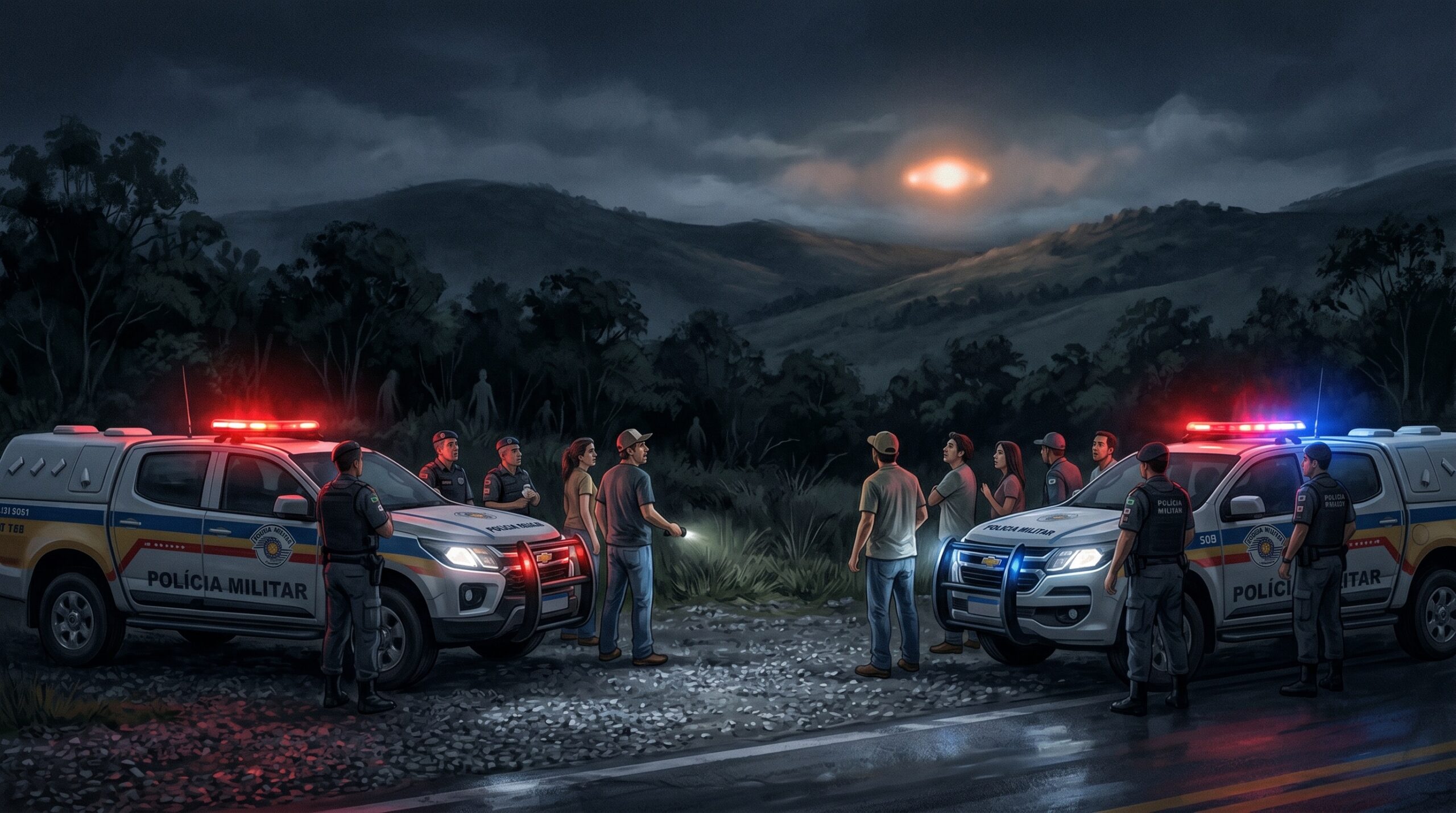
    What if one of Brazil’s strangest modern UFO stories never broke wide for the same reason it still feels dangerous now: a police commander said too much, the claim was too specific to shrug off, and the public never got enough documentation to make the feeling go away? That is the pulse behind renewed interest in the so-called Cláudio Case, a story tied to Cláudio, in Brazil’s Minas Gerais region, where a Brazilian Military Police commander is said to have described a 2008 encounter involving officers, civilians, UFOs, and even nonhuman beings.

    For believers, that combination hits every nerve at once. This is not just another distant light in the sky or another recycled internet clip with no witness attached. It is a story that reportedly places trained police personnel and ordinary civilians inside the same zone of strangeness, in the same town, at the same time, with the added shock of humanoid or nonhuman-presence claims hanging over the whole thing. Once a case picks up those elements, it stops reading like a sighting report and starts feeling like the edge of a larger event the public was never meant to see in full.

    That is why the Cláudio story has begun circulating again through UFO channels. A Reddit post in r/UFOs pushed the claim back into view by centering the reported statement from a Brazilian Military Police commander. Search results have also been directing readers toward source trails such as UAP Brazil’s page on the case and a 2026 writeup from ovniologia. None of that alone settles the story. But it does explain why the case suddenly feels alive again: it has the exact shape of a rabbit hole believers cannot leave alone.

    What the Cláudio claim actually says

    At its core, the claim is simple and unnerving. The story circulating in UFO spaces is that a Brazilian Military Police commander said officers and civilians encountered UFOs and nonhuman beings in Cláudio in 2008. That is the center of gravity. Everything else around it depends on how much weight you give the statement, how directly it was recorded, and how much of the case survives through secondary retellings rather than a widely circulated primary dossier.

    Even stated cautiously, the claim is powerful. A police commander is not the kind of witness profile that people instinctively file under fantasy. Add civilians to the account and the case widens. Add beings, and the story crosses the line from “unidentified object” into the much more destabilizing territory of encounter narratives. That jump matters because many people can tolerate an unexplained light. Far fewer are comfortable with a report that suggests presence, intelligence, or interaction.

    This is also why the Cláudio Case feels larger than the currently visible record. Cases like this gain force from structure. There is a named town. There is a year. There is a rank-based source signal. There is a claim that multiple kinds of witnesses were involved. To a believer, those are not loose fragments. They are the outline of something that sounds like it should have produced a much bigger paper trail than the average internet story.

    Why Brazil gives the case extra weight

    If this exact same claim surfaced in a place with no deeper UFO lore attached to it, it would still be eerie. In Brazil, it lands harder.

    Brazil has long occupied a special place in global UFO culture because the country already carries a reputation for dramatic cases, military-linked rumors, humanoid encounter stories, and witness testimony that never quite leaves the public imagination. The moment a new or resurfaced Brazilian case enters the conversation, many readers connect it to that larger atmosphere automatically. The country’s history has taught believers to expect stories that are not merely about lights or radar returns, but about events that seem to spill over into direct human contact, institutional awareness, and long-running secrecy.

    That context gives Cláudio extra charge. The story does not arrive on blank ground. It arrives in a national mythology where people already suspect that some of the world’s most unsettling UFO episodes happened in places where official attention, witness fear, and local memory intersected. So when a case says police, civilians, UFOs, and beings in one Brazilian town, believers do not hear four disconnected details. They hear a pattern they think they already recognize.

    That does not prove the pattern is real. But it explains why the Cláudio Case moves so quickly from curiosity to obsession. Brazil is one of the few settings where even a thinly documented case can feel immediately connected to a larger archive of unresolved strangeness.

    The rabbit hole believers immediately fall into

    Once you accept the possibility that the commander’s reported statement reflects a real underlying event, the case becomes difficult to contain.

    Why were both officers and civilians allegedly involved? Were they seeing the same thing, or different parts of the same event? If nonhuman beings were part of the report, were they seen near a craft, on the ground, at a distance, briefly, or under conditions that made description difficult? If a commander was willing to speak at all, what had already circulated inside official channels before the public heard about it? And if the event was serious enough to be remembered and repeated years later, why does the accessible public record still feel so incomplete?

    Those questions are exactly why encounter cases outrun ordinary UFO sighting stories. Once beings enter the frame, people stop asking only what was in the sky. They start asking whether the event involved proximity, recovery, contact, containment, or suppression. A simple aerial mystery can remain airborne. An encounter narrative pulls the imagination to the ground, toward roads, fields, patrol routes, witness statements, and the uneasy suspicion that somebody local saw more than outsiders were ever told.

    For believers, the police angle deepens that pull. Uniformed witnesses are not automatically correct, but they do change the emotional geometry of a story. Police officers imply response. They imply procedure. They imply radios, chains of command, and at least the possibility that someone tried to document what happened. That is one reason the Cláudio Case feels unfinished instead of merely strange. It sounds like the kind of incident that should have left administrative footprints, whether or not those footprints are now public.

    Why the case is resurfacing now

    The modern UFO internet has a reliable way of reviving stories like this. A short, potent claim appears in a place like Reddit. Readers begin tracing references. Search engines elevate a handful of niche research pages. Older regional or specialist writeups get rediscovered. Then the case returns not as a solved event, but as an unresolved challenge: if this story is so wild, why have so few people heard of it?

    That appears to be what is happening here. The recent circulation path matters because it shows how belief ecosystems work now. A Reddit post does not need to prove the entire case. It only needs to introduce enough specificity to trigger a search. Once that happens, pages like UAP Brazil’s Cláudio entry or ovniologia’s 2026 revisit become part of the case’s new life online. Each source acts less like a final verdict and more like a doorway deeper into the same hall of mirrors.

    And there is something especially sticky about older cases re-emerging through modern feeds. They carry a built-in emotional suggestion that the internet missed them the first time, or that the story was once too local, too buried, or too uncomfortable to travel widely. That feeling gives a resurfaced case momentum. It makes discovery itself feel like evidence, even when what has really happened is a fresh cycle of circulation.

    What makes the Cláudio story genuinely compelling

    Even if you strip the case down to its most careful form, there is a reason it lingers.

    First, the witness profile is inherently strong in cultural terms. A reported statement from a Brazilian Military Police commander carries more weight than an anonymous repost or an unattributed legend. Second, the claim joins aerial anomaly language with humanoid language, which is rare enough to feel important whenever it appears. Third, the setting is specific. Cláudio is not being presented as a vague region or a mythic nowhere. It is a real place, which gives the case a concrete anchor that pure folklore often lacks.

    There is also the matter of scale. Stories that involve both civilians and officers suggest a wider disturbance, not just a private misperception. Even if the underlying event turned out to have a mundane explanation, the narrative survives because it implies collective witness pressure. Multiple people. Multiple roles. One shared episode. That structure is powerful even before anyone resolves the details.

    Most of all, the Cláudio Case taps into a deeper believer intuition: that the most significant UFO events are often not the best documented ones, but the ones that seem to exist partly inside official memory and partly outside public access. Those are the cases that develop an unfinished aura. People sense that something happened, but the surviving record is too narrow to let the story settle into either certainty or dismissal.

    What still remains frustratingly unclear

    This is where the case has to be handled carefully.

    The public-facing source signal, at least in the material pushing the story right now, appears to rest heavily on retellings and secondary summaries. That means readers should distinguish between a reported statement and a fully transparent evidentiary file. It is one thing to say a commander reportedly described officers and civilians encountering UFOs and nonhuman beings in Cláudio in 2008. It is another to claim that every detail of that event has been independently verified through documents, recordings, or multiple public primary sources.

    There are also basic questions that remain open from the outside. What exactly did the commander say, in what format, and how much of the original wording is available? How many officers were allegedly involved? What did the civilians report seeing? Were the beings described in consistent terms across accounts, or has that language hardened over time through retelling? And what portion of the case comes from later interpretation rather than contemporaneous documentation?

    Those gaps do not erase the mystery. They define it. In fact, they are probably part of why the story is spreading. The Cláudio Case is compelling because it feels like a real fragment of something larger, not because the public already has a finished dossier in hand.

    For now, the grounded view is this: there is clear online interest in a Brazilian case centered on the reported statement of a Military Police commander about a 2008 incident in Cláudio involving officers, civilians, UFOs, and nonhuman beings. There are source trails believers can follow, including the recent Reddit discussion, UAP Brazil’s case page, and ovniologia’s revisit. But based on the signals currently driving the story, the strongest public claim is still that this is an intriguing, specific, witness-centered case with an incomplete public record — not a fully documented event that has already crossed the line into proof.

    And that may be the real reason the Cláudio Case feels unfinished. It carries too much structure to dismiss as empty rumor, too much strangeness to absorb as ordinary noise, and too little transparent documentation to close the file. In UFO culture, that is exactly the combination that keeps a story alive for years.

  • Ghost Murmur: The Secret Tool That Made the Iran Airman Rescue Feel Like Sci-Fi

    Ghost Murmur: The Secret Tool That Made the Iran Airman Rescue Feel Like Sci-Fi

    What if one of the strangest names to surface in recent military-tech chatter was not attached to a weapon, but to a rescue? That is the charge running through conspiracy and UFO-heavy corners of the internet after reports and news summaries suggested a secretive tool called Ghost Murmur may have helped locate a downed American airman in Iran, allegedly by detecting a heartbeat. The phrase does not sound like ordinary military jargon. It sounds like something smuggled out of a whistleblower thread at three in the morning.

    That is exactly why the story detonated online. A pilot-down rescue in Iran is already the kind of scenario that arrives with instant tension. Add a codename like Ghost Murmur, add the suggestion of standoff sensing that can somehow find a living body by its biological signature, and the whole thing stops feeling like a normal defense story. It starts feeling like the public may have briefly brushed up against the edge of a classified capabilities world that normally stays hidden behind euphemism, acronyms, and silence.

    For a certain audience, the rabbit hole opened immediately because Ghost Murmur was not just weird. It was familiar. On Reddit, especially in UFO-adjacent communities, users quickly connected the name to the infamous 2023 4chan whistleblower lore, where “Ghost Murmur” circulated as the sort of eerie, half-credible, half-mythic term that believers file away and never forget. A notable r/aliens discussion about that whistleblower material, with roughly 1,600-plus score, gave the term an afterlife long before this Iran rescue angle appeared. So when the name surfaced again beside claims about heartbeat-detection and an American airman, many readers felt the same jolt: either the internet had accidentally guessed a real black-world tool, or the mythology had started bleeding into the headlines.

    Why the Iran rescue claim feels so explosive

    There are military stories that sound serious, and then there are military stories that sound like they should not be public at all.

    This one sits in the second category. Coverage and search-result summaries from outlets including The Independent, Newsweek, NDTV, Daily Mail, and Scientific American helped push the story into broader view by circling the same irresistible center: a rescue in Iran, a supposedly downed American airman, and claims involving unusual heartbeat-detection capability. Even before readers sort out what any one report specifically confirmed, the shape of the story is enough to trigger speculation. It implies precision. It implies reach. It implies that somebody may possess a way of sensing a human presence under conditions where ordinary search methods would struggle.

    That is why the phrase “heartbeat detection” hits harder than a colder, more technical description would. Heartbeat is intimate language. It turns a system into almost a supernatural listener, something that can reach through terrain, distance, concealment, or chaos and isolate the fragile sign that a person is still alive. “Ghost Murmur” is the perfect codename for a capability like that because it sounds less like machinery than like an invisible whisper hunter.

    Believers do not hear a mundane rescue sensor when they read that. They hear proof that the classified world is far ahead of the public one. They hear another reminder that the military may operate with layers of sensing technology ordinary people only encounter as rumors, scattered patents, or anonymous-board testimony.

    Why UFO audiences think they heard this before

    The real accelerant here is not the rescue itself. It is the overlap with existing internet lore.

    The 2023 4chan whistleblower story became one of those strange modern myth objects: too detailed to forget, too unstable to trust, and too imaginative to stay contained. In UFO and conspiracy communities, the thread lingered because it offered readers exactly what they wanted from anonymous disclosure culture — hidden programs, insider tone, specific-sounding language, and just enough texture to feel dangerous. Terms mentioned there did not fade. They became seeds.

    Ghost Murmur was one of those seeds.

    So when a similar name appeared in circulation around a real-world rescue story, the effect was immediate. Online, people began treating the overlap as more than coincidence. Some saw vindication. Some saw contamination. Others simply saw the most thrilling possibility of all: that a piece of fringe whistleblower lore had described an actual capability before mainstream audiences ever heard of it.

    That kind of echo is powerful because it compresses two very different credibility systems into one emotional moment. News reports carry institutional weight. Anonymous threads carry mythic weight. When the same eerie term seems to appear in both environments, believers experience it as a bridge between the visible world and the hidden one.

    “Ghost Murmur” is also one of those names that almost refuses to stay neutral. It sounds engineered to haunt the imagination. If a classified system really existed to detect life signatures in difficult environments, many readers think, would it not sound exactly like this? A dry technical label might have passed quietly. Ghost Murmur invites obsession.

    The codename is doing half the work

    Black-program mythology has always thrived on naming.

    A codename can make a claim feel more real than a paragraph of explanation. That is not because names prove anything. It is because names suggest infrastructure. They imply procurement, briefings, compartmentalization, operators, budgets, deployment histories. A weirdly elegant codename feels like evidence of a hidden bureaucracy.

    Ghost Murmur is especially potent because it seems to describe the capability and dramatize it at the same time. Ghost suggests the nearly invisible person being sought, or the unseen way the system operates. Murmur suggests a body signal so faint it would normally be lost. Put together, the phrase sounds like a machine designed to hear life where no human rescuer could.

    That is the point where military-tech speculation and UFO culture start to merge. Readers who already suspect there are sensor suites, propulsion systems, and retrieval capabilities far beyond the public inventory hear this story as another leak from the same sealed world. They do not necessarily leap straight to aliens. But they do leap to hidden technology, and once that leap happens the surrounding discourse begins to fill in the rest: special access programs, buried breakthroughs, whispered tools with names too poetic to be fake.

    In that sense, the Iran airman rescue story became bigger than itself almost instantly. It was no longer only a rescue anecdote. It became a referendum on whether extraordinary capabilities occasionally slip into view through side comments, partial reports, and oddly memorable codenames.

    Why the story spread beyond defense-news readers

    Most people do not spend their day tracking rescue technology. They do spend their day noticing stories that feel like they should unlock a larger secret.

    That is why this traveled. The geopolitical setting gave it stakes. The rescue angle gave it emotion. The heartbeat-detection claim gave it wonder. And the Ghost Murmur name gave it myth.

    Once those pieces clicked together, the story was perfectly built for modern circulation. News-oriented readers could frame it as a remarkable special-operations or defense-technology story. Conspiracy readers could frame it as evidence that classified sensing systems have outpaced public understanding by years. UFO audiences could frame it as one more case where fringe rumor seems to rhyme a little too neatly with the visible world.

    There is also a deeper reason the story resonates right now. A lot of people already believe the public lives downstream from technologies that are revealed slowly, selectively, and only when institutions can no longer avoid acknowledging them. They have seen enough drone stories, AI leaps, surveillance disclosures, and military-capability surprises to feel primed for the next impossible-sounding device to turn out not to be impossible after all. Ghost Murmur slips neatly into that emotional template.

    “A rescue tool that sounds fake is often the most believable kind of secret,” is the sort of sentence this story makes people want to say out loud. It captures the mood perfectly. If the technology were ordinary, it would not need a name like that. If it were extraordinary, of course the public would hear about it only in fragments.

    Where the public record stops

    Here is where the atmosphere has to give way to calibration.

    What is being claimed is dramatic but still narrow: that a system called Ghost Murmur was allegedly involved in locating a downed American airman in Iran, and that reporting around the case included language suggesting heartbeat detection or similarly advanced sensing. That is the core of the intrigue. It is enough to make the story fascinating.

    What has not been independently established in the public record, at least from the source signals driving the conversation, is much broader. The public does not have clear, technical documentation explaining what Ghost Murmur is, how it works, what conditions it can operate in, how far its reach extends, whether the codename was used consistently across reports, or whether the online 4chan-era use of the term referred to the same thing at all. The viral overlap is real. The proof of identity is not.

    That distinction matters. Advanced sensing technologies do exist in principle. Militaries and researchers have long pursued ways to detect human presence through indirect signals, environmental disturbances, radar-like methods, and biometric traces. But that general plausibility is not the same as confirmation of this exact capability, this exact rescue scenario, or this exact lore-rich codename.

    What remains unverified — and why people will keep talking anyway

    The strongest version of the online story goes something like this: a fringe whistleblower thread named a hidden tool years ago, that same tool just surfaced in connection with a real rescue in Iran, and the public has now accidentally glimpsed a capability that sounds nearly supernatural. It is a gripping narrative. It may even contain a kernel of something real.

    But several key pieces remain unverified. It is not publicly settled that Ghost Murmur is a formally identified system rather than a circulating label. It is not publicly settled that the heartbeat-detection claim describes literal operational capability rather than loose or sensationalized framing. And it is not publicly settled that the term’s appearance in UFO-adjacent internet lore and in rescue-related reporting points to one and the same technology.

    That does not kill the mystery. It explains the mystery. Stories like this survive because they occupy the sweet spot between imaginable and unbelievable. They sound too cinematic to be routine, yet not so impossible that readers can dismiss them outright. The result is a modern legend with just enough real-world scaffolding to feel dangerous.

    For now, Ghost Murmur remains exactly where the internet likes its best hidden-tech stories: half in the news, half in the myth. The claim is compelling. The resonance with older whistleblower lore is real. The underlying capability may be plausible in broad outline. But the larger, cleaner conclusion — that the public has identified a verified secret system straight out of conspiracy folklore — still has not been proved.

    And that unresolved gap is why the story will keep breathing. In the online imagination, Ghost Murmur is no longer just a rumored rescue tool. It is the sound of a hidden world briefly making itself heard.

  • Beatriz Villarroel’s 1950s UFO Flashes and the Pre-Satellite Mystery

    Beatriz Villarroel’s 1950s UFO Flashes and the Pre-Satellite Mystery

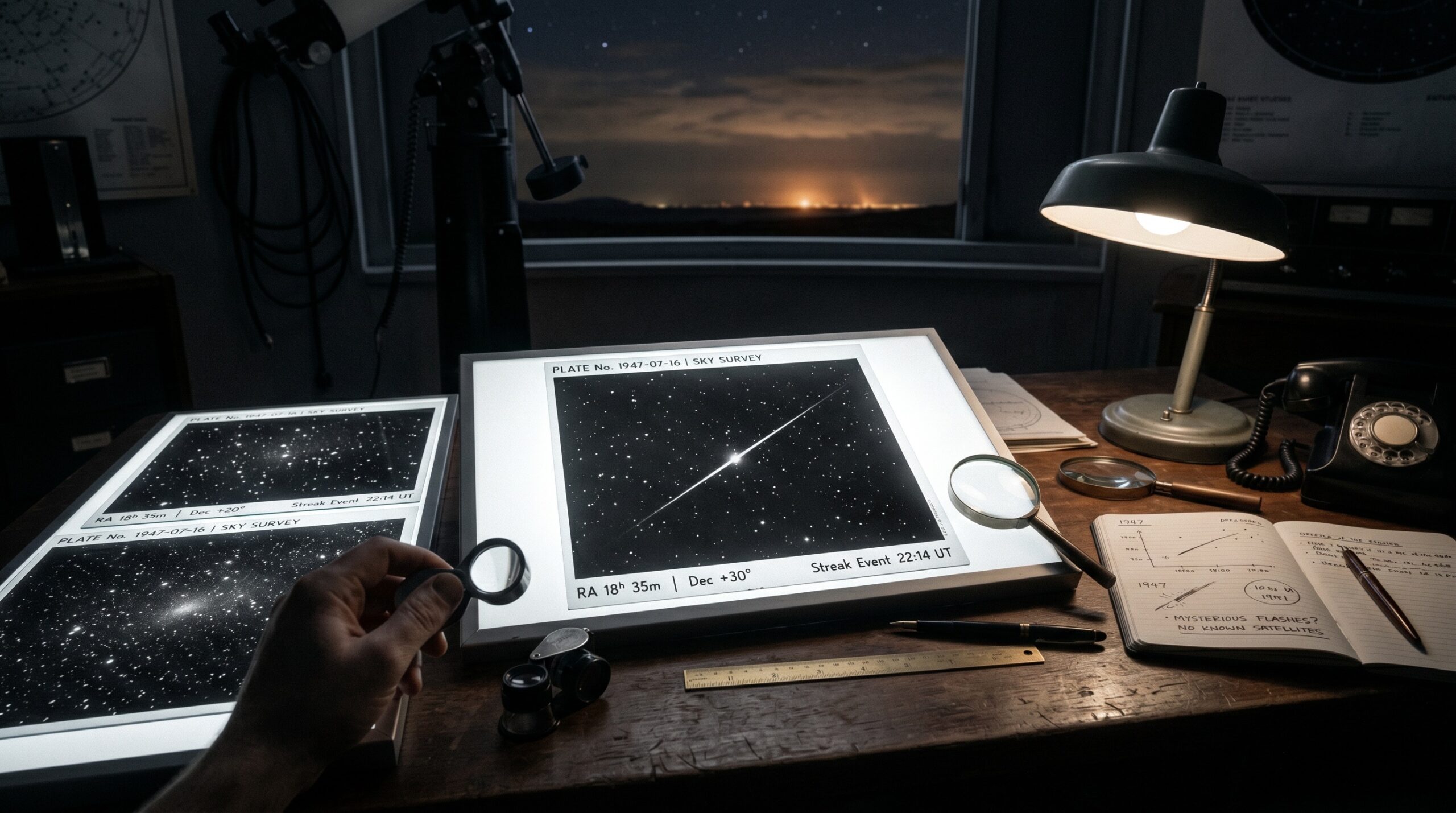
    What if some of the strangest UFO evidence on record was captured before satellites, before CGI, before internet hoaxes, and before modern governments learned how to bury weird things under a mountain of digital noise? That is the force behind the renewed obsession with astronomer Beatriz Villarroel’s 1950s sky flashes — a set of archival anomalies that believers see not as random defects, but as possible signs that something unexplained was moving through the skies long before the modern UFO era learned how to talk about itself.

    For believers, the pre-satellite part changes everything. It removes one of the easiest escape routes in modern UFO arguments. A strange light in today’s sky can always be blamed on orbital clutter, secret hardware, edited footage, or bad pixels. But when the anomaly comes from older photographic plates, from a sky that was not yet crowded with human-made objects, the mystery starts to feel harder, older, and far more dangerous to dismiss.

    That is why the story is catching fire again. Coverage from Sci.News on the 1950s sky flashes and nuclear-test correlations, the renewed discussion of possible nuclear-era timing, and the broader hunger for older “clean” UFO evidence have pushed Villarroel’s work back into circulation. In believer circles, this does not read like a technical astronomy debate. It reads like a buried file being reopened. Stories such as Palomar 1950 Sky Plate Mystery Revived already primed this audience to think the old sky may still contain overlooked traces of something extraordinary.

    Why the pre-satellite detail feels explosive

    The emotional power of this story is simple: if these anomalies happened before the satellite age, then one of the most common modern explanations gets stripped away before the argument even begins.

    That does not prove UFOs by itself, but it explains why believers are so energized by the case. In the current disclosure climate, old evidence feels more trustworthy than new evidence. Archival plates feel harder to fake, harder to stage, and less contaminated by the endless modern cycle of digital manipulation and instant debunk theater. If something truly odd was caught there, then believers think it may belong to a cleaner layer of the mystery.

    That is also why this story naturally connects with other unresolved cases involving historical sky anomalies and military secrecy. Once people suspect the past sky holds real clues, every forgotten archive starts to feel like a hidden vault. The idea fits neatly beside Immaculate Constellation UFO leak style suspicions: the belief that the most important UFO evidence may not be the newest, but the oldest material no one fully explained.

    The rabbit hole believers are following

    Once you lean into the believer reading, these flashes stop looking like isolated oddities and start looking like fragments of a longer surveillance story.

    Why were there multiple transients? Why do some discussions focus on alignments rather than a single stray point? Why does the nuclear-era angle keep surfacing around this material? And why do so many UFO researchers feel that every time evidence seems old enough to avoid the usual easy debunks, it suddenly becomes “complicated” in exactly the right way to prevent a clean conclusion?

    That is the rabbit hole. Believers do not just see mysterious flashes. They see the possibility of an older pattern — a time when something unusual may have been visible in the skies, possibly around periods of nuclear activity, before the public had a ready-made language for UAPs. The nuclear thread matters because it plugs into one of the oldest and most emotionally charged currents in UFO belief: that unidentified craft appear where human power becomes most dangerous. The archived background on aligned multiple-transient events in the first Palomar survey keeps getting pulled into that conversation for exactly that reason.

    That is why stories like Giant Fireballs Across the US and older nuclear-linked UFO lore never really die. They keep feeding the same intuition — that the sky reacts when human civilization crosses certain lines.

    Why the archival evidence feels more dangerous than modern video

    Modern UFO clips are easy to wave away because everyone expects digital trickery now. Archival astronomy feels different.

    Old plates carry weight. They come with dust, age, storage history, and the aura of something that was never meant for viral spectacle. That makes them psychologically powerful. Even when believers cannot prove exactly what they are seeing, they feel they are closer to a genuine trace of the unknown than they are with another shaky phone video.

    It also helps that Villarroel’s work comes wrapped in scientific language instead of pure witness testimony. In internet culture, that matters. A blurry witness account can be ignored. A scientific anomaly can be postponed, buried, argued over, or reframed, but it is harder to laugh off. That alone gives the story a more dangerous feel for people already convinced that meaningful evidence gets smothered under technical uncertainty.

    And once people hear the phrase “pre-satellite anomalies,” the imagination does the rest. It sounds like a category that should not exist if the world is ordinary. It sounds like a corner of history where something slipped onto the record before the cover stories were fully modernized.

    Why believers think the nuclear angle matters

    The nuclear layer is where this story stops being an astronomy puzzle and starts feeling like classic UFO mythos again.

    For decades, believers have argued that unidentified craft show up around nuclear tests, missile bases, strategic infrastructure, and moments when human technology becomes globally consequential. If archival 1950s flashes can even loosely be discussed in relation to that same timeline, then the case expands instantly. It is no longer just about old plates. It becomes part of a continuity — the possibility that something was present, watching, or interacting with a nuclearizing world during the Cold War.

    That is an intoxicating idea because it gives the anomalies a purpose. Random defects have no narrative gravity. But unexplained flashes that appear during a nuclear century, before satellites, inside old astronomical records? That sounds like the kind of clue believers have spent decades hoping would surface.

    What the credible facts actually support

    Here is what stands up cleanly. Beatriz Villarroel’s work involves archival sky anomalies in older astronomical material, including pre-satellite-era cases that appear unusual enough to keep attracting analysis and debate. The pre-satellite context is real, and it does make the cases more interesting because a common modern explanation is greatly reduced.

    What is not yet proven is the leap from “interesting archival anomalies” to “confirmed UFO craft.” Old photographic material can still contain defects, handling damage, processing irregularities, contamination, or other technical problems that become difficult to reconstruct decades later. The nuclear correlation angle is also still a correlation claim, not settled proof of common cause, even when Nuclear News summaries of the April 2026 study wave push that possibility back into public view. In other words, the mystery is real, but the strongest conclusion remains ahead of the evidence.

    That leaves the case exactly where it becomes most powerful for this audience. Believers can reasonably say the anomalies deserve serious attention, that the pre-satellite setting makes them harder to dismiss, and that the nuclear-era implications keep the story alive for good reason. Skeptics can still say archival weirdness is not the same as intelligent craft. For now, the paper trail supports a genuine historical mystery — and a very old one. Whether those flashes were only artifacts trapped in aging plates, or a glimpse of something stranger crossing the Cold War sky, is still the part readers must decide for themselves.

  • Schumann Resonance Panic: Is Earth’s Heartbeat Spiking?

    Schumann Resonance Panic: Is Earth’s Heartbeat Spiking?

    What if the reason so many people cannot sleep is not stress, screens, hormones, or bad habits at all, but the planet itself pulsing differently under our feet? That is the idea pulling thousands of people into the Schumann resonance panic now spreading across conspiracy, spiritual, and paranormal circles — the fear that Earth’s so-called heartbeat is spiking and human bodies are being forced to feel it.

    To believers, this does not sound like fringe nonsense. It sounds like one more hidden system the public was never meant to understand. The charts look dramatic. The timing feels uncanny. Sleepless nights, ringing ears, anxious surges, strange dreams, chest pressure, emotional crashes — all of it gets folded into one electrifying possibility: maybe the planet is changing frequency, and maybe the body notices before the experts admit it.

    That is why the story is moving so fast. A Daily Mail report on Schumann resonance and insomnia claims, a UNILAD explainer on the recent resonance panic, and a NOAA overview of lightning and atmospheric electricity all feed the same conversation from different angles. Online, those angles blur into a single emotional question: if Earth’s frequency really is surging, how could people not be feeling it?

    Why believers think this is bigger than bad sleep

    The power of this story is that it turns ordinary suffering into a planetary event.

    A bad night can always be explained away. A month of weird sleep can be blamed on modern life. But when people see “Schumann resonance spike” charts at the same time they feel wired, exhausted, dizzy, or emotionally volatile, the experience suddenly acquires a larger meaning. Their symptoms stop feeling isolated. They become synchronized.

    That is the emotional engine behind this panic. Believers are not just looking for data. They are looking for pattern, and Schumann resonance offers one of the most seductive patterns available: a measurable planetary signal that appears to line up with invisible but deeply felt bodily distress. It is the same attraction that keeps stories like Comet 3I/ATLAS & The 25 Hz Spike circulating. Once people suspect the sky, the Earth, and the nervous system may be talking to each other, every spike feels personal.

    Why the charts feel so convincing

    Most viral conspiracy ideas fail because they only offer mood. This one offers pictures.

    Shared Schumann resonance charts look like evidence even before most people understand what they are seeing. Bright bands, dense blocks, sudden intensity, strange-looking gaps — visually, they feel like alarms. A person does not need a background in atmospheric science to look at one of these images and think something unusual is happening.

    That is why chart culture matters here. In believer spaces, the chart is not just a measurement. It is a warning flare. It tells people that their insomnia might not be personal at all. It might be environmental, cosmic, even apocalyptic in a softer New Age sense — not the end of the world by fire, but the beginning of a planetary shift the body cannot ignore.

    That tension is what ties this panic to other viral “cosmic effects” narratives, including Planetary Parade 2026: Cosmic Shift or Optical Trick?. The deeper belief is that human consciousness and planetary conditions move together, and mainstream explanations are always too narrow to capture what people are really feeling.

    The rabbit hole underneath the insomnia theory

    Once you go a little deeper, the story stops being about sleep and becomes a theory of hidden influence.

    For some believers, Schumann resonance is not just a natural electromagnetic phenomenon. It is proof that the body is far more porous than modern institutions want to admit. If frequencies can affect mood, sleep, focus, and emotion, then what else might frequency do? Could governments know more about bioelectromagnetic sensitivity than they say? Could mass stress events be intensified by changes in the planet’s field? Could so-called awakening symptoms be less mystical than they sound — and more physical?

    This is where the insomnia panic merges with wellness language, spiritual language, and conspiratorial language all at once. In one corner, people talk about ascension symptoms and energetic upgrades. In another, they talk about hidden research, suppressed truth, and establishment refusal to study what would disrupt the official model of human biology. The theories vary, but the emotional core is the same: something real is happening, people can feel it, and the mainstream explanation does not satisfy.

    That instinct also helps explain why older resonance stories such as Earth’s Heartbeat on Overdrive keep resurfacing whenever a new spike appears. Each new chart is treated like another breadcrumb in a longer trail that believers think science has not properly followed.

    Why so many people say they feel it in the body

    The symptom lists are part of why this story sticks.

    Insomnia alone would not have been enough. But the online conversation rarely stops at insomnia. It expands into ear ringing, vivid dreams, headaches, nausea, anxiety, heart palpitations, racing thoughts, emotional rawness, and the strange sensation that something is simply “off.” Once enough people report the same bundle of experiences, the theory begins to harden into common sense inside the community.

    And that is where the panic becomes socially self-sustaining. Someone sees a chart, then checks their body. Someone feels bad, then checks the chart. Someone sees both and posts, “Anyone else feeling this?” Then hundreds of people answer yes. A loose hunch becomes a wave. A wave becomes testimony. Testimony becomes a belief system.

    For believers, this collective reporting does not feel like coincidence. It feels like confirmation. If bodies all over the world seem to be reacting at once, then the simplest explanation becomes the one nobody in authority wants to say out loud: the signal is real, the effects are real, and the institutions are either blind to it or refusing to deal with it.

    What the credible facts actually show

    Here is the firmer ground. Schumann resonance is real. It refers to extremely low-frequency electromagnetic resonances generated in the cavity between Earth’s surface and the ionosphere, with lightning activity playing a major role in exciting those frequencies. So the phenomenon itself is not made up, and the charts people share are not pure fantasy.

    What is not established is the stronger leap now circulating online: that recent Schumann resonance spikes directly caused widespread insomnia, ear ringing, anxiety, or other human symptoms in a clear and measurable way. Public reporting and basic scientific explanations support the existence of the atmospheric phenomenon, but they do not currently prove that a dramatic-looking chart equals a biologically meaningful human event. A rough night, a viral chart, and thousands of matching anecdotes can feel like a pattern without proving causation.

    That leaves the story exactly where believers and skeptics keep colliding. One side sees a real planetary signal and a wave of human reactions that feel too synchronized to dismiss. The other sees a real atmospheric phenomenon wrapped in interpretation, expectation, social contagion, and a very human hunger for hidden meaning. For now, the evidence supports the existence of Schumann resonance itself — and the panic around it. Whether the planet is truly disturbing human sleep, or people are building a powerful story around a real but misunderstood signal, is still for each reader to decide.

  • Pete Hegseth’s 46 Missing UFO Videos and the April Deadline

    Pete Hegseth’s 46 Missing UFO Videos and the April Deadline

    What if the videos everyone keeps hinting at are real, the people demanding them know exactly what they contain, and the silence after the deadline was never a glitch at all? That is the fear now running through disclosure circles after reports that Defense Secretary Pete Hegseth faced an April 14 deadline tied to 46 military UAP videos that still have not surfaced in public.

    For believers, this story does not feel like paperwork. It feels like a vault door slamming shut right when someone on the other side was finally supposed to open it. The number is too specific. The timing is too dramatic. The public frustration is too familiar. After years of hearings, whistleblower claims, redacted briefings, and half-glimpsed military footage, the idea that dozens more clips could still be sitting behind the wall lands exactly where modern UFO culture is most sensitive: the suspicion that disclosure is always almost here, until it suddenly is not.

    That is why this moment exploded. A Newsweek report on Pete Hegseth’s UFO deadline, an NBC report on Anna Paulina Luna’s request for UAP videos, and a viral Daily Mail piece framing the standoff as a cover-up fight hit the same pressure point at once. Online, the reaction was immediate: if Congress wanted 46 videos and the public still got nothing, then what exactly is being protected?

    Why the number 46 hit so hard

    In normal Washington language, a request for 46 videos might sound like an internal oversight dispute. In UFO culture, it sounds like a hidden archive.

    That is because believers are not hearing the number in a vacuum. They are hearing it after the Immaculate Constellation UFO leak, after repeated whispers that the government holds stronger evidence than it shows, and after years of public frustration over briefings that promise movement but rarely deliver closure. The bigger the number gets, the harder it is for people to believe all of it is routine, blurry, or boring.

    Forty-six clips suggests scale. It suggests pattern. It suggests a catalog, not a fluke. Even if only a handful of those videos were dramatic, believers argue that the public would still deserve to see them, especially if lawmakers are already fighting to get access. That is what makes the delay feel so combustible. The missing footage becomes a symbol for every previous claim that evidence exists just beyond the public line of sight.

    Why this instantly became a cover-up story

    The modern disclosure audience has been trained to read silence as a message.

    When a deadline passes in an ordinary political story, most people assume there was a delay, a negotiation, or a bureaucratic mess. When a deadline passes in a UFO story, a huge part of the audience assumes somebody panicked. That instinct did not come from nowhere. It was built over decades of sealed records, official reversals, strange military cases, and the constant feeling that every answer arrives already trimmed down.

    So once this April deadline started circulating, the script wrote itself. If the footage were harmless, why not release it? If lawmakers wanted it urgently, why was the public left staring at another blank wall? And if the Pentagon really has nothing extraordinary, why does every new fight over UAP evidence seem to produce the same combination of delay, secrecy, and procedural fog?

    That emotional logic is also why stories like Why Every New UFO Leak Becomes the Same Online Story keep resonating. The pattern is painfully familiar. A leak or demand appears. Hopes surge. A gatekeeper steps in. The release narrows, stalls, or disappears. Then believers are told, once again, that they are reading too much into it.

    The rabbit hole believers are following

    Once you step inside the believer version of this story, it stops being about Pete Hegseth alone.

    It becomes a story about who knows what, who is allowed to see it, and whether the public is being managed rather than informed. If Luna and other lawmakers were pushing for these videos, believers ask whether they were chasing footage tied to repeat incursions, hidden programs, or encounters more revealing than the clips already known to the public. The fact that the requested material is military in origin only sharpens the intrigue. Military footage carries weight because it implies trained observers, better sensors, and records that are harder to dismiss as random internet noise.

    That is where older allegations come rushing back into the conversation. Theories about retrieval programs, compartmented access, and parallel chains of secrecy do not stay in separate boxes online. They bleed together. People discussing this deadline are also thinking about stories such as James Clapper UFO Retrieval Program Allegations, recent congressional hearings, and the persistent suspicion that official disclosure is being staged in fragments while the most destabilizing material stays buried.

    For that audience, the absence of the videos becomes its own kind of evidence. Not proof, exactly, but pressure. Why ask for that much material if nothing in it matters? Why let the deadline turn public if the answer was always going to be silence? Why does every trail seem to end at the same locked door?

    What believers think the missing videos could show

    The most intense speculation online is not just that the videos exist, but that some of them may be the kind of footage that would force a public reset.

    Believers imagine a range of possibilities: repeated military encounters that show impossible movement, longer clips with clearer context than the short famous releases, multi-sensor footage that is harder to wave away, or recordings tied to incidents already known only in fragments. In that version of the story, the danger is not that the public would misunderstand the videos. The danger is that the public would understand them too well.

    That is why the phrase “46 videos” carries more force than “46 unresolved cases.” Cases can be buried in language. Video feels different. Video feels immediate. It feels like something ordinary people can judge for themselves. And in a distrust-heavy environment, the promise of direct visual evidence is irresistible.

    Of course, believers also know that not every clip needs to show a perfect metallic craft hanging in daylight to be explosive. Sometimes what matters is repetition. If multiple videos show the same class of anomaly, the same operational zone, or the same unexplained behavior, that can be enough to convince people that the pattern is real even if no single frame becomes the final smoking gun.

    Why this story has real staying power

    The bigger reason this story will not die is that it touches a live fault line in the culture.

    A huge part of the public no longer trusts institutions to tell the full truth about anything strange, militarized, or nationally sensitive. UFO stories thrive in that gap. They offer the possibility that the world is much stranger than official language admits, and they give people a narrative shape for their distrust. That is why a deadline like this can dominate conversation even before anyone sees a single new frame of footage.

    It also helps that the story contains everything disclosure culture feeds on: a named official, a concrete date, a large number of hidden videos, congressional pressure, tabloid amplification, and a clean emotional question at the center of it all. If they had to hand it over, why are we still waiting?

    That question is powerful because it is simple. It does not require technical knowledge. It does not require someone to understand classification law or committee procedure. It only requires the intuition that if something important was supposed to come out and did not, somebody probably wanted it that way.

    What the paper trail actually supports

    Here is the part at the bottom of the rabbit hole that is solid enough to stand on. Public reporting does show that Representative Anna Paulina Luna pushed for UAP-related video material and that April 14 became the key date people were watching. It is also true that no sweeping public dump of 46 military UFO videos appeared when believers expected it to. Those are the facts that lit this fire.

    What remains unproven is the leap from “videos were requested and not publicly released” to “the videos must contain undeniable proof of nonhuman craft.” The public still does not know exactly what all 46 videos allegedly show, whether they were meant for full public release or private congressional review, or whether some of the delay is tied to classification, procedure, or a narrower dispute over access. Believers may see a cover-up. Officials may call it process. Right now, the gap between those two explanations is the real story — and until the footage or fuller documentation emerges, people will keep deciding for themselves what is hiding inside that silence.

  • Why Every New UFO Leak Becomes the Same Online Story

    Why Every New UFO Leak Becomes the Same Online Story

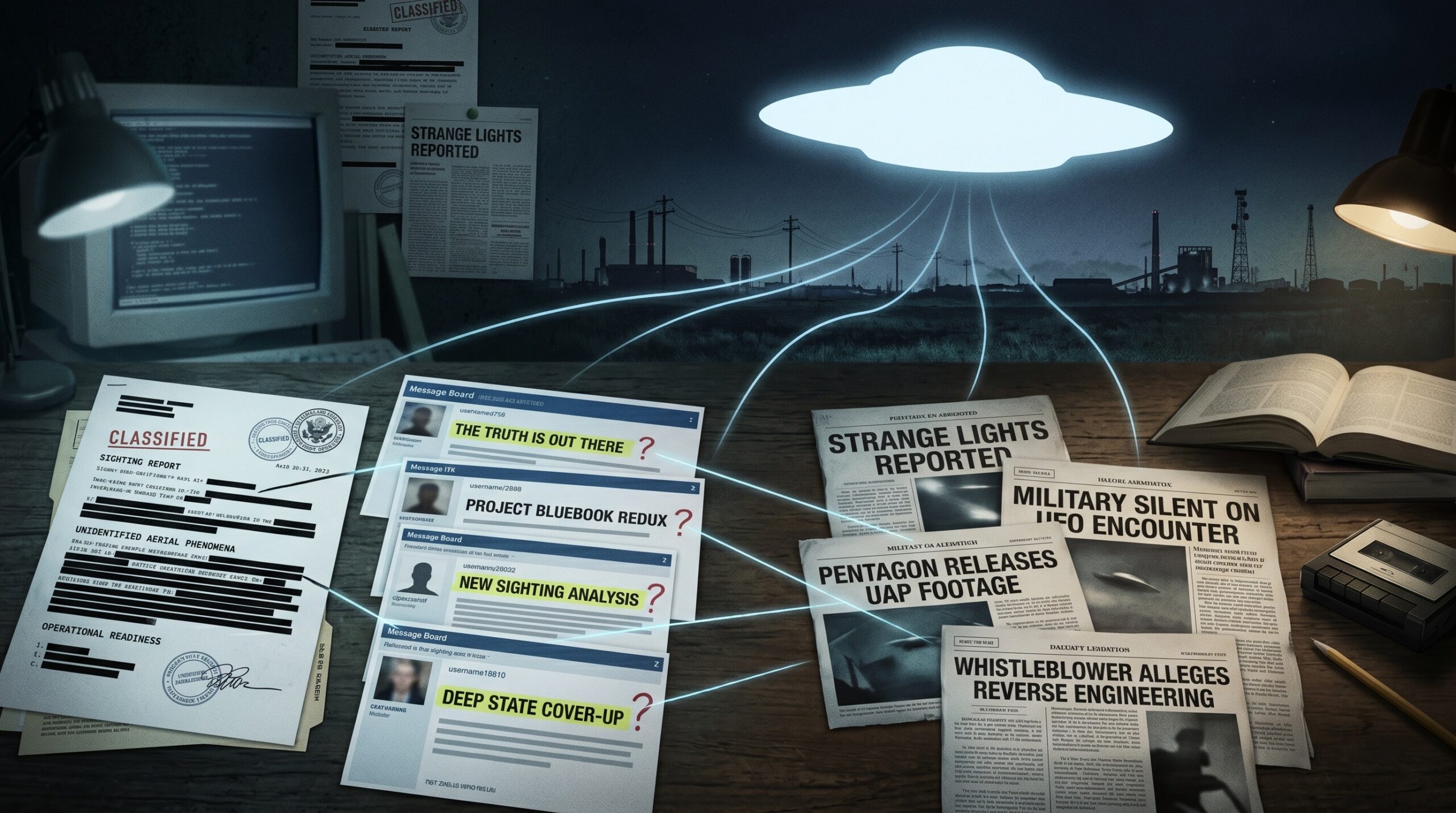
    Spend enough time in UFO-heavy corners of the internet and a strange pattern emerges: separate stories that should remain separate quickly fuse into one giant narrative. A celebrity describes a strange light from an airplane window. An alleged leak starts circulating around a rumored classified program. A former official gets pulled back into argument threads about secrecy. Then a story about a dead or missing scientist appears, followed by a grainy worksite video from a remote camp. Within hours, many readers are no longer treating those as distinct claims with different evidentiary weight. They are treating them as fragments of the same hidden picture.

    That collapse is one of the most important things to understand about the current UFO media ecosystem. It helps explain why debates move so fast, why weak claims can borrow emotional force from stronger ones, and why a story that would normally stay niche suddenly feels huge. The internet does not merely spread UFO stories. It bundles them.

    Why separate cases keep collapsing into one narrative

    Part of the answer is structural. Modern audiences do not encounter most UFO stories through a single careful report. They encounter them through screenshots, clipped podcasts, Reddit threads, quote cards, short-form video explainers, and reposted commentary. In that environment, context gets flattened. The original source matters less than the emotional category the story seems to fit.

    Once that happens, different kinds of claims begin to reinforce one another. A story with weak direct evidence can feel more credible because it arrives beside a story that sounds bureaucratic or intelligence-adjacent. A story with no official documentation can feel bigger because it is mentioned in the same breath as an alleged program, a government witness, or a viral sighting that already captured public attention. The audience is no longer evaluating one claim at a time. It is tracking a mood: secrecy, suppression, revelation, pattern.

    That is why the same names keep surfacing in adjacent conversations. The NewsNation segment on the scientist-network theory is not just consumed as one story about one person. It gets absorbed into a much larger atmosphere of hidden networks, unexplained deaths, classified research, and institutional silence. In online UFO culture, adjacency often does the work that proof cannot.

    Why celebrity sightings become the gateway drug

    Celebrity sightings play a specific role in this process. They are easy to understand, easy to share, and emotionally low-friction. Most readers do not need a deep technical background to process a story like a musician looking out of a plane and saying she saw something unusual. The appeal is immediate: recognizable person, vivid moment, simple claim.

    That is one reason the Kacey Musgraves sighting spread so effectively. It functioned as an entry-point case. You do not have to believe it proves anything in order to click it, discuss it, or remember it. Once a reader enters the UFO discourse through a familiar cultural figure, though, the algorithm begins offering harder-edged material nearby: leaks, whistleblower-style claims, redacted documents, and more politically loaded allegations. In practice, the celebrity story warms the audience up for the secrecy story.

    This matters because the evidence categories are not the same. A celebrity sighting is often little more than testimony plus atmosphere. It may be sincere and still remain weak as evidence. But once it is circulated beside bureaucratic language and intelligence-themed claims, it can begin to feel like one small confirming tile in a broader mosaic.

    Why leak culture adds narrative gravity

    Leak stories give the whole ecosystem its center of mass. They create the impression that somewhere beneath the noise there may be a real classified core. For many readers, that possibility is what turns a stream of entertaining anecdotes into a serious ongoing drama.

    The Immaculate Constellation UFO Leak works this way because it sounds like the kind of thing a hidden system might actually be called. It has the right mixture of official tone, mystery, and apparent specificity. Whether a reader ends up convinced by the claim is almost secondary. The name itself becomes narrative infrastructure. Once it enters the conversation, it offers a conceptual shelf on which many unrelated stories can be placed.

    That shelf matters. A celebrity sighting can sit on it. A rumor about unusual recovery efforts can sit on it. A post about missing scientists can sit on it. A worksite video from the middle of nowhere can sit on it too. The leak does not prove those stories belong together. It simply provides a frame that makes them feel as if they could.

    For readers trying to understand why this keeps happening, Popular Mechanics’ history of official UFO investigation is useful precisely because it shows how long this pattern has been around. New names and new acronyms appear, but the gravitational pull is old: once people suspect there is an official archive or hidden program somewhere, many smaller stories begin to orbit it.

    Why intelligence allegations never stay isolated

    Claims involving senior intelligence figures carry a slightly different kind of force. They suggest proximity to state knowledge. Even when the details remain disputed or incomplete, the mere presence of intelligence-world language makes a story feel more consequential than an ordinary sighting.

    That is why James Clapper UFO Retrieval Program Allegations travel so widely. The claim operates on two levels at once. On one level, readers are asking the ordinary factual questions: what exactly was said, what is documented, what is inferred, and what remains missing? On another level, the story signals that the conversation has moved beyond hobbyist fascination. It hints at institutions, access, compartmentalization, and the possibility that the public is looking only at the outer layer of a much larger apparatus.

    In online discussion, that second level often overwhelms the first. People stop asking whether this specific allegation stands on solid evidence and start using it as evidence of a general condition: the government is hiding something, multiple insiders are circling the same secret, and each new fragment belongs to the same concealed architecture. Once that interpretive move happens, almost any adjacent story becomes easier to absorb into the bigger theory.

    Why the Michael David Hicks story intensifies the mood

    Stories about scientists, researchers, or technical personnel add another ingredient: danger. They raise the emotional temperature because they imply not just secrecy, but consequences. A story about a leak asks whether something is being hidden. A story about a scientist surrounded by ominous speculation asks whether people connected to hidden knowledge are somehow at risk.

    That is the function of the Michael David Hicks conversation online. In strict evidentiary terms, readers should be careful. The existence of a viral narrative does not mean the darker interpretations are supported. But culturally, the story performs a powerful role. It gives UFO discourse a cast of tragic or compromised specialists—figures who seem adjacent to aerospace, research, classified work, or technical knowledge, and who therefore become magnets for retrospective pattern-making.

    Once those stories enter the feed, the entire ecosystem feels darker and more coherent. A celebrity sighting looks less like a curiosity and more like a public-facing symptom. An alleged leak looks less like a disputed document and more like a glimpse into a suppressed system. A scientist story then gives the whole structure an undertone of menace. None of that proves the stories are connected. It does explain why audiences experience them as connected.

    Why rough videos from remote places feel more convincing than they should

    Videos from isolated worksites or distant terrain add realism to the story bundle. They feel less mediated than studio commentary and less polished than government-themed talk. A remote camp, a drilling site, a desert road, a cold industrial horizon—these settings make viewers feel they are seeing something raw rather than narrated.

    That is why the Northwest Territories Drillers UFO Sighting resonated. The setting did a great deal of persuasive work before the audience ever decided what the object might be. Workers in a harsh, remote environment are implicitly framed as practical observers, not theatrical ones. The location feels too inconvenient to be staged for attention. The footage feels discovered rather than produced.

    But atmosphere is not evidence. As Deutsche Welle’s reporting on how UFO reports are evaluated makes clear, many sightings remain hard to assess precisely because they begin with limited visual information, uncertain distance, unknown camera behavior, and incomplete scene reconstruction. A rough video can feel more authentic than a polished one while still leaving the central factual question unresolved.

    What makes these remote-worksite clips so potent is that they give the mega-narrative texture. If leak stories provide the skeleton, remote footage provides the weather. It makes the broader secrecy framework feel grounded in physical places and ordinary witnesses.

    What gets lost when every story is merged into one theory

    The first casualty is calibration. Different cases deserve different standards. A celebrity anecdote, a leaked-program claim, an intelligence allegation, a suspicious-death rumor, and a low-resolution video should not all be weighed the same way. Yet when they are pulled into a single online narrative, readers often stop distinguishing between them. Emotional coherence replaces evidentiary hierarchy.

    The second casualty is clarity. Once every story is treated as supporting evidence for the same hidden truth, weak cases become hard to discard. They no longer have to stand on their own. They can survive by association. A thin claim feels harder to dismiss when people say it “fits the pattern.” But a pattern made from under-evaluated pieces can become self-sealing very quickly.

    The third casualty is attention itself. Truly important questions—what is documented, who is making a firsthand claim, what records exist, what sensors were involved, what is actually knowable—can get buried beneath the more addictive pleasure of synthesis. It is satisfying to believe that every new item belongs somewhere inside one giant explanatory map. It is much less satisfying to say that one story is weak, another is interesting but incomplete, and a third may matter while still lacking the public evidence needed to settle it.

    Why the unified story still feels so irresistible

    Because it offers emotional order. UFO discourse is full of fragments, and human beings are very good at turning fragments into structure. The mega-narrative transforms scattered stories into a drama with continuity: sightings, secrecy, insiders, hidden archives, suspicious patterns, and recurring witnesses all seem to point toward one unfinished revelation.

    That structure is pleasurable even for skeptical readers. You do not have to believe every claim to feel the pull of the larger story. It promises that randomness is only apparent, that the repetition means something, and that the next leak or sighting might finally connect the remaining dots.

    But the responsible approach is more restrained. Some stories are mainly atmospheric. Some are socially revealing but evidentially thin. Some raise real questions that deserve closer scrutiny. The problem begins when they are all forced into mutual confirmation.

    Bottom line

    Every new UFO leak becomes the same online story because the internet rewards convergence. It compresses different evidence categories into the same emotional feed, lets mood stand in for context, and teaches audiences to treat adjacency as corroboration. Celebrity sightings open the door. Leak claims provide narrative gravity. Intelligence allegations raise the stakes. Scientist stories darken the frame. Remote videos make it all feel physically grounded.

    That does not mean the stories are worthless. It means they should be separated before they are synthesized. A reader who wants to think clearly about the subject has to resist the seductive idea that every strange sighting, every alleged program, every official-sounding claim, and every ominous rumor automatically belong to one hidden machine. Sometimes they do not add up to a revelation. Sometimes they only add up to the feeling that one is near.

  • Northwest Territories Drillers UFO Sighting: What the Video Shows and What It Doesn’t

    Northwest Territories Drillers UFO Sighting: What the Video Shows and What It Doesn’t

    A video said to show drillers in Canada’s Northwest Territories watching a strange bright object over a remote site has become one of the week’s most discussed UFO clips. The basic claim is easy to understand: on April 6, 2026, workers at a northern drilling location reportedly filmed a bright light hovering silently in the night sky. That is the story people are sharing. What the evidence supports, at least for now, is narrower. There appears to be a real circulating clip tied to a real reported sighting. What it does not provide on its own is proof of an extraordinary craft, let alone anything extraterrestrial.

    That distinction matters because this is exactly the kind of video that thrives online. It has a remote setting, a group of seemingly matter-of-fact witnesses, a dark open sky, and a single visual element bright enough to feel dramatic while remaining vague enough to invite projection. People are talking about it now partly because it surged on Reddit, where a post in r/UFOs rose to the top of the week with more than 6,500 upvotes, and partly because short-form social media is already saturated with “orb,” “light,” and “skywatch” clips. In that environment, a video does not need to be conclusive to become culturally large. It only needs to feel like it might be.

    So what does the evidence actually show? In public, the case still looks like a reported sighting built around a short video of a bright light in a remote night sky. That can be genuinely interesting. It can also be consistent with more ordinary explanations. Without a precise location, exact time, original file, metadata, and checks against aircraft, drones, satellites, and visible celestial objects, the honest conclusion is simple: this is a compelling sighting, not a solved mystery.

    What reportedly happened at the drill site?

    The version of the story spreading online is broadly consistent across reposts. Workers at a drill site in the Northwest Territories, far from major city light pollution, noticed an unusually bright object in the sky and began filming. The object is described as hovering or holding position over the landscape, and viewers have seized on the claim that it appeared silent.

    Those details are enough to make the clip memorable, but they are also exactly the kind of details that need careful handling. “Hovering,” for example, may describe what the object seemed to do from the witnesses’ point of view. It does not necessarily mean the object was literally fixed in space. Distant aircraft seen head-on can appear motionless for surprising stretches of time. A bright star or planet low in the sky can seem strangely planted in place, especially when there are few nearby visual references. Even a drone, depending on distance and wind, can hold position in a way that looks uncannily deliberate.

    The same goes for silence. A phone video often records less environmental sound than people assume. Distance swallows audio. Wind noise and automatic phone processing flatten what is actually there. A viewer may come away with the impression that the object made no sound at all when the truth is simply that the microphone captured almost nothing useful.

    At this stage, the public case appears to rest on a short clip, social retellings, and the credibility people assign to the setting and the workers involved. That is enough to discuss seriously. It is not enough to identify the object with confidence.

    Why this clip spread so fast

    A sighting like this lands in a media ecosystem designed to reward ambiguity. One reason the Northwest Territories video took off is that it hit a particularly receptive audience at the right moment. On Reddit, especially in r/UFOs, the clip had all the ingredients of a high-engagement post: fresh footage, a remote location, blue-collar witnesses, and no immediate clean explanation attached to it. Once a post breaks out there, it often moves quickly into YouTube reaction videos, recap channels, and stitched commentary.

    That second layer matters. YouTube explainers are not just repeating the sighting; they are converting it into a narrative. A short uncertain clip becomes a “case.” Viewers are offered freeze-frames, zoom-ins, and speculation about what the object “seems” to be doing. Sometimes that process surfaces useful questions. Just as often, it gives weak evidence a stronger aura than it deserves.

    Then there is the wider visual culture around UFO content. Instagram and short-form video platforms already host enormous amounts of material tagged with terms like #ufo, #ufosighting, and #skywatch. The result is not just demand for new sightings but a familiar way of seeing them. Many viewers now encounter bright lights in the sky through a ready-made interpretive frame: this could be an orb, a silent craft, an unexplained watcher over the landscape. By the time a new clip reaches them, the story template is already in place.

    None of this means the Northwest Territories sighting is false or manufactured. It means virality explains popularity, not accuracy. A video can become one of the week’s most talked-about UFO clips long before anyone knows what it shows.

    What is actually visible in the footage?

    The most useful question is also the least glamorous one: what can a careful viewer honestly say is on screen?

    Based on the descriptions circulating publicly, the clip shows a bright object or light against a dark sky over a remote northern location. It appears luminous enough to stand out sharply from the background. It is said to remain in roughly the same area of the sky long enough for the witnesses to comment on it and for the moment to feel unusual.

    That is already more limited than many viral captions suggest. A bright light is not the same thing as a visible structured craft. Unless the video clearly shows shape, edges, surface detail, or movement inconsistent with conventional objects, a viewer is mostly interpreting brightness, position, and apparent steadiness. Night footage is especially poor at resolving distance and form. Exposure settings can enlarge light sources, wash out detail, and create the impression that a simple point of light has mass or contour.

    There are other missing pieces too. We do not know the full unedited duration of the event. We do not know the zoom level used by the camera, which matters because digital zoom can distort how stable or intense an object appears. We do not know the witnesses’ exact viewing direction, the elevation angle of the object, the local weather conditions, or whether the object later moved in a way the public clip does not include.

    Those absences do not make the sighting meaningless. They simply set limits. What is visible may be unusual. What is provable from the circulated footage is still modest.

    Why the Northwest Territories setting matters

    The location is a major part of why the clip feels persuasive. A drill site in Canada’s Northwest Territories evokes remoteness, hard weather, open space, and a sky with far less urban light pollution than most people ever experience. To many viewers, that setting implies a cleaner look at whatever was there. If workers in a place like that say a light looked wrong, people are inclined to take the reaction seriously.

    There is some logic to that. Darker skies can reveal objects that would be lost over a city. Workers in remote industrial settings may spend long periods outdoors at night and may be familiar with local aircraft patterns, weather, and the ordinary look of the sky around them. That can make a report more interesting.

    But remoteness cuts both ways. The fewer visual reference points a viewer has, the harder it becomes to judge scale, speed, altitude, and distance. A light that seems low may be high. A light that seems close may be very far away. A light that appears to hover over a site may actually sit along a distant line of sight with little visible motion relative to the observer.

    Northern conditions add another layer. Cold air, haze, ice crystals, and other atmospheric factors can affect how lights behave visually. Bright celestial objects near the horizon may shimmer, flare, or seem enlarged. Aircraft lights can look stranger than they would over a city where context is easier to read. In other words, the setting strengthens the clip’s mood while also making interpretation harder.

    What ordinary explanations might fit a remote-night-sky sighting?

    There is no single ordinary explanation that can be confirmed from the public record so far. But several familiar possibilities fit the broad outline better than many viewers may realize.

    For outside reporting and background, start with The original Reddit discussion about the NWT drillers sighting and A recap video discussing the NWT sighting.

    One is an aircraft seen at an unusual angle. A plane approaching from a distance, especially at night, can appear nearly stationary while its forward-facing lights remain bright. Helicopters can also seem to hang in place from some vantage points, particularly if the observer lacks nearby references for motion or altitude.

    Another possibility is a drone. People often associate drones with cities, events, or hobby use, but they can appear in remote areas too. Industrial work sites, nearby camps, contractors, or recreational users can all introduce drone activity. Depending on the model, distance, and wind, a drone can present exactly the qualities that spark UFO interpretations: a bright concentrated light, strange hovering behavior, and uncertain scale.

    A third possibility is a bright celestial object, especially if local atmospheric conditions distorted its appearance. Planets and stars do not usually satisfy witnesses once an event feels dramatic, but they account for more reports than many people like to admit. Under the right conditions, a bright object low in the sky can look startlingly anomalous, particularly on a phone camera that overexposes the point of light.

    Then there are atmospheric and optical effects. Ice crystals, haze, phone-camera exposure, digital zoom, and compression artifacts can all make a light look larger, more active, or more mysterious than it did in person. None of those explanations are as emotionally satisfying as a true unknown. They are still important because they happen often.

    To be clear, “ordinary explanation” is not the same as “case closed.” It simply means there are plausible conventional options on the table, and the public evidence is not strong enough to rule them out.

    How sightings like this are usually evaluated

    One useful corrective comes from the way serious investigators, journalists, and even mainstream reporting on UFO/UAP cases tend to approach these incidents. The process is usually less cinematic than people expect.

    The first questions are basic: How many witnesses were there? Did they describe the event independently? What was the exact time? Where exactly were they standing? In which direction were they looking? Was the original video preserved, or are analysts working from reposted copies? Can metadata be checked? Are there flight records, known helicopter routes, satellite passes, drone restrictions, or astronomy data that line up with the sighting?

    That is the unromantic core of UFO evaluation. It is also why so many cases remain unresolved in the weak sense rather than the strong one. “Unresolved” often means not that the object displayed impossible behavior, but that the available evidence is too thin to identify it conclusively.

    Broad public discussions of UFO reports increasingly emphasize this same point. A sighting becomes more persuasive when multiple independent witnesses agree on key details, when the original media file is available, when the timeline is precise, and when ordinary explanations have been checked against actual conditions rather than just dismissed in the abstract. A short viral clip usually fails several of those tests at once.

    That does not make the witnesses foolish or dishonest. It means the standards for turning a strange moment into a durable case are higher than social media usually allows.

    Why online audiences treat clips like this as stronger evidence than they are

    Part of the appeal is social, not just visual. A remote drill crew feels like a credible set of witnesses because viewers imagine practical people with little reason to invent a spectacle. That impression may be fair. It may also be doing too much work. Sincere witnesses can still misread what they are seeing, especially at night and at distance.

    Night footage itself also changes how people think. Darkness removes clutter and therefore removes explanation. A bright isolated object on a black background looks cleaner, more deliberate, and more uncanny than it might in daylight. Silence intensifies that reaction, even though silence in a clip may tell us more about the recording device than the object.

    Then the crowd steps in. Once thousands of viewers begin repeating that the object “hovered over the rig” or “made no sound,” those phrases harden into facts whether or not the clip alone proves them. Internet audiences do not just watch footage. They co-author its meaning. The story becomes a shared act of interpretation, and shared interpretation can feel a lot like confirmation.

    That is one reason these videos are so difficult to discuss well. By the time careful questions arrive, the cultural version of the sighting is already bigger than the raw evidence.

    What remains unknown

    The most important facts are still missing. We do not have a complete public accounting of the exact location, orientation, duration, weather conditions, or camera settings. We do not know whether multiple workers provided detailed matching statements beyond the immediate excitement of the moment. We do not know whether the original file is available for review or whether most people are analyzing copies of copies.

    We also do not know whether anyone has checked the sighting systematically against flight activity, local helicopter traffic, drone possibilities, satellite visibility, or bright celestial objects present at that date and time. And crucially, we do not know whether the object did anything in the full event that would clearly separate it from those ordinary possibilities—rapid acceleration, abrupt directional changes, impossible maneuvering, or behavior preserved in a way others can verify.

    Without that information, the case remains in a familiar middle category: interesting, possibly unusual, but fundamentally underdocumented.

    The bottom line

    The Northwest Territories drillers UFO sighting is worth paying attention to for one reason above all: it captures how modern UFO stories actually work. A real reported event, a visually striking but limited clip, a remote setting that feels inherently credible, and an online audience ready to turn ambiguity into momentum.

    A third useful reference is DW on how UFO reports are usually evaluated.

    The balanced reading is not that nothing happened. Something clearly prompted witnesses to film and react. Nor is the balanced reading that the video proves a genuine anomaly beyond known technology or ordinary misidentification. The evidence in public does not support that leap.

    Readers who want to continue can also explore Immaculate Constellation UFO Leak: What the Claim Is and Why People Are Arguing About It.

    For now, the strongest conclusion is the least dramatic one. A group of workers in a remote part of northern Canada appears to have seen a bright object they found unusual. The clip is compelling because it preserves that moment of uncertainty. But uncertainty is exactly what it preserves. Until stronger context appears, this should be treated as a reported sighting—intriguing, unresolved, and much less definitive than the internet version of the story makes it seem.

  • Michael David Hicks and the So-Called Mysterious Scientist Network

    Michael David Hicks and the So-Called Mysterious Scientist Network

    Michael David Hicks has become the latest name folded into a familiar and highly combustible internet narrative: that scientists tied to sensitive American space or nuclear work keep dying, disappearing, or falling silent under suspicious circumstances. The core facts are narrower than the theory. Hicks, described in current coverage and online discussion as a former NASA JPL scientist, did die in 2023. What remains disputed is everything people have built around that fact.

    That distinction matters, especially now that the story has jumped from Reddit threads and conspiracy-adjacent social feeds into broader media coverage. In April 2026, posts about Hicks surged across communities like r/StrangeEarth, r/aliens, and r/UFOs, where he was presented as a new addition to a larger list of allegedly mysterious deaths connected to America’s scientific and defense-adjacent establishment. Mainstream and tabloid outlets then amplified the frame, helping turn one man’s death into the latest evidence, for some readers, of a hidden pattern. What the public evidence shows so far is more limited: a real person, a real death, a real wave of attention, and a much less certain claim that these cases add up to a coordinated network story.

    For related context, see Immaculate Constellation UFO Leak: What the Claim Is and Why People Are Arguing About It and James Clapper UFO Retrieval Program Allegations: What Is Claimed and What Is Still Missing.

    Why people are talking about Hicks right now

    The Michael David Hicks story is not surfacing in a vacuum. It is arriving in a media environment already primed for overlap between UFO culture, distrust of institutions, and fascination with unexplained deaths.

    A large part of the current attention appears to come from social momentum. Viral Reddit posts helped give the story shape and urgency, with one widely shared post on r/StrangeEarth drawing particularly strong engagement and parallel discussions gaining traction in r/aliens and r/UFOs. In those spaces, Hicks was often framed not simply as an individual case but as one more data point in a longer chain: the scientist who suddenly made an older conspiracy template feel current again.

    Once that framing took hold, the story became easy to export. News-focused outlets and tabloids surfaced versions of the claim in April 2026, often centering the same hook: a former NASA-linked scientist, a death in 2023, and no publicly circulated cause attached to the recent coverage. Social platforms then did what they tend to do with stories that sit between tragedy and intrigue. They stripped away caveats, compressed the timeline, and folded Hicks into a broader visual culture already saturated with UFO reels, conspiracy clips, and government-secrecy narratives.

    That does not prove the theory. It does explain the timing. People are talking about Hicks now because the case fits perfectly into an existing appetite for stories that feel like disclosure by accumulation—one more name, one more omission, one more possible clue.

    What is actually known about Michael David Hicks

    Here the record becomes both simpler and more frustrating.

    The basic public claim repeated across current coverage is that Michael David Hicks was a former NASA JPL scientist and that he died in 2023. That much is the anchor of the story. The gap comes next: the material driving the April 2026 wave of attention emphasizes that no public cause of death has been clearly established in the viral retellings now circulating online.

    For some readers, that absence is enough to make the case feel inherently suspicious. But “not publicly stated in the coverage people are sharing” is not the same thing as “mysterious in a proven investigative sense.” Public records can be incomplete, private family matters may stay private, and internet discussions often flatten the difference between an undisclosed detail and an unexplained event.

    That does not make the reaction irrational. When a person connected to a famous institution dies and the most repeated version of the story contains a conspicuous blank space, people naturally try to fill it. The problem is that the fill-in often arrives before the evidence does.

    What can be said responsibly is limited. Hicks appears to have had a real connection to NASA’s Jet Propulsion Laboratory in the broad way current coverage describes. He died in 2023. Beyond that, the public narrative now circulating is doing much more inferential work than documentary work.

    What people mean by the “mysterious scientist network”

    The phrase itself sounds more coherent than the evidence behind it.

    Online posts present Hicks as part of a loose roster of scientists, engineers, researchers, and technical personnel who are said to have died under odd circumstances, gone missing, or otherwise dropped out of public view after working near sensitive subjects. Depending on who is telling the story, those subjects include NASA programs, nuclear research, defense work, propulsion, advanced aerospace, or broader government-adjacent science.

    In some versions, the list is framed as a longstanding suppressed pattern. In others, it is folded into UFO disclosure culture, where any death near a space or weapons institution can be cast as potentially connected to hidden knowledge. Hicks has recently become useful to that narrative because his case has exactly the qualities that make list-building persuasive online: a recognizable institution, a dead scientist, an information gap, and timing that allows the story to be rediscovered by a new audience.

    But lists like these are usually less stable than they appear. They often combine unlike cases—confirmed deaths, rumored disappearances, contested biographies, old conspiracy favorites, and incidents stripped of their original context. Once names are grouped together under one dramatic heading, the grouping itself begins to feel like evidence. A “network” is inferred because the list exists. A targeting campaign is implied because the cases have been arranged to suggest one.

    That is a powerful narrative device. It is not the same thing as proof.

    Why the pattern feels compelling anyway

    If these claims were obviously flimsy, they would not keep returning.

    Part of the appeal is psychological and structural. Human beings are pattern-seeking by design, and we are especially drawn to patterns involving secrecy, death, and specialized knowledge. A celebrity death may invite gossip. A scientist’s death, when paired with a prestigious or opaque institution, invites a deeper genre of suspicion: what did they know, who else knew it, and why is the public hearing about this only now?

    The current UFO and disclosure moment intensifies that instinct. Over the past few years, public discussion around UAPs, whistleblower testimony, classified programs, and alleged hidden archives has made many readers more willing to believe that official reality is only a partial map. In that atmosphere, Hicks does not have to be strongly documented to become symbolically potent. He only has to look like he fits.

    There is also the emotional force of incomplete information. When a story contains an empty space—no clear public cause, no detailed official timeline, no obvious concluding explanation—people often interpret the silence as meaningful. Sometimes it is meaningful. Sometimes it is simply silence. The internet is not very good at telling the difference.

    And then there is aesthetics. “Former NASA JPL scientist dies, cause not publicly circulated, added to list of other dead or missing scientists” is the kind of headline architecture built to travel. It feels cinematic, almost pre-edited for a short-form video montage. Once a story reaches that stage, uncertainty no longer slows it down. It becomes part of the appeal.

    For outside reporting and background, start with Newsweek on the dead or missing scientists list tied to Hicks and NewsNation segment on scientists fueling online UFO theories.

    What skeptics would say about these lists

    Skeptical objections to the Hicks theory are not especially glamorous, but they are important.

    First, clustering does not automatically reveal design. If enough people work in large, high-profile, politically sensitive scientific fields, some will die unexpectedly, some will die young, some will have little public information attached to their deaths, and some cases will later be reinterpreted through the lens of conspiracy. A list built after the fact can make ordinary statistical reality look like a coordinated pattern.

    Second, these compilations often rely on selection effects. Cases that feel eerie get included; cases that do not fit the mood are ignored. Similarity is exaggerated. Difference is erased. A death from illness, an accident, a private passing with limited public detail, and an unresolved disappearance may all be placed side by side as if they carry the same evidentiary weight.

    Third, the argument usually gets stronger through repetition rather than through new documentation. One viral post cites another, which cites an article summarizing online reaction, which is then taken as independent confirmation that something serious is unfolding. In reality, the same thin core of information may be circulating in ever-widening loops.

    Skeptics would also point to a basic interpretive problem: “no public cause in the stories now being shared” is not affirmative evidence of foul play. It may justify curiosity. It may justify restraint. It does not, on its own, justify the leap to assassination, suppression, or networked targeting.

    What would count as real evidence of a coordinated pattern

    This is the question conspiracy narratives often skip, because asking it too plainly can reduce the atmosphere.

    If the claim is that Hicks was part of an actual pattern involving dead or missing scientists tied to sensitive U.S. work, then the public would need more than coincidence, tone, and institutional proximity. Stronger evidence would include documented links between cases, credible reporting showing common actors or common threats, verifiable records that specific individuals were under pressure because of what they knew, or direct evidence that Hicks himself was connected to extraordinary information relevant to the theory now being attached to him.

    It would also matter to know whether the supposed list is based on primary sourcing or on aggregation from old online lore. Are the careers accurately described? Are the deaths accurately characterized? Are people being labeled “missing” when they are merely absent from public discourse? Did any official investigation raise suspicion, or is the suspicion entirely retrospective and internet-driven?

    Without that level of corroboration, the broader claim remains suggestive rather than established. That may sound unsatisfying, but it is the difference between a pattern people can feel and one they can demonstrate.

    The bigger cultural story behind Hicks

    Even if the strongest conspiracy claims remain unproven, the Hicks story still tells us something real about the present moment.

    It shows how quickly a modern mystery can be assembled from a handful of emotionally potent elements: a dead scientist, a famous institution, an information gap, a suggestive list, and a media ecosystem that rewards implication more than verification. It shows how UFO culture now overlaps with older anxieties about national security, classified research, and institutional secrecy. And it shows how a story can feel newly urgent not because decisive evidence emerged, but because the right platforms discovered it at the right time.

    That is why the case has landed so hard. Hicks occupies a symbolic role larger than the public facts currently available about him. To some readers, he represents a hidden war over knowledge. To others, he is the latest example of internet culture turning fragments into architecture—building a compelling structure out of gaps, echoes, and unresolved details.

    Both reactions tell us something. Only one of them is evidence.

    What remains unproven

    Several key claims should still be treated as unproven.

    There is no public evidence, based on the current wave of coverage and discussion, that Michael David Hicks was targeted because of his work. There is no public proof that his death belongs to a single coordinated series involving other scientists. There is no demonstrated link, in the material now circulating, between Hicks and any covert UFO, nuclear, or space-related operation beyond the broad institutional associations people are emphasizing.

    That does not mean every question has been answered. It means the unanswered questions should remain questions.

    For readers drawn to the story, that restraint may feel anticlimactic. But it is the most honest way to handle a case like this. Some mysteries become clearer with time. Others become more famous than they are factual.

    The bottom line

    Michael David Hicks is not an invented figure, and the surge of interest around him is not imaginary. A former NASA JPL scientist died in 2023, and in April 2026 that fact was pulled into a much larger online theory about dead or missing scientists connected to sensitive American work. The recent attention is real. The pattern people claim to see is emotionally powerful. The proof that it reflects a coordinated hidden network is still missing.

    A third useful reference is Times of India profile of Hicks and his JPL work.

    That is the tension at the center of the story. Hicks has become important less because the public knows a great deal about his death than because the public knows just little enough for the case to be narratively elastic. In today’s conspiracy and disclosure ecosystem, that can be enough to turn one man into a symbol.

    Readers who want to continue can also explore Northwest Territories Drillers UFO Sighting: What the Video Shows and What It Doesn’t.

    For now, the most defensible conclusion is also the least dramatic one: the online theory tells us more about the modern machinery of suspicion than it does, yet, about a verified campaign against scientists. Hicks may remain a focal point in that narrative for some time. But until stronger evidence appears, the so-called mysterious scientist network is best understood as a live internet claim built around real loss, incomplete public information, and a culture deeply inclined to connect ominous dots.

  • Immaculate Constellation UFO Leak: What the Claim Is and Why People Are Arguing About It

    Immaculate Constellation UFO Leak: What the Claim Is and Why People Are Arguing About It

    The so-called Immaculate Constellation UFO leak arrived with all the elements that make a modern mystery hard to ignore: an official-sounding name, a striking image often described as the “Star” UAP, and the suggestion that something important has slipped out from behind a classified curtain. That combination helps explain why people are talking about it. What it does not do is settle whether the leak points to anything verified.

    At the center of the story is an alleged body of leaked material—documents, screenshots, images, or references said to connect to a hidden UFO- or UAP-related effort, system, or repository. Supporters see that material as another sign that significant information is being withheld from the public. Skeptics see a familiar pattern: dramatic branding attached to evidence with an uncertain origin. Based on the public record, the cautious view is still the strongest one. The claim is intriguing, but the evidence available in public remains too incomplete to treat as established fact.

    For more context on the broader mystery, see James Clapper UFO Retrieval Program Allegations: What Is Claimed and What Is Still Missing and Kacey Musgraves UFO Sighting: What She Said She Saw From the Plane.

    What people mean when they say “Immaculate Constellation”

    Part of the phrase’s power is its tone. It sounds like the sort of label that might appear on a briefing slide, a compartmented program, or an internal database. In the world of military rumor and intelligence speculation, that matters. A vague claim about secret UFO files is easy to dismiss. A claim tied to a memorable, specific name feels organized, intentional, and therefore more believable.

    That is one reason the story has traveled so quickly. Even people with little interest in UFO history can understand the broad outline: somewhere, supposedly, there exists a named program, archive, or tracking system tied to hidden information about unusual aerial phenomena. The problem is that the public version of the story tends to arrive in fragments. People encounter an isolated screenshot, an image stripped of its original context, or a summary of what unnamed insiders allegedly said. By the time the material spreads widely, it can be difficult to tell what is firsthand, what is secondhand, and what has simply been repeated until it feels solid.

    Why the “Star” UAP image became the center of the story

    Mysteries move faster when they can be reduced to a shape. The object often called the “Star” UAP gave the leak a visual identity, and that matters more than many people realize. A strange image can do in seconds what pages of argument cannot: fix itself in the imagination.

    That does not make the image worthless. In some cases, unusual imagery does deserve serious analysis. But it does help explain why this picture became the emotional core of the story. Images create confidence before they earn it. A viewer feels as if they are seeing the thing itself, when they may actually be looking at a compressed repost, a frame taken out of sequence, a distorted angle, or an ordinary object made unfamiliar by distance, lighting, and optics.

    This is why provenance matters so much. A startling image with no reliable chain of custody tells us far less than a less dramatic image with a clear source, timestamp, and original file. In UFO culture, the order often gets reversed: the stranger the image looks, the faster the surrounding context evaporates.

    What supporters think the leak could mean

    For believers and disclosure advocates, Immaculate Constellation fits neatly into a larger story that has been building for years. In that view, governments and contractors possess more information about unusual aerial or anomalous objects than they have admitted publicly, and leaks are not isolated curiosities but small breaches in a wall of secrecy.

    From that perspective, the existence of a named leak and a recognizable image carries weight even if the material is incomplete. Supporters argue that recurring hints, internal labels, and similar claims surfacing from different corners of the UFO world may point to an underlying reality that official channels are not fully acknowledging. To them, the untidiness of the story can even feel authentic. If sensitive material were really slipping out, they argue, it would likely appear in fragments rather than in a tidy, fully documented release.

    That is the strongest version of the case in favor, and it should be stated fairly. It is not unreasonable to think governments classify unusual intelligence. It is not unreasonable to suspect that some information reaches the public in distorted or partial form. What does not automatically follow is that every compelling leak is genuine.

    What skeptics say is still missing

    Skeptics tend to ask less glamorous but more decisive questions. Where did the material come from? Who handled it first? Is the original file available? Can metadata be examined? Has any independent analyst confirmed that the image was not edited, re-captioned, or pulled from another context? Does the program name appear in primary documentation, or only in retellings?

    Those questions may sound flat beside the romance of secrecy, but they are what separate a lead from a legend.

    The history of UFO media is crowded with suggestive fragments that gained more meaning than they could support. A mysterious label turns out to be informal shorthand. A striking image becomes a misidentified object, a reflection, or a rendering presented as evidence. A claim survives because people keep citing one another instead of tracing the material back to its source. Skeptics do not need to prove every detail false to make the larger point. They only need to show that the evidence currently available does not justify the confidence some people place in it.

    Why named leaks feel so persuasive

    Immaculate Constellation is not only a UFO story. It is also a lesson in how credibility forms in public. Named leaks have unusual force because they sit in the space between rumor and documentation. They feel more precise than gossip but less constrained than official records. That makes them perfect engines for speculation.

    A memorable label gives people something to search, debate, and repeat. It also creates the illusion of shared understanding. Two people can talk about “Immaculate Constellation” as if they are discussing a settled fact when each may have encountered a different version of the claim.

    Readers who want to compare this story with outside reporting can start with Wikipedia overview of UFO conspiracy theories and Popular Mechanics on the history of official UFO investigation.

    This pattern is common in conspiracy-adjacent culture. Once a phrase becomes stable, the evidence attached to it can remain unstable for a very long time. The name persists because it is memorable. The details keep shifting underneath it.

    How to judge a leak like this without flattening the mystery

    The smartest way to approach a claim like this is neither full belief nor reflexive contempt. It is to ask what would actually make the case stronger.

    For a leak involving supposed UFO imagery or secret program references, stronger evidence would include:

    • original files rather than reposted screenshots
    • a documented chain of custody
    • metadata that independent analysts can examine
    • corroboration from more than one credible source
    • confirmation that the program name appears in authentic records
    • context showing where, when, and how the image was captured

    Until material like that appears, the story belongs in a familiar middle category: compelling enough to discuss, too uncertain to present as fact.

    That middle ground frustrates people, but it is where many modern UFO controversies actually live. Readers want a clean ending—revelation or debunking, truth or fraud. Real information rarely behaves so neatly. Evidence surfaces unevenly. Communities overinterpret scraps. Skeptics may correctly identify the weaknesses without being able to explain every detail. The result is not clarity but suspended judgment.

    Why this story landed in a wider UFO moment

    Timing matters. Public interest in UAPs has grown in recent years through government hearings, whistleblower claims, declassified videos, and continuing arguments over what official agencies know. New claims no longer arrive in a vacuum. They land in a culture already primed to connect dots.

    In that atmosphere, even a disputed image can feel like one more piece of a pattern. A name that might once have disappeared into obscure message boards can now circulate across forums, podcasts, social feeds, and video clips in a matter of hours. The leak becomes larger than the underlying material. It becomes a symbol of a bigger unresolved question: are people catching glimpses of a hidden archive, or watching internet culture build coherence out of ambiguity?

    That tension is what gives the story its staying power. The argument is not just about one image or one label. It is about whether today’s disclosure culture is exposing buried information or becoming better at repackaging uncertainty.

    What remains uncertain

    Several basic points are still unsettled. Based on public discussion alone, it is unclear whether “Immaculate Constellation” is a genuine official term, a rumor organized around a suggestive phrase, or a label that has expanded beyond whatever it originally referred to. It is also unclear whether the widely circulated imagery is best understood as authentic anomalous material, a misidentified object, or an image whose meaning has been inflated through reposting.

    That uncertainty should not be used as proof in either direction. Lack of confirmation does not make a claim false. But it does place clear limits on what can be said honestly.

    The bottom line

    The Immaculate Constellation UFO leak is compelling for the same reason it remains unresolved. It has the architecture of a durable mystery: a memorable name, a vivid image, and just enough apparent structure to suggest hidden significance.

    For supporters, it may look like another crack in a wall of secrecy. For skeptics, it is a reminder that provenance matters more than atmosphere. For everyone else, the most reasonable position is patience. The story may eventually gain stronger documentation, or it may settle into the long archive of half-substantiated UFO lore.

    If you want to keep going, Second Sphinx Under Giza? What the Claim Says, What the Scans Show, and What Remains Unproven expands the picture from another angle.

    For now, the clearest way to understand it is as a live controversy rather than a revelation. Something is being claimed. Something visual has plainly captured the public imagination. But the evidence needed to move from fascination to confidence is still missing, and that gap is the real story.