Tag: ancient mysteries

  • The 4,000-Year-Old Tablet Nobody Can Explain

    The 4,000-Year-Old Tablet Nobody Can Explain

    A small clay object has emerged from the soil of northern Italy carrying a message that may never have been a message at all.

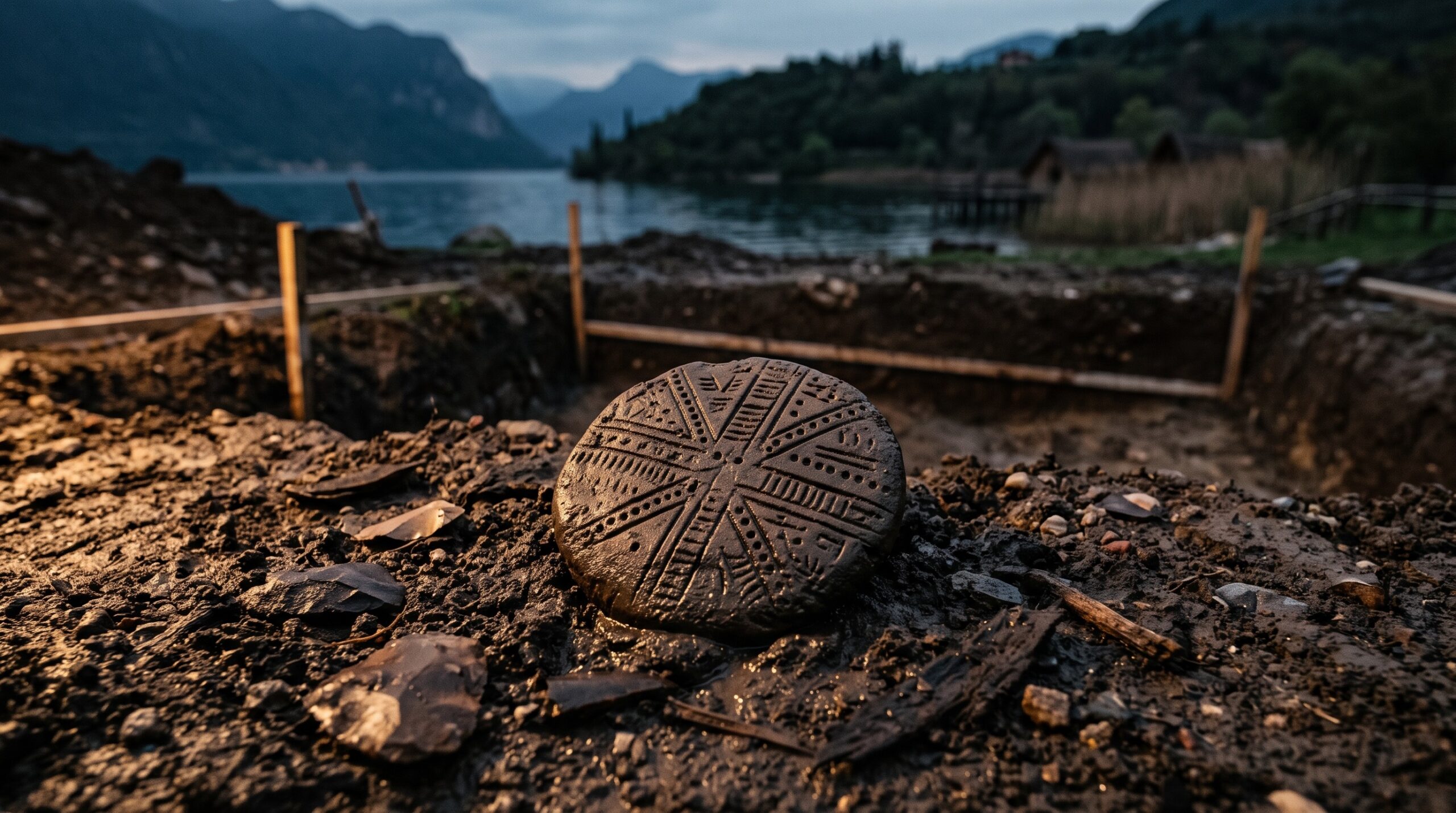
    Archaeologists excavating the prehistoric settlement of Lucone di Polpenazze, near Lake Garda, have uncovered an intact Bronze Age object covered with geometric markings. It belongs to the strange family of artifacts known as enigmatic tablets—rounded clay or stone pieces marked with circles, dots, triangles, squares and lines whose purpose remains unknown.[1]

    The discovery is unusually important because it was found intact. Many examples are fragments, stripped from their original setting and separated from the layers that might explain how they were used. At Lucone, the new find emerged during the third week of the 2026 excavation campaign from a charcoal-rich archaeological layer identified as US 1015. It is the third enigmatic tablet recovered from Lucone’s Site D, and the 21st recorded across the settlement plain.[1]

    That number changes the mystery. One puzzling object can be dismissed as an oddity. Twenty-one objects from one prehistoric landscape begin to look like a system.

    Not a lost book written in an unknown language

    The word “tablet” invites the wrong image. These are not miniature Mesopotamian documents waiting for a translator. No accepted writing system has been identified on the objects, and the markings are not known to represent sentences, names or a conventional alphabet.[1]

    German-language scholarship often calls them Brotlaibidole, or “bread-loaf idols,” because many have a rounded, loaf-like form. Italian researchers use the more neutral phrase tavolette enigmatiche—enigmatic tablets. Both names reveal the central problem: archaeologists can describe their shape and markings, but not their function.

    The geometric signs are not random scratches. Their repeated forms and combinations suggest deliberate manufacture. Yet deliberate does not automatically mean written language. A pattern can record ownership, count goods, identify a group, mark a ritual, map a relationship, or communicate information without being readable as prose.

    That distinction matters. The most tempting version of the story is that Lucone has yielded a Bronze Age code. The evidence supports something more cautious and, in its own way, more unsettling: people were making portable visual objects according to conventions that modern observers can see but no longer understand.

    The site preserves a vanished landscape

    Lucone di Polpenazze once occupied a wetland basin in the hills west of Lake Garda. The settlement is part of the UNESCO World Heritage property known as the Prehistoric Pile Dwellings Around the Alps, a transnational group of 111 prehistoric settlements in six European countries.[2]

    Wet environments are difficult places for ancient communities, but they can become extraordinary archaeological archives. Waterlogged layers may preserve organic materials that would normally disappear—wood, plant remains, food traces and the dark sediments created by repeated occupation. At Lucone, that setting gives the tablets something many isolated artifacts lack: context.

    The location also helps explain why a geometric object from northern Italy may matter beyond one village. Lucone was not sealed off from the wider Bronze Age world. Archaeological work at the settlement has pointed to contacts extending toward Central Europe and the Carpathian Basin, including evidence associated with faience beads and other exchange networks.[1]

    If the tablets were part of communication, their distribution may be a clue to the people moving through those networks. If they were ritual objects, their repeated forms may reveal shared beliefs. If they were tools for tracking goods or obligations, they could represent an economic system that left no surviving written archive.

    In each case, the object becomes more than a mystery from the past. It becomes a possible trace of connection.

    Why the markings are so difficult to interpret

    Ancient writing can sometimes be deciphered because it appears in long texts, bilingual inscriptions or familiar historical settings. Enigmatic tablets offer almost the opposite conditions. They are small, the signs are limited, and the number of examples is still modest. Even when the same motif appears on multiple pieces, researchers cannot be certain whether it carries the same meaning each time.

    A circle might be a symbol, a counter, a decorative element or an impression made by a tool. A repeated group might encode a quantity—or simply reflect a standard design. Without a clear contemporary inscription explaining the system, every interpretation risks becoming a modern projection.

    The strongest research path is therefore comparative rather than sensational. Researchers can catalogue the marks, compare manufacturing techniques, study the clay and examine the archaeological layers where each object was found. Three-dimensional scanning and morphological analysis may show whether tablets from distant regions were made according to shared conventions.[1]

    That work could eventually reveal whether particular motifs cluster by place, period or material. It may show that the signs traveled with commodities, that they belonged to particular communities, or that they changed over time. It may also show that similar-looking marks were produced independently and never formed one unified system.

    The mystery survives either result. A shared code would tell us that Bronze Age communication was more structured than the surviving record suggests. Independent invention would show how easily humans converge on geometric ways of organizing information.

    The “lost civilization” trap

    Objects that cannot be explained are often recruited into stories about vanished super-civilizations, visitors from the sky or knowledge supposedly too advanced for their age. The Lucone tablet does not require any of those explanations. Its genuine strangeness is already visible in the evidence: an ancient community made a carefully marked object, preserved it in a settlement layer, and left no readable explanation for us.

    That does not make the artifact less mysterious. It makes the mystery more precise.

    There is no evidence that the signs describe astronomy, encode a forgotten machine or prove contact with a civilization outside Bronze Age Europe. There is also no justification for pretending the purpose is obvious. The responsible position is the narrow space between those extremes: the markings are intentional, the function is unknown, and the surrounding archaeological context may gradually reduce the possibilities.

    The fact that Lucone has produced 21 examples is the most promising development. A single tablet can generate theories. A large group can be tested. Researchers can ask whether the pieces share dimensions, clay recipes, mark sequences, orientation, wear patterns or placement within buildings. They can search for correlations rather than rely on the emotional force of one unusual object.

    What could happen next

    The new tablet may be examined alongside the other Lucone examples and compared with related finds from the Alpine and Central European regions. If its markings match known combinations, it could strengthen the case for a wider visual tradition. If it is unlike the others, it may point to local experimentation or a different use entirely.

    The most revealing evidence may come from what is not visible on the surface. Microscopic wear could show whether the tablet was handled repeatedly, tied to something, pressed into wet material or stored. Residue analysis could identify contact with pigments, food, metals or organic substances. The layer itself may help establish whether the object was lost, discarded, deposited deliberately or left behind when the settlement changed.

    For now, the Lucone enigmatic tablet is not a translated message from a forgotten empire. It is something quieter and harder to dismiss: a surviving fragment of a communication world that may have made perfect sense to its creators.

    The markings look simple because they are geometric. Their meaning may have depended on everything that once surrounded them—the people who made them, the goods they exchanged, the rituals they remembered and the landscape they inhabited. That surrounding world is gone. The tablet remains, asking a question it cannot answer in words.

    Do you think these objects were a form of writing, a Bronze Age accounting tool, or something ritual that was never meant to be read?

    Sources and Further Reading

    The reporting on the excavation is based on the Lucone tablet report, which includes the excavation context and the current count of known examples. The site’s wider heritage setting is documented by the UNESCO World Heritage Centre.

    For readers interested in other archaeological mysteries, the Unexplained.co archive includes the 3,700-year-old ritual site found beyond a lonely rock, the sunken basilica at Iznik, and the Etruscan well sealed with human remains.

    Sources

    [1] Arkeonews, “Rare 4,000-Year-Old ‘Enigmatic Tablet’ Found Intact at Lucone Bronze Age Village in Italy” — https://arkeonews.net/rare-4000-year-old-enigmatic-tablet-found-intact-at-lucone-bronze-age-village-in-italy/

    [2] UNESCO World Heritage Centre, “Prehistoric Pile Dwellings Around the Alps” — https://whc.unesco.org/en/list/1363/
  • The Etruscan Well Sealed With Human Remains Is Stranger Than a Sacrifice Story

    The Etruscan Well Sealed With Human Remains Is Stranger Than a Sacrifice Story

    The most unsettling detail in the newly reported Etruscan discovery is not that human remains were found underground. It is that the place appears to have been treated like a living presence: opened, fed with offerings, used, and then deliberately closed.

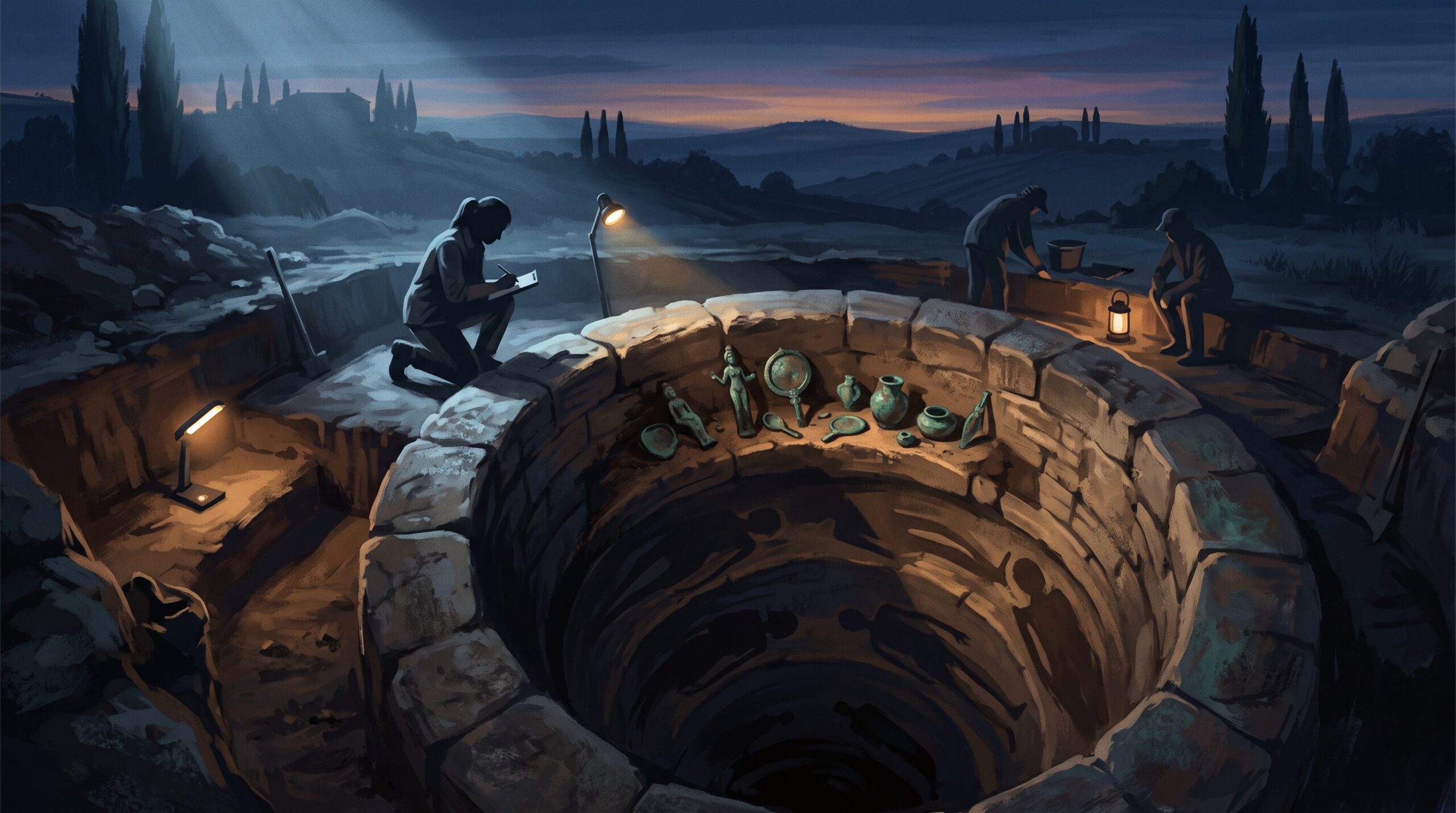
    Archaeologists investigating the ancient Etruscan city of Veii in Italy have reported a ritual well associated with bronze objects, offerings and human bodies. The discovery has already been compressed online into a darker phrase—human sacrifice—but the evidence is more precise, and more mysterious, than that headline suggests. The excavation points to a sacred installation whose final closure mattered deeply to the people who used it.

    The [new report from Live Science](https://www.livescience.com/archaeology/archaeologists-discover-etruscan-well-that-was-ritually-opened-with-offerings-for-a-goddess-and-closed-with-human-bodies) describes the well as part of an ancient cult setting. It does not, by itself, prove that every person found there was deliberately killed as a ritual victim. That distinction is essential. Archaeology can reveal where remains were placed and what surrounded them; it cannot automatically recover the intentions, identities or causes of death behind every deposit.

    A sacred place in the shadow of Rome

    Veii was one of the most important Etruscan cities in central Italy. It stood close enough to Rome to become a long-term rival, and its eventual defeat by Rome in the early fourth century BCE helped reshape the balance of power in the region. Today, the site is often remembered through the Roman story of conquest, but the well offers a glimpse of something older: a religious world with its own rules for communicating with gods, ancestors and the landscape.

    The city’s history matters; another Unexplained.co investigation of an abandoned place shows how location-based mystery can outlive its original story. because the find is not an isolated oddity. Etruscan ritual life often involved thresholds—places where the human world met the divine one. Wells, pits and underground chambers could carry offerings out of sight, toward powers associated with water, fertility, health, protection or the underworld. The [background history of Veii](https://en.wikipedia.org/wiki/Veii) helps explain why a buried installation could be more than a practical water source.

    In this setting, the well’s architecture becomes part of the evidence. A vessel dropped into a pit is one thing. A carefully arranged sequence of offerings followed by a formal closure is another. It suggests that the community was not merely abandoning a hole in the ground. It was ending a relationship with a place.

    What was found—and what remains uncertain

    The reported discovery links the well to bronze artifacts, ritual offerings and human remains. Those elements create a powerful narrative, but they do not all carry the same evidentiary weight.

    The bronze objects may indicate ceremonial activity. Their placement can help archaeologists reconstruct when the well was used and how the deposit was assembled. The human remains establish that people were placed in or around the installation. They do not, without further analysis, establish whether those people were sacrificed, buried after ordinary deaths, connected to the cult, or involved in an event that archaeologists have not yet reconstructed.

    That is where the story’s most important information gain lies. The sensational interpretation asks, “Were humans sacrificed?” The better question is, “What does the sequence of opening, offering and closure tell us about how the Etruscans understood sacred space?”

    A final deposit can be a form of ritual punctuation. Once a sanctuary, spring or well had completed its religious function, closing it may have protected the community from whatever power was believed to remain below. The bodies may have been part of that act, but their precise role must be tested rather than assumed.

    Why “closed with human bodies” is not the same as proof of sacrifice

    Ancient human remains are easily turned into a single dramatic explanation. The word sacrifice feels as though it solves the mystery, but it can conceal several separate questions:

  • Were the individuals alive when they entered the well?
  • Were they killed specifically for the ceremony?
  • Were they already dead and then deposited as part of a funerary or commemorative rite?
  • Were they outsiders, members of the community, or people connected to the cult?
  • Did the closure happen once, or over several phases?
  • Archaeologists can approach those questions through osteological examination, trauma analysis, radiocarbon dating, isotope studies and the spatial relationship between bones and artifacts. Evidence of cut marks, binding, blunt-force trauma or unusual treatment could change the interpretation. So could evidence that the remains represent ordinary burials later incorporated into a ritual closure.

    Until those studies are published, “human sacrifice” should be treated as a possibility—not a settled fact. The less dramatic wording is also the more responsible one: human remains were incorporated into a ritual deposit whose meaning is still being reconstructed.

    The goddess connection

    The discovery has been described as connected to offerings for a goddess. That detail makes the well feel almost animate. A goddess associated with the installation would not necessarily have been imagined as a figure waiting inside it. In ancient Mediterranean religion, divine power could be attached to a place, a spring, an object or a recurring ceremony rather than represented by a single statue.

    This helps explain why closure could matter. If a well was a route into a sacred domain, sealing it may have been a way to end access, contain danger or mark the completion of a vow. Offerings could be gifts, payments, memorials or attempts to restore balance. The same object can carry different meanings depending on when and where it was deposited.

    That ambiguity is not a weakness in the discovery. It is the mystery. The material record preserves the action while withholding the words that would have explained it.

    Veii’s older mystery beneath the Roman story

    Earlier archaeological mysteries covered by Unexplained.co show why buried sites attract competing explanations. The Roman conquest of Veii supplies a familiar ending: a powerful city falls, its territory is absorbed, and later history is written by the victor. But ritual deposits such as this one resist that neat conclusion. They preserve a private and local world that existed before the conquest and may have continued through periods of political change.

    The well may therefore become important for more than the question of human remains. It could help researchers map how Etruscan religious practices changed over time, how rituals were reorganized when communities faced pressure, and whether the final closure belongs to a moment of crisis or to an ordinary religious cycle.

    It also offers a warning about how ancient mysteries are made. Online retellings often remove the uncertainty that makes archaeology valuable. A bronze object becomes a talisman. A burial becomes a sacrifice. A sealed well becomes a portal. Each transformation makes the story more vivid, but each can move it farther from the evidence.

    What happens next

    The next decisive information should come from the remains themselves and from the excavation’s full technical publication. Dating could establish whether the bodies and offerings belong to the same event. Bioarchaeology could reveal age, sex, health and geographic origin. Trauma analysis could test whether violence occurred. The arrangement of the deposit may show whether the closure was carefully planned or accumulated over time.

    Those results may produce a darker story, a more ordinary one, or something stranger than either. They might show a deliberate killing, a funerary act, a mixed deposit or a sequence of rituals that modern categories cannot easily describe.

    For now, the strongest conclusion is also the most haunting: at Veii, people appear to have opened a sacred underground place, placed gifts within it, and eventually sealed it with human remains. We know something happened there. We do not yet know whether the dead were offerings, mourned individuals, victims, guardians of the closure—or several of these things at once.

    That unanswered question is why the well still feels alive in the archaeological record. What do you think the final deposit was meant to accomplish?

    Sources and further reading

    The primary current account used for this article is Live Science report on the Etruscan well. For historical context, see the [reference overview of Veii](https://en.wikipedia.org/wiki/Veii). The article treats the sacrifice interpretation as unproven pending detailed osteological and excavation results.

  • Second Sphinx Under Giza? What the Claim Says, What the Scans Show, and What Remains Unproven

    Second Sphinx Under Giza? What the Claim Says, What the Scans Show, and What Remains Unproven

    The idea of a second Sphinx hidden beneath the Giza Plateau has all the ingredients of a durable modern myth: one of the world’s most famous ancient sites, hints of buried chambers, suggestive scans, and the possibility that something enormous has been sitting just out of sight for centuries. But no confirmed archaeological discovery has shown that a second Sphinx lies beneath Giza. For now, the claim remains an interpretation, not an established find.

    That does not make the subject trivial. Giza is exactly the kind of place where genuine uncertainty and grand imagination have always coexisted. The plateau is ancient, complex, and still capable of surprising researchers. Remote-sensing tools add another layer to that mystery, offering glimpses below the surface without immediately telling us what those glimpses mean. In the space between data and conclusion, speculation thrives.

    For more context on the broader mystery, see Ancient Demon Traps in Mesopotamia? The Bowls Buried Beneath the House and Kola Superdeep ‘Screams From Hell’: The Hoax and the Real Discoveries Beneath the Earth.

    So the real story is not simply whether a second Sphinx exists. It is how the claim arose, what the scans can and cannot show, why the theory keeps returning, and what kind of evidence would be needed before archaeologists could treat it as more than an alluring possibility.

    Why the theory keeps resurfacing

    The theory endures because it feels intuitively plausible. Monumental architecture often leans on symmetry. Sacred landscapes are full of paired features, mirrored alignments, and guardian figures arranged with deliberate balance. Once people see the Great Sphinx as a lone sentinel on one of history’s most symbolically charged plateaus, it is a short imaginative step to ask whether it once had a counterpart.

    Ancient Egyptian architecture gives that instinct some cultural grounding. Pairing, alignment, and ceremonial order mattered deeply in Egyptian design. Processional routes could be lined with sphinxes, and monuments often formed parts of larger symbolic arrangements rather than standing as isolated statements in stone.

    But that is also where the theory’s strongest intuitive appeal outruns the evidence. The fact that paired symbolism existed in ancient Egypt does not show that Giza specifically concealed, or once featured, another Great Sphinx-scale monument. It explains why the idea sounds plausible. It does not prove that the idea is true.

    What people usually mean when they cite “new scans”

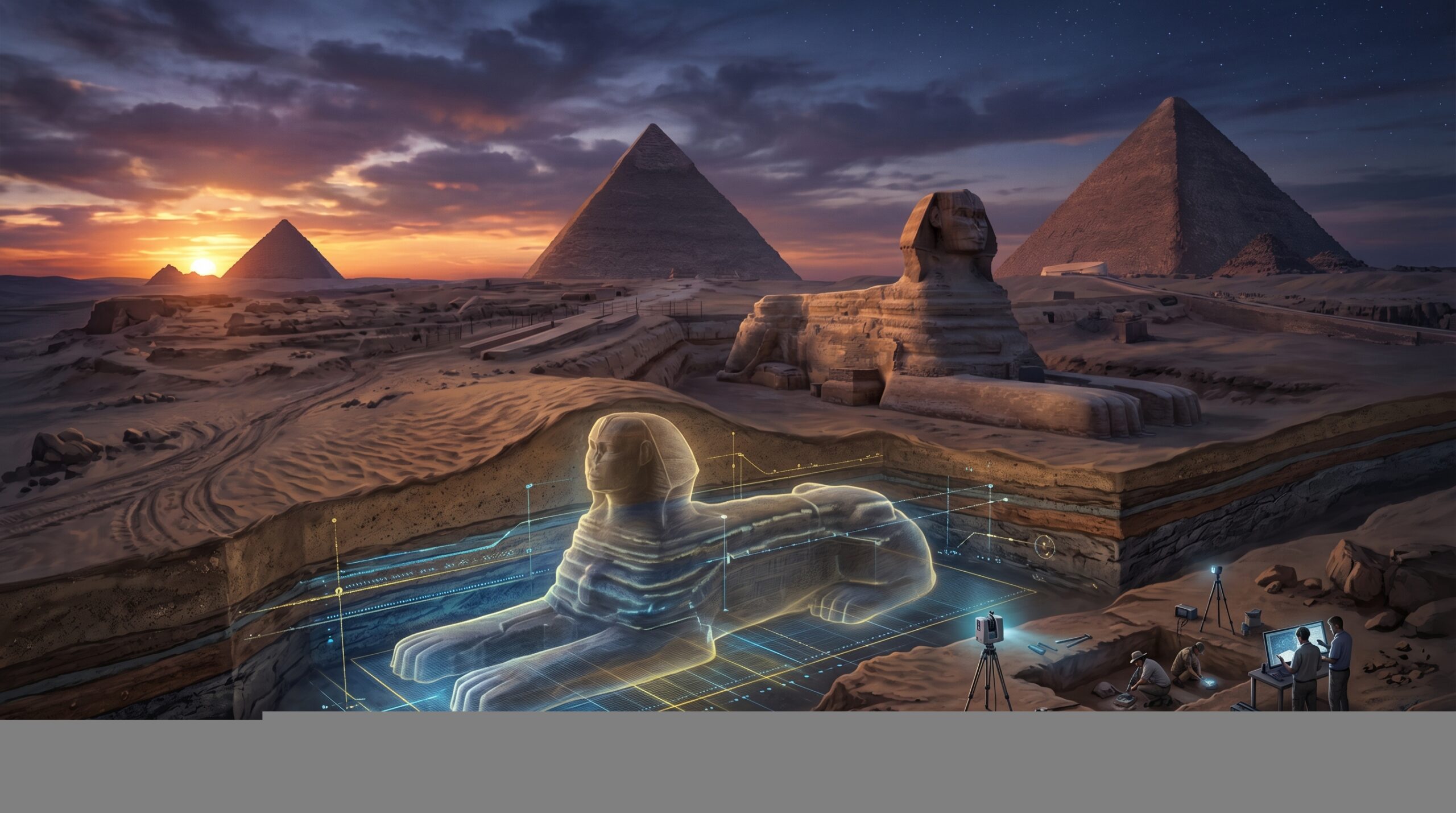
    When headlines or social posts claim that scans have revealed a second Sphinx under Giza, they are almost never describing a clean underground image of a buried statue. More often, they are referring to subsurface anomalies: density shifts, unusual reflections, void-like signatures, geometric-looking shapes, or patterns that some interpreters think appear artificial.

    Those anomalies can be worth attention. Methods such as ground-penetrating radar, seismic analysis, electrical resistivity, and satellite-based remote sensing are useful archaeological tools. They can identify areas that may deserve closer study and sometimes reveal hidden features that would otherwise remain invisible.

    But they are not magical X-rays. These methods do not simply produce a labeled picture of what lies underground. The data must be processed, contextualized, and interpreted. Local geology matters. Bedrock irregularities matter. Depth, calibration, interference, and methodology matter. So do the expectations of the people studying the data.

    That is where the leap often happens. An anomaly becomes a chamber. A chamber becomes a structure. A structure becomes a monument. Before long, a buried Sphinx is being discussed as though the statue itself had already been photographed underground.

    Why Giza attracts theories like this

    Few places invite hidden-structure theories the way Giza does. The reason is obvious the moment the plateau comes into view. The pyramids and the Great Sphinx are not modest ruins. They are among the most famous and most symbolically overloaded monuments on Earth. Their scale alone makes the surrounding landscape feel unfinished in the public imagination, as though more must be waiting below the surface.

    That feeling has been reinforced for generations by a mix of serious investigation, alternative history, esoteric speculation, and popular culture. Giza has been cast again and again as a place of lost chambers, buried records, secret passageways, forgotten sciences, and withheld discoveries. In that atmosphere, even a minor anomaly can acquire a dramatic afterlife.

    A small void becomes a hidden hall. A disputed feature becomes evidence of suppression. A pattern that might have several explanations becomes, in retelling, proof of something extraordinary. Giza’s fame does not create the data, but it strongly shapes how the data is received.

    What archaeologists would need to see

    For mainstream archaeology to treat the buried-second-Sphinx idea as more than speculation, the evidence would need to move well beyond suggestive scans and dramatic interpretation.

    First, the methods would need to be clear and transparent. What instrument was used? At what resolution and depth? How was the data processed? What possible distortions, noise, or geological complications were accounted for?

    Second, the findings would need replication. One intriguing result is not enough for a claim of this scale. Independent teams using comparable or better tools would need to identify the same feature.

    Third, the anomaly would have to be interpreted within the real context of the plateau. Giza is not an untouched blank canvas. It contains cut bedrock, cavities, quarry marks, trenches, restoration work, later interventions, and a long history of excavation and modification. Any unusual signal has to be distinguished from all of that.

    Finally, if permissions and conservation ethics allowed it, some form of targeted physical investigation would usually be needed. Archaeology does not confirm buried monuments through excitement alone. It confirms them through converging evidence.

    Readers who want to compare this story with outside reporting can start with Wikipedia on the Great Sphinx of Giza and Coverage of the recent buried second Sphinx claim.

    Until that happens, the second-Sphinx idea remains an intriguing possibility to some, an overreach to others, and unverified speculation to everyone else.

    Is there historical evidence for a paired Sphinx at Giza?

    This is where the distinction between cultural logic and direct proof matters most. It is true that paired guardians and symmetrical planning existed in Egyptian architecture. It is also true that Giza is a vast ceremonial and funerary landscape shaped by quarrying, redesign, restoration, and layers of later interpretation.

    What is not publicly established is a historical record or archaeological finding showing that a second Great Sphinx-scale monument once stood nearby and was later buried or lost. The theory often borrows force from broader ideas about Egyptian symbolism, or from legends of hidden halls and forgotten structures, but those are not the same thing as evidence for this specific claim.

    Some fringe accounts fold the second-Sphinx theory into much larger stories about lost civilizations or concealed records beneath Giza. Those narratives are culturally influential and undeniably fascinating, but they are not accepted archaeological proof. They tell us more about the modern imagination surrounding Egypt than they do, by themselves, about what lies under the plateau.

    What believers, skeptics, and archaeologists each see

    People drawn to the second-Sphinx theory often argue that Giza is not fully understood, that official institutions can be too cautious or too slow to pursue unconventional leads, and that remote-sensing anomalies deserve more serious attention than they usually receive. Some also believe the plateau is older or more architecturally complex than standard chronologies allow.

    Skeptics answer that the pattern is already familiar. In their view, ambiguous data gets publicized before careful review, symbolic reasoning gets mistaken for measurement, and unresolved questions are recast as evidence of suppression. To them, the second-Sphinx claim looks less like a hidden discovery and more like wonder outrunning proof.

    Professional archaeologists generally occupy a narrower middle ground. They do not need to deny that undiscovered features may exist. Ancient sites often do hold surprises, and noninvasive methods can reveal important structures. But they insist on a basic distinction that is easy to lose online: anomalies are not monuments, interpretations are not discoveries, and possibility is not confirmation.

    It is not the most dramatic position. It is usually the most defensible one.

    Why scan-based stories spread so quickly

    Stories like this travel quickly because they fuse old and new forms of mystery. On one side is ancient Egypt, already surrounded by awe, symbolism, and centuries of speculation. On the other is modern technology, which seems to promise a glimpse beneath the surface without the delay and caution of excavation.

    That combination is powerful. A colorful map, a suspicious shape, and a few scientific terms can create the impression that a breakthrough is already in hand. Once those images begin circulating without full context, interpretation races ahead. People do not need technical expertise to feel that a feature “looks artificial” or that a world-famous site “must be hiding more.”

    Remote sensing is especially vulnerable to this because its outputs are rarely self-explanatory to non-specialists. The mystery lives not just in the underground data, but in the gap between what experts can responsibly say and what the public hopes the images reveal.

    What remains genuinely possible

    It would be a mistake to swing too far in the other direction and insist that nothing of interest lies below Giza. Ancient landscapes of this scale often contain features that are still unexplored, misunderstood, or only partly documented. New tools really can reveal voids, shafts, walls, quarry zones, and other buried elements worth further study.

    So the careful position is not that there is nothing there. It is that there is no confirmed evidence, at least publicly available, that what lies there is a second Sphinx.

    The underground features hinted at in scans could be geological. They could be man-made but unrelated to any sphinx. They could reflect construction activity, quarrying, drainage, later reuse, or other aspects of the plateau’s long history. They could also, in some cases, point toward genuinely surprising discoveries. What they do not currently amount to is a verified buried twin to the Great Sphinx.

    The real fascination is the uncertainty

    A confirmed second Sphinx would be one of the most extraordinary archaeological discoveries of the century. That possibility alone helps keep the theory alive. But the scale of the hypothetical discovery should not be confused with the strength of the present evidence.

    Right now, the evidence points to ambiguity: intriguing anomalies, contested interpretations, and a public eager for a dramatic revelation at one of history’s most myth-laden sites. That may be less sensational than the legend, but it is still a compelling story. It is a story about how wonder gathers around famous places, how new tools can sharpen mystery as much as they resolve it, and how difficult it is to separate possibility from proof when the setting itself seems built to invite both.

    If you want to keep going, Heaven’s Gate Website Still Online? The 1997 Cult Site That Never Went Away expands the picture from another angle.

    For now, that is where the matter stands. The second Sphinx under Giza remains an intriguing theory, a recurring rumor, and an unresolved question—not a confirmed discovery.