# The Lonely Rock That Led Archaeologists to a 3,700-Year-Old Ritual Site
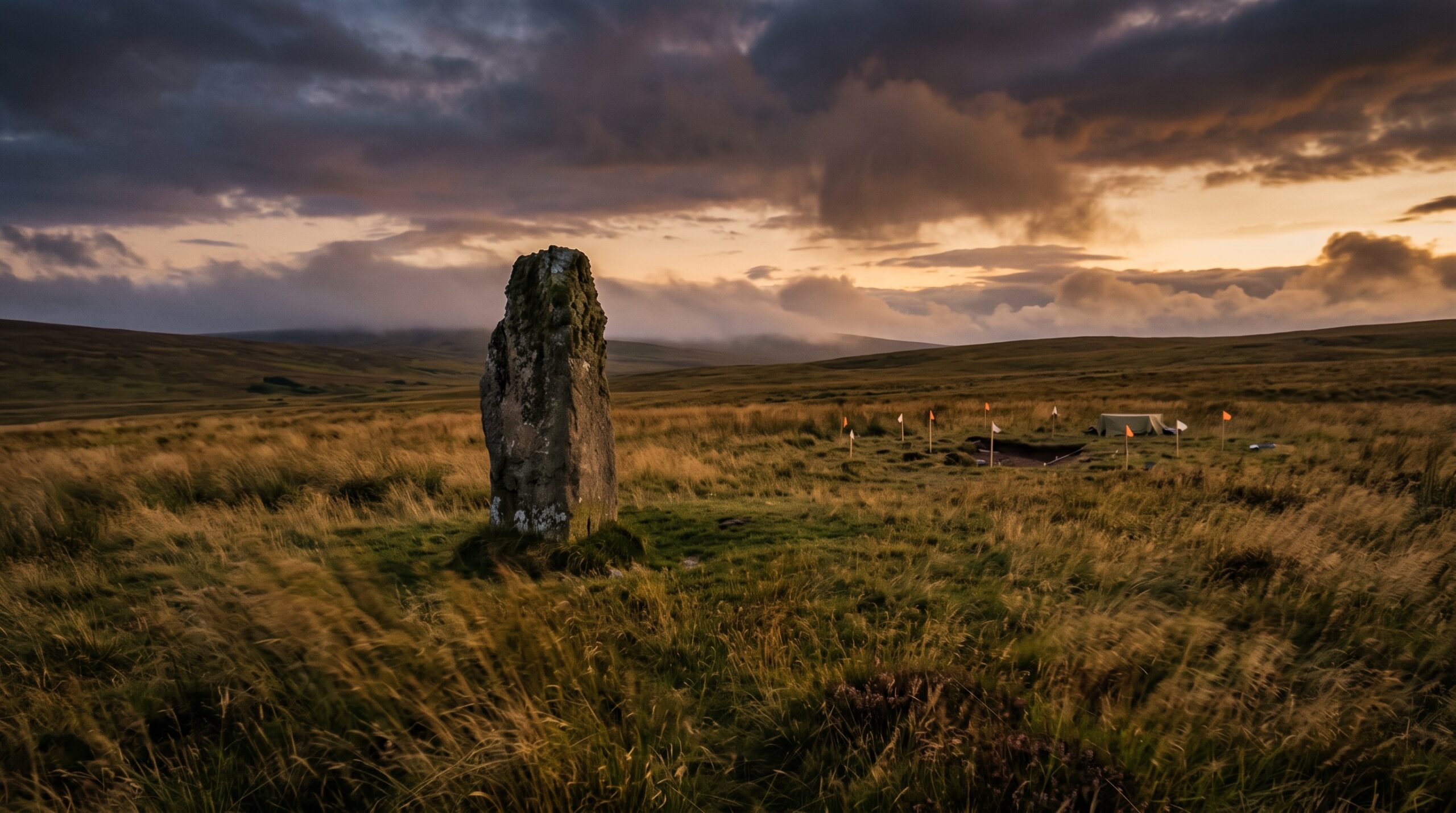
The clue looked almost insultingly ordinary: one lonely rock sitting where no lone rock should have been. But when a student stopped to look more closely, the stone became the first visible thread in a buried landscape—one that archaeologists now date to roughly 3,700 years ago.
The discovery matters because it is not simply a story about an old object. It is a reminder that ancient ritual places were often designed to disappear into the terrain. The site’s meaning is not written in a surviving inscription. It has to be reconstructed from position, material, and the strange persistence of a single stone.
## What the discovery reveals
According to the report in Popular Mechanics, the student’s observation prompted archaeologists to investigate the surrounding area. Their work identified evidence of a Bronze Age ritual site, dating to a period when communities across Britain and Europe were building, reusing, and reinterpreting ceremonial landscapes.
That sequence is the first important insight: the site was not found because a spectacular monument was sticking out of the ground. It was found because an apparently unremarkable feature did not fit its surroundings. Archaeology often advances through such mismatches—the detail that looks wrong until someone asks why it is there.
A second insight is that “ritual site” does not necessarily mean a temple in the modern sense. Prehistoric ceremonial places could include settings for burial, seasonal gatherings, processions, offerings, feasting, or acts whose significance is now lost. The label describes a pattern of evidence, not a surviving explanation for every action performed there.
## Why one rock could matter so much
A lone stone can be a remnant, a boundary marker, a deliberately placed object, or the surviving part of a structure whose other elements have vanished. Its importance comes from context. In a landscape repeatedly reshaped by farming, construction, erosion, and modern roads, the stone may preserve a relationship that is no longer obvious at ground level.
This is why archaeologists compare a new find with the wider history of prehistoric monuments rather than treating it as an isolated curiosity. Historic England’s research on prehistoric monuments shows how much interpretation depends on landscape relationships, preservation, and the difference between what survives physically and what once mattered socially.
The discovery also complicates the popular image of ancient people building only enormous, unmistakable monuments. Some ritual activity may have depended on controlled access, repeated memory, or subtle markers known to local communities. A place could be important without looking dramatic to an outsider thousands of years later.
## Confirmed, suggested, and still unknown
What is strongest here is the physical discovery and its archaeological dating. The existence of a prehistoric ritual context is an evidence-based conclusion reported from the investigation. What remains less certain is the exact ceremony, belief, or community story connected to it.
There is no responsible reason to turn the site into proof of lost technology, visitors from elsewhere, or a civilization more advanced than the evidence allows. But uncertainty does not make the discovery less mysterious. It makes the mystery more precise. We know a place was used in a particular period; we know a surviving feature helped reveal it; we do not know what participants believed they were doing there.
That gap is where the human story becomes most haunting. A monument can survive while its instructions disappear. The stone remains, but the agreement that gave it meaning is gone.
## The larger mystery is the landscape itself
The most useful way to understand the find is as a connection between attention and deep time. A student noticed something that routine movement through a landscape might have ignored. Archaeologists then read the surrounding ground as a record rather than scenery.
That method offers a broader lesson for unexplained history: the past is not always hidden behind a dramatic revelation. Sometimes it is hiding in plain sight, compressed into a feature that seems too small to matter. The information gain is not merely that a new ancient site exists. It is that the site shows how fragile our assumptions about “empty” landscapes can be.
Further excavation, dating, and comparison with nearby sites may clarify whether the location belonged to a larger ceremonial network. Until then, the lonely rock is both evidence and question—an object that points toward a vanished ritual without telling us what the ritual meant.
If you encountered a stone that seemed completely out of place, would you assume it was natural—or stop to ask who might have put it there, and why?