The officer drew his weapon. That is the part nobody forgets.
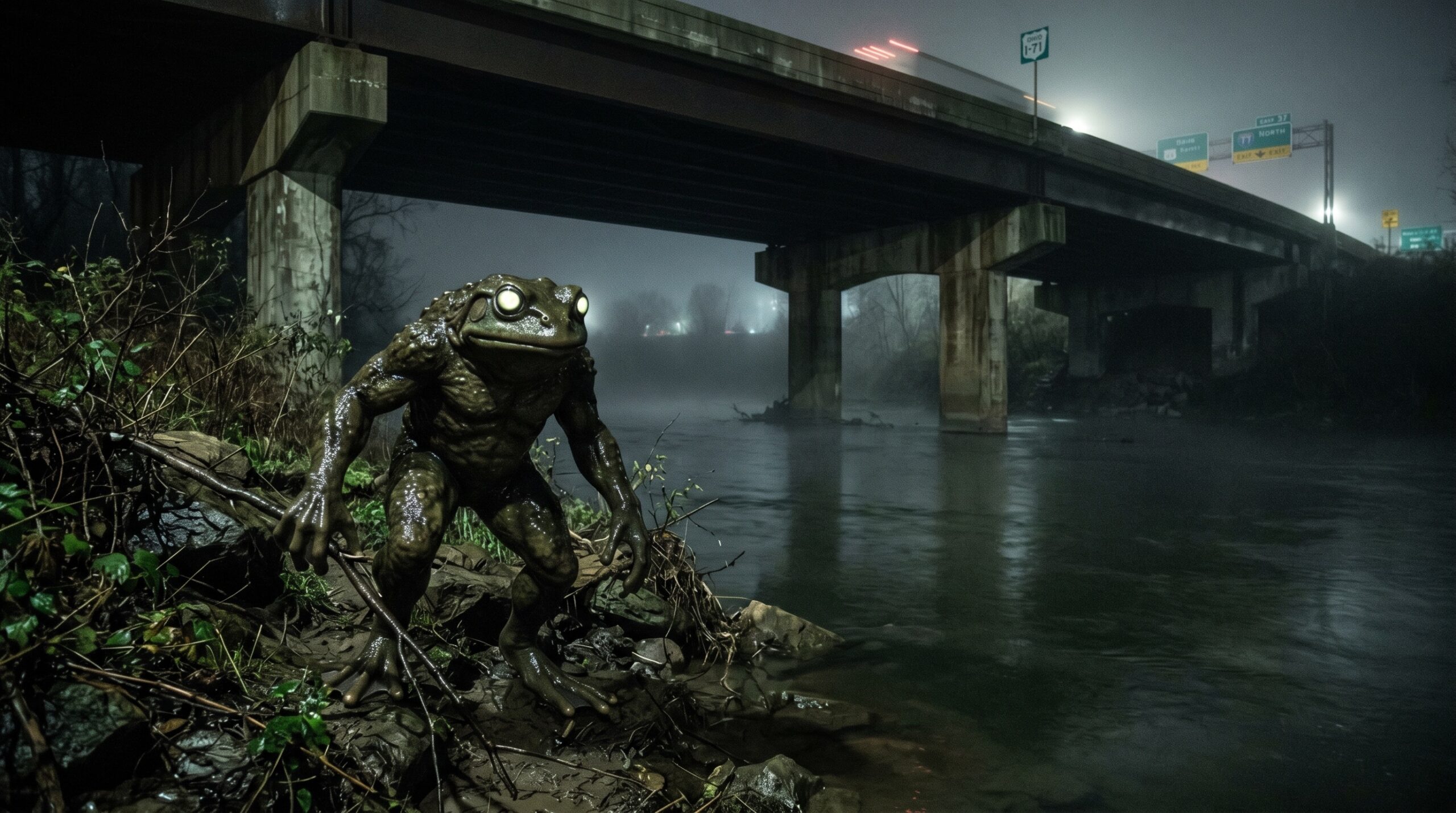
In March 1972, a Loveland police officer named Ray Shockey was patrolling the banks of the Little Miami River at 1:00 a.m. when he encountered something that had no business existing in the tax records of Clermont County. The creature was approximately four feet tall, bipedal, with leathery skin and a face that Shockey later described as “frog-like.” It was not aggressive. It was not obviously frightened. It simply stood in the headlight glow, holding what appeared to be a metal wand, and then climbed over the guardrail and vanished into the river darkness. Shockey did not fire. He sat in his cruiser for ten minutes before radioing dispatch. The incident report, which survives in scanned PDFs circulated by Ohio paranormal researchers, uses the word “animal” three times and the word “unknown” seven.
Fifty-three years later, the Loveland Frogman has achieved something few cryptids manage: formal recognition by the Ohio General Assembly. House Bill 471, introduced in April 2026 by Representative Jamie Callender, proposes designating the Frogman as Ohio’s official “cryptid ambassador” and allocating $250,000 annually for “cryptid ecology research and tourism infrastructure” in the Little Miami watershed. The bill is not expected to pass. It has already succeeded in forcing the creature back into national headlines, and in doing so, has reopened one of the most thoroughly documented—and most inexplicable—cryptid cases in American history.
The 1955 Origins
The modern Frogman legend begins not with Shockey, but with a business traveler named Robert Hunnicutt. In May 1955, Hunnicutt claimed he saw three bipedal frog-like creatures conversing beside the road near Branch Hill. According to his account, the creatures were two to three feet tall, had wrinkled skin, and displayed webbed hands and feet. One held a wand that emitted sparks. Hunnicutt, a sober salesman with no prior interest in the paranormal, reported the sighting to local police and stuck to his story until his death in 1988.
The 1955 report was largely forgotten until Shockey’s 1972 encounter catalyzed a second wave of sightings. In the same month as Shockey’s report, another officer, Mark Matthews, claimed to see a similar creature—this time wounded, with what appeared to be a laceration on its back. Matthews fired his weapon. The creature escaped. A subsequent search found no blood, no body, and no explanation.
Matthews later recanted, suggesting he had shot a large monitor lizard that had lost its tail. Cryptozoologists point out that monitor lizards are not native to Ohio, do not stand upright, and do not hold wands. The recantation, they argue, bears the hallmarks of institutional pressure rather than honest correction. Small-town police departments in the 1970s were not eager to become national laughingstocks, and officers who maintained extraordinary claims often found their careers quietly derailed. Smithsonian Magazine profiled the case in 2014 and concluded that the evidence, while inconclusive, had never been fully explained.
The Decades Between
From 1972 to the present, the Little Miami River corridor has produced dozens of additional reports. Most describe the same core figure: a bipedal amphibian between three and five feet tall, observed near water at night, often associated with unexplained electrical interference. One 1985 report from a fisherman described the creature emitting a low-frequency hum that caused his boat’s depth finder to malfunction. A 2016 trail-camera photograph, debated fiercely online, shows a hunched figure at the water’s edge that experts have been unable to conclusively identify as either human or known animal.
The sightings share characteristics with other global cryptid traditions. The Japanese kappa, a water-dwelling humanoid with reptilian features, occupies a similar ecological niche in folklore. The South African tikoloshe, though typically more malevolent, shares the amphibious habitat and nocturnal behavior pattern. Whether these parallels represent convergent cultural evolution or something more literal remains one of cryptozoology’s persistent questions.
What distinguishes the Loveland case is the documentation. Unlike most cryptid reports, which rely on single-witness testimony, the Frogman has produced multiple independent law enforcement sightings, physical evidence in the form of the 2016 photograph, and now legislative acknowledgment. The creature has survived decades of mockery without being conclusively debunked.
The 2026 Bill
Representative Callender’s bill is framed as economic development. The Little Miami watershed draws hikers and kayakers, but lacks the destination tourism infrastructure of more famous cryptid regions like Point Pleasant, West Virginia. Callender argues that formalizing the Frogman’s status would generate revenue, preserve green space, and celebrate Ohio folklore. The $250,000 allocation would fund trail maintenance, night-vision camera networks, and an annual “Frogman Festival.”
Critics call the bill a publicity stunt. They note that Callender’s district includes Loveland and that the representative faces a competitive primary. The bill’s text, however, contains language that surprises even its detractors. Section 4 requires the Ohio Department of Natural Resources to “investigate and catalog all credible sightings of amphibious humanoids within the Little Miami watershed” and to publish annual reports. For the first time, a state agency would be formally tasked with cryptid research.
The bill has attracted national attention. Cryptozoology organizations have submitted letters of support. Skeptical scientists have testified that public funds should not be spent chasing legends. The debate has become a proxy for larger questions about what states owe to local heritage, what qualifies as legitimate research, and whether the category of “credible sighting” can ever be meaningfully defined.
Scientific and Folkloric Context
Biologists who have examined the Frogman descriptions note similarities to known animals. The Ohio River valley hosts large populations of bullfrogs and snapping turtles. Standing water can produce optical illusions, particularly at night when headlights or flashlights reflect off ripples. Mass hallucination, while statistically rare, has been documented in communities primed by shared narrative expectation.
However, the law enforcement sightings resist easy dismissal. Both Shockey and Matthews were trained observers. Both filed formal reports at personal professional risk. Neither profited from their claims. Shockey, in a rare 1995 interview, expressed frustration that his encounter had defined his career: “I saw what I saw. I don’t know what it was. But I know it wasn’t a man in a suit, and it wasn’t a lizard.”
Folklorists offer a different lens. The Frogman functions as a boundary guardian in local narrative—a creature that patrols the liminal space between developed land and wild river, between human order and natural chaos. Its repeated association with wands and electrical interference suggests a figure drawn from older fairy traditions, updated for an industrial landscape of power lines and patrol cars. Whether the Frogman exists as a biological entity or as a living story, it clearly performs a function: it makes the river strange again, preserving mystery in a landscape increasingly mapped and managed.
What Remains Unexplained
The 2016 trail-camera image, analyzed by photographic experts at Ohio University, shows a figure with proportions inconsistent with both humans and known local wildlife. The image’s metadata confirms it was captured by a Reconyx camera triggered by heat and motion, not by a human operator. The figure’s posture—leaning forward on elongated hind limbs—matches no recognized animal gait.
Skeptics have proposed that the image shows a person in a wetsuit retrieving fishing equipment. The temperature data from the camera, however, indicates the figure’s heat signature was significantly lower than human baseline, suggesting either cold-blooded physiology or ambient temperature matching. The image alone does not prove the Frogman exists. It proves that something triggered a research-grade camera in the exact location where police officers reported amphibious humanoids four decades earlier.
The bill will likely die in committee. The sightings will likely continue. And somewhere in the reeds along the Little Miami River, whatever patrols those banks will remain undisturbed by legislative proceedings, continuing a watch that predates Ohio’s statehood and will likely outlast its infrastructure. The officer drew his weapon. The creature did not flinch. That balance of fear and strangeness, frozen in a 1972 police report, is what keeps the story alive.