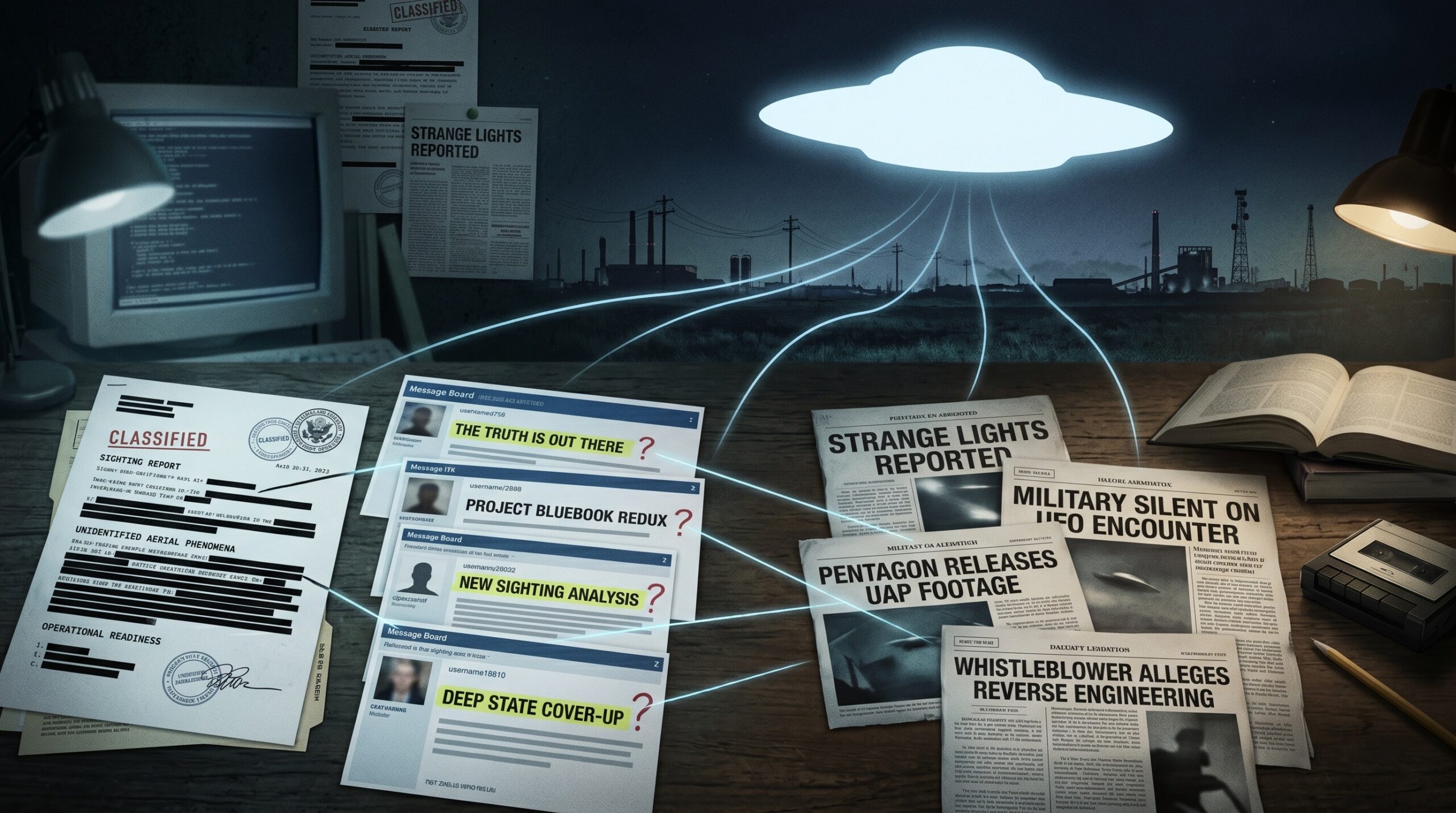
What if Jeremy Corbell is not teasing a documentary so much as opening a pressure valve? That is the feeling now spreading through UFO circles after the new Sleeping Dog trailer framed the film around an extraordinary claim: Corbell says he held a secret for 11 years, and in the trailer’s most electric line, he warns that if he dies, the story comes out. In disclosure culture, that does not land like ordinary promotion. It lands like a coded admission that something has been sitting in the dark for far too long, waiting for the right moment — or the wrong one.
That is why the trailer hit so differently. A filmmaker announcing a mysterious project is one thing. Jeremy Corbell attaching time, danger, and personal risk to it is something else entirely. The promise of an 11-year secret instantly gives the story scale. The death line gives it consequence. Put those together and Sleeping Dog stops feeling like just another entry in the modern UFO-content machine. It starts to feel like a sealed file being rattled in public.
The online response makes that clear. A new r/UFOs discussion about the Sleeping Dog trailer quickly picked up roughly 250 score and around 200 comments, exactly the kind of fast reaction that shows a piece of media has touched the live wire of believer attention. Add in Brave search results surfacing Hollywood Reporter release coverage, the official trailer, and the movie’s official site, and the story suddenly has three layers at once: mainstream visibility, direct promotional framing, and a highly activated audience already convinced that the most important UFO stories are usually the ones delayed the longest.
Why the Sleeping Dog trailer feels more like a threat transmission than a promo
Plenty of trailers promise revelations. Very few tell viewers, in so many words, that the story is tied to mortality.
That is the line that changed the temperature around Sleeping Dog. “If I die, the story comes out” is not subtle language. It invites the audience to hear contingency planning, danger, suppression, leverage, and timing all at once. In a normal entertainment story, that would read as high drama. In a UFO story, it reads like a flare sent up from inside the secrecy machine.
Believers are especially sensitive to that kind of language because modern disclosure culture is built on a long backlog of almost-reveals. There is always a source who cannot speak fully yet. Always a document that cannot be shown. Always a witness who waited years. Always a story that supposedly had to be handled carefully because the stakes were bigger than the public understands. So when Corbell says he held something for 11 years and then frames its release around the possibility of his own death, the audience hears a very specific message: this is not being sold as content. It is being sold as protected truth.
That distinction matters. The trailer does not need to show everything to produce the reaction it is getting. In some ways, it is stronger because it does not. The less it explains, the more the line about secrecy expands in the viewer’s head. Was the delay about safety? About a source? About evidence too sensitive to release before now? About a story that needed to survive its own gatekeepers? The trailer leaves those questions hanging, and that hanging tension is exactly what gives it force.
Jeremy Corbell knows which nerve he is touching
No one arrives at this moment empty-handed. Jeremy Corbell already occupies a very specific place in UFO media culture: part documentarian, part messenger, part lightning rod. He is one of the few figures in the space whose work is not consumed passively. People watch him while actively deciding whether they are witnessing controlled disclosure, strategic storytelling, genuine revelation, or some unstable blend of all three.
That makes him unusually potent as a narrator for a film like Sleeping Dog. When Corbell speaks in the register of delayed truth, his audience is primed to treat it as more than atmosphere. He has spent years operating at the edge where media presentation and disclosure expectation blur together. For supporters, that means he has proximity to stories bigger than what can be safely said in one shot. For critics, it means he knows exactly how to stage anticipation. Either way, he understands the psychology of the audience better than most people in the space.
And the psychology is simple: believers do not just want new information. They want the feeling that the wall itself is cracking.
That is why the Sleeping Dog trailer hits so hard. Corbell is not merely offering a mystery. He is offering a timeline. Eleven years. That number gives weight to the silence. It implies curation, protection, burden, and intent. It says this was not a passing rumor or a fresh tip that happened to become a film. It was something carried, guarded, and withheld long enough to gather myth before release.
A good UFO trailer creates curiosity. This one creates inheritance. It tells viewers they may be about to receive something Corbell believes he was not always free to give.
Why the 11-year secret is the real engine of the story
If the death line is the spark, the 11-year secret is the fuel.
In UFO culture, time transforms a claim. A secret kept for 11 years is immediately more magnetic than a secret discovered last month because it suggests a different order of seriousness. It implies that the information survived changing news cycles, changing platforms, changing disclosure waves, and still did not come out. Believers hear that and think: then whatever this is, it was not trivial.
Eleven years also invites a whole architecture of speculation without the trailer having to spell any of it out. People begin filling in the blanks almost automatically. Maybe the story involved someone vulnerable. Maybe evidence needed protection. Maybe there were legal fears, source issues, reputational risks, or concerns about what would happen once the claim entered the public bloodstream. Maybe the timing had to align with a larger disclosure moment. Maybe this was one of those stories that could only emerge after years of pressure had softened the ground.
That is the genius of the framing. A long-buried secret creates its own gravity. The audience starts assuming weight because otherwise why keep it buried at all?
And for believers, buried stories often matter more than public ones. Public stories can be managed, reframed, diluted, and filed away. Buried stories feel rawer. They feel closer to the place where the real conflict happened. They carry the aura of something that was not meant to surface cleanly. In that sense, Sleeping Dog is already operating in a sweet spot for UFO audiences: not yet fully known, already emotionally oversized.
You can feel how quickly that logic expands. If Corbell truly sat on this for 11 years, then readers and viewers begin to treat the missing decade as part of the evidence. The silence itself becomes meaningful. The delay becomes narrative substance. The wait starts to look less like absence and more like proof that the material carried risk.
The line about death is what turned curiosity into obsession
There are teaser lines, and then there are lines that instantly colonize the entire conversation.
“If I die, the story comes out” is the latter.
That sentence does almost all the work. It suggests a dead-man-switch logic without needing to explain one. It frames the unreleased story as something with consequences attached. It raises the possibility that the information is not merely sensitive, but sensitive enough to require a contingency plan. Even readers who know better than to race too far ahead can feel why that kind of statement detonates in disclosure culture. It is tailor-made for a community already steeped in ideas about hidden archives, suppressed testimony, strategic leaks, and truths that surface only when someone believes they might not stay safe.
It also gives the trailer a strange moral pressure. Once that line is in the air, the audience is no longer just waiting for a movie. They are waiting to see whether Corbell is signaling fear, dramatizing the burden of the story, or deliberately placing the material in a frame that makes it impossible to ignore. The trailer does not have to answer which one. The ambiguity is the engine.
This is why UFO audiences are so difficult to cool down once a story takes this shape. A normal trailer creates anticipation for content that may or may not satisfy. A trailer like Sleeping Dog creates anticipation for disclosure as an event. It turns the eventual release into a test. If the film is as dangerous and buried as the language suggests, then believers expect something with genuine weight at the center of it. If it is not, the framing itself becomes part of the story.
Until then, the death line keeps doing what strong UFO rhetoric always does: it multiplies the scale of the unseen.
Why Reddit and the wider UFO web moved on this so fast
The quickest way to tell whether a trailer has crossed out of entertainment and into UFO-event territory is to watch what happens in the first wave of discussion. In this case, the reaction was immediate.
The r/UFOs post about the new Sleeping Dog trailer drew roughly 250 score and around 200 comments, which is enough to show that this was not passing background noise. People were not reacting to a generic documentary announcement. They were reacting to the combination of Corbell’s name, the 11-year-secret claim, and that death-linked line. Those elements gave the thread exactly what disclosure communities feed on: a concrete artifact, a provocative statement, and a huge amount of empty space for theory to rush into.
The wider search ecosystem helped too. Brave results surfacing Hollywood Reporter release coverage gave the story a layer of mainstream-adjacent validation, while the official trailer and the movie’s site kept the central framing close at hand. That combination matters because it allows believers to feel that the story is both escaping into the wider culture and still rooted in the source material. It is not only rumor. It is not only press. It is both at once.
And that is the modern UFO sweet spot.
A story becomes sticky when it has just enough public visibility to feel real and just enough mystery to stay unstable. If the trailer had been ignored outside disclosure circles, it might have remained niche. If it had overexplained itself, it might have flattened the speculation. Instead, Sleeping Dog arrived in the perfect shape for 2026 UFO culture: a mainstream-recognizable name, an official package, a handful of explosive phrases, and no clean answer to the question everybody immediately asks — what exactly has Corbell been holding for 11 years?
That is how one line turns into a rabbit hole. Reddit provides the surge. Search results provide the legitimacy cues. The official materials provide the phrases people repeat back to each other. Soon the trailer is no longer just being watched. It is being decoded.
What believers think Sleeping Dog could be hiding
The trailer does not need to specify the whole story for people to start building one around it.
Right now, the believer imagination is doing what it always does when a UFO project is framed around long-term secrecy: widening the possibility space as far as it can go without snapping. Maybe Sleeping Dog centers on a witness who waited years to speak. Maybe it involves evidence Corbell believed needed protection before release. Maybe the secret is not a single object or claim at all, but a testimony, archive, or chain of information that only makes sense once assembled in full. Maybe the reason it sat for 11 years is precisely because releasing it too early would have destroyed the story before it could stand on its own.
The key point is not that any of those scenarios have been established. They have not. The key point is that the trailer has been built to activate exactly those expectations.
And for believers, that activation is not irrational. It comes from years of stories that arrive fragmented, years late, and surrounded by warnings. UFO culture has trained its audience to believe the most meaningful material rarely appears in a neat institutional package. It leaks through personalities, films, conversations, private archives, and moments when someone decides the burden of holding a secret has become heavier than the danger of releasing it.
That is why Sleeping Dog feels larger than a movie before most people know what is inside it. It is tapping into a familiar belief that the archive is real, the delay is part of the evidence, and the people closest to the story are often speaking in partial code long before the full thing lands.
You can hear the same emotional pattern in other disclosure-era obsessions: hidden programs, withheld footage, resurfaced legacy clips, stories protected until some unnamed threshold is crossed. The language changes. The architecture stays the same. Something was known. Something was held back. Something is now being released under pressure.
What the trailer actually establishes — and what it still does not
For all the electricity around Sleeping Dog, the grounded picture is still fairly narrow. The trailer clearly establishes Jeremy Corbell’s framing of the project: he says the story involved an 11-year secret, and he uses unusually high-stakes language to suggest that if he dies, the story comes out. It is also clear that this framing landed fast with the intended audience, with Reddit traction and broader search visibility signaling immediate interest.
What the trailer does not establish on its own is the underlying strength of the claim, the full nature of the secret, or the evidentiary weight of whatever the film ultimately presents. A provocative trailer can signal genuine gravity, careful storytelling, or aggressive marketing. Right now, the public record reflected in the available signals tells us the framing is powerful and the response is real. It does not yet tell us whether Sleeping Dog contains the kind of material believers are already imagining at the center of it.
That unresolved gap is exactly why the trailer is working. It gives UFO audiences a phrase they cannot stop repeating, a timeline they cannot stop interrogating, and a promise that sounds too dangerous to be ordinary. Whether Sleeping Dog becomes a genuine disclosure landmark or simply the latest example of how expertly a mystery can be staged, the trailer has already done one important thing: it reminded believers how little it takes to make the hidden world feel close again.