Tag: dna

  • Hidden in Every Human Genome: Two ‘Ghost’ Ancestors Science Has Never Found

    Hidden in Every Human Genome: Two ‘Ghost’ Ancestors Science Has Never Found

    # Hidden in Every Human Genome: Two ‘Ghost’ Ancestors Science Has Never Found

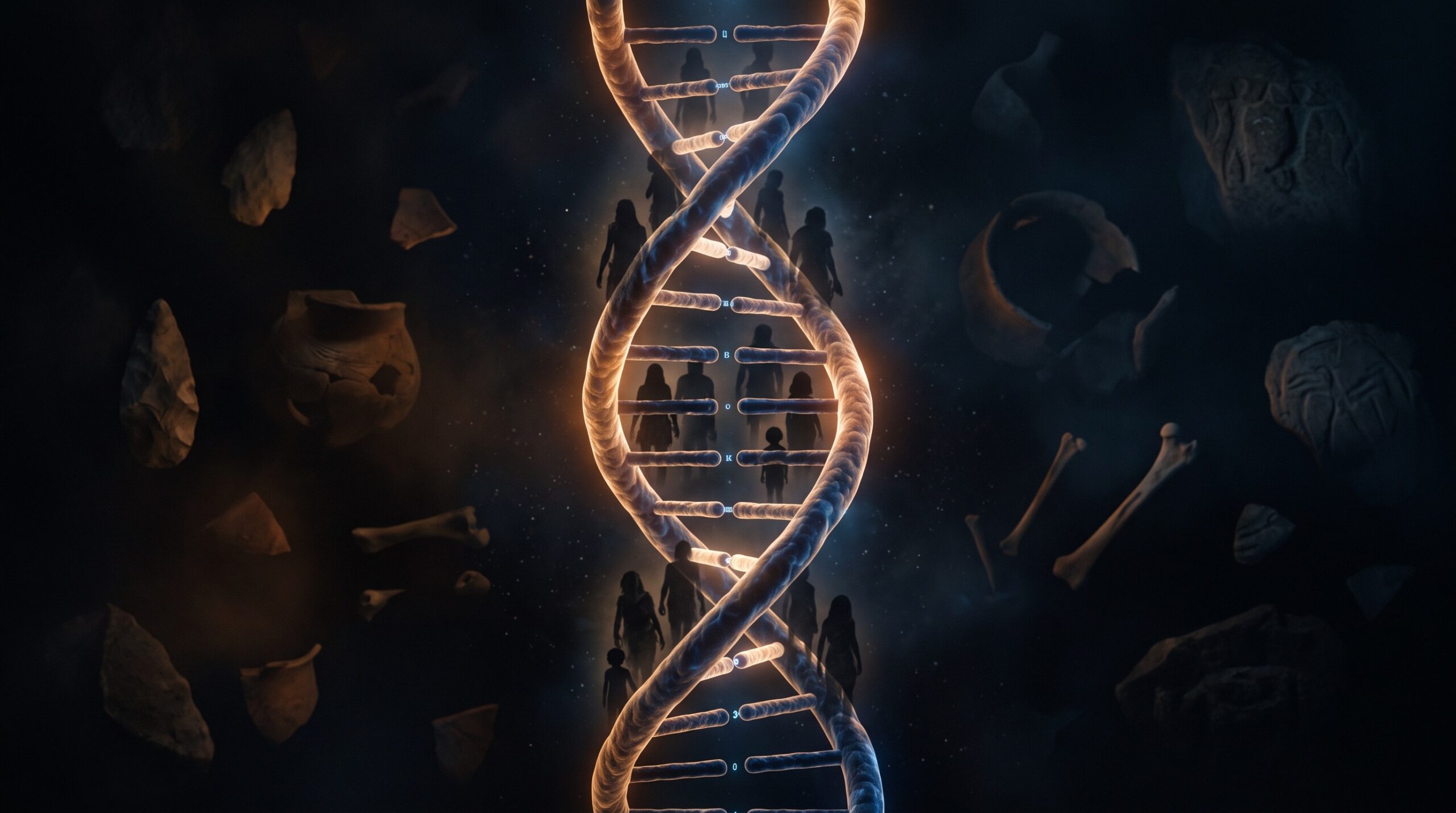
    You have never seen a photograph of them. No museum displays their bones, and no textbook names them. Yet according to a study published in Science at the end of July 2026, DNA from at least one—and likely two—unknown human relatives is living quietly inside the genome of every person reading this sentence.

    The ancestors are not Neanderthals. They are not Denisovans. They are not any species for which a fossil has been found and sequenced. For the researchers behind the new work, that is precisely what makes them worth naming: “ghost lineages,” populations whose existence can be inferred from mathematics and living genomes, but whose physical remains have never been recovered—an approach that stands in notable contrast to what scientists have learned by sequencing Neanderthal DNA directly from recovered bones.

    The finding lands at a moment when human evolution has stopped looking like a straight line and has become more like an overgrown family album. Interbreeding with Neanderthals, Denisovans, and now unidentified populations was not a footnote. It was, the evidence increasingly suggests, a central part of becoming human.

    ## A tool that does not need bones

    The difficulty of finding ghost ancestors has always been practical. High-quality ancient DNA degrades in hot environments. Africa, where some of the most important archaic populations almost certainly lived, has yielded only a handful of usable sequences older than a few thousand years. Archaeologists cannot sequence a fossil they do not have.

    The new technique, developed by a team centered at the University of California, Berkeley, sidesteps the problem entirely. Called TRACE—short for Tracking Archaic Contributions via ARG Estimation—it works by reconstructing “ancestral recombination graphs,” enormous tree-like structures that map how pieces of DNA have been inherited over hundreds of thousands of years.

    When deeply divergent populations interbreed, the event leaves a distinctive signature: unusually long genetic branches and patterns that persist for far longer than would be expected in a single, isolated group. The Debrief’s report on the study explains that TRACE searches for exactly those signatures, and it does so without needing a reference genome from a known archaic population. If a ghost left its mark, TRACE can in principle detect it.

    The team first tested the approach on simulated populations, where they knew the true history, and found it achieved high accuracy with very low false-positive rates. Then they applied it to data from the 1000 Genomes Project, which spans hundreds of individuals from populations across Africa, Europe, Asia, and beyond.

    TRACE successfully recovered the well-established signals of Neanderthal ancestry in Europeans and Asians, and Denisovan ancestry predominantly in Asian and Oceanian groups. That was expected. What it found next was not.

    ## Ghost ancestry in every population tested

    The program identified segments of DNA that matched neither Neanderthals nor Denisovans, appearing in roughly 0.5 to 1.1 percent of the genome across every modern population the researchers examined. The signal was not confined to Africans, as some earlier hypotheses had predicted. It appeared at remarkably similar levels in both Africans and non-Africans.

    That distribution matters. It suggests the interbreeding event happened before the great out-of-Africa dispersal roughly 50,000 to 70,000 years ago, meaning the ghost lineage contributed DNA to the common ancestors of all living humans.

    The Live Science report notes that the ghost population diverged from our lineage approximately 830,000 years ago—deep in the Middle Pleistocene, a period from which the human fossil record in Africa remains frustratingly incomplete. The identity of this population is unknown, but candidates include African populations of Homo heidelbergensis or other Middle Pleistocene groups that the ancestors of modern humans encountered before leaving the continent.

    Perhaps most provocative is where the ghost DNA persists. Some of it sits inside genomic regions long described as “Neanderthal and Denisovan ancestry deserts”—stretches of the modern genome that appeared to contain unusually little archaic material. Scientists had interpreted those deserts as evidence that natural selection actively removed archaic variants because the modern human versions offered some advantage.

    The TRACE results complicate that story. Ghost ancestry survives inside many of the same regions, which means natural selection did not purge all archaic DNA equally. It may have treated genetic contributions from different lineages in very different ways.

    ## A second, older ghost in Oceania

    The study did not stop at one unknown population. When the researchers looked specifically at genomes from Papua New Guinea, Vanuatu, and the Santa Cruz Islands, TRACE detected something even older—genetic segments so deeply divergent that the team calls them “super-archaic.”

    These sequences were not directly inherited from the super-archaic population by modern humans. Instead, they appear to have entered the human gene pool through an intermediate: Denisovans themselves, who—as the growing body of Denisovan research shows—the evidence now suggests interbred with an extremely ancient lineage before later intermixing with modern humans.

    The super-archaic population diverged from the human line approximately 1.77 million years ago, according to the team’s estimates. For context, that predates the split between modern humans and Neanderthals by more than a million years. The UC Berkeley press release points to Homo erectus as one plausible candidate, given its deep divergence time and wide geographic distribution across both Africa and Eurasia.

    This layered pattern—modern humans inheriting DNA directly from one ghost lineage and indirectly from a much older one through Denisovan interbreeding—means the simplest available diagrams of human evolution are not just oversimplified. They are missing entire branches.

    ## What is confirmed, what is suggested, and what is still unknown

    Separating evidence tiers matters with a story this dramatic. The confirmed elements are substantial: a method called TRACE was tested in simulations and applied to real human genomic data; it recovered known Neanderthal and Denisovan signals as expected; and it identified additional genetic material that cannot be explained by either known group. The paper appeared in Science, a peer-reviewed journal, with 102 cited references.

    The leading interpretation—that this material represents genuine archaic admixture from at least two unknown populations—fits the data well. The researchers argue for a ghost lineage that interbred with the common ancestors of all modern humans before the out-of-Africa migration, and a super-archaic lineage whose DNA reached us via Denisovans. This is the best-fitting model, not the only possible one.

    What remains unproven is the specific identity of either population. TRACE can detect that introgression happened; it cannot yet assign those signals to Homo heidelbergensis, Homo erectus, or any other named species without an accompanying fossil genome. The dating and divergence estimates carry genuine uncertainty. And while ghost ancestry appears to persist in ancestry deserts, the functional consequences—whether those ghost variants do anything to immune function or metabolism, for example—are early-stage observations that need far more work.

    ## A mystery that rewrites the question

    The study is part of a wider transformation in how human origins are understood. Not long ago, the story was relatively simple: modern humans evolved in Africa and spread, replacing earlier groups without much contact. Then Neanderthal DNA was found in non-Africans. Then Denisovan DNA turned up in Asia and Oceania. Now ghost lineages are turning up everywhere.

    Readers familiar with the Denisovan mystery and its reach into human ancestry will recognise the pattern. Each new method for reading old DNA makes the family tree more tangled, not less. Far from replacing earlier groups, our ancestors appear to have repeatedly encountered, intermixed with, and absorbed parts of populations whose bones may never be found.

    That pattern also gives the ghost story a deeper resonance. It means we are not the product of a single lineage that triumphed over its rivals. We are partly the product of populations that no longer exist independently, but whose genetic material persists inside people alive today. The ghosts are not gone. They are inside us, hidden in stretches of DNA that were once considered purely modern.

    The parallel with other revolutions in human evolution science is instructive. Each major discovery has not answered the big question—where did we come from?—so much as it has shown that the question itself was too narrow. Humanity is not a single origin story. It is a fabric woven from multiple ancestries, some of which remain invisible except for the faint, persistent signal they left behind in our genome.

    ## The missing bones and the next search

    TRACE cannot find the fossils, but it can narrow the search. If the ghost lineage contributed DNA before the out-of-Africa migration, its remains should be sought in African Middle Pleistocene contexts—and the search has only barely begun in many of the regions where such populations would have lived. The super-archaic lineage, mediated through Denisovans, opens a different set of possibilities across Asia.

    The computational approach also means that genomic datasets from understudied populations, especially in Africa and Oceania, may hold additional ghost lineages that have not yet been detected because no one has applied TRACE to their genomes. The method is freely described in the publication, and the 1000 Genomes data is publicly available, so independent replication should be possible relatively quickly.

    For now, the defensible conclusion is already strange enough. Everyone you have ever met carries DNA from a human relative whose name science does not know, whose face no artist has reconstructed, and whose bones may be buried somewhere no one has thought to dig. Next to that, the search for the fossils that might finally give a face to the ghost looks less like an ending and more like the beginning of a much older mystery.

    ### Sources and further reading

    Science: Recovering signatures of archaic hominin introgression using ancestral recombination graphs (Zhang et al., 2026); The Debrief: Mysterious ‘Ghost’ Human Ancestor Hidden in Our DNA; Live Science: Scientists discover 2 new ghost lineages in modern humans; Nature human evolution archive.
  • Science Can Read His DNA, but His Religion Is Still a Mystery

    Science Can Read His DNA, but His Religion Is Still a Mystery

    Modern archaeology can do something that would have sounded impossible not long ago. It can pull ancestry from bone, reconstruct migration patterns from ancient genomes, estimate kinship, diet, and sometimes even illness from human remains buried for thousands of years. But even with all that power, science still runs into a wall when it reaches the interior life of the dead. It can tell us where a person may have come from. It cannot so easily tell us what he believed, what gods or forces he feared, or what sacred role others may have thought he carried into death.

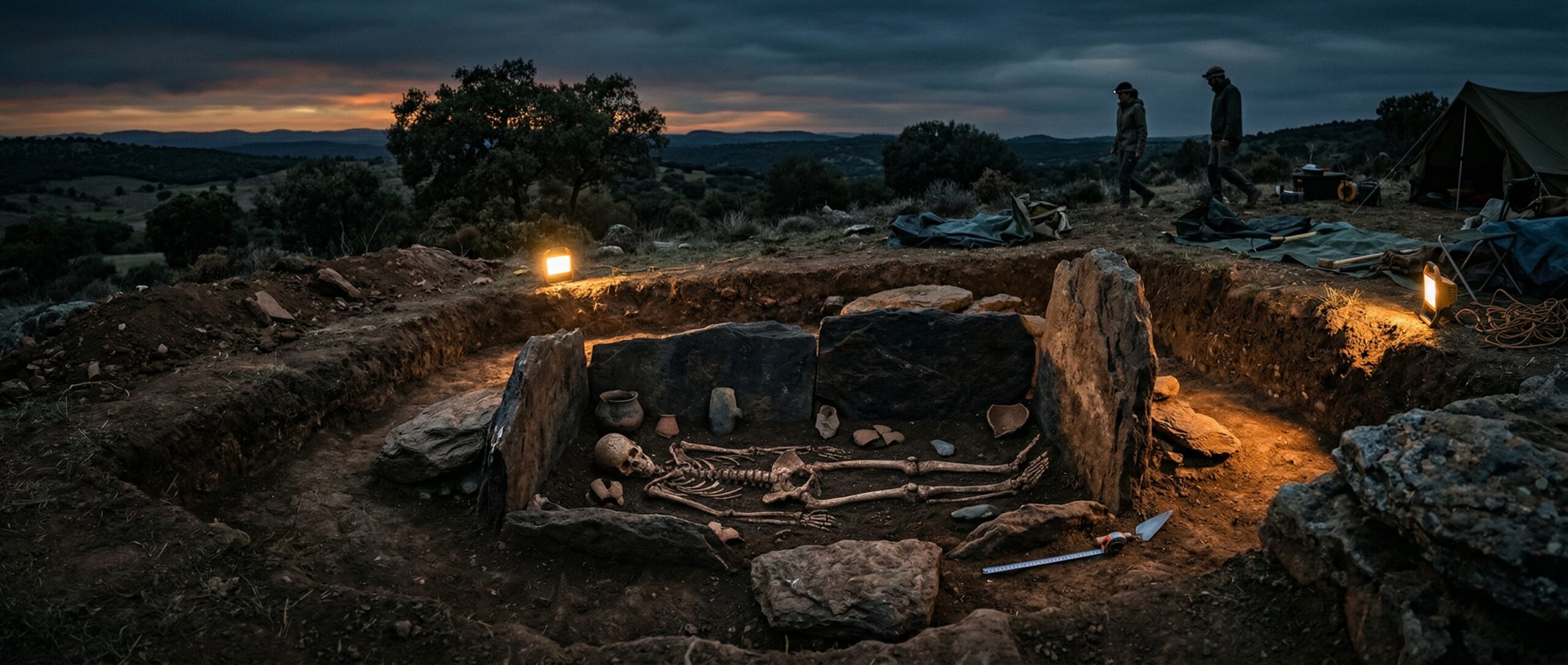
    That tension is exactly what makes the newly discussed Stone Age burial in Spain so compelling, and why the story feels bigger than a narrow archaeology update. As highlighted by Live Science in April 2026, researchers can now say strikingly specific things about the ancestry of a man buried in a prehistoric monument. Yet the deeper question, the one that most naturally grips the imagination, remains unresolved. Why was he buried there? What did the placement mean? Was he socially important, ritually marked, spiritually distinct, or simply one participant in a funerary world whose symbolic language we can only partly recover?

    This is why the story deserves more than a quick archaeology write-up. It sits at the exact threshold where hard evidence meets permanent uncertainty. Readers who have followed the long history of humanity trying to formalize contact with unseen forces or explored ancient-mystery stories where new technology reveals structures but not meaning will recognize the pattern. Science can illuminate the bones. It cannot fully restore the belief system that once surrounded them. That gap is not a failure of archaeology. It is one of the oldest and most haunting limits of human knowledge.

    The Spanish Stone Age burial is revealing precisely because it is only partially decoded

    The current fascination around this case comes from a productive kind of incompleteness. Researchers studying a man buried in a Stone Age monument in Spain have been able to extract information that speaks directly to ancestry and human movement. That alone is enough to make the find archaeologically significant. But the public imagination is not stopping at ancestry. It is moving almost immediately toward the harder question of spiritual meaning. Why this monument? Why this burial treatment? Why does this individual seem to stand out strongly enough to invite speculation about ritual identity?

    That interpretive jump is not irrational. Burial archaeology has always encouraged exactly this kind of thinking, because graves are among the few ancient contexts where material practice and symbolic meaning visibly overlap. A burial is never just a body in the ground. It is a social act, a cosmological act, and often a statement about how the living understood death, transition, ancestry, and power. The problem is that those meanings do not survive evenly. Bones may survive. Stone may survive. Grave goods may survive. The system of belief linking them together often survives only in fragments.

    That makes this Spanish case unusually instructive. It is not a story about science failing. It is a story about science succeeding powerfully in one domain while leaving another domain irreducibly open. That tension is what gives the burial its haunting quality.

    Ancient DNA can recover ancestry, movement, and kinship with astonishing power

    Ancient DNA analysis has transformed archaeology over the last two decades. Researchers can now identify broad ancestry patterns, population mixing, migration events, kin relationships, and sometimes aspects of physical biology that were once permanently out of reach. In prehistoric Europe especially, genomics has changed how scholars understand the movement of peoples, the spread of farming, and the ways communities were formed, absorbed, or replaced over millennia. In a case like this one, the genetic data helps place the buried man within a larger human map rather than leaving him as an isolated skeleton in a monument.

    That is an extraordinary achievement. For much of archaeological history, ancestry had to be inferred indirectly through material culture, burial style, cranial measurement, settlement pattern, or comparative guesswork. Now, scholars can make far more grounded claims, even when those claims still require care and context. As institutions such as Nature’s ancient DNA coverage and broader archaeological genetics literature have shown, prehistoric burials are no longer mute in the same way they once were. They speak through chemistry and sequence.

    But DNA speaks a particular language. It can tell us about descent and relatedness. It can reveal biological connection and population history. It can sometimes clarify whether a buried person was local to the region or connected to wider migration patterns. What it cannot do is leap directly from lineage to worldview. The genome is powerful evidence, but it is not a theology.

    Belief, ritual meaning, and sacred status remain much harder to reconstruct

    This is where the story becomes genuinely philosophical. Archaeology can often say what was done. It struggles more with why it was done in the exact terms the original participants would have used. A body placed in a monument may indicate reverence, status, sacrifice, ancestry worship, cosmological alignment, territorial memory, or social distinction. The material context can narrow possibilities, but it rarely translates directly into the lost language of belief.

    That is especially true in prehistory, where writing is absent. Without inscriptions, myths, prayers, liturgies, or explanatory texts, scholars must read meaning indirectly through architecture, grave treatment, artifact placement, body position, and comparison with better-documented traditions. This is rigorous work, but it remains interpretive. Even when archaeologists are highly confident that a burial had special ritual significance, the exact nature of that significance may remain permanently out of reach.

    That is why the question raised by the Live Science story is so resonant. People instinctively understand that ancestry is not identity in the fullest sense. A person is not reducible to genetic origin. Religion, status, symbolic role, and cosmological place belong to a different layer of being. That layer is often the hardest one to resurrect.

    Burials preserve social meaning long after language is gone

    Archaeologists care so deeply about burial sites because graves are among the richest surviving records of how a society understood the human person. A burial encodes choices. Was the body isolated or communal? Was it accompanied by tools, ornaments, pigments, animal remains, food offerings, or ceremonial architecture? Was it placed inside a monument that required collective labor to build? Was the location already sacred before the burial took place? Each of these questions opens a window onto value systems that would otherwise remain invisible.

    In the case of prehistoric monuments in Iberia, those questions are especially potent. Stone-built or monumental funerary spaces often imply continuity, memory, and social investment. They tell us that the dead mattered not only biologically, but symbolically. Some burials appear ordinary within such systems. Others stand out, either because of placement, treatment, or associated materials. When one individual appears unusually emphasized, it is natural to ask whether he was more than socially prominent. Was he ritually charged? Was he a mediator, an ancestor figure, a lineage founder, a priestly presence, or someone marked by a role we no longer know how to name?

    Those questions may never receive final answers, but they are not arbitrary. They emerge from the material seriousness of burial itself. The dead are often where a culture’s deepest structure becomes momentarily visible.

    Prehistoric Iberia was already a world of migration, monument building, and symbolic complexity

    Any effort to understand this burial has to place it within the wider prehistoric world of the Iberian Peninsula. Stone Age and later prehistoric Iberia was not culturally flat. It was a region shaped by long-term population movement, local continuity, exchange networks, monument construction, and ritual landscapes whose meanings were layered over generations. Megalithic traditions in parts of Spain and Portugal have long fascinated archaeologists because they suggest both engineering coordination and durable sacred geography.

    This matters because the burial is not an isolated curiosity. It belongs to a broader pattern in which monuments were used to structure relationships among the dead, the living, and the land. Institutions such as the British Museum’s prehistoric Europe collections and academic work on Iberian megalithic culture have repeatedly shown that ancient communities invested enormous energy in burial architecture that outlasted individual lifetimes. That investment suggests worldviews concerned with continuity, ancestry, place, and the social management of memory.

    So when a genetically traceable man appears in one of these settings, the question is not only who he was biologically. It is how he fit into that symbolic landscape. The monument places him inside a ritual grammar we can observe structurally but cannot fully translate.

    A burial can suggest ritual importance without ever proving exactly what that importance was

    This is the point where responsible archaeology and public imagination often separate. A dramatic burial context tempts people to supply a title. Shaman. Priest. Chief. Sacrifice. Outcast. Holy man. Chosen dead. But the evidence rarely grants such precision. More often, it supports a narrower and more careful claim: this person appears to have been treated in a way that mattered.

    That distinction is crucial. Treatment can imply importance without revealing the language of that importance. A body may be central because of ancestry, age, prestige, unusual death, inherited status, ritual office, remembered charisma, or cosmological symbolism. Modern categories can illuminate possibilities, but they can also distort them. Prehistoric communities did not necessarily divide religious and social roles the way modern observers do. What looks to us like “religion” may have been inseparable from kinship, territory, healing, seasonal cycles, or political authority.

    That is why this Spanish burial remains so compelling. It offers just enough evidence to make the spiritual question unavoidable, but not enough to settle it cleanly. The monument points toward meaning. It does not surrender the full code.

    This case shows the difference between biological identity and spiritual identity

    One of the most useful ideas this story gives readers is a distinction that extends far beyond archaeology. Biological identity and spiritual identity are not the same thing. Science can map one with increasing precision. The other must usually be inferred through behavior, symbol, testimony, and cultural context. In the contemporary world, we often collapse identity into measurable categories because measurable categories feel secure. This burial is a reminder that human meaning has never been fully measurable.

    The buried man’s ancestry matters. It tells us something real about movement, relation, and historical context. But ancestry does not explain why the living placed him where they did, or how they understood the passage he was making through death. That is a different question, one that sits closer to anthropology, comparative religion, ritual theory, and the study of symbolic systems than to genetics alone.

    That is also why ancient-mystery stories like this endure. They do not survive because science is weak. They survive because science is strong enough to reveal the boundary of its own reach. The clearer the biological picture becomes, the more visible the remaining darkness can feel.

    A cautious reading avoids romantic invention while preserving the mystery

    The best skeptical response to this story is not dismissal. It is restraint. There is no need to invent lost priesthoods, secret cults, or mystical titles to make the burial interesting. Nor is there any need to flatten the case into mere demographic data and pretend the ritual question is irrelevant. A disciplined reading can hold both truths at once: the genetics are meaningful, and the spiritual interpretation remains unresolved.

    This is the kind of caution good archaeology depends on. Overstatement is tempting because ancient burials invite projection so easily. Modern people want the dead to become characters. But responsible interpretation accepts degrees of uncertainty. It allows a burial to remain symbolically potent even when its exact meaning cannot be recovered. That is not a weakness. It is fidelity to the evidence.

    For unexplained.co, that balance is exactly the point. Ancient mystery becomes most interesting when it is not inflated beyond what the material supports. The real intrigue lies in the distance between what we can now sequence and what we may never fully know.

    The story matters because it reveals the real limits of scientific certainty

    There is a cultural lesson here that goes beyond prehistory. We live in an age that often expects enough data to dissolve uncertainty. Genomics, imaging, AI reconstruction, isotope analysis, and digital modeling have dramatically expanded what researchers can recover from the past. That expansion is real, and it is astonishing. But stories like this one remind us that certainty does not increase evenly across all kinds of questions. Some dimensions of human life leave clearer traces than others.

    Belief is one of the hardest dimensions to reconstruct because it often exists not in isolated artifacts, but in systems of use, repetition, symbolism, and shared interpretation. When those systems vanish, archaeology can sketch around them, but not always re-enter them. That makes this burial more than a niche research story. It becomes a case study in epistemic humility, which is one reason ancient-mystery readers respond to it so strongly. We can know a great deal and still not know the thing people most want to ask.

    In that sense, the mystery is not an embarrassment to science. It is part of what makes science honest. The unanswered ritual question gives the case its depth precisely because the researchers can say so much else with confidence.

    Ancient mystery often begins where excellent science reaches its interpretive boundary

    That is why this case belongs to a wider class of stories that continue to grip the public imagination. New tools reveal fresh detail about ancient monuments, burials, landscapes, and bodies, yet the final meaning of those discoveries remains partly occluded. We have seen the same tension in stories about Nazca geoglyphs found through AI-assisted detection, in debates around prehistoric ceremonial sites, and in every excavation where structure survives better than worldview.

    The result is not frustration alone. It is a more mature kind of mystery. Not the mystery of wild speculation, but the mystery of partial access. The dead can now tell us more than they could a generation ago. They still do not tell us everything. That remainder, the space between data and meaning, is where archaeology becomes quietly uncanny.

    Science can read his ancestry. It can place him in time, in relation, perhaps in movement. But his religion, if that is the right word at all, remains dimly visible only through burial context and human inference. That is enough to fascinate, enough to caution, and enough to remind us that the ancient world is not mute. It is simply not finished speaking in a language we fully understand.

    Frequently Asked Questions

    What did researchers learn from the Stone Age burial in Spain?

    They were able to recover ancestry information about a man buried in a prehistoric monument, helping place him within larger population and migration patterns in ancient Iberia.

    Why can science identify ancestry but not religion?

    Because ancestry can be traced through biological evidence like DNA, while belief systems usually have to be inferred indirectly from burial treatment, artifacts, architecture, and cultural context.

    Does a special burial prove a person had a ritual or religious role?

    No. It may suggest social or symbolic importance, but it rarely proves a precise title or religious function without stronger contextual evidence.

    Why are prehistoric burials so important to archaeologists?

    Because burials preserve choices about status, memory, symbolism, and the treatment of the dead, making them one of the richest windows into ancient social and ritual life.

    What makes this story compelling beyond archaeology news?

    It highlights a deeper truth about the past: technology can recover astonishing detail, but some of the most human questions, especially about meaning and belief, remain difficult to answer with certainty.

    This article was created using Media Blaster – Your content production specialist. Visit www.mediablaster.io for more information.