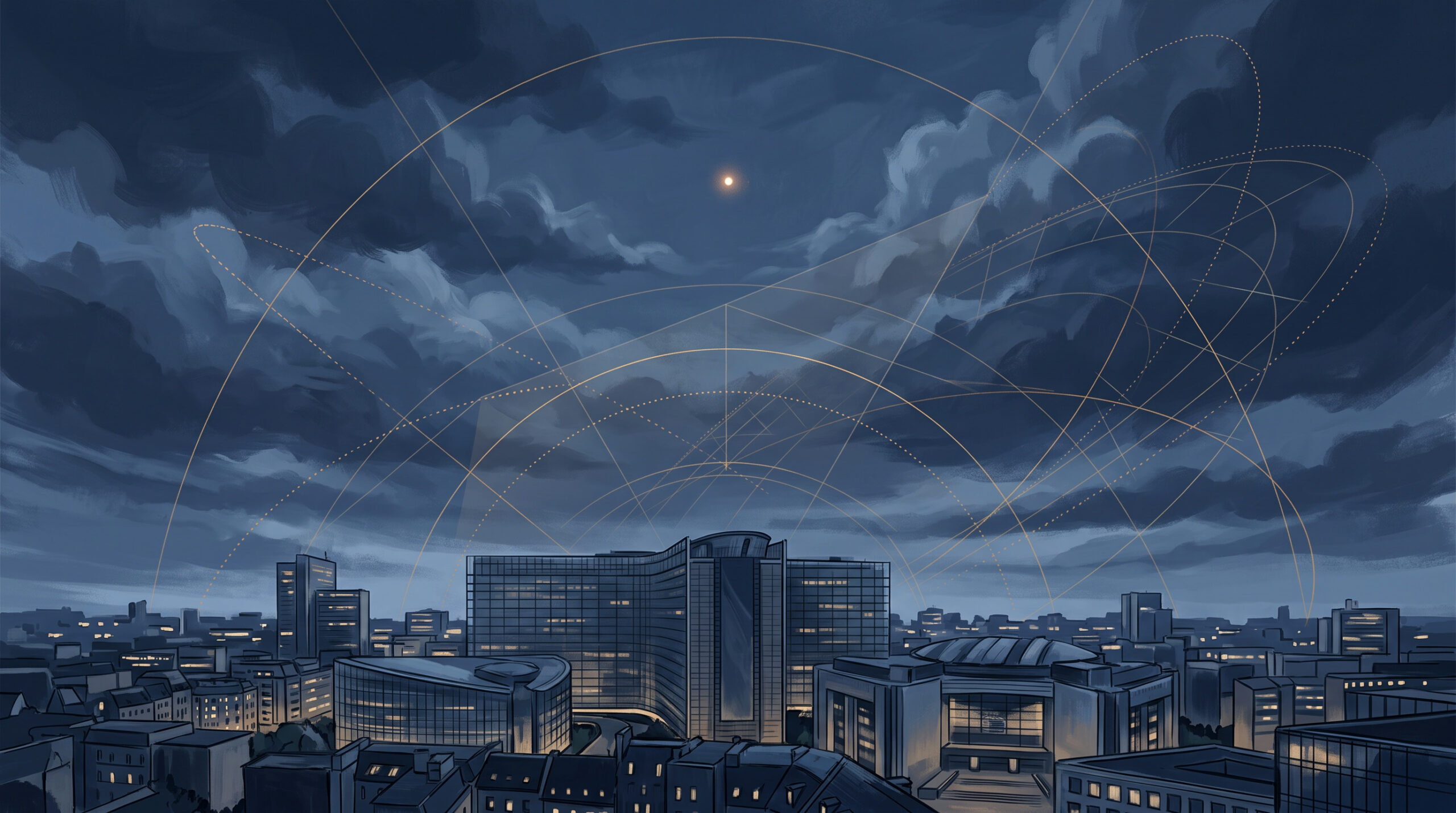
The European Commission has been paying attention to unidentified anomalous phenomena more closely than its public silence suggested. Newly reported correspondence shows that officials reviewed a package of 37 sky and space images submitted by two Malaysian amateur astronomers, discussed Europe’s improving ability to detect objects around Earth, and acknowledged that better sensors might help identify at least some unexplained observations.
That is not evidence of extraterrestrial craft, nor is it a declaration that Brussels has opened a secret UFO office. It is something more concrete and, in its own way, more revealing: a paper trail showing that the European Union’s executive arm has treated UAP reports as a question of observation capability, space safety and institutional responsibility since at least 2023.
The documents, first reported by Euronews on August 17, expose the central weakness in Europe’s current approach. The continent has increasingly sophisticated systems for tracking satellites, debris and airborne threats, but no transparent public process designed to collect, compare and investigate anomalous reports across national borders.
The Letter That Reached Brussels
The story began in October 2022, when a Malaysian father-and-son astronomy team contacted European Commission President Ursula von der Leyen. According to the correspondence reviewed by Euronews, they submitted 37 images described as UAP captures made with an ultraviolet-infrared telescope.
The pair claimed the objects appeared near aircraft and sensitive locations, including military and nuclear facilities. They also reported unusual signals in local Wi-Fi frequencies. Those claims remain allegations by the observers; the publicly described correspondence does not establish what the images depict, whether the apparent objects were physical, or whether the reported signals were connected to them.
What matters is how the Commission answered. Officials said the sightings were outside the EU’s jurisdiction because they occurred over Malaysia. But they did not simply dismiss the submission. The response said Europe intended to increase its ability to detect objects in the space environment around Earth, partly to identify UAP and the debris that threatens satellites and other space operations.
The Commission was careful not to promise a solution. Better observation, it said, might explain some cases—not all of them. That distinction is important. Improved sensors can turn an unidentified light into a satellite, aircraft, balloon or fragment of debris. They can also produce better records of events that remain unresolved.
What Europe Can Track—and What It Cannot
Europe already operates a substantial space-monitoring network. The EU Space Surveillance and Tracking partnership links national capabilities to monitor orbiting objects, assess collision risks, detect fragmentation events and support re-entry analysis. Its purpose is practical: keep spacecraft and people safe in an increasingly crowded orbital environment.
That mission overlaps with part of the UAP problem, but only part of it. A system built to follow catalogued objects in orbit is not automatically an investigative bureau for unusual reports from pilots, police officers, radar operators or members of the public. Nor does tracking a point of light explain intent, origin or the reliability of the observer’s interpretation.
This creates a jurisdictional maze. A report may involve civil aviation, military airspace, border security, meteorology, astronomy, satellite operations or law enforcement. Each institution can own one piece of the puzzle while no institution owns the mystery itself.
The newly reported correspondence therefore reveals a structural gap rather than a hidden conclusion. Europe possesses sensors and expertise, but it lacks a single visible channel where anomalous observations can be submitted, preserved and compared across agencies and countries.
That gap matters because unusual aerial events do not respect borders. A track that begins over one member state may continue into another. A pilot may report an object to an airline, while military radar data remains classified and astronomical observations sit in a separate archive. Without a common protocol, potentially ordinary explanations can remain undiscovered—and genuinely unusual cases can disappear between systems.
Why This Is Different From the American Model
The United States has spent years moving UAP from the cultural fringe into formal government procedure. The Pentagon’s All-domain Anomaly Resolution Office publishes case material and accepts military-related reporting, while NASA convened an independent study focused on how better data and scientific methods could improve analysis.
NASA’s public UAP study materials stress a point that is often lost in arguments about aliens: the principal obstacle is not necessarily a shortage of sightings, but a shortage of standardized, high-quality data. Camera metadata, sensor calibration, observation geometry and independent corroboration can matter more than how dramatic an image appears.
Europe has no exact equivalent of the Pentagon’s UAP office. National governments and militaries may investigate incidents within their own systems, but the Commission correspondence suggests that the EU-level answer has largely been to improve broader detection capabilities rather than establish a dedicated public-facing investigation process.
That may be sensible bureaucratically, yet it leaves an accountability problem. If Brussels is “getting better at seeing” anomalous objects, as the reported letter put it, who decides which observations deserve further analysis? Where are the findings published? What evidentiary standard separates a resolved case from an unresolved one?
Those questions echo the debate surrounding Japan’s review of UAP material and the persistent controversy over American UFO file releases. Governments are becoming more willing to acknowledge anomalous reports, but acknowledgment is not the same as transparent investigation.
What the 37 Images Do Not Prove
The Malaysian submission is intriguing because it generated an institutional response, not because the images have been independently authenticated as extraordinary. Based on the public reporting, there is no demonstrated chain of custody, calibrated instrument record or multi-sensor confirmation that would establish unknown technology.
Ultraviolet and infrared imaging can reveal details invisible to the eye, but it can also produce artifacts that are unfamiliar to non-specialists. Internal reflections, sensor noise, compression, insects near the lens, satellites, aircraft and atmospheric effects can all appear unusual when distance and scale are unknown.
The reported Wi-Fi-frequency claim is even harder to assess without raw measurements, equipment details, timing data and an independently repeatable correlation. A signal detected “from above” is not automatically connected to a photographed object. The responsible position is neither to ridicule the observers nor to treat the claim as proven. It is to ask whether the underlying data can support the interpretation.
This is where a formal European protocol could make a real difference. Submissions could require original files, timestamps, coordinates, instrument specifications and witness statements. Analysts could compare them with satellite catalogues, air-traffic records, weather data and astronomical events. Resolved cases could be published with an explanation; genuinely unresolved cases could be preserved for further study.
Three Things the Documents Really Change
First, they move the European UAP debate from speculation about official interest to documented institutional correspondence. The Commission did not endorse an extraordinary explanation, but it did engage with the problem in the language of detection and identification.
Second, the response links UAP identification to Europe’s broader space-domain awareness. That means future improvements may come not from a dedicated “UFO detector,” but from the same systems built to track debris, protect satellites and understand activity around Earth.
Third, the correspondence exposes the absence of a continent-wide reporting architecture. Better sensors are only useful if observations can be combined with contextual data and reviewed by people who have permission to cross institutional boundaries.
This is not the first sign that UAP questions are becoming international rather than uniquely American. Japan’s recent document review, parliamentary questions in several countries and continuing military concern about unidentified drones all point toward the same reality: even when an object has an ordinary explanation, identifying it can be a matter of aviation and national security.
The broader history of government UFO investigations also cautions against reading official attention as proof of alien visitation. Programs such as Project Blue Book examined thousands of reports while resolving most of them conventionally. Yet a small unresolved remainder kept the subject alive, partly because inconsistent data made firm conclusions impossible. Modern sensor networks offer a chance to do better—if agencies share enough information to use them.
What Happens Next
The Commission’s reported promise to improve detection does not establish a timetable, a dedicated budget or a public reporting mechanism. The immediate next question is whether the EU will translate general space-surveillance capability into a transparent anomaly-analysis policy.
A credible European system would not need to begin with extraterrestrials. It could begin with flight safety, drone incursions, space debris and sensor anomalies. But it should publish its methods, define what “unresolved” means and create a lawful way to combine civilian and government observations without exposing sensitive defence capabilities.
Until then, Brussels appears to be watching without fully explaining how it watches. The newly revealed correspondence does not solve the mystery of the Malaysian images. It does reveal that Europe’s institutions recognize a practical problem hiding underneath the extraordinary claims: unidentified things are being reported in increasingly monitored skies, and no single European authority is publicly responsible for determining what they are.
Would a transparent EU-wide reporting system reduce UFO speculation by resolving more cases—or uncover a smaller set of observations that remain genuinely difficult to explain?