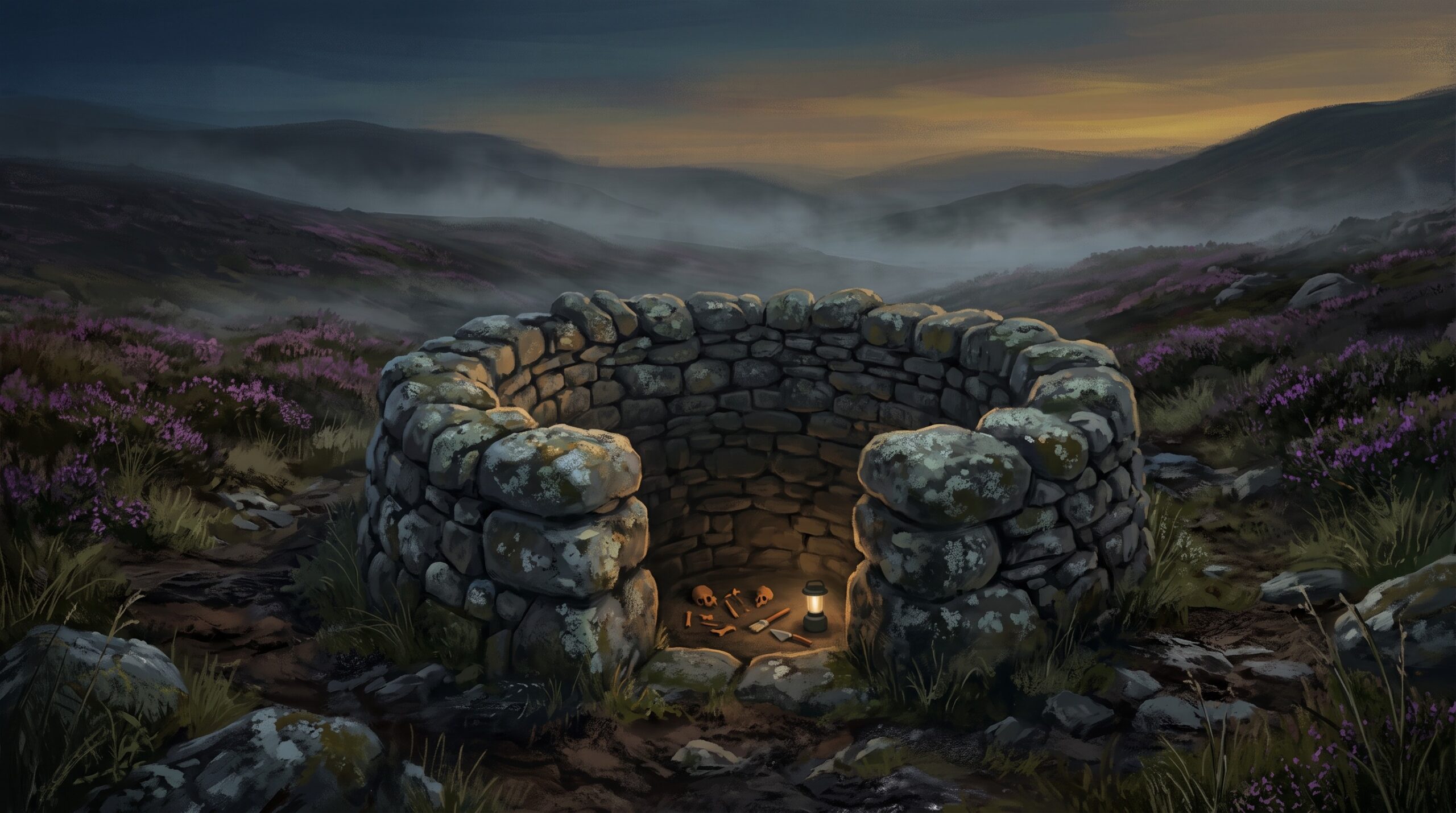
The body was placed at the bottom of a well in the Scottish Highlands, then covered with animal bones. Two thousand years later, archaeologists are asking whether the burial marked the moment the well was deliberately closed—or whether the strange setting means something else entirely.
The discovery is recent, but the mystery is old-fashioned: a carefully built water structure, an adult human burial with no obvious grave goods, and an arrangement that seems too deliberate to dismiss as ordinary disposal. The evidence does not prove sacrifice, execution, or any single ritual. It does show that an Iron Age community treated this particular place as significant.
The find was made during the expansion of a quarry in northern Scotland. According to a statement from Highland Archaeology Services reported by Live Science’s account of the excavation, the feature is about 10 feet long and 3 feet deep. Its base was lined with stone slabs, with clay pressed between gaps in the masonry—possibly an effort to help it retain water.
That construction matters. This was not simply a hole in the ground. It was a built environment, and the person was found at its base.
What archaeologists know so far
The burial appears to date to the Iron Age, broadly a period running from about 800 B.C. to A.D. 400 in Britain. The dating is provisional and rests on artifacts found near the well rather than on a completed radiocarbon sequence for the human remains.
The person was an adult, but the excavation team has not yet established the individual’s sex, precise age, cause of death, or pathology. No grave goods were reported. Animal bones lay above the burial, creating a sequence that could reflect ritual placement, later activity, or both.
Those limits are important. A burial in an unusual location can feel like a message from the past, but archaeology has to recover the grammar of that message one detail at a time. Until the remains and associated material are analysed, the most dramatic interpretations remain possibilities rather than findings.
The site is also located near Camore Wood, an Iron Age settlement where archaeologists have identified at least 20 hut circles. Possible roundhouses were found nearer the well. The relationship is suggestive, but not proven: the settlement is roughly 1 mile, or 1.6 kilometres, away, and the team has not established that the person belonged to that community.
That distance opens several possibilities. The well may have served the settlement. It may have belonged to a smaller nearby occupation that has not survived archaeologically. Or it may have been a special place whose meaning extended beyond daily water use.
Why a well could become a ritual place
Wells and other water features occupy an unusual position in ancient archaeology. They are practical installations, but they also create a physical boundary between the visible world and what lies below it. Objects placed into them can disappear from ordinary view while remaining materially present.
That makes a well a useful place for offerings, closure ceremonies, and deliberate deposition. It does not mean every ancient well burial was religious. Some wells became rubbish pits; some received bodies during conflict or crisis; some were simply reused after their original function ended.
The Scottish discovery becomes especially intriguing because the structure may have been abandoned in a controlled way. The stone lining and clay packing suggest investment in construction. If the well was then closed, placing a body at its base and animal remains above it could have formed part of a final act. The sequence might have symbolised the end of the well’s useful life, the transfer of the place into another kind of service, or an attempt to manage whatever the community believed the water connected to.
This is the information the headline versions of the discovery can easily miss: the question is not merely why a body was found in a well. It is whether the well’s final moment was itself the ceremony.
The comparison at High Pasture Cave
Highland Archaeology Services has pointed to another Iron Age context on Skye, where a woman and two babies were found at the entrance to High Pasture Cave. The cave was ceremonially closed, making it a useful comparison—but not a direct explanation of the Scottish well.
A cave and a water well are not interchangeable. Their architecture, visibility, access, and practical functions differ. The comparison is valuable because it demonstrates that some Iron Age communities may have used human deposition during the closure of significant places. It does not establish that the Highland well followed the same ritual script.
That distinction protects the story from becoming too neat. Archaeologists are not saying, “This is the same ceremony.” They are asking whether a broader pattern—burials associated with the sealing or transformation of special places—could help explain the evidence.
Readers familiar with the Etruscan well burial discovered at Veii will recognise the larger mystery. Across different cultures, wells can become places where ordinary explanations feel incomplete. But similarities should prompt comparison, not erase local context. The Scottish case must be interpreted through its own landscape, construction methods, chronology, and community.
Confirmed, possible, and still unknown
The clearest way to read the discovery is to separate what has been observed from what it might mean.
- Confirmed: an adult human burial was found at the base of a stone-lined feature in the Scottish Highlands.
- Confirmed: animal bones were placed above the burial.
- Reported: nearby artifacts suggest an Iron Age date.
- Possible: the feature was a water-holding well, with clay used to improve its seal.
- Possible: the burial occurred during a closing ceremony when the well was abandoned.
- Unknown: the person’s sex, age, cause of death, health history, and relationship to the nearby settlement.
- Unknown: whether the animal remains were placed at the same time as the body.
The unknowns are not minor details. If the skeleton shows trauma, the story changes. If the person died from illness or age-related causes, the deposit may reflect a postmortem ritual rather than killing. If the animal bones are much later, they may have nothing to do with the burial’s original meaning.
Likewise, the well’s function remains to be established. A structure that held water may have had a different significance from a dry shaft or a feature used for industrial work. Sediment analysis, plant remains, animal-bone study, and microscopic examination of the lining could all change the interpretation.
What the next analysis could reveal
The excavation team expects further analysis to provide a date for both the feature and the human remains, as well as information about sex, age range, and pathologies. Those results could answer several questions at once.
First, dating may show whether the burial and well belong to the same phase. A person buried centuries after construction would tell a very different story from someone placed there when the structure was first closed.
Second, the skeleton may preserve evidence of injury, disease, diet, or strenuous activity. Even an absence of obvious trauma would be meaningful: it would weaken interpretations that depend on a violent death, though it would not eliminate ritual deposition.
Third, the animal bones may reveal species, butchery marks, burning, and timing. Food waste, a slaughtered offering, and naturally accumulated remains can look superficially similar until laboratory work separates them.
Finally, the surrounding landscape may tell researchers whether this was an isolated act. Mapping the well, roundhouses, hut circles, paths, and other features could show whether people approached it as part of a settlement or encountered it as a distinct landmark.
The Bronze Age ritual site found around an apparently ordinary rock offers a useful reminder: ancient ritual landscapes are often identified not by one spectacular object, but by the relationship between a modest feature and the actions carried out around it.
A burial, a closure, or something we have not named yet?
The strongest interpretation at present is cautious but compelling. The adult may have been placed in the well as part of a closing ritual, with the animal bones forming part of the final deposit. The location, construction, and sequence make that possibility worth investigating.
But the evidence does not yet justify calling the person a sacrifice. Nor does it show that the burial was connected to the nearby settlement, or that the well was abandoned immediately after the deposit. Those claims may become stronger—or collapse—when the scientific results arrive.
That uncertainty is precisely what makes the site interesting. The mystery is not that archaeologists have found something inexplicable. It is that they have found a carefully arranged situation whose meaning remains just out of reach, waiting in the bones, clay, sediment, and chronology.
The ancient community may have been closing a well. It may have been honouring a dead person. It may have been dealing with a crisis, a boundary, or a place believed to possess unusual power. For now, the Scottish Highlands have preserved the act but not the explanation.
What do you think the burial represents: a closing ritual, an emergency burial, or a practice that modern archaeology has not yet learned how to name?
### Sources and further reading
Live Science report on the Scottish well burial; Highland Historic Environment Record field-report entry; Unexplained.co’s report on the Lucone tablet.