Tag: ohio

  • Loveland Frogman: How an Ohio Cryptid Became a Real State Bill

    Loveland Frogman: How an Ohio Cryptid Became a Real State Bill

    The officer drew his weapon. That is the part nobody forgets.

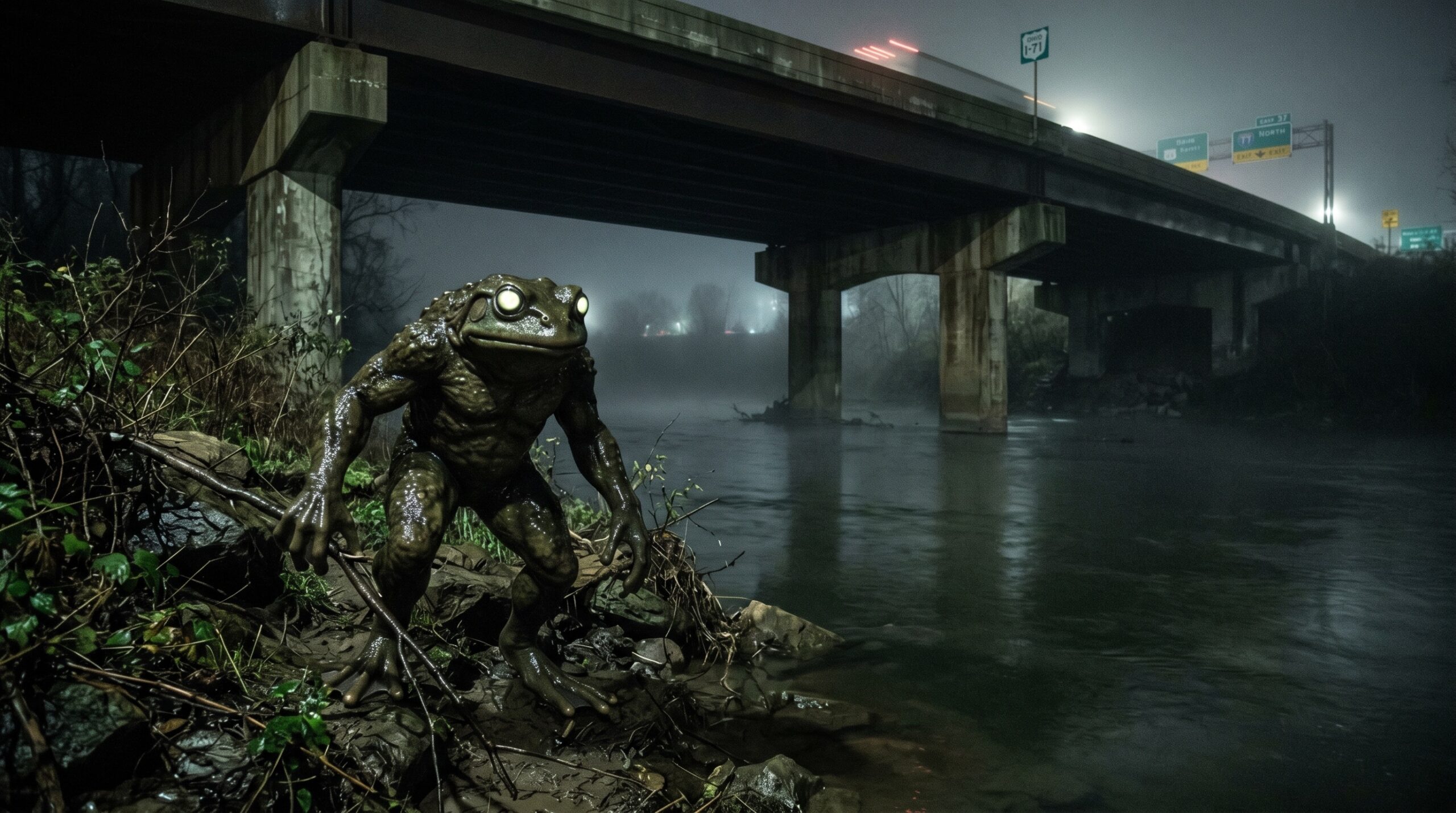
    In March 1972, a Loveland police officer named Ray Shockey was patrolling the banks of the Little Miami River at 1:00 a.m. when he encountered something that had no business existing in the tax records of Clermont County. The creature was approximately four feet tall, bipedal, with leathery skin and a face that Shockey later described as “frog-like.” It was not aggressive. It was not obviously frightened. It simply stood in the headlight glow, holding what appeared to be a metal wand, and then climbed over the guardrail and vanished into the river darkness. Shockey did not fire. He sat in his cruiser for ten minutes before radioing dispatch. The incident report, which survives in scanned PDFs circulated by Ohio paranormal researchers, uses the word “animal” three times and the word “unknown” seven.

    Fifty-three years later, the Loveland Frogman has achieved something few cryptids manage: formal recognition by the Ohio General Assembly. House Bill 471, introduced in April 2026 by Representative Jamie Callender, proposes designating the Frogman as Ohio’s official “cryptid ambassador” and allocating $250,000 annually for “cryptid ecology research and tourism infrastructure” in the Little Miami watershed. The bill is not expected to pass. It has already succeeded in forcing the creature back into national headlines, and in doing so, has reopened one of the most thoroughly documented—and most inexplicable—cryptid cases in American history.

    The 1955 Origins

    The modern Frogman legend begins not with Shockey, but with a business traveler named Robert Hunnicutt. In May 1955, Hunnicutt claimed he saw three bipedal frog-like creatures conversing beside the road near Branch Hill. According to his account, the creatures were two to three feet tall, had wrinkled skin, and displayed webbed hands and feet. One held a wand that emitted sparks. Hunnicutt, a sober salesman with no prior interest in the paranormal, reported the sighting to local police and stuck to his story until his death in 1988.

    The 1955 report was largely forgotten until Shockey’s 1972 encounter catalyzed a second wave of sightings. In the same month as Shockey’s report, another officer, Mark Matthews, claimed to see a similar creature—this time wounded, with what appeared to be a laceration on its back. Matthews fired his weapon. The creature escaped. A subsequent search found no blood, no body, and no explanation.

    Matthews later recanted, suggesting he had shot a large monitor lizard that had lost its tail. Cryptozoologists point out that monitor lizards are not native to Ohio, do not stand upright, and do not hold wands. The recantation, they argue, bears the hallmarks of institutional pressure rather than honest correction. Small-town police departments in the 1970s were not eager to become national laughingstocks, and officers who maintained extraordinary claims often found their careers quietly derailed. Smithsonian Magazine profiled the case in 2014 and concluded that the evidence, while inconclusive, had never been fully explained.

    The Decades Between

    From 1972 to the present, the Little Miami River corridor has produced dozens of additional reports. Most describe the same core figure: a bipedal amphibian between three and five feet tall, observed near water at night, often associated with unexplained electrical interference. One 1985 report from a fisherman described the creature emitting a low-frequency hum that caused his boat’s depth finder to malfunction. A 2016 trail-camera photograph, debated fiercely online, shows a hunched figure at the water’s edge that experts have been unable to conclusively identify as either human or known animal.

    The sightings share characteristics with other global cryptid traditions. The Japanese kappa, a water-dwelling humanoid with reptilian features, occupies a similar ecological niche in folklore. The South African tikoloshe, though typically more malevolent, shares the amphibious habitat and nocturnal behavior pattern. Whether these parallels represent convergent cultural evolution or something more literal remains one of cryptozoology’s persistent questions.

    What distinguishes the Loveland case is the documentation. Unlike most cryptid reports, which rely on single-witness testimony, the Frogman has produced multiple independent law enforcement sightings, physical evidence in the form of the 2016 photograph, and now legislative acknowledgment. The creature has survived decades of mockery without being conclusively debunked.

    The 2026 Bill

    Representative Callender’s bill is framed as economic development. The Little Miami watershed draws hikers and kayakers, but lacks the destination tourism infrastructure of more famous cryptid regions like Point Pleasant, West Virginia. Callender argues that formalizing the Frogman’s status would generate revenue, preserve green space, and celebrate Ohio folklore. The $250,000 allocation would fund trail maintenance, night-vision camera networks, and an annual “Frogman Festival.”

    Critics call the bill a publicity stunt. They note that Callender’s district includes Loveland and that the representative faces a competitive primary. The bill’s text, however, contains language that surprises even its detractors. Section 4 requires the Ohio Department of Natural Resources to “investigate and catalog all credible sightings of amphibious humanoids within the Little Miami watershed” and to publish annual reports. For the first time, a state agency would be formally tasked with cryptid research.

    The bill has attracted national attention. Cryptozoology organizations have submitted letters of support. Skeptical scientists have testified that public funds should not be spent chasing legends. The debate has become a proxy for larger questions about what states owe to local heritage, what qualifies as legitimate research, and whether the category of “credible sighting” can ever be meaningfully defined.

    Scientific and Folkloric Context

    Biologists who have examined the Frogman descriptions note similarities to known animals. The Ohio River valley hosts large populations of bullfrogs and snapping turtles. Standing water can produce optical illusions, particularly at night when headlights or flashlights reflect off ripples. Mass hallucination, while statistically rare, has been documented in communities primed by shared narrative expectation.

    However, the law enforcement sightings resist easy dismissal. Both Shockey and Matthews were trained observers. Both filed formal reports at personal professional risk. Neither profited from their claims. Shockey, in a rare 1995 interview, expressed frustration that his encounter had defined his career: “I saw what I saw. I don’t know what it was. But I know it wasn’t a man in a suit, and it wasn’t a lizard.”

    Folklorists offer a different lens. The Frogman functions as a boundary guardian in local narrative—a creature that patrols the liminal space between developed land and wild river, between human order and natural chaos. Its repeated association with wands and electrical interference suggests a figure drawn from older fairy traditions, updated for an industrial landscape of power lines and patrol cars. Whether the Frogman exists as a biological entity or as a living story, it clearly performs a function: it makes the river strange again, preserving mystery in a landscape increasingly mapped and managed.

    What Remains Unexplained

    The 2016 trail-camera image, analyzed by photographic experts at Ohio University, shows a figure with proportions inconsistent with both humans and known local wildlife. The image’s metadata confirms it was captured by a Reconyx camera triggered by heat and motion, not by a human operator. The figure’s posture—leaning forward on elongated hind limbs—matches no recognized animal gait.

    Skeptics have proposed that the image shows a person in a wetsuit retrieving fishing equipment. The temperature data from the camera, however, indicates the figure’s heat signature was significantly lower than human baseline, suggesting either cold-blooded physiology or ambient temperature matching. The image alone does not prove the Frogman exists. It proves that something triggered a research-grade camera in the exact location where police officers reported amphibious humanoids four decades earlier.

    The bill will likely die in committee. The sightings will likely continue. And somewhere in the reeds along the Little Miami River, whatever patrols those banks will remain undisturbed by legislative proceedings, continuing a watch that predates Ohio’s statehood and will likely outlast its infrastructure. The officer drew his weapon. The creature did not flinch. That balance of fear and strangeness, frozen in a 1972 police report, is what keeps the story alive.
  • Ohio School TikTok Skinwalker: The Viral Video That Has Everyone Asking What Was Walking Outside That School at Night?

    Ohio School TikTok Skinwalker: The Viral Video That Has Everyone Asking What Was Walking Outside That School at Night?

    Something was moving in the dark outside that Ohio school—and someone caught it on camera. When a viral TikTok surfaced in February 2026, it didn’t take long for the internet to reach a verdict: skinwalker. Within weeks, millions had seen the footage, forums were ablaze, and even mainstream outlets were asking the same unsettling question. What exactly was walking near that school at night? iHorror on TikTok skinwalker hysteria is one of the main outside reports driving that part of the discussion.

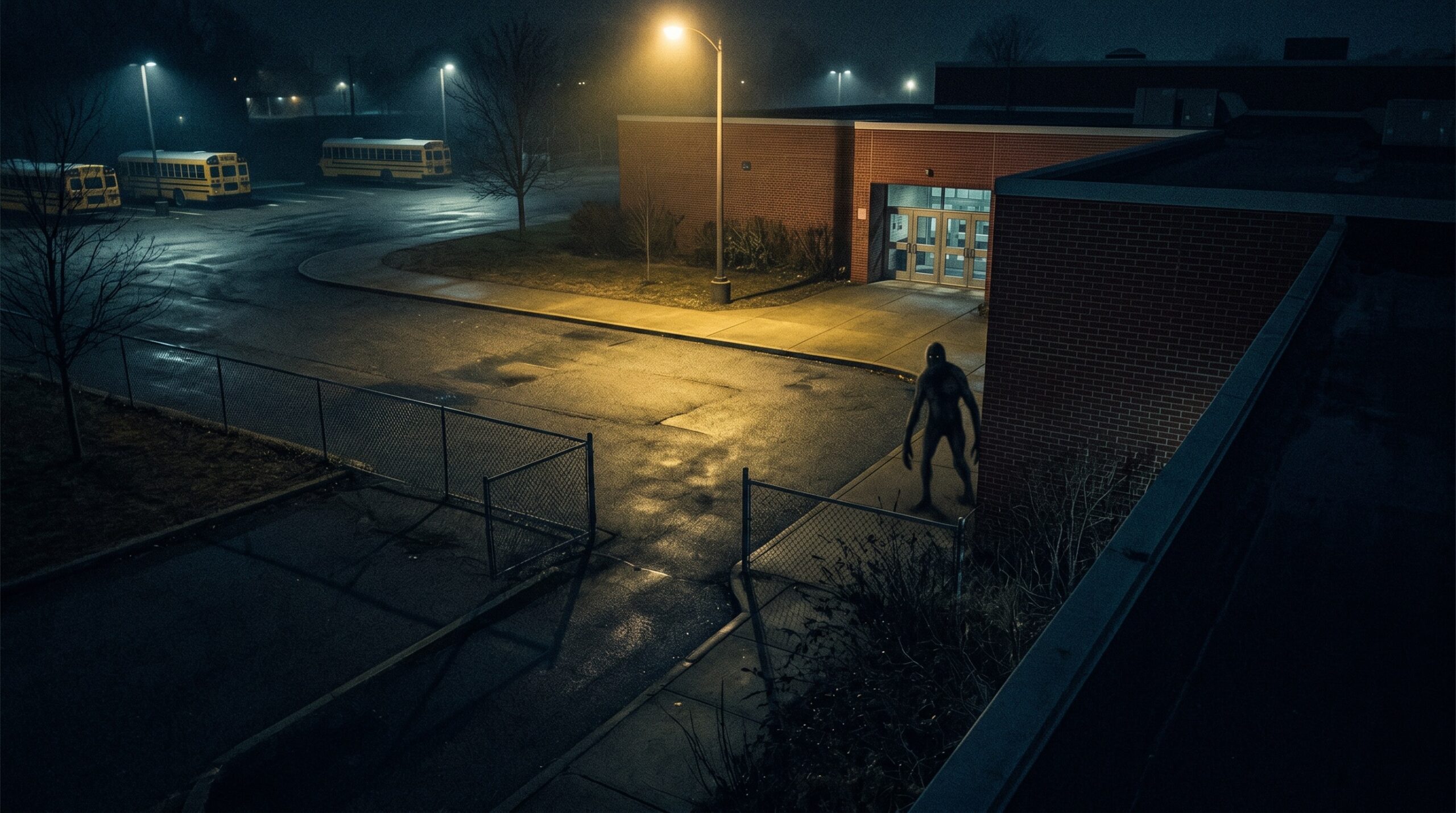
    The video, posted anonymously to TikTok in mid-February, appears to capture grainy CCTV footage from the exterior of a school building somewhere in Ohio. The timestamp reads like a punch to the gut: 3:47 AM. In the footage, a figure moves across the frame with a gait that several viewers described as “fundamentally wrong”—too tall, too thin, moving in a way that seemed to defy normal human locomotion. The poster’s caption, since deleted in a wave of attention, reportedly read: “Something is wrong in our town.”

    Within days, the video had accumulated several million views. By the time TikTok’s algorithm finished with it, the conversation had shifted from “creepy video” to something far more specific—and far more disturbing. TikTok skinwalker videos is one of the main outside reports driving that part of the discussion.

    The TikTok That Started It All

    The original TikTok video was uploaded with minimal context, which only amplified the mystery. A dark parking lot. A school building silhouetted against a moonlit sky. And then—that movement. The figure enters the frame from the left side, walking with long, deliberate strides toward the right edge before disappearing behind a structure. At no point does the figure turn, look at the camera, or break its stride. It simply passes through, as if it knows exactly where it’s going.

    What makes the footage particularly unsettling isn’t just the figure itself—it’s the way the figure moves. In the grainy night-vision resolution, legs appear to bend at angles that don’t quite match typical human locomotion. The proportions seem off: the torso too long, the limbs too angular. Someone watching it reported feeling a visceral sense of unease they couldn’t explain.

    “They know,” one commenter wrote beneath the reshared video. “They know exactly where they’re going. That’s what makes it so wrong.”

    The video gained traction on TikTok through a series of duets and stitches—other creators reacting to the footage, adding their own commentary, sometimes their own theories. Within two weeks, the original post had been viewed an estimated eight million times across multiple shares. The account that posted it went private, then deleted entirely. The same vacuum of context that surrounded the Oklahoma mystery animal attack—where an attacker was never identified despite injuries and DNA evidence—also applies here: anonymity amplifies both fear and credibility in equal measure.

    The Spread to Twitter and Mainstream

    By late March, the video had migrated to Twitter, where it found an entirely new audience. The transition from TikTok to Twitter is a pattern often seen with viral content—the TikTok audience tends to be younger, more meme-literate, while Twitter draws a crowd more inclined toward longer analysis and debate. This video seemed to bridge that gap, spawning threads that analyzed every frame, every pixel, every possible mundane explanation.

    One particularly viral thread garnered over two million views, breaking down the footage frame by frame and concluding—reluctantly—that nothing in the video suggested a human figure. Another user compiled comparisons with known skinwalker sightings, creating what became a reference post for the emerging discourse.

    Mainstream outlets began covering the phenomenon in early April. iHorror’s April 2026 piece, titled “TikTok’s Skinwalker Obsession Has Gone Full CCTV Hysteria,” documented the spread and attempted to contextualize why this particular video had resonated so deeply. Local Ohio news stations ran segments. National mystery-focused publications picked up the story. The pattern was familiar to anyone who’s watched viral paranormal content unfold before—but this time felt different.

    Why? Part of it has to do with the setting. A school. At night. The implications alone are enough to generate anxiety. But beyond that, the video’s ambiguity meant that no one could definitively say what they were looking at. That uncertainty is precisely what keeps these conversations burning.

    Why the “Skinwalker” Label Matters

    The word “skinwalker” carries weight. It isn’t a term that internet culture invented or diluted—it comes from Navajo mythology, describing a practitioner of witchcraft who has the ability to shapeshift into animals, particularly wolves, coyotes, and other creatures. In the traditional understanding, a skinwalker is never merely an animal in disguise. It retains something fundamentally inhuman—the way it moves, the way it watches, the wrongness that radiates from it even in animal form.

    When viewers described the Ohio school figure as moving with a “wrong” gait, they were invoking this exact cultural memory. The figure didn’t walk like a person pretending to be something else. It moved like something that had never been a person at all—something wearing a shape that only approximated humanity. This distinction matters enormously to those who study the skinwalker phenomenon.

    The comparison to other footage intensified the speculation. When the Alberta valley Bigfoot footage surfaced, viewers immediately drew parallels—not to Bigfoot, but to the same category of encounter. The uncanny, the unverifiable, the deeply unsettling footage that defies easy categorization. These videos don’t prove anything, but they share something important: the feeling they produce is real, even if the explanation is uncertain.

    Believers in the skinwalker concept have a framework for understanding this footage. They would argue that the figure’s behavior—walking purposefully past the school at 3:47 AM, never breaking stride, never acknowledging the camera—fits a pattern. Skinwalkers, in the folklore, are said to be drawn to places of significance, to circle and observe. The school, in this reading, isn’t just a random location. It’s a gathering point for young people, for potential victims, for something the entity might view as prey or territory.

    The skeptic’s counter-argument—that the label is applied too broadly, that any dark unclear footage gets labeled “skinwalker” now—has merit. Internet paranormal culture does have a tendency to over-apply dramatic terminology. But the response from believers is equally valid: when you see something that genuinely unsettles you, you reach for the language that most precisely captures that feeling. For many viewers, “skinwalker” was the only phrase that fit.

    What the Video Actually Shows

    It’s worth being clear about what the video does and doesn’t show.

    The footage is grainy, captured on what appears to be a standard school security camera operating in low-light or night-vision mode. The figure that crosses the frame is visible only as a dark silhouette against a lighter background. At no point does the footage clearly reveal a face, hands, or any of the details that would allow for confident identification.

    Could it be a person? Yes. A maintenance worker, a security guard, a teenager sneaking out to meet friends. The school is a location where humans have every reason to be present, even at 3:47 AM. A person walking normally, even purposefully, could produce something like this if the footage were degraded enough by the camera quality.

    Could it be an animal? A deer caught in the camera’s field of view might create strange elongated shapes in night vision. The proportions that seem “wrong” to human eyes might simply be an animal’s legs and body rendered poorly by low-resolution equipment.

    Could it be a衣架—a clothing rack, a decorative structure, something that caught the wind or the camera’s glitch in a way that produced a moving silhouette? Some users have floated this possibility, though it doesn’t account for the consistent movement across multiple frames.

    The honest assessment is this: the video does not contain enough information to definitively identify what it shows. The ambiguity is genuine, not manufactured. The figure could be human. It could be animal. It could be something else entirely. The footage doesn’t prove anything—and that’s precisely what keeps the conversation alive.

    Video analysis communities have made various attempts to enhance the footage, to pull details from the grain, to compare pixel patterns. Some analyses have suggested the figure’s height exceeds normal human parameters. Others have noted that the movement pattern doesn’t match typical human walking gait under careful frame-by-frame review. None of these analyses are conclusive, but together they build a picture of genuine ambiguity—footage that resists easy explanation.

    Why This Story Won’t Fade

    The Ohio school skinwalker video is not going to disappear from the cultural conversation, and there are structural reasons for that.

    Platform algorithms are designed to amplify content that generates strong emotional responses. Mystery. Unease. Fear. The video produces all three in viewers who encounter it unprepared. When content performs well by these metrics, platforms reward it with more distribution. The result is a self-reinforcing cycle: more people see it, more people discuss it, more people create derivative content about it.

    But beyond the algorithmic mechanics, there’s something else at work. The skinwalker concept is tied to real cultural folklore—real enough that the Navajo Nation has historically asked that outsiders not engage with or sensationalize skinwalker stories. When a video like this goes viral, it brings that folklore into mainstream conversation in a way that feels both thrilling and disrespectful, depending on your perspective.

    This pattern of viral paranormal content isn’t new, but each iteration seems to generate more intensity than the last. Something about our current cultural moment—the isolation of recent years, the erosion of trust in institutions, the sense that the world might contain more than we were taught—makes us hungry for mystery. We want there to be something beyond the mundane. We want the dark to hold secrets. The Loch Ness Monster sightings that continue to arrive every year—including the first 2026 report from the Caledonian Canal in March—demonstrate that this appetite for cryptid mystery isn’t fading.

    And so the debate continues, months later, still unresolved. The video sits on servers, archived and reshared, watched by new audiences who find it through different pathways each time. Forums continue to analyze it. Skeptics continue to propose mundane explanations. Believers continue to feel, in their bones, that something was out there that night.

    Something was out there that night. That much, at least, the footage does show.

    Frequently Asked Questions

    What is a skinwalker?

    A skinwalker is a figure from Navajo mythology—specifically from the tradition of the Navajo people (Diné). In the traditional understanding, a skinwalker is a person who has gained supernatural powers through witchcraft and can shapeshift into animals, most commonly wolves, coyotes, foxes, and crows. The term is often used more broadly in paranormal culture to describe any entity that appears to mimic human or animal form while possessing something fundamentally “wrong” or otherworldly.

    Was the Ohio school video verified?

    The video has not been officially verified by any authority. The school has not publicly confirmed or denied the footage’s authenticity, and the original poster’s account has been deleted. Attempts by journalists and researchers to identify the school or confirm the video’s origins have not produced definitive results.

    What do skeptics say about the video?

    Skeptics have proposed several mundane explanations: the figure could be a person walking normally, an animal rendered indistinguishably by low-quality footage, or an inanimate object caught in a way that produced a moving silhouette. Video quality limitations—CCTV grain, night-vision distortion—make it impossible to clearly identify details that would allow for definitive explanation either way.

    Why did this video go so viral?

    The video’s virality is attributed to several factors: the inherently unsettling setting (a school at night), the genuine ambiguity of the footage (which resists easy debunking), the emotional response it generates in viewers, and the role of platform algorithms in amplifying mystery and shock content. The spread from TikTok to Twitter to mainstream outlets followed a pattern commonly seen with viral paranormal content.

    Has this happened before with other videos?

    Yes. The skinwalker phenomenon has produced numerous viral videos over the years, from dashcam footage to security camera captures. The pattern of a grainy, ambiguous video generating massive online discussion and debate is well-established in paranormal internet culture. Each new video adds to the corpus of footage that believers point to when making their case.