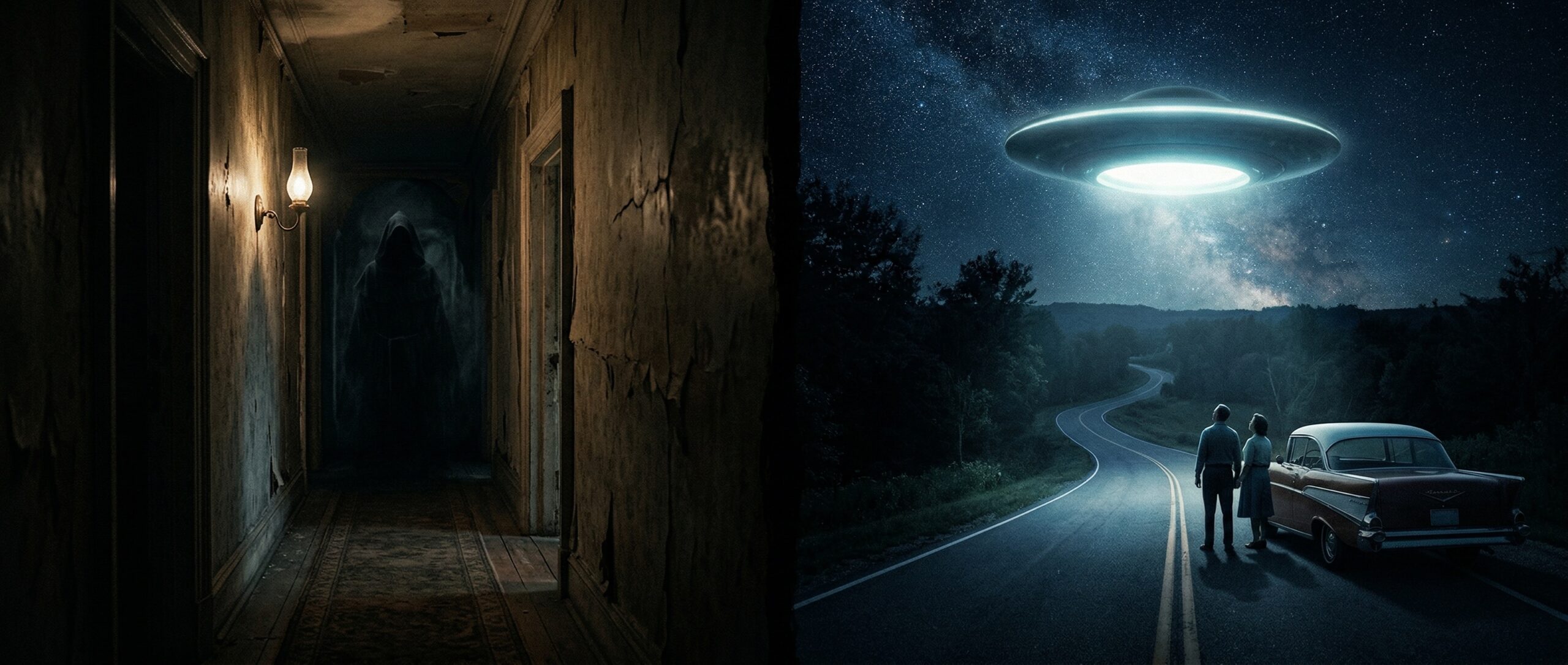
In the arid hills outside Ras Al Khaimah, the Al Qasimi Palace still stands like a mirage that refused to vanish—marble columns crumbling under salt wind, Swarovski chandeliers swinging in empty ballrooms, and a fleet of luxury cars rusting in the courtyard. The family who built it as a $130 million monument to opulence left so abruptly that dinner plates remained on the table, closets still held tailored silk robes, and the keys to a Rolls-Royce Silver Shadow sat on a kitchen counter gathering dust. Officially, the story stopped there. But in the surrounding villages, whispers traveled faster than any press release. They spoke of jinn.
Not ghosts. Not superstition. Jinn—intelligent, unseen beings recognized in Islamic theology long before Hollywood invented the poltergeist. According to locals who still refuse to approach the palace after sunset, something ancient and territorial had decided the Qasimi family had built too close, dug too deep, or simply claimed what was never meant to be owned. Within weeks of the sudden evacuation, construction workers hired to seal the property reportedly heard footsteps in corridors where no human walked. Security cameras placed by subsequent caretakers allegedly captured doors slamming with force that shattered their frames. One watchman, interviewed anonymously by Gulf paranormal investigators, claimed he saw a figure in traditional Emirati dress standing on the main balcony at 3:00 a.m.—a balcony that had collapsed the previous year.
The palace was never merely a residence. Its architecture blended ancient Egyptian motifs with Islamic geometric patterns and subterranean chambers that extended far beneath the foundation plans filed with the municipality. Some researchers who have studied the property from satellite imagery note that the underground levels form a shape disturbingly similar to older temples found in the region—structures predating Islam by millennia. If the Qasimis accidentally built atop a site with older significance, the theory goes, they may have provoked guardians that do not recognize modern deeds of ownership. Islamic theological texts on jinn describe them as territorial beings capable of displacing human occupants from land they claim.
What the Watchmen Saw
By 2012, the palace had cycled through four different security firms. Each company terminated its contract early. The common thread in their exit interviews was not pay or working conditions—it was the third floor.
Multiple guards described identical phenomena: a pervasive feeling of being observed in the east wing, electronic equipment failing simultaneously at 3:33 a.m., and the sound of heavy furniture dragging across marble above rooms that were definitively empty. One firm installed motion detectors throughout the corridor network. According to leaked maintenance logs, the sensors triggered 200–400 activations per night in a building with no occupants, no animals, and no accessible entry points. The pattern was not random. The activations moved sequentially, as if something was patrolling the halls on a route.
A former supervisor told regional journalists that his team captured audio of a voice speaking classical Arabic—a dialect none of the guards recognized until a linguist identified it as rooted in pre-Islamic Nabataean pronunciation. The recording, which circulated briefly on Middle Eastern paranormal forums before vanishing, allegedly contained a single repeated phrase: “This threshold is older than your God.”
The Jinn Framework
Western paranormal enthusiasts often default to ghostly explanations, but the Arabian Peninsula has a far older conceptual vocabulary. Jinn are described in the Quran as beings created from “smokeless fire,” possessing free will, intelligence, and territorial instincts. Unlike ghosts—residual echoes of the dead—jinn are considered living entities with agency, capable of jealousy, rage, and protection of sacred spaces.
Scholars of Islamic esotericism note that the Ras Al Khaimah region sits on trade routes active since the Bronze Age, corridors where incense, copper, and ritual artifacts moved between Mesopotamia and the Indus Valley. Local folklore holds that certain hills are “inhabited,” not empty, and that construction without proper acknowledgment can provoke retaliation. In this context, the Al Qasimi Palace is not an anomalous haunting but a predictable outcome within a cosmology that treats land as occupied by multiple orders of beings.
The Official Narrative
The Qasimi family has never publicly addressed the paranormal claims. Through representatives, they maintain that the palace was vacated for undisclosed financial reasons following the 2008 market contraction. Real estate analysts point out that Ras Al Khaimah’s luxury property sector did suffer significant losses during that period, and that abandoning a trophy asset—while extreme—is not unprecedented.
However, the financial explanation struggles against certain details. The family left behind art collections conservatively valued in the millions. They abandoned vehicles rather than shipping them. They did not sell the property, lease it, or demolish it—they simply stopped returning, stopped answering questions, and stopped paying the local utilities, which were eventually disconnected by the municipality in 2010. A bankruptcy-driven exit typically involves asset liquidation. This looked like evacuation.
Global Parallels
The Al Qasimi case belongs to a category of high-value abandonments that resist neat accounting. In India, the Bhangarh Fort carries a legally enforced sunset curfew due to persistent phenomena that have made overnight stays impossible for centuries. In Romania, the Baciu Forest has driven experienced researchers to psychological breakdown. These locations share a common feature: they were not abandoned because of economic downturn, but because human presence became untenable.
What distinguishes the Al Qasimi Palace is its scale of luxury. Haunted houses are typically decaying Victorian structures or remote cabins. A $130 million palace with imported marble, gold-plated fixtures, and underground temples suggests that whatever prompted the departure was powerful enough to override the most potent human motivator: wealth.
What Remains
Today, the palace stands in controlled decay. Local authorities have sealed the main entrances, but satellite photography shows fresh disturbances in the desert around the subterranean wings—excavation marks that do not match any permitted archaeological or construction activity. Drone operators who have flown over the property report GPS interference localized specifically above the central dome, a phenomenon documented in video but never explained by geologists.
The surrounding communities have integrated the palace into their oral tradition. Parents warn children away from the perimeter fence. Taxi drivers refuse fares that end at the palace gates after dark. The structure has become a landmark not of wealth, but of boundary—a physical reminder that certain territories remain ungovernable by money, law, or modernity.
Skeptics note that abandonment often breeds legend, and that economic trauma can be mythologized into supernatural narrative by communities seeking symbolic explanations for inequality. The Qasimi family’s silence, while consistent with private grief or legal strategy, has also created a vacuum that folklore naturally fills. Without access to the property’s interior, investigators cannot verify the motion logs, the audio recording, or the collapsed balcony apparition. Documented cases of abandoned luxury properties frequently attract paranormal attribution within months of vacancy.
Yet the guards who quit keep quitting. The sensors keep triggering. And in the villages below the palace, where the call to prayer echoes across hills older than recorded history, the answer to what happened inside those marble halls has never changed. The jinn were there before the foundation was poured. They will be there when the last column falls.
Paranormal culture has a memory problem, but it also has an immortality problem. New videos, fresh sightings, viral ghost clips, and rapidly spreading conspiracy threads appear every week, yet most of them vanish almost as fast as they arrive. Then there are the cases that do not die. They survive format changes, skeptical reappraisal, media cycles, and generational turnover. They keep resurfacing as if they were never fully finished with us. The Black Monk of Pontefract is one of those cases. So is the Barney and Betty Hill abduction story. Both remain active in public imagination not because they are the newest mysteries, but because they satisfy something deeper than novelty ever can.
That is why renewed 2026 interest in classic paranormal cold cases matters. This is not just another nostalgia wave. It is evidence that some unexplained stories become permanent cultural property. They move beyond their original witnesses and become frameworks through which later audiences understand haunting, abduction, terror, testimony, and the possibility that a single case can define an entire subgenre. Modern paranormal media keeps rediscovering these stories because they still outperform plenty of newer material on the level that matters most, symbolic durability.
This is the real pillar angle. The question is not merely why these two cases are famous. It is why certain paranormal cold cases become immortal while others collapse into footnotes. Readers who have followed how the Westall UFO mystery still shapes witness culture or seen why Borley Rectory remains the template for haunted-house myth will recognize the pattern. The strongest paranormal cases do not survive because they are solved, but because they remain useful to the imagination. They survive because they are narratively complete enough to feel real and unresolved enough to stay alive.
Classic paranormal cold cases survive because they become story engines, not just old reports
Most unexplained stories flare and disappear because they never achieve full narrative architecture. They may be creepy, strange, even briefly viral, but they do not generate enough enduring structure to support endless retelling. The cases that last do something different. They become story engines. They offer memorable witnesses, emotionally charged details, symbolic settings, escalating strange events, unresolved interpretation, and enough documentation to keep both believers and skeptics engaged without closing the case.
That is what separates a durable paranormal cold case from a passing weird headline. A durable case has shapes people can remember. A room, a road, a family, a night drive, a monk, missing time, poltergeist violence, fear on the faces of witnesses, official uncertainty, and just enough evidence to argue over forever. These elements make a story portable. They allow it to live in books, television, podcasts, YouTube explainers, TikTok summaries, and campfire-style retellings without losing coherence.
In that sense, the best paranormal cold cases operate like folklore with documentation attached. They are modern legends that retain the persuasive force of named people, specific places, and archived accounts. That combination is rare, and it is one reason only a small number of old mysteries become permanently renewable.
The Black Monk of Pontefract still represents the ideal haunted-house case
The Black Monk of Pontefract remains one of Britain’s most persistent haunting legends because it contains nearly every element a classic ghost case needs. A family home. Repeated disturbances. object movement. Physical attacks. witness fear. Apparitions. A historical backstory involving a monk. Investigators. Religious framing. Media circulation. Whether one treats the events as supernatural, psychological, exaggerated, socially contagious, or some unstable combination of all four, the case is narratively rich in a way that very few haunting stories are.
Its power comes partly from the domestic scale of the fear. A haunting works best when it invades the place that should be safe. Pontefract’s endurance has less to do with a single spectacular piece of evidence than with the layered way the case accumulated menace. The reports do not feel like one odd moment. They feel like an environment turning hostile. That kind of escalation allows audiences to imagine themselves into the story very easily.
It also helps that the Black Monk story sits comfortably between folklore and case file. The image is unforgettable, but so is the setting. The story remains vivid because it compresses haunting into a symbolic form almost anyone can grasp: the home is breached, the unseen has presence, and the past refuses to stay buried. That formula still works because it touches something older than modern paranormal branding.
Barney and Betty Hill became the template for modern alien abduction narrative
If Pontefract helped define the haunted-house cold case, Barney and Betty Hill helped define the abduction case in its modern form. Their 1961 experience in New Hampshire became one of the most influential UFO contact stories ever told, not only because of what they claimed happened but because of how the case was narrated, recorded, investigated, and culturally processed afterward. Missing time, hypnosis, recurring memory fragments, emotional trauma, road-based encounter structure, and the possibility of nonhuman contact all converged into a template that later abduction stories would echo for decades.
The Hill case remains so powerful because it feels transitional. It belongs to an older UFO era while also prefiguring the psychologically intimate abduction accounts that would dominate later discourse. It is not simply a story about lights in the sky. It is a story about what happens when witness experience becomes uncertain even to the witnesses themselves. That makes it especially durable. A case survives longer when it contains not only external mystery, but interior fracture.
It also matters that Barney and Betty Hill were real people whose testimony carried emotional complexity. Their story was never purely cinematic. It felt disorienting, human, and difficult. That quality has helped keep the case alive across generations, especially as disclosure culture and alien-contact media continue to reframe older abduction narratives as foundational texts rather than quaint early episodes.
These cases endure because they sit at the intersection of testimony, atmosphere, and cultural timing
The Black Monk and the Hill abduction look like very different paranormal stories, but they survive for related reasons. Each case offers strong atmosphere, emotionally memorable witnesses, a symbolic setting, and enough ambiguity to remain arguable. Each also emerged at a time when the surrounding culture was ready to absorb and amplify its meaning. A haunting case thrives in a culture still attuned to domestic spiritual fear. An abduction case thrives in a culture already primed by space-age anxiety, technological futurity, and the possibility of cosmic intrusion.
That balance matters. A case that is too evidentially thin will not last. A case that is too conclusively resolved also tends to lose long-term force. The immortal cases sit in a middle zone where details are strong enough to support retelling but uncertain enough to resist closure. They invite perpetual reinterpretation. That is exactly what contemporary media wants from legacy mystery content.
This is also why audiences keep comparing old cases to newer ones. The older stories feel denser. They carry accumulated interpretation. They have had time to become myth without losing their documentary traces. Newer cases often arrive raw and scattered. The classics arrive already shaped.
Modern podcasts, documentaries, and social clips keep reanimating legacy mysteries
One reason classic paranormal cold cases are surging again is structural. Modern media formats are unusually well suited to reviving them. Podcasts reward layered storytelling and witness reconstruction. YouTube essays reward archival collage and theory comparison. Short-form clips reward a single unforgettable image or detail. Streaming documentaries reward atmosphere, reenactment, and open-ended interpretation. A good old case can now be redistributed across every format at once.
This gives legacy mysteries a major advantage over newer reports that may lack narrative density. An older case comes preloaded with chronology, context, secondary commentary, and decades of accumulated cultural residue. Creators do not have to invent the gravity. They inherit it. That is why a story like the Black Monk or the Hill abduction can be repackaged endlessly without feeling exhausted. Each retelling borrows prestige from every previous retelling.
This same engine helps explain the continued success of other legacy mysteries on unexplained.co, from Westall to long-lived haunting narratives and revived sky anomalies. Old cases scale well because they already know how to survive interpretation.
Believers and skeptics both help keep the best cold cases alive
One of the least appreciated truths about paranormal survival is that skeptical attention can be as important as believing attention. A case that only believers discuss may remain within a subculture. A case that skeptics, historians, psychologists, folklorists, and debunkers keep revisiting becomes harder to bury. Every argument extends the shelf life. Every attempted explanation becomes another chapter in the case’s afterlife.
The Black Monk benefits from this dynamic because haunting cases invite questions about suggestion, fraud, family stress, religious imagination, and mass influence. The Hill case benefits because abduction narratives raise issues of memory, hypnosis, trauma, cultural contamination, and UFO belief formation. In both cases, skepticism does not erase the story. It thickens it. It gives it more layers to survive on.
That is why true cold-case durability often depends on interpretive conflict. If everyone agreed entirely, the case would settle. The immortal paranormal case remains alive because it never stops producing productive disagreement.
Many newer paranormal stories fail because they produce reaction without mythic structure
Modern internet culture can make almost any unexplained clip feel huge for 48 hours. But virality is not the same as mythic staying power. Many newer cases fail because they generate immediate reaction without building durable symbolic structure. There may be a strange video, a dramatic caption, a wave of commentary, and then nothing to hold onto. No strong witness arc. No layered setting. No emotional core. No room for long-term reinterpretation.
By contrast, the classic cold cases keep offering more than one thing at once. They provide incident, atmosphere, testimony, historical context, interpretive conflict, and iconic imagery. They become reusable narrative skeletons. This is why the classics keep outperforming new material. They are not simply older. They are more complete.
That completeness is not always about better evidence. Sometimes it is about better storytelling conditions. A case becomes immortal when it fuses event and myth before anyone realizes it has done so.
Immortal cases become containers for fear, belief, and identity across generations
Over time, the strongest paranormal cold cases stop functioning as isolated events and start functioning as cultural containers. People use them to think with. A haunting case becomes a way of imagining what a home means under threat. An abduction case becomes a way of imagining helplessness, contact, violation, or revelation. A witness story becomes a proxy for larger fears about authority, reality, and what kinds of experiences polite society will permit as real.
This is why such cases survive generational turnover. Younger audiences may not approach them in the same way earlier audiences did, but they still find use in them. The Black Monk can be read as folklore, trauma narrative, media artifact, or genuine haunting. The Hill case can be read as UFO history, psychological puzzle, race-era witness testimony, or foundational mythology of alien contact. The stories remain alive because they can do new work without losing their old force.
That flexibility is one of the clearest markers of paranormal immortality. A dead case cannot be repurposed. A living cold case can keep absorbing new anxieties and new interpretive styles indefinitely.
The return of classic cases says something important about the state of paranormal culture now
If classic cold cases are surging again, it may be because paranormal culture is growing more archival, not less. Audiences are no longer satisfied only by raw novelty. They want depth, lineage, and stories with enough texture to reward long attention. They want cases that feel like they matter because they have already survived scrutiny, retelling, and disagreement. In that environment, legacy mysteries become premium material.
This also suggests a broader fatigue with disposable weirdness. Endless minor anomalies can create temporary buzz, but they rarely build collective memory. The return to classic cases indicates that people still hunger for stories with weight. Not necessarily stories with answers, but stories with enough structure to support obsession.
That is why the current resurgence is more than content recycling. It is a sign that paranormal audiences still recognize the difference between a passing oddity and a case that has earned its place in the canon of the unexplained.
The paranormal cold case revival belongs to a wider hunger for durable mystery
Seen from a wider angle, the renewed fascination with classic cases belongs to a larger cultural pattern. People are gravitating toward mysteries that come with history attached, whether in UFOs, hauntings, occult revivals, or unsolved disappearances. A durable case offers continuity. It lets audiences step into a long conversation rather than consuming a single disposable moment. That continuity is valuable in an overstimulated media environment.
The Black Monk and Barney and Betty Hill continue to haunt us because they are not merely famous. They are structurally alive. They still offer fear, wonder, ambiguity, and interpretive space in proportions that newer stories rarely achieve. They remain arguable without becoming empty. They remain iconic without becoming inert.
That is the real answer to why old paranormal mysteries keep outperforming new ones. The strongest cases do not fade because they never stop functioning. They still help us rehearse the oldest questions: what happened, who can be believed, what entered the room, what crossed the road, and why some stories refuse to let the living move on.
Frequently Asked Questions
Why do classic paranormal cold cases keep returning?
Because the strongest old cases combine memorable witnesses, symbolic settings, unresolved interpretation, and enough documentation to support endless retelling across new media formats.
Why is the Black Monk of Pontefract still so famous?
It remains one of the most effective haunted-house cases ever told, combining domestic terror, repeated disturbances, apparition lore, and a setting that makes the fear feel intimate and believable.
Why does the Barney and Betty Hill case still matter?
Because it helped define the modern alien abduction narrative, especially the themes of missing time, psychological disruption, and intimate witness testimony that later cases would build on.
Do skeptics help old paranormal cases survive?
Yes. Ongoing skeptical debate adds layers to a case and keeps it active in public conversation, rather than allowing it to settle into a closed belief-only niche.
Why do many newer paranormal stories fade so quickly?
Because many generate short-term reaction without the deeper narrative structure, witness texture, and interpretive richness that allow a mystery to survive for decades.
The Ouija board has spent more than a century doing something almost no other occult object has managed to do. It moves effortlessly between worlds. One moment it is sold as a game, a novelty, a curiosity, something to pass around at a sleepover or pull off a shelf at Halloween. The next, it is treated as a threshold object, a ritual device, a portal, a mistake waiting to happen. Few tools in modern folk occultism carry that much contradictory power. Fewer still keep surviving each new wave of skepticism, parody, and pop-cultural overexposure without losing their charge.
That is exactly why the Ouija board keeps coming back, and why it never stays dead for long in the public imagination. It is trending again in 2026 for a reason. Younger audiences rediscover it through paranormal podcasts, short-form horror clips, reactivated urban legends, and retellings of old possession or haunting cases. Each generation believes it is encountering the board fresh. In reality, it is inheriting a ritual object already loaded with stories, warnings, dare culture, religious panic, and the seductive possibility that ordinary people might be able to contact something just beyond the visible world.
This is what makes the Ouija board more than an evergreen spooky topic. It is one of the clearest examples of how an occult object can function as a cultural mirror. The board reflects what an era fears, what it wants to believe, and how it negotiates the line between play and danger. Readers who have followed the deeper history of occult practice or watched how stories like the Witch Farm case continue to shape modern haunting culture will recognize the pattern immediately. The Ouija board is not powerful because everyone agrees on what it is. It is powerful because nobody agrees, and that uncertainty itself becomes part of the ritual.
The Ouija board lives in the unstable space between toy, ritual, and taboo
The most important thing to understand about the Ouija board is that its power is inseparable from its ambiguity. A tarot deck usually enters the room as a divination tool. A grimoire arrives carrying the weight of hidden knowledge. A Ouija board can arrive in a shopping bag, a closet, a thrift store haul, or a joke gift, and still change the emotional temperature of a room immediately. That instability is part of its enduring force. People do not only react to what the board is supposed to do. They react to what it should never have been allowed to become.
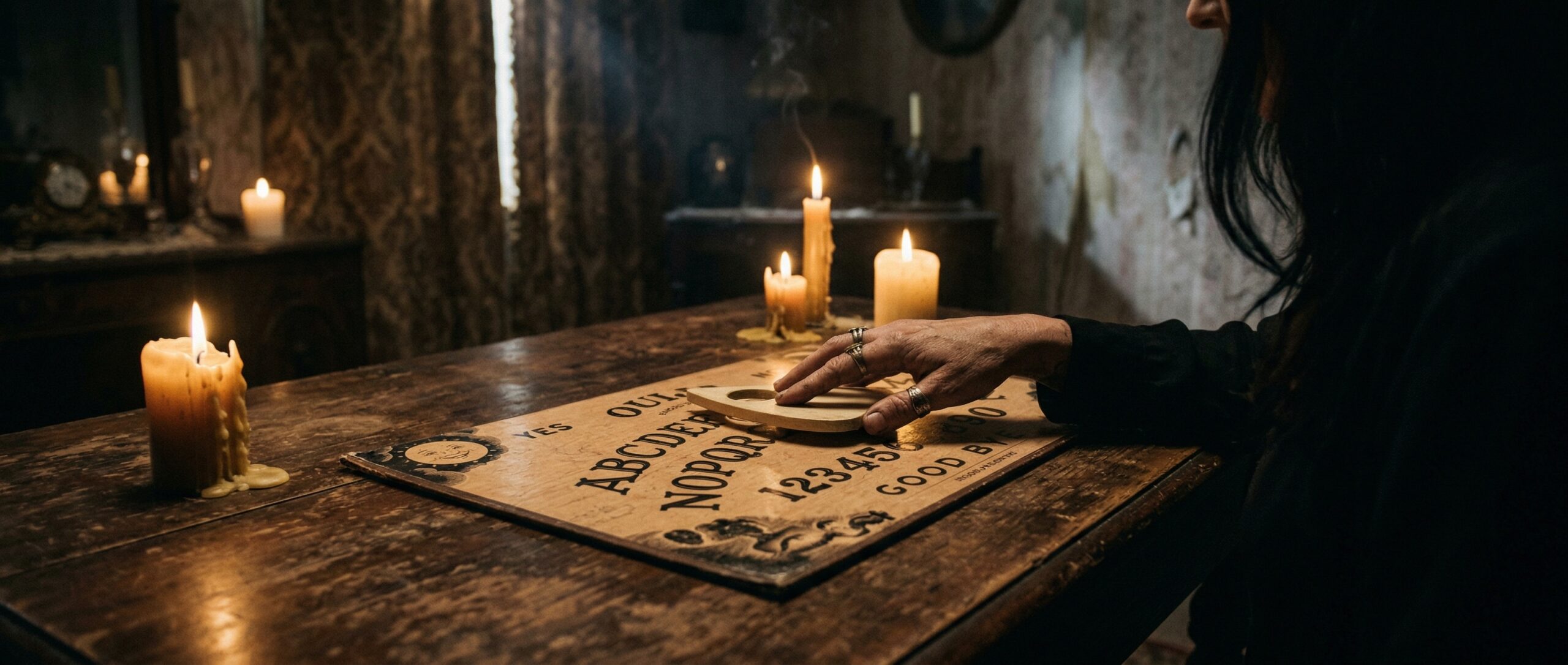
At a basic level, the board is simple: letters, numbers, yes, no, goodbye, and a planchette that appears to move beneath participants’ fingers. But culturally it is anything but simple. It sits at the point where entertainment, ritual, folk belief, spiritual experimentation, and dare culture all overlap. That is why it unsettles people who do not believe in it and fascinates people who do. It asks a dangerous-seeming question in the easiest possible form: what if communication with the unseen required almost no expertise at all?
This is also why the board feels different from many other occult tools. It democratizes contact. It does not ask for years of ceremonial study, rare texts, or complex symbolic systems. It invites beginners. It invites mockery. It invites bad faith. And then, because it is associated with movement that appears to happen under the users’ own hands, it turns even skepticism into participation. The board does not merely get used. It stages an experience, and that experience is what people carry away.
The board emerged from nineteenth-century spiritualism, not ancient occult tradition
For all its reputation as an ancient or timeless forbidden device, the Ouija board is a relatively modern product. Its roots lie in the spiritualist movement of the nineteenth century, when séances, spirit communication, automatic writing, table-turning, and mediumship became wildly popular in the United States and Europe. The board emerged from that same environment: a moment when mass grief, religious uncertainty, pseudoscientific curiosity, and fascination with unseen intelligence were all feeding into new forms of ritual contact.
Historians of occultism have long noted that spiritualism was revolutionary partly because it made the supernatural feel procedural. Contact was no longer reserved for saints, magicians, prophets, or village cunning folk. It could be attempted in parlors by ordinary middle-class participants. The Ouija board fit perfectly into that democratized landscape. As Smithsonian Magazine has documented, the board’s commercial history is tied to both spiritualist culture and patent-era entrepreneurship, which means it was never only a sacred instrument. It was also a commodity.
That strange dual identity never went away. The board was born at the intersection of belief and marketing, sincerity and performance. That is one reason it remains so hard to pin down. Unlike older ritual tools whose authority comes from antiquity, the Ouija board derives authority from modern repetition. It becomes powerful because generation after generation keeps reenchanting it.
Every generation rediscovers the Ouija board because it offers danger without complexity
There are many occult tools more elaborate than the Ouija board and many traditions more intellectually rich. Yet few have the same recurring mass appeal. That is because the board solves a cultural problem elegantly. It gives people an immediate, participatory brush with forbidden possibility without requiring much study. No initiatory structure, no memorized correspondences, no difficult ritual language. Just a board, a question, and the suggestion that something might answer back.
That simplicity makes the board unusually adaptable. Teenagers can approach it as a dare. Horror fans can approach it as a genre artifact. occult-curious audiences can approach it as a beginner’s ritual technology. Skeptics can approach it as a test of whether anything unusual really happens. The same object serves all of them. That flexibility helps explain why the board keeps reviving across media cycles. It is endlessly reusable because it can absorb whatever a generation already fears.
In 2026, the board’s revival fits especially neatly into platform culture. It performs well in short clips. It produces stories quickly. It invites reenactment. It turns uncertainty into narrative immediately. Whether a session is presented as real spirit contact, ironic experimentation, or post-midnight horror content almost does not matter. The board’s structure does the work. It gives any recording or retelling a built-in arc: question, movement, dread, interpretation.
The board became a fear object because stories gave it a personality of its own
The Ouija board did not become feared only because people used it. It became feared because stories gathered around it faster than around most other occult devices. Tales of the board rarely remain procedural. They become narrative almost at once. Someone asked the wrong question. Something followed them home. The planchette sped up. A name appeared that should not have appeared. The goodbye was ignored. A participant changed afterward. Even when these stories are secondhand, embellished, or impossible to verify, they create the sense that the board has preferences, moods, and consequences.
That is a key part of the board’s folkloric power. It stops behaving like an instrument and starts behaving like a character. People speak of it as though it can invite, mislead, deceive, or punish. That narrative shift changes how users approach it. The board becomes less like a neutral device and more like a threshold with agency. Folklore scholars have often shown that objects gain cultural force when they are embedded in cautionary storytelling, and the Ouija board may be one of the clearest modern examples of that rule.
Once that happens, every use session becomes haunted by prior stories. Participants do not begin from zero. They begin from layers of warning. That is why even a motionless session can feel charged. The board carries its archive into the room with it.
Religious warning culture helped turn the board into a forbidden threshold
No account of the Ouija board’s modern reputation would be complete without acknowledging the role of religious panic and moral warning culture. Across multiple Christian traditions, especially in the twentieth century, the board was treated not as harmless superstition but as an active invitation to deception, oppression, or demonic influence. Parents, pastors, and religious pamphleteers did not merely say the board was silly. They often said it was spiritually dangerous.
That distinction mattered enormously. Once religious authority framed the board as forbidden, the board’s cultural charge intensified. A thing condemned so strongly acquires mystique automatically. The warning itself becomes advertisement. This is one reason the Ouija board has remained more potent in popular imagination than many other mass-market occult objects. It was repeatedly named as the one object that could open the wrong door in an ordinary home.
That language still lingers even among people who no longer belong to the religious environments that spread it. Many modern users approach the board with inherited rules they cannot fully source: never use it alone, never mock it, never forget to say goodbye, never ask who will die, never burn it casually, never trust what comes through. These rules may vary, but together they form a shadow liturgy around the board. The object survives partly because the taboo does.
Psychology offers one explanation, but it does not dissolve the experience for participants
The most widely cited skeptical explanation for Ouija movement is the ideomotor effect, the phenomenon in which people make small physical movements unconsciously while sincerely feeling that they are not controlling them. Psychological research has long used this concept to explain dowsing, facilitated movement, and spirit-board sessions. From that perspective, the planchette moves because participants move it without consciously deciding to do so. The board becomes a mirror for expectation, suggestion, group dynamics, and hidden intention.
That explanation is persuasive, and for many cases it is likely sufficient. But it does not fully erase the board’s power at the level where most people actually experience it. If anything, it complicates it. The unsettling part is not only the possibility that spirits are real. It is the possibility that people can reveal things to themselves without realizing they are doing it. The board remains eerie under either reading. It either mediates something beyond the self, or it stages the return of something buried within the self. For many users, neither option feels especially safe.
This is why skeptical explanations often fail to end the fascination. They answer mechanism, but not meaning. They explain movement, but not why the room felt different, why certain answers landed so hard, or why the session seemed to expose hidden emotional currents in everyone touching the planchette. The board survives skepticism because skepticism does not entirely flatten what the experience feels like to the people inside it.
Horror media kept the Ouija board culturally alive even when belief changed
Even when direct belief in spirit communication became less common, the Ouija board never really left the cultural bloodstream. Horror cinema, paperback occult sensationalism, television hauntings, creepypasta logic, and later internet folklore all kept feeding the board new life. It became one of the few ritual objects that could be recognized instantly across generations, whether as a sincere danger, a camp icon, or a horror shortcut that needed almost no explanation.
That media afterlife matters because it means many people meet the board first through narrative before they ever encounter the object physically. They know what it signifies before they know its history. It means haunted contact, opened doors, and consequences that outlast the session. That symbolic condensation is incredibly efficient. Very few occult objects carry such a complete emotional script in public culture.
The board also adapts unusually well to retelling. A séance with layered ceremonial symbolism is harder to compress into a viral story. A spirit board session that spells out a name and ends badly can travel anywhere. It works in horror films, podcast episodes, TikTok reenactments, and whispered personal testimony. That portability has helped the Ouija board outlast changing belief systems and changing media forms alike.
Younger audiences keep returning because the board feels participatory and dangerously simple
The current revival makes sense partly because younger paranormal audiences are drawn to experiences that are interactive, aesthetic, and socially performable. The Ouija board does all three. It is visual. It is tactile. It can be staged easily. It produces suspense without special effects. Most importantly, it lets participants become part of the story immediately. In a culture saturated with spectatorship, that is a powerful selling point.
The board also fits the broader return of folk ritual aesthetics. Many younger audiences are interested in candles, divination, haunted objects, ancestral practices, liminal spaces, and atmospheric tools that feel old even when their current usage is highly mediated through the internet. The Ouija board sits comfortably in that ecosystem, especially because it already carries a reputation for danger. It allows users to flirt with the occult while feeling that they are not merely performing a lifestyle trend. They are risking something.
That risk may be symbolic, psychological, or theatrical, but it feels real enough to matter. The board survives because it makes the unseen feel participatory. It turns haunting into a format people can touch.
The board still matters because it dramatizes the human desire to test the unseen
Strip away the toy branding, the horror clichés, the demonic warnings, and the skeptical rebuttals, and the Ouija board still returns us to a very old human impulse. We want to know whether the boundary is permeable. We want to know whether the dead answer, whether hidden intelligences notice us, whether ordinary rooms can become charged, whether meaning can arrive through simple material forms. The board does not create that desire. It concentrates it.
That is why the object endures. It stages one of the oldest religious and paranormal questions in an almost offensively accessible way. It says: sit down, ask, wait, see what moves. That is both ridiculous and profound. It is ridiculous because the format is so commercially ordinary. It is profound because the emotional stakes people attach to the answer remain enormous.
In that sense, the Ouija board is not just a spooky artifact. It is a recurring machine for producing uncertainty. That uncertainty can be dismissed, feared, ritualized, or aestheticized, but it rarely stays inert. The board continues to matter because it turns invisible questions into visible motion.
The Ouija revival fits a wider return to ritual objects, haunted folklore, and intimate occult fear
Seen in a wider context, the 2026 return of Ouija conversation is part of a larger cultural pattern. Old ritual tools keep resurfacing because they promise intimacy with the forbidden. Not abstract conspiracy, not distant mythology, but something close enough to hold in your hands. That is also why audiences continue to respond to haunted-location narratives, witchcraft revivals, spirit-communication stories, and classic possession lore. The scale is domestic. The risk is personal. The danger comes into the room.
This is where the board connects to unexplained.co’s wider territory. It belongs alongside investigations into occult history, haunted houses, folk ritual, and the repeated ways modern audiences reinvent old fears in new media environments. It also helps explain why some objects outlive debunking. They are too symbolically useful to disappear. The Ouija board remains one of the purest examples of that survival mechanism in modern occult culture.
The board was never just a board. It was a script, a dare, a threshold, a market product, a séance machine, a warning label, and a portable haunting myth. That is why every generation eventually picks it up again. Not because the mystery was solved, but because it never really stopped asking to be touched.
Frequently Asked Questions
Why does the Ouija board still scare people so much?
Because it sits between game, ritual, and taboo, and because generations of ghost stories, religious warnings, and horror media have taught people to see it as a tool that might open the wrong kind of door.
Was the Ouija board originally an occult object?
It emerged from nineteenth-century spiritualist culture rather than ancient occult tradition, which means it has always carried a mixed identity as both commercial product and spirit-contact device.
What is the skeptical explanation for Ouija board movement?
The most common explanation is the ideomotor effect, in which people move the planchette unconsciously while sincerely feeling that they are not controlling it.
Why does the Ouija board keep returning in pop culture?
Because it is visually recognizable, easy to dramatize, and perfectly suited to stories about haunting, possession, forbidden contact, and private fear.
Why are younger audiences interested in the Ouija board again?
It feels interactive, aesthetic, and risky in a way that fits modern paranormal media culture, especially for audiences drawn to ritual objects, haunted folklore, and participatory occult experiences.
This article was created using Media Blaster – Your content production specialist. Visit www.mediablaster.io for more information.