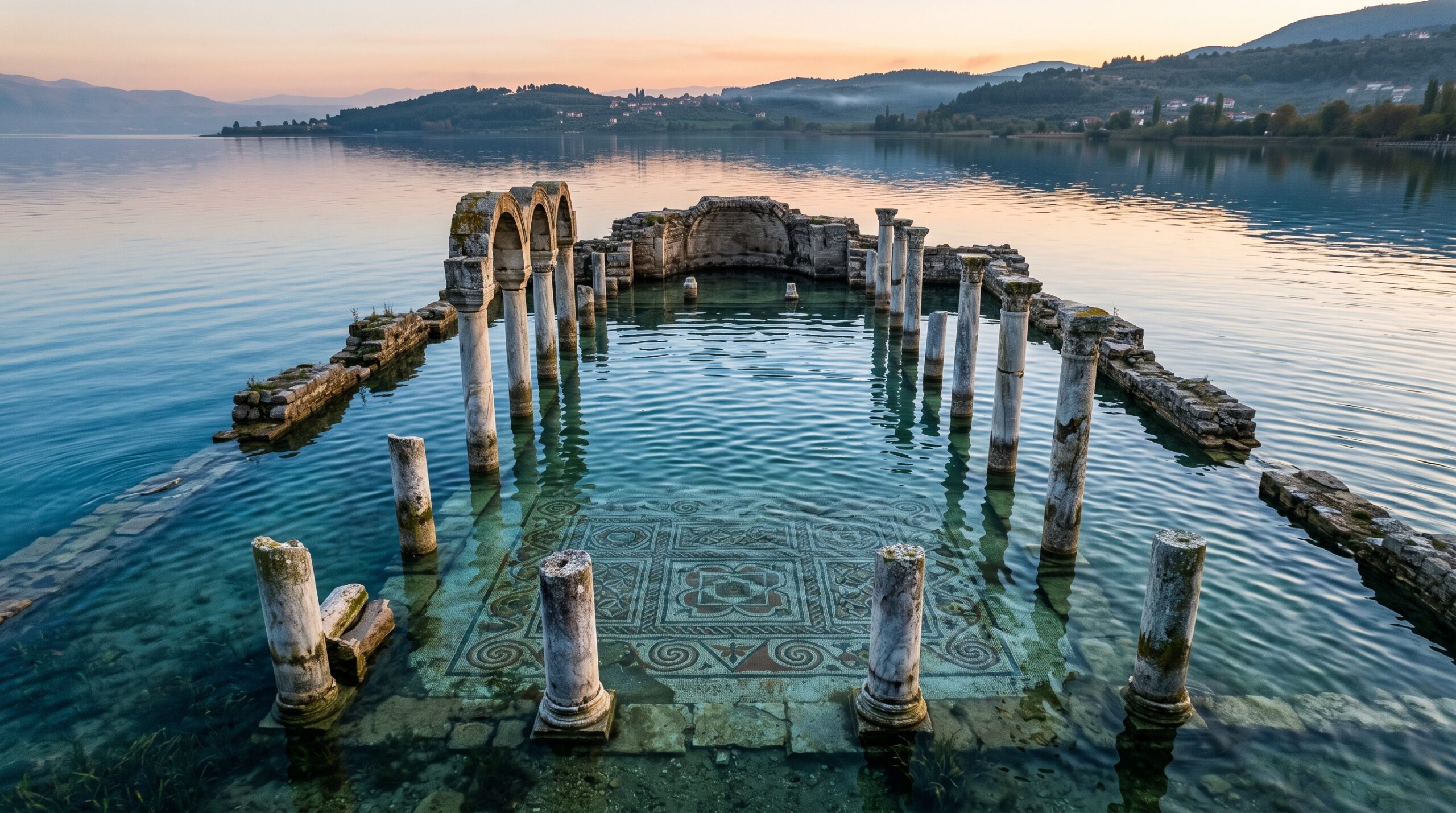
# The Sunken Basilica of Iznik: Did a Lake Hide the Council of Nicaea?
Beneath the water of Lake Iznik, the outline of a fourth-century basilica has turned a familiar chapter of Christian history into a physical mystery. The structure is real. The more dramatic claim—that it was the church where the First Council of Nicaea met in A.D. 325—remains possible, disputed, and not yet proven.
That distinction matters. The submerged ruins are not a fantasy, but the identity of the building depends on reconstructing a vanished shoreline, a changing city, and a council whose surviving historical record does not hand archaeologists a simple address.
## What is beneath Lake Iznik?
The basilica lies offshore from İznik, the modern Turkish town built over ancient Nicaea. Archaeologists identified the submerged remains after aerial photography and later underwater investigation revealed walls, columns, and a church plan beneath the lake. Live Science’s archaeological report describes a fourth-century structure that appears to have been built near the ancient shoreline before later earthquakes and changes in water level altered the setting.
The site is therefore more than a picturesque “sunken church.” Its date and location place it inside the right historical world: Nicaea was an important Roman and early Christian center, and the region experienced seismic and environmental changes capable of reshaping the waterfront.
The first information gain is the separation of three claims that are often compressed into one headline: the basilica exists; it dates to the relevant broad period; and it hosted the council. The first two are archaeological propositions. The third is an identification argument.
## Why the Council of Nicaea connection is so powerful
The First Council of Nicaea was convened under Constantine I to address a major dispute over Christian doctrine, especially the relationship between God the Father and Christ. Its decisions helped produce the Nicene Creed and gave the gathering an importance far beyond the walls of one ancient city. The historical outline from Britannica places the council in Nicaea in 325, but does not identify a surviving basilica as its meeting hall.
That missing address is the opening through which the mystery enters. If the council met in a building now below the lake, the ruins could connect a famous theological turning point to a concrete landscape. If not, the basilica still reveals how early Christian architecture occupied a city later transformed by disaster, rebuilding, and rising water.
Supporters of the identification point to proximity, chronology, and the church’s prominence. A large basilica near Nicaea’s ancient shore would be an intuitively plausible setting for an imperial-era gathering. But plausibility is not the same as proof, especially when the literary sources do not provide a definitive architectural match.
## The archaeological argument—and its limits
The strongest evidence is physical: the submerged church, its construction period, and its position relative to ancient Nicaea. Archaeology Magazine’s coverage of the Iznik basilica provides wider context for the discovery and the continuing work around the site.
The weaker link is the leap from “important fourth-century church” to “the council church.” Many early Christian buildings were rebuilt, expanded, or assigned new functions. A basilica’s size can suggest status, but it cannot by itself identify a specific meeting. Archaeologists would need a denser chain of evidence: inscriptions, construction phases, artifact patterns, or a spatial relationship that can be matched to ancient descriptions.
A second insight is that the lake may be as important to the story as the council. Water does not merely conceal ruins; it changes the conditions under which they survive. Walls, foundations, and shoreline relationships may preserve information that a later urban landscape erased, while also making excavation slower and interpretation more difficult.
## What happened to the church?
The basilica appears to have stood in a landscape vulnerable to earthquakes and shifts in the lake. Over centuries, the shoreline changed and the building passed out of ordinary view. That does not require a single catastrophic “sinking” event. Ancient waterfronts can disappear gradually through subsidence, sediment, reconstruction, and changing water levels.
This is where the story resists the cleanest version of the legend. The ruins may have been submerged through a combination of natural processes rather than one dramatic night. Yet gradual disappearance can be more revealing than a catastrophe: it shows how a functioning sacred landscape can become invisible without anyone needing to erase it.
For comparison, the discovery also echoes a broader archaeological pattern in which a small clue opens a much larger landscape. As with the 3,700-year-old ritual site found after a student noticed one lonely rock, the decisive evidence was not a ready-made monument with an explanation attached. It was a surviving feature that forced researchers to ask what the surrounding terrain once meant.
## Confirmed, plausible, and unknown
**Confirmed:** a substantial basilica lies beneath Lake Iznik; it belongs broadly to the early Christian period; and it sits near the ancient city of Nicaea.
**Plausible:** the church may have been important enough to connect with elite or imperial Christian activity, and its location makes the council theory understandable.
**Unproven:** that the First Council of Nicaea actually met inside this specific structure. The identification remains an interpretation rather than a settled archaeological fact.
That uncertainty should not flatten the story. It sharpens it. The ruins give us a rare physical encounter with the world around one of late antiquity’s most consequential gatherings, even if they cannot yet answer the most seductive question.
## The mystery beneath the mystery
The real enigma is not simply whether a famous council met in a sunken church. It is how much of history depends on places whose names survived while their physical settings vanished. Nicaea remains on the map, but the shoreline has moved, the buildings have changed, and the old city now has to be read through water.
Further underwater excavation, dating, and comparison with historical descriptions may strengthen—or weaken—the basilica’s proposed identity. Until that work is complete, the responsible conclusion is neither “this is definitely the council church” nor “the theory is meaningless.” It is a documented ancient building carrying a plausible historical possibility that still needs decisive evidence.
Would finding an inscription beneath Lake Iznik change how you imagine the First Council of Nicaea—or would the unanswered question be part of what makes the ruins so compelling?