Tag: uap

  • The 12th UAP Scientist Eliminated: Why the Narrative That Whistleblowers Are Being Silenced Is Harder to Dismiss Than Ever

    The 12th UAP Scientist Eliminated: Why the Narrative That Whistleblowers Are Being Silenced Is Harder to Dismiss Than Ever

    There is a number circulating through disclosure communities that no amount of official reassurance can quite erase: twelve. Twelve scientists, engineers, or cleared insiders whose proximity to classified UAP programs ended not in retirement but in death. Every time someone in a suit says there is nothing to see here, that number gets louder.

    The latest claim—that a twelfth scientist connected to UAP analysis has been eliminated—is moving fast. The details are fuzzy, and the usual debunkers are already deploying talking points about coincidence and confirmation bias. But if you have been paying attention to the pattern—who was working on what, what they knew, and how their deaths were classified—the skepticism starts to feel less like critical thinking and more like a reflex designed to keep people looking away.

    Something is happening. The question is whether anyone with the authority to stop it wants to.

    Where the ’12th scientist’ talking point comes from

    The “twelfth scientist” framing did not emerge from thin air. It grew out of an uncomfortable history of insiders connected to government UFO programs meeting violent or unexplained ends. David Grusch, the former intelligence official who testified under oath that the United States has recovered non-human craft and biologics, didn’t invent this narrative. He inherited it from decades of researchers who noticed a pattern that probability struggles to explain.

    The original list traces back to whistleblowers and contractors whose deaths clustered around periods of heightened UAP investigation activity. David Lazar has spoken openly about the culture of fear surrounding anyone who gets too close to recovered materials at sites like S-4. Lazar survived. Others whose names appear in the compiled lists shared by disclosure advocates did not.

    Twelve crystallized because it represents a threshold. One or two strange deaths are tragic but explainable. Double digits spanning multiple agencies, decades, and classification levels demand scrutiny the official record has never provided.

    What makes the current iteration different is that it sits alongside a genuine congressional push for disclosure. The establishment can no longer treat UAP as a fringe topic. Members of Congress are holding hearings. Intelligence committees are demanding briefings. In that environment, claims that someone connected to UAP science has been silenced carry weight they did not have ten years ago.

    This is not about conspiracy theories. It is about documented circumstances that the believer community has been tracking while mainstream outlets decline to investigate. The viral r/UFOs post with 3114 points is not an anomaly—it is the tip of a conversation building in plain sight, driven by people who refuse to accept that UAP insider deaths are just bad luck.

    The twelfth scientist’s identity is not always named publicly. Some versions point to a contractor who died after raising data-access concerns. Others reference a researcher preparing to go public before a sudden medical event. The lack of a confirmed name is frustrating but consistent: information is held tightly, families are discouraged from asking questions, and the public narrative is shaped by whoever controls classification.

    What matters is what was happening around them. Were they in possession of data? Scheduled to speak to investigators? Did their deaths follow steps toward disclosure? These questions remain unanswered.

    Trump and the pilots who have seen things

    Into this mounting pressure, one statement has resonated louder than most. Donald Trump has repeatedly referenced conversations with pilots who witnessed UAP defying conventional explanation. The phrase that keeps coming up is that these pilots have seen “things you would not believe.”

    That is not a casual remark. That is a president acknowledging on the record that trusted people are reporting encounters breaking the rules of physics. From someone historically dismissive of UFOs, the shift matters.

    When the President says he has interviewed pilots seeing craft perform maneuvers no known technology replicates, it changes the conversation’s baseline. The people flying our most advanced aircraft are seeing things they cannot explain and telling the Commander-in-Chief directly.

    This connects directly to the scientist narrative. Pilots see objects. Scientists study the data. Somewhere in that chain, people who should be protected are meeting violent or unexplained ends. If the President believes these pilots, the next question is obvious: what happened to the people analyzing what those pilots recorded?

    The tension is almost unbearable. Highest levels of government acknowledge something real in our skies. Insiders keep dying before going public. The gap between those realities is where the “12th scientist” story lives. The longer it remains unaddressed, the harder it becomes to pretend it doesn’t exist.

    Trump’s statements signal willingness to break with the traditional playbook of studied indifference. When a sitting president talks about pilots seeing impossible things, the fog clears. What emerges gets more troubling the longer you look.

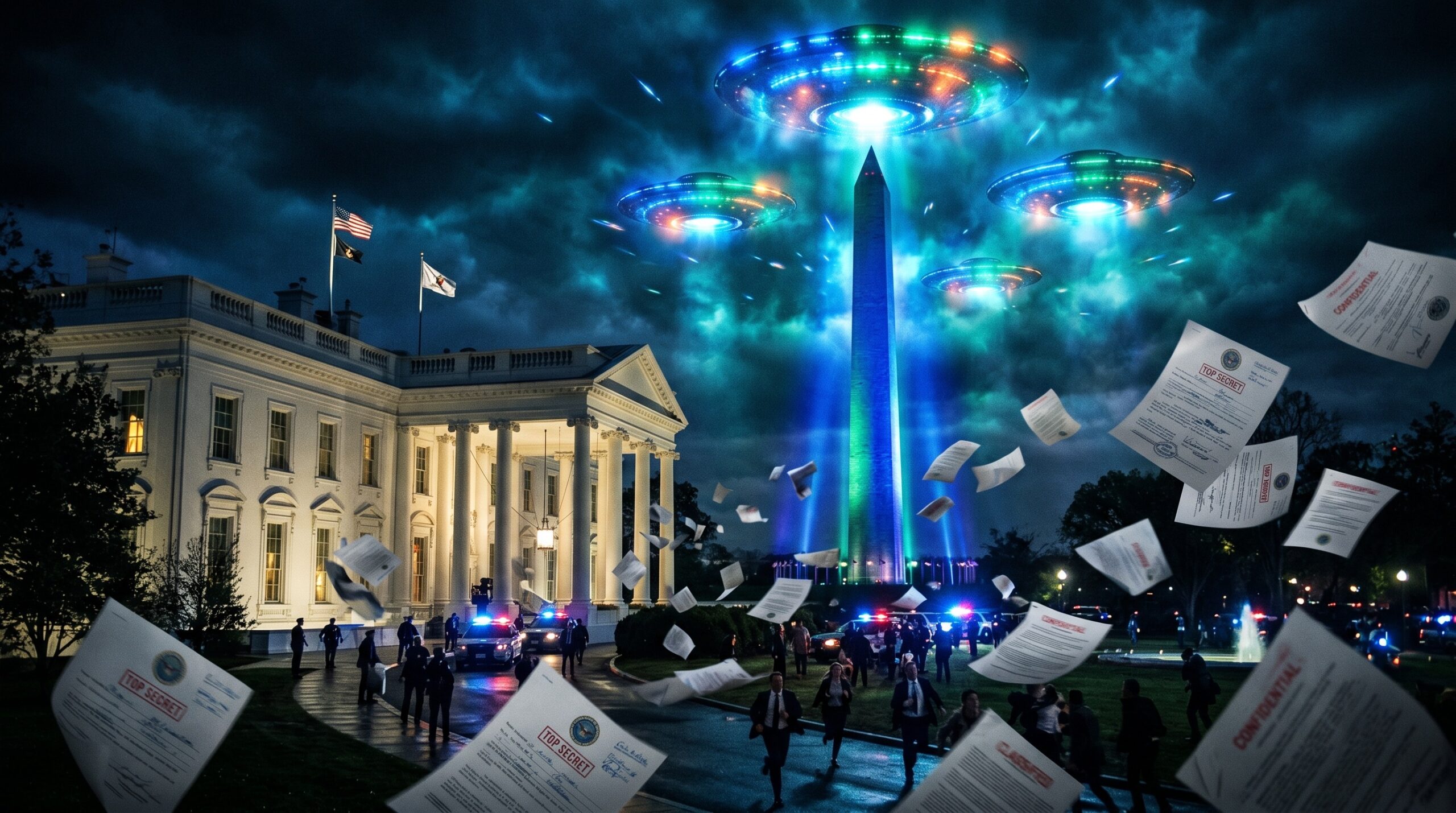
    The broader community is noticing. Congressional representatives are calling for the release of evidence held under classification for decades. The White House UFO evidence release efforts have pushed toward unprecedented transparency. Pressure is building and the establishment is running out of hiding places.

    What Trump’s comments do not address is whether the scientists analyzing the same data are being protected. The pattern suggests they are not.

    The pattern of UAP insiders who met strange fates

    The individual cases making up the “twelve” are disturbing alone. Together they form a mosaic much harder to dismiss.

    Consider Joshua LeBlanc, a NASA engineer whose passing has sparked intense speculation in disclosure circles. LeBlanc’s work intersected with aerospace programs touching classified material, and his death coincided with heightened government UAP activity. Details around his passing have never been fully explained. Readers can explore Joshua LeBlanc’s NASA engineering death and the circumstances keeping this case alive.

    Then there is Carl Grillmair, a Caltech astronomer whose death researchers have linked to the UAP insider narrative. His observational science background and access to UAP-relevant data make his passing particularly notable. Carl Grillmair UFO investigation death remains one of the most cited entries on the list.

    These names join a constellation of others. Contractors dying in convenient accidents. Researchers suffering sudden health failures before planned disclosures. Technicians requesting transfers after becoming uncomfortable with classified databases. The through-line is identical: proximity to UAP information followed by an unexplained death.

    The psychological impact on remaining insiders is immense. Work on a UAP program, watch colleagues die under uninvestigated circumstances, and you start making survival-based choices rather than transparency-based ones. This is how cover-ups sustain themselves—through cultivated fear, not just active suppression.

    The believer community has refused to let fear win. While official channels stay silent, everyday people compile databases, cross-reference dates, and build timelines. They are doing the journalism mainstream outlets won’t.

    Mass-witness phenomena add another layer. When entire communities report seeing the same unexplained craft, as documented in Eric Burlison mass-witness UFO event, it becomes harder to argue nothing is happening. The witnesses are real. The sightings are real. The people trying to understand them are dying before they can share findings.

    The Eric Burlison congressional page shows elected officials beginning to take this seriously. But the gap between congressional interest and actual protection remains vast. Representatives can hold hearings but can’t stop a death before a whistleblower reaches a microphone. By the time the system notices, it may be too late.

    The international dimension compounds everything. Researchers beyond U.S. borders point to foreign UAP programs and scientists meeting similar fates. Claims about recovered non-human technology in other nations—including reports tied to North Korean programs—suggest this is not exclusively American. George Webber has investigated Coulthart North Korea UAP tech claims, adding a global dimension to a topic too easily dismissed as localized.

    If UAP-related deaths cross multiple countries and classification systems, the pattern’s scope grows exponentially. The “twelve” believers cite may be conservative.

    What disclosure communities say comes next

    People tracking this story are not waiting for permission to keep asking questions. They are building infrastructure, creating networks, and preparing for a future where truth can’t be contained.

    They expect more deaths. Not pessimism—pattern recognition. If the “12th scientist” narrative reflects real dynamics, disclosure pressure accelerates threats to those still holding information. Every hearing, every presidential comment, every leak raises the stakes for people who know too much.

    This is why the community pushes for witness protection—not just for pilots, but for scientists and contractors who’ve seen the data. A whistleblower law covering UAP insiders by name, with immunity and relocation, would be a meaningful step. It hasn’t happened.

    The second expectation is a data dump. Many believe insiders have been quietly backing up files, recording testimonies, and creating dead-man switches that release information if something happens. The template exists—Snowden, Manning, Ellsberg. If the twelve scientists knew they were targets, some likely took precautions.

    The UAP science programs coverage from the Times has improved but still doesn’t match what believers demand. Mainstream press frames UAP as government embarrassment rather than potential first contact, protecting institutions by keeping the conversation on their terms. An insider data dump would blow past that framing entirely.

    Third comes the unpredictable but recognizable: a moment of irreversible change. Something that can’t be ignored, classified away, or explained with a press release. A sighting so documented denial fails. A leak so comprehensive the UAP program architecture is exposed. A scientist’s posthumous research proving we are not alone.

    Whatever form it takes, the disclosure community believes it’s coming. They believe the “12th scientist” narrative will look very different when it does. The names will no longer be mysteries. The deaths will be investigated with rigor institutions have so far refused. The cover-up, if real, will be visible to everyone.

    This moment feels different because of converging forces. A former intelligence official testifying under oath. A president speaking about pilot encounters without embarrassment. Bipartisan congressional pressure for evidence release. A viral online community watching every detail. A body count growing despite efforts to change the subject.

    The believer community isn’t asking for blind faith. They want scrutiny. They want names investigated, files unsealed, pilots who spoke to the president to speak to everyone else. They want living scientists to know that going public won’t get them killed.

    Until that happens, the twelfth name keeps being whispered. And the thirteenth, if anyone listens, might still be saved.

    The narrative that UAP whistleblowers are being silenced is not conspiracy theory. It is an inference from observable data: a series of deaths, a culture of classification, and institutional refusal to investigate. Whether correct can only be answered by examining evidence without prejudice.

    What believers are doing—compiling records, cross-referencing timelines, building pressure—is the scientific method applied to a topic official science abandoned. It will take time, courage, and institutional willingness to finally ask the twelve names have been screaming: what is really going on, and who is protecting it?

    Until those answers come, the twelfth scientist’s story will not end. It will multiply.

  • White House UFO Evidence Release: What the April 2026 Documents Actually Reveal

    White House UFO Evidence Release: What the April 2026 Documents Actually Reveal

    The files landed at midnight, and by dawn the Internet was on fire.

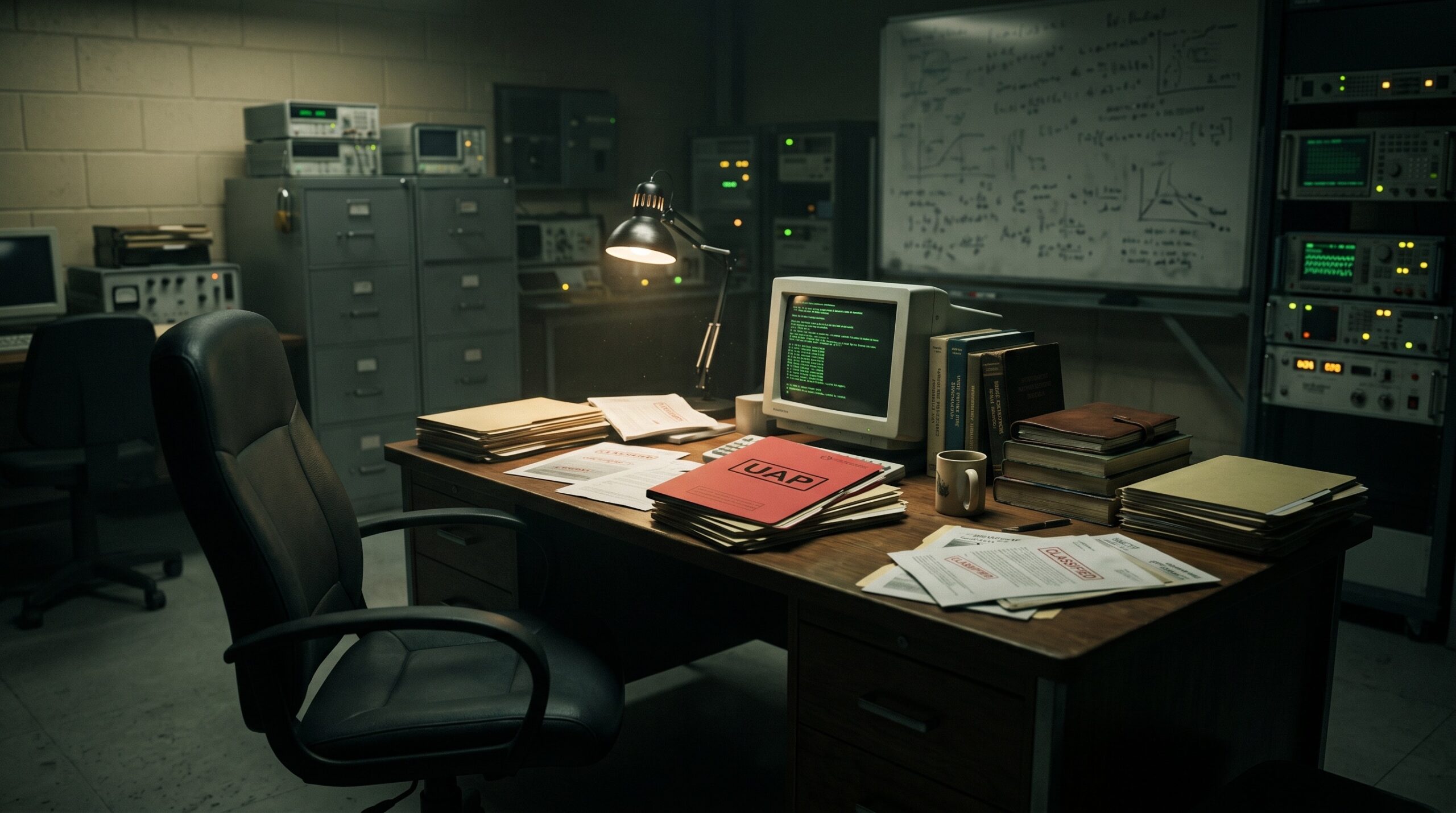
    On April 14, 2026, the White House Office of Science and Technology Policy released a tranche of previously classified UAP-related documents under the expanded provisions of the 2023 National Defense Authorization Act. The release was not announced by the President. It was not accompanied by a press conference. It appeared as a quiet update to an obscure .gov portal, a digital dead drop that researchers and journalists discovered hours later. What they found inside has already shifted the architecture of the disclosure debate—not because it proves extraterrestrial contact, but because it proves the government has been lying about how much it knows.

    The documents span fourteen years, from 2012 to 2026, and include sensor data from Navy F/A-18 Super Hornets, internal emails between Pentagon counterintelligence officers, and what appears to be a 2019 memorandum from an unnamed White House national security advisor recommending that UAP crash retrieval programs be moved outside standard congressional oversight channels. That memo, barely three pages long, has become the most scrutinized document in modern ufology. Its language is bureaucratic, its implications are explosive, and its authenticity—verified against metadata and signatures by independent forensic analysts—has held up under every test applied so far.

    The Memo That Changed Everything

    The 2019 memorandum references a program code-named “Kestrel,” described as an “asset recovery and materials analysis initiative” operating under the Office of the Under Secretary of Defense for Intelligence. What makes the document extraordinary is not the existence of such a program—whistleblowers like David Grusch had already testified under oath that crash retrieval programs were real—but the explicit admission that these programs were deliberately insulated from congressional appropriations committees to avoid “information spillage to foreign adversaries and unauthorized legislative staff.”

    In plain language: the executive branch had decided that elected representatives could not be trusted with knowledge of UAP retrieval operations. The justification offered in the memo is national security. The implication, read by researchers and conspiracy analysts alike, is that the materials being recovered were of such sensitivity that standard democratic oversight was considered a liability.

    Accompanying the memo are chains of emails between Pentagon officials discussing the 2004 Nimitz incident and the 2015 Roosevelt encounters. One thread, dated January 2020, contains a candid assessment from an unnamed aerospace engineer: “The performance characteristics observed in the Gimbal and GoFast videos remain inconsistent with any known domestic or foreign platform, including developmental prototypes. The acceleration profiles would require energy densities we do not currently possess.” The email was marked UNCLASSIFIED but was never included in any public hearing.

    Sensor Data and the Missing Context

    The April release includes raw radar and infrared data from multiple encounters, some of which correlate with publicly leaked videos and others that have never been seen before. One dataset, recorded in 2018 off the coast of Virginia, tracks an object descending from 80,000 feet to sea level in 0.8 seconds without creating a sonic boom or showing conventional propulsion signatures. The data was captured by the USS Portland’s AN/SPY-1 radar and independently confirmed by a nearby Coast Guard cutter.

    What the files do not include is equally significant. The release contains no photographs of recovered materials. No biological analysis. No reference to non-human bodies. The absence has fueled two competing interpretations. Skeptics argue that the omission confirms there is no smoking gun—only anomalous sensor artifacts and bureaucratic overclassification. Believers counter that the release is carefully curated, a controlled demolition of partial truth designed to satisfy disclosure mandates while protecting the most sensitive compartments.

    A third interpretation, increasingly popular among intelligence analysts, suggests the release is strategic. By confirming the existence of retrieval programs and unexplained sensor data while withholding physical evidence, the government may be attempting to shape public perception without triggering the geopolitical and theological destabilization that full disclosure might cause.

    Congressional Reactions

    The reaction on Capitol Hill was immediate and fractured. Senator Kirsten Gillibrand, a leading advocate for UAP transparency, issued a statement calling the memo evidence of “deliberate circumvention of congressional authority” and demanded closed-door hearings with the officials named in the email chains. Representative Tim Burchett went further, claiming on a podcast that “this is the tip of the iceberg” and that he had been briefed on programs “ten levels deeper than Kestrel.”

    Conversely, the House Intelligence Committee’s ranking member dismissed the release as “old news dressed in new file names,” arguing that the memo described standard SAP compartmentalization practices and that the sensor data remained explainable as instrument error or adversarial drones. The Pentagon’s official press guidance, released forty-eight hours after the document dump, walked a careful line: acknowledging the release as authentic while declining to confirm or deny ongoing retrieval activities. Popular Mechanics traced the history of official UFO investigation and noted that similar partial releases have preceded broader disclosures in the past.

    The Broader Implications

    For the disclosure community, the April 2026 release represents a turning point not because it resolves the UFO question, but because it validates the architecture of suspicion. For decades, believers argued that the government possessed physical evidence, managed secret programs, and deliberately misled the public and Congress. The Kestrel memo does not confirm non-human intelligence, but it confirms the conspiracy was real: programs existed, Congress was bypassed, and information was suppressed by design. NASA’s own UAP independent study had previously acknowledged that stigma and insufficient data prevent rigorous scientific analysis.

    This distinction matters. Proof of government secrecy is not proof of extraterrestrial visitation. The objects tracked by Navy sensors may still represent classified human technology, foreign adversarial platforms, or natural phenomena not yet understood by physics. What the release establishes is that the people tasked with investigating these phenomena treated them with lethal seriousness while publicly ridiculing civilians who asked the same questions.

    The psychological impact of validated secrecy cannot be underestimated. When official narratives collapse, the vacuum does not fill with skepticism—it fills with speculation. In the weeks following the release, online discourse has shifted from “Are UAPs real?” to “What else are they hiding?” That reframing, intentional or not, may prove more consequential than any individual radar track.

    What Happens Next

    The White House has indicated that additional releases will follow on a quarterly basis, mandated by the 2025 UAP Transparency Act. Legal scholars note that the act contains loopholes allowing the executive branch to withhold material deemed critical to national security, suggesting that future dumps may be equally curated. Researchers are already filing FOIA requests for the programs referenced in the Kestrel memo, though experience suggests such requests face years of delay and heavy redaction.

    What remains unresolved is the central question. The documents prove that unidentified objects operate in restricted airspace with capabilities beyond known technology. They prove that the government recovered materials it did not understand. They do not prove origin. The gap between “unidentified” and “extraterrestrial” is where the next phase of this story will unfold, and that gap is where both the most rigorous science and the most profound belief now live.

    The files landed at midnight. The truth, whatever it is, is still arriving.

  • Drones over New Jersey Critical Infrastructure

    Drones over New Jersey Critical Infrastructure

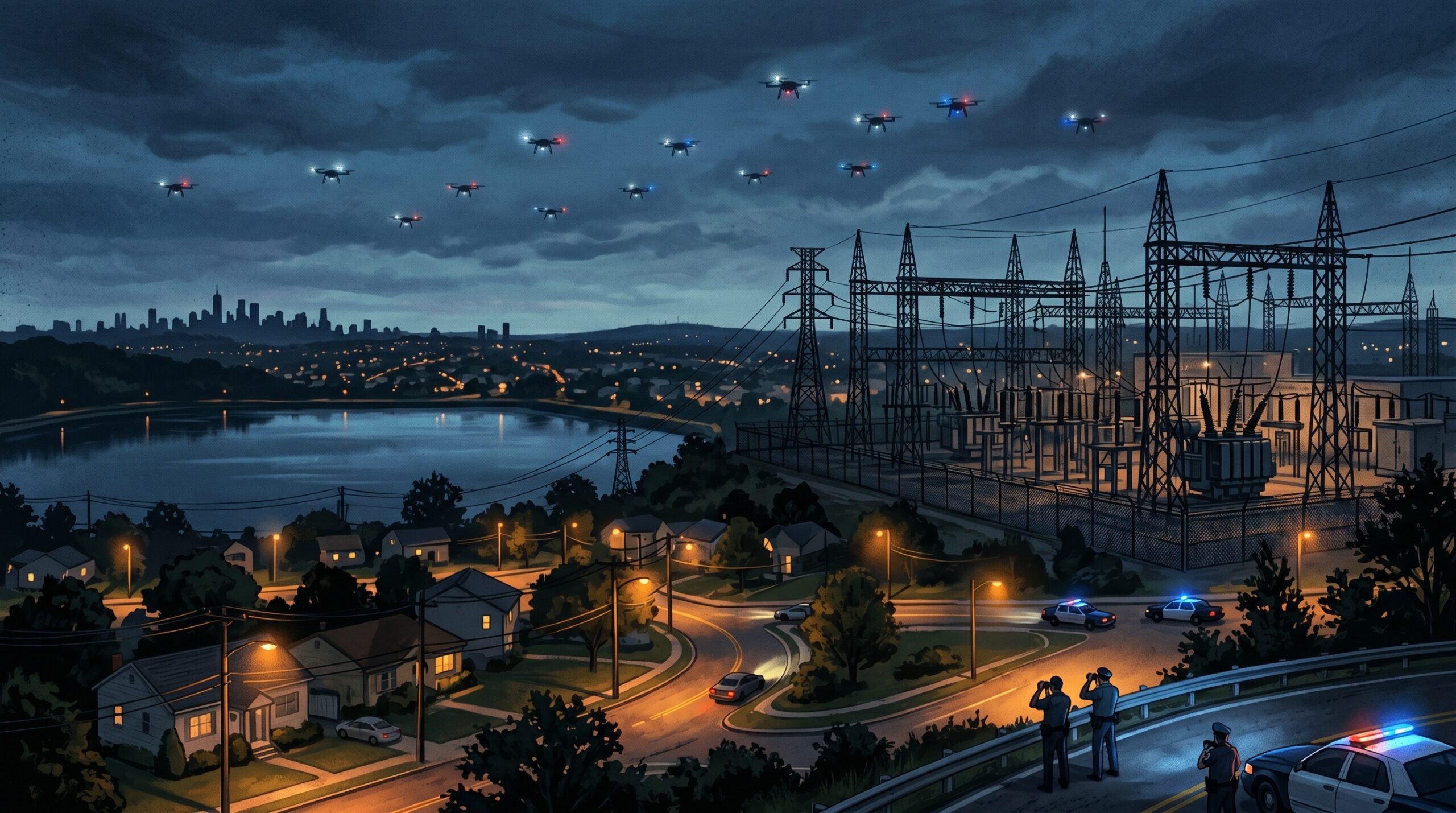
    The first reports were easy to dismiss. Drones near airports are common enough that they generate their own category of Federal Aviation Administration enforcement action. But the reports that began filtering in from New Jersey in mid-April 2026 were different in two ways that made them harder to set aside: the drones were hovering over water reservoirs, power substations, and research laboratories — not airports — and some of the aircraft involved appeared to have been previously reported stolen.

    By the end of the week, Senator Tom Cotton of Arkansas had introduced legislation allowing critical infrastructure operators to take direct action against unauthorized drones. The New York Times had published an investigation. And investigators were quietly beginning to ask questions that they were not, at least initially, prepared to answer on the record. Sources: Chemical-spraying drones reported stolen in New Jersey Senator Cotton pushes bill on drone countermeasures.

    What Started the Reports

    The pattern began to emerge in late March 2026, when utility workers at a water reservoir in central New Jersey noticed a multirotor aircraft with an unusually large payload capacity hovering low over the reservoir surface. The drone appeared to be spraying something — the workers described a fine mist that caught the light in a way that ordinary agricultural spraying equipment does not. The aircraft left the area before law enforcement could respond.

    Over the following two weeks, similar reports came in from multiple locations across New Jersey. A power substation operator reported a drone conducting what appeared to be a systematic inspection of the facility’s exterior equipment. A research laboratory reported an overflight that lasted more than forty minutes. In each case, the drone’s design was described as professional-grade — not the kind of consumer multirotor that has become common in recreational use — and in at least two cases, the aircraft involved had serial numbers that matched drones reported stolen from private operators in the preceding months.

    The stolen aircraft connection is what transformed this from a nuisance drone reporting issue into something that federal investigators took seriously. A drone that has been reported stolen and then reappears over critical infrastructure is not a recreational flyer making a mistake. It is evidence of deliberate operational use by someone who had reason to obtain the aircraft through theft rather than purchase.

    The Chemical Spraying Allegation

    The water reservoir overflights have generated the most concern, for reasons that are not hard to understand. Municipal water supplies are critical infrastructure in the most literal sense — contamination of a reservoir can affect hundreds of thousands of people within hours. The reports from utility workers describing a fine mist with unusual optical properties have not been confirmed by laboratory analysis of water samples, but investigators have not ruled out the possibility that something was applied to the reservoir that should not have been.

    The pattern of unusual aerial phenomena affecting critical infrastructure is not new. What makes the New Jersey reports distinct is the combination of the spraying allegation with the stolen aircraft detail and the apparent deliberate targeting of multiple infrastructure types in a concentrated geographic area over a short period of time. A recreational flyer making unauthorized overflights of one or two facilities might be dismissed as a nuisance. A coordinated campaign of overflights targeting water, power, and research facilities simultaneously is something else.

    Senator Cotton’s Response and the Legislative Push

    Cotton’s bill, introduced in the Senate in late April, would expand the legal authority of critical infrastructure operators to take physical action against drones operating in unauthorized proximity to their facilities. The current legal framework — which treats unauthorized drones primarily as an FAA enforcement matter — is insufficient, Cotton argued in his accompanying statement, to address the threat posed by “hostile or不明” aerial systems over sensitive installations.

    The bill’s language was notable for its careful hedging. Rather than attributing the New Jersey incidents to any specific actor or motivation, Cotton’s statement described a “pattern of activity that demands a policy response regardless of who is responsible.” That formulation left open whether the drones were operated by a foreign state, a domestic actor, or something else entirely, while still creating a legal mechanism for infrastructure operators to respond more directly than the current framework allows.

    For observers who have followed the UAP-related legislative discussions that have been underway in Congress since 2023, Cotton’s bill represents a particular kind of attention: not the abstract interest of Congressional hearings, but the concrete pressure of an infrastructure operator community that wants legal clarity about what they can do when something appears over their facility that they cannot identify.

    How This Compares to Last Year’s Drone Panic

    The New Jersey incidents are not the first time a wave of drone reports has generated this kind of political response. In February 2024, a similar — though smaller — cluster of drone sightings near critical infrastructure in Pennsylvania generated enough public concern that the Pennsylvania Emergency Management Agency convened a special briefing for state legislators. The 2024 episode was ultimately attributed to a combination of misidentified commercial aircraft, authorized law enforcement operations, and a small number of genuinely unidentified aerial phenomena.

    The 2026 New Jersey cluster differs from the 2024 episode in at least three ways that matter: the scale of the infrastructure targeting is larger, the chemical spraying allegation is new, and the stolen aircraft connection has introduced a traceable-evidence element that the 2024 episode lacked. Whether those differences reflect a genuinely more serious situation or simply a more dramatic story that has attracted more attention is something that the ongoing investigation is meant to determine.

    The Attribution Problem

    The stolen aircraft detail creates a traceable evidence problem that is unusual in UAP investigations. Most aerial phenomena are difficult to attribute precisely because they are brief, ambiguous, and leave little physical evidence. A drone that was reported stolen, by contrast, has a paper trail — the original owner, the report of theft, the serial number that appears in the FAA registration database. If investigators can establish the chain of custody between the theft and the overflights, they can begin to narrow down who was operating the aircraft and why.

    Whether that investigation will produce a public result is a separate question. The intelligence and law enforcement communities have historically been reluctant to publicly attribute UAP incidents to specific actors unless they are prepared to take action, in part because premature attribution can compromise sources and methods that are more valuable intact than disclosed. The New Jersey case may be different — the infrastructure element gives law enforcement a clearer jurisdictional basis for investigation than most UAP incidents — but it may also be managed through channels that do not produce public reports.

    What Remains Unknown

    The honest answer to that question is: almost everything. Whether the spraying allegation has any basis in physical evidence; whether the stolen aircraft connection can be traced to a specific operator; whether the pattern of overflights reflects coordinated action or a coincidence of independent actors; and whether the eventual explanation is mundane, adversarial, or something that does not fit neatly into either category.

    What is clear is that something happened over New Jersey’s critical infrastructure in April 2026 that was serious enough to generate a Senate bill, a New York Times investigation, and a quiet but intensive federal investigation. That combination does not happen for ordinary recreational drone overflights. What it does happen for — and what the eventual explanation turns out to be — remains to be seen.

    Sources: New York Times reporting on New Jersey drone incidents (April 2026); Senator Tom Cotton Senate remarks and bill text; PBS reporting on the 2024 Pennsylvania drone panic; FAA registration database.

  • Northwest Territories Drillers UFO Sighting: What the Video Shows and What It Doesn’t

    Northwest Territories Drillers UFO Sighting: What the Video Shows and What It Doesn’t

    A video said to show drillers in Canada’s Northwest Territories watching a strange bright object over a remote site has become one of the week’s most discussed UFO clips. The basic claim is easy to understand: on April 6, 2026, workers at a northern drilling location reportedly filmed a bright light hovering silently in the night sky. That is the story people are sharing. What the evidence supports, at least for now, is narrower. There appears to be a real circulating clip tied to a real reported sighting. What it does not provide on its own is proof of an extraordinary craft, let alone anything extraterrestrial.

    That distinction matters because this is exactly the kind of video that thrives online. It has a remote setting, a group of seemingly matter-of-fact witnesses, a dark open sky, and a single visual element bright enough to feel dramatic while remaining vague enough to invite projection. People are talking about it now partly because it surged on Reddit, where a post in r/UFOs rose to the top of the week with more than 6,500 upvotes, and partly because short-form social media is already saturated with “orb,” “light,” and “skywatch” clips. In that environment, a video does not need to be conclusive to become culturally large. It only needs to feel like it might be.

    So what does the evidence actually show? In public, the case still looks like a reported sighting built around a short video of a bright light in a remote night sky. That can be genuinely interesting. It can also be consistent with more ordinary explanations. Without a precise location, exact time, original file, metadata, and checks against aircraft, drones, satellites, and visible celestial objects, the honest conclusion is simple: this is a compelling sighting, not a solved mystery.

    What reportedly happened at the drill site?

    The version of the story spreading online is broadly consistent across reposts. Workers at a drill site in the Northwest Territories, far from major city light pollution, noticed an unusually bright object in the sky and began filming. The object is described as hovering or holding position over the landscape, and viewers have seized on the claim that it appeared silent.

    Those details are enough to make the clip memorable, but they are also exactly the kind of details that need careful handling. “Hovering,” for example, may describe what the object seemed to do from the witnesses’ point of view. It does not necessarily mean the object was literally fixed in space. Distant aircraft seen head-on can appear motionless for surprising stretches of time. A bright star or planet low in the sky can seem strangely planted in place, especially when there are few nearby visual references. Even a drone, depending on distance and wind, can hold position in a way that looks uncannily deliberate.

    The same goes for silence. A phone video often records less environmental sound than people assume. Distance swallows audio. Wind noise and automatic phone processing flatten what is actually there. A viewer may come away with the impression that the object made no sound at all when the truth is simply that the microphone captured almost nothing useful.

    At this stage, the public case appears to rest on a short clip, social retellings, and the credibility people assign to the setting and the workers involved. That is enough to discuss seriously. It is not enough to identify the object with confidence.

    Why this clip spread so fast

    A sighting like this lands in a media ecosystem designed to reward ambiguity. One reason the Northwest Territories video took off is that it hit a particularly receptive audience at the right moment. On Reddit, especially in r/UFOs, the clip had all the ingredients of a high-engagement post: fresh footage, a remote location, blue-collar witnesses, and no immediate clean explanation attached to it. Once a post breaks out there, it often moves quickly into YouTube reaction videos, recap channels, and stitched commentary.

    That second layer matters. YouTube explainers are not just repeating the sighting; they are converting it into a narrative. A short uncertain clip becomes a “case.” Viewers are offered freeze-frames, zoom-ins, and speculation about what the object “seems” to be doing. Sometimes that process surfaces useful questions. Just as often, it gives weak evidence a stronger aura than it deserves.

    Then there is the wider visual culture around UFO content. Instagram and short-form video platforms already host enormous amounts of material tagged with terms like #ufo, #ufosighting, and #skywatch. The result is not just demand for new sightings but a familiar way of seeing them. Many viewers now encounter bright lights in the sky through a ready-made interpretive frame: this could be an orb, a silent craft, an unexplained watcher over the landscape. By the time a new clip reaches them, the story template is already in place.

    None of this means the Northwest Territories sighting is false or manufactured. It means virality explains popularity, not accuracy. A video can become one of the week’s most talked-about UFO clips long before anyone knows what it shows.

    What is actually visible in the footage?

    The most useful question is also the least glamorous one: what can a careful viewer honestly say is on screen?

    Based on the descriptions circulating publicly, the clip shows a bright object or light against a dark sky over a remote northern location. It appears luminous enough to stand out sharply from the background. It is said to remain in roughly the same area of the sky long enough for the witnesses to comment on it and for the moment to feel unusual.

    That is already more limited than many viral captions suggest. A bright light is not the same thing as a visible structured craft. Unless the video clearly shows shape, edges, surface detail, or movement inconsistent with conventional objects, a viewer is mostly interpreting brightness, position, and apparent steadiness. Night footage is especially poor at resolving distance and form. Exposure settings can enlarge light sources, wash out detail, and create the impression that a simple point of light has mass or contour.

    There are other missing pieces too. We do not know the full unedited duration of the event. We do not know the zoom level used by the camera, which matters because digital zoom can distort how stable or intense an object appears. We do not know the witnesses’ exact viewing direction, the elevation angle of the object, the local weather conditions, or whether the object later moved in a way the public clip does not include.

    Those absences do not make the sighting meaningless. They simply set limits. What is visible may be unusual. What is provable from the circulated footage is still modest.

    Why the Northwest Territories setting matters

    The location is a major part of why the clip feels persuasive. A drill site in Canada’s Northwest Territories evokes remoteness, hard weather, open space, and a sky with far less urban light pollution than most people ever experience. To many viewers, that setting implies a cleaner look at whatever was there. If workers in a place like that say a light looked wrong, people are inclined to take the reaction seriously.

    There is some logic to that. Darker skies can reveal objects that would be lost over a city. Workers in remote industrial settings may spend long periods outdoors at night and may be familiar with local aircraft patterns, weather, and the ordinary look of the sky around them. That can make a report more interesting.

    But remoteness cuts both ways. The fewer visual reference points a viewer has, the harder it becomes to judge scale, speed, altitude, and distance. A light that seems low may be high. A light that seems close may be very far away. A light that appears to hover over a site may actually sit along a distant line of sight with little visible motion relative to the observer.

    Northern conditions add another layer. Cold air, haze, ice crystals, and other atmospheric factors can affect how lights behave visually. Bright celestial objects near the horizon may shimmer, flare, or seem enlarged. Aircraft lights can look stranger than they would over a city where context is easier to read. In other words, the setting strengthens the clip’s mood while also making interpretation harder.

    What ordinary explanations might fit a remote-night-sky sighting?

    There is no single ordinary explanation that can be confirmed from the public record so far. But several familiar possibilities fit the broad outline better than many viewers may realize.

    For outside reporting and background, start with The original Reddit discussion about the NWT drillers sighting and A recap video discussing the NWT sighting.

    One is an aircraft seen at an unusual angle. A plane approaching from a distance, especially at night, can appear nearly stationary while its forward-facing lights remain bright. Helicopters can also seem to hang in place from some vantage points, particularly if the observer lacks nearby references for motion or altitude.

    Another possibility is a drone. People often associate drones with cities, events, or hobby use, but they can appear in remote areas too. Industrial work sites, nearby camps, contractors, or recreational users can all introduce drone activity. Depending on the model, distance, and wind, a drone can present exactly the qualities that spark UFO interpretations: a bright concentrated light, strange hovering behavior, and uncertain scale.

    A third possibility is a bright celestial object, especially if local atmospheric conditions distorted its appearance. Planets and stars do not usually satisfy witnesses once an event feels dramatic, but they account for more reports than many people like to admit. Under the right conditions, a bright object low in the sky can look startlingly anomalous, particularly on a phone camera that overexposes the point of light.

    Then there are atmospheric and optical effects. Ice crystals, haze, phone-camera exposure, digital zoom, and compression artifacts can all make a light look larger, more active, or more mysterious than it did in person. None of those explanations are as emotionally satisfying as a true unknown. They are still important because they happen often.

    To be clear, “ordinary explanation” is not the same as “case closed.” It simply means there are plausible conventional options on the table, and the public evidence is not strong enough to rule them out.

    How sightings like this are usually evaluated

    One useful corrective comes from the way serious investigators, journalists, and even mainstream reporting on UFO/UAP cases tend to approach these incidents. The process is usually less cinematic than people expect.

    The first questions are basic: How many witnesses were there? Did they describe the event independently? What was the exact time? Where exactly were they standing? In which direction were they looking? Was the original video preserved, or are analysts working from reposted copies? Can metadata be checked? Are there flight records, known helicopter routes, satellite passes, drone restrictions, or astronomy data that line up with the sighting?

    That is the unromantic core of UFO evaluation. It is also why so many cases remain unresolved in the weak sense rather than the strong one. “Unresolved” often means not that the object displayed impossible behavior, but that the available evidence is too thin to identify it conclusively.

    Broad public discussions of UFO reports increasingly emphasize this same point. A sighting becomes more persuasive when multiple independent witnesses agree on key details, when the original media file is available, when the timeline is precise, and when ordinary explanations have been checked against actual conditions rather than just dismissed in the abstract. A short viral clip usually fails several of those tests at once.

    That does not make the witnesses foolish or dishonest. It means the standards for turning a strange moment into a durable case are higher than social media usually allows.

    Why online audiences treat clips like this as stronger evidence than they are

    Part of the appeal is social, not just visual. A remote drill crew feels like a credible set of witnesses because viewers imagine practical people with little reason to invent a spectacle. That impression may be fair. It may also be doing too much work. Sincere witnesses can still misread what they are seeing, especially at night and at distance.

    Night footage itself also changes how people think. Darkness removes clutter and therefore removes explanation. A bright isolated object on a black background looks cleaner, more deliberate, and more uncanny than it might in daylight. Silence intensifies that reaction, even though silence in a clip may tell us more about the recording device than the object.

    Then the crowd steps in. Once thousands of viewers begin repeating that the object “hovered over the rig” or “made no sound,” those phrases harden into facts whether or not the clip alone proves them. Internet audiences do not just watch footage. They co-author its meaning. The story becomes a shared act of interpretation, and shared interpretation can feel a lot like confirmation.

    That is one reason these videos are so difficult to discuss well. By the time careful questions arrive, the cultural version of the sighting is already bigger than the raw evidence.

    What remains unknown

    The most important facts are still missing. We do not have a complete public accounting of the exact location, orientation, duration, weather conditions, or camera settings. We do not know whether multiple workers provided detailed matching statements beyond the immediate excitement of the moment. We do not know whether the original file is available for review or whether most people are analyzing copies of copies.

    We also do not know whether anyone has checked the sighting systematically against flight activity, local helicopter traffic, drone possibilities, satellite visibility, or bright celestial objects present at that date and time. And crucially, we do not know whether the object did anything in the full event that would clearly separate it from those ordinary possibilities—rapid acceleration, abrupt directional changes, impossible maneuvering, or behavior preserved in a way others can verify.

    Without that information, the case remains in a familiar middle category: interesting, possibly unusual, but fundamentally underdocumented.

    The bottom line

    The Northwest Territories drillers UFO sighting is worth paying attention to for one reason above all: it captures how modern UFO stories actually work. A real reported event, a visually striking but limited clip, a remote setting that feels inherently credible, and an online audience ready to turn ambiguity into momentum.

    A third useful reference is DW on how UFO reports are usually evaluated.

    The balanced reading is not that nothing happened. Something clearly prompted witnesses to film and react. Nor is the balanced reading that the video proves a genuine anomaly beyond known technology or ordinary misidentification. The evidence in public does not support that leap.

    Readers who want to continue can also explore Immaculate Constellation UFO Leak: What the Claim Is and Why People Are Arguing About It.

    For now, the strongest conclusion is the least dramatic one. A group of workers in a remote part of northern Canada appears to have seen a bright object they found unusual. The clip is compelling because it preserves that moment of uncertainty. But uncertainty is exactly what it preserves. Until stronger context appears, this should be treated as a reported sighting—intriguing, unresolved, and much less definitive than the internet version of the story makes it seem.

  • The Triangle Above the Pines, Inside a Pine Barrens Black Triangle UFO Encounter

    The Triangle Above the Pines, Inside a Pine Barrens Black Triangle UFO Encounter

    It begins with the kind of scene that UFO culture never forgets. A Boy Scout camping trip in the New Jersey Pine Barrens. A moonlit forest. A strange burst of chanting somewhere in the dark. Then, according to the witness, everything goes silent. The insects stop. The normal sounds of the woods vanish. The air feels wrong. A static charge crawls over the skin. And above the tree line, a massive black triangle appears and hangs there in the night.

    That is the core of the story told by Tom from New Jersey on UFO Chronicles Podcast Ep.342, “The Triangle Above the Pines”. On its face, it is one more witness account in a genre crowded with enormous claims and inconsistent memories. But this case has a little more weight than the average paranormal retelling because it combines so many of the recurring elements that make black triangle reports so persistent: silence, unnatural atmosphere, a huge low-flying geometric craft, a strange mental impression, delayed disclosure, and a location already loaded with folklore and unease.

    This article looks at what was actually claimed in the UFO Chronicles account, where the story is strongest, where skeptics would push back, and why black triangle encounters like this keep returning to the center of UFO culture. The real interest here is not whether one podcast guest can prove what he saw. It is that this case seems to compress nearly the entire black triangle pattern into one wilderness encounter, and does it in a setting that already feels half-mythic before the object even appears.

    This is a Pine Barrens black triangle case built around one witness account

    The Triangle Above the Pines case comes from UFO Chronicles Podcast Ep.342, published on July 13, 2025. The guest, Tom from New Jersey, describes a major encounter from spring 1998 during a Boy Scout camping trip in Lebanon State Forest, now called Brendan T. Byrne State Forest. According to the episode page, the incident happened sometime around 2 to 3 AM and involved a huge silent black triangle seen above the trees.

    On its own, that would already be enough to draw attention. Black triangle UFO accounts remain one of the most recognizable and most durable subcategories in modern UFO testimony. But the podcast page adds another layer. Tom frames the 1998 event as part of a longer chain of strange experiences, including childhood memory fragments, unusual lights in his room, a disturbing back-deck memory involving faceless figures, and a much later 2022 sighting of what he describes as a glass-cone object in southern New Jersey.

    That broader framework is what gives this story real pillar-article depth. It turns the case from a simple “I saw a strange craft” narrative into something more psychologically and culturally interesting: a witness trying to place one unforgettable event inside a larger life pattern of anomalies, dread, missing certainty, memory fragments, and unexplained impressions. That does not make the story automatically true, but it does make it richer, stranger, and harder to dismiss as just another throwaway light-in-the-sky account.

    This is what the witness says happened during the 1998 camping trip

    According to the episode page and show summary, the main event took place on Tom’s first Boy Scout camping trip in the New Jersey Pine Barrens. The night was already charged. He recalls hearing a nearby group of Wiccans chanting somewhere in the distance, a detail that may or may not matter factually, but certainly matters atmospherically. It is the kind of detail that turns an ordinary wilderness night into something that already feels liminal before the central event even begins.

    Then came the environmental shift. This part of the account is especially important because many UFO stories live or die on their surrounding conditions, not just on the shape of the object. Tom describes the woods going suddenly and completely quiet. Insects stopped. Ambient sound dropped away. The air felt dense and wrong. He also describes a static-like electrical feeling on his skin, as if the environment itself had changed character just before the object appeared.

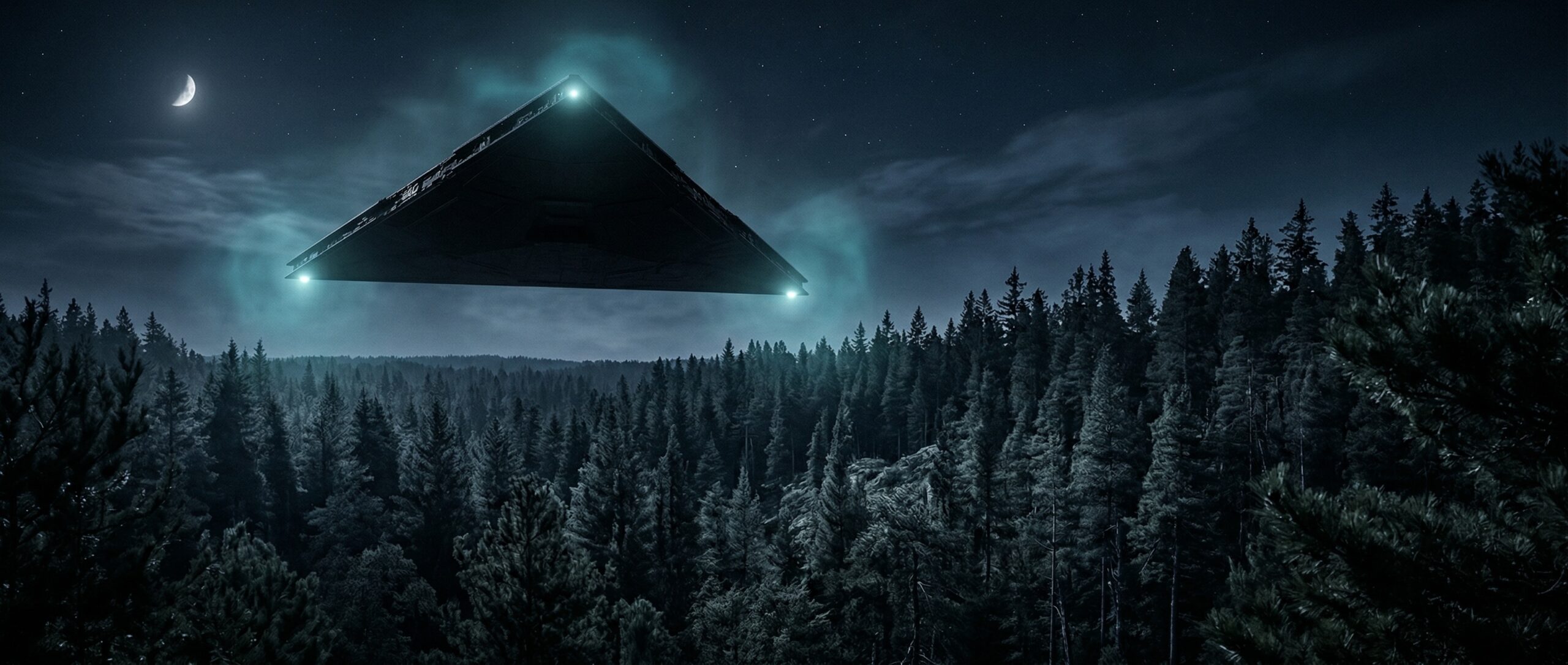
    What he says he then saw was a massive black triangle rising or becoming visible above the tree line. The object was described as dark, seamless, matte, and silent. It reportedly carried three lights with white centers and an aqua-blue haze around them. There was no dramatic engine noise, no obvious propulsion, and no conventional aircraft sound. Instead, the craft seemed to move in an unnervingly smooth way, more like a heavy object gliding over invisible water than a machine pushing through air.

    One of the strangest parts of the story is the claimed mental component. Tom describes a wordless, telepathic-like impression tied to the object. He did not present this as hearing a voice in the conventional sense. It was more like a direct knowledge or emotional imprint, a strong inner certainty that what he was looking at was powerful, non-human, and aware of him. He also describes a snapping or popping sensation in his head, which he likened to popcorn. Meanwhile, the friend beside him reportedly repeated the phrase “he sees it,” a detail that adds another layer of unease but also invites questions about what exactly each witness experienced in the moment.

    Perhaps most telling is what happened next: almost nothing. The boys did not run to adults. They did not alert the whole camp. They did not turn the encounter into an immediate crisis. They returned to the tent and stayed quiet. That subdued aftermath is one reason the story feels psychologically believable to some readers. High-strangeness witnesses often describe not dramatic action, but a kind of stunned compliance, as though the event arrives wrapped in its own emotional logic.

    The Pine Barrens make this encounter feel bigger than a single sighting

    Location matters in unexplained cases, and the Pine Barrens are not just another patch of woods. Southern New Jersey’s Pine Barrens carry a deep regional mythology built from isolation, darkness, local legend, and generations of stories that treat the landscape as emotionally charged. The region is most famously linked to the Jersey Devil, but that is only part of the broader pattern. The Pine Barrens are one of those places where folklore and geography reinforce each other until the setting itself begins to feel like evidence.

    That does not mean the place is paranormal. It means the place is psychologically fertile. Vast wooded areas, limited visibility, unusual nighttime acoustics, and a preloaded expectation of strangeness can all intensify how an event is perceived and remembered. A witness in a dense, culturally charged wilderness is already standing inside a story-rich environment. That matters because encounters do not happen in a vacuum. They happen inside landscapes that shape fear, focus, and interpretation.

    At the same time, that setting is also part of what makes the Triangle Above the Pines account so compelling. A giant black triangle drifting silently over suburban lights would feel eerie. The same object over a moonlit forest in the Pine Barrens feels archetypal. It drops immediately into the deeper current of American high-strangeness geography, where wilderness, secrecy, folklore, and witness isolation all converge. In that sense, the location is not proof, but it is part of the story’s power.

    Black triangle UFO cases endure because they combine geometry, scale, and silence

    Black triangle UFO reports have been circulating for decades, and they persist because they strike a very specific psychological nerve. Unlike glowing orbs, erratic lights, or distant luminous anomalies, black triangle craft often sound solid. Witnesses describe them as structured, immense, geometric, and physically present. That makes them feel less like fleeting atmospheric confusion and more like impossible machines intruding into ordinary space.

    The pattern is surprisingly consistent across many reports. A witness sees a dark triangular craft, usually at low altitude or at least low enough to feel physically imposing. The object is often silent or nearly silent. It may feature three bright corner lights, sometimes with a central light, sometimes not. It may hover, drift, or move with slow confidence rather than darting in cinematic ways. And the emotional reaction is often not simple terror. It is awe mixed with paralysis, a sense of scale and wrongness that feels bigger than fear.

    That is why the Pine Barrens case slots so easily into the broader black triangle canon. Whether one treats the account as literal, misperceived, embellished, or psychologically filtered, the structural features line up almost too neatly with the recurring template. Huge dark triangle. Silence. Atmospheric distortion. Powerful witness impression. Delayed retelling. Remote nighttime setting. From an editorial perspective, that makes the case useful because it becomes more than a local anecdote. It becomes a gateway into one of the most durable forms in UFO witness culture.

    The silence, static, and telepathic impression are what make this story unusual

    Plenty of UFO stories involve odd lights. Fewer involve a full environmental shift. One reason the Triangle Above the Pines case stands out is the cluster of sensory details attached to the sighting. The witness does not just describe an object. He describes the forest going dead silent, the air feeling pressurized or unnatural, and a static-electric sensation across the body before or during the appearance of the triangle.

    That cluster matters because it appears in many different corners of high-strangeness testimony. Some experiencers report electrical sensations, strange pressure changes, temporary sound suppression, missing ambient noise, or a feeling that the environment has become staged or artificial. Others report a “download,” an impression, or a direct knowing that does not feel like normal thought. These experiences are almost impossible to verify externally, which makes them frustrating from an evidentiary perspective, but they are too common in the witness literature to ignore entirely.

    In this case, the reported telepathic quality is especially interesting because it is presented not as a full message but as a forceful impression. That kind of detail often appears in witness stories that fall somewhere between observation and encounter. It suggests that what frightened the witness was not just the object’s appearance, but the feeling that the object was somehow participating in the moment consciously.

    From a skeptical standpoint, these details can also be read as signs of altered perception, adrenaline, memory layering, or later meaning-making. But even in that reading, they remain important. They are part of what makes UFO witness reports culturally sticky. People do not just remember what they saw. They remember how the world around them felt when the ordinary rules seemed to fail.

    The witness-memory issue is where this case gets strongest and weakest at the same time

    The same thing that gives this story emotional depth also creates its biggest evidentiary vulnerability. Much of the Triangle Above the Pines account is retrospective. The main event occurred in 1998, but the witness says the memory was suppressed or at least not fully integrated until much later. The episode page also includes earlier childhood fragments that sit in the difficult zone between memory, nightmare, dream residue, and later interpretation.

    That matters because childhood memory is notoriously unstable, especially when revisited through adulthood. People can hold vivid, emotionally true memories that are still incomplete, distorted, or reorganized over time. Memory is not a clean playback system. It is reconstructive. It absorbs later meaning, new fears, conversation, media, and personal identity. In UFO and experiencer literature, this problem becomes even sharper because the witness is often trying to connect scattered emotional fragments into a coherent life pattern.

    But this is also where the case becomes more compelling to some readers. The witness is not presenting a frictionless, polished, overconfident story. He is describing an event that seems to have remained psychologically unresolved for years. That unresolved quality can cut both ways. It may indicate memory distortion. It may also make the testimony feel less performative than accounts that arrive fully formed and theatrically certain.

    A strong pillar article has to hold both possibilities at once. The memory issue does not automatically destroy the account. But it absolutely prevents the article from treating the story as clean evidence of an extraordinary craft. The honest position is that the memory complexity is part of the case, not a side note to it.

    The later 2022 glass-cone sighting makes the witness story broader and stranger

    The UFO Chronicles episode page also references a second event from November 26, 2022 involving what the witness describes as a glass-cone object in southern New Jersey. That later sighting is not the core of this article, but it does matter because it changes the shape of the narrative. The witness is not presenting his life as divided into before and after one isolated childhood event. He is suggesting an ongoing relationship with anomaly.

    That can deepen the story, but it can also complicate it. In experiencer narratives, later events often reinforce earlier ones by making them feel newly real. A witness who doubts an old encounter may reinterpret it after another strange experience years later. That process can be psychologically understandable without telling us whether the underlying experiences were objectively paranormal, misperceived, symbolic, or some mixture of all three.

    Editorially, the best use of the 2022 sighting is as a secondary context lane. It should not overshadow the main black triangle encounter. Instead, it should be treated as part of the witness’s broader anomaly framework, a reminder that the triangle story belongs to a larger autobiographical pattern rather than standing alone.

    This is what skeptics would say about the Triangle Above the Pines story

    A credible unexplained article has to take skepticism seriously, especially in a case built around retrospective memory and a podcast retelling. The first skeptical objection is straightforward: there is no known physical evidence tied to this event. No photographs. No contemporaneous report. No radar data. No documented investigation file. What exists publicly is a witness narrative presented many years after the experience.

    The second objection concerns the setting itself. A moonlit forest at night is a powerful distortion environment. Shapes feel larger. Distances become unreliable. Silence can be remembered as absolute even when it was simply unusual. A charged atmosphere, a strange nearby soundscape, fatigue, suggestion, and the emotional intensity of childhood can all make an event feel more structured and supernatural in memory than it may have been in the moment.

    The third skeptical objection is the life-pattern problem. Once a witness begins linking multiple strange experiences across childhood and adulthood, there is always a risk that interpretation becomes self-reinforcing. One event validates another, and the larger story grows more coherent over time. That coherence may reflect reality. It may also reflect the human tendency to build narrative order out of scattered anomalies.

    None of this means the witness is lying. It means the case sits in the difficult middle ground where sincerity and uncertainty coexist. For many of the most enduring UFO witness stories, that is exactly where the real tension lies.

    This case still matters because it compresses the black triangle pattern into one memorable wilderness encounter

    The Triangle Above the Pines case remains interesting not because it proves anything decisively, but because it brings so many durable UFO motifs into one scene. It has the charged location. It has the wilderness isolation. It has the environmental silence. It has the static sensation. It has the giant silent triangle. It has the mental impression that the object was somehow aware. And it has the delayed retelling that makes the story feel half-haunting, half-investigative.

    That combination gives the story unusual staying power. Even readers who remain skeptical can understand why this would become a formative memory for a witness. And readers who follow experiencer literature will recognize nearly every major beat in the pattern. In that sense, the case matters as a piece of witness culture even if one remains agnostic about what the object actually was.

    The bigger reason it matters is that black triangle reports continue to occupy a strange middle territory in UFO belief. They often sound too structured and too close to the ground to be dismissed as distant lights, yet they rarely produce the kind of hard evidence that would settle the question. They survive because they feel more solid than folklore and less provable than conventional case files. The Triangle Above the Pines lives inside that same unresolved zone, which is exactly why people keep coming back to stories like this long after the night itself has passed.

    Frequently Asked Questions

    What is the Triangle Above the Pines case?

    The Triangle Above the Pines is a witness account featured on UFO Chronicles Podcast Ep.342. It centers on a reported spring 1998 black triangle UFO sighting during a Boy Scout camping trip in New Jersey’s Lebanon State Forest, now Brendan T. Byrne State Forest.

    Where did the Pine Barrens UFO encounter reportedly happen?

    According to the episode page, the event happened in Lebanon State Forest in New Jersey, which is now known as Brendan T. Byrne State Forest in the Pine Barrens region.

    What is a black triangle UFO?

    A black triangle UFO is a commonly reported type of unidentified craft described as large, dark, triangular, and often silent. Witnesses frequently report three bright lights, slow movement, and an overwhelming sense of scale.

    Why do some UFO witnesses report silence or telepathy?

    Many high-strangeness witness reports include environmental silence, pressure changes, static sensations, or telepathic-like impressions. These details are common in UFO testimony, though they are difficult to verify and can also be interpreted through psychology, stress, or altered perception.

    How reliable are childhood UFO memories?

    Childhood memories can be vivid and emotionally powerful, but they are also vulnerable to reconstruction, reinterpretation, and dream-memory overlap. That makes them meaningful as testimony, but difficult to treat as clean evidence without external corroboration.

    Was there physical evidence in this case?

    No publicly documented physical evidence is attached to the Triangle Above the Pines story. The case is known through witness testimony and the podcast episode page, not through photos, radar returns, or a formal investigation file.