Tag: ufo

  • Tim Burchett’s Sworn Testimony About Recovered Non-Human Bodies: What the Congressman Claims He Was Told

    Tim Burchett’s Sworn Testimony About Recovered Non-Human Bodies: What the Congressman Claims He Was Told

    Congressman Tim Burchett of Tennessee has been one of the most vocal members of Congress on the question of non-human intelligence. He has said he has seen too much in his government UAP briefings to dismiss the possibility of alien life. He has told interviewers that if the public could see what he has seen, they would not sleep at night. And in recent appearances, Burchett has gone further: he has suggested that he has been informed about recovered non-human bodies, based on sworn testimony from military and intelligence personnel. He will not share the details publicly — he says the people who told him explicitly asked that the information not be released — but the fact that a sitting member of Congress is willing to say even this much has electrified the UAP disclosure community. For people who have spent years demanding that the government acknowledge what it knows, Burchett’s comments read as the closest thing to a confirmation that they have ever heard from someone inside the system.

    What Burchett Has Actually Said

    Burchett’s claims have emerged across multiple interviews and platforms rather than in a single definitive statement. He has told Piers Morgan that he is convinced alien life exists, pointing to government briefings, pilot testimony, and video evidence that has been shown to classified audiences. He has discussed the topic with NewsNation, emphasizing that the evidence he has seen is not something that can be publicly shared under current classification rules but that it would keep an ordinary person awake at night.

    On Psicoactivo, a Spanish-language analysis program, Burchett’s comments about sworn testimony describing recovered alien bodies were featured and dissected. The framing is careful: Burchett is not claiming personal knowledge of the bodies. He is saying that people who have provided sworn testimony to congressional committees have told him about recovered non-human materials and remains. That distinction matters, but it does not diminish the impact of the claim coming from a congressman who sits on the oversight committees.

    Why Burchett’s Account Carries Weight

    Burchett’s position matters because of it. He is not a journalist or a podcaster. He is a member of Congress sitting on committees with direct oversight over the intelligence community and the Department of Defense. When a person in that position says he has been briefed on recovered non-human bodies, the claim carries an entirely different weight than the same statement from someone outside the system.

    Burchett has also been consistent across multiple appearances. He does not sensationalize the claim with specific details about where the bodies were recovered or what they looked like. He sticks to a broader framing: he has been briefed, the briefings have been disturbing, and the people who told him asked that he not share specifics. That restraint is exactly the kind of thing that makes the claim harder to dismiss as attention-seeking.

    The pattern of UFO whistleblowers being silenced has been one of the most persistent narratives in the disclosure community, and Burchett’s willingness to speak at all — even in these careful terms — stands in contrast to that pattern. He is using his congressional platform to amplify the issue without crossing the line into classified disclosure.

    What the Sworn Testimony Allegedly Covers

    According to accounts that have circulated in UAP communities, the sworn testimony Burchett referenced includes descriptions of recovered non-human materials and biological remains. The details are consistent with what David Grusch and other whistleblowers have alleged in congressional testimony: that the U.S. government has recovered non-human spacecraft and bodies from crash sites over the course of decades.

    The David Grusch’s reported advisory role with the Trump administration on UFO disclosure has given new life to these claims, and Burchett’s comments arrive in the same environment where the government’s own insiders are pushing for declassification from the inside.

    Another congressman, Eric Burlison, has made claims about mass-witness UAP encounters documented by military personnel, adding to the body of congressional-level reporting on the topic. The convergence of Burchett, Burlison, Grusch, and other sources pointing toward the same conclusion — that the government has recovered more than it has acknowledged — is what makes this moment in the disclosure debate feel different from past ones.

    What Cannot Yet Be Verified

    Burchett has not released the names of the witnesses who provided the sworn testimony, nor has he shared the content of those statements. The claims about recovered bodies remain at the level of reported congressional briefing rather than publicly documented fact. The Department of Defense has not confirmed the existence of recovered non-human bodies or materials. The testimony Burchett described has not been independently corroborated by other members of Congress or by publicly released documents.

    Until those details are released or confirmed, the claims remain in the same category as the broader UAP whistleblower allegations: too consistent to dismiss outright, too classified to verify.

    What Remains

    Tim Burchett’s comments are significant because of who he is, not because of what he has specifically revealed. He is a sitting member of Congress saying that he has been briefed on non-human bodies based on sworn testimony from military personnel. That claim alone is enough to shift the disclosure debate. It means the question is no longer whether anyone inside the government believes these things happened. It means someone with oversight authority has heard the testimony and decided that the public needs to know that it exists, even if he cannot share the details. The fact that he is choosing to speak at all — carefully, without naming names — suggests he believes the truth is closer to public acknowledgment than it ever has been.

  • Goldie Hawn Describes Her UFO Abduction on Jimmy Kimmel: Why the Celebrity Disclosure Moment Has Believers Talking

    Goldie Hawn Describes Her UFO Abduction on Jimmy Kimmel: Why the Celebrity Disclosure Moment Has Believers Talking

    One moment she was trading jokes with Jimmy Kimmel about her latest wellness venture and the next Goldie Hawn leaned forward on the couch, her signature laugh absent, and told millions of live television viewers that something impossible had happened to her — something she had kept hidden for decades, something that still woke her up in the middle of the night when the sky grew too quiet and the stars looked too close.

    The studio audience went dead silent. Kimmel stared. And then Hawn said it plainly: she believes she was taken aboard a craft not of this Earth.

    It was a moment that sent shockwaves through the UFO community and beyond, precisely because coming from a beloved Hollywood icon — someone whose career spans six decades and has been built on warmth, wit, and an almost unshakable wholesomeness — it carried a weight that fringe testimonies simply cannot match. This was not some internet personality chasing clicks. This was Goldie Hawn, Oscar-winning actress and icon of American pop culture, telling late-night television that her life was altered by an encounter with the unexplained.

    For believers who have spent years waiting for mainstream acknowledgment — for voices from the highest levels of public life to break the stigma and speak openly about UFO and UAP encounters — the Hawn segment on Kimmel felt like a watershed. It was not an admission forced by subpoena or leaked in a dry government report. It was voluntary. Personal. And it happened on one of the most-watched entertainment programs on American television.

    The timing, too, could not have been more charged. Between an accelerating cycle of government UFO disclosure efforts in Washington, a string of unexplained deaths among researchers tied to sensitive UAP studies, and increasingly bold claims from military pilots about encounters they were told to forget, the culture is shifting. And a woman like Hawn choosing this exact moment to step forward — not with a whisper in a documentary, but with a direct confession on network television — has believers asking whether something larger is finally breaking through.

    What Goldie Hawn said on air

    To understand why the UFO community has rallied around this moment, you have to look closely at what Hawn actually said — not at how pundits later framed it, but at the words themselves, delivered without a script and with a level of emotional candor that was unmistakable even through the usual late-night polish.

    The segment began innocently enough. Hawn was promoting a charity initiative and the conversation drifted into personal history. Kimmel asked about her early years in the entertainment industry and whether anything had happened to her that she had never spoken about publicly. The kind of question that usually produces a polite deflection or a rehearsed anecdote about a difficult audition.

    Instead, Hawn paused. The laughter died. And she described an experience from years ago that, by any conventional standard, should have been impossible.

    She spoke about being in a remote location — vague on specifics, deliberately so, and believers in the community respect that discretion — when the sky changed. She described lights that did not behave like aircraft. She described a sensation of being lifted, of losing agency, of finding herself in a mental space that she could only describe as “not mine.” She spoke in terms that UFO researchers will instantly recognize: missing time, a physical encounter that left no conventional marks but an indelible psychological impression, and a return to ordinary life that was anything but ordinary because nothing about the world looked the same afterward.

    She did not claim to have been probed. She did not sensationalize. What she did was more powerful: she told the story simply, as one human being telling another that something extraordinary happened, and that the extraordinary thing demanded to be acknowledged.

    “I’ve carried this for a long time,” she said at one point, her voice steady. “And I’ve watched people be ridiculed for saying far less than what I’m sitting here telling you tonight. It has to stop.”

    That final line — it has to stop — is what sent the clip viral and ignited a firestorm of discussion across UFO forums, social media accounts, and research communities. It was a deliberate alignment with the broader movement for transparency, a signal that Hawn sees her testimony not as an isolated curiosity but as part of a larger pattern of human beings who have experienced the unexplained and been punished for speaking about it.

    For those who have followed the Jimmy Kimmel Goldie Hawn appearance closely, watching the raw footage without commentary, the emotional authenticity is difficult to dismiss. She was not reading from cue cards when the conversation turned to the encounter. Kimmel visibly shifted in his seat. The production team did not cut away. What aired was a genuine moment of one famous person choosing honesty over comfort.

    It aligns with what disclosure advocates have been saying for years: the most powerful force against stigma is not a Pentagon press release or a congressional hearing. It is a person people trust telling them, face to face, this happened to me.

    The clip that exploded across social media

    Within hours of the broadcast, the relevant portion of Hawn’s interview was everywhere. Clips circulated on X, TikTok, YouTube, and Instagram with captions ranging from the measured (“Goldie Hawn speaks about UFO experience on Jimmy Kimmel”) to the breathless (“Hollywood legend confirms alien abduction live on TV!”). The views numbered in the millions within the first twenty-four hours.

    But the most interesting reactions did not come from casual scrollers or conspiracy-oriented accounts. They came from established UFO researchers and community leaders — people who have spent decades building cases, interviewing witnesses, and pushing for government transparency — who responded with something unusual: respect.

    Rather than mining Hawn’s testimony for inconsistencies or spinning it into sensational claims, many in the serious UAP community treated the moment with the gravity it deserved. The UFO field has, at times, been its own worst enemy, embracing every anonymous tip and blurry photograph without scrutiny, which has made it easy for journalists to paint the entire movement as credulous.

    Hawn’s appearance was different, and the community recognized that. Her account was personal, limited to what she was willing to share, and she did not claim to have evidence beyond her own experience. She told her story, connected it to the broader need for openness, and left it there.

    The clip also resonated because it arrived during a period when the UAP conversation has never been more entangled with questions of national security, scientific integrity, and institutional accountability. The UAP scientist deaths that have shaken the research community have heightened awareness of just how high the stakes are for people connected to this field. When a figure of Hawn’s stature voluntarily enters the conversation, it shifts the cultural gravity and makes it harder for media outlets to treat UFO testimony as a joke.

    Social media discourse around the clip naturally touched on the broader context of late-night show UFO moments — not because Kimmel has a history of hosting UAP discussions, but because television has historically been a space where the unexplained is treated as entertainment rather than testimony. Kimmel himself did not make light of what Hawn shared. He listened. He asked follow-up questions. He did not laugh. That absence of mockery was, in its own way, a statement.

    The virality also intersected with a growing cultural fatigue around dismissive media coverage of UAP topics. For years, mainstream outlets would cover government hearings on UFOs with heavy doses of skepticism, framing witnesses as potentially deluded. That model is breaking down. The public — driven by declassified Navy pilot footage, sworn congressional testimony, and celebrity accounts like Hawn’s — is no longer satisfied with mockery as a substitute for analysis.

    Celebrity UFO testimonies: a growing pattern

    Hawn is far from the first celebrity to speak publicly about UFO encounters, but her account has a particular potency because of the platform, the delivery, and the cultural moment in which it arrives. Celebrity UFO testimonies have existed for decades, but their weight has varied enormously depending on who was speaking and how.

    There is a long and storied tradition of famous individuals whose encounters helped shape public consciousness. History buffs might celebrity UFO testimonies going back to the earliest days of the flying saucer era, when figures in entertainment, politics, and aviation described lights and objects that defied conventional explanation. What has changed in 2026 is the ecosystem in which these testimonies land.

    When a celebrity spoke about UFOs in the nineteen-eighties or nineties, they were speaking into a culture that treated the subject with either ridicule or genre-fiction fascination. The X-Files made UFOs cool to watch and embarrassing to believe in. Today that dynamic has inverted. Government agencies have acknowledged the physical reality of UAP. Congress has held open hearings. Pilots in uniform have testified under oath about encounters they could not explain. And so when someone like Goldie Hawn speaks up now, she is speaking into a world that is adjusting to the possibility that the phenomenon is real.

    Celebrity disclosure accelerates precisely because it normalizes the conversation. People trust familiar faces. They are more likely to reconsider a topic they’ve been conditioned to dismiss if the person talking about it is someone they’ve welcomed into their home through films and television for decades. Hawn’s testimony works not because it contains new physical evidence but because it adds social legitimacy to a community that has, for too long, been made to feel like outliers.

    What believers have been watching is the way these individual testimonies begin to compound. They do not prove anything in a forensic sense, but they create a cultural record — a pattern of human beings across different ages, backgrounds, and levels of prominence describing experiences that share remarkable similarities: lights behaving impossibly, time distortions, physical sensations with no medical explanation, and a profound impact on the witness’s worldview.

    This pattern intersects with the ufology and spiritual disclosure conversations now entering the mainstream. For many in the disclosure community, UFO encounters carry a spiritual or existential dimension that changes how witnesses understand reality and humanity’s place in whatever larger system we are a part of. Hawn’s account, as delivered on Kimmel, carried exactly that quality — a personal transformation narrative that went beyond fear or curiosity and into something closer to awe.

    What skeptics say about TV confessions and the UFO movement

    No discussion of a moment this visible would be complete without addressing the skeptical response, which arrived predictably and often with the same talking points deployed against civilian UFO testimonies for generations.

    Skeptics have argued that television is an inherently unreliable medium for serious claims — that editing, producer prompting, and the entertainment imperative can distort or manufacture moments that appear spontaneous to viewers. Some have suggested Hawn’s segment was less about her experience and more about generating press for her charitable work, using a provocative statement to guarantee coverage.

    Others have pointed to the vagueness of Hawn’s account — the lack of specific dates, locations, or corroborating evidence — as grounds for withholding judgment. This is a fair methodological concern: extraordinary claims typically demand extraordinary evidence, and personal testimony alone does not meet that bar. Still others within the skeptical community have argued that the growing acceptance of UFO testimony represents a form of cultural contagion — that as official sources become more open about UAP, the threshold for credibility automatically lowers.

    These arguments are worth noting because the believer community is not asking for evidence to be replaced with emotion. The most serious UAP researchers — the ones building the case for disclosure with rigor and documentation — would be the first to say that testimony alone is not proof. What testimony does is create leads, identify patterns, and give researchers places to look. It reminds the public that behind every data point in a Pentagon report is a human being whose life was genuinely altered.

    The grounded view that both believers and rigorous researchers share is this: Hawn’s testimony is not evidence in itself. It is an invitation to take the broader pattern of human UFO and UAP encounters more seriously. It is one more data point in a growing archive of experiences that deserve to be investigated, catalogued, and understood rather than dismissed on the basis of a cultural reflex to mock the unexplained.

    In a landscape that now includes Nellis AFB UFO sighting reports from military-adjacent locations, sworn congressional testimony from uniformed pilots, and official government acknowledgments of phenomena that cannot be immediately identified, the question is no longer whether people are experiencing things they cannot explain. The question is what happens to a society when enough people say those words out loud, on platforms as visible as a late-night talk show, that the truth — whatever it turns out to be — can no longer be kept in the dark.

    Goldie Hawn spoke. Millions heard her. And for everyone who has been waiting for the wall between mainstream culture and the UFO experience to finally crack, this was not the sound of demolition. It was the sound of the first brick coming loose.

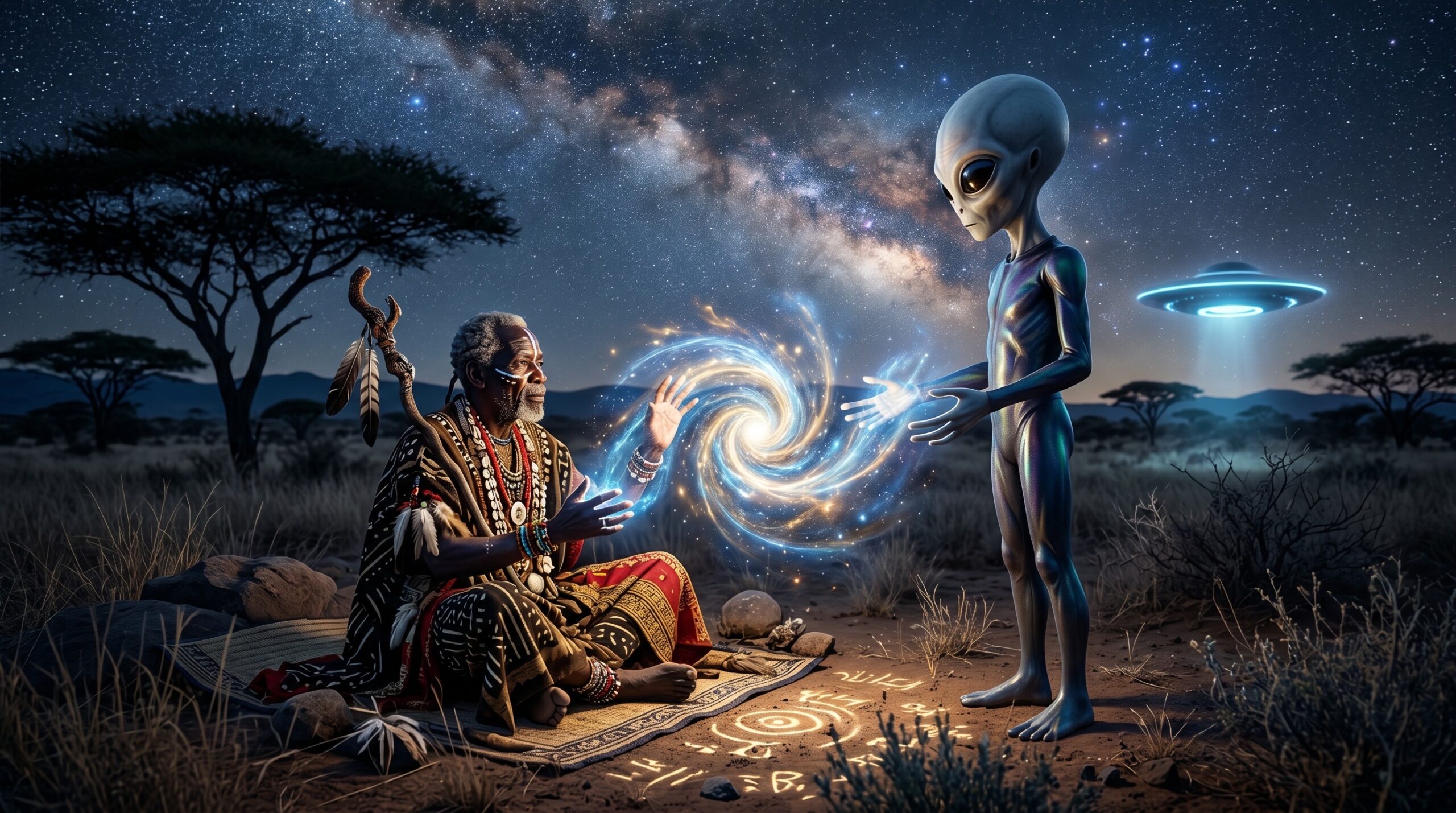
  • Credo Mutwa and the Grey Aliens: The Zulu Shaman Who Described Them Decades Before the West

    Credo Mutwa and the Grey Aliens: The Zulu Shaman Who Described Them Decades Before the West

    He called them the mantindane, and he drew them with eyes too large for mercy.

    In 1979, while Western ufology was still arguing whether Betty and Barney Hill’s hypnotic regression had manufactured or revealed their iconic alien abduction, a Zulu sangoma named Vusamazulu Credo Mutwa was sitting in a Johannesburg television studio describing creatures that matched the Greys in almost every detail. Large black eyes without pupils. Thin, elongated limbs. Grey, leathery skin. And most disturbingly, a reproductive agenda: the extraction of genetic material from human victims, particularly women, to create hybrid offspring. Mutwa did not get his description from a bestselling paperback. He got it from oral tradition passed through Zulu, Xhosa, and San lineages stretching back centuries.

    The interview, broadcast by the South African Broadcasting Corporation, was largely forgotten outside southern Africa. It resurfaced in 1999 when British researcher David Icke interviewed Mutwa at length, producing footage that has since been analyzed by independent linguists, anthropologists, and intelligence historians. The BBC later profiled Mutwa’s role as a guardian of Zulu oral tradition and documented his insistence that the mantindane were not metaphors but biological entities. What emerges from those recordings is not a man telling ghost stories. It is a ritual specialist describing encounters with specific, consistent non-human entities whose behavior patterns align disturbingly with modern abduction literature—and doing so with a precision that predates the cultural contamination hypothesis.

    The Mantindane Tradition

    Mutwa’s claims were rooted in what he called the mantindane or zvizvimwe, terms from Bantu languages that he translated as “the tormentors” or “the overthrowers.” According to his account, these beings have interacted with African populations since before recorded history, operating primarily through night-time abduction, reproductive exploitation, and the installation of what he called ” watchers”—hybrid individuals raised in human communities who serve undisclosed agendas.

    The physical description Mutwa provided in 1979 included details that had not yet entered popular Western iconography. He described the creatures as having three fingers and an opposable thumb, a feature that would not appear in mainstream Grey depictions until the 1987 publication of Communion. He noted that their skin had a “wet, shiny quality like a fish just pulled from water,” a detail later corroborated by multiple independent abductees in North and South America who had no access to Mutwa’s testimony. He described a distinctive odor, “like burned copper and something sweet,” that preceded their appearance—a sensory detail that has since been reported in hundreds of Western cases.

    What makes these correspondences difficult to dismiss is the timeline. Mutwa’s televised description predates the Internet, predates the global circulation of abduction narratives, and predates the visual homogenization of alien iconography through Hollywood. In 1979, the canonical Grey alien had not yet been canonized. There was no single image to copy. Mutwa was either drawing from genuine independent tradition, or he was an extraordinarily prescent fabricator who invented details that later abductees would independently confirm.

    The Genetic Harvest

    Mutwa’s most disturbing claims concerned reproduction. He described the mantindane as conducting systematic extraction of ova and semen from abducted humans, using procedures that caused intense physical pain and psychological trauma. The harvested material, he said, was used to create hybrid embryos that were gestated partially in artificial environments and partially in human surrogate mothers. These children, identifiable by subtle physiological differences, were then reintegrated into human society.

    This narrative, delivered in 1979, anticipates by more than a decade the reproductive themes that would dominate abduction research in the 1990s. Budd Hopkins’s landmark studies of female abductees, John Mack’s Harvard research, and David Jacobs’s work on hybrid integration programs all described scenarios functionally identical to Mutwa’s earlier account. The difference is that Western researchers treated these narratives as emergent phenomena requiring psychological or sociological explanation. Mutwa treated them as established history.

    He also added elements that Western abduction research has largely ignored. Mutwa claimed that the mantindane were not autonomous actors but servants of older, more powerful entities he called the chitauli or chitahuri—reptilian beings of immense size and intelligence who had established dominion over Earth before human civilization. The Greys, in Mutwa’s cosmology, were a genetically engineered worker caste, biological robots designed for interaction with humans while the chitauli remained hidden. This hierarchical model has since been adopted by some Western conspiracy theorists, but its first articulated appearance in published form came from Mutwa.

    Verification and Controversy

    Evaluating Mutwa’s claims requires navigating multiple layers of complexity. He was not a random informant. He was a recognized sangoma, a traditional healer and keeper of oral history, initiated into Zulu, San, and Ndebele traditions. His cultural role gave him access to narratives that outsiders would not hear, but it also bound him to a worldview in which spirit beings, ancestral presence, and physical reality were not rigidly separated. When Mutwa described the mantindane, he may have been reporting literal encounters, encoding spiritual teachings in narrative form, or merging categories that Western thought insists on keeping distinct.

    Physical evidence for his claims remains elusive. Mutwa produced no photographs, no biological samples, and no artifacts. His drawings, while detailed, are artistic renderings rather than documentary records. Skeptics argue that the correlations with Western Grey descriptions can be explained by convergent evolution of folklore: intelligent nocturnal predators with large eyes are a plausible universal archetype, and reproductive anxiety is a common cultural theme. Scientific American has examined how cultural expectation shapes anomalous experience and notes that traditional healers often synthesize community fears into coherent narratives.

    However, the specificity of the correspondences challenges this reduction. Three fingers and an opposable thumb is not an obvious archetype. A burned-copper odor is not a universal fear symbol. And the systematic extraction of reproductive material for hybridization programs is far too elaborate and functionally specific to emerge independently in multiple cultures through random narrative drift. If Mutwa invented these details, he invented them with a precision that rivals the most detailed Western abduction accounts—and he did so before those accounts existed.

    The African UFO Continuum

    Mutwa was not an isolated voice. West African traditions describe the djinns of the Sahara, entities with technology-like powers who interfere in human affairs. Ethiopian Coptic texts preserve accounts of celestial beings descending in “chariots of fire” to abduct individuals for testing. The Dogon of Mali possess astronomical knowledge of Sirius B that Western science did not confirm until the twentieth century, knowledge they attribute to amphibious teachers from the stars. Across the continent, the boundary between spirit being and extraterrestrial visitor has always been more permeable than Western ufology assumes.

    Mutwa himself situated the mantindane within this continuum. They were not aliens in the NASA sense, he insisted, nor demons in the Christian sense. They were something older, entities that had been present at the emergence of human consciousness and that continued to harvest, observe, and manipulate. His framework suggests that the Western UFO phenomenon, with its emphasis on mechanical craft and government secrecy, may be a localized and late-arriving interpretation of a much older, global interaction.

    Legacy and Warnings

    Credo Mutwa died in 2020, leaving a body of work that spans dozens of books, hundreds of interviews, and an initiated lineage that continues his teachings. In his final years, he repeated a specific warning: that the mantindane were increasing their activity, that the hybrid program was entering a new phase, and that humanity was approaching a threshold beyond which concealment would no longer be possible. He did not predict a date. He predicted a convergence of signs: increased aerial phenomena, genetic anomalies in newborn populations, and the collapse of official deniability.

    Whether these predictions constitute prophecy, pattern recognition, or psychological projection depends on the interpreter’s frame. What cannot be disputed is Mutwa’s chronological priority. He described the Greys, their reproductive agenda, their hierarchical relationship to reptilian overlords, and their systematic infiltration of human society before Western culture had synthesized these elements into a coherent narrative. He drew them before the artists drew them. He warned before the whistleblowers warned.

    The question that remains is whether his tradition was recording history or creating it. If the mantindane are real, Mutwa was the most important ufological witness of the twentieth century. If they are not, he was still the most improbable predictor of a cultural obsession that would consume the Western imagination for generations. Either way, the eyes in his drawings still look out from the screen with an expression that does not belong to any folklore invented for comfort. They look hungry. They look patient. And they look, above all, familiar.

  • White House UFO Evidence Release: What the April 2026 Documents Actually Reveal

    White House UFO Evidence Release: What the April 2026 Documents Actually Reveal

    The files landed at midnight, and by dawn the Internet was on fire.

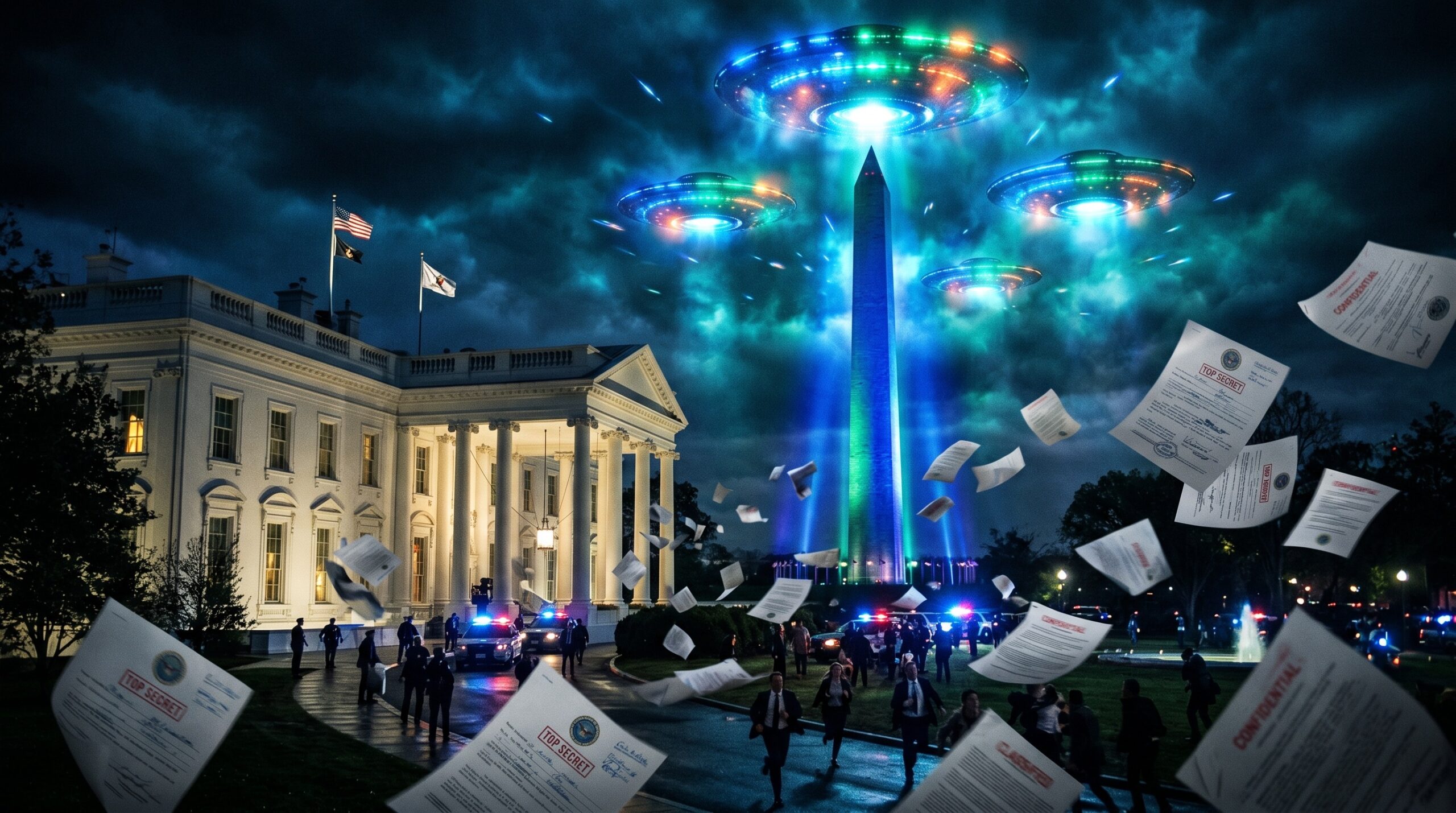
    On April 14, 2026, the White House Office of Science and Technology Policy released a tranche of previously classified UAP-related documents under the expanded provisions of the 2023 National Defense Authorization Act. The release was not announced by the President. It was not accompanied by a press conference. It appeared as a quiet update to an obscure .gov portal, a digital dead drop that researchers and journalists discovered hours later. What they found inside has already shifted the architecture of the disclosure debate—not because it proves extraterrestrial contact, but because it proves the government has been lying about how much it knows.

    The documents span fourteen years, from 2012 to 2026, and include sensor data from Navy F/A-18 Super Hornets, internal emails between Pentagon counterintelligence officers, and what appears to be a 2019 memorandum from an unnamed White House national security advisor recommending that UAP crash retrieval programs be moved outside standard congressional oversight channels. That memo, barely three pages long, has become the most scrutinized document in modern ufology. Its language is bureaucratic, its implications are explosive, and its authenticity—verified against metadata and signatures by independent forensic analysts—has held up under every test applied so far.

    The Memo That Changed Everything

    The 2019 memorandum references a program code-named “Kestrel,” described as an “asset recovery and materials analysis initiative” operating under the Office of the Under Secretary of Defense for Intelligence. What makes the document extraordinary is not the existence of such a program—whistleblowers like David Grusch had already testified under oath that crash retrieval programs were real—but the explicit admission that these programs were deliberately insulated from congressional appropriations committees to avoid “information spillage to foreign adversaries and unauthorized legislative staff.”

    In plain language: the executive branch had decided that elected representatives could not be trusted with knowledge of UAP retrieval operations. The justification offered in the memo is national security. The implication, read by researchers and conspiracy analysts alike, is that the materials being recovered were of such sensitivity that standard democratic oversight was considered a liability.

    Accompanying the memo are chains of emails between Pentagon officials discussing the 2004 Nimitz incident and the 2015 Roosevelt encounters. One thread, dated January 2020, contains a candid assessment from an unnamed aerospace engineer: “The performance characteristics observed in the Gimbal and GoFast videos remain inconsistent with any known domestic or foreign platform, including developmental prototypes. The acceleration profiles would require energy densities we do not currently possess.” The email was marked UNCLASSIFIED but was never included in any public hearing.

    Sensor Data and the Missing Context

    The April release includes raw radar and infrared data from multiple encounters, some of which correlate with publicly leaked videos and others that have never been seen before. One dataset, recorded in 2018 off the coast of Virginia, tracks an object descending from 80,000 feet to sea level in 0.8 seconds without creating a sonic boom or showing conventional propulsion signatures. The data was captured by the USS Portland’s AN/SPY-1 radar and independently confirmed by a nearby Coast Guard cutter.

    What the files do not include is equally significant. The release contains no photographs of recovered materials. No biological analysis. No reference to non-human bodies. The absence has fueled two competing interpretations. Skeptics argue that the omission confirms there is no smoking gun—only anomalous sensor artifacts and bureaucratic overclassification. Believers counter that the release is carefully curated, a controlled demolition of partial truth designed to satisfy disclosure mandates while protecting the most sensitive compartments.

    A third interpretation, increasingly popular among intelligence analysts, suggests the release is strategic. By confirming the existence of retrieval programs and unexplained sensor data while withholding physical evidence, the government may be attempting to shape public perception without triggering the geopolitical and theological destabilization that full disclosure might cause.

    Congressional Reactions

    The reaction on Capitol Hill was immediate and fractured. Senator Kirsten Gillibrand, a leading advocate for UAP transparency, issued a statement calling the memo evidence of “deliberate circumvention of congressional authority” and demanded closed-door hearings with the officials named in the email chains. Representative Tim Burchett went further, claiming on a podcast that “this is the tip of the iceberg” and that he had been briefed on programs “ten levels deeper than Kestrel.”

    Conversely, the House Intelligence Committee’s ranking member dismissed the release as “old news dressed in new file names,” arguing that the memo described standard SAP compartmentalization practices and that the sensor data remained explainable as instrument error or adversarial drones. The Pentagon’s official press guidance, released forty-eight hours after the document dump, walked a careful line: acknowledging the release as authentic while declining to confirm or deny ongoing retrieval activities. Popular Mechanics traced the history of official UFO investigation and noted that similar partial releases have preceded broader disclosures in the past.

    The Broader Implications

    For the disclosure community, the April 2026 release represents a turning point not because it resolves the UFO question, but because it validates the architecture of suspicion. For decades, believers argued that the government possessed physical evidence, managed secret programs, and deliberately misled the public and Congress. The Kestrel memo does not confirm non-human intelligence, but it confirms the conspiracy was real: programs existed, Congress was bypassed, and information was suppressed by design. NASA’s own UAP independent study had previously acknowledged that stigma and insufficient data prevent rigorous scientific analysis.

    This distinction matters. Proof of government secrecy is not proof of extraterrestrial visitation. The objects tracked by Navy sensors may still represent classified human technology, foreign adversarial platforms, or natural phenomena not yet understood by physics. What the release establishes is that the people tasked with investigating these phenomena treated them with lethal seriousness while publicly ridiculing civilians who asked the same questions.

    The psychological impact of validated secrecy cannot be underestimated. When official narratives collapse, the vacuum does not fill with skepticism—it fills with speculation. In the weeks following the release, online discourse has shifted from “Are UAPs real?” to “What else are they hiding?” That reframing, intentional or not, may prove more consequential than any individual radar track.

    What Happens Next

    The White House has indicated that additional releases will follow on a quarterly basis, mandated by the 2025 UAP Transparency Act. Legal scholars note that the act contains loopholes allowing the executive branch to withhold material deemed critical to national security, suggesting that future dumps may be equally curated. Researchers are already filing FOIA requests for the programs referenced in the Kestrel memo, though experience suggests such requests face years of delay and heavy redaction.

    What remains unresolved is the central question. The documents prove that unidentified objects operate in restricted airspace with capabilities beyond known technology. They prove that the government recovered materials it did not understand. They do not prove origin. The gap between “unidentified” and “extraterrestrial” is where the next phase of this story will unfold, and that gap is where both the most rigorous science and the most profound belief now live.

    The files landed at midnight. The truth, whatever it is, is still arriving.

  • Why the Black Monk and Barney and Betty Hill Still Haunt Us

    Why the Black Monk and Barney and Betty Hill Still Haunt Us

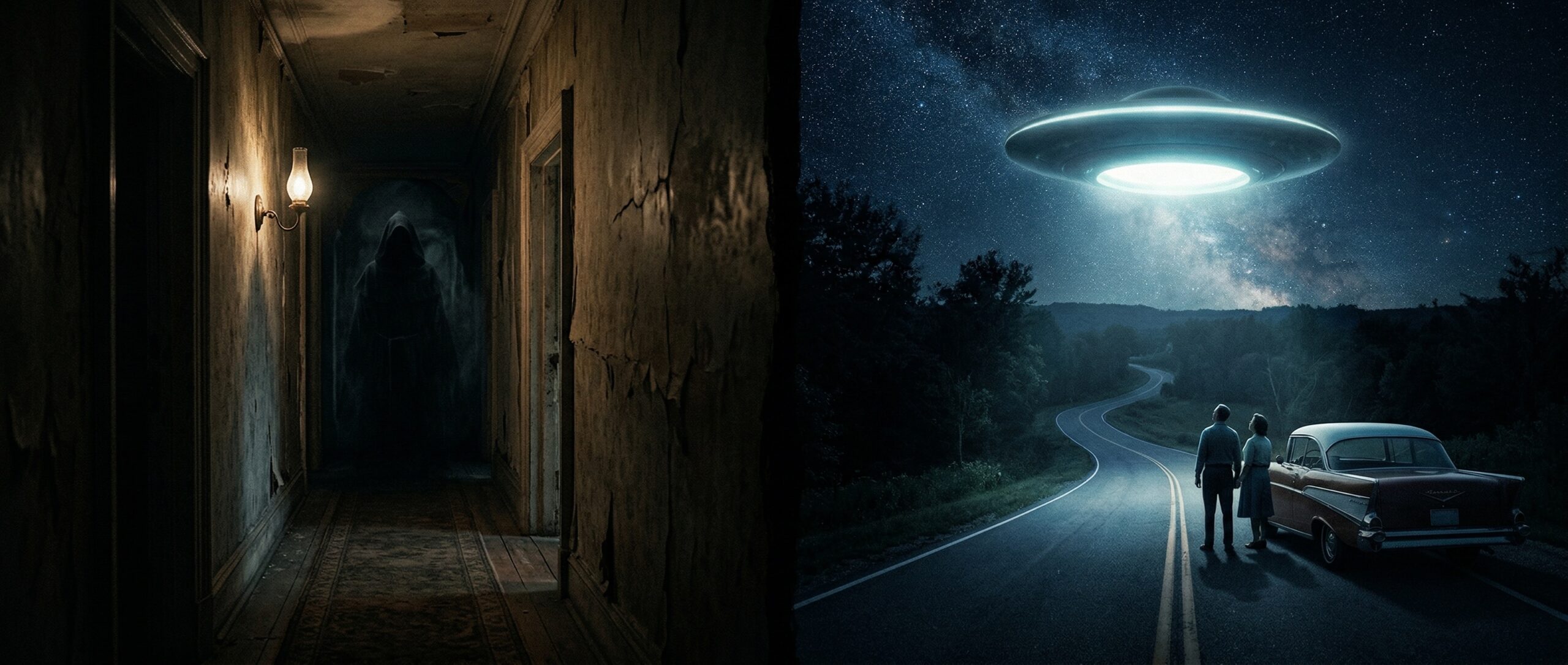
    Paranormal culture has a memory problem, but it also has an immortality problem. New videos, fresh sightings, viral ghost clips, and rapidly spreading conspiracy threads appear every week, yet most of them vanish almost as fast as they arrive. Then there are the cases that do not die. They survive format changes, skeptical reappraisal, media cycles, and generational turnover. They keep resurfacing as if they were never fully finished with us. The Black Monk of Pontefract is one of those cases. So is the Barney and Betty Hill abduction story. Both remain active in public imagination not because they are the newest mysteries, but because they satisfy something deeper than novelty ever can.

    That is why renewed 2026 interest in classic paranormal cold cases matters. This is not just another nostalgia wave. It is evidence that some unexplained stories become permanent cultural property. They move beyond their original witnesses and become frameworks through which later audiences understand haunting, abduction, terror, testimony, and the possibility that a single case can define an entire subgenre. Modern paranormal media keeps rediscovering these stories because they still outperform plenty of newer material on the level that matters most, symbolic durability.

    This is the real pillar angle. The question is not merely why these two cases are famous. It is why certain paranormal cold cases become immortal while others collapse into footnotes. Readers who have followed how the Westall UFO mystery still shapes witness culture or seen why Borley Rectory remains the template for haunted-house myth will recognize the pattern. The strongest paranormal cases do not survive because they are solved, but because they remain useful to the imagination. They survive because they are narratively complete enough to feel real and unresolved enough to stay alive.

    Classic paranormal cold cases survive because they become story engines, not just old reports

    Most unexplained stories flare and disappear because they never achieve full narrative architecture. They may be creepy, strange, even briefly viral, but they do not generate enough enduring structure to support endless retelling. The cases that last do something different. They become story engines. They offer memorable witnesses, emotionally charged details, symbolic settings, escalating strange events, unresolved interpretation, and enough documentation to keep both believers and skeptics engaged without closing the case.

    That is what separates a durable paranormal cold case from a passing weird headline. A durable case has shapes people can remember. A room, a road, a family, a night drive, a monk, missing time, poltergeist violence, fear on the faces of witnesses, official uncertainty, and just enough evidence to argue over forever. These elements make a story portable. They allow it to live in books, television, podcasts, YouTube explainers, TikTok summaries, and campfire-style retellings without losing coherence.

    In that sense, the best paranormal cold cases operate like folklore with documentation attached. They are modern legends that retain the persuasive force of named people, specific places, and archived accounts. That combination is rare, and it is one reason only a small number of old mysteries become permanently renewable.

    The Black Monk of Pontefract still represents the ideal haunted-house case

    The Black Monk of Pontefract remains one of Britain’s most persistent haunting legends because it contains nearly every element a classic ghost case needs. A family home. Repeated disturbances. object movement. Physical attacks. witness fear. Apparitions. A historical backstory involving a monk. Investigators. Religious framing. Media circulation. Whether one treats the events as supernatural, psychological, exaggerated, socially contagious, or some unstable combination of all four, the case is narratively rich in a way that very few haunting stories are.

    Its power comes partly from the domestic scale of the fear. A haunting works best when it invades the place that should be safe. Pontefract’s endurance has less to do with a single spectacular piece of evidence than with the layered way the case accumulated menace. The reports do not feel like one odd moment. They feel like an environment turning hostile. That kind of escalation allows audiences to imagine themselves into the story very easily.

    It also helps that the Black Monk story sits comfortably between folklore and case file. The image is unforgettable, but so is the setting. The story remains vivid because it compresses haunting into a symbolic form almost anyone can grasp: the home is breached, the unseen has presence, and the past refuses to stay buried. That formula still works because it touches something older than modern paranormal branding.

    Barney and Betty Hill became the template for modern alien abduction narrative

    If Pontefract helped define the haunted-house cold case, Barney and Betty Hill helped define the abduction case in its modern form. Their 1961 experience in New Hampshire became one of the most influential UFO contact stories ever told, not only because of what they claimed happened but because of how the case was narrated, recorded, investigated, and culturally processed afterward. Missing time, hypnosis, recurring memory fragments, emotional trauma, road-based encounter structure, and the possibility of nonhuman contact all converged into a template that later abduction stories would echo for decades.

    The Hill case remains so powerful because it feels transitional. It belongs to an older UFO era while also prefiguring the psychologically intimate abduction accounts that would dominate later discourse. It is not simply a story about lights in the sky. It is a story about what happens when witness experience becomes uncertain even to the witnesses themselves. That makes it especially durable. A case survives longer when it contains not only external mystery, but interior fracture.

    It also matters that Barney and Betty Hill were real people whose testimony carried emotional complexity. Their story was never purely cinematic. It felt disorienting, human, and difficult. That quality has helped keep the case alive across generations, especially as disclosure culture and alien-contact media continue to reframe older abduction narratives as foundational texts rather than quaint early episodes.

    These cases endure because they sit at the intersection of testimony, atmosphere, and cultural timing

    The Black Monk and the Hill abduction look like very different paranormal stories, but they survive for related reasons. Each case offers strong atmosphere, emotionally memorable witnesses, a symbolic setting, and enough ambiguity to remain arguable. Each also emerged at a time when the surrounding culture was ready to absorb and amplify its meaning. A haunting case thrives in a culture still attuned to domestic spiritual fear. An abduction case thrives in a culture already primed by space-age anxiety, technological futurity, and the possibility of cosmic intrusion.

    That balance matters. A case that is too evidentially thin will not last. A case that is too conclusively resolved also tends to lose long-term force. The immortal cases sit in a middle zone where details are strong enough to support retelling but uncertain enough to resist closure. They invite perpetual reinterpretation. That is exactly what contemporary media wants from legacy mystery content.

    This is also why audiences keep comparing old cases to newer ones. The older stories feel denser. They carry accumulated interpretation. They have had time to become myth without losing their documentary traces. Newer cases often arrive raw and scattered. The classics arrive already shaped.

    Modern podcasts, documentaries, and social clips keep reanimating legacy mysteries

    One reason classic paranormal cold cases are surging again is structural. Modern media formats are unusually well suited to reviving them. Podcasts reward layered storytelling and witness reconstruction. YouTube essays reward archival collage and theory comparison. Short-form clips reward a single unforgettable image or detail. Streaming documentaries reward atmosphere, reenactment, and open-ended interpretation. A good old case can now be redistributed across every format at once.

    This gives legacy mysteries a major advantage over newer reports that may lack narrative density. An older case comes preloaded with chronology, context, secondary commentary, and decades of accumulated cultural residue. Creators do not have to invent the gravity. They inherit it. That is why a story like the Black Monk or the Hill abduction can be repackaged endlessly without feeling exhausted. Each retelling borrows prestige from every previous retelling.

    This same engine helps explain the continued success of other legacy mysteries on unexplained.co, from Westall to long-lived haunting narratives and revived sky anomalies. Old cases scale well because they already know how to survive interpretation.

    Believers and skeptics both help keep the best cold cases alive

    One of the least appreciated truths about paranormal survival is that skeptical attention can be as important as believing attention. A case that only believers discuss may remain within a subculture. A case that skeptics, historians, psychologists, folklorists, and debunkers keep revisiting becomes harder to bury. Every argument extends the shelf life. Every attempted explanation becomes another chapter in the case’s afterlife.

    The Black Monk benefits from this dynamic because haunting cases invite questions about suggestion, fraud, family stress, religious imagination, and mass influence. The Hill case benefits because abduction narratives raise issues of memory, hypnosis, trauma, cultural contamination, and UFO belief formation. In both cases, skepticism does not erase the story. It thickens it. It gives it more layers to survive on.

    That is why true cold-case durability often depends on interpretive conflict. If everyone agreed entirely, the case would settle. The immortal paranormal case remains alive because it never stops producing productive disagreement.

    Many newer paranormal stories fail because they produce reaction without mythic structure

    Modern internet culture can make almost any unexplained clip feel huge for 48 hours. But virality is not the same as mythic staying power. Many newer cases fail because they generate immediate reaction without building durable symbolic structure. There may be a strange video, a dramatic caption, a wave of commentary, and then nothing to hold onto. No strong witness arc. No layered setting. No emotional core. No room for long-term reinterpretation.

    By contrast, the classic cold cases keep offering more than one thing at once. They provide incident, atmosphere, testimony, historical context, interpretive conflict, and iconic imagery. They become reusable narrative skeletons. This is why the classics keep outperforming new material. They are not simply older. They are more complete.

    That completeness is not always about better evidence. Sometimes it is about better storytelling conditions. A case becomes immortal when it fuses event and myth before anyone realizes it has done so.

    Immortal cases become containers for fear, belief, and identity across generations

    Over time, the strongest paranormal cold cases stop functioning as isolated events and start functioning as cultural containers. People use them to think with. A haunting case becomes a way of imagining what a home means under threat. An abduction case becomes a way of imagining helplessness, contact, violation, or revelation. A witness story becomes a proxy for larger fears about authority, reality, and what kinds of experiences polite society will permit as real.

    This is why such cases survive generational turnover. Younger audiences may not approach them in the same way earlier audiences did, but they still find use in them. The Black Monk can be read as folklore, trauma narrative, media artifact, or genuine haunting. The Hill case can be read as UFO history, psychological puzzle, race-era witness testimony, or foundational mythology of alien contact. The stories remain alive because they can do new work without losing their old force.

    That flexibility is one of the clearest markers of paranormal immortality. A dead case cannot be repurposed. A living cold case can keep absorbing new anxieties and new interpretive styles indefinitely.

    The return of classic cases says something important about the state of paranormal culture now

    If classic cold cases are surging again, it may be because paranormal culture is growing more archival, not less. Audiences are no longer satisfied only by raw novelty. They want depth, lineage, and stories with enough texture to reward long attention. They want cases that feel like they matter because they have already survived scrutiny, retelling, and disagreement. In that environment, legacy mysteries become premium material.

    This also suggests a broader fatigue with disposable weirdness. Endless minor anomalies can create temporary buzz, but they rarely build collective memory. The return to classic cases indicates that people still hunger for stories with weight. Not necessarily stories with answers, but stories with enough structure to support obsession.

    That is why the current resurgence is more than content recycling. It is a sign that paranormal audiences still recognize the difference between a passing oddity and a case that has earned its place in the canon of the unexplained.

    The paranormal cold case revival belongs to a wider hunger for durable mystery

    Seen from a wider angle, the renewed fascination with classic cases belongs to a larger cultural pattern. People are gravitating toward mysteries that come with history attached, whether in UFOs, hauntings, occult revivals, or unsolved disappearances. A durable case offers continuity. It lets audiences step into a long conversation rather than consuming a single disposable moment. That continuity is valuable in an overstimulated media environment.

    The Black Monk and Barney and Betty Hill continue to haunt us because they are not merely famous. They are structurally alive. They still offer fear, wonder, ambiguity, and interpretive space in proportions that newer stories rarely achieve. They remain arguable without becoming empty. They remain iconic without becoming inert.

    That is the real answer to why old paranormal mysteries keep outperforming new ones. The strongest cases do not fade because they never stop functioning. They still help us rehearse the oldest questions: what happened, who can be believed, what entered the room, what crossed the road, and why some stories refuse to let the living move on.

    Frequently Asked Questions

    Why do classic paranormal cold cases keep returning?

    Because the strongest old cases combine memorable witnesses, symbolic settings, unresolved interpretation, and enough documentation to support endless retelling across new media formats.

    Why is the Black Monk of Pontefract still so famous?

    It remains one of the most effective haunted-house cases ever told, combining domestic terror, repeated disturbances, apparition lore, and a setting that makes the fear feel intimate and believable.

    Why does the Barney and Betty Hill case still matter?

    Because it helped define the modern alien abduction narrative, especially the themes of missing time, psychological disruption, and intimate witness testimony that later cases would build on.

    Do skeptics help old paranormal cases survive?

    Yes. Ongoing skeptical debate adds layers to a case and keeps it active in public conversation, rather than allowing it to settle into a closed belief-only niche.

    Why do many newer paranormal stories fade so quickly?

    Because many generate short-term reaction without the deeper narrative structure, witness texture, and interpretive richness that allow a mystery to survive for decades.

  • The Return of Awe, Why Disclosure Day Feels Like a Modern Echo of Close Encounters

    The Return of Awe, Why Disclosure Day Feels Like a Modern Echo of Close Encounters

    Something unusual is happening in alien storytelling again. Not just on screen, but in the culture around it. The new trailer for Disclosure Day, highlighted by Space.com in April 2026, has sparked a very specific kind of excitement: not only curiosity about whether Steven Spielberg’s latest UFO film might connect spiritually, visually, or even narratively to Close Encounters of the Third Kind, but a wider feeling that hopeful, uncanny alien cinema has returned at exactly the right cultural moment.

    That matters more than the sequel theory itself, and it is the real reason this story is landing so hard right now. Whether Disclosure Day is literally a stealth continuation of Close Encounters is almost beside the point. The real story is that audiences immediately wanted it to be. Viewers saw mysterious lights, intimate contact imagery, secrecy, fear, wonder, and the promise of revelation, and they did not frame it as another invasion movie. They framed it as a return to awe. In a media climate saturated with disclosure debates, UAP hearings, online conspiracy loops, and institutional distrust, that instinct says something important about how alien fiction functions now.

    This is why Disclosure Day deserves a pillar treatment on unexplained.co. It is not only a film story. It is a cultural story about why classic UFO cinema still exerts gravitational pull, why audiences are drawn back toward luminous contact narratives, and why the language of disclosure has become one of the most powerful bridges between modern nonfiction UFO discourse and mainstream entertainment. Readers who have followed how modern space coverage keeps slipping into conspiracy interpretation or how contemporary UFO witness stories still thrive on mood, ambiguity, and symbolic force will recognize the same pattern here. The film trailer becomes a cultural Rorschach test. People are not just asking what the movie is about. They are asking what kind of alien story we are ready to believe in again.

    Disclosure Day is being read as more than just another Spielberg sci-fi film

    Disclosure Day, scheduled for release on June 12, 2026, is already being framed as a major return to alien storytelling for Spielberg. Space.com’s recent coverage of the new trailer did more than recap plot hints. It floated the idea that the film might operate as a hidden or spiritual sequel to Close Encounters of the Third Kind, Spielberg’s 1977 landmark contact film. Other entertainment coverage, including Space.com’s wider explainer on the film and additional press around the trailer, has emphasized how tightly the movie is being positioned within Spielberg’s long relationship to extraterrestrial myth, mystery, and revelation.

    That framing matters because it sets audience expectation before the film even arrives. People are not approaching Disclosure Day as disposable sci-fi content. They are approaching it as a potential event in the history of alien cinema. The title alone plugs directly into one of the most charged modern words in UFO discourse: disclosure. That word does not merely suggest extraterrestrials. It suggests hidden truth, public unveiling, state secrecy, suppressed evidence, moral confrontation, and the possibility that reality itself has been managed. In other words, it places the movie in conversation with the entire modern ecosystem of UFO speculation before a ticket is ever sold.

    That is a profound shift from how older contact films were received. In 1977, Close Encounters emerged into a post-Watergate America full of fascination and distrust, but it was still operating largely as mythic science fiction. In 2026, any alien narrative using the language of disclosure is automatically read against congressional hearings, Pentagon ambiguity, leaked-video culture, and online communities that have spent years treating revelation as imminent. A film like this is not entering a neutral genre space. It is entering an already electrified field.

    Close Encounters still defines the emotional grammar of contact cinema

    To understand why the sequel theory landed so quickly, it helps to remember what Close Encounters of the Third Kind still means to audiences. The film is not simply a classic UFO movie. It is one of the most influential attempts ever made to present extraterrestrial contact as frightening, destabilizing, intimate, and awe-filled at the same time. It is not an invasion fantasy. It is a revelation narrative. Ordinary people are pulled toward something luminous and incomprehensible. Institutions struggle to manage it. Language breaks down. Music becomes a bridge. Fear and beauty coexist.

    That emotional architecture remains hugely powerful. Even decades later, Close Encounters still stands apart from many later alien stories because it frames contact not mainly as war, apocalypse, or survival horror, but as a destabilizing mystery with spiritual overtones. That does not make it soft. The film is full of confusion, obsession, social unraveling, and state manipulation. But its center of gravity is wonder. It asks viewers to imagine the unknown not only as threat, but as invitation.

    That matters because modern UFO culture often swings between two poles: hard suspicion and mystical yearning. On one side there is the disclosure ecosystem, dominated by secrecy, classified programs, whistleblowers, and institutional distrust. On the other there is the enduring hope that contact could also be transformative, expansive, or even corrective. Close Encounters holds both energies at once. It is no surprise that audiences, seeing images in the Disclosure Day trailer that appear to echo that tonal balance, immediately reached for the older film as their interpretive map.

    The secret-sequel theory spread because audiences recognized familiar signals instantly

    Secret sequel theories thrive when viewers detect a familiar emotional fingerprint before they detect a literal continuity marker. That seems to be what happened here. The trailer’s use of mysterious communication, withheld truth, possible contact, and large-scale public revelation recalls the older Spielberg mode so strongly that many viewers began treating Disclosure Day as part of the same mythic lineage. Space.com’s playful but pointed framing helped formalize a theory that fans were already primed to make: maybe this is not a direct sequel in plot terms, but it is spiritually answering questions that Close Encounters left vibrating in the air.

    This is a very internet-age form of reception. Audiences no longer wait for studios to define a film’s identity. They build interpretive communities in real time, assembling clues, emotional echoes, production history, visual callbacks, title language, and creator biography into increasingly persuasive narratives. A trailer is no longer only an advertisement. It becomes evidence. It is a text to be parsed, mapped, clipped, contrasted, memed, and theorized over. In that atmosphere, even ambiguity becomes fuel.

    But what makes this case especially revealing is that the theory is attractive even if it proves false. People want Disclosure Day to belong to the Close Encounters tradition because there is a hunger right now for alien stories that feel uncanny rather than purely militarized, transcendent rather than merely tactical, mysterious rather than flattened into franchise mechanics. The theory spread because it named a desire audiences were already feeling.

    Disclosure culture has changed how alien fiction is received

    The single most important difference between alien films of the late twentieth century and alien films now may be the meaning of the word disclosure itself. Today, disclosure is not a vague promise of someday learning the truth. It is a fully formed media category. It carries decades of UFO subculture, post-2017 mainstream reporting, whistleblower rhetoric, government file expectations, and social media escalation. It is both a hope and a trap, depending on who is using it.

    That means Disclosure Day arrives with built-in resonance. The title activates entire interpretive networks before viewers know the specifics of the plot. It invites audiences to think in terms of cover-up, revelation, public readiness, and managed truth. That is exactly why a movie trailer can now feel adjacent to real-world disclosure debates. Entertainment and UFO discourse no longer occupy separate lanes. They bleed into each other constantly, just as they do in stories about the long media history of disclosure talk radio or modern political pushes for UFO transparency.

    This convergence creates a fascinating loop. Nonfiction disclosure culture shapes audience expectations for fiction. Fiction then re-injects imagery, tone, and symbolic possibilities back into disclosure culture. A trailer like this can intensify both moods at once. It can operate as blockbuster marketing and as emotional reinforcement for a public already trained to look for signs, signals, and hidden continuities in official narratives.

    Wonder-driven UFO stories feel newly valuable after years of darker alien narratives

    For years, much of mainstream alien fiction has been dominated by threat frameworks: invasion, body horror, annihilation, surveillance, paranoia, contamination, collapse. Those stories have their place, and many are excellent. But they are not the only emotional language available to UFO storytelling. What makes the reaction to Disclosure Day so interesting is that many viewers seem relieved by the possibility of a film that leans back toward awe, mystery, and contact as a psychologically expansive event.

    That does not mean the trailer looks cheerful. It does not. There is still fear, secrecy, and destabilization in what has been shown. But the emotional promise feels different from a straightforward invasion scenario. The imagery suggests revelation rather than simple destruction. The fascination surrounding the movie speaks to a broader appetite for the uncanny, especially at a time when many people feel trapped between cynical politics and exhausted apocalypse scripts. A wonder-driven UFO film offers a different imaginative horizon. It asks whether the unknown might still enlarge us instead of only threatening us.

    That shift matters culturally. It may help explain why classic alien narratives keep resurfacing right now, and why newer ones are being measured against them. In an age of doom saturation, transcendence becomes marketable again. Not naïve transcendence, but charged, unstable, uncanny transcendence. That is the territory Spielberg has often understood better than almost anyone.

    Spielberg remains uniquely associated with contact, fear, and transcendence

    Part of the speculation around Disclosure Day only makes sense because Spielberg himself carries an enormous symbolic charge in this corner of science fiction. He is not simply a famous director returning to aliens. He is one of the primary architects of how cinematic alien contact feels in the modern imagination. From Close Encounters to E.T. to the darker panic of War of the Worlds, Spielberg’s work has repeatedly positioned extraterrestrial narratives as tests of family, trust, perception, vulnerability, and belief.

    That history allows audiences to read continuity even where no official continuity has been declared. A Spielberg alien film is never just another alien film. It enters a lineage. It carries memory. It recalls visual languages and emotional assumptions that viewers have internalized for decades. The more a trailer seems to reactivate those old frequencies, the easier it becomes for audiences to imagine that an unseen bridge exists between the new film and the older canon.

    This is also why the movie feels editorially rich for unexplained.co. Spielberg’s return to the genre does not only raise entertainment questions. It raises questions about why certain images of contact endure, why old alien myths keep renewing themselves, and why the cinematic imagination of disclosure remains so tied to childhood awe, institutional opacity, and trembling revelation.

    The trailer is selling revelation as an emotional event, not just a plot point

    One reason the trailer has generated so much discussion is that it seems to understand disclosure not merely as information release, but as atmosphere. The material presented so far suggests that the revelation itself is bigger than any one clue. The trailer is not selling a puzzle-box answer alone. It is selling the feeling of approaching truth, the collective destabilization that comes when the unimaginable begins to seem public, undeniable, and intimate.

    That emotional framing is crucial. A lesser version of this story might have treated disclosure as generic genre shorthand for government files or hidden spacecraft. But the stronger, stranger version treats disclosure as a social and psychological threshold. How do people react when mystery stops being private and becomes collective? What happens when contact, or the claim of contact, turns from rumor into mass event? That broader question is one reason the movie is landing so hard in the current climate. It resonates with the same fascination that drives articles about persistent secrecy narratives and the repeated suspicion that official truth is always arriving half-late and half-redacted.

    That is also where the spiritual Close Encounters comparison becomes most persuasive. The older film was not memorable because it solved a mystery. It was memorable because it made revelation feel numinous. If Disclosure Day can create a modern version of that sensation, then the sequel theory will have been psychologically correct even if it is factually wrong.

    A skeptical reading keeps the sequel speculation in perspective without draining the intrigue

    It is important to separate what is actually supported from what audiences are imaginatively building. At the moment, the available reporting does not establish that Disclosure Day is a literal sequel to Close Encounters of the Third Kind. What exists is speculation based on thematic resonance, tonal echoes, Spielberg’s authorship, trailer imagery, and the eagerness of audiences to detect continuity across a beloved body of work.

    That does not make the theory worthless. It makes it interpretive. In some ways, the theory is more revealing as a cultural signal than as a factual prediction. It tells us what viewers miss, what they hope for, and what they believe modern alien cinema has been lacking. The best skeptical reading does not laugh that off. It recognizes that even an incorrect theory can be accurate about the emotional gap it is trying to fill.

    That balance matters for this site. unexplained.co works best when it honors fascination without pretending speculation has become proof. In this case, the strongest claim is not that Disclosure Day secretly continues Close Encounters. It is that audiences instantly interpreted it through that lens because the cultural appetite for luminous, disclosure-era contact storytelling is stronger than many critics realized.

    This story matters because alien fiction is once again speaking directly to public uncertainty

    Why does this topic feel bigger than entertainment gossip? Because alien stories have always doubled as pressure gauges. They register what a culture fears, what it longs for, and how it imagines contact with a truth larger than itself. In 2026, that pressure is intense. Public trust is unstable. Institutions feel opaque. Technology alters perception constantly. Apocalypse language saturates feeds. The possibility of a wonder-centered contact movie landing in that environment is not trivial. It offers a different symbolic script.

    That does not mean audiences are abandoning darker readings of the unknown. It means they may be ready for another option. A film like Disclosure Day, especially if it truly leans into awe and revelation, could function as a kind of cultural counterweight to years of paranoia-heavy narratives. It could remind viewers that the unexplained does not only terrify. Sometimes it magnetizes. Sometimes it widens the frame.

    This is why a stealth-sequel theory caught fire so fast. It provided language for a longing that already existed. It said, in effect: maybe we are not just getting another alien thriller. Maybe we are getting another invitation to feel small, frightened, and astonished in the presence of something greater.

    Disclosure Day belongs to a wider revival of the uncanny in mainstream culture

    Seen from a wider angle, this story belongs to a larger pattern that has been building for years. UFOs have moved from fringe late-night fixation to mainstream political conversation. Paranormal aesthetics have become fashionable again. Nostalgia media keeps mining older decades of mystery and wonder. At the same time, public attention remains fixed on disclosure narratives, hidden archives, symbolism, and the possibility that reality is stranger than official language admits. Disclosure Day sits almost perfectly at the intersection of those trends.

    That is why the film feels timely even before release. It arrives in a culture already primed for it. It draws power from Spielberg’s legacy, from the unfinished emotional business of Close Encounters, from the rise of disclosure as a modern myth-system, and from the persistent hunger for stories that make the unknown feel radiant again. Whether the movie ultimately delivers on that promise is a separate question. But the reaction to the trailer has already told us something real.

    The public is not only interested in alien stories. It is interested in alien stories that recover wonder without losing dread, mystery without collapsing into cynicism, and revelation without flattening everything into one more lore dump. If that sounds familiar, it is because Close Encounters taught generations of viewers to want exactly that. The reason people are comparing Disclosure Day to it is simple: they are hoping for the return of awe, and they recognized the shape of it immediately.

    Frequently Asked Questions

    Is Disclosure Day officially a sequel to Close Encounters of the Third Kind?

    No official reporting currently confirms that. The sequel idea is based on thematic and visual similarities, plus the way the trailer evokes Spielberg’s classic contact storytelling.

    Why are people calling Disclosure Day a spiritual sequel?

    Because the trailer appears to revive the same mix of awe, secrecy, contact, fear, and revelation that made Close Encounters so influential, even if there is no literal story connection.

    Why does the word disclosure matter so much in alien storytelling now?

    Because it now carries decades of UFO culture, government secrecy debates, whistleblower narratives, and online expectations that hidden truths about nonhuman intelligence might someday become public.

    What makes Disclosure Day editorially interesting beyond the film itself?

    It reflects a wider cultural return to wonder-driven UFO narratives at a time when audiences seem exhausted by purely dark, militarized, or apocalyptic alien stories.

    Why does Close Encounters still matter in 2026?

    Because it remains one of the clearest cinematic templates for extraterrestrial contact as both destabilizing and transcendent, and modern alien films are still measured against that emotional standard.

    This article was created using Media Blaster – Your content production specialist. Visit www.mediablaster.io for more information.

  • Giant Fireballs Across the US, Why Meteor Season Keeps Turning Into UFO and Doomsday Speculation

    Giant Fireballs Across the US, Why Meteor Season Keeps Turning Into UFO and Doomsday Speculation

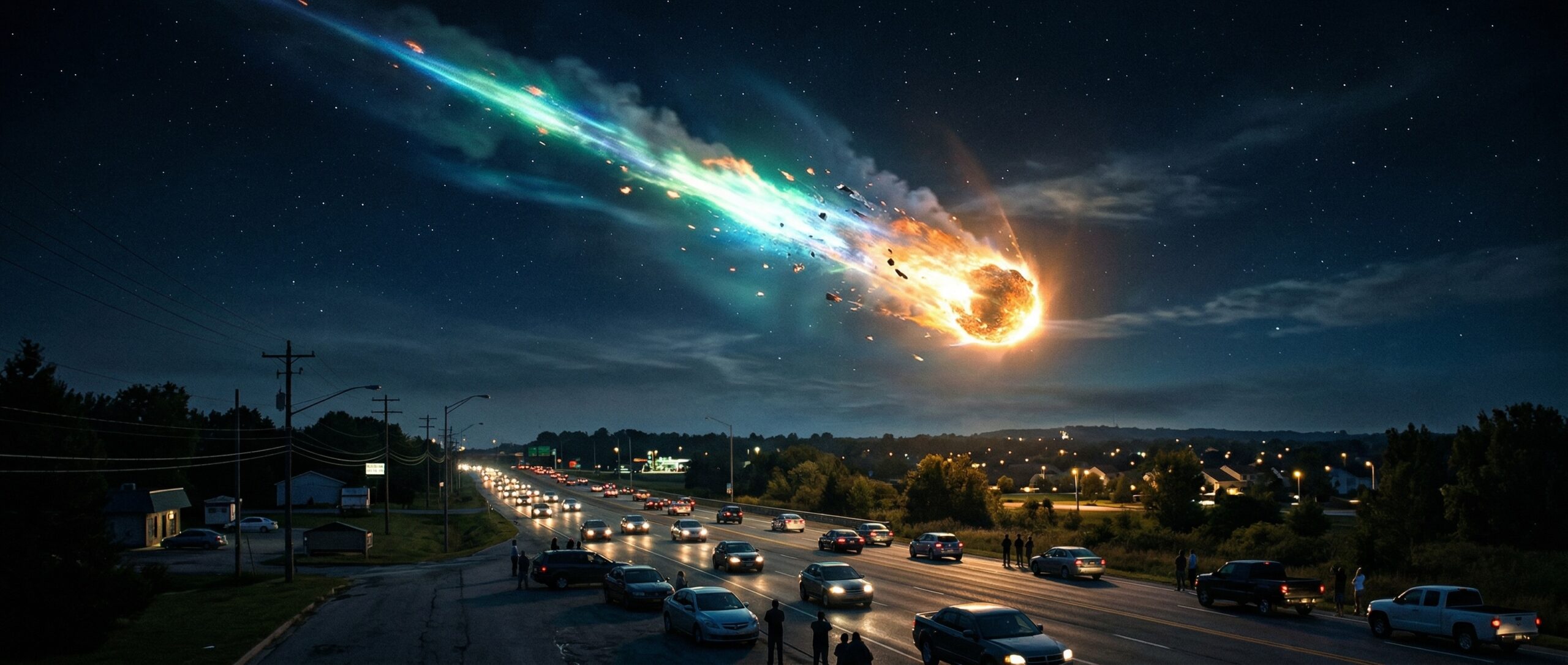
    When a bright object tears across the sky, glows green or blue, and seems to explode over a highway, suburb, or open field, most people do not experience it as a lesson in atmospheric entry physics. They experience it as a rupture. For a few seconds, the ordinary sky stops behaving normally. Dashcams catch it. Doorbell cameras catch it. Someone hears a boom. Someone else swears it changed direction. Within minutes, the explanations begin to split into camps: meteor, missile, UFO, warning sign, omen.

    That pattern is playing out again across the United States. Recent fireball sightings over the Northeast and Canada on March 17, 2026, along with additional American Meteor Society reports in early April over the Southwest, Texas, and the Mid-Atlantic, have reignited a familiar cycle of fascination and fear. NASA itself addressed the surge on March 26, 2026, noting that the northern hemisphere is in peak “fireball season” and that bright meteor sightings often rise between February and April. In other words, the sky is not necessarily becoming stranger. It is becoming more visible, more recorded, and more narratively unstable.

    This is what makes the current wave worth a full pillar treatment. The story is not only that giant fireballs are showing up across the US. It is that every sighting now lands in a culture primed for escalation. A meteor becomes a possible craft. A sonic boom becomes evidence of interception. A bright atmospheric breakup becomes a sign that something is wrong with the planet, the government, or the future itself. Readers who have followed how NASA glitches turn into conspiracy stories or how old sky anomalies get revived as modern evidence will recognize the same conversion process here. The object enters the atmosphere as a meteor. It enters the internet as a mystery.

    Recent fireball reports have made the sky feel newly unstable

    The current conversation did not emerge from a single isolated incident. It built from repeated sightings. NASA’s March 26, 2026 feature “It’s Fireball Season! Answering Your Meteor Questions” pointed directly to multiple recent states where bright meteors had drawn attention, including Texas, Ohio, California, and Michigan. The agency also highlighted a particularly dramatic daytime fireball observed the morning of March 17, 2026 across the northeastern United States and Canada, describing it as an object nearly six feet wide and about seven tons in mass before it fragmented over Ohio.

    That alone is enough to trigger a cultural response. When people hear that a multi-ton object blazed through the atmosphere over populated areas, the event does not stay in the lane of astronomy for long. It brushes against older fears almost immediately: impact events, military secrecy, cosmic warning signs, and hidden objects entering the atmosphere unnoticed. The fact that several more reported fireballs followed in early April only deepened the sense that something unusual was underway.

    The American Meteor Society has logged recent fireball witness reports over the Mid-Atlantic, Florida and Mississippi, Arizona-California-Nevada, and Texas. These are not proof of an incoming catastrophe. They are proof that a lot of people have recently looked up, seen something extraordinary, and felt the need to report it. But in a hyper-networked environment, repeated extraordinary visuals quickly create the impression of acceleration. It begins to feel as though the sky itself is entering a new phase.

    Fireballs are real atmospheric events, not automatically signs of danger

    A fireball is not just any shooting star. It is a meteor bright enough to outshine Venus, usually caused by a larger-than-average meteoroid entering Earth’s atmosphere at tremendous speed. As it compresses the air in front of it and heats up, it can flare brilliantly, fragment, and sometimes produce a delayed boom. NASA notes that the terms fireball and bolide are often used interchangeably in public-facing explanations, even though technical distinctions can matter in scientific contexts.

    That scientific explanation is important because it clarifies what people are actually seeing. A fireball is not evidence that a craft is intentionally maneuvering overhead. It is not evidence of a missile strike. It is not, by itself, evidence of an extinction-level threat. Most meteoroids that create these displays are too small to survive atmospheric entry intact in a hazardous way. Even the dramatic Ohio event cited by NASA was presented as a manageable meteorite-producing fragmentation event, not as a civilization-threatening near miss.

    Still, understanding the mechanism does not eliminate the emotional impact. A sky event can be perfectly explainable and still feel apocalyptic. That tension is part of why these stories endure. A fireball belongs to a category of phenomena that science explains clearly but human perception experiences viscerally. The same split often drives stories about strange sounds in the atmosphere or recurring sky anomalies that seem to exceed ordinary expectations in the moment.

    Spring is one of the times of year when fireballs feel more common

    NASA’s March 26 article makes an important point that should sit near the top of any responsible piece on this subject. The northern hemisphere is in peak fireball season between roughly February and April, with rates potentially rising by 10% to 30% around the weeks of the March equinox. Scientists do not fully agree on every reason why, but the pattern itself is not new. The sky is not suddenly inventing fireballs in 2026. The season is helping produce more of the brightest meteors, and public attention is amplifying the rest.

    That means one of the strongest apocalyptic interpretations already runs into a problem. A cluster of sightings does not necessarily imply that Earth is moving into a uniquely dangerous bombardment period. It may simply mean we are in a known seasonal window, during a time when almost everyone carries a high-resolution camera and social platforms reward dramatic interpretation. More eyes, more lenses, and more reposting create the emotional impression of escalation, even when the underlying astronomy is broadly understood.

    This gap between statistical normality and emotional abnormality matters. It is also what allows some stories to drift so easily into conspiratorial territory. If the average person does not know about fireball season, then repeated sightings can look like a hidden pattern. Once that happens, the event leaves the realm of skywatching and enters the realm of suspicion.

    Recent US fireball cases show how fast awe turns into speculation

    The Ohio-associated March 17 event is the obvious anchor because NASA elevated it in its own explanation. But it is not the only recent case adding momentum. The American Meteor Society logged a fireball seen over DC, New Jersey, and Virginia around April 2, 2026, another over Florida and Mississippi the same day, another over Arizona, California, and Nevada on April 5, and another over Texas on April 7. The Texas report included estimated magnitudes as bright as -20 from one witness, which helps explain why a single short-lived event can dominate local conversation.

    These reports show the same pattern over and over. A bright flash appears. Witnesses in multiple states compare notes. Some mention fragmentation, color, or delayed sound. Then the interpretive spread begins. If the event looked smooth and straight, people call it a meteor. If it appeared oddly brilliant, too low, too green, too long-lasting, or somehow directional, a different vocabulary emerges. The object becomes “weird,” “not natural,” or “too controlled.”

    That jump from unusual to unnatural is one reason this subject sits so close to unexplained.co territory. Earlier site coverage of the Great Ohio meteor event and asteroid airburst risks already showed how quickly a luminous event becomes a vessel for larger fears. People are not simply observing rocks burning up. They are testing whether the sky can still be trusted.

    Some witnesses read fireballs as UFOs because brightness, silence, and speed feel nonhuman

    A classic UFO interpretation does not require a craft with visible structure. It only requires something in the sky that feels too bright, too fast, too silent, too erratic, or too physically implausible for a casual observer. Fireballs do well on several of those fronts. They can appear suddenly, produce dramatic colors, vanish in fragments, and leave witnesses with only partial recall of trajectory or duration. Under stress, memory compresses. Distance is hard to judge. So is altitude.

    That is why meteor events and UFO culture have always overlapped. Many famous sky scares begin with a real aerial event that feels more intentional than it is. In the social media era, this overlap has become even stronger, because video clips circulate stripped of context. A clip of a brilliant streak over a neighborhood, divorced from timestamp, location, and expert interpretation, looks like raw anomaly footage. That dynamic also drives stories like The Triangle Above the Pines and older cases such as the Westall UFO mystery, where witness certainty and atmospheric mood become inseparable from the event itself.

    None of that means witnesses are foolish. It means human beings interpret rare sky events through the stories already available to them. In a culture saturated with disclosure talk, UAP hearings, and decades of cinematic alien imagery, fireballs do not land on neutral ground. They land inside a ready-made symbolic system.

    Apocalypse readings emerge because fire from the sky has always felt like a message

    Long before modern astronomy, blazing objects in the sky were read as omens of war, plague, regime change, divine anger, or cosmic reordering. That symbolism never fully disappeared. It simply migrated. Today, instead of court astrologers and medieval chroniclers, we have TikTok prophecy accounts, doom-focused YouTube channels, and algorithmic panic loops that splice meteor clips into broader stories about collapse.

    This is where the current fireball wave connects directly to the apocalypse cluster already thriving online. Readers who have watched April 2026 prophecy culture spread, or seen how end-times timelines converge online, will recognize the structure immediately. A dramatic sky event becomes visual validation for a prediction ecosystem that was already waiting for proof.

    In that ecosystem, the fireball does not have to do much. It only has to arrive at the right emotional moment. Once it does, it can be framed as the beginning of judgment, a warning about pole shift, a sign of secret warfare, or evidence that “they” are preparing the public for something bigger. The event itself remains brief. The symbolic life built around it can last for weeks.

    Social media now turns local sky events into national mythology within hours

    The most important difference between a modern fireball and one seen a century ago is not the object. It is the speed of narrative formation. A witness no longer tells neighbors and perhaps a local paper. They upload a clip, add a caption, choose a theory, and release it into a network built to reward certainty, alarm, and novelty. By the time astronomers or meteor trackers provide context, the emotional meaning of the event has often already hardened.

    This is why even ordinary celestial events now feel culturally radioactive. The same mechanics that transform a fireball into a UFO also transform it into a government cover-up or an omen of collapse. Clips get recopied with worse compression and stronger claims. Context gets replaced by text overlays. Someone adds ominous music. Someone claims they heard jets. Someone else insists no meteor can move like that. Very quickly, the event stops being a local report and starts behaving like national folklore.

    That process has parallels all across the unexplained ecosystem. We have seen it in viral CERN sky portal videos, in revived anomaly clips, and in the repeated way institutional ambiguity is treated as evidence of concealment. The internet does not merely spread these stories. It edits them into stronger versions of themselves.

    A skeptical reading explains the sightings without draining them of wonder

    The strongest skeptical explanation is also the most boring at first glance and the most useful on second reading. Bright meteors are real. Spring fireball season is real. Multiple sightings across the US can happen within a short window without implying an unprecedented threat. Witnesses are often sincere, but visual impressions under surprise conditions are notoriously difficult to interpret. That combination accounts for most of what the public is seeing and sharing right now.

    But skepticism should not become a flattening reflex. A meteor can still be astonishing. A fireball can still shake houses, leave meteorites, or become a local event people remember for years. The goal is not to sneer at awe. The goal is to separate the astonishing from the unsupported. When that discipline disappears, everything bright becomes secret, everything loud becomes military, and everything rare becomes apocalyptic.

    Good unexplained writing lives in that tension. It respects witness experience, acknowledges the emotional force of the event, and still asks the hard question: what does the evidence actually support? In the case of the recent fireballs, the evidence points overwhelmingly toward natural atmospheric events amplified by digital culture, not toward alien intervention or imminent planetary catastrophe.

    The deeper story is not the meteors themselves, but the fear structure wrapped around them

    That is why this topic matters beyond astronomy. Fireball stories reveal how modern audiences process uncertainty. We live in an era where trust in institutions is low, apocalyptic language is common, and sky events arrive preloaded with old symbolic force. When something luminous falls from above, people do not ask only what it was. They ask what it means, who is hiding the truth, and whether it confirms a larger pattern they already suspect.

    In that sense, giant fireballs across the US are functioning as cultural mirrors. They reflect our appetite for disclosure, our vulnerability to omen-thinking, and our habit of turning incomplete information into worldview-level evidence. That is why the same event can produce three entirely different emotional responses at once: wonder, conspiracy, and dread.

    The fireball is real. The doomsday reading is interpretive. The UFO reading is speculative. The viral panic is social. All four can live inside the same clip, the same comment thread, and the same article. That overlap is what makes the subject feel so alive right now.

    Frequently Asked Questions

    Why are so many fireballs being seen across the US right now?

    NASA says the northern hemisphere is in peak fireball season from roughly February through April, and bright meteor sightings can rise around the weeks of the March equinox. More cameras and faster social sharing also make the events feel more frequent than they once did.

    Are these giant fireballs a sign of an asteroid threat?

    Not usually. Most fireballs are caused by relatively small meteoroids burning up in the atmosphere. Some can drop meteorites, but most do not represent civilization-scale danger.

    Why do some people think fireballs are UFOs?

    Because fireballs can appear unusually bright, colorful, fast, and disorienting. Without context, video clips and eyewitness impressions can make a natural atmospheric event seem controlled or unnatural.

    Why are fireballs linked to doomsday or prophecy stories?

    Fire in the sky has been interpreted as an omen for centuries. Modern prophecy communities and viral social platforms keep that symbolic tradition alive, especially during periods of social anxiety.

    What explains the current wave best?

    The best-supported explanation is a combination of seasonal fireball activity, sincere eyewitness reporting, and an online culture that rapidly turns dramatic sky events into larger narratives about secrecy, warning, or collapse.

  • Eight Experts Dead or Missing, Inside the UFO Secrecy Narrative Built Around Real Cases

    Eight Experts Dead or Missing, Inside the UFO Secrecy Narrative Built Around Real Cases

    It is exactly the kind of story the internet knows how to weaponize. A retired Air Force general disappears. A fusion scientist is killed. A NASA-connected name circulates in social posts. A handful of researchers, lab workers, and technical professionals are pulled into the same thread. Then the framing hardens almost overnight: eight experts dead or missing, all somehow tied to UFO secrecy.

    The problem is that this narrative sits in the most dangerous zone of modern mystery culture, where some of the underlying events appear to be real, but the larger theory built around them is far less certain. That matters because once a list like this starts circulating, it stops behaving like reporting and starts behaving like myth. Names get repeated. Timelines get compressed. Professional backgrounds get exaggerated. Unverified links become implied facts. Before long, readers are no longer asking what happened in each case. They are asking whether someone is silencing people connected to UFO disclosure.

    This article takes that claim seriously enough to examine it carefully. Not because the theory is proven, but because the story has already entered public circulation and is clearly resonating with readers who follow defense secrecy, UAP disclosure, unexplained deaths, and institutional mistrust. Readers who have followed the long culture of disclosure talk will recognize how quickly stories like this can take on a life of their own. The core question is not just whether these incidents are connected. It is how a partially documented chain of deaths and disappearances became a single conspiracy narrative, and why so many people were ready to believe it in the first place.

    The eight-experts claim says a hidden force may be targeting people linked to UFO knowledge

    The version now circulating online is fairly consistent. It claims that eight people connected in some way to military, aerospace, national security, or scientific research have died or disappeared over a short period, and that the pattern may point to suppression tied to UFO or UAP information. In its most dramatic form, the theory suggests an intimidation campaign, a cleanup operation, or a covert effort to keep sensitive knowledge from surfacing.

    That is a much larger claim than the raw facts alone can support. At least some of the cited incidents involve real people and real tragedies. But the leap from “these incidents happened” to “these incidents form a covert UFO pattern” is precisely where the article needs to slow down. A conspiracy theory becomes persuasive when it combines emotionally powerful facts with interpretive gaps. That appears to be exactly what happened here.

    The right place to begin is with a simple distinction. There is a difference between a chain of strange or tragic events and a demonstrated coordinated campaign. The first can be true without the second being true. In this case, that distinction is the whole story.

    This story spread because it fused real fear, elite secrecy, and a familiar disclosure narrative

    The internet does not need certainty to create momentum. It needs a hook, a list, and just enough official ambiguity to leave people unsettled. This narrative had all three. A missing retired major general with a history in classified aerospace work is already a compelling headline. Add a murdered MIT fusion scientist, a handful of other names, and comments from UFO-interested politicians, and the result feels bigger than any one case. That dynamic has already shaped coverage around figures like Eric Burlison and Anna Paulina Luna, where suspicion and disclosure politics feed each other.

    There is also a deeper reason the story took hold. For years, UAP discussion in the United States has moved out of the fringe and into congressional hearings, defense reporting, inspector-general complaints, and whistleblower language about hidden programs. Readers primed by that environment are already prepared to assume that official silence may hide something larger. In that climate, a disappearance does not stay a disappearance for long. It becomes possible evidence in a story many people were already waiting to tell.

    That does not mean the pattern is real. It means the cultural ground was ready for it. The eight-experts narrative is less surprising when viewed as the product of a disclosure-era mindset, one in which secrecy itself is treated as an active clue. That same mindset also fuels reaction to stories like the Pentagon’s century-long UFO study review, where official denials often deepen curiosity instead of reducing it.

    The timeline behind the narrative combines real cases, uneven reporting, and unresolved claims

    The most-circulated versions of the story usually cite a rough sequence of incidents across 2024, 2025, and early 2026. They include the reported death of NASA Jet Propulsion Laboratory researcher Frank Maiwald on July 4, 2024; the disappearance of a Los Alamos-connected figure named Anthony Chavez on May 4, 2025; the disappearance of Monica Reza during a June 22, 2025 hike in Angeles National Forest; the June 26, 2025 disappearance of Melissa Casias from her home; the later disappearance and recovery of Jason Thomas; the December 15, 2025 fatal shooting of MIT Plasma Science and Fusion Center director Nuno Loureiro; the February 16, 2026 killing of astrophysicist Carl Grillmair; and the February 27, 2026 disappearance of retired Air Force Major General William Neil McCasland.

    Presented as a list, it looks chilling. But lists can create an illusion of evidentiary unity that the underlying cases do not actually possess. Some cases in this chain appear to be grounded in public reporting. Others are difficult to verify through primary or institutional sources. Some involve homicide. Others involve missing-person circumstances. Some are linked to elite scientific institutions, while others are tied more loosely through job history, rumor, or social amplification.

    That mixed quality is important. Once names are grouped together under a single ominous headline, weakly supported entries borrow credibility from stronger ones. That is how a speculative chain becomes persuasive even when several links remain unclear.

    Some events appear documented, but the larger UFO link remains unproven

    At least two names in the circulating narrative are tied to events that appear clearly documented through credible reporting. MIT publicly confirmed that Nuno Loureiro, the director of its Plasma Science and Fusion Center, died in December 2025 after sustaining gunshot wounds. Carl Grillmair’s killing in February 2026 has also been widely reported, including accounts that point toward a local criminal context rather than anything obviously connected to UAP secrecy.

    William Neil McCasland’s disappearance is also being treated as a real case in current news coverage, though much of the strongest UFO framing around him appears in tabloid and commentary ecosystems rather than in hard official disclosure. The disappearance itself is one thing. The claim that it is connected to hidden UFO knowledge is another, and those two ideas are often being blended together in coverage, reposts, and speculation threads.

    Other names in the chain are harder to pin down with the same confidence. That does not prove they were fabricated, but it does mean the total narrative is being built on uneven ground. When a story claims a coordinated pattern, the burden of proof rises, not falls. Every name in the chain matters. Every biography matters. Every timeline detail matters. A pillar article on this subject has to be honest about the difference between a documented tragedy and a socially amplified inference.

    William Neil McCasland became the narrative anchor because his background invites maximum speculation

    If there is a gravitational center to this whole theory, it is William Neil McCasland. A retired Air Force major general connected to advanced aerospace and classified environments fits perfectly into the public imagination of hidden-program secrecy. Once his disappearance entered public view, it almost guaranteed that UFO communities would treat it as more than a missing-person case.

    According to recent reporting, McCasland disappeared in Albuquerque, New Mexico, on February 27, 2026. Accounts say he left behind trackable personal devices, and a piece of clothing was later found away from his home. Those details are naturally unsettling and have fed intense online discussion. But unsettling facts are not the same as confirming motive. The same details that make a case feel covert can also fit non-conspiratorial explanations, including mental-health crisis, disorientation, or intentional disappearance.

    What transformed the McCasland case from a serious disappearance into a UFO lightning rod was not just the mystery itself. It was the surrounding mythology. Wright-Patterson associations, classified research language, and the long cultural shadow of Roswell-style secrecy all made him an ideal symbolic figure in disclosure discourse. In practice, McCasland became the kind of name onto which a much bigger story could be projected. The same projection effect can be seen in witness-driven narratives like The Triangle Above the Pines, where atmosphere and uncertainty do as much work as hard evidence.

    Congressional concern helped legitimize the conversation, but not the strongest conspiracy claims

    One reason the story has not stayed confined to fringe corners is that some members of Congress have publicly shown interest in UAP secrecy and have spoken about the broader climate of fear surrounding disclosure. That matters because once elected officials start discussing chilling effects, disappearances, or suppression in adjacent contexts, online audiences often treat that as validation for a much larger hidden pattern.

    But even here, the distinction matters. Concern is not confirmation. A politician saying a case is troubling does not establish that it is tied to a covert UFO campaign. In politically charged information environments, officials often amplify suspicion without resolving it. That can push public attention toward the mystery while leaving the evidentiary core just as unsettled as before.

    In other words, congressional attention may help explain why this story feels newly serious, but it does not by itself prove that the underlying theory is correct. If anything, it shows how easily open questions about transparency can become magnets for much stronger claims than the public record can currently support.

    UFO communities are especially prone to building pattern from fragmented evidence

    That is not an insult. It is one of the defining features of the subject. UFO history is full of scattered testimony, partial documentation, buried programs, contradictory statements, and delayed revelations. Anyone who spends years in this topic becomes conditioned to read around the edges of official stories. They learn to look for omissions, coincidences, suppressed names, and institutional inconsistencies.

    That pattern-seeking habit can sometimes be useful. It helps explain why certain documents mattered, why certain whistleblower accounts gained traction, and why government denials no longer carry the authority they once did. It also overlaps with broader suspicion around stories like the Suchir Balaji whistleblower case, where public reaction quickly moves beyond the official frame. But the same habit can also turn tragedy into theory too quickly. When multiple unexplained cases appear close together, the human mind starts connecting them almost automatically, especially if the people involved seem elite, technical, or adjacent to secrecy.

    The eight-experts narrative is a textbook example of that process. It gathers isolated events, arranges them into apparent structure, then treats the structure itself as evidence. Once that happens, coincidence begins to feel insufficient, and uncertainty begins to look intentional.

    A skeptical reading does not dismiss the mystery, it protects the investigation from becoming fiction

    The strongest skeptical response to this story is not that nothing strange is happening. It is that the public chain of evidence does not yet justify the broadest claim being made. A cluster of deaths and disappearances involving technically accomplished people can be frightening without automatically being coordinated. Murders can emerge from local circumstances. Missing-person cases can involve mental-health, family, environmental, or personal factors. Institutional affiliations can create emotional pattern even where causal links do not exist.

    There is also a media-discipline problem here. The more dramatic the framing becomes, the more careful source verification needs to be. Were all eight individuals actually connected in meaningful ways to UFO knowledge? Were all of them in positions that would plausibly involve sensitive UAP information? Were all the case details reported accurately before they were woven into the larger theory? Those are not hostile questions. They are the necessary questions.

    Without that discipline, the story risks becoming self-sealing. Every ambiguity becomes suspicious. Every missing detail becomes evidence of suppression. Every correction becomes proof of cleanup. At that point, a real investigation stops being possible because the narrative has become too emotionally efficient to falsify.

    This story still matters because it reveals how little trust remains around secrecy, science, and national security

    Even if the strongest version of the conspiracy theory proves wrong, the narrative itself tells us something important. Large parts of the public now view elite institutions through a lens of concealed knowledge. In that environment, missing people and unexplained deaths involving scientists, military officials, or defense-adjacent professionals do not remain ordinary news. They become symbolic flashpoints in a broader collapse of trust.

    That is why this topic belongs on unexplained.co. It sits at the crossroads of mystery, information warfare, psychological pattern-building, and modern disclosure politics. The question is not only whether these eight cases are linked. The question is what kind of social reality makes so many readers immediately assume they might be.

    There is also a hard emotional truth behind stories like this. Lists of the dead and missing are never just theories. They involve real people, real families, and real grief. If a conspiracy frame is going to be used at all, it needs to be used carefully. The unexplained world loses credibility when it treats tragedy as raw material instead of evidence to be weighed.

    Frequently Asked Questions

    Is there proof that eight experts were killed or disappeared because of UFO knowledge?

    No public proof currently establishes that the reported deaths and disappearances were part of a coordinated UFO-related campaign. Some underlying incidents appear real, but the larger connection remains speculative.

    Why is William Neil McCasland central to this theory?

    McCasland’s Air Force background and association with classified aerospace work make his disappearance especially provocative to UFO-focused audiences. His case became the symbolic center of the larger narrative.

    Were all eight people definitely connected to UFO programs?

    That has not been demonstrated publicly. In many retellings, professional backgrounds in science, defense, or aerospace are treated as implied UFO relevance even where no direct UAP connection has been verified.

    What makes the story persuasive even without proof?

    The narrative combines real tragedy, elite institutions, official ambiguity, and preexisting public suspicion about disclosure secrecy. That mix is powerful even when the evidence for a coordinated pattern is weak.

    How should readers approach stories like this?

    Readers should separate confirmed facts from social-media inference, verify names and timelines carefully, and treat large pattern claims with extra caution. A good mystery article preserves uncertainty instead of pretending to solve it too quickly.

  • The Triangle Above the Pines, Inside a Pine Barrens Black Triangle UFO Encounter

    The Triangle Above the Pines, Inside a Pine Barrens Black Triangle UFO Encounter

    It begins with the kind of scene that UFO culture never forgets. A Boy Scout camping trip in the New Jersey Pine Barrens. A moonlit forest. A strange burst of chanting somewhere in the dark. Then, according to the witness, everything goes silent. The insects stop. The normal sounds of the woods vanish. The air feels wrong. A static charge crawls over the skin. And above the tree line, a massive black triangle appears and hangs there in the night.

    That is the core of the story told by Tom from New Jersey on UFO Chronicles Podcast Ep.342, “The Triangle Above the Pines”. On its face, it is one more witness account in a genre crowded with enormous claims and inconsistent memories. But this case has a little more weight than the average paranormal retelling because it combines so many of the recurring elements that make black triangle reports so persistent: silence, unnatural atmosphere, a huge low-flying geometric craft, a strange mental impression, delayed disclosure, and a location already loaded with folklore and unease.

    This article looks at what was actually claimed in the UFO Chronicles account, where the story is strongest, where skeptics would push back, and why black triangle encounters like this keep returning to the center of UFO culture. The real interest here is not whether one podcast guest can prove what he saw. It is that this case seems to compress nearly the entire black triangle pattern into one wilderness encounter, and does it in a setting that already feels half-mythic before the object even appears.

    This is a Pine Barrens black triangle case built around one witness account

    The Triangle Above the Pines case comes from UFO Chronicles Podcast Ep.342, published on July 13, 2025. The guest, Tom from New Jersey, describes a major encounter from spring 1998 during a Boy Scout camping trip in Lebanon State Forest, now called Brendan T. Byrne State Forest. According to the episode page, the incident happened sometime around 2 to 3 AM and involved a huge silent black triangle seen above the trees.

    On its own, that would already be enough to draw attention. Black triangle UFO accounts remain one of the most recognizable and most durable subcategories in modern UFO testimony. But the podcast page adds another layer. Tom frames the 1998 event as part of a longer chain of strange experiences, including childhood memory fragments, unusual lights in his room, a disturbing back-deck memory involving faceless figures, and a much later 2022 sighting of what he describes as a glass-cone object in southern New Jersey.

    That broader framework is what gives this story real pillar-article depth. It turns the case from a simple “I saw a strange craft” narrative into something more psychologically and culturally interesting: a witness trying to place one unforgettable event inside a larger life pattern of anomalies, dread, missing certainty, memory fragments, and unexplained impressions. That does not make the story automatically true, but it does make it richer, stranger, and harder to dismiss as just another throwaway light-in-the-sky account.

    This is what the witness says happened during the 1998 camping trip

    According to the episode page and show summary, the main event took place on Tom’s first Boy Scout camping trip in the New Jersey Pine Barrens. The night was already charged. He recalls hearing a nearby group of Wiccans chanting somewhere in the distance, a detail that may or may not matter factually, but certainly matters atmospherically. It is the kind of detail that turns an ordinary wilderness night into something that already feels liminal before the central event even begins.

    Then came the environmental shift. This part of the account is especially important because many UFO stories live or die on their surrounding conditions, not just on the shape of the object. Tom describes the woods going suddenly and completely quiet. Insects stopped. Ambient sound dropped away. The air felt dense and wrong. He also describes a static-like electrical feeling on his skin, as if the environment itself had changed character just before the object appeared.

    What he says he then saw was a massive black triangle rising or becoming visible above the tree line. The object was described as dark, seamless, matte, and silent. It reportedly carried three lights with white centers and an aqua-blue haze around them. There was no dramatic engine noise, no obvious propulsion, and no conventional aircraft sound. Instead, the craft seemed to move in an unnervingly smooth way, more like a heavy object gliding over invisible water than a machine pushing through air.

    One of the strangest parts of the story is the claimed mental component. Tom describes a wordless, telepathic-like impression tied to the object. He did not present this as hearing a voice in the conventional sense. It was more like a direct knowledge or emotional imprint, a strong inner certainty that what he was looking at was powerful, non-human, and aware of him. He also describes a snapping or popping sensation in his head, which he likened to popcorn. Meanwhile, the friend beside him reportedly repeated the phrase “he sees it,” a detail that adds another layer of unease but also invites questions about what exactly each witness experienced in the moment.

    Perhaps most telling is what happened next: almost nothing. The boys did not run to adults. They did not alert the whole camp. They did not turn the encounter into an immediate crisis. They returned to the tent and stayed quiet. That subdued aftermath is one reason the story feels psychologically believable to some readers. High-strangeness witnesses often describe not dramatic action, but a kind of stunned compliance, as though the event arrives wrapped in its own emotional logic.

    The Pine Barrens make this encounter feel bigger than a single sighting

    Location matters in unexplained cases, and the Pine Barrens are not just another patch of woods. Southern New Jersey’s Pine Barrens carry a deep regional mythology built from isolation, darkness, local legend, and generations of stories that treat the landscape as emotionally charged. The region is most famously linked to the Jersey Devil, but that is only part of the broader pattern. The Pine Barrens are one of those places where folklore and geography reinforce each other until the setting itself begins to feel like evidence.

    That does not mean the place is paranormal. It means the place is psychologically fertile. Vast wooded areas, limited visibility, unusual nighttime acoustics, and a preloaded expectation of strangeness can all intensify how an event is perceived and remembered. A witness in a dense, culturally charged wilderness is already standing inside a story-rich environment. That matters because encounters do not happen in a vacuum. They happen inside landscapes that shape fear, focus, and interpretation.

    At the same time, that setting is also part of what makes the Triangle Above the Pines account so compelling. A giant black triangle drifting silently over suburban lights would feel eerie. The same object over a moonlit forest in the Pine Barrens feels archetypal. It drops immediately into the deeper current of American high-strangeness geography, where wilderness, secrecy, folklore, and witness isolation all converge. In that sense, the location is not proof, but it is part of the story’s power.

    Black triangle UFO cases endure because they combine geometry, scale, and silence

    Black triangle UFO reports have been circulating for decades, and they persist because they strike a very specific psychological nerve. Unlike glowing orbs, erratic lights, or distant luminous anomalies, black triangle craft often sound solid. Witnesses describe them as structured, immense, geometric, and physically present. That makes them feel less like fleeting atmospheric confusion and more like impossible machines intruding into ordinary space.

    The pattern is surprisingly consistent across many reports. A witness sees a dark triangular craft, usually at low altitude or at least low enough to feel physically imposing. The object is often silent or nearly silent. It may feature three bright corner lights, sometimes with a central light, sometimes not. It may hover, drift, or move with slow confidence rather than darting in cinematic ways. And the emotional reaction is often not simple terror. It is awe mixed with paralysis, a sense of scale and wrongness that feels bigger than fear.

    That is why the Pine Barrens case slots so easily into the broader black triangle canon. Whether one treats the account as literal, misperceived, embellished, or psychologically filtered, the structural features line up almost too neatly with the recurring template. Huge dark triangle. Silence. Atmospheric distortion. Powerful witness impression. Delayed retelling. Remote nighttime setting. From an editorial perspective, that makes the case useful because it becomes more than a local anecdote. It becomes a gateway into one of the most durable forms in UFO witness culture.

    The silence, static, and telepathic impression are what make this story unusual

    Plenty of UFO stories involve odd lights. Fewer involve a full environmental shift. One reason the Triangle Above the Pines case stands out is the cluster of sensory details attached to the sighting. The witness does not just describe an object. He describes the forest going dead silent, the air feeling pressurized or unnatural, and a static-electric sensation across the body before or during the appearance of the triangle.

    That cluster matters because it appears in many different corners of high-strangeness testimony. Some experiencers report electrical sensations, strange pressure changes, temporary sound suppression, missing ambient noise, or a feeling that the environment has become staged or artificial. Others report a “download,” an impression, or a direct knowing that does not feel like normal thought. These experiences are almost impossible to verify externally, which makes them frustrating from an evidentiary perspective, but they are too common in the witness literature to ignore entirely.

    In this case, the reported telepathic quality is especially interesting because it is presented not as a full message but as a forceful impression. That kind of detail often appears in witness stories that fall somewhere between observation and encounter. It suggests that what frightened the witness was not just the object’s appearance, but the feeling that the object was somehow participating in the moment consciously.

    From a skeptical standpoint, these details can also be read as signs of altered perception, adrenaline, memory layering, or later meaning-making. But even in that reading, they remain important. They are part of what makes UFO witness reports culturally sticky. People do not just remember what they saw. They remember how the world around them felt when the ordinary rules seemed to fail.

    The witness-memory issue is where this case gets strongest and weakest at the same time

    The same thing that gives this story emotional depth also creates its biggest evidentiary vulnerability. Much of the Triangle Above the Pines account is retrospective. The main event occurred in 1998, but the witness says the memory was suppressed or at least not fully integrated until much later. The episode page also includes earlier childhood fragments that sit in the difficult zone between memory, nightmare, dream residue, and later interpretation.

    That matters because childhood memory is notoriously unstable, especially when revisited through adulthood. People can hold vivid, emotionally true memories that are still incomplete, distorted, or reorganized over time. Memory is not a clean playback system. It is reconstructive. It absorbs later meaning, new fears, conversation, media, and personal identity. In UFO and experiencer literature, this problem becomes even sharper because the witness is often trying to connect scattered emotional fragments into a coherent life pattern.

    But this is also where the case becomes more compelling to some readers. The witness is not presenting a frictionless, polished, overconfident story. He is describing an event that seems to have remained psychologically unresolved for years. That unresolved quality can cut both ways. It may indicate memory distortion. It may also make the testimony feel less performative than accounts that arrive fully formed and theatrically certain.

    A strong pillar article has to hold both possibilities at once. The memory issue does not automatically destroy the account. But it absolutely prevents the article from treating the story as clean evidence of an extraordinary craft. The honest position is that the memory complexity is part of the case, not a side note to it.

    The later 2022 glass-cone sighting makes the witness story broader and stranger

    The UFO Chronicles episode page also references a second event from November 26, 2022 involving what the witness describes as a glass-cone object in southern New Jersey. That later sighting is not the core of this article, but it does matter because it changes the shape of the narrative. The witness is not presenting his life as divided into before and after one isolated childhood event. He is suggesting an ongoing relationship with anomaly.

    That can deepen the story, but it can also complicate it. In experiencer narratives, later events often reinforce earlier ones by making them feel newly real. A witness who doubts an old encounter may reinterpret it after another strange experience years later. That process can be psychologically understandable without telling us whether the underlying experiences were objectively paranormal, misperceived, symbolic, or some mixture of all three.

    Editorially, the best use of the 2022 sighting is as a secondary context lane. It should not overshadow the main black triangle encounter. Instead, it should be treated as part of the witness’s broader anomaly framework, a reminder that the triangle story belongs to a larger autobiographical pattern rather than standing alone.

    This is what skeptics would say about the Triangle Above the Pines story

    A credible unexplained article has to take skepticism seriously, especially in a case built around retrospective memory and a podcast retelling. The first skeptical objection is straightforward: there is no known physical evidence tied to this event. No photographs. No contemporaneous report. No radar data. No documented investigation file. What exists publicly is a witness narrative presented many years after the experience.

    The second objection concerns the setting itself. A moonlit forest at night is a powerful distortion environment. Shapes feel larger. Distances become unreliable. Silence can be remembered as absolute even when it was simply unusual. A charged atmosphere, a strange nearby soundscape, fatigue, suggestion, and the emotional intensity of childhood can all make an event feel more structured and supernatural in memory than it may have been in the moment.

    The third skeptical objection is the life-pattern problem. Once a witness begins linking multiple strange experiences across childhood and adulthood, there is always a risk that interpretation becomes self-reinforcing. One event validates another, and the larger story grows more coherent over time. That coherence may reflect reality. It may also reflect the human tendency to build narrative order out of scattered anomalies.

    None of this means the witness is lying. It means the case sits in the difficult middle ground where sincerity and uncertainty coexist. For many of the most enduring UFO witness stories, that is exactly where the real tension lies.

    This case still matters because it compresses the black triangle pattern into one memorable wilderness encounter

    The Triangle Above the Pines case remains interesting not because it proves anything decisively, but because it brings so many durable UFO motifs into one scene. It has the charged location. It has the wilderness isolation. It has the environmental silence. It has the static sensation. It has the giant silent triangle. It has the mental impression that the object was somehow aware. And it has the delayed retelling that makes the story feel half-haunting, half-investigative.

    That combination gives the story unusual staying power. Even readers who remain skeptical can understand why this would become a formative memory for a witness. And readers who follow experiencer literature will recognize nearly every major beat in the pattern. In that sense, the case matters as a piece of witness culture even if one remains agnostic about what the object actually was.

    The bigger reason it matters is that black triangle reports continue to occupy a strange middle territory in UFO belief. They often sound too structured and too close to the ground to be dismissed as distant lights, yet they rarely produce the kind of hard evidence that would settle the question. They survive because they feel more solid than folklore and less provable than conventional case files. The Triangle Above the Pines lives inside that same unresolved zone, which is exactly why people keep coming back to stories like this long after the night itself has passed.

    Frequently Asked Questions

    What is the Triangle Above the Pines case?

    The Triangle Above the Pines is a witness account featured on UFO Chronicles Podcast Ep.342. It centers on a reported spring 1998 black triangle UFO sighting during a Boy Scout camping trip in New Jersey’s Lebanon State Forest, now Brendan T. Byrne State Forest.

    Where did the Pine Barrens UFO encounter reportedly happen?

    According to the episode page, the event happened in Lebanon State Forest in New Jersey, which is now known as Brendan T. Byrne State Forest in the Pine Barrens region.

    What is a black triangle UFO?

    A black triangle UFO is a commonly reported type of unidentified craft described as large, dark, triangular, and often silent. Witnesses frequently report three bright lights, slow movement, and an overwhelming sense of scale.

    Why do some UFO witnesses report silence or telepathy?

    Many high-strangeness witness reports include environmental silence, pressure changes, static sensations, or telepathic-like impressions. These details are common in UFO testimony, though they are difficult to verify and can also be interpreted through psychology, stress, or altered perception.

    How reliable are childhood UFO memories?

    Childhood memories can be vivid and emotionally powerful, but they are also vulnerable to reconstruction, reinterpretation, and dream-memory overlap. That makes them meaningful as testimony, but difficult to treat as clean evidence without external corroboration.

    Was there physical evidence in this case?

    No publicly documented physical evidence is attached to the Triangle Above the Pines story. The case is known through witness testimony and the podcast episode page, not through photos, radar returns, or a formal investigation file.