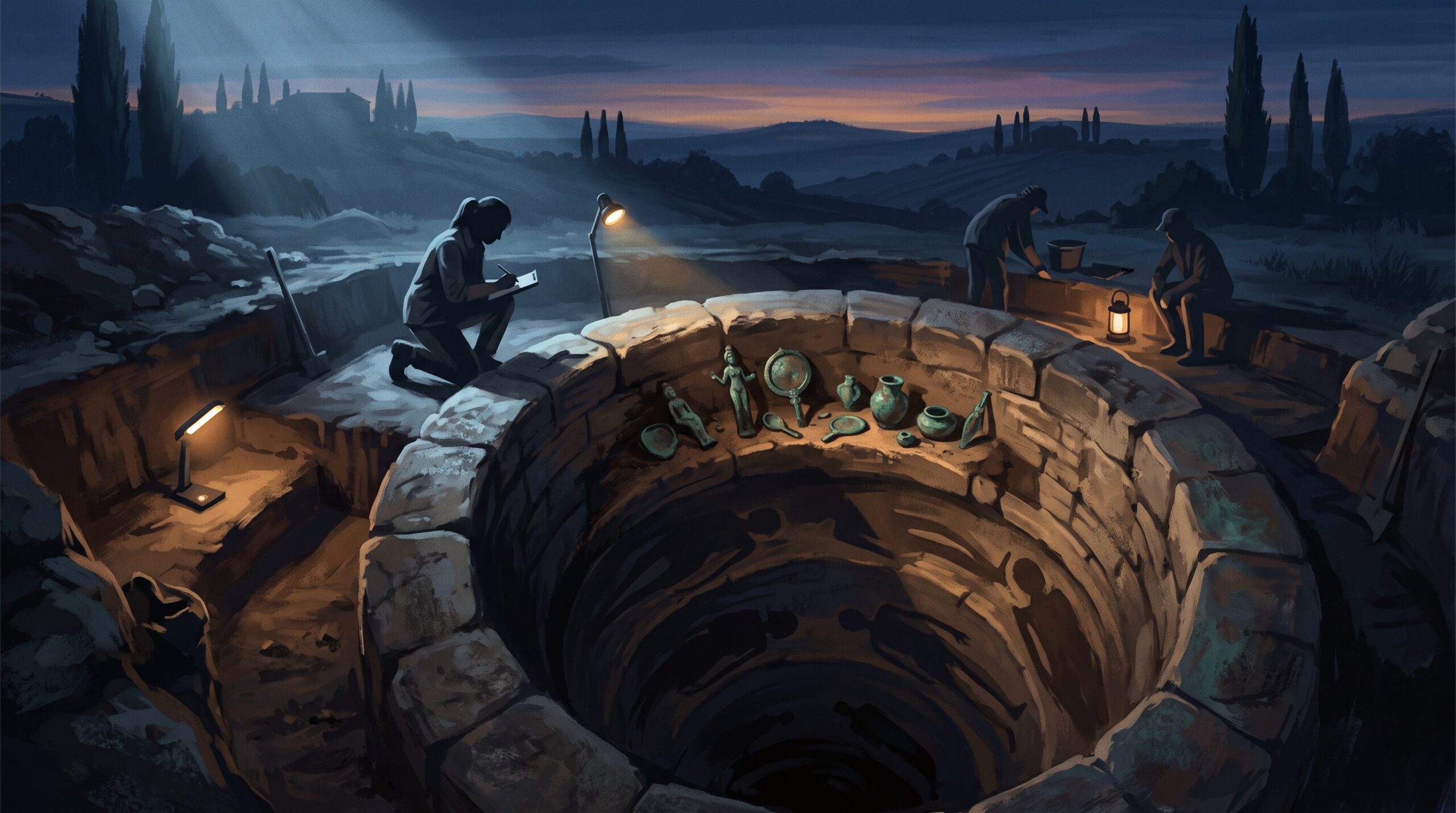
The most unsettling detail in the newly reported Etruscan discovery is not that human remains were found underground. It is that the place appears to have been treated like a living presence: opened, fed with offerings, used, and then deliberately closed.
Archaeologists investigating the ancient Etruscan city of Veii in Italy have reported a ritual well associated with bronze objects, offerings and human bodies. The discovery has already been compressed online into a darker phrase—human sacrifice—but the evidence is more precise, and more mysterious, than that headline suggests. The excavation points to a sacred installation whose final closure mattered deeply to the people who used it.
The [new report from Live Science](https://www.livescience.com/archaeology/archaeologists-discover-etruscan-well-that-was-ritually-opened-with-offerings-for-a-goddess-and-closed-with-human-bodies) describes the well as part of an ancient cult setting. It does not, by itself, prove that every person found there was deliberately killed as a ritual victim. That distinction is essential. Archaeology can reveal where remains were placed and what surrounded them; it cannot automatically recover the intentions, identities or causes of death behind every deposit.
A sacred place in the shadow of Rome
Veii was one of the most important Etruscan cities in central Italy. It stood close enough to Rome to become a long-term rival, and its eventual defeat by Rome in the early fourth century BCE helped reshape the balance of power in the region. Today, the site is often remembered through the Roman story of conquest, but the well offers a glimpse of something older: a religious world with its own rules for communicating with gods, ancestors and the landscape.
The city’s history matters; another Unexplained.co investigation of an abandoned place shows how location-based mystery can outlive its original story. because the find is not an isolated oddity. Etruscan ritual life often involved thresholds—places where the human world met the divine one. Wells, pits and underground chambers could carry offerings out of sight, toward powers associated with water, fertility, health, protection or the underworld. The [background history of Veii](https://en.wikipedia.org/wiki/Veii) helps explain why a buried installation could be more than a practical water source.
In this setting, the well’s architecture becomes part of the evidence. A vessel dropped into a pit is one thing. A carefully arranged sequence of offerings followed by a formal closure is another. It suggests that the community was not merely abandoning a hole in the ground. It was ending a relationship with a place.
What was found—and what remains uncertain
The reported discovery links the well to bronze artifacts, ritual offerings and human remains. Those elements create a powerful narrative, but they do not all carry the same evidentiary weight.
The bronze objects may indicate ceremonial activity. Their placement can help archaeologists reconstruct when the well was used and how the deposit was assembled. The human remains establish that people were placed in or around the installation. They do not, without further analysis, establish whether those people were sacrificed, buried after ordinary deaths, connected to the cult, or involved in an event that archaeologists have not yet reconstructed.
That is where the story’s most important information gain lies. The sensational interpretation asks, “Were humans sacrificed?” The better question is, “What does the sequence of opening, offering and closure tell us about how the Etruscans understood sacred space?”
A final deposit can be a form of ritual punctuation. Once a sanctuary, spring or well had completed its religious function, closing it may have protected the community from whatever power was believed to remain below. The bodies may have been part of that act, but their precise role must be tested rather than assumed.
Why “closed with human bodies” is not the same as proof of sacrifice
Ancient human remains are easily turned into a single dramatic explanation. The word sacrifice feels as though it solves the mystery, but it can conceal several separate questions:
Archaeologists can approach those questions through osteological examination, trauma analysis, radiocarbon dating, isotope studies and the spatial relationship between bones and artifacts. Evidence of cut marks, binding, blunt-force trauma or unusual treatment could change the interpretation. So could evidence that the remains represent ordinary burials later incorporated into a ritual closure.
Until those studies are published, “human sacrifice” should be treated as a possibility—not a settled fact. The less dramatic wording is also the more responsible one: human remains were incorporated into a ritual deposit whose meaning is still being reconstructed.
The goddess connection
The discovery has been described as connected to offerings for a goddess. That detail makes the well feel almost animate. A goddess associated with the installation would not necessarily have been imagined as a figure waiting inside it. In ancient Mediterranean religion, divine power could be attached to a place, a spring, an object or a recurring ceremony rather than represented by a single statue.
This helps explain why closure could matter. If a well was a route into a sacred domain, sealing it may have been a way to end access, contain danger or mark the completion of a vow. Offerings could be gifts, payments, memorials or attempts to restore balance. The same object can carry different meanings depending on when and where it was deposited.
That ambiguity is not a weakness in the discovery. It is the mystery. The material record preserves the action while withholding the words that would have explained it.
Veii’s older mystery beneath the Roman story
Earlier archaeological mysteries covered by Unexplained.co show why buried sites attract competing explanations. The Roman conquest of Veii supplies a familiar ending: a powerful city falls, its territory is absorbed, and later history is written by the victor. But ritual deposits such as this one resist that neat conclusion. They preserve a private and local world that existed before the conquest and may have continued through periods of political change.
The well may therefore become important for more than the question of human remains. It could help researchers map how Etruscan religious practices changed over time, how rituals were reorganized when communities faced pressure, and whether the final closure belongs to a moment of crisis or to an ordinary religious cycle.
It also offers a warning about how ancient mysteries are made. Online retellings often remove the uncertainty that makes archaeology valuable. A bronze object becomes a talisman. A burial becomes a sacrifice. A sealed well becomes a portal. Each transformation makes the story more vivid, but each can move it farther from the evidence.
What happens next
The next decisive information should come from the remains themselves and from the excavation’s full technical publication. Dating could establish whether the bodies and offerings belong to the same event. Bioarchaeology could reveal age, sex, health and geographic origin. Trauma analysis could test whether violence occurred. The arrangement of the deposit may show whether the closure was carefully planned or accumulated over time.
Those results may produce a darker story, a more ordinary one, or something stranger than either. They might show a deliberate killing, a funerary act, a mixed deposit or a sequence of rituals that modern categories cannot easily describe.
For now, the strongest conclusion is also the most haunting: at Veii, people appear to have opened a sacred underground place, placed gifts within it, and eventually sealed it with human remains. We know something happened there. We do not yet know whether the dead were offerings, mourned individuals, victims, guardians of the closure—or several of these things at once.
That unanswered question is why the well still feels alive in the archaeological record. What do you think the final deposit was meant to accomplish?
Sources and further reading
The primary current account used for this article is Live Science report on the Etruscan well. For historical context, see the [reference overview of Veii](https://en.wikipedia.org/wiki/Veii). The article treats the sacrifice interpretation as unproven pending detailed osteological and excavation results.