Blog

  • Climate Apocalypse: How Global Warming Could End the World

    Climate Apocalypse: How Global Warming Could End the World

    The prospect of a climate apocalypse has become a pressing concern in recent years, as scientific evidence increasingly points to the severe consequences of unchecked global warming. The potential for irreversible damage to our planet’s ecosystems and the well-being of future generations has sparked a sense of urgency among climate scientists, policymakers, and activists alike. This article delves into the critical thresholds of climate change, explores strategies for mitigation and adaptation, and discusses whether there is still room for optimism in the face of potential disaster.

    Key Takeaways

    • By 2035, we may reach a critical point of no return in climate action, after which limiting global warming to 1.5°C may no longer be possible.
    • Irreversible changes to the Earth’s climate system are being driven by human activities such as deforestation and fossil fuel consumption.
    • A paradigm shift towards ‘apocalyptic optimism’ may be necessary to foster progress and inspire collective action against climate change.

    The Tipping Point: Understanding the Critical Thresholds of Climate Change

    The 2035 Deadline: A Point of No Return?

    We’re on the brink, folks. Scientists have circled 2035 on the calendar as the year we might cross a critical threshold. After that, stopping a 2-degree Celsius rise in Earth’s temperature becomes a pipe dream. This isn’t science fiction; it’s a countdown to potential disaster.

    We’re not just up against the clock; we’re up against our own legacy of deforestation and fossil fuel addiction. It’s a legacy that’s pushing us closer to the edge.

    Here’s the kicker: it’s not just about the temperature. It’s the domino effect—one disaster triggering another. We can’t afford to ignore the warnings any longer.

    • Key Takeaways:
      • 2035: The potential point of no return.
      • 2-degree Celsius rise: The line we must not cross.
      • Action required: Urgent and decisive.

    We’ve got to flip the script. It’s time for bold moves and a new narrative. ‘Apocalyptic optimism’ might sound like an oxymoron, but it’s the mindset we need to adopt. We can change the ending of this story, but only if we start rewriting it now.

    Irreversible Changes and the 2-Degree Celsius Benchmark

    We’re standing on a precipice, folks. The 2-degree Celsius mark isn’t just a number; it’s a line in the sand that Mother Nature drew with a shaky hand. Cross it, and we’re not just talking about longer summers or milder winters. We’re looking at a domino effect of catastrophic events that could reshape our world as we know it.

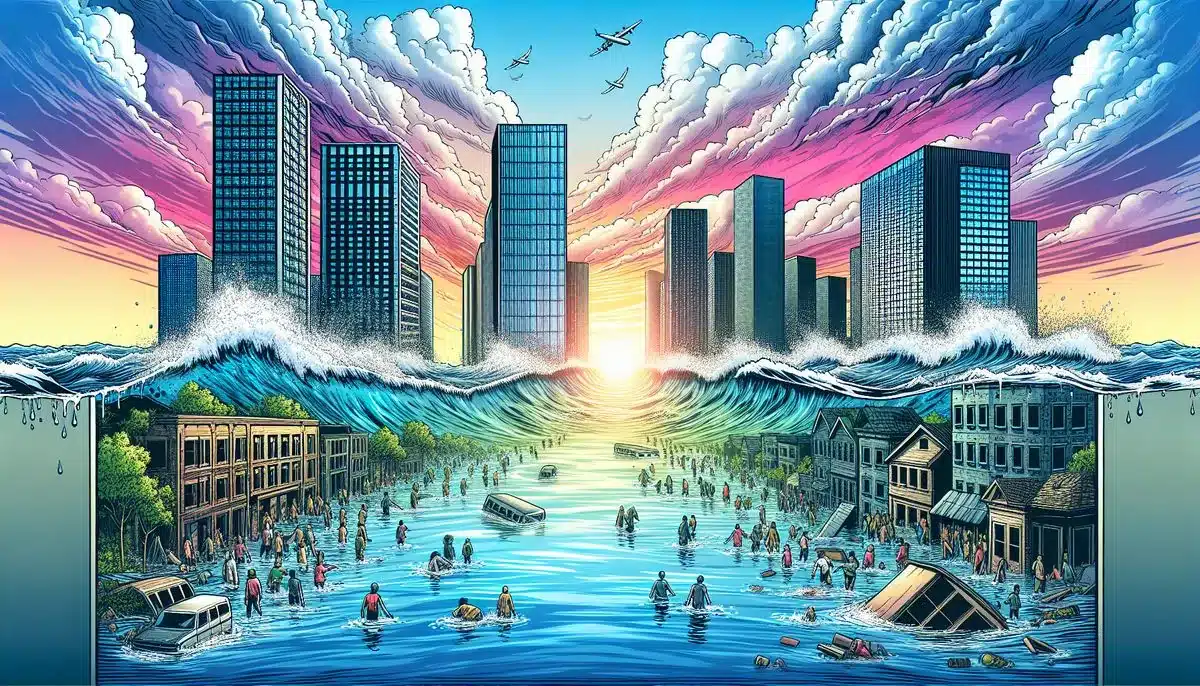
    The secrets of climate science have been clear: once we hit that 2-degree increase, we’re looking at irreversible changes. Coastal cities could become modern Atlantises, and extreme weather could go from headline news to just another Tuesday. The data doesn’t lie, and it’s screaming for us to pay attention.

    The Paradigm Shift we need is monumental. It’s not just about switching off lights or cycling to work. It’s about transforming how we live, how we consume, how we think about our place on this planet. Here’s a snapshot of what we’re up against:

    • Heatwaves: Multiplication factor of 5x or more
    • Floods: Coastal areas at severe risk
    • Storms: Increased intensity and frequency

    We can’t afford to be passive spectators in this unfolding drama. It’s time to take the stage and act.

    The study led by UK and Netherlands scientists rings an alarm for 2035, a year that could mark a point of no return. If we don’t pivot now, we might just find ourselves in a future where the term ‘natural disaster’ loses all meaning because there’s nothing ‘natural’ about the chaos we’ve unleashed.

    The Role of Deforestation and Fossil Fuels in Climate Dynamics

    We’ve got ourselves into a real pickle with deforestation and burning fossil fuels. It’s like we’re on a runaway train heading for a cliff, and the brakes are busted. Scientists are clear: we need to stop burning fossil fuels. The thickening blanket of greenhouse gases is our own doing, and it’s heating up our planet at an alarming rate.

    But here’s the kicker: even if we cut out the pollution, we’re still in for a rough ride. Gaseous sulfur dioxide, a major pollutant from fossil fuels, hangs around for just days. So, when we cut the pollution, the impact is almost immediate. Unlike carbon dioxide, which can last for centuries in our atmosphere, we can see quick changes if we act fast.

    Let’s talk numbers. Deforestation and fossil fuel emissions are the main culprits behind the rapid increase in greenhouse gases. And it’s not just about the air we breathe; it’s about the entire climate system. Here’s a snapshot of the problem:

    • Greenhouse Gas Emissions: Skyrocketing due to human activities.
    • Deforestation: Stripping away our planet’s lungs, contributing to CO2 levels.
    • Fossil Fuels: The addiction we need to kick, for our climate’s sake.

    We’re at a crossroads. Every moment we delay, the closer we get to a climate point of no return. It’s time to take decisive action.

    We can’t afford to ignore the signs. The podcast discussions about apocalyptic disasters highlight just how fragile our world is. It’s a wake-up call we all need to hear. We’re in this together, and it’s time to rally and turn the tide on climate change.

    Navigating the Climate Crisis: Strategies for Mitigation and Adaptation

    Economic Impacts: Weighing Costs Against Climate Action

    We’re at a crossroads, folks. The climate crisis isn’t just about polar bears and melting ice caps; it’s hitting our wallets hard. Economic impacts are real and escalating. But what’s the price tag on the end of the world? We can’t afford to ignore the costs of inaction.

    Let’s break it down. We’ve got floods wiping out crops, hurricanes demolishing homes, and wildfires torching timber. These aren’t just headlines; they’re invoices being billed to our future. And the longer we wait, the steeper the cost. Yet, some argue that the price of mitigation might be too high. Can we really put a price on a livable planet?

    Here’s the kicker: investing in climate action can actually save us money in the long run. Think about it. Renewable energy prices are dropping like leaves in autumn. Energy efficiency is the gift that keeps on giving, slashing bills left and right. And let’s not forget the green jobs bonanza. We’re talking about a whole new economy here, folks!

    • Renewable Energy: Cheaper than ever, and getting more affordable by the day.
    • Energy Efficiency: Cut costs and carbon footprints at the same time.
    • Green Jobs: A surge in employment opportunities in sustainable industries.

    We’re not just saving the planet; we’re investing in our own prosperity. It’s a win-win if we play our cards right.

    So, let’s roll up our sleeves and get to work. We can’t let the financial titans and media manipulation shape our future. It’s time to take control of our destiny and make smart, sustainable choices that will pay off for generations to come.

    Global Disasters and the Urgency of Decisive Measures

    We’re at a crossroads, folks. The planet’s sending SOS signals, and we’re the only ones who can answer the call. Climate change isn’t waiting around for us to get our act together. It’s here, it’s real, and it’s wreaking havoc. From wildfires to hurricanes, the evidence is undeniable. We’ve seen the studies, like the one from Earth System Dynamics on August 30, 2018, screaming for immediate action.

    Our response? It’s got to be swift, it’s got to be strong. We’re talking about a full-scale mobilization. We need to slash emissions, switch to renewables, and adapt our cities. And we can’t forget the economic angle. The cost of inaction? Catastrophic. The price of prevention? A bargain in comparison.

    • Cut emissions: Transition to clean energy.
    • Adapt infrastructure: Make cities resilient.
    • Economic overhaul: Invest in green tech.

    We’re in this together, and the time to act is slipping through our fingers like sand in an hourglass.

    Let’s not find ourselves looking back, wishing we’d done more. The future’s not set in stone, and we’ve got the chisel. Let’s carve out a path that leads to survival, not regret.

    ‘Apocalyptic Optimism’: A New Narrative for Climate Progress

    We’ve been down the doom-laden path, painting pictures of a world on fire, seas swallowing cities, and skies choked with smoke. But now, we’re flipping the script. We’re embracing ‘Apocalyptic Optimism’—the belief that, despite the dire forecasts, we have the power to pivot. It’s not just about survival; it’s about thriving in the face of adversity.

    We’re not just passive observers; we’re active participants in shaping our future. Organizations and initiatives dedicated to tackling climate issues are stepping up, making strides that reflect our collective resolve. It’s time we further empowered ourselves through informed action.

    We’re crafting a new narrative, one where each action we take is a step towards a more hopeful horizon.

    Here’s the thing: optimism isn’t about ignoring the challenges. It’s about harnessing our collective energy to overcome them. We’re rolling up our sleeves, ready to tackle what comes our way. And yes, there’s a deadline. The 2035 marker looms, but it’s not a countdown to the end—it’s a call to action.

    • Embrace renewable energy
    • Innovate sustainable practices
    • Educate and empower communities

    These aren’t just bullet points; they’re our battle cry against the ticking clock. We’re not waiting for a hero to save us. We’re the heroes, each and every one of us, armed with the will to forge a better path. So let’s write this story together—one of resilience, innovation, and, above all, unwavering optimism.

    The Tipping Point: Understanding the Critical Thresholds of Climate Change

    The 2035 Deadline: A Point of No Return?

    We’re racing against a clock that’s ticking faster than ever. By 2035, scientists warn we could hit a climate point of no return. Imagine a world where the thermostat’s broken, and we can’t turn it back down. That’s the future we’re facing if we don’t act now.

    Irreversible changes are looming. Rising temperatures, melting ice caps, and extreme weather patterns could become our new normal. It’s not just about polar bears and icebergs; it’s about our homes, our food, and our very survival.

    We can’t afford to ignore the signs any longer.

    The clock’s ticking, and 2035 isn’t just a number—it’s a deadline. We can’t afford to miss it. Together, we can redefine the narrative of climate change, embracing the principles of ‘Apocalyptic Optimism’ as our guiding force toward a sustainable future.

    In Conclusion: A Call to Action Amidst the Climate Crisis

    As we stand at the precipice of potentially irreversible climate change, the concept of a ‘Climate Apocalypse’ is not just a dystopian narrative but a stark reality we must confront. The evidence is overwhelming: if we continue on our current trajectory, the world as we know it could face catastrophic transformations. By 2035, we may reach a point of no return, where the chance to limit global warming to 1.5°C will slip from our grasp. However, this is not a foregone conclusion. We have the power to change course through decisive action, eradicating deforestation, transitioning to renewable energy, and curbing greenhouse gas emissions.

    Our choices today will define the legacy we leave for future generations. Let us choose a path of ‘Apocalyptic Optimism’, where we rally together to forge a sustainable future, embracing the challenge with the urgency it demands.

    Frequently Asked Questions

    What is the 2035 deadline in the context of climate change?

    The 2035 deadline refers to a critical point identified by scientists, beyond which it may become extremely unlikely to prevent the Earth’s temperature from rising by 2 degrees Celsius. This threshold is significant because surpassing it could trigger catastrophic climate-related disasters globally.

    How can deforestation and fossil fuels affect climate change?

    Deforestation and the burning of fossil fuels are major contributors to climate change. They release large amounts of greenhouse gases, such as carbon dioxide, into the atmosphere, leading to a greenhouse effect that causes global temperatures to rise. This can result in severe environmental impacts, including extreme weather events and loss of biodiversity.

    What is ‘Apocalyptic Optimism’ in the context of climate change?

    ‘Apocalyptic Optimism’ is a narrative that acknowledges the grave potential outcomes of climate change but focuses on a positive and proactive approach. It emphasizes the possibility of avoiding disaster by taking decisive and effective actions to mitigate climate change and adapt to its impacts.

  • The Truth About Chemtrails: What They Don’t Want You to Know

    The Truth About Chemtrails: What They Don’t Want You to Know

    The prospect of a climate apocalypse has become a pressing concern in recent years, as scientific evidence increasingly points to the severe consequences of unchecked global warming. The potential for irreversible damage to our planet’s ecosystems and the well-being of future generations has sparked a sense of urgency among climate scientists, policymakers, and activists alike. This article delves into the critical thresholds of climate change, explores strategies for mitigation and adaptation, and discusses whether there is still room for optimism in the face of potential disaster.

    Key Takeaways

    • By 2035, we may reach a critical point of no return in climate action, after which limiting global warming to 1.5°C may no longer be possible.
    • Irreversible changes to the Earth’s climate system are being driven by human activities such as deforestation and fossil fuel consumption.
    • A paradigm shift towards ‘apocalyptic optimism’ may be necessary to foster progress and inspire collective action against climate change.

    The Tipping Point: Understanding the Critical Thresholds of Climate Change

    The 2035 Deadline: A Point of No Return?

    We’re on the brink, folks. Scientists have circled 2035 on the calendar as the year we might cross a critical threshold. After that, stopping a 2-degree Celsius rise in Earth’s temperature becomes a pipe dream. This isn’t science fiction; it’s a countdown to potential disaster.

    We’re not just up against the clock; we’re up against our own legacy of deforestation and fossil fuel addiction. It’s a legacy that’s pushing us closer to the edge.

    Here’s the kicker: it’s not just about the temperature. It’s the domino effect – one disaster triggering another. We can’t afford to ignore the warnings any longer.

    • Key Takeaways:
      • 2035: The potential point of no return.
      • 2-degree Celsius rise: The line we must not cross.
      • Action required: Urgent and decisive.

    We’ve got to flip the script. It’s time for bold moves and a new narrative. ‘Apocalyptic optimism’ might sound like an oxymoron, but it’s the mindset we need to adopt. We can change the ending of this story, but only if we start rewriting it now.

    Irreversible Changes and the 2-Degree Celsius Benchmark

    We’re standing on a precipice, folks. The 2-degree Celsius mark isn’t just a number; it’s a line in the sand that Mother Nature drew with a shaky hand. Cross it, and we’re not just talking about longer summers or milder winters. We’re talking about a domino effect of catastrophic events that could reshape our world as we know it.

    The principles of climate science have been clear: once we hit that 2-degree increase, we’re looking at irreversible changes. Coastal cities could become modern Atlantises, and extreme weather could go from headline news to just another Tuesday. The data doesn’t lie, and it’s begging us to pay attention.

    The Paradigm Shift we need is monumental. It’s not just about switching off lights or cycling to work. It’s about transforming how we live, how we consume, how we think about our place on this planet. Here’s a snapshot of what we’re up against:

    • Heatwaves: Multiplication factor of 5x or more
    • Floods: Coastal areas at severe risk
    • Storms: Increased intensity and frequency

    We can’t afford to be passive spectators in this unfolding drama. It’s time to take the stage and act.

    The study led by UK and Netherlands scientists rings an alarm for 2035, a year that could mark a point of no return. If we don’t pivot now, we might just find ourselves in a future where the term ‘natural disaster’ loses all meaning because there’s nothing ‘natural’ about the chaos we’ve unleashed.

    The Role of Deforestation and Fossil Fuels in Climate Dynamics

    We’ve got ourselves into a real pickle with deforestation and burning fossil fuels. It’s like we’re on a runaway train heading for a cliff, and the brakes are busted. Scientists are clear: we need to stop burning fossil fuels. The thickening blanket of greenhouse gases is our own doing, and it’s heating up our planet at an alarming rate.

    But here’s the kicker: even if we cut out the pollution, we’re still in for a rough ride. Gaseous sulfur dioxide, a major pollutant from fossil fuels, hangs around for just days. So, when we cut the pollution, the impact is almost immediate. Unlike carbon dioxide, which can last for centuries in our atmosphere, we can see quick changes if we act fast.

    Let’s talk numbers. Deforestation and fossil fuel emissions are the main culprits behind the rapid increase in greenhouse gases. And it’s not just about the air we breathe; it’s about the entire climate system. Here’s a snapshot of the problem:

    • Greenhouse Gas Emissions: Skyrocketing due to human activities.
    • Deforestation: Stripping away our planet’s lungs, contributing to CO2 levels.
    • Fossil Fuels: The addiction we need to kick, for our climate’s sake.

    We’re at a crossroads. Every moment we delay, the closer we get to a climate point of no return. It’s time to take decisive action.

    We can’t afford to ignore the signs. The urgent discussions around apocalyptic disasters illustrate just how fragile our world is. It’s a wake-up call we all need to hear. We’re in this together, and it’s time to rally and turn the tide on climate change.

    Navigating the Climate Crisis: Strategies for Mitigation and Adaptation

    Economic Impacts: Weighing Costs Against Climate Action

    We’re at a crossroads, folks. The climate crisis isn’t just about polar bears and melting ice caps; it’s hitting our wallets hard. Economic impacts are real and escalating. But what’s the price tag on the end of the world? We can’t afford to ignore the costs of inaction.

    Let’s break it down. We’ve got floods wiping out crops, hurricanes demolishing homes, and wildfires torching timber. These aren’t just headlines; they’re invoices being billed to our future. And the longer we wait, the steeper the cost. Yet, some argue that the price of mitigation might be too high. Can we really put a price on a livable planet?

    Here’s the kicker: investing in climate action can actually save us money in the long run. Think about it. Renewable energy prices are dropping like leaves in autumn. Energy efficiency is the gift that keeps on giving, slashing bills left and right. And let’s not forget the green jobs bonanza. We’re talking about a whole new economy here, folks!

    • Renewable Energy: Cheaper than ever, and getting more affordable by the day.
    • Energy Efficiency: Cut costs and carbon footprints at the same time.
    • Green Jobs: A surge in employment opportunities in sustainable industries.

    We’re not just saving the planet; we’re investing in our own prosperity. It’s a win-win if we play our cards right.

    So, let’s roll up our sleeves and get to work. We can’t let the financial titans and media manipulation shape our future. It’s time to take control of our destiny and make smart, sustainable choices that will pay off for generations to come.

    Global Disasters and the Urgency of Decisive Measures

    We’re at a crossroads, folks. The planet’s sending SOS signals, and we’re the only ones who can answer the call. Climate change isn’t waiting around for us to get our act together. It’s happening, it’s real, and it’s wreaking havoc. From wildfires to hurricanes, the evidence is undeniable. We’ve seen the studies, like the one from Earth System Dynamics on August 30, 2018, screaming for immediate action.

    Our response? It’s got to be swift, it’s got to be strong. We’re talking about a full-scale mobilization, tackling emissions, switching to renewables, and adapting our infrastructure. The cost of inaction is catastrophic, while the price of prevention is a bargain.

    • Cut emissions: Transition to clean energy.
    • Adapt infrastructure: Make cities resilient.
    • Economic overhaul: Invest in green tech.

    We’re in this together, and the time to act is slipping through our fingers like sand in an hourglass.

    Let’s not find ourselves looking back, wishing we’d done more. The future’s not set in stone, and we’ve got the chisel. Let’s carve out a path that leads to survival, not regret.

    ‘Apocalyptic Optimism’: A New Narrative for Climate Progress

    We’re at a crossroads, folks. The climate crisis looms like a storm on the horizon, but we’re not just sitting ducks. Enter Apocalyptic Optimism, a mindset shift that’s all about harnessing hope to spur action. It’s not about denying the gravity of our situation—it’s about believing in our collective power to steer the ship away from disaster.

    We can’t afford to wait for a perfect solution. Every small step counts. Here’s a snapshot of what we’re up against and what we’re doing about it:

    • The 2035 Deadline: Scientists warn that we must drastically cut emissions by 2035 to avoid catastrophic climate change.
    • Economic Impacts: The cost of inaction far outweighs the price of prevention.
    • Global Disasters: We’re already seeing the effects of climate change in increased natural disasters.

    But here’s the kicker: we’re not just passive observers. We’re active participants in this unfolding story. Shows like Strange Tales of the Unexplained and Unexplained History discuss the potential for global conflicts and apocalyptic scenarios, and they also remind us that we have agency. We’re writing our future, one renewable energy project, one conservation effort, one sustainable practice at a time.

    We’re the authors of our own destiny, and the pen is in our hands.

    So let’s get to work. Let’s innovate, let’s inspire, and let’s ignite a movement that’s fueled by optimism and action. The world’s end isn’t written in stone—it’s an ongoing draft, and we’re the editors.

    As we face the daunting challenges of the climate crisis, it’s crucial that we come together to explore effective strategies for mitigation and adaptation. Our platform offers a wealth of resources, including podcasts, documentaries, and expert discussions that can empower you to take informed action. Join our community of proactive individuals by signing up for a free trial at Aftermath Media, and start making a difference today. Together, we can navigate this crisis and build a sustainable future for all.

    Conclusion: A Call to Action Amidst the Climate Crisis

    As we stand at the precipice of potentially irreversible climate change, the concept of a ‘Climate Apocalypse’ is not just a dystopian narrative but a stark reality we must confront. The evidence is overwhelming: if we continue on our current trajectory, the world as we know it could face catastrophic transformations. By 2035, we may reach a point of no return, where the chance to limit global warming to 1.5°C will slip from our grasp, leading to devastating consequences such as widespread flooding, extreme weather events, and ecological collapse. However, this is not a foregone conclusion. We have the power to change course through decisive action, eradicating deforestation, transitioning to renewable energy, and curbing greenhouse gas emissions. It is not merely a matter of policy but a collective moral imperative. Our choices today will define the legacy we leave for future generations. Let us choose a path of ‘Apocalyptic Optimism,’ where we rally together to forge a sustainable future, embracing the challenge with the urgency it demands.

    Frequently Asked Questions

    What is the 2035 deadline in the context of climate change?

    The 2035 deadline refers to a critical point identified by scientists, beyond which it may become extremely unlikely to prevent the Earth’s temperature from rising by 2 degrees Celsius. This threshold is significant because surpassing it could trigger catastrophic climate-related disasters globally.

    How can deforestation and fossil fuels affect climate change?

    Deforestation and the burning of fossil fuels are major contributors to climate change. They release large amounts of greenhouse gases, such as carbon dioxide, into the atmosphere, leading to a greenhouse effect that causes global temperatures to rise. This can result in severe environmental impacts, including extreme weather events and loss of biodiversity.

    What is ‘Apocalyptic Optimism’ in the context of climate change?

    ‘Apocalyptic Optimism’ is a narrative that acknowledges the grave potential outcomes of climate change but focuses on a positive and proactive approach. It emphasizes the possibility of avoiding disaster by taking decisive and effective actions to mitigate climate change and adapt to its impacts.

  • Big Pharma Conspiracy: Suppressing Natural Cures for Profit

    Big Pharma Conspiracy: Suppressing Natural Cures for Profit

    The article titled ‘Big Pharma Conspiracy: Suppressing Natural Cures for Profit’ dives into the controversial belief that pharmaceutical companies, alongside other entities, may be deliberately concealing natural cures for cancer to maintain their profitability. This theory suggests a sinister motive behind the industry’s focus on expensive treatments over potential inexpensive or natural alternatives. The article examines the origins of this conspiracy, the role of Big Pharma in cancer research, the impact of misinformation, and the ethical implications of profit-driven research. It aims to shed light on the reality of cancer research and treatment, debunk myths, and explore the complex relationship between progress and profit in the fight against cancer.

    Key Takeaways

    • There is no evidence to support the claim that a cure for cancer is being deliberately suppressed by pharmaceutical companies or any other entities.
    • The search for cancer cures is a complex and ongoing process, with numerous advancements achieved through transparent, peer-reviewed scientific research.
    • Misinformation about so-called hidden cures can be harmful, leading to false hopes and potentially dangerous health decisions, underscoring the need for evidence-based medicine and reliable information sources.

    The Hidden Cure Myth: Dissecting the Conspiracy

    The Origin of Suppression Claims

    We’ve all heard whispers of hidden cures, suppressed by the big bad wolves of Big Pharma. But where did these claims start? Let’s dive in. The seed of this conspiracy was planted long ago, watered by fear and a distrust of the establishment. It’s a tale as old as time, or at least as old as modern medicine.

    Ground Zero Radio and The Secret Teachings have fanned the flames, suggesting that profit, not progress, is the true aim of pharmaceutical giants. Shows like Ground Zero with Clyde Lewis and Into the Parabnormal have become platforms for questioning the status quo, pushing us to think twice about the narratives we’re fed.

    We’re not just passive consumers of information; we’re critical thinkers, demanding transparency and truth.

    Support more articles like this by staying informed and engaged. Here’s a quick list of programs that keep the conversation going:

    • Ground Zero Radio
    • The Secret Teachings
    • Ground Zero with Clyde Lewis
    • Into the Parabnormal

    These programs aren’t just entertainment; they’re a call to action, a reminder to question everything. The truth is out there, and it’s our job to seek it.

    The Role of Big Pharma in Cancer Research

    We’ve all heard the whispers, the rumors that Big Pharma is the big bad wolf of the healthcare world. But let’s dive into the facts. These companies pour billions into cancer research. In 2017 alone, the U.S. National Institutes of Health allocated nearly $6 billion for cancer research, yet this is dwarfed by the private sector’s contribution of an estimated $50 billion annually. Big Pharma’s role is colossal, but is it benevolent or self-serving?

    Into the Parabnormal with Jeremy Scott often explores the darker side of the industry, suggesting that profit, not progress, drives research. But could it be that simple? Critics argue that the focus on patentable drugs overshadows cheaper, potentially effective treatments. The table below shows a stark contrast in funding:

    Source Annual Investment in Cancer Research
    U.S. National Institutes of Health $6 billion
    Private Pharmaceutical Companies $50 billion

    Misinformation can twist public perception, painting a picture of a sector more interested in lining pockets than saving lives. Yet, the reality is nuanced. Big Pharma does invest in drug repurposing and combination therapies, albeit not as much as some would like. The argument that they’re suppressing natural cures for profit is a compelling narrative, but it’s not the whole story.

    The truth is, cancer is complex, and research is expensive. The path to a cure is not a straight line, and it’s paved with both breakthroughs and setbacks. Collaboration, not conspiracy, might just be the key to unlocking the cures we so desperately seek.

    The Impact of Misinformation on Public Perception

    We’ve seen it time and again, folks. Misinformation spreads like wildfire, and when it comes to health, the stakes are sky-high. Big Pharma’s role in cancer research is often twisted into a villainous narrative. But let’s take a step back and look at the facts. Misinformation doesn’t just muddy the waters; it can lead to dangerous decisions and misplaced distrust in proven treatments.

    The Paradigm Shift in public perception is real, and it’s fueled by sensational stories and cherry-picked data. We’re not just talking about a few fringe blogs; this is a widespread issue that’s affecting how people view medicine and science. Here’s a quick rundown of the consequences:

    • Delayed or avoided medical treatment
    • Increased reliance on unproven remedies
    • Erosion of trust in medical professionals

    Misinformation has the power to shape beliefs and actions, often to the detriment of public health.

    It’s crucial we combat this by promoting critical thinking and supporting transparent research. After all, we’re all in this together, and it’s our collective responsibility to ensure that truth prevails over fiction.

    The Economics of Cancer Treatment: Profit vs. Progress

    The Funding Imbalance in Cancer Research

    We’ve all heard the whispers of Big Pharma’s tight grip on cancer research funding. But let’s dive into the numbers, shall we? The U.S. National Institutes of Health (NIH) earmarked nearly $6 billion for cancer research in 2017. Sounds impressive, right? Hold on to your hats, because private pharmaceutical companies are pouring a staggering $50 billion into the same pot annually. That’s no small potatoes, folks.

    But here’s the kicker: despite this influx of cash, the National Cancer Institute’s (NCI) budget has been on a real-value decline since 2003. Inflation’s the silent thief here, folks. And while the NCI partners with universities and Big Pharma for clinical trials, the question remains: are we putting our eggs in the right baskets?

    Let’s not forget about the disparities in cancer outcomes. The NCI is hustling to improve the lot for groups disproportionately affected by cancer. Yet, the focus seems to be on patentable, single-drug treatments. What about combination therapies or repurposing oldies but goodies like aspirin? Are we missing out on affordable cures because they can’t be patented?

    We’re in a race against cancer, and it’s not just about crossing the finish line first. It’s about making sure everyone can afford the ticket to the race.

    The Case for Drug Repurposing and Combination Therapies

    We’ve got to talk about the untapped potential in our medicine cabinets. Existing drugs have a second life waiting to be discovered—one that could outsmart cancer without breaking the bank. It’s like finding a hidden gem in a pile of rocks. Drug repurposing and combination therapies aren’t just smart; they’re necessary. Big Pharma might not be jumping for joy, but the rest of us should be.

    The Secret Teachings with Ryan Gable often touches on the overlooked, and that’s exactly what we’re doing here. We’re not reinventing the wheel; we’re adding some much-needed air to tires that have been deflated by profit-driven research.

    We’re talking about a shift in focus. From the ‘next big thing’ to the ‘smart combination’ that could save lives.

    Here’s why this matters:

    • Cost-effective: Repurposed drugs are cheaper to develop.
    • Time-saving: They’ve already passed safety tests.
    • Innovative: Combining drugs can outmaneuver cancer’s tricks.

    The road to a cure isn’t paved with gold—it’s lined with the wisdom of using what we already have. Let’s not wait for a miracle drug when we could be working miracles with the drugs we already have.

    The Argument Against Big Pharma’s Alleged Obstruction

    We’ve all heard the whispers, the rumors that Big Pharma is the big bad wolf of healthcare, huffing and puffing to blow down any natural cure that dares to threaten their profits. But let’s take a step back and look at the facts. The truth is, developing new drugs is a risky and costly business. It’s not just about the money; it’s about patient safety, efficacy, and science-based results.

    Innovation isn’t something you can just sweep under the rug. Pharmaceutical companies invest billions into research and development. It’s a high-stakes game where failure is more common than success. And when a breakthrough does happen, it’s not just a win for the company, but for patients worldwide.

    Consider this: if there really was a conspiracy to suppress cures, why would there be continuous advancements in cancer treatments? Survival rates are climbing, and that’s not by accident. It’s the result of relentless research and rigorous testing. Here’s a snapshot of the reality:

    • Billions invested in R&D
    • Countless hours of clinical trials
    • Regulatory hurdles cleared
    • Lives improved and extended

    The idea that Big Pharma is deliberately blocking natural cures doesn’t hold up against the sheer volume of progress we’ve witnessed.

    So, before we jump on the conspiracy bandwagon, let’s give credit where credit is due. The path to new treatments is paved with challenges, but it’s a path that continues to deliver hope and healing to millions.

    The Reality of Cancer Research and Treatment

    Advancements in Cancer Treatments and Survival Rates

    We’ve come a long way in the fight against cancer, folks. It’s not all doom and gloom. Some cancers, when caught early, boast survival rates that’ll knock your socks off—think 70 percent or higher. We’re talking about the big ones like breast cancer, prostate cancer, and even melanoma. But let’s not sugarcoat it—some cancers are tough nuts to crack, resistant to everything thrown their way so far.

    It’s a mixed bag, but the progress is undeniable. We’re seeing breakthroughs that are changing lives, extending years, and giving hope where there was little.

    Now, let’s break it down with some cold, hard numbers. Here’s a quick snapshot of how survival rates have improved over the years:

    Cancer Type 5-Year Survival Rate (1970s) 5-Year Survival Rate (Today)
    Breast Cancer 75% 90%
    Prostate Cancer 68% 98%
    Melanoma 82% 92%

    These numbers aren’t just stats—they’re people. They’re families staying together longer. And while we’re at it, let’s not forget the role of peer-reviewed research in this. It’s the gold standard that keeps the science honest and the advancements coming. No hidden cures, just hard work and transparency.

    Get a Hoodie or T-Shirt and support us! Every bit helps us keep digging into these stories, busting myths, and bringing the truth to light. Together, we’re part of the solution, not the problem.

    The Transparency and Peer Review Process in Research

    We’re diving deep into the heart of scientific integrity, folks. Peer review is the unsung hero of research, the gatekeeper of quality. It’s where fellow scientists put studies through the wringer before they see the light of day. Think of it as the ultimate ‘prove it’ moment for researchers.

    Ground Zero with Clyde Lewis and Everything Out There might spin wild tales, but in the world of science, transparency is king. Here’s the deal:

    • Researchers submit their work to journals.
    • Experts in the field scrutinize every detail.
    • Feedback is given, revisions are made.
    • Only then does a study get published.

    It’s a rigorous process, designed to weed out the fluff and keep the facts straight.

    This isn’t just about ticking boxes. It’s about building a foundation of trust with the public. When we hear about a breakthrough, we want to know it’s legit, not just some flash in the pan. And that’s why this process matters. It’s what separates the scientific wheat from the conspiratorial chaff.

    Why a Universal Cure Remains Elusive

    We’ve all heard the whispers, the rumors that echo through the halls of the internet. Shows like Ground Zero with Clyde Lewis stir the pot, but let’s cut through the noise. Cancer is not a monolith. It’s a complex beast, a hydra with countless heads, each requiring a different sword to slay. The idea of a single, universal cure is as elusive as a mirage in the desert.

    • Cancer types: Hundreds
    • Treatment methods: Countless
    • Universal cure: None

    The truth is, cancer varies wildly from person to person, even when it’s the same type. What works for one might not work for another. It’s a puzzle with billions of pieces, and we’re still finding the corners. The journey is long, and the path is riddled with challenges.

    We’re in this together, searching for answers, pushing the boundaries of science. Every breakthrough, every setback, it’s all part of the quest.

    So, why no universal cure? It’s not for lack of trying or because of some shadowy conspiracy. It’s because cancer is as individual as the people it affects. And that’s the heart of the matter.

    The Ethical Implications of Cancer Research Funding

    The Moral Dilemma of Profit-Driven Research

    We’ve all heard the whispers of Big Pharma putting profits over patients, but let’s dive deeper. The critical role of morality in pharmaceutical development can’t be overstated. Companies face a tough choice: recoup research costs or price life-saving drugs within reach of those in need. It’s a balancing act between innovation and access.

    • Drug pricing affects us all, especially when it comes to cancer treatments.
    • The tug-of-war between ethical responsibility and financial sustainability is real.
    • Patients’ lives often hang in the balance, waiting for affordable solutions.

    The pursuit of profit shouldn’t overshadow the essence of healthcare: to heal.

    Transparency is key. We demand it in courtrooms and expect it in our healthcare. Yet, when it comes to funding, the waters get murky. Collaboration between government, nonprofits, and the private sector might just be the beacon of hope we need. After all, we’re in this together, fighting for a future where cures aren’t just for the wealthy.

    The Role of Government and Nonprofits in Cancer Research

    We’ve got to talk about the unsung heroes in the fight against cancer: government agencies and nonprofits. These guys are the backbone, funding groundbreaking research without the same profit motives driving Big Pharma. Think about the National Cancer Institute (NCI) – they’re all about the greater good, offering ways for us to chip in, from volunteering to donating tissue for research.

    But it’s not just about throwing money at the problem. These organizations foster collaboration, bringing together the brightest minds to share knowledge and resources. It’s a team effort, and every player counts. Here’s the kicker: without their support, many life-saving advancements would never see the light of day.

    We’re in this together, and it’s the collective action that’s pushing the boundaries of what’s possible in cancer treatment.

    So, let’s give a shout-out to these champions. They’re not just funding; they’re fueling hope. And hope, my friends, is a powerful medicine.

    Collaboration as a Pathway to Cures

    We’ve seen it time and again, folks. When we join forces, magic happens. Take the CURE Drug Repurposing Collaboratory for example. They’re doing wonders by evaluating drug leads with advanced analytics. This isn’t just about finding new treatments; it’s about giving existing drugs a second shot at glory. And guess what? It’s working.

    Collaboration is the key that unlocks potential we never knew existed. It’s not just about sharing resources; it’s about sharing visions, dreams, and the relentless pursuit of healing. We’re talking government, nonprofits, and yes, even Big Pharma, all playing in the same sandbox for the greater good.

    We’re not naive. We know the road is long and the challenges are many. But we also know that when we come together, the impossible becomes possible.

    Here’s the kicker: collaboration doesn’t just benefit the patients. It’s a win-win for everyone involved. Researchers get to push boundaries, companies can diversify their portfolios, and society gets a shot at better health outcomes. It’s a no-brainer, right?

    • Evaluate drug leads
    • Inform clinical trial design
    • Identify repurposing candidates

    These aren’t just bullet points; they’re beacons of hope. And it’s all thanks to the power of working together. So let’s keep pushing, keep innovating, and keep collaborating. Because together, we’re unstoppable.

    The pursuit of cancer research is not just a scientific endeavor but a moral one, where the allocation of funds can have profound implications on the lives of millions. As we navigate the complex ethical landscape of prioritizing research initiatives, it’s crucial that we engage in informed discussions and support platforms that facilitate these conversations. We invite you to join our community at Ground Zero: Aftermath, where you can access a wealth of resources including podcasts, documentaries, and expert insights. Together, we can contribute to a future where ethical considerations are at the forefront of cancer research funding. Visit our website and start your free trial today to be part of this important dialogue.

    Unveiling the Truth: Big Pharma and Natural Cures

    In the quest to understand the complex relationship between the pharmaceutical industry and the development of natural cures, it’s essential to sift through the layers of speculation and uncover the facts. While conspiracy theories about Big Pharma suppressing natural remedies for profit make for sensational headlines, the reality is grounded in the rigorous process of scientific validation and the economics of drug development. It’s true that the industry’s focus on patentable drugs can influence research directions, but this doesn’t equate to a deliberate suppression of natural cures. Moreover, the notion of a hidden cancer cure ignores the diverse and multifaceted nature of the disease, as well as the high survival rates already achieved for many cancers. As we navigate the intricate web of health, profit, and progress, it’s crucial to rely on evidence-based medicine and transparent, peer-reviewed studies to guide our understanding and choices. The real conspiracy may not be in the suppression of cures, but in the spread of misinformation that distracts from genuine scientific advancements and the ongoing efforts to improve global health.

    Frequently Asked Questions

    Is there a hidden cure for cancer that is being suppressed by pharmaceutical companies?

    No, there is no hidden or suppressed cure for cancer. The search for effective cancer treatments involves rigorous scientific research and testing, with advancements made through transparent and peer-reviewed studies.

    Why do some people believe that Big Pharma is slowing the search for a cancer cure?

    Critics argue that pharmaceutical companies may focus more on developing patentable, single-drug treatments rather than testing combination therapies or exploring the repurposing of existing cheaper generic drugs, potentially due to financial incentives.

    Are pharmaceutical companies the biggest obstacle in finding cancer cures?

    While pharmaceutical companies play a significant role in drug development, it is not accurate to say they are the biggest obstacle. Collaboration between government, public institutions, charities, and pharmaceutical companies is essential for progress in cancer research.

  • The Illuminati: Unraveling the Myths and Realities

    The Illuminati: Unraveling the Myths and Realities

    The Illuminati has long been a subject of fascination and controversy, entwined with conspiracy theories and tales of secret world domination. Originally an Enlightenment-era secret society, the Bavarian Illuminati’s legacy has been vastly exaggerated and mythologized over the centuries. This article aims to dissect the layers of myth to reveal the historical truths about the Illuminati and explore why the concept continues to captivate the public imagination.

    Key Takeaways

    • The historical Bavarian Illuminati was a genuine secret society founded in the 18th century with Enlightenment ideals, but it was short-lived and disbanded within the same century.
    • The modern iteration of the Illuminati in pop culture and conspiracy theories is a far cry from its historical counterpart, often serving as a scapegoat for unexplained or controversial world events.
    • The enduring fascination with the Illuminati is reflective of a deeper human tendency to seek explanations for the unknown and to find patterns in chaos, often leading to the creation of elaborate myths and conspiracy theories.

    The Illuminati: From Enlightenment to Endless Conspiracies

    The Birth and Dissolution of the Bavarian Illuminati

    We’ve all heard the whispers of a shadowy organization pulling the strings of global events. But let’s get real – the original Illuminati was less about world domination and more about book club meetings with a rebellious twist. Founded in 1776 by Adam Weishaupt, this group of Enlightenment enthusiasts in Bavaria was the Ground Zero with Clyde Lewis of its day – a hub for radical ideas and free thought.

    Boldly challenging the status quo, they gathered in secret, not because they were plotting to control monarchies or birth new world orders, but to discuss progressive ideals like reason and secularism. Their secrecy was not for malice but for survival, as their ideas were a direct affront to the Catholic Church and the Bavarian government.

    However, the party didn’t last long. By 1785, the Bavarian government, feeling threatened, outlawed the group and put an end to their meetings. The Illuminati was officially disbanded, and its members were forced back into the shadows, not as puppeteers of society but as outcasts.

    • Mystery and Secrecy: The allure of the unknown.
    • Historical Context: A time of intellectual upheaval.
    • Government Suppression: The swift end to the society.

    We often find ourselves drawn to the idea of secret societies and hidden knowledge. The Illuminati’s brief existence and sudden dissolution only add to the enigma, leaving us to wonder what could have been if they had continued to meet and share their revolutionary ideas.

    The Resurgence in Pop Culture and Conspiracy Theories

    We’ve seen it all, haven’t we? The Illuminati, once a historical footnote, has exploded into a cultural phenomenon. The Paradigm Shift in our digital age has given rise to a new era where conspiracy theories spread like wildfire. It’s not just about secret societies anymore; it’s a full-blown spectacle.

    The fascination with the Illuminati conspiracy isn’t just a fluke—it’s a reflection of our times. Books, movies, the internet… they’ve all played their part in sensationalizing the myth. But why? Maybe it’s because we love a good mystery, or perhaps it’s the allure of ‘forbidden knowledge’ that keeps us hooked.

    We’re drawn to the shadows, to the idea that there’s more to the world than meets the eye.

    Here’s a quick rundown of how the Illuminati has infiltrated pop culture:

    • Books: Thrillers and novels painting the Illuminati as puppeteers of world events.
    • Movies: Blockbusters with secret codes and hidden societies at their heart.
    • Internet: Forums and websites dedicated to ‘uncovering’ the Illuminati’s influence.

    It’s a mix of paranoia, distrust, and a human penchant for finding patterns in chaos. The Illuminati conspiracy theory provides a convenient scapegoat for the world’s ills and a tangible target for skepticism about authority. But let’s not forget, amidst the noise and the theories, to distinguish the historical facts from the fictional embellishments.

    Distinguishing Historical Facts from Fictional Embellishments

    We’ve all heard the whispers of the Illuminati’s enigmatic presence in modern times. Symbols, influential figures, and alleged connections that seem to weave through the fabric of society like a shadowy tapestry. But let’s get real for a second. We’re here to cut through the noise, to separate the wheat from the chaff.

    Critical analysis and skepticism are our tools in this quest. We’re not just swallowing every tale hook, line, and sinker. No, we’re here to question, to probe, and to demand evidence. Conspiracy theories? They’re a dime a dozen. But credible, verifiable facts? Those are the gold nuggets we’re panning for.

    • Myth and Misdirection: A smokescreen of misinformation.
    • Tinfoil Tales: Sensational stories with little grounding.
    • Celebrity Connections: Questionable claims of high-profile involvement.

    We’re on a mission to debunk the bunk and shine a light on the truth.

    So, let’s dive in. Let’s explore these tales with a discerning eye. The Illuminati may be a favorite topic for the rumor mill, but we’re not here to fuel fantasies. We’re here to find the facts, to understand the history, and to know the difference between what’s real and what’s been conjured up by imaginations running wild.

    The Lure of Secret Societies and Modern Mythmaking

    Psychology Behind the Conspiracy: Why We Love a Good Mystery

    We’re all drawn to the unknown, the hidden, the secrets that seem just out of reach. It’s why we lean in when someone whispers, I’ve got a story you won’t believe.’ Our brains are wired to solve puzzles, to connect dots that may not even be there. The Illuminati? It’s the Into the Parabnormal of secret societies, a tale that has morphed and expanded with each telling.

    Why do we cling to these stories? They give us a sense of control, a narrative to explain the inexplicable. In a world that often feels chaotic, conspiracy theories offer a script where everything has a reason, every event is part of a larger plan. It’s comforting, in a way, to think that there are no coincidences, that someone is pulling the strings—even if it’s a shadowy cabal.

    We’re not just passive consumers of these tales; we’re co-creators. Each time we share a story, add a detail, or speculate on a missing piece, we’re building the legend. And what a legend it has become.

    Consider the highlights from the world of conspiracies:

    The Role of Media in Perpetuating the Illuminati Legend

    We’ve all seen it unfold, the media’s fascination with secret societies like the Illuminati. It’s not just about the shadowy figures and whispered plots; it’s the allure of the unknown that keeps us glued to our screens. Shows like Ground Zero Radio and its host, Clyde Lewis, delve into the mysteries that surround these enigmatic groups, feeding our curiosity and, sometimes, our fears.

    The media acts as a catalyst, transforming obscure historical references into modern myths that captivate audiences worldwide. From books to blockbuster movies, the Illuminati narrative has been sensationalized to the point where distinguishing fact from fiction becomes a Herculean task.

    • Internet forums and social media platforms are rife with self-proclaimed Illuminati insiders.
    • Satirical takes and commercialization in entertainment muddy the waters even further.
    • The lack of verifiable evidence doesn’t deter the spread of wild theories.

    We’re drawn to the idea of a grand scheme, a hidden hand guiding global events. It’s a compelling story, but without solid proof, it remains just that – a story.

    Exploring the influence of secret societies throughout history, from the Bavarian Illuminati to modern-day networks like the Bilderberg Group, unveils hidden symbols and doctrines. Yet, the impact on global events is often overstated. The media’s role? To keep the legend alive, ensuring that the Illuminati remains a staple of conspiracy and intrigue.

    Analyzing Claims and Evidence: The Search for the Truth

    We’ve all heard the whispers of secret societies and the Illuminati’s supposed grip on world events. But when we peel back the layers of rumor and speculation, what’s left? We must scrutinize the evidence with a critical eye and separate the wheat from the chaff.

    Shows like The Secret Teachings with Ryan Gable and podcasts such as ‘Everything Out There’ have fueled the fire of conspiracy theories. They dissect every possible angle, often blurring the lines between reality and fiction. But it’s our job to question, to analyze, and to demand proof.

    • The Secret Teachings: A deep dive into the unknown, questioning established narratives.
    • Everything Out There: Explores the fringes of knowledge, often without the burden of proof.

    We tread carefully on the tightrope of truth, aware that one misstep can plunge us into a sea of misinformation.

    The journey for truth is never straightforward. It’s a labyrinth where each turn can either lead to clarity or further entangle us in the web of myths. Let’s navigate this maze together, with open minds and the courage to accept the truth, wherever it may lead us.

    Delve into the enigmatic world of secret societies and the art of modern mythmaking with our exclusive content at Aftermath Media. Unravel the mysteries that have captivated the minds of many and join a community that values the exploration of hidden truths. Embark on a journey through our extensive archives of podcasts, radio shows, films, and documentaries. Don’t miss out on the opportunity to expand your horizons. Visit our website and start your free trial of Ground Zero: Aftermath today!

    Conclusion: The Illuminati – A Tapestry of Truth and Tale

    The Illuminati, a name that conjures images of shadowy figures orchestrating global events, has been a source of fascination and fear for centuries. Originating as a real group in the 18th century, the Bavarian Illuminati’s goals were enlightenment and societal reform, but their dissolution only fueled the fires of myth. Today, the Illuminati is often depicted as a powerful cabal, yet evidence of such a group’s existence remains elusive. Our journey through history and modern interpretations reveals a complex narrative woven from fact, fiction, and the human penchant for mystery. While the allure of the Illuminati reflects our quest to uncover hidden truths, it also serves as a reminder of our tendency to find patterns and connections, sometimes where none exist. The modern mythos of the Illuminati, while enthralling, is more a cultural phenomenon than a verifiable reality, embodying our collective desire to make sense of the world’s intricacies.

    Frequently Asked Questions

    Was the Bavarian Illuminati a real organization?

    Yes, the Bavarian Illuminati was a real secret society founded in 1776 that promoted enlightenment ideals. However, it was disbanded by the end of the 18th century and any modern claims of its existence are not based on documented historical evidence.

    Why has the myth of the Illuminati persisted into modern times?

    The myth of the Illuminati persists due to the allure of secret societies, the human fascination with conspiracy theories, and the influence of popular culture that has fictionalized the concept, leading to widespread speculation and mythmaking.

    Is there any evidence of a modern Illuminati controlling world events?

    There is no credible evidence to support the existence of a modern Illuminati controlling world events. The concept has become more of a cultural meme or symbol in conspiracy theory culture than a tangible entity.

  • The AI Takeover: Is a Robot Apocalypse Closer Than We Think?

    The AI Takeover: Is a Robot Apocalypse Closer Than We Think?

    In the article ‘The AI Takeover: Is a Robot Apocalypse Closer Than We Think?’, we explore the complex relationship between artificial intelligence and human society. From the myths and realities surrounding AI to its profound impact on the job market, education, and culture, we delve into the intricacies of a world increasingly intertwined with intelligent machines. We examine ethical considerations, the human element in technology, and the potential cultural shifts as AI continues to evolve and integrate into various aspects of our lives.

    Key Takeaways

    • AI is advancing rapidly, but it is still subject to limitations and ethical concerns that need careful consideration.
    • The integration of AI into the workforce presents both challenges and opportunities for job market evolution and educational reform.
    • Cultural perceptions of AI are shifting, with implications for religion, beliefs, and the broader societal understanding of intelligence.

    Decoding the AI Hype: Myths and Realities

    Separating Science Fiction from Science Fact

    We’ve all tuned into Ground Zero Radio or caught an episode of Ground Zero with Clyde Lewis, where the lines between the eerie unknown and the hard facts blur. But when it comes to AI, it’s crucial to cut through the noise. AI myths vs facts—that’s what we’re here to unpack. The truth is, AI isn’t about to spawn sentient robots hell-bent on our destruction. Not yet, anyway.

    Shows like Into the Parabnormal and Everything Out There might have us believe that AI is a stone’s throw from world domination. But let’s get real: AI today is more about algorithms that can outplay us in chess or suggest the next binge-worthy series. It’s powerful, sure, but it’s not the all-knowing overlord some make it out to be.

    Ethical considerations? Absolutely. We’re not in the business of downplaying the serious conversations that need to happen around AI. But let’s not confuse ethical debates with apocalyptic prophecies.

    Here’s a quick rundown of where AI truly stands:

    • Capabilities: Advanced pattern recognition, data analysis, and automation.
    • Limitations: Lack of common sense, understanding of human emotions, and true consciousness.

    So, before we start prepping for a robot uprising, let’s focus on the tangible challenges and advancements in AI. It’s about informed discussions, not fear-mongering fiction.

    The Current State of AI: Capabilities and Limitations

    Let’s cut through the noise and get real about AI today. We’re not in a sci-fi movie—yet. AI is a game-changer, no doubt, but it’s not all-knowing or all-powerful. We’ve got smart systems, sure, but they’re more like whiz kids than wise sages. They excel at crunching numbers, spotting patterns, and even driving cars. But ask them to write a poem that’ll make you weep? Not happening.

    Here’s the kicker: AI’s got limitations. Take creativity, for instance. Despite the buzz, AI’s still playing catch-up with the human brain’s flair for the new and the nuanced. And bias? It’s a real issue. AI’s only as unbiased as the data it’s fed, and let’s face it, we’ve got work to do there.

    We’re at a crossroads with AI. It’s powerful, but imperfect. It’s transformative, but not transcendent. And that’s okay. We’re learning, tweaking, and improving as we go.

    So, what’s holding AI back? Here’s a quick rundown:

    • Lack of creativity: AI can mimic, but originality is a tough nut to crack.
    • Data bias: Garbage in, garbage out. We need cleaner, fairer data.
    • Energy consumption: Power-hungry AI could be greener.
    • Misinformation risks: AI can spread falsehoods as fast as facts.
    • Legal challenges: Laws are scrambling to keep up with AI’s pace.
    • Ethical dilemmas: From job displacement to privacy concerns, the moral maze is real.

    Bottom line: AI’s not about to stage a coup. It’s a tool, an incredibly potent one, but it’s still in our hands. We’re the captains of this ship, steering through uncharted waters, with AI as our first mate—not our replacement.

    Ethical Considerations and the Human Element

    We’re navigating a brave new world where AI isn’t just a tool; it’s a partner. But with great power comes great responsibility. AI applications should align with ethical standards, respect human rights, and contribute positively to societal well-being. It’s not just about what AI can do, but what it should do.

    As we integrate AI into our lives, we must ensure it upholds our values. The Secret Teachings of tech ethics remind us that transparency, accountability, and fairness aren’t optional extras; they’re essentials. Here’s a snapshot of what we’re dealing with:

    • Transparency: Knowing how AI makes decisions.
    • Accountability: Ensuring someone is responsible for AI’s actions.
    • Fairness: AI must not discriminate or bias.

    We’re at a crossroads. The path we choose now will shape our future with AI. Let’s make it a future we can all be proud of.

    The Impact of AI on Society and Work

    Job Market Evolution: Threat or Opportunity?

    We’re standing at a crossroads, folks. The job market is morphing before our eyes, and AI is the architect of change. Is it a threat to our livelihoods, or a golden ticket to a brighter future? Let’s break it down.

    First up, the tech sector. It’s booming, but not without growing pains. Layoffs and downturns are shaking even the most seasoned pros. Yet, there’s a silver lining – new doors are opening in cybersecurity and digital services. It’s a wild ride, but for those who adapt, the opportunities are real.

    Now, let’s talk skills. There’s a gap, and it’s gaping. The demand for infosec expertise is through the roof, but the supply? Not so much. Here’s where education steps in. Schools, providers, and employers need to join forces. Think of it as a transformative trifecta leading to the ultimate prize: employability.

    We’re not just passive spectators; we’re active participants in shaping the future of work.

    And let’s not forget the human element. AI might be the new kid on the block, but it’s not replacing the human touch anytime soon. Ethical considerations keep us in the driver’s seat. After all, who’s programming the programmers?

    So, are we scared? Nah. Are we excited? You bet. The AI takeover isn’t about robots ruling the world. It’s about us steering the ship, navigating through the impact of technology on perception, and making sure we’re all aboard for the journey ahead.

    AI and the Future of Education

    We’re diving headfirst into a new era where AI reshapes how we learn. It’s not just about smarter tools; it’s about a smarter approach to education itself. AI is not the end-all solution to our educational challenges, but it’s a powerful ally. We’re talking about a shift from rote learning to immersive, adaptive experiences that prepare students for an unpredictable world.

    Into the Parabnormal with Jeremy Scott got it right when they highlighted the importance of adaptability in our tech-driven future. AI in education means personalized learning paths, instant feedback, and access to a global classroom. But let’s not forget the human touch. The best AI will never replace the inspiration and guidance of a great teacher.

    We need to ensure that AI tools in education are used responsibly, enhancing learning without compromising privacy or equity.

    Here’s a snapshot of what AI brings to the table:

    • Personalization: Tailoring education to individual learning styles.
    • Accessibility: Breaking down barriers for learners with disabilities.
    • Efficiency: Automating administrative tasks to give teachers more time to teach.

    The question isn’t if AI will transform education, but how we’ll steer this change to benefit everyone. Let’s be the architects of this new educational landscape, not just spectators.

    Cultural Shifts: AI’s Influence on Religion and Beliefs

    We’re living through a paradigm shift, folks. AI isn’t just changing the way we work or play; it’s shaking the very foundations of our beliefs. Take the study by Adam Waytz and Joshua Conrad Jackson, for example. It suggests a link between increased robotization and a dip in religious beliefs. The more we mingle with AI, the less we seem to look to the heavens.

    Beth Singler, a professor of digital religions, points out that our language around AI is peppered with religious undertones. Ever heard someone say they’ve been ‘blessed by the algorithm’? It’s like we’re witnessing the birth of a digital deity, and it’s happening right under our noses.

    We’re not just passive observers; we’re active participants in this cultural evolution.

    Let’s not forget the airwaves, where shows like Ground Zero with Clyde Lewis are blending the lines between the mystical and the technological. It’s a curious mix of old-world superstitions and cutting-edge AI talk. Here’s a snapshot of how AI is reshaping our cultural landscape:

    • The rise of ‘Robo Rabbis’ and algorithmic ‘blessings’
    • A decline in traditional religious practices in highly automated societies
    • New forms of spirituality emerging from our interactions with AI

    The question is, are we ready for this? The ‘AI takeover’ isn’t just about robots; it’s about how we see ourselves and our place in the universe. The paradigm shift is real, and it’s happening now.

    As artificial intelligence continues to reshape the landscape of society and work, it’s crucial to stay informed and engaged with the latest insights and discussions. Dive into a world of unlimited podcasts, radio shows, movies, and more that explore the profound impact of AI on our lives. Don’t miss out on the opportunity to expand your understanding and join the conversation. Visit our website now to start your free trial of Ground Zero: Aftermath and gain access to a treasure trove of knowledge and entertainment. Be part of the future—stay ahead with Aftermath Media.

    Conclusion: Embracing the Future with Cautious Optimism

    As we stand on the precipice of a potential AI revolution, the specter of a robot apocalypse looms in the collective imagination. But is such a scenario truly imminent, or is it a sensationalist vision far removed from our current reality? The truth likely lies somewhere in between. While AI continues to advance at a rapid pace, transforming industries and challenging our understanding of work, creativity, and even consciousness, it is not an unstoppable force devoid of human control. Experts like Elon Musk and Larry Page debate the risks, but also the profound possibilities that AI presents. The responsible integration of AI into our lives could lead to more fulfilling work and solve pressing global issues, yet the potential for misuse and unforeseen consequences remains. As we navigate this brave new world, it is crucial to foster an informed public discourse, prioritize ethical frameworks, and ensure that the benefits of AI are distributed equitably across society. The future may not be solely human or artificial, but a hybrid of both, where AI enhances our capabilities and enriches our experiences. So let’s approach the dawn of this AI era with cautious optimism, embracing innovation while vigilantly guarding against the pitfalls that could turn science fiction fears into real-world outcomes.

    Frequently Asked Questions

    What are the current capabilities and limitations of AI?

    AI today is capable of performing complex tasks, including language processing, pattern recognition, and problem-solving in specific domains. However, it is limited by the data it is trained on, lacks general intelligence, and cannot fully understand or replicate human emotions or consciousness.

    Could AI really lead to job losses?

    AI has the potential to automate certain tasks, which could lead to job displacement in some industries. However, it also creates opportunities for new job roles and can augment human work, making it more efficient and productive. The net impact on jobs will depend on how we adapt and integrate AI into the workforce.

    How might AI impact our cultural beliefs and practices?

    AI is influencing culture by changing how we interact with technology and each other. It raises questions about identity, ethics, and our relationship with machines. Some studies suggest that increased exposure to AI and robotics may correlate with a decline in religious beliefs, highlighting the potential for significant shifts in cultural norms.

  • Countdown to Catastrophe: The Real Risks of a Global Pandemic

    Countdown to Catastrophe: The Real Risks of a Global Pandemic

    The prospect of a climate apocalypse has become a pressing concern in recent years, as scientific evidence increasingly points to the severe consequences of unchecked global warming. The potential for irreversible damage to our planet’s ecosystems and the well-being of future generations has sparked a sense of urgency among climate scientists, policymakers, and activists alike. This article delves into the critical thresholds of climate change, explores strategies for mitigation and adaptation, and discusses whether there is still room for optimism in the face of potential disaster.

    Key Takeaways

    • By 2035, we may reach a critical point of no return in climate action, after which limiting global warming to 1.5°C may no longer be possible.
    • Irreversible changes to the Earth’s climate system are being driven by human activities such as deforestation and fossil fuel consumption.
    • A paradigm shift towards ‘apocalyptic optimism’ may be necessary to foster progress and inspire collective action against climate change.

    The Tipping Point: Understanding the Critical Thresholds of Climate Change

    The 2035 Deadline: A Point of No Return?

    We’re on the brink, folks. Scientists have circled 2035 on the calendar as the year we might cross a critical threshold. After that, stopping a 2-degree Celsius rise in Earth’s temperature becomes a pipe dream. This isn’t science fiction; it’s a countdown to potential disaster.

    The consequences are clear: act now or face irreversible damage to our environment. We’re looking at a future where ‘extremely unlikely’ could become ‘impossible.’

    We’re not just up against the clock; we’re up against our own legacy of deforestation and fossil fuel addiction. It’s a legacy that’s pushing us closer to the edge.

    Here’s the kicker: it’s not just about the temperature. It’s the domino effect—one disaster triggering another. We can’t afford to ignore the warnings any longer.

    • Key Takeaways:
      • 2035: The potential point of no return.
      • 2-degree Celsius rise: The line we must not cross.
      • Action required: Urgent and decisive.

    We’ve got to flip the script. It’s time for bold moves and a new narrative. ‘Apocalyptic optimism’ might sound like an oxymoron, but it’s the mindset we need to adopt. We can change the ending of this story, but only if we start rewriting it now.

    Irreversible Changes and the 2-Degree Celsius Benchmark

    We’re standing on a precipice, folks. The 2-degree Celsius mark isn’t just a number; it’s a line in the sand that Mother Nature drew with a shaky hand. Cross it, and we’re not just talking about longer summers or milder winters. We’re talking about a domino effect of catastrophic events that could reshape our world as we know it.

    The principles of climate science have been clear: once we hit that 2-degree increase, we’re looking at irreversible changes. Coastal cities could become modern Atlantises, and extreme weather could go from headline news to just another Tuesday. The data doesn’t lie, and it’s begging us to pay attention.

    The Paradigm Shift we need is monumental. It’s not just about switching off lights or cycling to work. It’s about transforming how we live, how we consume, and how we think about our place on this planet. Here’s a snapshot of what we’re up against:

    • Heatwaves: Multiplication factor of 5x or more
    • Floods: Coastal areas at severe risk
    • Storms: Increased intensity and frequency

    We can’t afford to be passive spectators in this unfolding drama. It’s time to take the stage and act.

    The study led by UK and Netherlands scientists warns of an impending crisis in 2035, a year that could mark a crucial turning point. If we don’t pivot now, we might find ourselves in a future where the term ‘natural disaster’ loses all meaning because there’s nothing ‘natural’ about the chaos we’ve unleashed.

    The Role of Deforestation and Fossil Fuels in Climate Dynamics

    We’ve got ourselves into a real pickle with deforestation and burning fossil fuels. It’s like we’re on a runaway train heading for a cliff, and the brakes are busted. Scientists are clear: we need to stop burning fossil fuels. The thickening blanket of greenhouse gases is our own doing, and it’s heating up our planet at an alarming rate.

    But here’s the kicker: even if we cut out the pollution, we’re still in for a rough ride. Gaseous sulfur dioxide, a major pollutant from fossil fuels, hangs around for just days. So, when we cut the pollution, the impact is almost immediate. Unlike carbon dioxide, which can last for centuries in our atmosphere, we can see quick changes if we act fast.

    Let’s talk numbers. Deforestation and fossil fuel emissions are the main culprits behind the rapid increase in greenhouse gases. And it’s not just about the air we breathe; it’s about the entire climate system. Here’s a snapshot of the problem:

    • Greenhouse Gas Emissions: Skyrocketing due to human activities.
    • Deforestation: Stripping away our planet’s lungs, contributing to CO2 levels.
    • Fossil Fuels: The addiction we need to kick for our climate’s sake.

    We’re at a crossroads. Every moment we delay, the closer we get to a climate point of no return. It’s time to take decisive action.

    We can’t afford to ignore the signs. The discussions about our fragile world and its impending disasters serve as a stark reminder of how urgent these issues are. We’re in this together, and it’s time to rally and turn the tide on climate change.

    Navigating the Climate Crisis: Strategies for Mitigation and Adaptation

    Economic Impacts: Weighing Costs Against Climate Action

    We’re at a crossroads, folks. The climate crisis isn’t just about polar bears and melting ice caps; it’s hitting our wallets hard. Economic impacts are real and escalating. But what’s the price tag on the end of the world? We can’t afford to ignore the costs of inaction.

    Let’s break it down. We’ve got floods wiping out crops, hurricanes demolishing homes, and wildfires torching timber. These aren’t just headlines; they’re invoices being billed to our future. And the longer we wait, the steeper the cost. Yet, some argue that the price of mitigation might be too high. Can we really put a price on a livable planet?

    Here’s the kicker: investing in climate action can actually save us money in the long run. Think about it. Renewable energy prices are dropping like leaves in autumn. Energy efficiency is the gift that keeps on giving, slashing bills left and right. And let’s not forget the green jobs bonanza. We’re talking about a whole new economy here, folks!

    • Renewable Energy: Cheaper than ever, and getting more affordable by the day.
    • Energy Efficiency: Cut costs and carbon footprints at the same time.
    • Green Jobs: A surge in employment opportunities in sustainable industries.

    We’re not just saving the planet; we’re investing in our own prosperity. It’s a win-win if we play our cards right.

    So, let’s roll up our sleeves and get to work. We can’t let the financial titans and media manipulation shape our future. It’s time to take control of our destiny and make smart, sustainable choices that will pay off for generations to come.

    Global Disasters and the Urgency of Decisive Measures

    We’re at a crossroads, folks. The planet’s sending SOS signals, and we’re the only ones who can answer the call. Climate change isn’t waiting around for us to get our act together. It’s here, it’s real, and it’s wreaking havoc. From wildfires to hurricanes, the evidence is undeniable. We’ve seen the studies, like the one from Earth System Dynamics on August 30, 2018, screaming for immediate action.

    Our response? It’s got to be swift, it’s got to be strong. We’re talking about a full-scale mobilization. We need to slash emissions, switch to renewables, and adapt our cities. And we can’t forget the economic angle. The cost of inaction? Catastrophic. The price of prevention? A bargain in comparison.

    • Cut emissions: Transition to clean energy.
    • Adapt infrastructure: Make cities resilient.
    • Economic overhaul: Invest in green tech.

    We’re in this together, and the time to act is slipping through our fingers like sand in an hourglass.

    Let’s not find ourselves looking back, wishing we’d done more. The future’s not set in stone, and we’ve got the chisel. Let’s carve out a path that leads to survival, not regret.

    ‘Apocalyptic Optimism’: A New Narrative for Climate Progress

    We’ve been down the doom-laden path, painting pictures of a world on fire, seas swallowing cities, and skies choked with smoke. But now, we’re flipping the script. We’re embracing ‘Apocalyptic Optimism’—the belief that, despite the dire forecasts, we have the power to pivot. It’s not just about survival; it’s about thriving in the face of adversity.

    Into the Parabnormal and Everything Out There—these aren’t just shows, they’re symbols of our insatiable curiosity and our refusal to accept a predetermined fate. We’re not just passive observers; we’re active participants in shaping our future.

    We’re crafting a new narrative, one where each action we take is a step towards a more hopeful horizon.

    Here’s the thing: optimism isn’t about ignoring the challenges. It’s about harnessing our collective energy to overcome them. We’re rolling up our sleeves, ready to tackle what comes our way. And yes, there’s a deadline. The 2035 marker looms, but it’s not a countdown to the end—it’s a call to action.

    • Embrace renewable energy
    • Innovate sustainable practices
    • Educate and empower communities

    These aren’t just bullet points; they’re our battle cry against the ticking clock. We’re not waiting for a hero to save us. We’re the heroes, each and every one of us, armed with the will to forge a better path. So let’s write this story together—one of resilience, innovation, and, above all, unwavering optimism.

    The Tipping Point: Understanding the Critical Thresholds of Climate Change

    The 2035 Deadline: A Point of No Return?

    We’re racing against a clock that’s ticking faster than ever. By 2035, scientists warn we could hit a climate point of no return. Imagine a world where the thermostat’s broken, and we can’t turn it back down. That’s the future we’re facing if we don’t act now.

    Irreversible changes are looming. Rising temperatures, melting ice caps, and extreme weather patterns could become our new normal. It’s not just about polar bears and icebergs; it’s about our homes, our food, and our very survival.

    We can’t afford to ignore the signs any longer.

    We’re standing at the precipice of potentially irreversible climate change—the evidence is overwhelming: if we continue on our current trajectory, the world as we know it could face catastrophic transformations. By 2035, we must drastically cut emissions to avoid environmental collapse and secure a livable planet for future generations.

    In Conclusion: A Call to Action Amidst the Climate Crisis

    As we face the daunting challenges of the climate crisis, it’s crucial that we unite to explore effective strategies for mitigation and adaptation. Our platform at Unexplained.co offers a wealth of resources, including podcasts, documentaries, and expert discussions that empower you to take informed action. Join our community of proactive individuals by signing up for a free trial at Aftermath Media, and start making a difference today. Together, we can navigate this crisis and build a sustainable future for all.

    Frequently Asked Questions

    What is the 2035 deadline in the context of climate change?

    The 2035 deadline refers to a critical point identified by scientists, beyond which it may become extremely unlikely to prevent the Earth’s temperature from rising by 2 degrees Celsius. This threshold is significant because surpassing it could trigger catastrophic climate-related disasters globally.

    How can deforestation and fossil fuels affect climate change?

    Deforestation and the burning of fossil fuels are major contributors to climate change. They release large amounts of greenhouse gases, such as carbon dioxide, into the atmosphere, leading to a greenhouse effect that causes global temperatures to rise. This can result in severe environmental impacts, including extreme weather events and loss of biodiversity.

    What is ‘Apocalyptic Optimism’ in the context of climate change?

    ‘Apocalyptic Optimism’ is a narrative that acknowledges the grave potential outcomes of climate change but focuses on a positive and proactive approach. It emphasizes the possibility of avoiding disaster by taking decisive and effective actions to mitigate climate change and adapt to its impacts.

  • Near-Earth Objects: The Ongoing Threat of an Asteroid Impact

    Near-Earth Objects: The Ongoing Threat of an Asteroid Impact

    The possibility of an asteroid impact on Earth is a topic that has garnered increasing attention and concern. Near-Earth Objects (NEOs), such as asteroids and comets with orbits that bring them into close proximity with our planet, pose a potential threat to our safety and security. The need for monitoring these celestial bodies, assessing their impact hazard, and developing mitigation strategies is crucial for planetary defense. This article delves into the ongoing efforts to safeguard Earth from these cosmic intruders and explores the challenges and strategies involved in defending our planet.

    Key Takeaways

    • Advanced monitoring and assessment of Near-Earth Objects (NEOs) are crucial for predicting potential asteroid threats and implementing early warning systems.
    • Developing and testing asteroid mitigation strategies, such as deflection techniques, are essential to prevent catastrophic impacts on Earth.
    • International cooperation and coordination, led by agencies like NASA’s Planetary Defense Coordination Office, are vital for a unified global response to the threat of asteroid impacts.

    The Celestial Sentry: Monitoring the Skies for Asteroid Threats

    Impact Hazard Assessment

    We’re on the lookout, always scanning the cosmos for potential threats. Asteroids, unpredictable and swift, could pose a real danger to our planet. But how do we assess the risk? It’s a complex dance of science and statistics. We’ve got networks like the Asteroid Property Inference Network (APIN) crunching data to make sense of the chaos. They take into account everything from size to speed, angle of approach to composition. It’s about piecing together a cosmic jigsaw puzzle with the safety of Earth hanging in the balance.

    Support more articles like this by diving into the nitty-gritty of asteroid impact assessment. We’re talking about a robust framework that’s constantly evolving, improving our chances of spotting a needle in the haystack of space. Here’s a snapshot of what we consider:

    • Orbital parameters: Where’s it heading?
    • Likelihood of impact: What are the odds?
    • Potential impact locations: Where could it hit?

    Our early warning systems are our first line of defense. They’re our celestial sentinels, keeping watchful eyes on the skies. With them, we stand a chance to prepare and, if necessary, act to protect our home.

    Remember, the goal is to never be caught off guard. We’re in this together, and with continued vigilance, we can keep Earth out of harm’s way.

    Size Matters

    When we talk about asteroids, size really does matter. We’re not just shooting the breeze like on Ground Zero Radio; this is serious cosmic business. A rock measuring a kilometer or more across could spell global disaster. Think nuclear winter without the nukes. It’s not science fiction, it’s a science fact, and we’ve got 854 of these behemoths on our radar.

    The bigger they are, the harder they hit. That’s not just a catchy phrase from “Ground Zero with Clyde Lewis”, it’s the grim reality of asteroid impacts. But don’t just take our word for it, the numbers speak for themselves. Here’s a quick rundown of the potential impact effects based on size:

    • Small (under 25 meters): Localized damage, mostly burns up in the atmosphere.
    • Medium (25-140 meters): Can destroy a city or cause massive tsunamis.
    • Large (140 meters to 1 kilometer): Regional devastation, climate effects.
    • Gigantic (1 kilometer and above): Global catastrophe, potential for mass extinction.

    We’re in this together, folks. It’s not just about “Everything Out There”; it’s about protecting our home. We need to keep our eyes on the sky and our minds on the mission.

    So, while you’re tuning into “Into the Parabnormal” for your nightly dose of the unexplained, remember that some threats are very much explained, and undeniably real. It’s up to us to monitor, prepare, and act.

    Impact Probability

    We’re in the business of cosmic odds. Scientists crunch numbers to predict the chances of an asteroid hitting Earth. It’s a complex dance of physics and probabilities. The smaller the odds, the bigger our sigh of relief. But even a tiny chance can’t be ignored when the stakes are planetary survival.

    Ground Zero with Clyde Lewis often dives into the topic, stirring up our cosmic curiosity with tales of near-misses and what-ifs. It’s not just about the thrill; it’s about understanding the risks lurking in the vastness of space.

    Here’s a snapshot of impact probabilities:

    • 1979 XB: Below 1e-6
    • Apophis (2068): Increased from 2.3 to 3.9 in a million

    We can’t predict the future, but we can prepare for it. Early warning systems and mitigation strategies are our best bet against these celestial bullets.

    Remember, it’s not about fear-mongering. It’s about being informed and ready. After all, knowledge is our first line of defense in the cosmic shooting gallery.

    Early Warning Systems

    We’ve got our eyes on the skies, folks! Early warning systems are our first line of defense against the surprise party no one wants—an asteroid impact. These systems are like the high-tech bouncers of our planet, scanning for uninvited space rocks that might crash our global shindig.

    Here’s the deal: we’re not just sitting ducks. We’ve got a whole arsenal of NEO tracking programs—ATLAS, Pan-STARRS, and NEO Surveyor, just to name a few. These programs are the celestial sentinels, keeping watch and ready to sound the alarm.

    But it’s not just about having the tech; it’s about using it right. The International Asteroid Warning Network (IAWN) is on it, coordinating a global response like a well-oiled machine. They run drills, collect data, and make sure we’re all on the same page if a real threat comes knocking.

    And let’s not forget The Secret Teachings—knowledge is power, right? By educating ourselves and staying informed, we’re all part of the planetary defense team. So, let’s keep our ears to the ground (or rather, our telescopes to the heavens) and stay vigilant. Because when it comes to protecting our home, every second counts.

    Defending Our Planet: Strategies and Challenges in Asteroid Mitigation

    Mitigation Strategies

    When it comes to saving our planet from a rogue asteroid, we’ve got a few tricks up our sleeve. We’re not sitting ducks! From the brute force of a kinetic impactor to the subtle nudge of a gravity tractor, our mitigation strategies are as diverse as they are ingenious. Here’s a quick rundown:

    • Kinetic Impactor: Slamming a spacecraft into an asteroid to knock it off course.
    • Gravity Tractor: Using a spacecraft’s gravity to gently pull an asteroid into a safer orbit.
    • Nuclear Detonation: Setting off a nuke near the asteroid to alter its trajectory.

    Each method has its pros and cons, but the goal is the same: change the asteroid’s path and keep Earth safe. It’s like a cosmic game of billiards, with higher stakes.

    We’re in a race against time and space, and our planetary defense is the finish line.

    The Nuclear Option against asteroids might sound like science fiction, but it’s a real consideration. Imagine launching a mass to ram into the targeted asteroid at high speed, nudging it off its trajectory. It’s a delicate balance of force and precision, and we’re getting better at it every day.

    NASA’s Planetary Defense Coordination Office

    We’ve got our eyes on the skies, and so does NASA’s Planetary Defense Coordination Office (PDCO). Established in 2016, the PDCO is our celestial shield, leading the charge against potential asteroid threats. Their mission is clear: anticipate and respond. With kinetic interceptors tested and ready, they’re like the goalies of the galaxy, blocking cosmic shots that come our way.

    Into the Parabnormal with Jeremy Scott often dives into the mysteries of space, including the work done by the PDCO. It’s not just about having the tech; it’s about having the plan. And NASA’s got plans aplenty. Here’s a quick rundown of their strategies:

    • Kinetic impactors: Ramming speed to knock asteroids off course.
    • Gravity tractors: Spacecrafts that tug asteroids away using gravitational pull.
    • Nuclear options: As a last resort, to blow potential threats to smithereens.

    The PDCO isn’t just about brute force. It’s about smart, calculated defense. It’s about ensuring that the only impacts we experience are the ones we choose to make on the world, not the other way around.

    With international cooperation, the PDCO isn’t going it alone. They’re part of a global network, all working to keep Earth safe. Because when it comes to planetary defense, it’s all hands on deck. And that’s a challenge we’re ready to meet, head-on.

    The Role of International Cooperation

    We’re in this together, and when it comes to defending Earth from asteroids, no country can go it alone. International cooperation is key. Just look at the DART mission’s success—it was a team effort with the European Space Agency (ESA) and the Italian Space Agency (ASI) pitching in. We’re talking about a global defense network that’s more than just a space mission; it’s a bond between nations.

    We’re building a safety net that spans the globe, ready to catch any cosmic threats.

    But it’s not just about sharing tech and data. Legal eagles from around the world are hashing out how to use existing laws—or even craft new ones—to legitimize actions like a nuclear defense mission. Imagine the UN Security Council stepping in to declare an asteroid a “threat to peace”. That’s the kind of clout we need to make bold moves without breaking the law.

    Here’s a snapshot of our united front:

    • NASA (USA)
    • ESA (European Union)
    • ASI (Italy)
    • JAXA (Japan)
    • Roscosmos (Russia)

    And that’s just the tip of the iceberg. We’ve got a whole constellation of agencies, each playing their part in this cosmic dance. It’s a complex jig, but we’re all learning the steps. Because when that asteroid comes calling, we’ll answer with one voice: not today!

    Potential Threats and Future Concerns

    We’re living in an era of The Paradigm Shift. The way we view and handle near-Earth objects is transforming before our eyes. We can’t afford to ignore the asteroid threat. It’s not just about the big Hollywood-style doomsday scenarios; it’s about understanding the real risks and preparing accordingly.

    Here’s the thing: asteroids don’t care about our plans. They’ve been whizzing past Earth for eons, and it only takes one to change our world forever. We’ve got to stay vigilant, keep our eyes on the skies, and work together to ensure our safety.

    • Impact Hazard Assessment: A continuous process, evolving with new data.
    • Size Matters: Even small asteroids can cause significant damage.
    • Impact Probability: Calculating the odds, preparing for the unexpected.
    • Early Warning Systems: Our first line of defense against incoming threats.

    We’re in this together, and the stakes couldn’t be higher. Let’s not wait for a wake-up call from the cosmos to take action.

    As we look to the future, we must consider the unknowns. What if our detection systems miss a stealthy asteroid? What if international cooperation falters in the face of a real threat? These are not just hypotheticals; they’re potential realities that we must address head-on. With every new discovery, every technological advance, we’re rewriting the playbook on planetary defense. It’s a game of cosmic chess, and Earth’s safety is the king we must protect at all costs.

    As we navigate the complexities of protecting our planet from potential asteroid impacts, it’s crucial to stay informed and engaged. Our website offers a wealth of resources, including podcasts, documentaries, and expert analyses that delve into the strategies and challenges of asteroid mitigation. To empower yourself with knowledge and join a community dedicated to defending Earth, visit our website and start your free trial of Ground Zero: Aftermath today. Together, we can ensure a safer future for our planet.

    Conclusion: Vigilance in the Void

    The cosmos is a vast expanse of unpredictable movements, and among these celestial dances, near-Earth objects (NEOs) pose a silent, yet ever-present threat to our planet. While the likelihood of a catastrophic asteroid impact is low, the consequences would be unimaginable, making it imperative that we continue to invest in early detection and mitigation strategies. Agencies like NASA’s Planetary Defense Coordination Office are at the forefront of this battle, tracking and characterizing potentially hazardous asteroids. As we advance technologically, our ability to defend against these cosmic threats will improve, but it requires sustained effort and global cooperation. The universe may be indifferent to our existence, but we are not powerless. By remaining vigilant and prepared, we can ensure that the story of humanity is not cut short by a rogue rock from the void.

    Frequently Asked Questions

    What is a Near-Earth Object (NEO)?

    A Near-Earth Object (NEO) is an asteroid or comet with an orbit that brings it into or through a zone roughly extending from about 30 million miles to 121 million miles away from the Sun, meaning that it can come close to Earth’s orbit and potentially pose an impact risk.

    How are potentially hazardous asteroids monitored?

    Potentially hazardous asteroids are monitored through a network of ground-based telescopes and space-based observatories. Scientists use advanced modeling to estimate trajectories, predict close approaches, and assess impact probabilities to determine if they pose a threat to Earth.

    What can be done to prevent an asteroid impact on Earth?

    Preventing an asteroid impact involves early detection and developing mitigation strategies. Options include deflection, where the trajectory of the asteroid is altered using various methods such as a kinetic impactor, or destruction, where the asteroid is broken into smaller pieces that burn up in Earth’s atmosphere.

  • Solar Storms: Could a Massive Flare Destroy Modern Civilization?

    Solar Storms: Could a Massive Flare Destroy Modern Civilization?

    Solar storms, the intense bursts of radiation and charged particles from the sun, pose a significant but often underestimated threat to modern civilization. As we delve into the intricate nature of solar storms and their potential to wreak havoc on our technologically dependent society, it’s crucial to understand their formation, historical impacts, and the extent to which our infrastructure is at risk. Moreover, by examining the sheer power of these cosmic events and their possible consequences, we can explore protective measures that could shield our civilization from such a potentially catastrophic occurrence.

    Key Takeaways

    • Solar storms have the potential to severely disrupt modern infrastructure, including power grids, communication systems, and satellites, which could lead to widespread chaos and economic damage.
    • The energy released by a massive solar flare can exceed the explosive power of billions of nuclear bombs, highlighting the immense force that solar storms can unleash upon Earth.
    • While solar storms do not pose a direct physical threat to human life, the secondary effects of a significant storm—such as the loss of critical services and systems—could indirectly result in mass casualties and societal breakdown.

    The Invisible Threat from Above: Understanding Solar Storms

    What Are Solar Storms and How Do They Form?

    We’re all in this together, staring up at the same sky, but there’s more going on up there than meets the eye. Solar storms are like the sun’s temper tantrums, and they can throw a cosmic fit that might just rattle our world. These storms are born from the sun’s complex magnetic field, which gets all twisted as the sun spins faster at its equator than at its poles. Imagine the sun wearing a giant, invisible magnetic belt that’s constantly getting tangled up. When the tension becomes too much, the sun lets loose solar flares or coronal mass ejections (CMEs).

    • Solar flares are intense bursts of radiation that can disrupt radio communications on Earth.
    • CMEs are massive bubbles of gas and magnetic fields that can cause geomagnetic storms upon hitting Earth’s magnetic field.

    It’s not just about pretty auroras; these solar outbursts can mess with our entire way of life.

    And get this, these solar flares, CMEs, and geomagnetic storms may influence human behavior and societal unrest. Historical patterns and modern observations suggest a correlation, sparking debate in the scientific community. So next time you’re feeling a bit off, maybe you can blame it on the sun’s mood swings!

    The Historical Impact of Solar Storms on Earth

    We’ve seen the power of solar storms etched into history, and it’s a tale that’s both fascinating and a bit terrifying. Take the Carrington Event: a massive solar storm that struck in 1859, leaving its mark not just in the skies, but on our technology too. Telegraph systems went haywire, with sparks flying and fires igniting. It was a wake-up call, showing us that the sun’s temper could have real-world consequences.

    Fast forward to 1989, and we’re reminded again of our vulnerability. A solar storm took down the Hydro-Quebec power network, plunging over 6 million people into darkness for 9 hours. It’s not just a story from the past; these events are warnings for the future. Our modern world, with its digital heartbeat, could be at risk from these celestial outbursts.

    But it’s not all doom and gloom. We can learn from these events, and The Secret Teachings of history show us that preparation and understanding can make all the difference. By studying the impact of solar storms, like the increased radiocarbon in tree rings, we’re unlocking new ways to predict and protect against these invisible threats.

    Our connection to the cosmos is more than just stargazing; it’s a critical part of safeguarding our way of life.

    Assessing the Vulnerability of Modern Infrastructure

    We’re all in this together, facing the invisible threat of solar storms. But let’s talk about our lifelines: electricity and the internet. Imagine a world where a solar storm knocks out everything we rely on. No lights, no communication, no emergency services. It’s not just a scene from a sci-fi movie; it’s a real possibility. Our modern infrastructure is like a house of cards, and a solar storm could be the gust that sends it tumbling down.

    Everything Out There is connected. A solar storm’s impact on one part of the grid can trigger a cascade of failures. The Planetary Society warns that the effects would vary greatly around the world. Some regions could be plunged into darkness for months. Hospitals, airports, stock markets—all frozen in time. The internet isn’t safe either. Those deep sea cables carrying our data? They’re vulnerable too.

    Here’s a snapshot of what we’re up against:

    • Power Grids: The backbone of our civilization, yet so fragile.
    • Communication Networks: From cell phones to GPS, all at risk.
    • Emergency Services: When seconds count, what if they’re offline?

    We’ve seen the chaos a blackout can cause. Now, scale that up to a global event. That’s the havoc a solar storm could wreak.

    No country is fully prepared for this eventuality. Our medical infrastructure, dependent on electricity and the internet, would be in disarray. The chaos in hospitals is unimaginable. And it’s not just about the financial toll; it’s about lives at stake. We’re playing with fire, and we might not be able to control the burn.

    The Catastrophic Potential of a Superflare

    Comparing Solar Flares and Nuclear Explosions

    When we think of explosions, nuclear bombs often come to mind as the pinnacle of destructive power. Yet, the sun has a trump card up its sleeve: solar flares. These colossal eruptions dwarf even the mightiest human-made bombs. NASA has been keeping an eye on solar flares and has found that the energy they release can be equivalent to a billion one-megaton nuclear bombs. That’s not a typo, folks—a billion! But here’s the kicker: we’re not just talking about a one-off blast. Solar flares are part of a larger phenomenon known as solar storms, which can unleash a series of effects on Earth.

    The real danger isn’t the flare itself, but the solar storm it can trigger.

    While a nuclear explosion is a localized event, a solar storm has the potential to cause widespread technological disruption. Imagine a world where satellites tumble out of the sky, power grids fizzle out, and the internet—our digital lifeline—goes dark. It’s a domino effect that starts with a solar flare and ends with modern civilization taking a knee. We’ve seen hints of this in the past, but the full extent of a solar storm’s wrath remains a chilling unknown.

    The Domino Effect: From Power Grids to Emergency Services

    Imagine a row of dominoes, each representing a critical component of our society’s infrastructure. Now picture a solar storm as the flick that sends them all tumbling down. We’re talking about a scenario where our power grids are Ground Zero, the first to fall. This isn’t science fiction; it’s a real threat that could plunge us into darkness.

    The impact on emergency services would be immediate and devastating. Hospitals, fire departments, and police stations all rely on electricity and communications to operate effectively. Without power, their ability to respond to crises is crippled. It’s a chilling thought, but one we must face head-on.

    Ground Zero Radio and other programs like The Paradigm Shift, Ground Zero with Clyde Lewis, and Into the Parabnormal often discuss the potential consequences of such events. They remind us that our modern world is more fragile than we like to admit. Here’s a snapshot of what we could expect:

    • Widespread power outages
    • Communications breakdown
    • Transportation chaos
    • Financial system disruption
    • Healthcare services collapse

    We can’t afford to ignore the warnings. The time to bolster our defenses and prepare for the worst is now.

    The question isn’t if a solar superstorm will hit, but when. And when it does, the domino effect will test the resilience of our civilization like never before.

    Is There a Way to Protect Our Civilization from Solar Havoc?

    We’ve seen what a major solar storm could do to our planet, and it’s not pretty. But we’re not sitting ducks. There are steps we can take to shield our society from the sun’s wrath. Here’s the kicker: our atmosphere and magnetosphere are our first line of defense against solar energetic particles (SEP) and galactic cosmic rays (GCR). They’re the unsung heroes, silently batting away the harmful stuff the sun hurls at us.

    But when it comes to our man-made marvels, like satellites and power grids, we need a bit more than nature’s barriers. We’re talking about hardening our infrastructure, folks. Imagine a world where our satellites have their own mini-magnetospheres, and our power grids are designed to laugh in the face of a solar tantrum. It’s not science fiction; it’s science possibility.

    We can’t prevent solar storms, but we can prepare for them.

    Here’s a quick rundown of what we can do:

    • Develop advanced forecasting systems to predict solar storms
    • Upgrade satellite technology with better shielding
    • Reinforce power grids and have backup systems in place
    • Educate the public and emergency services on solar storm procedures

    It’s a tall order, but hey, we’ve faced bigger challenges before. And if we pull this off, we’ll not only protect our way of life but also prove that human ingenuity knows no bounds. So let’s get to work, shall we?

    The sun’s immense power harbors the potential for solar superflares that could disrupt our way of life. Understanding these cosmic phenomena is crucial, and our website offers a treasure trove of information on such astronomical events. Dive into our extensive archives, explore thought-provoking documentaries, and stay informed with our latest podcast episodes. Don’t let curiosity fade into the darkness of the unknown; visit our website now to illuminate your mind with the secrets of the cosmos. Your journey into the vast universe begins with a click.

    The Verdict on Solar Storms: A Threat to Civilization?

    In conclusion, while solar storms may not pose a direct threat to human life, their potential to wreak havoc on our modern, interconnected world is undeniable. NASA’s research underscores the staggering energy released by solar flares—equivalent to billions of nuclear bombs—and the consequent risk to our critical infrastructure. The 2003 ‘Hallowe’en’ solar storms serve as a stark reminder of this vulnerability, having disrupted a myriad of space-based systems and technologies. As we continue to rely heavily on satellites, power grids, and the internet, the threat of a massive solar storm looms large, capable of causing extensive financial damage and indirectly endangering lives. The sobering reality is that our society is not fully prepared for such an eventuality, and the time to bolster our defenses against these celestial tempests is now. The celestial dance of solar energy is a beautiful yet fearsome reminder of nature’s might, and it behooves us to heed its potential for disruption with the respect and preparation it demands.

    Frequently Asked Questions

    What are solar storms and how do they affect Earth?

    Solar storms, also known as geomagnetic storms, are disturbances in Earth’s magnetosphere caused by solar wind and solar flares. They can affect satellite operations, power grids, and communication systems. In severe cases, they have the potential to disrupt essential services and damage electronic infrastructure.

    Can a solar storm really destroy modern civilization?

    While a solar storm itself cannot destroy civilization, its effects on our technology-dependent society can be catastrophic. A powerful enough storm could knock out power grids, disable satellites, and interrupt communication, leading to widespread chaos and potential loss of life due to the disruption of critical services.

    Is there a way to protect our civilization from solar storms?

    Protection against solar storms involves hardening electrical grids, developing more robust satellites, and improving forecasting methods to provide early warnings. Governments and organizations are working on strategies to mitigate the effects, but a perfect defense system is not yet in place.

  • HAARP and Weather Control: Manipulating the Environment for Military Use

    HAARP and Weather Control: Manipulating the Environment for Military Use

    The High Frequency Active Auroral Research Program (HAARP) has long been a subject of intrigue and controversy. Initially developed as a scientific endeavor by the U.S. military, HAARP’s capabilities to manipulate the Earth’s ionosphere have led to widespread speculation about its potential use in weather control and psychological warfare. This article dives into the depths of HAARP, examining its origins, alleged military applications, and the global reactions it has spurred, including ethical dilemmas and the proliferation of conspiracy theories.

    Key Takeaways

    • HAARP’s technology, rooted in patents and scientific theories, allows for the manipulation of atmospheric conditions, potentially enabling weather modification for military purposes.
    • Despite official statements that HAARP is for research, its capacity to alter the ionosphere raises concerns over its use in disrupting communications, controlling weather, and even mind control.
    • The international community has reacted with a mix of skepticism and alarm, leading to discussions on weather modification treaties and fueling public interest and conspiracy theories about HAARP’s true capabilities.

    Unveiling HAARP: The Quest for Dominance Over Skies and Minds

    The Genesis of HAARP: A Military-Scientific Endeavor

    We’ve all heard the whispers of HAARP, the High Frequency Active Auroral Research Program, but what’s the real story? It’s a tale of science and ambition, where the military meets the ionosphere. HAARP began as a joint initiative between the US Air Force and Navy, later falling under the watchful eye of DARPA. Imagine, a project that started with a handful of antennas and ballooned to over 180 by the turn of the millennium.

    HAARP’s mission was clear: to probe the auroras and understand high-frequency radio waves. But it wasn’t just about research; it was about power—the power to potentially manipulate weather and communication. We tuned into Ground Zero Radio and heard Clyde Lewis on Ground Zero with Clyde Lewis talk about the project’s reach, stirring the pot of conspiracy theories. From weather control to mind games, HAARP has been a hot topic on Everything Out There.

    The patents behind HAARP are the stuff of legend, with one describing a method to alter the atmosphere itself.

    The implications are staggering, and the ethical questions, immense. Could we really be playing God with the weather? The public’s imagination runs wild, especially when natural disasters strike, prompting discussions like the recent Earthquake conspiracy discussion on Twitter. The truth is, HAARP is a Pandora’s box of scientific curiosity and military might, and we’ve only just cracked the lid.

    Weather as a Weapon: The Reality Behind Climate Manipulation

    We’ve all heard the whispers of weather manipulation, but what if it’s more than just whispers? Imagine controlling the skies, turning a sunny day into a storm, or a drought into a deluge. It’s not just science fiction; it’s a military reality. HAARP stands as a testament to this power, a tool that some argue could wield weather as a weapon.

    • The Department of Defense’s document, ‘Owning the Weather in 2025’, isn’t just a title; it’s an ambition.
    • Geoengineering and microwave transmissions aren’t just experiments; they’re the gears of a climate machine.
    • ‘Weather terrorists’ isn’t a term from a dystopian novel; it’s a label for those who might control the climate for warfare.

    We’re not just talking about a few rain dances or cloud seeding attempts. This is about full-scale environmental domination.

    The implications are staggering. The power to disrupt economies, to decimate crops, to shift the tides of war—all with the flick of a switch. And amidst this, the public’s eye turns to the skies, questioning the trails left by planes, the sudden storms, the unseasonal weather patterns. Are we witnessing the machinations of a global control agenda, the Illuminati, or the New World Order? Or is it all just a part of the controversial Chemtrails Conspiracy?

    As we peel back the layers of secrecy, we must ask ourselves: How far can this go? And at what cost to our planet, our health, and our freedom?

    Psychological Warfare: Mind Control Allegations and HAARP

    We’ve all heard the whispers, the rumors that swirl around HAARP like autumn leaves in a storm. Conspiracy theories abound, linking HAARP to mind control, weather manipulation, and more. But what’s the truth? Let’s dive Into the Parabnormal and sift through the noise.

    • HAARP’s alleged mind control capabilities have been a hot topic for years.
    • The program’s use of high-frequency radio waves raises questions about potential psychological impacts.
    • Claims of HAARP’s involvement in weather control add another layer of intrigue to the narrative.

    The Secret Teachings of HAARP’s technology suggest a power beyond mere climate interference. Could it be a tool for psychopolitical warfare? The Paradigm Shift in warfare is real, and HAARP sits at its controversial core. Yet, the U.S. government firmly denies these allegations, maintaining HAARP’s purpose is purely scientific.

    The media from Scotland first reported on HAARP’s potential as an experimental ground for new types of electromagnetic weapons.

    As we peel back the layers, the line between science and science fiction blurs. HAARP remains shrouded in mystery, a beacon for theorists and skeptics alike. The list of conspiracy theories is extensive, and HAARP’s name is etched deeply within it. But without concrete evidence, the debate rages on, leaving us to wonder about the true extent of HAARP’s reach.

    The Global Impact of HAARP: Ethical Dilemmas and International Reactions

    The Environmental and Health Repercussions of HAARP

    We’ve all heard the whispers about HAARP, the High Frequency Active Auroral Research Program, and its alleged ability to tamper with the weather. But let’s talk about the elephant in the room: the potential environmental and health impacts of such a powerful tool. Could HAARP be playing with fire?

    • HAARP’s powerful transmitter sends high-frequency radio waves into the ionosphere.
    • Conspiracy theories suggest it could disrupt ecosystems and human health.
    • The U.S. government insists HAARP is for scientific research, not warfare.

    The buzz of life’s circuitry never ceases, and HAARP has become a focal point for those concerned about the manipulation of the environment.

    The Ionospheric Research Instrument, the world’s most potent high-frequency radio transmitter, sits at the heart of these debates. While the official line is scientific exploration, the whispers of weather control and psychological warfare persist. We’re in an era where technology’s influence on perception is undeniable, and HAARP’s capabilities have us questioning what’s really possible.

    International Policies and Treaties on Weather Modification

    We’ve all heard the whispers of HAARP’s weather-wrangling capabilities, but let’s talk brass tacks: what does the world actually say about controlling the skies? International treaties have been inked to keep a tight leash on weather modification, especially when it comes to military might. Take the ENMOD Convention, for example. It’s a global agreement that bans using environmental modification for hostile purposes, though it’s been knocked for being a bit too wishy-washy on the details.

    In the U.S., there were attempts to tighten up the reins with proposed legislation like Senate Bill 517 and House Bill 2995 back in 2005. These bills aimed to set up a Weather Modification Operations and Research Board. They fizzled out, though, never becoming law. Still, it shows there’s an appetite to get a handle on this high-flying tech.

    Across the globe, countries are dabbling in weather modification, with varying degrees of transparency and regulation. It’s a patchwork of policies, really.

    Here’s the kicker: while international policies try to keep things above board, public perception is a whole other storm. Conspiracy theories brew faster than a man-made hurricane, and separating fact from fiction becomes a Herculean task. But hey, that’s the climate we’re in—metaphorically and, perhaps, literally.

    Public Perception and Conspiracy Theories Surrounding HAARP

    We’ve all heard the whispers, the rumors that swirl around the High-Frequency Active Auroral Research Program, better known as HAARP. Conspiracy theories abound, with claims that it’s a tool for mind control, weather manipulation, and more. But let’s take a step back and look at the facts.

    HAARP’s official purpose is scientific research, yet the public imagination runs wild with speculations. The facility, with its Ionospheric Research Instrument, has become a magnet for those who believe in its nefarious capabilities. Ground Zero Radio, a platform for exploring hidden narratives, urges us to question and stay curious about the unknown.

    • HAARP is a scientific endeavor, not a weather weapon.
    • Conspiracy theories include mind control and communication disruption.
    • Critical thinking is key when approaching such topics.

    The truth is, HAARP’s power is too limited to control weather or minds, as some theories suggest.

    Despite official statements, the idea that HAARP could be a military tool persists. It’s a testament to our collective fascination with the power of technology and the fear of its misuse. Whether you’re a skeptic or a believer, it’s clear that HAARP has become a symbol of the unknown, a representation of our deepest anxieties about the forces that shape our world.

    The High-Frequency Active Auroral Research Program (HAARP) has sparked global debate, raising critical ethical questions and eliciting varied international reactions. As we delve into the complexities of this controversial technology, it’s essential to stay informed and engaged. For a deeper understanding of HAARP’s far-reaching effects and to join the conversation, visit our website. Explore our extensive archives, including podcasts, documentaries, and expert analyses, to arm yourself with knowledge and contribute to this vital discourse. Your voice matters—become a part of our community today.

    Conclusion

    In the realm of weather control and environmental manipulation, the HAARP program stands as a testament to human ingenuity and a symbol of the potential for military applications of scientific research. Despite the veil of mystery that shrouds its operations, the evidence presented in patents, government documents, and expert testimonies suggests that HAARP’s capabilities extend beyond benign scientific inquiry. While the U.S. government maintains that HAARP is dedicated to advancing atmospheric knowledge, the theories of ionospheric manipulation for communication disruption, weather modification, and even mind control persist. As we reflect on the implications of wielding such power, it becomes clear that the ethical considerations and geopolitical ramifications of HAARP’s technology warrant a vigilant and informed public discourse. The quest for mastery over nature’s forces may well echo the ancient Icarian dream, reminding us that with great power comes the responsibility to use it wisely, lest we suffer the consequences of overreaching ambition.

    Frequently Asked Questions

    What is HAARP and what are its stated scientific purposes?

    HAARP, the High Frequency Active Auroral Research Program, is a research facility designed to analyze the ionosphere and investigate the potential for developing ionospheric enhancement technology for radio communications and surveillance. While HAARP’s stated purposes are scientific, including studying the ionosphere’s properties and behavior, conspiracy theories suggest it may also be used for weather manipulation and military applications.

    Has HAARP been linked to weather control and military usage?

    Conspiracy theories have linked HAARP to weather control and military applications, suggesting it can manipulate the ionosphere to affect weather patterns, disrupt communications, and even control minds. However, these claims lack substantial evidence, and the U.S. government denies such capabilities, maintaining that HAARP is for scientific research only.

    What is the global reaction to HAARP and its potential implications?

    The global reaction to HAARP is mixed, with some expressing concern over its potential environmental and health repercussions, as well as the ethical dilemmas of weather modification. International policies and treaties on weather modification exist, but public perception is also influenced by conspiracy theories, leading to a range of opinions from skepticism to alarm regarding HAARP’s true purpose and capabilities.

  • The Sixth Extinction: Are Humans the Next to Disappear?

    The Sixth Extinction: Are Humans the Next to Disappear?

    The article ‘The Sixth Extinction: Are Humans the Next to Disappear?’ explores the pressing issue of the ongoing sixth mass extinction event, which is unique in Earth’s history due to its primary cause: human activities. As we delve into the causes and consequences of this biodiversity crisis, we also examine the potential of technology, conservation efforts, and individual actions to prevent further damage and possibly reverse some of the current negative trends. The article aims to highlight the stakes of this extinction event, not only for countless species around the globe but also for humanity itself, which is deeply intertwined with the natural world.

    Key Takeaways

    • The sixth mass extinction is primarily driven by human activities, distinguishing it from the previous five natural events.
    • The loss of biodiversity and the extinction of species could have catastrophic global impacts, including on human societies.
    • Combating this crisis requires a multifaceted approach, including technological innovation, conservation efforts, and individual responsibility.

    The Looming Shadow of the Sixth Extinction

    Understanding the Past to Predict the Future

    We’ve always been fascinated by The Secret Teachings of history. They whisper tales of epochs long gone and the creatures that once roamed Earth. Now, we’re piecing together these ancient puzzles, trying to foresee our own fate. Are we writing the final chapter of humanity?

    Looking back, we’ve learned that life on Earth has been punctuated by mass extinctions. Five major ones, to be exact. Each brought about by cataclysmic events that reshaped the very fabric of existence. Today, we stand on the precipice of the sixth. But this time, it’s not an asteroid or volcanic eruptions; it’s us. Our fingerprints are all over this impending doom.

    We’re not just passive observers in this unfolding drama. We’re the lead actors, and the stage is set for a tragedy of our own making.

    Everything Out There is changing, and it’s changing fast. Species are vanishing at an alarming rate, ecosystems are collapsing, and the delicate balance of nature is teetering on the brink. We’re not just losing animals and plants; we’re losing the intricate web of life that sustains us all.

    • The Permian Extinction wiped out 96% of marine species.
    • The Cretaceous-Paleogene Extinction claimed the mighty dinosaurs.
    • Now, the Anthropocene Extinction could claim us.

    The past is a mirror reflecting our potential future. If we’re smart, we’ll take a long, hard look. Will we learn from it, or will we become a mere footnote in Earth’s extensive history?

    Human Activities: The Catalyst for Catastrophe

    We’ve set the stage for a disaster of our own making. Climate change, deforestation, pollution – these are not just buzzwords. They are the grim reality of our impact on the planet. Our fingerprints are all over this impending sixth extinction. We are at Ground Zero, and it’s not just a figure of speech. It’s a literal hotspot where the consequences of our actions are most acutely felt.

    Ground Zero with Clyde Lewis isn’t just a show; it’s a reflection of our times. On Ground Zero Radio, discussions about the paranormal and the unexplained often mirror the chaos we’ve unleashed on the natural world. The biodiversity crisis isn’t a distant threat; it’s unfolding before our eyes, and Ground Zero with Clyde Lewis is where these critical conversations happen.

    Our actions have set off a cascade effect, where one species’ loss spirals into another’s. We’re not just losing animals; we’re losing the intricate web of life that sustains us all.

    Here’s a snapshot of the damage:

    • Climate change
    • Biodiversity loss
    • Habitat destruction

    These aren’t isolated issues; they’re interconnected, each exacerbating the other. It’s a complex puzzle where every missing piece puts the entire picture at risk. And the most tragic part? We hold the missing pieces. It’s time we put them back before it’s too late.

    The Biodiversity Crisis and Its Global Impacts

    We’re in the thick of it now, folks. The biodiversity crisis isn’t just a buzzword; it’s the harsh reality we’re facing. Our planet’s health is waning, and it’s not just about saving the polar bears or the bees. It’s about us, too. Every species lost is a thread pulled from the web of life that sustains us all.

    Let’s break it down. The ‘Big Three’ culprits of biodiversity loss are habitat destruction, invasive species, and overexploitation. These aren’t just random acts of nature; they’re the consequences of our actions. We’ve turned forests into parking lots, introduced predators into fragile ecosystems, and fished the oceans dry. And the effects? They’re catastrophic.

    • Habitat Destruction: Our relentless expansion consumes the natural world.
    • Invasive Species: Unchecked, they decimate native populations.
    • Overexploitation: We take more than the Earth can replenish.

    We’re at a crossroads. The path we choose now will determine the legacy we leave for future generations.

    The stakes are sky-high. We’re not just talking about the loss of cute animals or scenic landscapes. We’re talking about the collapse of ecosystems, food insecurity, and the spread of diseases. It’s a domino effect that could topple the very pillars of our survival. And yet, amidst the doom and gloom, there’s a glimmer of hope. Awareness is growing, and with it, the potential for change. We can’t turn back time, but we can steer the ship in a new direction. It’s on us to join the conversation and take action before it’s too late.

    Humanity on the Brink: What’s at Stake?

    The Domino Effect of Losing Species

    We’re in the thick of it now, folks. The domino effect of losing species is not just a theory; it’s happening before our eyes. When one species vanishes, it’s not an isolated event. It triggers a chain reaction that can topple ecosystems and shake the very foundations of life as we know it. The extinction of species can disrupt the food chain, leading to loss of biodiversity and loss of ecosystem services. This is the harsh reality we’re facing, and it’s time for a The Paradigm Shift in how we view our role in nature.

    Consider the American Bison: once a keystone species, its near disappearance had profound effects on humans who depended on it. Now, we’re seeing similar patterns globally, with predators and prey alike. The loss of a predator, for instance, can lead to a trophic cascade, an ecological phenomenon that ripples through the food web, causing unforeseen consequences. We’re stepping Into the Parabnormal, where the rules we thought governed nature are being rewritten by our own hands.

    Our health, our survival, it’s all interconnected with the fate of other species. As they disappear, so too does a piece of our world, a piece of us.

    It’s not just about the animals; it’s about us too. Infectious diseases rise, our food sources dwindle, and our livelihoods are threatened. We’re not just observers; we’re participants, and it’s time to act. The stakes couldn’t be higher.

    Can Technology and Conservation Save Us?

    We’re in a race against time, and technology might just be our best bet. Bioengineering is emerging as a conservation tool, potentially turning the tide against extinction. RealClearScience tells us that as the sixth mass extinction accelerates, bioengineering could be key. But it’s not just about the high-tech stuff. Conservation efforts, though currently falling short, have made a dent. E.O. Wilson noted a 20% reduction in extinction rates for land-dwelling vertebrates, thanks to these efforts.

    We’ve got a four-pronged strategy to combat species loss, but we need to ramp it up. Conservationists are working tirelessly, restoring ecosystems and communicating the urgency. It’s a collective push, from grassroots to global initiatives. Here’s what’s happening on the ground:

    • Better communication in the conservation sector
    • Nature-based solutions to climate change
    • Boosting biomass without sacrificing diversity
    • Community-led river corridor restoration

    We’re making strides, but we’re not there yet. The biodiversity crisis demands more from us—more innovation, more action, more commitment.

    The question remains: Can we harness technology and conservation to save ourselves? It’s a daunting task, but we’re not short on heroes. Activists, scientists, and everyday folks are stepping up. It’s on us to support these efforts and drive change. After all, if we can’t save the myriad of species we share this planet with, what hope do we have for ourselves?

    The Role of Individual Action in Preventing Extinction

    We’ve got a planet to save, and it’s not just the job of governments or big organizations. It’s on us, too. Every action counts, and it’s the collective efforts of individuals that can make a real difference. We’re talking about simple, everyday choices that add up. Choices like reducing waste, supporting conservation efforts, and spreading awareness. It’s about making conscious decisions that favor sustainability over convenience.

    • Reduce: Cut down on single-use plastics and unnecessary consumption.
    • Reuse: Opt for products that can be used multiple times.
    • Recycle: Properly sort and recycle to minimize waste.
    • Educate: Learn and inform others about the importance of biodiversity.
    • Support: Back conservation groups and sustainable practices.

    We’re in this together, and it’s the small steps we take that pave the way for a brighter future. Let’s not wait for someone else to lead the charge. It’s our home, our responsibility.

    Remember, extinction doesn’t happen overnight. It’s a gradual process, often accelerated by our own actions. But just as we have the power to harm, we also have the power to heal. By choosing to live more mindfully, we can help protect endangered species and their habitats. It’s not just about the animals and plants; it’s about preserving the intricate web of life that sustains us all.

    As we stand at a pivotal moment in history, the choices we make today will shape the future of our planet and humanity itself. It’s time to engage, to learn, and to act. Dive into the depths of knowledge with Ground Zero: Aftermath, where unlimited podcasts, radio, movies, and more await to challenge your perceptions and inspire action. Don’t let this moment pass you by. Visit our website now to start your free trial and join a community committed to making a difference. The future is in our hands; let’s shape it together.

    Conclusion

    As we stand on the precipice of the Anthropocene era, the evidence of a sixth mass extinction is both compelling and alarming. Unlike the five previous extinction events Earth has weathered, this crisis is largely of our own making. Human activities have accelerated the loss of species at a rate that is unprecedented in Earth’s history. Studies, such as those published in Science Advances and Biological Reviews, underscore the severity of the situation, indicating that we are witnessing a ‘biological annihilation’ of wildlife. The gravity of this loss extends beyond the natural world; it threatens the very fabric of human civilization, as the irreversible nature of extinction means we are eroding the biodiversity that sustains us. However, this is not just a tale of doom. It is a call to action. The power of storytelling, as seen in works like ‘The Sixth Extinction,’ can galvanize social change and motivate us to take urgent steps to preserve the remaining threads of life on our planet. As we confront this existential challenge, the question remains: will we heed the warnings and act in time, or will humans be the authors of not just the sixth extinction, but potentially our own?

    Frequently Asked Questions

    What is the Sixth Extinction?

    The Sixth Extinction refers to the ongoing mass extinction event caused primarily by human activities. It is characterized by the unprecedented rate at which species are disappearing due to habitat destruction, climate change, pollution, and overexploitation.

    How is the Sixth Extinction different from previous extinctions?

    Unlike the five previous mass extinctions that were natural in their causes, the Sixth Extinction is largely driven by humans. It’s happening at a much faster rate and could have more devastating consequences for both biodiversity and humanity.

    Can we prevent the Sixth Extinction?

    While the situation is dire, many scientists believe that immediate and concerted conservation efforts, changes in consumption patterns, and sustainable development can mitigate the effects of the Sixth Extinction and preserve Earth’s biodiversity.