Blog

  • Mystery Phenomenon Stirring Up Off America’s West Coast

    Mystery Phenomenon Stirring Up Off America’s West Coast

    The tranquil waters off America’s West Coast hide strange secrets this year. Unusual marine anomalies, erratic weather, and surprising seismic activities have sent researchers scrambling for answers. Is this Mother Nature’s tantrum or a sign of a broader environmental shift?

    Pacific Ocean’s Unusual Marine Heatwaves and Anomalies

    Strange occurrences have become alarmingly frequent in the Pacific Ocean, stirring curiosity and concern among oceanographers and marine biologists. Marine heatwaves, significant anomalies causing temperature deviations, have intensified, impacting marine biodiversity and weather patterns. According to NOAA, these marine anomalies raise concerns about ecosystem disruptions and unprecedented climatic consequences. Severe Weather Europe details these anomalies and their potential threats (read summary).

    Seismic Unrest Along the West Coast

    A noticeable increase in seismic activities off California’s coast adds to the environmental intrigue. According to a US Geological Survey model, about 75% of the United States, including California, could experience significant earthquakes due to increased seismic activity along tectonic boundaries (full details). This unrest deepens the mystery and anxiety about potential geological upheavals and their impact.

    The Pacific Decadal Oscillation’s Role

    Analyzing the Pacific Decadal Oscillation (PDO) simplifies understanding the Pacific Ocean’s complexities. Defined by Wikipedia, the PDO features warm or cool surface waters that significantly affect marine life and climate from California to Alaska (learn more). Recent temperature and ecological anomalies may indicate a larger PDO phase change, impacting regional weather patterns and beyond.

    Climate Concerns and Long-Term Impacts

    Experts warn that ecological, climatic, and geological anomalies could have far-reaching effects. Similar instances documented by Unexplained.co offer deeper insights; environmental anomalies worldwide indicate alarming patterns. Marine heatwaves and abrupt climate phenomena correspond with historical precedents, showing potential long-term shifts that require immediate attention.

    A Call for Vigilance

    As researchers closely monitor these phenomena, the public remains divided between scientific explanations and conspiracy theories. While anomalies spark concern, they also necessitate increased vigilance and adaptation strategies. Communities must prepare robust plans to mitigate adverse outcomes and effectively harness scientific advancements in response to environmental threats.

  • Shadow in Orbit: The Enigma of Earth’s 13,000-Year Guardian

    Shadow in Orbit: The Enigma of Earth’s 13,000-Year Guardian

    On a winter night in 1899, Nikola Tesla paced his Colorado Springs lab, convinced that clicks on his receiver were messages from space. More than a century later, a shard photographed during NASA’s STS-88 mission invited the same cosmic speculation. Between those points stretches the legend of the Black Knight Satellite, an alleged alien probe said to have patrolled near-polar orbit for 13,000 years. The tale fuses Cold War paranoia, misinterpreted data, and an internet age that favors mystery over mundane engineering.

    No official catalogue lists such a satellite, yet its footprint lingers in podcasts, Reddit threads, and late-night radio. The story’s durability says less about extraterrestrials than about us—our craving for grand narratives that connect isolated anomalies into elegant conspiracy. To understand why the myth resists debunking, we need to track each breadcrumb: Tesla’s signal, long-delayed echoes, 1950s radar surprises, and that famous shuttle photograph stored at NASA’s Earth-observatory archive. Each fragment behaves like orbital debris of its own, colliding and fusing until the final object appears larger and stranger than its parts.

    STS-88 and the Photo That Launched a Thousand Forums

    The modern Black Knight craze ignited in late 1998 when astronauts on the first ISS assembly flight snapped a charcoal-colored shape drifting far below. Space historian James Oberg later traced the object to a thermal blanket lost during a spacewalk, yet the photograph’s eerie silhouette proved irresistible. High-definition zooms birthed captions about alien craft, igniting threads that soon knitted the image to rumors archived in this cybersecurity case study on viral misinformation.

    The photo’s staying power illustrates how visual evidence trumps technical details. NASA released multiple angles, orbital elements, and EVA transcripts, but none matched the spell of a lone, black shard framed against Earth’s blue limb. The same dynamic fuels geopolitical rumor cycles such as the battlefield snapshots dissected in a recent conflict analysis, proving that an enigmatic image can override context even when the engineering answer sits one click away.

    Tesla’s Radio Echoes and the Birth of Cosmic Paranoia

    Long before digital filters, Tesla’s reception of repeating pulses ignited speculation that an intelligent beacon orbited our planet. Fringe outlets like this ZeroHedge commentary still cite the incident as early evidence of alien outreach, even though astrophysicists now credit the clicks to natural radio phenomena like pulsars detailed on Wikipedia. The myth, however, thrives on hindsight bias: Tesla’s brilliance imbues the anomaly with significance, making subsequent “confirmations” seem to fulfill his hunch.

    During the 1920s, HAM operators documented long-delayed echoes—signals that returned seconds after transmission. At the time, ionospheric science was embryonic, allowing mystery to thrive. Decades later, conspiracy writers wove those echoes into the Black Knight narrative, much as commentators fold solar-storm warnings into doomsday forecasts like the geomagnetic scare explored in this solar-weather report. In both cases, scientific puzzles morph into malevolent portents once perched atop a cosmic perch.

    Duncan Lunan’s Star Map and the Power of Pattern-Making

    The legend jumped from radio to astronomy in 1973 when Scottish researcher Duncan Lunan claimed that plotting delay intervals from those echoes produced a star map centered on Epsilon Boötis. Popular magazines ran the decoding triumph; only later did Lunan retract, citing methodological errors. Still, the “map” persists, amplified by websites like Greater Ancestors, which present the graphic as proof of a 13,000-year-old envoy.

    Cognitive scientists call this apophenia—the mind’s tendency to read significance into randomness. It explains why cloud watchers spot dragons and why pundits link unrelated global tremors in earth-change chronicles. In Lunan’s case, a scatterplot of echo delays became an extraterrestrial treasure map precisely because the human brain abhors chaos.

    Cold War Radar and the Birth of the “Mystery Satellite”

    The myth’s Cold War chapter began in 1954 when aviation writer Donald Keyhoe told press outlets the U.S. Air Force had detected two rogue satellites—impossible since no nation could yet loft one. Historians later found no corroborating documents; most likely, Keyhoe sought column inches for his UFO book tour. Nevertheless, the claim fit neatly beside spy-satellite anxieties analyzed in this nuclear brinkmanship piece. The era’s fog of secrecy allowed speculative dots to connect unchecked, ensuring that any unidentified radar blip could masquerade as an ancient alien sentinel.

    By the 1960s, orbital tracking improved, but so did misinformation. A dark object thought Soviet turned out to be a wayward American Discoverer capsule. Corrections never travel as far as rumors, leaving just enough ambiguity for the Black Knight to slip through NORAD’s catalog into urban legend.

    Space Debris, AI-Enhanced Hoaxes, and the Future of the Legend

    Today, low-Earth orbit holds more than 25,000 catalogued pieces of junk, a rising hazard detailed in this investigative dispatch. That congestion virtually guarantees fresh “mystery satellite” sightings whenever a tumbling panel crosses a backyard telescope. AI image enhancers further complicate debunking; a blurry IRIDIUM fragment can upscale into a stealthy monolith ready for TikTok virality.

    Commercial megaconstellations add layers of reflection and glint, spawning UFO reports that echo past panics catalogued in this chronicle of night-sky alarms. The Black Knight thus evolves with each technological shift: telegraphy birthed it, radar nurtured it, and social algorithms now keep it in perpetual orbit around public imagination.

    Why the Black Knight Refuses to Deorbit From Popular Culture

    Myth scholar Joseph Campbell argued that societies craft hero journeys to externalize the unknown. The Black Knight acts as a dark mirror, reflecting humanity’s simultaneous hope for cosmic company and fear of surveillance. Unlike Roswell’s grounded crash site, an orbital phantom remains out of reach, immune to excavation yet close enough to glimpse through binoculars—or Photoshop.

    Official comment often backfires. Each NASA denial spawns counterclaims of cover-up, akin to the secrecy tug-of-war outlined in this Vatican-document leak report. Transparency helps, but fascination endures because doubt itself entertains. As astrophysicist Carl Sagan noted, “Somewhere, something incredible is waiting to be known.” For many, that something circles overhead in shadow.

    So is the Black Knight Satellite real? Technically, no evidence supports a 13-millennia relic. Yet culturally, it’s as tangible as any constellation we invented to map the darkness. Whether alien probe or thermal blanket, it reminds us that the night sky is both a laboratory and a canvas for storytelling. Keep looking up—and if you seek deeper dives into cosmic mysteries and the narratives we weave around them, bookmark Unexplained.co. The next anomaly may prove even harder to dismiss.

  • Omen over St. Peter’s: Unpacking the Signs After a New Pope’s Election

    Omen over St. Peter’s: Unpacking the Signs After a New Pope’s Election

    Within hours of a new pope appearing on the balcony of St. Peter’s Basilica, the world saw three viral images: lightning striking the dome, white smoke above the Sistine Chapel, and a dove attacked by a seagull. Screens lit up from Manila to Milwaukee. Hashtags like #VaticanOmen surpassed a million mentions before dawn in Rome. To believers and skeptics, the convergence felt uncanny—part prophecy, part public relations. How do such symbols take shape? Why do they grip a data-driven planet?

    The answer lies where religion, perception, and algorithmic amplification intersect. A papal transition blends medieval pageantry with real-time livestreams. Cameras focus on a copper chimney for a puff of white smoke; drones target St. Peter’s lightning rods; influencers analyze bird sightings near the Apostolic Palace. In this sensory overload, even basic weather reports can transform into cosmic commentary. Let’s explore the literal and figurative elements that turned a Vatican succession into a global saga of signs.

    Lightning at the Vatican: Coincidence or Celestial Commentary?

    The most replayed clip of the night came from the BBC, capturing a jagged arc of electricity across the basilica’s cupola. The footage, archived at BBC News, gained millions of views in hours. Atmospheric scientists noted that winter thunderstorms hit Rome every season; a copper dome is an obvious target. Yet symbolism overshadowed statistics as social feeds combined the strike with passages from Revelation and modern thrillers like Angels & Demons.

    Newsrooms sought context, revisiting the spectacle after Pope Benedict XVI’s resignation in 2013. That historical echo added gravitas, prompting outlets to quote passages on divine displeasure. High-definition imagery blurred the line between coincidence and omen—especially for viewers influenced by investigations into uncanny events, such as this look at Vatican symbolism. Amplified by algorithms, the lightning became less a weather report and more a prophetic headline.

    White Smoke Tradition Meets Twenty-First-Century Spectacle

    Long before electric lighting, smoke communicated from a sealed conclave: black for inconclusive votes, white for victory. Modern Vatican engineers burn ballots mixed with chemical dye for camera-friendly results. That choreography unfolded as thousands of smartphones aimed upward during the decisive exhalation. The New York Times featured the ritual in an article—waiting for the smoke that heralds a new pope—illustrating how centuries-old rituals combine with real-time streaming.

    The paradox of secrecy and spectacle intrigues sociologists: cardinals vow silence yet perform a globally televised drama. This tension fuels conspiracy theories that thrive on partial information. Reports like this symbolism analysis examine how political commentators overlay modern power struggles on papal rituals, transforming an internal church election into a geopolitical chess match.

    Historically, the papal conclave isolated voters from external pressure. Today, isolation is impossible; cardinals enter the Sistine Chapel knowing an errant puff of smoke could trend globally in seconds. This awareness shapes media strategy and crowd psyche, turning each rite step into fodder for interpretation.

    The Dove and the Seagull: Avian Drama as Digital Parable

    Just after the “Habemus Papam” announcement, another visual flashpoint emerged. Two white doves released as symbols of peace flew above St. Peter’s Square—only to be attacked by a crow and a seagull. High-resolution photos of the encounter, documented by Inside the Vatican, sparked debate. Animal behavior experts provided mundane explanations: territorial birds, bright feathers, open sky. Meanwhile, conspiracy forums wove the incident into narratives about deception and false peace, echoing anxieties expressed in this examination of messianic panic.

    The digital timeline sped up: within ten minutes, clips of the bird clash appeared with captions predicting global conflict; within an hour, they featured in TikTok montages with ominous synth beats. This speed highlights the modern feedback loop: symbolism appears, amateurs remix it, and the remixed version reenters mainstream news. Researchers studying attention spikes—like those in this psychology feature—note that emotionally charged images consistently outperform policy-heavy stories.

    Media Velocity and the Business of Omens

    These spectacles—lightning, smoke, birds—generated revenue for platforms and broadcasters. Ad slots sold at premium prices, and vendors offered “Lightning Pope” hoodies by morning. The phenomenon mirrors monetization models explored in this critique of apocalyptic branding. Algorithms crave engagement, and nothing captures attention like an apparent sign from heaven.

    Financial markets react too. Futures traders monitor Vatican events for ripple effects on Italian tourism and gold prices, reflecting risk-on reactions explored in this geopolitical forecast. The spiritual transforms into a speculative asset, reinforcing a cycle where myth and money fuel each other.

    Interpreting Signs in an Age of Data Abundance

    Yet reality provides a calmer view. Meteorologists logged dozens of lightning strikes across Rome that evening; cameras caught only one. Chemists adjust smoke coloration to avoid confusion like the 2005 incident with gray plumes. Ornithologists confirm gulls prey on smaller birds in city squares. Interpretation relies not on rarity but on resonance. Symbols remain potent because they condense complex emotions—hope, fear, renewal—into single frames.

    Theologians remind us that Christianity wrestles with a paradox: the mundane physical world serves as a vessel for divine messages. In that light, an electrical discharge carries metaphorical weight regardless of its frequency in weather statistics. A balanced approach neither dismisses symbolism nor yields to superstition. It seeks context, often absent from social-media cycles.

    Balancing Awe and Inquiry for Future Conclaves

    What lessons arise for the next round of white smoke? Media literacy should accompany theological education. Viewers can appreciate ritual beauty while verifying sources and timelines. Journalists might pair viral clips with explanations of lightning-rod physics or bird migration routes. Platforms could boost such context algorithmically, even if it affects engagement metrics.

    The Vatican adapts as well. After past smoke confusion, engineers installed electronic bell alerts; future conclaves may add lightning detectors to prevent misinterpretation. Still, no technology will quell humanity’s desire for signs. As long as a pope stands on that balcony, the sky over St. Peter’s will serve as a stage for imaginations worldwide.

    Ultimately, perhaps the strangest occurrence after a new pope’s election is not the lightning or a rogue seagull, but our collective rush to decode every flicker in the Roman night. If you seek deeper exploration of symbols, risks, and the fine line between mystery and misinformation, watch Unexplained.co. Until the next sacred smoke billows, remember: meaning often emerges not from the clouds above but from the stories we create below.

  • The Looming Storage Crunch: Why Our Data Future Hinges on DNA and Glass

    The Looming Storage Crunch: Why Our Data Future Hinges on DNA and Glass

    Your phone feels limitless until the storage bar flashes red. Scale that anxiety to civilization: sensors, satellites, and social media fill cloud arrays that gulp more electricity than many nations. According to Cisco, global data generation will hit 180 zettabytes by 2025—double today’s footprint. Humanity has faced capacity ceilings before, but each time society evolved to survive. The third encounter looms in under two years, and this time silicon cannot save us.

    From clay tablets to quantum drives, information needs room to breathe. When it suffocates, economies seize, scientific progress stalls, and geopolitics falters. Warning signs appear in recent headlines: energy rationing in Dublin’s data centers, hard-drive supply shocks in Bangkok floods, and hospital ransomware exploiting neglected backups, themes dissected on marked-in-code-07212024. History reveals a pattern: we first store, then hoard, panic, and finally innovate. We once again stand on that pivot.

    From Clay to Cloud: A Timeline of Data Overload

    Information overload predates electricity. Ancient Sumerian scribes created clay-tablet catalogs to manage overflowing archives; medieval monks rebuilt scriptoria after fires to track royal edicts. However, the modern era faced its first capacity crisis in the 1890 U.S. census. Herman Hollerith’s punch-card system digitized demographic data and generated sixty million stiff paper tiles—so many that the government created dedicated warehouses and coined the term “data processing.” The tech press of that era questioned whether the republic could physically store its own statistics.

    Punch cards remained in business and academia for nearly a century, but their bulk indicated a ceiling. The punched-card page notes that a single line of code occupied an entire card—about 80 bytes. By the 1960s, universities were disposing of literal tons of cardboard when magnetic tape emerged. Crisis averted, but only for a generation.

    Punch Cards and Humanity’s First Digital Ceiling

    The punch-card crunch was more than a storage hiccup; it sparked the birth of IBM. Machines like the 407 Accounting Unit automated tabulation, highlighting the fragility of capacity planning. Scholars at the Computer History Museum estimate that had punch cards dominated during the space race, Cape Canaveral would need a storage building larger than its Vehicle Assembly Building just to house telemetry.

    The severity became clear during World War II, when encrypted traffic surged. Intelligence officers turned to microfilm to reduce intercept pools, foreshadowing modern compression techniques. Contemporary historians draw parallels to today’s edge-AI frenzy, examined in runaway-minds-ai-07152024, where model sizes balloon faster than GPU farms can grow.

    The 2002 Digital Tipping Point and the Second Crunch

    The second ceiling emerged silently in 2002, the first year digital storage surpassed analog. The landmark Science study by Hilbert & López, “The World’s Technological Capacity to Store, Communicate, and Compute Information”, calculated that humanity had 295 exabytes of storage—barely enough for the eight trillion SMS messages sent that year. It predicted we would double capacity every three years, but demand accelerated faster.

    By 2010, Netflix streaming, iPhone photos, and surveillance video pushed spindle drives to their limits. Engineers responded with flash, RAID arrays, and hyperscale data centers—cathedral-sized halls of humming servers chronicled during thermal emergencies captured on magnetic-mayhem-07172024. Yet each petabyte added more carbon and complexity, inviting new vulnerabilities for nation-state hackers or solar storms like those dissected on seconds-before-midnight-07112024.

    Zettabyte Era: Why We Will Hit Limit #3 by 2025

    Analysts at IDC project that by late 2025, we will generate 463 exabytes per day, exceeding viable growth curves for hard disks and NAND. For proof, check tariffs on helium, a crucial gas for modern 22-terabyte drives. Supply chains twist, CAPEX skyrockets, and enterprise CTOs resurrect tiered-storage strategies reminiscent of magnetic-tape vaults.

    Microsoft’s research arm recognizes the writing on the server rack. Its quartz-based Project Silica claims to etch seven terabytes into a coaster-size glass slate that withstands heat, radiation, and water damage. The initiative gained urgency after floods drowned datacenters in Thailand—themes echoed in celluloid-secrets-07092024, chronicling nitrate film’s flammability and archival loss. Silica pitches long-term archival resilience but acknowledges an imminent shortage of conventional bits per watt.

    Beyond Silicon: DNA and Glass as Radical Storage Futures

    Even glass may serve as a stop-gap. Molecular biologists tout DNA strands as the ultimate write-once medium: dense, self-replicating, and stable for 10,000 years if refrigerated. The concept of DNA digital data storage gained attention when researchers encoded all of Wikipedia into a vial smaller than a pepper flake. Start-ups are courting pharma-lab investors to automate synthesis and sequencing at scale.

    Critics call DNA storage impractical—slow, costly, and error-prone—but so were silicon wafers in 1959. Early transistor fabs could barely yield one functional chip per batch. By analogy, DNA write speeds need only double a dozen times to compete with tape for cold archives. Factor in energy savings—no spinning disks, no air conditioning—and the economics improve. These arguments frequently appear in venture decks, the same kind flagged in bunkered-beneath-07162024, where redundancy plans now list “biomolecular vaults” next to off-planet backups.

    Energy, Security, and the Geopolitics of Infinite Memory

    Storage is not neutral; it shapes sovereignty. The EU’s GAIA-X initiative seeks regional cloud autonomy; China’s Cybersecurity Law demands local data residency. If only a few nations master DNA or glass encoding, information asymmetry will grow. Consider that quartz slabs weigh little and require no power—ideal cargo for lunar habitats discussed in orbital-intruder-07142024. The entity establishing archival standards in orbit will influence future historiography.

    Cyber-offense also evolves. Immutable glass seems secure until adversaries steal a single slab containing state secrets. DNA archives might carry bio-active code, raising dual-use alarms where genomics meets espionage. Policy think-tanks already draft “Geneva conventions for data,” reflecting debates around kinetic and electromagnetic warfare on flashpoint-himalayas-07202024.

    Building Resilience Before the Capacity Cliff

    How can companies and governments avoid crunch #3? Multipronged strategies beckon: content deduplication, on-device AI summarizing instead of storing raw feeds, and regulatory incentives to delete stale logs. Some banks now practice “data fasting,” purging telemetry after verified audits. Edge-compute advocates claim that 70 percent of video analytics can run locally, sending only metadata upstream—an ethos paralleling conservation messages from interstellar-g-cloud-shock-07232024, which warns of limited planetary resources.

    Yet deletion cannot offset creative explosion—4K AR worlds, full-body VR scans, and extensive AI training sets loom large. Humanity will imprint memories into quartz panes and DNA coils, as narrative equals survival. In pursuing these frontiers, we must consider who curates master keys, certifies authenticity, and decides what deserves eternal shelf space. These answers will define cultural memory longer than any empire.

    Stay vigilant. Read the fine print in cloud contracts. For direct updates before the next storage alarm rings, bookmark Unexplained. History shows that when capacity runs dry, only the prepared keep their data—and their story—alive.

  • Smoke, Stone, and Silence: Investigating the Global Pattern of Vanishing Old-World Architecture

    Smoke, Stone, and Silence: Investigating the Global Pattern of Vanishing Old-World Architecture

    Night after night, news shows the same medieval silhouette engulfed by orange flames and the same drone shot of a blackened spire collapsing into embers. Yet, cameras always arrive late—never quite early enough to catch the first spark. When Notre-Dame burned in 2019, viewers gasped, insurers wrote nine-figure checks, and restorers promised a phoenix moment. But questions linger: Why do landmark sites often ignite during renovations, and why do official timelines for rebuilding resemble Marvel-cinematic CGI rather than brick-and-mortar reality?

    Welcome to the “Old World Erasure” hypothesis, a growing online movement claiming that somebody—be it the state, a secret society, or algorithmic fate—has spent centuries erasing evidence of a far older, more advanced global culture. Its proof points range from headless marbles of antiquity to Victorian showpieces like Alexandra Palace, which burned down just sixteen days after opening and, according to its archive, rose from the ashes in a mere two years. Combine those anomalies with missing building records, recycled architectural blueprints, and unusually generous insurance payouts, and the pattern becomes harder to dismiss with each new blaze.

    Cathedrals on Fire: Repeat Offenders in Stone and Steel

    Paris provides Exhibit A. The Notre-Dame fire began near the 19th-century spire—not the wooden roof—during a restoration project that placed welders and scaffolding precisely where the blaze ignited. Official investigations proposed theories ranging from cigarette butts to electrical faults, yet none produced a definitive ignition source. This uncertainty fuels the conspiracy engine: if the spire’s steel skeleton can burn first, skeptics wonder what prevents a torch aimed at the sky by design?

    The same narrative repeats across Europe. York Minster suffered three major fires during refurbishments, a detail skeptics cite alongside flashpoint-himalayas-07202024, outlining how crisis repetition can mask deliberate sabotage. Each incident ends with a fundraising blitz, hasty reconstruction, and little transparency about the original craftsmanship now lost forever.

    Headless Statues and the Mathematics of Erasure

    Move from churches to museums, and the evidence shifts to marble fragments. A viral photo essay showcased dozens of ancient sculptures missing heads, yet preserving delicate fingers and toes. Coincidence, or code? The top Brave result for “statues missing heads” points to a Turkish dig that finally reunited a bust with its body after six years, underscoring how easy it is to misplace the most identifiable part of a monument. Iconoclasm offers one mainstream explanation; historians link wide-scale beheadings to changing religious norms, summarized in iconoclasm’s Wikipedia entry.

    However, the Old-World-erased camp points to statistical imbalance: why do limbs survive while necklines fracture with such uncanny consistency? They cite computational models similar to the AI sentiment analysis explored in runaway-minds-ai-07152024 that simulate random breakage patterns. The models predict even damage distribution; yet, museums display selective decapitation. Either ancient vandals aimed strictly for heads, or someone needed to obliterate the feature most capable of revealing identity—and, by extension, technological lineage.

    Victorian Miracle Builds and the Logistics Black Hole

    Consider Alexandra Palace, London’s so-called “People’s Palace.” Construction began in 1865, wrapped by 1873, and burned within weeks. Contemporary newspapers reported a rebuild by 1875, involving cast-iron girders, acres of glass, and thousands of decorative tiles. Skeptics run the math: supply wagons maxed out at two tons, roads mired in mud half the year, and horsepower was literal. Transporting sixty thousand tons of material up Muswell Hill in under two years would require a freight chain longer than the palace itself. Yet, the official record stands uncontested—until now.

    The logistical paradox mirrors arguments in beneath-the-surface-secrets-power-grids-and-looming-extinction-11272023, questioning how modern infrastructure hides in plain sight. If nineteenth-century builders truly moved that mass so quickly, the achievement rivals today’s megaprojects. But if the palace pre-existed—merely re-skinned after the blaze—then the timeline problem evaporates, and the erasure thesis gains a keystone.

    Insurance Windfalls and the Economics of Forgetting

    Follow the money, say old-school detectives. After Notre-Dame’s flames died, pledges topped €850 million. Alexandra Palace enjoyed state grants and new commercial leases after each calamity. London’s Globe Theatre, Moscow’s Bolshoi, and Chicago’s Union Stock Yards all emerged from fire with better funding than before. These cyclical windfalls echo the disaster-capitalism loop dissected in seconds-before-midnight-07112024—where destruction seeds lucrative reconstruction, while archives and original artistry turn to char.

    Critics argue that insurers would never risk intentional arson; actuarial tables would expose patterns. Yet, the conspiracy counterpoints that every payout resets architectural genealogy, replacing stone carved with lost techniques by concrete poured to modern codes. Over centuries, iterative replacements erase fingerprints of whatever civilization raised the first walls.

    Digital Sleuths, Data Voids, and the New Iconoclasm

    Modern iconoclasts do not swing sledgehammers—they curate data voids. Wikis vanish, scanning projects stall, and 3-D models sit behind paywalls. Cultural-heritage NGOs lament “orphan monuments” whose records burned along with structures. That void amplifies suspicion, much like the censorship loops charted in orwells-echo-06152024. When official blueprints disappear, YouTubers fill the gap with laser scans and LIDAR fly-throughs, only to find their ads demonetized.

    Meanwhile, AI large-language models consume centuries of architectural lore. If someone controls the training data—swapping Gothic for “neo-Gothic,” downplaying rebuild timelines—they sculpt future consensus. The result resembles the memory-hole strategy in Orwell’s fiction, but real and algorithmically enforced.

    What Survives the Flames: A Path Forward

    Architectural historians push back gently. They note that fire loves tall timber roofs and lanternless chimneys, and that missing heads reflect political revolutions, not cosmic cover-ups. Yet, even they concede documentation gaps and timeline oddities. The answer, they say, is redundancy: photogrammetry, cloud-based archives, and citizen-science surveys to crowd-source monument baselines before the next spark. ESA’s heritage-imaging satellites, slated for launch next year, aim to map surface degradation in real time—an insurance against sudden erasure.

    Until then, skeptics and scholars share a common imperative: document everything. When the next cathedral scaffolds up for “restoration,” photographers should capture every joint, and drone pilots every column. Whether flames arise from faulty wiring or a clandestine torch, memory stored across multiple nodes is harder to delete.

    For ongoing deep dives—architectural or apocalyptic—bookmark Unexplained. Its archives connect cathedral fires to solar flares to shifting geopolitics, weaving the same tapestry conspiracy theorists unravel to question historical canon. Whether the Old World was erased or merely unlucky, its remaining stones deserve better than silence.

  • Countdown to the Unknown: Why 2025 Has Prophets, Physicists, and Investors on Edge

    Countdown to the Unknown: Why 2025 Has Prophets, Physicists, and Investors on Edge

    Feel the algorithmic air. Search engines auto-complete “2025” with terms like “prophecy,” “solar storm,” and “economic reset.” TikTok seers stream live hourly, while astrophysicists quietly extend risk assessments. What began as fringe chatter now splashes across brokerage research and government briefings: next year might be historic for the wrong reasons.

    The tipping point came when a Bulgarian clairvoyant, dead for nearly three decades, crashed global news feeds yet again. Baba Vanga’s name anchors forecasts that include super-flares from Solar Cycle 25, geopolitical spirals outlined in countdown-to-2025-07202024, and digital anxieties explored in ai-armageddon-the-digital-arsenal-that-might-just-save-us-11272023. As January approaches, the overlap between folklore and hard science feels unsettlingly tight.

    Baba Vanga’s 2025 Visions Go Mainstream

    Baba Vanga’s rising fame rests on predictions mapped to specific years. For 2025, she foresaw either a devastating European war or the start of an extinction timeline, depending on the translation. When Euronews unpacked those claims in December—its article shot to the top of Brave Search—mainstream audiences took notice, as did markets. Traffic surged on conspiracy hubs buzzing from false-messiah-panic-07122024, turning eschatology into a data-mining gold rush for social media platforms.

    Journalists attempted debunking, but virality trumped nuance. Hashtag #Vanga2025 topped a billion views, pulling even policy analysts into Google Scholar rabbit holes. One National Security Council aide conceded, off the record, that “belief is a strategic variable.” Langley learned that lesson years ago, as noted in the-doom-scroll-of-2025-shocking-revelations-await-11272023; ignoring prophetic narratives risks missing their real behavioral impacts.

    Solar Cycle 25: Space Weather Threat Meets Prophecy Fever

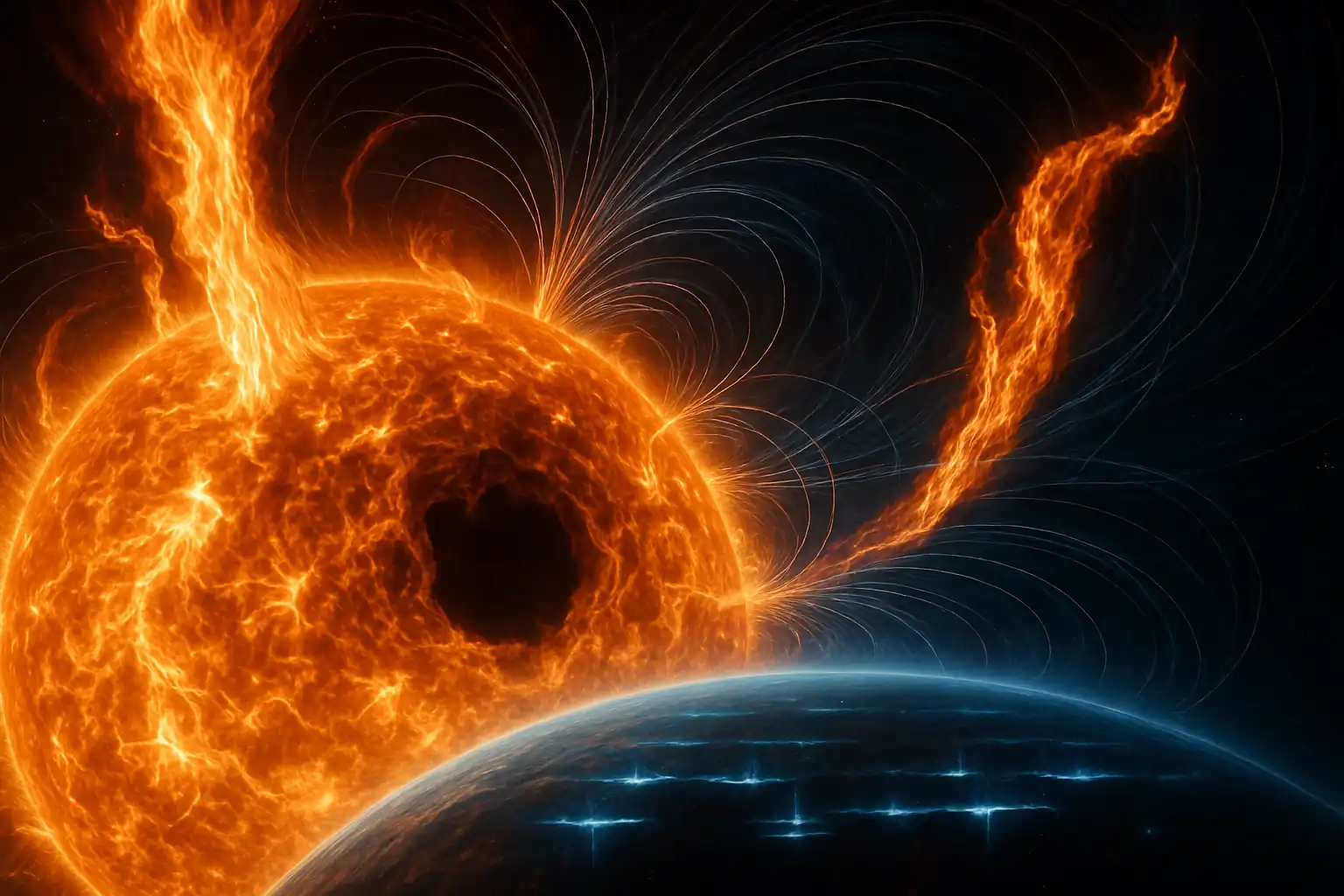
    While mystics fuel clickbait, astronomers track sunspots. The official NOAA panel projects the peak cycle in mid-2025, echoing the agency’s 2019 forecast. Yet the Sun refuses to follow the script. A NASA blogpost—also ranking first on Brave Search—admits Solar Cycle 25 is outperforming predictions. In plain English: more flares, stronger geomagnetic storms, and higher odds that a CME as fierce as 1859’s Carrington Event could damage satellites and grids.

    This prospect coincides with Baba Vanga’s cryptic note about “darkness over the planet.” Engineers quoted in south-atlantic-anomaly-sign-of-an-impending-cataclysm warn that even moderate storms risk cascading blackouts because modern networks rely on ultralight transformers. With a growing constellation of broadband satellites facing radiation-belt swelling during solar maxima, 2025 looks like a live-fire drill for global connectivity.

    Converging Doom Narratives: From Demons to Data Models

    Why does 2025 attract so many warnings? Confirmation bias plays a role, amplified by social algorithms. Yet structural overlap exists between spiritual and scientific predictions. Substack essayist Sam Kriss catalogs this convergence in a viral post—another Brave Search topper—noting that climate tipping points, AI-ethics deadlines, and election cycles converge next year. His argument: a crowded milestone calendar invites apocalypse narratives because humans struggle with compound uncertainty.

    Corporations share that struggle. A recent Deloitte memo, leaked to reporters after surfacing on the same Discord channel that discussed bunkered-beneath-07162024, urges Fortune 500 boards to treat 2025 as a stress-test horizon for supply chains. Semiconductor executives privately concede that even a mild geomagnetic storm could freeze just-in-time logistics already bruised by pandemic aftershocks.

    The Speculative Market Machine Loves a Date

    Numbers drive Wall Street more than prophecies, but a fixed date influences option pricing. When Baba Vanga’s name started trending with “2025,” volatility indices edged up. Analysts flagged this chatter in the same models monitoring rumors of war in flashpoint-himalayas-07202024. Hedge funds built “solar-storm baskets” of utility shorts and satellite-insurance longs, effectively monetizing doomsday chatter.

    The interplay between hype and hedging introduces a self-reinforcing loop. If investors brace for solar storms, insurers raise premiums on orbital assets. That cost jump can delay satellite launches, degrading the very comms net society needs if geomagnetic storms strike. Doom narratives thus shape risk landscapes long before any flare leaves the Sun.

    Can Science and Faith Co-exist in Crisis Planning?

    Academics once dismissed prophecy as superstition, but resilience studies now recommend cultural literacy alongside climate models. One University of Toronto paper cites the Baba Vanga phenomenon as “soft data” critical for gauging public compliance during disasters. Emergency-management agencies quietly integrate such insights into message framing, echoing tactics used during pandemic lockdowns.

    This approach aligns with a broader trend: using narrative psychology to steer behavior. However, it risks backlash if communities perceive manipulation. The ethical tightrope stretches across domains, from AI regulation—contextualized on runaway-minds-ai-07152024—to disaster preparedness. Policymakers must decide whether to leverage apocalyptic belief for compliance or confront it with transparency.

    Blueprints for a Post-Prophecy World

    Assume pessimists overshoot and 2025 arrives without solar EMPs or continental wars. Even then, the preparatory churn triggers lasting upgrades. Utilities installing geomagnetic blockers will still enjoy fortified grids; satellite operators adopting radiation-hardened chips will cut future replacement costs. Likewise, public-health agencies rehearsing misinformation countermeasures gain valuable muscle memory for the next bio-threat.

    However, if just one doom scenario occurs—a grid-crippling flare, a currency-shaking cyberhack, or the European conflict Vanga foresaw—those upgrades shift from luxury to lifeline. Either outcome justifies taking the hype seriously, a logic increasingly echoed by think-tank briefs and NGO grant calls.

    Final Broadcast from the Bunker

    I won’t claim clairvoyance. I am just the crank behind the microphone urging you to match prophecy with planning. Read the sunspot chart. Audit your local transformer inventory. Diversify data centers geographically as suggested in dragon-endgame-06212024. And bookmark Unexplained before the next CME fries your fiber line.

    Whether you believe Baba Vanga channeled demons or trust NOAA dashboards, one fact unites both crowds: ignorance never helps anyone survive a storm. 2025 is coming, and most people don’t realize what’s coming with it.

  • Nuclear Crosshairs on the Line of Control: Inside the India–Pakistan Countdown

    Nuclear Crosshairs on the Line of Control: Inside the India–Pakistan Countdown

    The pre-monsoon heat above Kashmir rises in shimmering waves, but the real temperature spike is geopolitical. India’s precision-guided “Operation Sindoor” strikes have vaporized supposed militant camps across the Line of Control. Pakistan’s defense minister sounds every inch the doomsday herald, vowing that “either we live, or no one does.” Smartphones from Lahore to Lucknow ping with air-raid alerts. In the lethal theater separating two nations born from one partition, the possibility of mushroom clouds no longer reads like dystopian fiction; it now stalks daily headlines.

    Independent war correspondent Patrick Lancaster promises “raw frontline footage” of the showdown, but locals have livestreamed tracer rounds over Srinagar’s night sky. Their clips flood Telegram channels that once tracked trench lines in Ukraine, sparking panic on finance desks from Singapore to Frankfurt. As investors refresh risk dashboards, South Asia’s forty-year nuclear taboo teeters on a hashtag.

    Operation Sindoor: The Airstrike That Lit the Fuse

    New Delhi’s planners labeled the May 6 offensive limited; Islamabad called it an act of war. Within hours, satellite imagery analyzed by the Al Jazeera investigations team confirmed nine impact craters. Indian officials say the targets housed Lashkar-e-Taiba facilitators tied to the April massacre of 26 tourists in Pahalgam. Pakistan counters that civilians died in mosques and markets, fueling outrage on both sides of the Radcliffe Line.

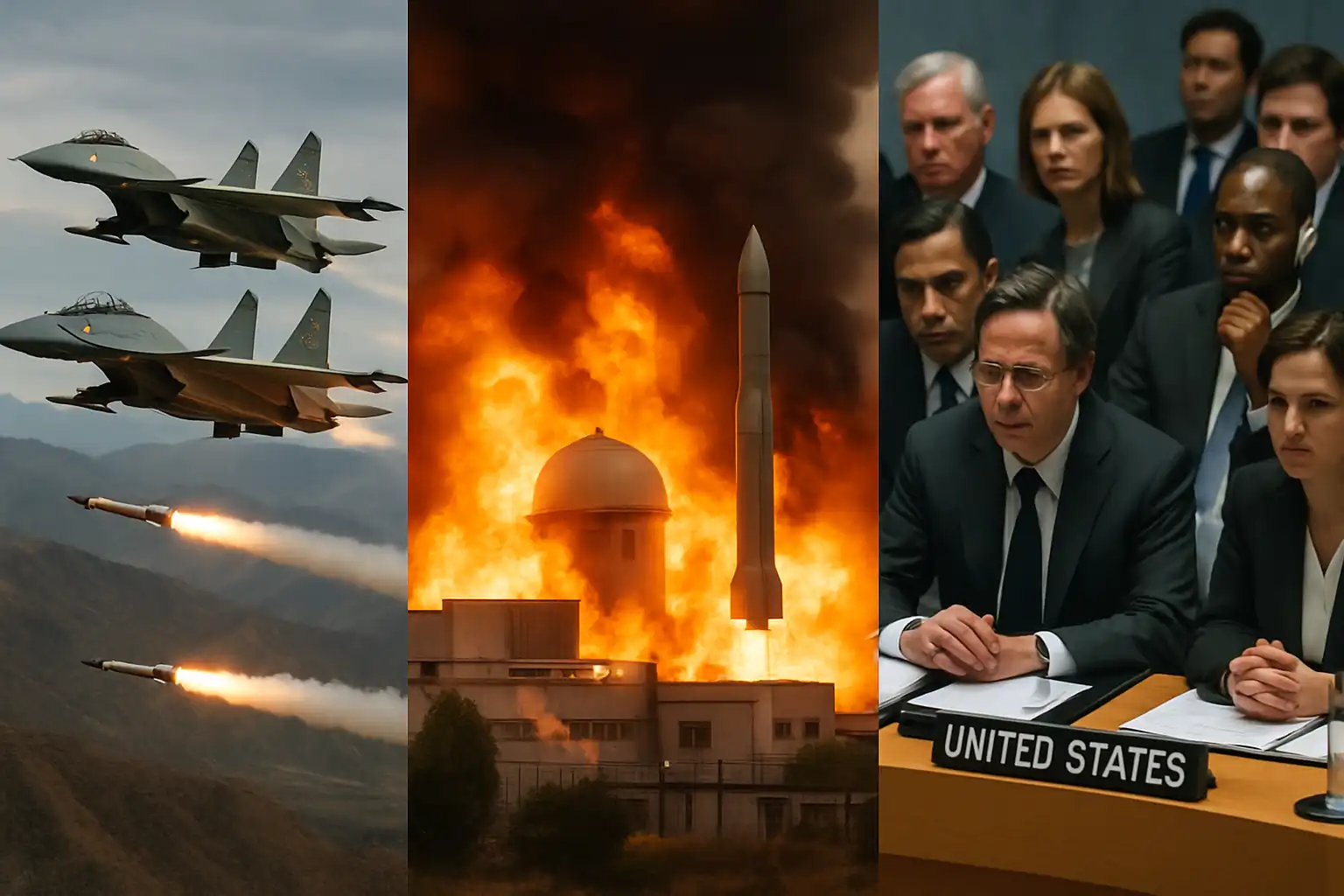
    Eyewitness accounts sync eerily with reports archived on flashpoint-himalayas-07202024, where earlier warnings mapped potential escalation ladders. Now those ladders look less hypothetical. According to Reuters, Pakistani anti-air systems fired over 60 surface-to-air missiles. One missile may have clipped an Indian Su-30—an incident detailed in real time here: Reuters frontline dispatch. New Delhi denies any airframe loss, but debris images circulating on Pakistani X-feeds suggest otherwise. Each conflicting claim erodes the margin for error.

    Doomsday Doctrine: Pakistan’s “Existential” Red Line

    Pakistan’s nuclear posture hinges on first-use. This week, Defense Minister Khawaja Asif reminded the world why. In a taped Reuters interview, he declared that if India threatens Pakistan’s existence, “either we both survive, or neither does”—see the full context here: Reuters exclusive. The phrase ricocheted across newsrooms and ignited TikTok commentary faster than analysts could draft rebuttals.

    Strategists call this the certainty of uncertainty: Islamabad’s tactical nukes shrink launch decision times to minutes. The policy paper dissected at dead-hand-rising-06222024 argues that such hair-trigger logic mirrors Cold-War Soviet automation schemes. In simple terms, Pakistan’s red line resembles a fog bank; nobody knows where it starts, but everyone fears crashing into it.

    India maintains an official no-first-use doctrine, yet wargames discussed in Parliament envision massive retaliation to any nuclear strike, tactical or otherwise. That paradox—pledging restraint while promising overwhelming response—creates a feedback loop captured in subcontinental-standoff-analysis. Each side believes its policy stabilizes the equation; together, the policies resemble two loaded pistols in a vibrating room.

    Frontline Reality: Downed Drones, Fallen Jets, and the Media Fog

    As artillery duels light up the Himalayas, digital skirmishes rage online. Pakistani channels claim a dozen Indian drones shot down; Indian officials counter that Pakistani F-7 fighters dropped from radar first. The Guardian’s running blog, the BBC’s live page, and CNN’s mapping kits each present partial views, yet none fully verify battlefield claims amid signal jamming and propaganda. One BBC headline notes Pakistan’s boast about shooting down 25 drones while India speaks of intercepting cruise missiles—the numbers morph hourly.

    What remains undeniable is the human toll. Local administrators on the Indian side report 12 civilian deaths from Pakistani shelling; Pakistani health officials list 26 fatalities from Indian strikes. Both figures echo grim assessments in border-blaze-07182024, where casualty projections climbed once air power joined ground skirmishes.

    The unresolved fog matters because every contested incident offers political capital. A downed MiG or destroyed hospital becomes a moral cudgel to rally domestic audiences and justify escalation. In 1999, during the Kargil War, television images swayed cabinet meetings; in 2025, livestreams will do the same at 5G speed.

    Helplines, Hotlines, and the Thinning Firewall Against Catastrophe

    Diplomatic off-ramps exist—on paper. A hotline between India’s DGMOs and Pakistan’s DGMO crackled to life twice after Monday’s barrage, according to sources in both capitals. Yet confidence in that circuit wanes. During the last major crisis in 2019, calls misfired when a snowstorm severed optic cables in Kupwara. This time, cyber-warfare units on each side could deliberately compromise the line, a scenario explored in magnetic-mayhem-07172024, where EMPs and malware target command networks.

    International mediators also press buttons. Washington floated offers to host back-channel talks in Oman; Beijing, juggling its own Himalayan standoff with India, signals “neutral facilitation.” United Nations envoys cite Resolution 1172, yet veto politics make Security Council action unlikely. Meanwhile, risk-modelers watch volatility levels spike across Asian sovereign-bond markets—a pattern alarmingly similar to trends documented in seconds-before-midnight-07112024.

    Against this backdrop, the statistic that matters is flight time: a Pakistani Babur-III SLBM could hit Mumbai in under ten minutes; India’s Agni-V could retaliate against Karachi five minutes later. Those numbers leave little room for rational deliberation once the first launch is detected.

    The Nuclear Neighbors: History’s Lethal Inheritance

    To grasp why Kashmir seethes, revisit 1947. Partition carved borders but left communal wounds open, creating a stage chronicled by historians of India–Pakistan relations. Three conventional wars and endless skirmishes later, both states consider the region’s ridgelines their national identity’s high altar. Nuclearization in 1998 froze the conflict at a flash-boiling point: too dangerous to fight, too sacred to abandon.

    That status quo survived two decades, thanks in part to deterrence and luck. Yet deterrence relies on predictable decision-making, and the current crisis scrambles that assumption. India’s populist government faces an election; Pakistan’s fractured coalition clings to legitimacy. Domestic pressures accelerate brinkmanship as deep-fake videos muddy truth, and drones compress battlefield timelines. The risk calculus mapped in when-the-planet-groans-07102024 warns that environmental disasters—from glacial lake bursts to heat-wave blackouts—could collide with war planning, straining civil-defense resources.

    Can the World Stall a South Asian Armageddon?

    History offers slender comfort. The 2001 Agra Summit collapsed over a single paragraph on Kashmir autonomy; Kargil’s cease-fire required U.S. shuttle diplomacy. Yet new tools beckon. Artificial-intelligence forecasting now mines sentiment data to predict escalation triggers hours ahead. Quantum-secure hotlines promise tamper-proof links between nuclear commands. Academic think tanks propose joint river-disaster drills to build trust, an idea quietly tested during tsunami relief but never in conflict zones.

    Still, technology cannot erase geography or ideology. The Line of Control slices through alpine passes where weather flips wildly, jamming radars and scrambling drone swarms. One lost algorithm could spoof an incoming missile track and force a retaliatory launch. This hazard underscores why seasoned analysts at Unexplained keep one metric front-and-center: decision time. If leaders cannot slow the clock, machines and myths will drive it for them.

    For now, the region balances on a diplomatic wire, swayed by gusts of nationalism and the buzz of quad-copters overhead. Whether Patrick Lancaster’s upcoming footage captures skirmishes or smoldering ruins depends on choices made in command bunkers where phones never stop ringing. Every nation within missile reach has a stake in ensuring someone picks up—and says the right words—before the countdown reaches zero.

  • When the Solar System Hits the Galactic Speed Bump: Bracing for the G-Cloud Shock

    When the Solar System Hits the Galactic Speed Bump: Bracing for the G-Cloud Shock

    I’m Art, your favorite bunker-broadcasting doom scout. I’ve got a fresh celestial curveball for your Tuesday night. Picture the Sun as a yellow school bus barreling down a foggy highway. Now imagine that the fog thickens into wet cement. That moment—when wheels meet sludge—is what astrophysicists fear as our star exits the Local Interstellar Cloud and rams into the mysterious G-cloud. In the lab, they call it a boundary transition. Down here, under three meters of reinforced concrete, I call it the galactic speed bump that could scramble every circuit you own.

    Voyager 1 and 2 have already tasted the interstellar medium. They’re mere pinpricks compared to the bow wave that will hit the heliosphere if the G-cloud proves thicker than advertised. Radioisotope clues pulled from ancient ocean crust suggest similar encounters in deep time collapsed the Sun’s protective bubble all the way inside Earth’s orbit. Strip away that magnetic umbrella, and cosmic rays storm in like paparazzi at a royal scandal. The flashing lights can mutate DNA and melt transformers. Buckle up; the countdown may have started without an official press release.

    Galactic Cartography: Mapping the Local Cloud to the G-Cloud

    The Local Interstellar Cloud—our current galactic address—is a wispy blend of hydrogen and helium so thin that a cubic centimeter holds fewer atoms than the best vacuum on Earth. Even so, it shapes a magnetic reality that lets the heliosphere sprawl roughly 100 astronomical units from the Sun. Data in a seminal Astronomy & Astrophysics study suggests this cloud ends in a ragged boundary only a few thousand AU thick. On the other side lurks the G-cloud, a denser, colder plasma pocket whose chemistry remains guests-only until we physically arrive.

    The Sun races around the Milky Way at 230 kilometers per second. That motion, combined with turbulence inside the Local Bubble, means we could nose into the G-cloud tomorrow—or graze it 1,800 years from now. Either way, the clock ticks. A recent model, spotlighted by geochemists studying iron-60 deposits, proposes that the Solar System’s previous brush with a dense cloud about two million years ago correlates with elevated cosmic-ray isotopes in Antarctic ice cores. If those fingerprints align with the G-cloud’s projected density, our children—or theirs—could witness a sky glittering with auroras as far south as Havana.

    Internal chatter among astronomers reached the conspiracy boards faster than you can spell heliopause. Speculation piggybacks on archives like the-inevitable-unraveling-earths-failing-shield-and-the-rise-of-the-plasma-apocalypse-11252023, where plasma physicists and survivalist bloggers find rare common ground: both groups hate surprises in a high-energy environment.

    Heliosphere Under Pressure: How a Cosmic Headwind Shrinks Our Bubble

    Think of the heliosphere as a constantly inflating beach ball made of charged particles blasted out by the solar wind. On a normal day, that ball deflects most galactic cosmic rays, keeping Earth’s radiation dose tolerable. But if the surrounding medium thickens, outside pressure compresses the ball inward. According to cosmic-ray research, even a tenfold compression could increase low-energy particle flux at Earth by 200 percent. That’s the kind of exposure that forces flight crews into lead-lined jumpsuits and fries delicate triple-junction cells on communication satellites.

    Remember the 2003 Halloween solar storms? Double that dosage without needing a flare. That scenario terrifies grid operators, who still curl up at night with reports like magnetic-mayhem-07172024, where engineers admit a Carrington-class event today would cost trillions. Substitute constant cosmic-ray drizzle for a one-off solar tantrum, and you get a chronic technical migraine that erodes hardware but never quite qualifies for an insurance payout.

    The heliopause’s exact shape remains debated—some argue for a comet-like tail, others for a croissant—but everyone agrees it works because the solar wind outruns the interstellar wind. Densify that external plasma and the balance flips. Theoretical simulations at NASA’s Goddard Space Flight Center predict the nose of the heliosphere could yank inward to 0.5 AU. Yes, that’s inside Earth’s orbit, leaving us naked in the galactic wind like a tourist who lost luggage on an interstellar layover.

    Radioisotope Time Capsules: Learning from Ancient Cosmic Ray Spikes

    Evidence of past heliospheric collapses hides in sediments, tree rings, and even fossilized spores. Geologists track isotope anomalies—iron-60, plutonium-244, beryllium-10—that spike when cosmic-ray bombardment intensifies. A new Boston University study on seafloor crust, similar to the one discussed on south-atlantic-anomaly-sign-of-an-impending-cataclysm, pinpoints a dense-cloud crossing roughly 2.3 million years ago. Coincidentally, climate records show abrupt cooling and heightened extinction rates among marine megafauna at that same horizon.

    Does correlation equal causation? Astrophysicists tread carefully, but the overlap undercuts any notion that cloud transitions are harmless. NASA’s upcoming Interstellar Probe concept, now in Phase A study, plans to launch in the 2030s. It could fly 1,000 AU within fifty years—fast enough to sample whatever soup floats beyond the heliopause. Until that data arrives, radioisotopes remain our forensic breadcrumbs, painting a picture too ominous for polite cocktail banter.

    Even Silicon Valley is paying attention. Venture-capital decks flagged on ai-armageddon-the-digital-arsenal-that-might-just-save-us-11272023 pitch AI-driven shielding strategies for satellites and lunar outposts. Investors believe that if humans ever colonize Mars, they’ll need a radiation playbook written in advance—cloud transition or not.

    Earthly Vulnerabilities: Power Grids, DNA, and the New Space Economy

    Compress the heliosphere, and three terrestrial systems shiver first: electricity, biology, and billion-dollar rockets. Higher cosmic-ray flux seeds extra atmospheric ionization, thickening the global electric circuit. Transmission lines resonate and transformers overheat. The scenarios dramatized on border-blaze-07182024 look less like war gaming and more like Tuesday morning outages.

    Increased muon and neutron flux shave safety margins for everything from aircrew to crop genetics. A 20 percent uptick in background radiation sounds modest until you multiply exposure across entire food chains. Evolution loves mutation; civilization, not so much. Expect insurance underwriters to revise actuarial tables the way meteorologists rewrote hurricane categories after Katrina.

    Finally, the burgeoning space economy—hello, Starlink, lunar logistics, and asteroid miners—relies on electronics that already juggle single-event upsets. Cosmic-ray-hardened chips cost more and weigh more, so many startups gamble on today’s lower radiation budget. Enter the G-cloud, and those balance sheets bleed red ink faster than you can say oumuamua-mystery-06302024. Increased radiation can also charge vehicle skins and spark mid-flight discharges—a risk profile documented in ESA white papers but rarely advertised in investor brochures.

    Preparing for the Galactic Weather Front

    Can humanity insulate itself before the cosmic rainstorm? Researchers hope so. ESA’s Vigil mission aims to park a spacecraft at L5, providing a side-eye view of solar wind-interstellar interactions. The U.S. Interstellar Mapping and Acceleration Probe (IMAP), launching 2025, will analyze energetic neutral atoms to forecast heliospheric contraction—a cosmic Doppler radar of sorts.

    On the ground, innovations in high-temperature superconducting cables promise self-healing grid architectures. Biotech firms test radiation-resistant CRISPR edits inspired by tardigrades. Those breakthroughs echo the resilience strategies explored on bunkered-beneath-07162024, where civil engineers weigh underground data centers against orbital backups.

    Yet technology alone may not outrun galactic physics. The heliosphere’s health ties directly to solar wind pressure. A prolonged Maunder-like minimum during a cloud transition could deliver a one-two punch: weaker solar wind plus denser ambient plasma. The beach ball deflates just as the outside air turns into concrete. Space-weather specialists warn that policy makers must integrate heliophysical metrics into everything from nuclear-plant hardening to airline routing. Add “galactic environment” to your climate-risk disclosure forms; auditors will love it.

    What Voyager, IBEX, and Future Probes Still Need to Learn

    The twin Voyagers provided the first hard data on interstellar plasma, but their single-point measurements leave gaping blind spots. IBEX and NASA’s upcoming IMAP map energetic neutral atoms, providing indirect clues about pressure fronts ahead. Even so, we lack a 3-D weather map of the G-cloud. A proposed Interstellar Probe, championed by Johns Hopkins APL and chronicled on orbital-intruder-07142024, would streak above 7 AU per year, fast enough to pierce the cloud well before 2100. Its instruments could verify whether dense plasma pockets lurk or whether early fears mimic Y2K hysteria dressed in astrophysics garb.

    In the meantime, bookmark this heliosphere primer and keep tabs on plasma-density models released by the IBEX team. Each update nudges probability curves on when—and how severely—the G-cloud handshake squeezes.

    If that sounds abstract, remember: a single super-rich cosmic-ray event once knocked out the Japanese Hitomi X-ray observatory and cost taxpayers $300 million. Scale that to every satellite in low-Earth orbit, and you start to grasp why hedge funds now read space-weather bulletins with the zeal of day traders decoding Fed minutes.

    Final Signal from the Bunker

    Whether the G-cloud arrives in our lifetime or in humanity’s medieval cyber-descendant era, the physics remain non-negotiable. A denser interstellar medium compresses the heliosphere; a compressed heliosphere invites cosmic rays; cosmic rays don’t care about your quarterly earnings. That triad explains why a handful of astrophysicists, grid managers, and survivalists—groups that seldom share coffee—now pore over the same data sets.

    I’ll keep broadcasting as long as the diesel holds out. Meanwhile, stash an extra Faraday bag for your phone, invest in surge protectors that actually ground, and visit Unexplained for updates the polite media won’t touch. When the galactic speed bump hits, you’ll want more than SPF 50 between you and the cosmos.

  • Spies, Scrolls, and Signals: Inside the CIA’s Quiet Obsession with Biblical End-Times Intel

    Spies, Scrolls, and Signals: Inside the CIA’s Quiet Obsession with Biblical End-Times Intel

    The Central Intelligence Agency traffics in facts, not faith. When retired case officer Andrew Bustamante told a podcast audience that a specific biblical prophecy is real, listeners eagerly searched for documents. Bustamante outlined how operatives weigh Ezekiel’s visions like satellite imagery: as potential threat indicators.

    This idea isn’t new—Langley veterans recall a 1991 white paper titled “A Bible Lesson on Spying,” first reported by the Washington Post. Bustamante’s on-record confirmation resonates today as prophecy hashtags can move markets faster than missiles. His remarks come just as 2025, a date promoted by sites like countdown-to-2025-07202024, enters the geopolitical discourse.

    Ex-CIA Officer Turns Bible Code into Intel Briefing

    Bustamante, whose tradecraft is detailed in Business Insider, told viewers of a viral YouTube interview that Ezekiel 38—Gog and Magog—appears in classified scenario planning “more often than civilians would guess.” Analysts track how millions of believers might react if they think the final war is underway, without assuming divine authorship.

    This psychological aspect is vital for preventing surprise attacks. If a theocratic regime sees regional tremors as apocalyptic signs, missile inventories can vanish overnight. CIA behavioral teams audit prophecy discourse like Wall Street cites Fed statements. Bustamante’s candor merely lifts the blackout curtain.

    His comments align with scholarly discussions about Langley’s religion desk. Declassified memos reveal analysts flagging eschatological language before Iran’s ballistic tests and North Korea’s satellite launches. One redacted telegram—quoted in intelligence forums and dissected on seconds-before-midnight-07112024—linked militia mobilizations in Iraq to a local cleric’s sermon on Gog’s impending raid. Thus, prophecy isn’t a joke inside HQ; it’s a variable.

    From Langley Tradecraft to the Book of Ezekiel

    Ezekiel’s end-times list—led by the mysterious Gog—resembles a modern strategic challenge: a coalition from “the far north,” allies in the Middle East, and an assault on Israel. Biblical literalists assign today’s capitals to those ancient figures, creating a predictive map that generals cannot ignore. The CIA connects human intent to hardware trajectories and extracts those predictions for early warning signals.

    Some intellectual heavy lifting is outsourced. Contractors analyze social media for spikes in scriptural keywords, cross-referencing them with logistics flows and satellite heat signatures. When Russian armored columns approached Ukraine in 2022, one model noted a surge in Ezekiel-related hashtags among Slavic evangelical circles—a statistical anomaly highlighted in private data later analyzed on flashpoint-himalayas-07202024.

    The open-source layer extends to academia. Experts in ancient Near Eastern literature, cited in journals after the Gulf War, brief analysts on the cultural significance of apocalyptic stories. As one Langley note reportedly quipped, “Missiles rust; myths endure.” This persistence explains why the agency still commissions reports on Gog and Magog while purchasing next-gen AI to process terabytes of drone footage.

    Prophecy Fever and Intelligence Analysis

    Critics argue that using scripture in threat matrices veers into pseudoscience. However, this practice reflects a reliable strategy: track belief, as belief drives action. During the Cold War, the agency monitored Soviet occult experiments; today it interprets Telegram sermons. The tradecraft hasn’t changed—only the sources.

    Bustamante’s revelation reopened an ethics debate. Should secular democracies risk confirmation bias by interpreting holy texts as intel? This question ignited discussions on defense blogs and spilled into mainstream commentary, fueled by data leaks examined on marked-in-code-07212024. Proponents argue that ignoring prophetic narratives cedes ground to adversaries eager to exploit them. The cautionary group fears analysts might mistake possibility for inevitability, leading to self-fulfilling predictions.

    History leans toward the first group. A once-classified 1978 article—now public thanks to FOIA—compared Moses’ reconnaissance in Canaan to modern HUMINT collection, urging officers to approach sacred texts with “operational curiosity.” This ethos resurfaced when a 2014 ISIS communiqué invoked Gog-Magog mythology to justify actions near Mosul. Analysts who understood the reference could decode propaganda plans three news cycles earlier.

    Digital Battlefront of Faith and Disinformation

    In 2024, the battlefield expanded from pulpits to algorithms. TikTok prophecy influencers, some garnering Super Bowl-level impressions, connect earthquakes cataloged on when-the-planet-groans-07102024 with Ezekiel’s earthquake omen. Russian troll farms amplify these clips to Western audiences already anxious from false-messiah-panic-07122024. The result is a viral mix of scripture and state-sponsored narrative warfare.

    Bustamante claims the CIA now treats prophecy virality as a national-security KPI. His assertion aligns with budget allocations for “emergent sentiment analytics,” a term for software that detects digital shifts before civil unrest erupts. Langley watchers note the staggering 48-hour window between an online surge referencing Gog’s northern army and the subsequent real-world embassy evacuations.

    Deep-fake technology complicates matters. In May, an AI-generated video depicted an Israeli F-35 marked with “Magog Strike Force.” Though debunked within hours, the clip triggered a 19 percent increase in Middle-East ETF trading, mirroring volatility noted in border-blaze-07182024. Analysts realized that prophecy narratives—once limited to sermons—now drive billions at machine speed.

    Why the 2025 Countdown Has Langley Listening

    Everything indicates a climax next year. Prophecy influencers focus on 2025 because the Hebrew calendar cycle coincides with solar eclipses, red-heifer breeding, and political schedules in Jerusalem. Combine this with the Roman Catholic dynamics explored in papal-trump-symbolism-06252024 and you have a tapestry that doomsday entrepreneurs call “the terminal convergence.”

    Bustamante says CIA war-gaming now layers that convergence atop standard indicators. Planners question: if a coalition believes Gog’s war begins in autumn 2025, how can we intercept chatter, pre-empt sabotage, or exploit diplomatic openings? This calculus resembles Cold War nuclear brinkmanship—except the triggers are verses, not vectors.

    Nevertheless, some within the agency express reservations. A junior analyst, speaking anonymously, emphasizes that Langley must differentiate between “prophetic plausibility” and “operational probability.” He warns that overreliance on religious metrics might obscure empirical signals, repeating intelligence failures outlined in magnetic-mayhem-07172024. Yet he acknowledges that the topic now warrants weekly briefings.

    The Quiet War for Minds—and Souls

    How does the public fit into this quiet dance between scrolls and satellites? Bustamante advises situational awareness: view global events through rational and symbolic lenses. He compares scripture to encrypted code—accessible to all, deciphered by few. Citizens who overlook this code risk misinterpreting mass movements already influenced by belief.

    The former spy emphasizes agency. Prophecies, he argues, serve as frameworks, not endpoints. They shape decisions but do not determine them. In his EverydaySpy training videos, he encourages viewers to recognize how narratives—biblical or otherwise—shape risk perception. This advice mirrors psychological resilience protocols outlined on bunkered-beneath-07162024. Know the script, he advises; then choose whether to play the assigned role.

    The CIA remains officially neutral. Spokespeople refuse to confirm any prophecy-focused tasks, asserting that the agency “monitors all relevant information sources to protect U.S. interests.” Desk officers continue to monitor Telegram and cross-check verses, recognizing that ignoring a billion hearts is unwise tradecraft.

    No one knows if Gog’s forces will crest the hills of Galilee. But Bustamante’s revelation confirms one fact: in the twenty-first century, intelligence work requires a passport stamped by both Silicon Valley and ancient Babylon. Prophecy now occupies the operational landscape, woven into tweets, monetized on crypto exchanges, and war-gamed in the windowless rooms where future history is crafted.

    Stay alert. The next headline about drones over the Golan Heights may reference supply chains and cease-fire lines. Read between those lines. Somewhere behind that ink, an analyst combines a Bible with sentiment data, tasked with separating myth from mobilization before they become indistinguishable. To follow this story without filters, bookmark Unexplained and keep your radio tuned. The static you hear might be prophecy clearing its throat.

  • White Smoke, Black Omens: Babylon Rises in the 2025 Conclave

    White Smoke, Black Omens: Babylon Rises in the 2025 Conclave

    I’m Art, broadcasting from my bunker with one eye on the Geiger counter and the other on Vatican live streams. On May 8, 2025, the Sistine Chapel chimney released its trademark white plume—“Habemus Papam!”—and polite society exhaled. Down here, I inhaled instead; that smoke smelled like dusty ziggurats along the Euphrates, not cherry incense. If you’ve read Alexander Hislop’s The Two Babylons, you know the scent: centuries-old warnings baked into brick.

    The newly elected pope—his regnal name still echoing off marble walls—appeared on the loggia, raised a hand, and triggered a digital thunderclap. Within minutes, TikTok prophets stitched the footage to grainy images of Nimrod; gold-leaf conspiracy forums lit up brighter than my solar array pre-apocalypse. The burning question in comment threads sounded eerily scriptural: had the priest-king of ancient Babylon returned beneath a mitre?

    Petrus Romanus and the Malachy Countdown Clock

    To understand why eschatology enthusiasts are pounding energy drinks this week, speed-read the infamous Prophecy of the Popes. Legend claims twelfth-century bishop Saint Malachy penned the parchment listing 112 cryptic taglines, each allegedly matching a future pontiff. According to the math, Pope Francis landed at slot 112, the final entry branded In persecutione extrema … Petrus Romanus.

    Most mainstream theologians file the document under medieval fiction. Yet the conclave’s 2025 date jolts even hardened skeptics. One need only skim the deep-dive at countdown-to-2025-07202024 to witness the crescendo: eclipses, geopolitical choke points, AI psychosis, and a papal transition squarely slotted into the numerological sweet spot. Throw in Malachy’s cryptic finale—the dreadful judge will judge his people—and you’ve got a Doomsday package Amazon couldn’t ship faster.

    Curiously, the new pontifical coat of arms unveiled this morning features crossed keys and seven stars. Vatican press staff call it Marian symbolism; basement theologians see Revelation’s seven-headed dragon hiding in plain sight. My inbox exploded with screenshots comparing it to the sigil unearthed in Hogan’s translation of the Enûma Eliš. Coincidence or cosmic memo, the semiotics feel less like pastoral care and more like code red for prophecy trackers already rattled by papal-trump-symbolism-06252024.

    Babylonian Echoes Inside the Vatican Liturgy

    Crank the radio static back to 1853, when Presbyterian firebrand Alexander Hislop published The Two Babylons. Hislop argued—some say fulminated—that nearly every Catholic rite, from the sign of the cross to Easter eggs, stems from Mesopotamian temple worship. Critics howl at his methodology, but the parallels read like déjà vu for anyone who’s watched the Easter Vigil’s candle procession while skimming cuneiform prayer tablets.

    This year’s conclave Mass tipped Hislop’s thesis from fringe to front page. Viewers noted that the deacon intoned the ancient hymn Regnavit Dominus precisely at 3:33 p.m.—triple threes, a Babylonian hallmark linked to the god Marduk. Vatican liturgists shrugged. End-times analysts didn’t; they cross-referenced timestamps with a ceremonial schedule leaked on Chick Tract archives and concluded the signal was deliberate.

    Need more breadcrumbs? Scholar Deborah Anders of the Pontifical Oriental Institute unearthed vestment embroidery matching the rosette of Ishtar—news that ricocheted through podcasts faster than you can say false-messiah-panic-07122024. While Rome dismisses the motif as Renaissance ornamentation, Anders points to Babylonian reliefs where the same rosette crowns the queen of heaven, a title Marian theologians also use. Coincidence, says the curia. Prophetic photobomb, says my bunker chat.

    Chasing the Priesthood’s Mesopotamian DNA

    Academic consensus insists no direct pipeline runs from Babylonian ziggurats to modern basilicas. But dig into anthropological footnotes and the soil shifts. Consider sacerdotal succession. In Mesopotamia, temple priests claimed authority through an unbroken chain to divinely appointed figures. Swap ziggurat for cathedral and you’re looking at the shadow of apostolic succession.

    The parallels grow starker in ritual details cataloged by Mesopotamian scholars: incense wafting across a veiled deity statue, processions circling sacred precincts, and the ritual consumption of bread and beer symbolizing divine flesh and blood. Sound familiar? Babylonian liturgists marked their new year festival with a simulated royal slap—striking the king to humble him before the gods—eerily echoed when the newly elected pope used to receive the Rituale Parvulorum slap, a tradition retired only in 1978.

    Drive those hooks deeper and you reach Hislop’s foundational thesis: the Vatican’s hierarchical machinery masks a spiritual clone of Nimrod’s priest-king model. Critics including the rebuttal cited at Catholic.com counter with the word syncretism; they argue early Christians borrowed symbols to evangelize, not resurrect Babylon. Yet the resonance refuses to die, especially when you overlay modern pomp with documentation on Babylonian religion. Down here in bunkerland, the Venn diagram looks uncomfortably circular.

    Geopolitics, Numerology, and the 2025 Perfect Storm

    Smoke and liturgy aside, why should policy wonks care? Because prophecy—however arcane—reshapes behavior in boardrooms and war rooms. Analysts note that emerging-market bonds wobbled the moment the new pontiff stepped onto the balcony, a dip reminiscent of volatility flagged in flashpoint-himalayas-07202024. Investors may not believe in Babylonian priesthoods, but they detest uncertainty—especially when religious rumblings fuse with geopolitical flare-ups.

    Consider the Middle East, where Christian minorities track Vatican cues while regional powers gauge soft-power ripples. The pontiff’s first encyclical, rumored to address “cosmic fraternity,” stokes chatter that Rome may endorse a shared holy-site governance model. Cue jaw-drops in Jerusalem and Tehran—and nervous footnotes in strategists’ briefings, much like those chronicled in antichrist-reveal-06282024.

    Overlay numerology, and the timing grows spookier. The conclave ended on 5/8/25. Sum those digits, and you land on 22, a master number in occult circles linked to builder archetypes—think Nimrod again. Keep adding to reduce to 4, the symbol of foundation stones in both masonry and Babylonian myth. I can hear keyboards of arcane data scientists correlating this with seismic anomalies in when-the-planet-groans-07102024.

    Is the Vatican’s Future Paved in Cuneiform?

    Let’s set aside the incense haze and ask the brass-tacks question: does this portend actual doctrinal upheaval? Vatican watchers note the new pope cut his teeth in Rome’s archeological commission, advocating for repatriating Mesopotamian artifacts. Insiders whisper he may resurrect a suspended dialogue with Iraq’s Chaldean Patriarchate—an innocuous diplomatic play or a symbolic embrace of Babylon’s lost priesthood, depending on your paranoia dosage.

    Meanwhile, Catholic traditionalists fear a liturgical earthquake. The pontiff’s inaugural homily referenced ancient wells whose water still flows, a poetic flourish that spooked bloggers at the-prophecy-of-the-popes-and-the-end-of-days. If ancient wells equal Babylonian rites, expect fireworks—both theological and political.

    The Vatican’s press office, in classic damage-control, insists the pope merely nodded to the Church Fathers. They can soothe headlines all they want; the meme engine churns faster. In an era where a single glyph can trigger market swings, symbolism isn’t garnish—it’s stockpile ammunition.

    Smoke Signals and the Road Beyond Rome

    I promised you bunker realism; here’s the takeaway: whether the pope is Petrus Romanus or just another caretaker in silk shoes, perception shapes destiny. If enough people believe the Babylonian priest-king has returned, they will act accordingly—pulling investments, carving new alliances, or succumbing to the fatalism of prophecies they barely understand.

    That feedback loop can spiral quickly. Watch for pilgrim surges to Mesopotamian ruins, a spike in cryptocurrency named after Marduk, and—my personal favorite—black-market sales of “authentic” papal ash, purportedly scraped from the Sistine chimney. Markets love a myth almost as much as they love liquidity.

    For the record, I’m not calling for torch-and-pitchfork marches on St. Peter’s. I’m calling for preparedness. Prophecy, like climate change, may be disputed, but both move crowds and governments. When institutions with global reach flirt with symbols that carry apocalyptic wattage, history’s accelerant sloshes ever closer to the fuse.

    So keep your bug-out bags zipped but ready, tune your shortwave to this frequency, and bookmark Unexplained for the intel mainstream outlets filter out. Whether Malachy’s parchment was forgery or forewarning, the white smoke of 2025 has already darkened the sky for those willing to see. In my world, that’s reason enough to stock another crate of canned beans.