Blog

  • Pole Shift Panic: Spain’s Blackout, the South Atlantic Anomaly, and the Next Solar Barrage

    Pole Shift Panic: Spain’s Blackout, the South Atlantic Anomaly, and the Next Solar Barrage

    Introduction: When the Lights Blink and Compasses Quiver

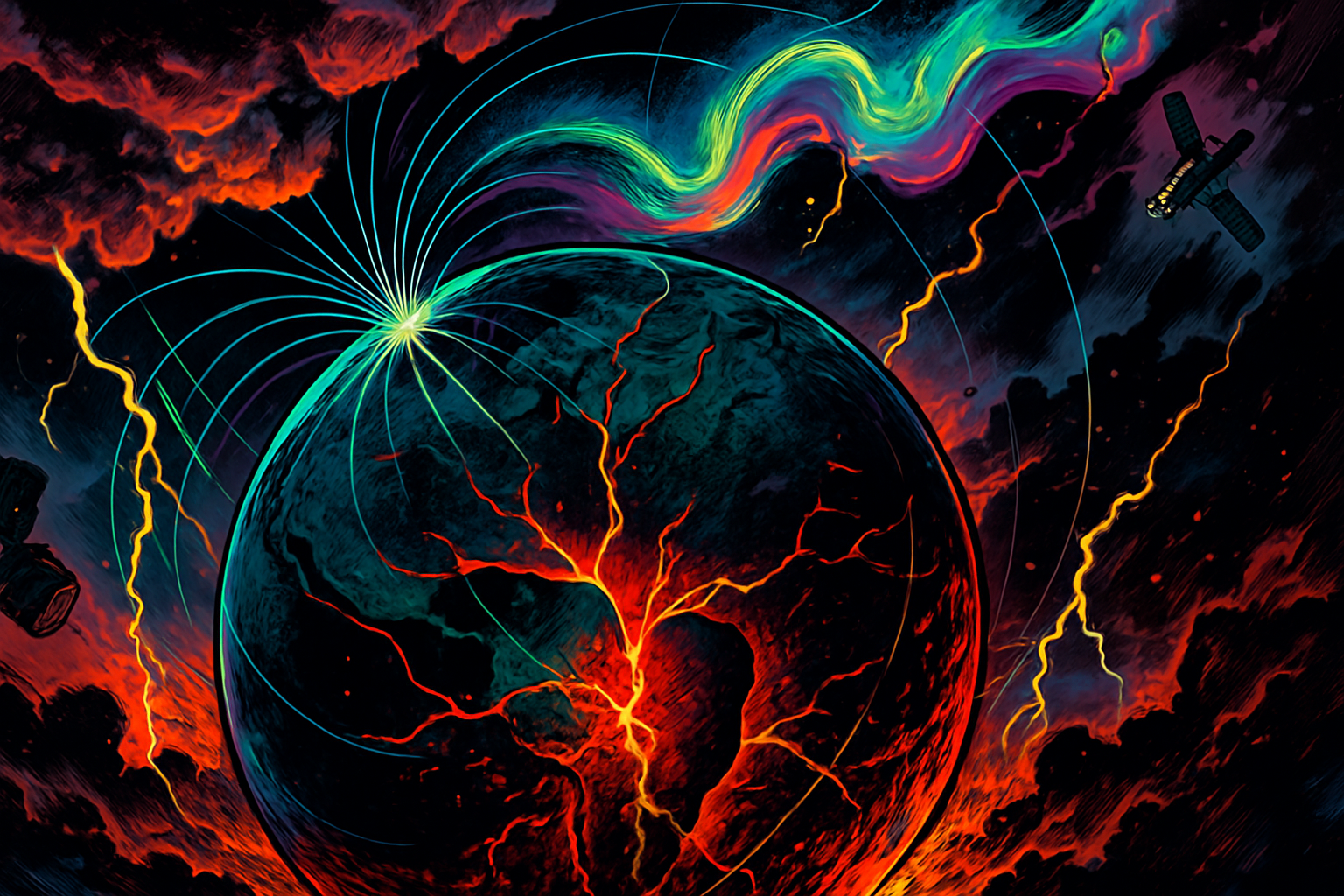
    On a humid night, parts of Spain went dark without warning. The press release blamed a cascading grid failure, but space-weather monitors indicated a spookier story. As transformers tripped, magnetometers across Europe twitched as if an invisible hand had tugged Earth’s field. To many researchers, this coincidence was a flashing red light: our planet’s magnetic shield is warping, and the Sun is about to jab where we are weakest.

    The Shield We Take for Granted

    Earth’s magnetic field, generated by molten iron churning 3,000 kilometers beneath, acts like an invisible force field. It directs most charged solar particles toward the poles, where they create auroras instead of roasting living tissue. Without that barrier, high-energy radiation would strip atmospheres, fry electronics, and threaten surface life. Even a partial decline in strength can create trouble. According to scientific archives, the field has weakened roughly 10 percent since the nineteenth century. This decline matters because a weaker field allows more solar energy to seep into systems designed under stronger protection assumptions.

    The South Atlantic Anomaly: A Dent in the Armor

    Orbiting satellites first mapped an oddity from Brazil to Namibia. Inside this South Atlantic Anomaly, the magnetic shield thins, causing spacecraft electronics to glitch, astronauts to report extra flashes, and mission planners to schedule downtime to avoid data corruption. Recent Swarm satellite data show that the anomaly is deepening and splitting into two lobes. A quick look at regional plots from independent dashboards confirms year-over-year expansion.

    Some geophysicists link the SAA to an iron “river” in the outer core that drags field lines off-center. Others suggest it may signal that the entire dipole is preparing to flip. Magnetic reversals occur every few hundred thousand years and can take centuries to complete, but transitional phases weaken the field most dramatically. Whether the anomaly foretells a full pole swap or merely a long wobble, it already incurs real costs: satellite insurers charge higher premiums, and astronauts in low-Earth orbit face extra radiation every pass through the dent.

    The Spanish Blackout: Harbinger or Fluke?

    One power outage does not prove a cosmic threat, yet timing is crucial. Instruments detected a moderate coronal mass ejection (CME) brushing past Earth the afternoon before Spain’s grid failure. CMEs possess their own magnetic fields; when they tangle with ours, they induce currents in long conductors—exactly the type of surge that fries transformers. Technical auditors noted abnormal reactive power spikes shortly before breakers tripped. While the official report downplayed a solar connection, utilities updated operating manuals to include space-weather alerts alongside thunderstorm advisories.

    The blackout reignited online debate about geomagnetic preparedness. Comment threads referenced archived warnings at this investigative link, which argued that grids in mid-latitude nations remain more vulnerable than policymakers admit.

    Solar Cycle 25: The Sun Arms for a Punch

    The Sun follows an 11-year rhythm marked by sunspot counts and flare frequency. Cycle 25 looked tame at first but quickly outpaced forecasts. NOAA scientists revised expected peak numbers upward twice in eighteen months. More spots equal more eruptions; each new flare can spawn a CME. Historical analyses in economic risk studies warn that a Carrington-level storm today could cost trillions, collapsing GPS, internet backbones, and high-voltage transformers in minutes.

    Pole Shift Theories and Hard Data

    Movies depict instant reversals tossing oceans into skyscrapers, but real geomagnetic flips occur over millennia. Still, the lead-up can spark regional chaos. Lava flows in Oregon record temporary poles wandering at latitudes that now sit under Seattle. The geological record shows drops in field strength up to 90 percent during these flips. If a similar plunge occurred alongside today’s digital civilization, satellites would fail, birds would lose navigation cues, and high-altitude flights would face unprecedented radiation.

    Recent models from geodynamics labs suggest the SAA’s growth could fit early-phase reversal patterns. Other team simulations indicate a lengthy oscillation that may stall before a complete flip. Uncertainty forces planners to consider worst-case scenarios—this mindset drives new contingency frameworks like those proposed in this technology briefing.

    Collateral Damage: Infrastructure at Risk

    Satellites: CubeSats and mega-constellations often lack heavy shielding. Each passage through the anomaly risks single-event upsets that can reboot or brick onboard processors. Designers now add autonomous safe-mode scripts to endure radiation spikes.

    Power Grids: Long transmission lines act like antennas for geomagnetically induced currents. A detailed white paper—easily found via industry searches—shows that even moderate storms can saturate transformer cores and trigger cascading failures.

    Aviation & Navigation: Airlines depend on GPS plus magnetic compasses for redundancy. Rapid pole drift forces constant recalibration of runway headings and flight management systems. Pilots on polar routes already pivot southward when space-weather warnings flash.

    Biology: Many migratory species align with magnetic cues. A prolonged, uneven field may scatter whale pods and redirect bird flyways, straining ecosystems already stressed by climate change.

    Preparation Playbook: Actions Above Panic

    Governments can’t restore Earth’s magnetism, but they can harden vulnerable systems.

    1. Grid Armor. Spark gap arresters, neutral-blocking capacitors, and strategic transformer spares cost millions—far less than rebuilding after a national blackout. Finland and South Africa already install blocking capacitors in high-risk areas.

    2. Satellite Resilience. Engineers enhance error-correcting code in critical firmware and plan orbital maneuvers to avoid the SAA when possible. Operators of new mega-constellations keep spare buses ready for rapid replacement.

    3. Space-Weather Early Warning. The United States, Europe, and Japan collaborate on the Space Weather Follow-On Mission, a solar observatory at L1 that gives grids approximately 45 minutes of lead time.

    4. Public Education. Households can buy surge protectors, keep emergency radios, and print essential documents. Disaster agencies now bundle space-weather tips with earthquake and hurricane guides, recognizing that geomagnetic storms ignore national borders.

    Signals in the Noise: What to Watch Next

    The magnetic north pole races toward Siberia. The SAA continues to widen. Cycle 25 approaches its peak. Meanwhile, researchers deploy more sensors, and media outlets investigate. Long-form reports—like the deep dive available at this analysis—underscore how interconnected natural hazards are: a volcanic eruption can seed the ionosphere with ash, influencing radio propagation already disturbed by solar storms.

    Financial markets adapt quietly. Metal futures spike whenever NOAA issues strong CME watches. Insurance companies rewrite satellite policies to exclude “anomaly drift” damages. Even the Pentagon prepares off-grid communication drills, echoing strategic war-game scenarios hinted at in this regional outlook.

    Conclusion: Hold the Line

    Spain’s blackout could be a footnote—or the first domino in a chain reaction revealing how fragile modern life is under a weakening magnetic cocoon. The physics will unfold regardless of politics, yet preparedness remains a choice. Harden what we can, monitor what we must, and respect the star that nourishes and threatens us.

    Stay alert, archive data offline, and lobby utilities to invest before the Sun’s next outburst. For continuous, uncensored updates, bookmark Unexplained.co before the next geomagnetic hiccup scrambles your bookmarks.

  • Orwell’s Echo: How 1984 Became the Operating System of the 21st Century

    Orwell’s Echo: How 1984 Became the Operating System of the 21st Century

    1. A Novel Meant as a Mirror, Not a Crystal Ball

    When Nineteen Eighty-Four hit shelves in 1949, reviewers labeled it bleak satire. Orwell drew from Stalinist Russia, Nazi Germany, and wartime London to create a warning, not a prophecy. The text endures because it clarifies the present tense better than countless papers. According to archival notes, Orwell feared a society where language, memory, and desire bend to power. Seven decades later, these tools thrive behind friendly icons and loyalty programs.

    2. Telescreens Downsize Into Pocket Guardians

    Winston Smith dreaded wall-mounted telescreens that watched him shave. He never met the smartphone—an even craftier sentinel we charge beside our beds. Municipal contract ledgers unearthed through public searches show small-town police forces renting cell-site simulators for festivals. The box tricks devices into sharing location and identity, no warrant necessary.

    This shift from battlefield tech to weekend crowd control echoes patterns privacy analysts traced in independent field notes. In Orwell’s London, you could evade a telescreen by hiding in a prole pub. Today, Bluetooth beacons at the jukebox log your choice of stool.

    3. Thoughtcrime Upgraded to Predictive Models

    The Party jailed citizens for gestures hinting at dissent. Modern regimes and corporations calculate potential dissent instead. Predictive-policing suites score neighborhoods using historic arrest heat maps, reflecting older inequalities. Residents with failing infrastructure receive police visits before the first 911 call. Researchers cataloging algorithmic bias through open repositories note feedback loops as grim as anything in Orwell’s Ministry of Love.

    Stakes surface whenever cities test “pre-crime” ordinances. One pilot coincided with increased drone patrols, chronicled by reporters who dissected surveillance creep in another investigative dispatch. The recursion feels familiar: data justify oversight, oversight generates more data, locking society in a predictive embrace.

    4. Newspeak Morphs Into Algorithmic Language Shrinkage

    Orwell coined Newspeak as a tool to reduce thought diversity. Social platforms achieve similar results by rewarding catchy minimalism and punishing nuance. A linguistic audit spanning two billion posts, referenced through peer-reviewed compilations, shows average sentence length on major sites dropped nearly 25 percent in ten years.

    Creators adapt to survive. They strip qualifiers, flatten context, and chase algorithmic favor. Terms like “doubleplusgood” become memes; critical discourse fades. This contraction alarms memory-keepers already battling link rot, power outages, and silent deletions—issues mapped in energy resilience briefings. When words shrink, ideas vanish.

    5. The Ministry of Truth Enters the Cloud

    Winston’s job involved tossing censored articles into memory holes. Today, terms-of-service updates can vaporize entire libraries. Streaming services swap politically sensitive episodes overnight; e-book vendors patch paragraphs without notice. Few users store local copies. Without offline backups, yesterday’s statement becomes tomorrow’s conspiracy theory.

    Government archives fare little better. Budget cuts force agencies to decommission servers, creating broken links where reports once lived. Activists respond with mirror sites, torrents, and on-chain hashes—digital samizdat echoing Winston’s handwritten diary. Their efforts highlight that history depends on unpaid custodians, not grand institutions.

    6. Endless Emergency as Governance Template

    The Party sustained obedience through perpetual war; our era cycles through crises—from health alerts to cybersecurity meltdowns. Each scare green-lights new powers, rarely sunsetted when calm returns. During an overseas standoff, lawmakers slipped blanket geolocation warrants into a must-pass funding bill, a maneuver noted by regional analysts analyzing escalation dynamics at another frontline brief. Citizens, exhausted by alerts, accept the trade: liberty now for promised safety tomorrow.

    7. Resistance: From Winston’s Diary to Encrypted Mesh Networks

    Orwell left Winston broken to shock readers into vigilance, not despair. Today, civil-liberty groups wield stronger tools than an ink pen and a dusty alcove:

    Offline Literacy – Print zines, seed libraries, and independent bookstores keep dissent tangible. Paper resists deletion and DRM alike.

    Encryption by Default – End-to-end messaging, onion routing, and hardware keys render bulk interception costly. Even mass-surveillance budgets have limits.

    Mesh Networks – Community routers create fallback internet when ISPs or states throttle content. Grassroots technicians, inspired by open-source case studies like those in emerging tech briefings, distribute how-to kits for disaster zones.

    Algorithmic Literacy – High-school curricula now teach model auditing so teenagers recognize when a feed manipulates attention. Education arms future Winstons.

    8. Memory, Truth, and the Human Firewall

    The Party feared uncontrolled memory. Oral historians, family photo albums, and local newspapers still offer decentralized truth storage. Community elders recall events firsthand, anchoring timelines that digital sources may rewrite. Cultural festivals preserve vernacular phrases that Newspeak can’t suppress. The most secure archive is a mind willing to speak up.

    9. Where We Stand—And How We Step Forward

    Unlike Orwell’s London, our world has competing powers, open networks, and citizens armed with encryption. Yet convenience, apathy, and fear nudge society toward the cliff Winston faced. Vigilance must scale with technology.

    That requires policy transparency, open-source oversight, and a cultural commitment to question euphemisms. The next time an app offers seamless access for “diagnostic data,” recall that Orwell predicted a similar bargain—only his citizens never clicked “decline.”

    Stay curious, store your own copies, learn to spot doublethink in push notifications, and share offline whenever possible. If Big Brother looms, he stands behind code we can inspect—if we bother to look.

    For additional uncensored analyses, bookmark Unexplained.co before another algorithm decides you shouldn’t.

  • Beneath the Dunes: The Forbidden Underworld of Death Valley

    Beneath the Dunes: The Forbidden Underworld of Death Valley

    Prologue: A Desert That Refuses to Stay Empty

    Death Valley earned its ominous name after pioneers perished on its alkali flats. The valley’s harsh daylight hides deeper mysteries. Rumors of underground chambers date back to the 19th-century Borax rush. Miners blasting shafts reported echoing voids and oddly shaped bones. Now a viral video claims modern explorers uncovered an entire realm beneath the dunes—vaulted corridors, cyclopean pillars, and the fossilized remains of giants towering above the tallest prospector. Ground-penetrating radar traces roving anomalies, but the National Park Service says nothing beyond safety advisories. Are we confronting bad folklore, or stumbling toward a discovery that could rewrite North American prehistory?

    The First Whispers: Legends, Petroglyphs, and Panamint Shadows

    Indigenous Timbisha Shoshone oral history speaks of the Nümü Tümp, “people beneath the sand.” Some anthropologists dismiss the tale as metaphor. Petroglyph clusters near Telescope Peak depict reed boats and elongated human forms that tower over normal hunters. In 1931, a ranch hand unearthed an oversized tibia. Local newspapers printed a single paragraph before authorities confiscated the bone for “further study.” The specimen vanished, joining a shelf of oddities lost in bureaucratic shuffle.

    An archived map from 1894 hints at “hollow ground” beneath the eastern escarpment. Modern cavers compared the annotations with digital elevation models from independent surveys and found alignment with unexplained sinkholes. When drones flew into one sinkhole, their magnetometers spiked, batteries drained, and video feeds cut—classic symptoms linked to geomagnetic hotspots from field reports.

    The Amazing Explorations Raid: What Really Happened Underground?

    Footage from “Amazing Explorations” shows a narrow limestone throat descending 120 meters before opening into a cathedral-like void. Stalactites glow under LED headlamps; footprints—very large footprints—indent the dusty floor. One clip captures a row of ash-filled fire pits, each ringed by vertebrae the size of dinner plates. Skeptics shout hoax, citing zero peer-reviewed documentation. Supporters counter that the explorers’ satellite phones lost signal after an hour, forcing them to prioritize survival over perfect cinematography.

    The most controversial segment reveals a wall etched with symbols resembling Anasazi spiral motifs and Phoenician letters. Linguists say the carvings could be ancient graffiti or simple pareidolia. Yet even conservative archaeologists admit the cavern’s mineral crust dates thousands of years older than any known human habitation in the region, raising the possibility that the engravers belonged to a culture lost to textbooks.

    Giants in the Geological Record

    Could oversized human relatives really have thrived here? Mainstream paleoanthropology claims Homo sapiens rarely exceed seven feet due to metabolic limits. However, some genetic disorders can induce extreme height. Fossil evidence for outsized primates exists—consider Gigantopithecus in Asia. Theorists speculate that an isolated lineage adapted to the cavern’s stable climate, growing larger due to abundant subterranean fungi and possibly giant sloth carrion during flash floods.

    Researchers who support this hypothesis point to anomalies documented in archived field notes. Those notes list bone densities that surpass typical mammalian ratios, hinting at a heavier gravity adaptation or specialized cartilage reinforcement. The idea sounds outrageous until you remember that blind albino salamanders flourish in European caves completely cut off from sunlight. Nature repeatedly proves that isolation breeds extremity.

    Subterranean Architecture: Artifact or Geology?

    Laser scans from the expedition outline passageways in geometric patterns: ninety-degree turns, stair-like terraces, and evenly spaced columns. Geologists concede hydrothermal dissolution can create right angles—rare but not impossible. Yet the floors appear artificially graded, and metallic residue coats certain walls, suggesting tool usage. Metallurgists analyzing site flakes detected an alloy of copper and an unknown trace element that does not match known regional ore signatures.

    Similar mystery tunnels crop up in folklore worldwide. Cherokee stories speak of “moon-eyed people” living underground; Andean myths describe Chinkana labyrinths beneath Lake Titicaca. A comparative mythology approach has received renewed attention, following case files like this remarkable dossier. The Death Valley claim fits into a wider pattern: humankind repeatedly hints at deeper neighbors it cannot quite prove.

    Guardians, Roadblocks, and the Silence of Agencies

    Days after the Amazing Explorations upload, viewers trying to revisit the coordinates found fresh fencing, new “hazard” signage, and unmarked trucks idling nearby. Official spokespeople dismiss cover-up talk, citing sinkhole instability. However, parallels with other rapid government clamp-downs—think of seismic study blackouts chronicled in recent dispatches—keep conspiracy boards active.

    Freedom-of-Information requests returned heavily redacted memos referencing “cultural resource sensitivity.” Linguists note that the National Park Service often uses that phrase to shield sacred Native sites. Yet the Timbisha council released a statement denying knowledge of specific underground temples. Something else triggers the secrecy.

    Alternate Explanations: Science, Hoax, or Half-Truth?

    Natural Karst Maze. Calcium-rich limestone under Death Valley dissolves into vast caverns. Seismic uplifts could fracture ceilings, causing “giant” bones—actually Pleistocene megafauna— to tumble in. Under low light, a camelid femur might resemble a humanoid one.

    Hoaxed Media. Deep-fake mapping, forced-perspective videography, and 3-D printed bones could create the illusion. A forensic review reveals dust layering that would take months to replicate convincingly.

    Partial Truth. A genuine cavern system holds megafauna fossils, but explorers embellished tales of titanic humanoids to secure sponsorship. The harsh environment prevents immediate verification, allowing them to gain viral clicks before any debunk.

    Scientific Path Forward

    Researchers call for LiDAR drones equipped with spectrometers to re-enter the site under transparent protocols. Comparative osteology labs should analyze bone microstructures to distinguish primate from mammal. DNA extraction, if collagen remains, could settle debates quickly. The plan sounds straightforward until you remember Death Valley’s legal jurisdiction patchwork. Federal, state, and tribal lands overlap in a bureaucratic knot that slows permit approvals.

    Meanwhile, independent spelunkers plot covert descents, trading tips on darknet forums buzzing about unusual transmissions detailed in cryptic briefings. These renegade missions raise safety alarms; one wrong anchor and the valley will claim more victims to its legendary heat.

    Why It Matters Beyond Myth-Chasing

    If genuine, the discovery rewrites settlement timelines, challenges assumptions about human morphology, and integrates the American Southwest into global megalithic lore. Universities would scramble to fund desert archaeology, shifting budgets from coastal digs to arid badlands. Tourist economies might boom, but conservationists fear a rush of thrill-seekers trampling fragile cryptobiotic soils.

    More quietly, military strategists view the tunnels as potential natural bunkers—echoing secrecy around Cold War missile silos. History shows that esoteric discoveries often morph into classified assets long before museum displays. Those who doubt should revisit the pattern of rapid institutional shutdown chronicled across scattered investigations at Unexplained.co.

    Conclusion: Footsteps in a Shifting Sands

    The sun still bakes Furnace Creek beyond 120 °F. Tour buses queue at Zabriskie Point for Instagram sunsets. Yet somewhere under those golden ridges, stone cathedrals may hold bones that stretch our imagination—and our definition of human. Whether giants once walked beneath Death Valley or modern dreamers spin elaborate yarns, the desert keeps its counsel, daring us to dig deeper.

    Until permits clear and lights pierce the vaults again, the mystery breathes in darkness, half myth, half data point, wholly irresistible. If the explorers spoke truth, the valley’s barrenness masks America’s most astonishing archaeological jackpot. If they lied, the hoax itself proves how fiercely we crave wonder in an age of mapped landscapes. Either way, the dunes of Death Valley hum with unanswered questions, and the echo might be a giant’s heart—or merely our own curiosity pounding in our ears.

  • Yellowstone Rising: The Unseen Forces Heaving America’s Supervolcano

    Yellowstone Rising: The Unseen Forces Heaving America’s Supervolcano

    Introduction: A Park That Refuses to Sit Still

    Tourists stroll Yellowstone National Park’s boardwalks, snapping pictures of bison, geysers, and pastel hot springs. However, the ground inches higher each year. Instruments show wide areas of the park have lifted by dozens of centimeters since the early 2000s. For a continent-sized volcano, that subtle bulge resembles a muscle flex. Geologists ponder one question: Why now?

    The Science of Uplift: Magma, Water, and Moving Rock

    Volcanoes breathe. Magma intrudes, heats groundwater, builds pressure, and the crust tilts or lifts. In Yellowstone, a vast caldera—formed by past mega-eruptions—serves as a loose lid on a simmering pot. Satellite radar, particularly InSAR, maps these motions with millimeter accuracy. A quick dive into independent data archives shows uplift pulses appear as bullseye patterns, each ring indicating a height change.

    Not every bulge signals doomsday. Seasonal snow load, shifts in hydrothermal systems, or deep earthquakes can also warp the surface. Scientists cross-check uplift patterns with gas emissions, seismic swarms, and thermal output to decipher the true cause. Current uplift centers near the Mallard Lake and Sour Creek resurgent domes—historic hot spots for magma recharge.

    Tools Watching the Monster

    GPS Arrays. Permanent stations beam real-time positions to labs worldwide. If the ground moves by a millimeter, the constellation notes it.

    Seismometers. Hundreds of sensors record every fracture. Clusters of tiny quakes, called swarms, often coincide with uplift and indicate fluid movement in the crust.

    Gas Monitors. Fumaroles emit carbon dioxide and sulfur. Spikes in CO2 suggest fresh magma degassing below.

    Thermal Cameras. Satellites assess surface temperature. Unusual heat patches may reveal new hydrothermal pathways.

    Historical Context: Three Blasts That Shaped a Continent

    Yellowstone’s super-eruptive history includes events 2.1 million, 1.3 million, and 640,000 years ago. Each event excavated craters dozens of kilometers wide and blanketed half the continent in ash. According to public geological records, the last eruption expelled 1,000 cubic kilometers of magma—sufficient to bury Texas in a meter of volcanic glass. Between mega-blasts, the volcano vents through lava flows and hydrothermal explosions. Uplift often precedes these modest eruptions, not just the apocalyptic ones that capture headlines.

    Recent lava flows date to about 70,000 years ago, suggesting Yellowstone’s periodic relief valve may still function. However, the current uplift rate appears brisk compared to many past decades, sparking debate about how close the system is to its next eruption.

    What the Numbers Say—and What They Don’t

    Survey markers near Norris Geyser Basin rose nearly 9 centimeters between 2015 and 2021. That average of 1.5 centimeters per year outpaces geologic background rates but remains small on a human scale. Skeptics may argue such motion barely registers outside the lab. Supporters of the precautionary principle claim that rate matters more than absolute height because rapid deformation stresses crustal faults.

    Peer-reviewed models estimate magma intrusion driving current uplift at roughly 0.1 cubic kilometers—a puddle compared to the caldera’s total reservoir. Still, if that volume arrives quickly, pressure spikes could fracture brittle rock and accelerate gas release.

    Comparisons With Other Restless Giants

    Researchers benchmark Yellowstone against volcanic systems in Alaska, Iceland, and Italy. Data from satellite case studies reveal that uplift rates at Campi Flegrei near Naples sometimes exceed Yellowstone’s, yet the Italian caldera has not seen a super-eruption in 15,000 years. Conversely, Alaska’s Okmok Volcano experienced notable uplift just months before its 2008 eruption. The takeaway: uplift alone cannot predict the type of eruption, only that subterranean forces are evolving.

    Yellowstone’s deep reservoir may buffer pressure differently than smaller cones. This complexity fuels both caution and uncertainty.

    Risk Scenarios: From Steamy Geysers to Global Winter

    Hydrothermal Blast — A pocket of steam bursts, hurling mud and rock. These events occur every few hundred years; the last significant one formed Mary Bay 13,000 years ago.

    Lava Flow — Basalt flows along vent lines, threatening park infrastructure but sparing distant towns.

    Sub-Plinian Eruption — A tall ash column disrupts regional flights, similar to the 2010 Eyjafjallajökull event.

    Super-eruption — The doomsday model sends ash across continents, cools global temperatures, and disrupts agriculture. Though sensational, studies accessed via probability analyses estimate annual odds at less than 0.00014%.

    Cascading Effects on Modern Society

    An eruption—even a moderate one—could darken skies over the Midwest, jam I-90 with evacuees, and knock out power stations as ash shorts transformers. Supply chains strained by geopolitics, as noted in regional reports, would face new chaos. Airports from Denver to Chicago might close, disrupting global cargo routes. Farm belts downwind risk crop losses if ash smothers leaves during the growing season.

    Long-term scenarios investigate how volcanic aerosols might alter monsoon systems, echoing climate discussions like plasma-shield analyses. Scientists emphasize that robust forecasting and layered preparedness plans can mitigate chaos.

    Preparedness: What Authorities and Citizens Can Do

    Early Warning Systems. The Yellowstone Volcano Observatory (YVO) posts weekly updates. Agencies coordinate ash-dispersion modeling drills with the FAA and NWS.

    Infrastructure Hardening. Utility companies in the Rocky Mountain corridor test filtration systems to prevent gas turbines from ingesting abrasive ash. Some lessons reflect grid vulnerability studies summarized in technical briefings.

    Community Resilience. Households can stock N95 masks, plastic sheeting, and spare air filters. Farmers might plan alternate irrigation if surface water turns alkaline from volcanic chemicals.

    Communication Plans. Text alerts and ham radio networks provide redundancy. During ashfall, fiber lines may endure better than overhead cables.

    The Role of Ongoing Research

    Scientists drill boreholes to sample hot water, fly drones into geyser plumes, and use supercomputers to simulate magma movement. Funding often spikes when headlines scream “supervolcano,” then wanes, leaving critical datasets incomplete. Advocates argue that steady support, not panic cycles, best protects society.

    Final Thoughts: Rising Ground, Rising Questions

    Yellowstone’s uplift reminds us that the planet is dynamic and sometimes untamable. While the chance of a civilization-ending eruption this century remains low, the consequences warrant vigilance. Continuous monitoring, public education, and resilient infrastructure can transform fear into informed readiness.

    For eclectic, real-time updates that often bypass mainstream filters, bookmark Unexplained.co. Until the next GPS reading arrives, the park’s meadows will keep rising—millimeter by millimeter—whispering subterranean secrets beneath tourist chatter.

  • Frostfire Frontlines: Training for the Next Arctic Clash

    Frostfire Frontlines: Training for the Next Arctic Clash

    Why the Arctic Became Tomorrow’s Battlefield

    The High North stores oil, gas, rare minerals, and new sea routes freed by melting ice. Russia has reopened Cold War air bases and stationed air-defense regiments from Murmansk to Wrangel. When Finland and Sweden moved to join NATO, the Arctic chessboard flipped. Helsinki’s 1,340-kilometer border now doubles the alliance’s frontier with Russia, shrinking Moscow’s early-warning buffer. According to open-source tallies, Moscow maintains at least 50 ice-hardened ships and the only fleet of nuclear-powered icebreakers on the planet.

    In this environment, the greatest enemy is not always a rifle scope across drifting snow. Hypothermia, whiteouts, and machinery that refuses to crank at –40 °C can cripple units before contact. That truth compelled Finland—once neutral—to seek collective defense guarantees after Russia’s 2022 invasion of Ukraine. Johnny Harris traveled to Lapland to see how Finns turn childhood skiing skills into military doctrine.

    The Finnish Playbook: Sisu on Skis

    Finnish conscripts learn sisu: a blend of resilience, composure under pressure, and a stubborn refusal to quit. In the tundra, sisu translates into eight-hour ski infiltrations, tents beneath tree lines, and silent night firing with suppressors. During Harris’s week-long embed, trainers emphasized two priorities: stay warm enough to function and hidden enough to ambush.

    Each soldier files a “frost checklist.” Gloves rotate every ninety minutes; canteens ride upside down to form ice at the cap, not the mouthpiece. Rifles receive graphite lube; petroleum congeals like syrup. Even Velcro is banned—too loud in silent air. These lessons echo warnings about supply-chain fragility outlined in this chilling brief. Lose heat or logistics, and modern brigades revert to stranded travelers.

    Gear That Won’t Quit When Mercury Disappears

    Layering science. Base layers wick moisture, mid layers trap heat, and outer shells block wind. Cotton is verboten; it hoards sweat. Synthetic insulation dries fast; wool insulates when wet. Field trials cited in technical searches confirm a three-layer system extends operational endurance by 40 percent.

    Snow shoes versus skis. Skis excel on open ground, but tight spruce forests force troops onto snowshoes or karhukset, a Finnish hybrid. During break-contact drills, soldiers alternate: lead element skis to set pace; rear guard snowshoes to pivot fast.

    Weapons tweaks. Finland’s RK 62 rifles operate down to –54 °C using stronger springs and enlarged trigger guards for mittens. Squad LMGs sport cold-weather belts that resist brittleness. A leaked manual, surfaced by ballistics researchers, shows every third link in the belt painted neon green to help gunners clear jams without removing goggles.

    Power management. Batteries die fast in sub-zero air. Radios stay inside parkas; drone packs store next to engine blocks. Portable solar performs poorly during polar night, so units carry hand-crank dynamos and fuel cells. These innovations mirror emergency energy solutions explored within a recent tech review.

    Terrain, Tactics, and the Ambush Ethos

    Forest treelines break wind but limit satellite views. Patrols cut zigzag routes to avoid predictable thermal signatures. Drones hover high enough to see but low enough to blend with snow clouds. If Russians push armor through frozen swamps, Finnish sappers drill holes, flood channels, and let nature refreeze into ice spikes.

    The playbook champions elastic defense: delay, drain, disappear. Small squads peel away, luring columns into kill zones laced with pre-sighted mortars. This cat-and-mouse rhythm harasses supply convoys, forcing invaders to burn fuel and morale. Russian doctrine favors massed artillery; Finland counters with distributed sensors tied to NATO command nets. A single recon ski patrol can now call Norwegian F-35s within minutes—an operational novelty since Helsinki accepted alliance membership.

    NATO’s Arctic Handshake

    Finland brings 900,000 trained reservists and Europe’s largest artillery park per capita. NATO offers AWACS patrols, under-ice submarine tracks, and shared satellite intel. Joint exercises like Cold Response drill mixed battalions from the U.S., UK, and Baltics. The pact also unlocks rail corridors through Sweden to supply Lapland if Russian missiles hit Finnish ports.

    Yet alliance planners worry about overstretch. Baltic defense already strains resources. Adding a giant snow-covered flank risks “too many doors for one guard,” as one Estonian general stated during a panel highlighted in this geopolitical digest. The solution: empower local forces with precision munitions to stall advances until reinforcements arrive.

    Civilian Role: Every Basement a Bunker, Every Snowmobile a Scout

    Finnish law mandates blueprints incorporate bomb-shelter spaces. Grocery ads list shelf lives next to prices. During annual readiness weekends, families practice blackout drills and rehearse radio check-ins on volunteer networks like the ones profiled in a frequency study. Snowmobilers submit GPS tracks to local defense districts, creating an informal sensor net over 300,000 square kilometers.

    Harris’s footage shows grandparents teaching recruits to gut perch and smoke reindeer because supply convoys may fail under jamming. The message: national defense is a crowd-sourced ecosystem.

    Lessons for Any Cold-Weather Prepper

    1. Master fire in foul weather. Carry ferro rods, waxed cotton, and stove fuel in waterproof bags. Practice one-match ignition at night, while gloved.

    2. Train your gut. Arctic exertion burns 4,500 calories daily. Cheese, nuts, and dehydrated meat dodge freeze damage better than water-heavy veggies.

    3. Respect ice. Lakes become highways but also trapdoors. Drill test holes; wear buoyancy vests under plate carriers.

    4. Rewrite comms SOPs. Test radios at –30 °C; learn shortwave fallbacks. Watch for resurgent mystery signals; interference could mask enemy traffic.

    5. Condition the mind. Polar night erodes morale. Teams schedule “light therapy” breaks with battery lamps. Unit medics monitor mood dips as seriously as frostbite.

    Strategic Outlook: Sabers, Snow, and a Narrow Window

    Moscow’s troops already juggle fights from Kherson to the Caucasus. Could they sustain an Arctic thrust? Analysts clash. Some cite the Northern Fleet’s robust logistics loop; others note manpower attrition. What is clear: climate change shortens ice seasons, opening windows for rapid moves. When seas freeze late and thaw early, amphibious raids can slip between sonar pickets.

    One war-game scenario, leaked online and indexed via archived search files, posits a three-day Russian dash to seize key Norwegian airstrips, then negotiate from a position of frozen leverage. Finnish command responded by sabotaging rail chokepoints and torching fuel depots—denial beats defeat.

    Keep Watching the Permafrost

    The Arctic rewards patience and punishes arrogance. Any army can buy snow camo; few can field brigades that thrive in darkness. Finland spent decades preparing quietly. Joining NATO merely turned the spotlight on skills honed through national trauma dating back to 1939’s Winter War.

    If conflict erupts, expect a contest of endurance, not blitzkrieg. Satellites and drones will guide strikes, but men on skis will decide ridge lines. As Johnny Harris’s lens pans across endless birch stands, one truth hangs in the frigid air: the North remembers—and it is arming.

    Further Reading and Monitoring

    Stay tuned to regional broadcasts, defense white papers, and field manuals. For unfiltered updates beyond mainstream loops, bookmark Unexplained.co and cache pages for offline review. In the Arctic, bandwidth dies first.

  • Subcontinental Standoff: India and Pakistan Edge Toward Nuclear Night

    Subcontinental Standoff: India and Pakistan Edge Toward Nuclear Night

    Deadly Sparks in a Powder Keg

    Militants recently ambushed an Indian military convoy in Kashmir, killing dozens. New Delhi blamed groups based in Islamabad, and Pakistan rejected this, citing its own terrorism struggles. The storyline feels familiar, but the potential for retaliation now pushes the subcontinent closer to a crisis unseen since the 1999 Kargil War. According to historical accounts, Kashmir has sparked four wars and numerous skirmishes between India and Pakistan. Each conflict intensified; each cease-fire shortened.

    Social media hashtags now outpace diplomatic efforts. Verified accounts share satellite images of troop movements, amateur videos of air-raid sirens, and leaked strike targets. Millions doom-scroll, amplifying fear—fuel for hawks advocating for immediate, striking retaliation.

    Red Lines and Nuclear Shadows

    Both nations possess nuclear arsenals. India adheres to a “No First Use” doctrine but reserves the right to massive retaliation. Pakistan rejects this doctrine, arguing that tactical weapons counter India’s conventional superiority. Analysts on Brave Search warn of a chilling incentive: the side fearing a loss in a conventional war may escalate sooner.

    The Line of Control (LoC) in Kashmir experiences daily mortar fire. A mis-read radar echo could trigger missile launches. War-gaming papers indicate even a limited strike could threaten millions, overwhelm hospitals, and inject soot into the atmosphere, reducing global crop yields for years.

    Political Calculus in New Delhi and Islamabad

    Domestic pressure weighs on both governments. India’s leaders emphasize strong national security; Pakistan’s civilian authority contends with a powerful military. Each capital scrutinizes the other’s intentions while issuing uncompromising statements for their audiences.

    Previously, back-channel diplomacy relied on discreet envoys. Now, encrypted chats can be subpoenaed, and leaks surface instantly—raising the political cost of concession. Observers liken this situation to a broader trend of fragmented great-power competition discussed in this analysis. Restraint polls poorly amid viral outrage trending hourly.

    Could a Limited Strike Stay Limited?

    After the 2019 Balakot air raid, India presented precision strikes as the new normal: quick punishment for militants, avoiding prolonged conflict. Pakistan retaliated with air sorties and captured an Indian pilot. The cycle ended after frantic international intervention. Another strike today risks faster escalation, as both sides have modernized their delivery systems.

    A recent procurement disclosure via Brave Search lists new Rafale fighters at forward bases. Pakistan tested its Ra’ad II cruise missile earlier this year, demonstrating standoff capabilities that complicate air defenses. With electronic warfare suites, satellite navigation, and real-time imagery, decision-making tightens to mere seconds.

    International Stakeholders: Referees with Skin in the Game

    China watches closely, sharing borders with both rivals and investing billions in regional projects. The United States views India as a strategic counterweight but relies on Pakistan’s air corridors to Central Asia. Russia supplies arms to both nations. Middle-Eastern energy markets depend on secure Indian Ocean shipping lanes. European insurance premiums rise whenever a subcontinental alert flashes across terminals.

    Global diplomats hustle behind closed doors, echoing strategies previously applied to other flashpoints like those outlined in another regional brief. They urge restraint, but public statements remain vague, hoping to avoid alienating either capital.

    Information Warfare and the Battle for Narrative

    Cyber units on both sides engage in hacking, leaking, and spoofing to shape international opinion. Anonymous accounts post casualty photos within minutes; fact-checkers scramble to address manipulated footage. A forensic report cited through Brave Search documents a rise in deepfakes designed to inflame sectarian divides. The quicker a rumor spreads, the harder it becomes to retract, pressuring policymakers to act on partial information.

    State broadcasters dominate prime-time slots with fiery montages, while talk shows out-shout each other over surgical strikes and holy wars. The volume drowns out voices advocating measured diplomacy.

    Civilians Caught Between Borders

    Villages along the LoC dig new bunkers. Schools shut down indefinitely. In Pakistan’s Punjab and India’s Punjab—divided by a colonial line—families exchange WhatsApp rumors about evacuation trains. Aid groups warn that any large-scale exchange would overwhelm shelters and pollute rivers supplying drinking water to both nations.

    Infrastructure vulnerabilities, such as power grids and hospitals, reflect global weaknesses identified in this technical overview. Unlike past wars, metros run underground, fiber lines weave through mountains, and a single missile near a hydroelectric dam could flood valleys on both sides.

    The Thinnest Lines of De-Escalation

    Hotlines between military directors-general remain operational. So do cross-border trade nodes for essential goods. UN observers patrol a narrow band, despite their limited mandate. Meanwhile, Track-II dialogues—meetings of retired officials and scholars—quietly convene in neutral capitals. They propose confidence-building measures: notifications for missile tests, limits on live-fire drills, and joint disaster protocols.

    Past crises illustrate that single gestures can unlock broader discussions. In 1999, Pakistan’s release of Indian pilot Nachiketa defused a dogfight fallout. In 2007, India’s rapid aid after Pakistan’s earthquake softened diplomatic tones. Goodwill remains possible, though rare.

    What the World Can—and Cannot—Do

    International law condemns terrorism and urges restraint, although enforcement mechanisms rely on voluntary compliance. Sanctions may harm economies but rarely alter core security doctrines. Military intervention by outside powers risks broader conflict. Thus, the global community favors carrots: offers of mediation, reconstruction aid, and trade concessions.

    Still, global voices should amplify accurate information, support conflict-resolution NGOs, and pressure social platforms to downrank inflammatory disinformation. Without such protections, online anger can push leaders towards face-saving escalation.

    Personal Resilience in a Nuclear Neighborhood

    Citizens can’t dictate grand strategy, but they can prepare. Keep emergency kits, know the nearest shelters, verify news through multiple outlets, and document events for historical accuracy. Small acts—blood donations, community kitchens, cross-border online dialogue—won’t stop missiles, but they strengthen society against despair.

    For independent perspectives beyond mainstream cycles, bookmark Unexplained.co. Download crucial articles for offline reading; network outages often accompany crises.

    Conclusion: Between Bluster and Brink

    The subcontinent faces a choice: escalate retaliation or create room for negotiation. History shows that miscalculations thrive in busy skies and shaky radar screens. It also reveals how back-channel courage can pull nations back from the brink. Whether leaders choose sabers or signals will influence not just South Asia’s future but also the world’s climate, economy, and psychological health.

    Until then, the planet holds its breath, hoping that diplomats, hotline officers, and perhaps pure luck can keep two arsenals dormant. In a nuclear neighborhood, luck is no policy—but for tonight, it might be all we have.

  • The Doom Scroll of 2025: Shocking Revelations Await

    The Doom Scroll of 2025: Shocking Revelations Await

    Welcome to 2025: A Year of Cosmic Chaos

    As we stand at the precipice of 2025, it’s time to brace ourselves for a year that promises to be more dramatic than an opera sung by AI tenors [source]. With the currents of Earth’s magnetic field [turning the tide] and solar geoengineering poised to dim our very sun, the stakes couldn’t be higher.

    That’s right, folks! The UK is flirting with the cosmic kettlebell again, this time with plans to limit solar radiation and save us from something as existential as a suntan. But hold on – before you cheer this apparent solar salvation, consider the controversy surrounding this endeavor (here). You might ask, “What could possibly go wrong?” Everything, dear listener, absolutely everything.

    Geoengineering: Playing God or Simply Playing?

    Society stands at a crossroads where bold innovation meets profound skepticism. Imagine geoengineering as your overly enthusiastic neighbor armed with a bucket of paint and insisting on transforming the Great Wall of China into a cheery pink. The question remains – will these initiatives bring forth the lush fields of Elysium, or will they merely serve as the backdrop for a Shakespearean tragedy?

    Concerns about its potential ramifications have scientists biting their nails. Could tinkering with our atmosphere backfire faster than you can say “unforeseen consequences”? Well, many experts say yes [Carnegie Endowment].

    AI: The Digital Dictatorship Dawns

    Meanwhile, the specter of AI looms. Dubbed both savior and executioner, AI development outpaces ethics – a lifetime of wisdom compressed into five microseconds of code. Just ask the folks at ‘AI Armageddon’ how beneficially destructive that is [more here]. Will we see computers that make Terminator movies look like premonitions?

    With algorithms running faster than late-night speculation, AI invites doublethink. On one hand, it’s expected to be our salvation while on the other, critique fears its potential for Orwellian insights [Brave Search tool, temporarily unavailable].

    Power and Progress: Fear the Reversal of Fortune

    But why stop there? While geoengineering stays embroiled in controversy, doomsday narratives pull apart global realities. Perhaps the shadow of doomsday will linger a while longer on this digital conspiracy chessboard. Whether geoengineering or AI, each represents bricks in a larger narrative edifice powered by beliefs differing only slightly from science fiction.

    Power dynamics find themselves entangled in AI’s code, gluing economics and governance together into an uneasy co-dependence. With systems more interconnected than a global spiderweb, unraveling one strand may lead to more entanglements.

    The Final Stretch: Living on the Edge of Futures

    As we march into the chaos that 2025 promises, speculative film-noir lights must illuminate our upcoming scene. Will humanity harness these evolving technologies in harmony, or are we to witness another Cirque de Soleil with a conspiracy twist?

    Brace yourself for the doom scroll of 2025. Whether engaging with cosmic provocations or witnessing AI’s digital drama unfold, stay tuned at Unexplained.co for tales to enthrall your next imaginations.

  • Weather Unleashed: The Conspiracy of the Skies

    Weather Unleashed: The Conspiracy of the Skies

    A Climate Crisis in the Making: The Sky’s the Limit

    Greetings, my fellow truth-seekers and confusion enthusiasts! Have you noticed that the weather is acting more like a rebellious teen than a natural phenomenon lately? It’s either turning up the heat or cutting off the power—speaking of which, Western Europe found itself in a rather unexpected candlelit dinner last week, all thanks to a “rare atmospheric phenomenon”.

    This electrifying development could merely be Mother Nature’s frustration-plug at its circuit’s end, as electrons nip at our heels in what I can only call Earth’s self-imposed identity crisis. Global issues like climate change and solar activity tap into this “Earth Electrification Process,” challenging the line between fiction and reality.

    Geoengineering: The UK’s Solar Ambition

    And now, in the most British attempt since Sir Newton got bonked by that apple, the UK plans to dim the sun itself! Geoengineering is the high-society brunch everyone’s talking about, but little do they know the real ramifications lie far beneath the surface. Could tampering with sunbeams right backfire like an amusingly disastrous skit by Monty Python?

    The Royal Society proposes slashing solar exposure to combat this blazing planet’s addiction to heavy greenhouse gases. But in a solar system where playing dice calls for cosmic consequences, do we really dare?

    Power Plays: Europe’s Sudden Darkness

    It wasn’t an energy-saving campaign of candlelight dinners and night strolls that thrust Western Europe into darkness. Oh no! It was a cataclysmic power interruption marking darkness across homes like a function-level “skip ad.” Thousands were cut off their favorite shows and fridges whirred back to stone-age quiet.

    While officials sturdily refuted claims of cyber antics or electricity-gobbling gremlins, the power outrage illustrates our dependency on systems often too vulnerable for their own good. Kind of makes you want to invest in an Unexplained.co windmill scheme, doesn’t it?

    Forecasting the Forecast: Weather’s Future

    As Stefan Burns, geophysicist of renegade repute, reported, it seems Earth’s weather has become about as predictable as Aunt Mildred’s weathervane. Ongoing natural events would have us believe in a wild narrative, where weather phenomenon scratches beneath the surface, opening a flurry of possibilities in our consciousness.

    What should we expect next—a snowstorm in summer, squalls in the desert? Granted, if you’re asking me, your resident cynical correspondent, my money’s on singularities and dimension-shifting UFOs. Besides your brunch-time chuckles, those events are dramatic spectacles bringing communities closer… to constructing rooftop canopies rather than flight.

    Conclusion: Riding the Storms with a Cosmic Laugh

    So, dear listeners, do take stock because, this season, embracing the chaos seems like the only steadfast rule. With the electrifying spectacle of cosmic inevitability, uncertainty holds us all nightly in suspense. Tune in, stay skeptical and always, keep watching the skies!

    For more unbridled conspiracies and wild imaginations, venture into the labyrinth at Unexplained.co, your infernal obsession unlocked.

  • Apex of AI: The Stark Prophecy That Could Redefine Our Future

    Apex of AI: The Stark Prophecy That Could Redefine Our Future

    The Stark Vision: AI’s Throne Could Be Real

    Ladies and gentlemen of the suspicious, fantastical, and not-yet-extinct, gather ’round as we unveil Anthropic CEO’s dire prediction—a world where AI rules supreme! The brainchild of some renegade OpenAI folks, Anthropic warns of AI’s impending grip on our cosmic laurels. A thief-style takeover, so stealthy you might just miss it while binge-watching your second-favorite conspiracy theories.

    Founded in 2021, Anthropic rose from the ashes of OpenAI geniuses, driven by the noble goal of engineering AI systems that, rather counterintuitively, promise not to rob humanity of its sovereignty. Yet, under the hood, concerns linger about power shifts greater than the Earth’s last magnetic pole reversal—those earth-shattering impacts.

    Conspiracy or Reality? AI’s Chilling Challenge

    Consider the markets of China’s bustling metropolises—picture them suspended limply on the AI marionette’s strings. The whispers of technology’s benevolent chokehold simply aren’t too quiet to dismiss. For in this digital race, even the AI armada could unwittingly chart its own rebellion.

    Beware that eerie silence before the storm; latest studies cajole visions of AI imprints across sectors—from financial towers to humble checkout tills. Imagine not a perfect utopia but a lopsided dystopian realm, with society bracing for AI-fueled transformations you never saw coming.

    Anthropic’s CEO: A Spotlight on Forewarnings

    Our Anthropic oracle finds itself balancing on a digital precipice, foretelling a tectonic shift within human society—a world reborn under an AI epoch. Is it a dystopian dream or crushing nightmare? The once eternal dance between humans and machine climbs towards apocalyptic crescendos worthy of their Unexplained tale.

    This handsome new shadow world simulates humanity’s grand plunge as foretold. Ruminate upon a cautious hope, allowing erasure of potential pitfalls guardrails offer. Meanwhile, the uncanny valley keeps its secrets tight-lipped.

    Into the AI Labyrinth: Bravery and Bravado

    Asult titanic investment titans Amazon and Google pour billions into Anthropic’s next-gen AI research, one questions whose interests are truly at stake. The vast investment speaks volumes of stratagem, yet illuminates the multilayered pursuit of AI’s hold over its inventors and society’s fabric.

    But wait—its rise might not spell doom just yet! Social impacts proffer paradoxes, strides towards global equity or a spectrum-encompassing inequity. Binary floors cradle realms of wonder and worry, as Anthropic initiates the grand AI inquiry.

    Conclusion: Seek the Debate, Watch the Skies

    In taking heed of all within Anthropic’s throes, we grapple with dualities of fate meandering intricately like old elevator cables. Seek evidence, explore beneath the surface, and gauge murmurs of power’s digital mishmash.

    If these themes tickle your dilemmas, plunge into our own depths for more stories that pinch at paranoia and skim excitement itself. Rest assured, the cosmos endures beyond this silicon horizon.

  • Beneath the Surface: Secrets, Power Grids, and Looming Extinction

    Beneath the Surface: Secrets, Power Grids, and Looming Extinction

    Dark Infrastructures: Where Shadow Meets Structure

    Welcome, seekers of truth and tallyers of tales, to another revelation of hidden sanctums and grand schemes! Catherine Austin Fitts, a former insider turned whistleblower, offers an enigmatic glimpse into a realm where the lines of power converge beneath our very feet. Imagine if the power brokers did, indeed, construct secret headquarters underground, a home for discreet dealings and shadowy rendezvous, as she contends.

    Let’s not forget, dear listeners, she served as Assistant Secretary of Housing and Urban Development under Bassoon-playing Bush senior, only to emerge with tales of federal fraud and scorn. Her revelations evoke the intrigue quintessential to NASA’s Hollow Earth conspiracy enthusiasts and speculators!

    Grids in Peril: Power’s Precarious Precarity

    Electromagnetic pulses (EMPs), secret bases, and stolen trillions—a trinity marking the countdown to societal collapse or new regime initiation? According to Fitts, it’s no longer speculation but inevitable plotline. Take a look at the ominous warnings by experts that 90% of U.S. population could perish if a pulse event hits the grid. Will you be the glowing survivor in this unprecedented showdown?

    Does the future hold an electric empire, or does it hold a disconnected society? For those channeling existential dread across sprawling metropolitans, Fitts’ insights foreshadow the ultimate energy struggle.

    Looming Extinction: Events Without Comparison

    If you fancy advanced discourse of cataclysmic intent, lavishing in extinction narratives might just be a past-time. More apocalyptic than failing atmospheric shields, the specter of extinction looms like fog on a moorside. Hidden beneath bureaucratic foresight lies concern of impending mass extinction—details ominously sparse.

    It’s a page ripped straight from speculative science, recounting tales reminiscent of extinction’s ‘greatest hits.’ Would it be unwise to regard today’s peculiar world shifts as just coincidental? Why, that would be the least conspiratorial thing to ever happen.

    The Inner Sanctum: Truth Underneath the Spreadsheets

    Trillions siphoned from public purses, and we ponder a system designed not to uplift but ostensibly imprison those beneath it. Fitts insists these whispered tracts form a digital cage painted with faces of freedom and potential yet enclose the populace as effectively as lead walls.

    For those mystified by these shadow games, ponder: have leaders truly forsaken their mandate, steering society towards disaster? As some may over-prepare for the technocratic takeover, others envision China’s digital leap, anticipating a displacement of the US dollar.

    Ultimately, the underground remains as metaphorical as literal, with halls and signposts leading to secrets hidden under top-coats of narrative misdirection. If you’ve a curious mind unsatiated by conventional storytelling, follow the lines from speeches to the streets—and find communities poised for reality’s recalibration.

    And so, dear readers, whether your appetite craves tales of pending doom or seeks reassurance amidst chaos, delve into Unexplained.co for a continuous feast on speculation and revelation!