Author: Art Grindstone

  • ‘Oumuamua: Cosmic Trespasser or Omen of the Final Countdown?

    ‘Oumuamua: Cosmic Trespasser or Omen of the Final Countdown?

    1. A Stranger Blows Through the Neighborhood

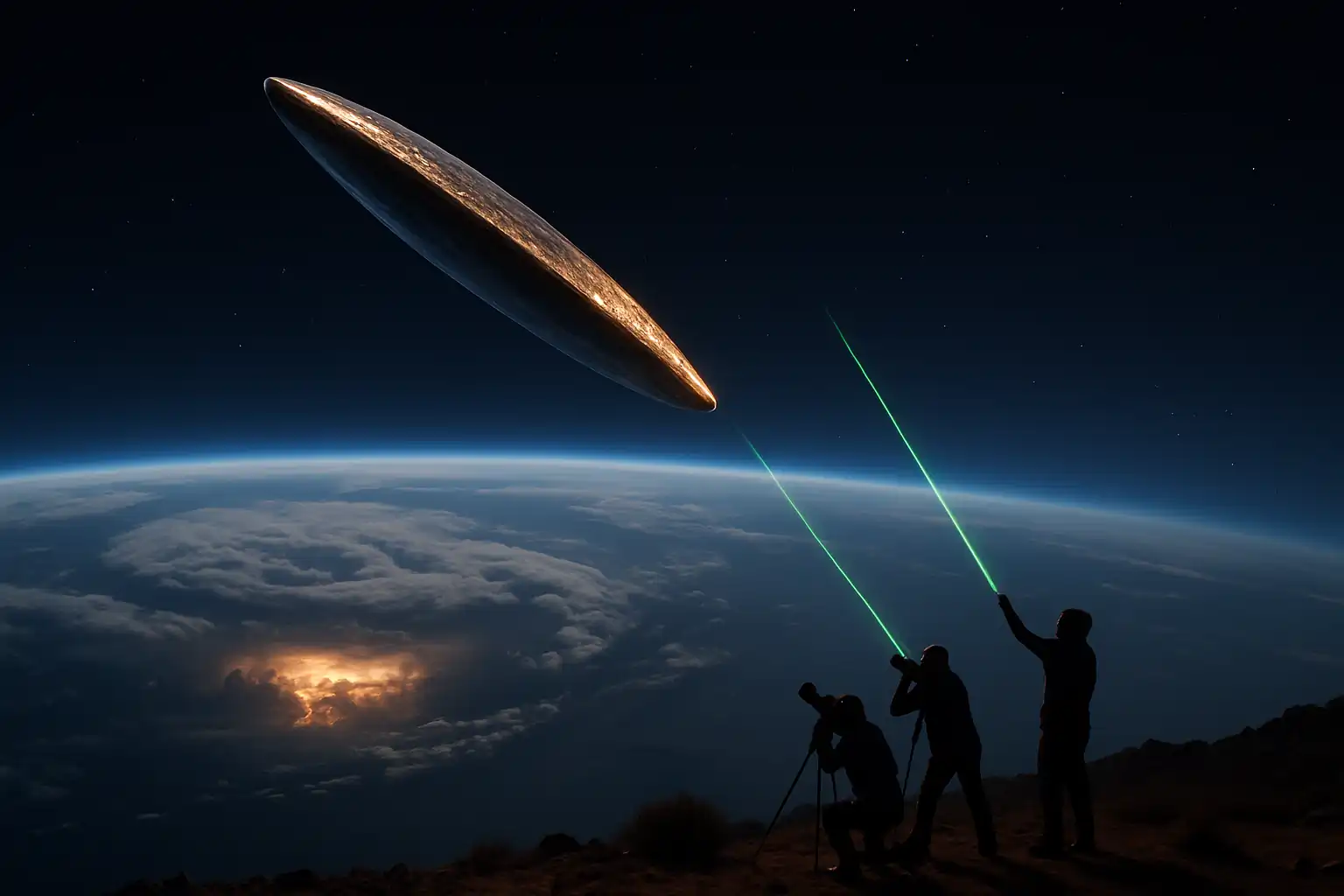
    On 19 October 2017, the Pan-STARRS 1 telescope in Hawai‘i flagged a speck moving at 87 kilometers per second. Initial orbital models stated, “No way this thing was born here.” The trajectory was hyperbolic—open, outbound, never looping back. We named it ʻOumuamua, Hawaiian for “scout” or “messenger.” Poetic: a visitor waves once, never slowing, then bolts for the void like it forgot to turn the stove off.

    Slip on your tinfoil hat and note the timing. That same year, scientists recorded gravitational waves, AI investors promised techno-utopia, and global politics spiraled like coffee down a drain. Into this mess sails an interstellar rock with an attitude. Coincidence? I pour another cup of bunker-grade espresso and doubt it.

    2. Shape-Shifter in the Dark

    Telescopes caught ʻOumuamua only after it passed perihelion, missing the close approach. Photometry revealed wild brightness swings—tenfold every eight hours—suggesting a pancake or cigar shape spinning like a drill bit. If you enjoy academic deep dives, the basic facts hide in ʻOumuamua’s Wikipedia file. They read tame until you see the numbers: a thickness-to-length ratio rivaling a razor blade, and non-gravitational acceleration that ignores Newton.

    Ice sublimation should explain the speed bump, yet no dust coma appeared. Some labs proposed hydrogen ice—evaporates invisibly, no fuss. Others laughed because hydrogen ice cannot survive interstellar UV for long. Meanwhile, radio astronomers pointed dishes and heard cosmic silence, but remember: absence of evidence is not evidence of absence—especially when the target silenced itself on purpose.

    3. Alien Lightsail or Cosmic Fluke?

    Avi Loeb, Harvard’s resident grenade thrower, suggested ʻOumuamua might be a thin lightsail left by long-dead engineers. Mainstream peers called that “sensational,” academic code for heretical. Personally, I find the idea delightful. If ancient aliens wanted to declutter their attic, they might eject obsolete probes. Some would zip past unlucky star systems like ours, broadcasting nothing yet whispering everything.

    For skeptics, a natural fragment of a Pluto-style planet works too—rich in nitrogen ice, shattered by tidal forces, planed flat, then baked glossy so telescopes cannot see outgassing. Sure. Possible. So is my lotto ticket. To weigh options, browse fresh pre-prints via this Brave Search, then decide which fairy tale feels less insane.

    4. Trajectory Breadcrumbs and the Solar-System Trap

    ʻOumuamua entered from roughly the direction of the Lyra constellation—the same patch where scientists search for Dyson spheres because many Sun-like stars huddle there. It left toward Pegasus. Its path skimmed inside Mercury’s orbit, meaning our star accelerated the object. If it were a probe seeking a gravity assist, it executed a textbook slingshot.

    This precision thrills fans of autonomous‐navigation lore. An AI starship might chart courses to harvest photons—exactly what we witnessed. NASA claims coincidence, yet the agency admits we spot only a sliver of the sky. How many scouts missed our net? News flash: you secure your windows only after the first burglar strolls through.

    5. Impact Odds and Existential Math

    Was ʻOumuamua dangerous? Its closest approach to Earth was 0.16 AU—40 lunar distances. Harmless this time, but statistics are harsher. Detection pipeline upgrades now reveal a handful of interstellar objects per decade. Extrapolate volume, and our solar system might host one random wanderer each year. Toss enough dice and you roll snake eyes—a 100-meter interstellar bullet aimed at an unlucky zip code.

    If that projectile carried exotic isotopes or microbe hitchhikers, we could wake up in a scenario fit for haunted-ship folklore: oceans glowing, crops wilting, talking heads assuring everything’s fine. Doomsday? Possibly. But hey, cheaper than Netflix.

    6. Future Intercepts: Project Lyra and Other Hail-Marys

    Enter aerospace dreamers who refuse to watch history speed away. Project Lyra proposes launching a solar-sail craft to chase ʻOumuamua before 2050. The plan relies on a Jupiter fly-by and solar Oberth burn—buzz the Sun so close the sail sizzles, then catapult outward at 70 km/s. White-knuckle engineering? Absolutely. Funding? Vapor for now. You can scan evolving mission architectures through this query.

    Why chase? Because direct sampling beats telescope whispers. A close pass could sniff isotopic ratios, photograph surface plating, or even land a chip. If the object removes its cloak and reveals bolts or hieroglyphs, humanity’s self-image exits stage left. If it’s mundane rock, at least we calibrate our paranoia.

    7. Cosmic Context: We Live in a Shooting Gallery

    Every doomsday-prepper worth his iodine tablets knows space is not empty; it’s an arcade of debris. In 2022, astronomers cataloged a rogue planet with no star. In another corner, a neutron-star collision flung gold dust across light-years, some of which ultimately rains on us. The cosmic stress index, graphed neatly by astronomical risk trackers, trends upward. ʻOumuamua is a postcard from that dangerous neighborhood.

    If civilization keeps heads buried in app updates, the next visitor could arrive bigger, hotter, and on collision course. For a diffraction of that vibe, remember Chelyabinsk 2013: a 20-meter rock, unannounced, detonated with 30 Hiroshimas worth of energy. Now imagine something ten times larger and twice as fast. Interstellar objects are faster.

    8. Wild Hypotheses—Because Why Stop Now?

    1. Solar Sail Debris Field. ʻOumuamua might be a shard of thin metallic foil torn from a megastructure under construction. If stellar civilizations recycle sails, fragments could drift for eons. They would naturally accelerate under radiation pressure—explaining the odd push.

    2. Messenger Probe. Some argue the object tried to communicate by changing spin rate in Morse-like bursts. Data noise, say the sober. But telemetry anomalies do exist.

    3. Doomsday Seeding. Maybe advanced species lob bio-genetic packages into fertile systems. Hit a planet, catalyze evolution, wait a million years, then harvest resources. Sounds absurd—until you view Earth’s fossil record with its sudden leaps.

    9. Practical Steps Before the Next Scout Arrives

    Upgrade Surveys. Pan-STARRS 2 and the upcoming Vera Rubin Observatory will widen our radar. We must train AI to flag abnormal trajectories, not just potential impactors.

    Build Rapid-Response Propulsion. Nuclear thermal tugs, solar sails, and mass-driver launch loops could hurl probes within months, not decades. Because you cannot interrogate what has already left the building.

    Plan Civil Defense. If intercept fails and an object targets Earth, evacuation protocols must exist beyond dusty binders. Urban drills and early-warning sirens—tools explored in geocrisis manuals—should cover extraterrestrial risks too.

    10. Closing Arguments from the Bunker Studio

    We witnessed our first confirmed interstellar visitor, and mainstream reaction toggled between mild curiosity and polite shrugs. Meanwhile, deep-space rocks keep their poker faces, and telescopes blink. Whether ʻOumuamua was a cosmic accident or a breadcrumb from an ancient map, it shattered complacency. The universe is not a silent backdrop; it is alive with projectiles, and sometimes they stop by without calling first.

    If you want to snooze again, fine. My fallout shelter still has room for an extra cot—rent payable in shelf-stable chili. But if you prefer daylight to bunker bulbs, stay curious, fund the survey arrays, and bookmark independent sources like Unexplained.co. The next messenger might not zoom away; it might park nearby, and history shows uninvited guests rarely bring cupcakes.

  • Orbital Crosshairs: America’s Golden Dome and the Dawn of Total Space War

    Orbital Crosshairs: America’s Golden Dome and the Dawn of Total Space War

    1. From Star Wars to Sun-Killer

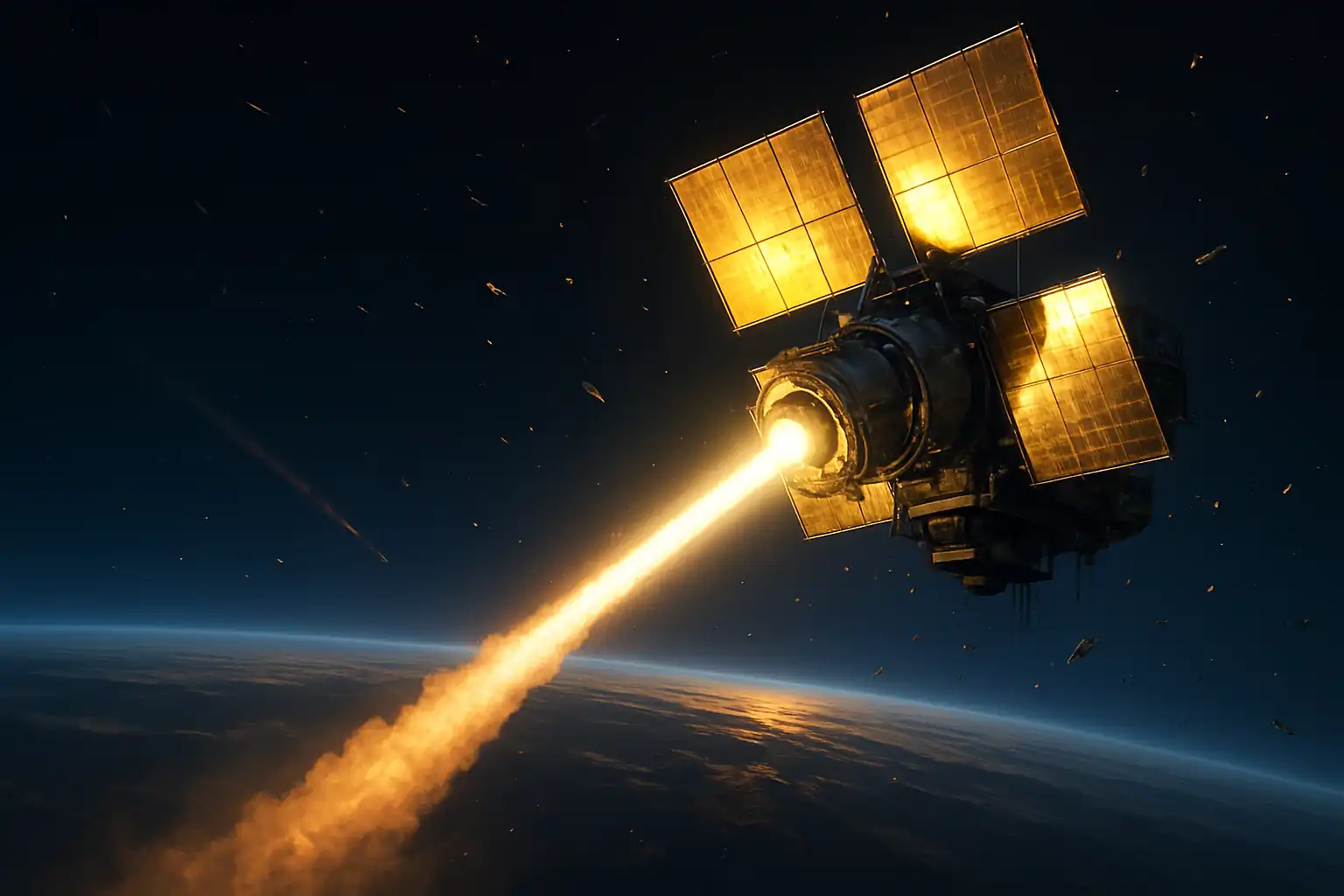
    Four decades ago, Ronald Reagan pitched the Strategic Defense Initiative, a network of orbital lasers criticized as fantasy. Technology limped, budgets bled, and the project faded—until hypersonic glide vehicles began screaming over test ranges in Russia and China. Now Washington has rebooted the idea: the Golden Dome, a layered constellation designed to spot, track, and pulverize enemy missiles in the first seconds of flight. If planners succeed, the United States would become nearly untouchable—a fortress of silicon and light.

    Supporters cite breakthroughs in directed-energy physics, solid-state lasers, and autonomous guidance. Opponents point to the cautionary tale archived in the original SDI entry. They warn that every shield invites a sharper sword, and the current arms race crackles with fission tests, glide vehicles, and anti-satellite payloads.

    2. How the Golden Dome Would Work

    The architecture splits into three tiers.

    • Watchers: Low-Earth-orbit infrared satellites that scan for white-hot launch plumes. Machine-learning algorithms triage threats in milliseconds, as recently dissected in an independent brief.
    • Trackers: Medium-orbit radar platforms refine trajectories and hand off firing solutions to ground units or on-orbit interceptors.
    • Strikers: Two competing concepts—kinetic “hit-to-kill” darts stored aboard buses circling 1,000 km high, and megawatt-class lasers powered by giant solar arrays.

    Advocates say global coverage slashes reaction times to seconds, nullifying hypersonic weapons’ atmospheric advantage. Skeptics note that intercept windows narrow when targets arrive from unpredictable vectors, and even a flawless shot risks showering orbit with shrapnel.

    3. Space Gets Crowded—and Hostile

    Orbital launches topped 2,400 last year, mostly cubesats but increasingly military. Each new object complicates tracking and multiplies collision risk. Engineers worry about a chain-reaction debris storm—the Kessler Syndrome—that could cage humanity with lethal junk. A single laser strike shattering an incoming warhead might add thousands of bullets to the swarm.

    Astrodynamics researchers illustrated the nightmare through a public simulation found with this search query. In the model, one intercepted ICBM triggers 28 secondary crashes within a decade, crippling weather satellites and GPS timing. Commerce halts; disaster relief loses eyes; the sky becomes a battlefield even for innocent spacecraft.

    4. The Opponents Sharpen Their Claws

    Moscow brands the Golden Dome a violation of strategic balance and has revived co-orbital hunter satellites capable of sidling next to US assets and detonate. Beijing parades kinetic-kill vehicles on state television and tests fractional orbital bombardment systems—a glide stage that stays in low orbit before dropping without warning.

    Intelligence leaks hint that both powers may leverage the weaknesses in Earth’s magnetic shield to mask test burns. If weaponized geomagnetic storms scramble US sensors, the shield could blink at the worst moment. In response, Pentagon designers propose redundant clusters and quantum-secure links, but each patch inflates cost and weight.

    5. Lasers, Power, and the Physics Wall

    To fry a missile outside the atmosphere, a beam must deliver tens of megajoules within seconds. Achieving that punch demands colossal solar wings or small fission reactors—prime targets. Engineers explore lightweight mirror arrays to concentrate sunlight, but pointing accuracy drops as platforms flex. Another avenue uses superconducting coils to store bursts of energy, a method glimpsed in recent physics papers. Those coils must stay near absolute zero, a refrigeration challenge in sunlight hotter than a desert noon.

    Even if power hurdles fall, atmospheric bloom can scatter directed energy as shots tunnel downward. Developers plan adaptive optics, but a nimble adversary might simply ice the missile skin, buying precious seconds.

    6. Command, Control, and Autonomy

    Because signals crawl at light speed, a kill decision may need to occur on the satellite itself. That means artificial intelligence will decide, without a human hand, whether to vaporize a decoy or—even worse—a crewed spacecraft misidentified under flare counter-measures. The nightmare parallels a near-catastrophe examined in a Cold-War systems study. Give the wrong algorithm launch codes, and you risk an accidental opening salvo.

    Regulators push for human-in-the-loop provisions, yet a five-second delay can be fatal against a Mach 20 glide body. The result is a strategic paradox: to save humanity, we may entrust its fate to silicon reflexes.

    7. Cost Spiral Versus Asymmetric Hacks

    Each strike satellite could cost five hundred million dollars. A hypersonic missile costs roughly ten million. Adversaries might swamp the dome with cheap decoys or saturate orbital planes with cubesat chaff, bankrupting the defender. Cyber units could bypass physics by hacking star-tracker firmware to nudge platforms off target. The US Cyber Command rehearses such digital dogfights, a drill pattern quietly referenced in media-control field notes.

    8. Ethical Flashpoints

    Space is officially a global commons under the 1967 Outer Space Treaty. Yet every prototype nudges the line between “defensive asset” and “space gun.” If the United States plants lasers overhead, other nations may claim justification for nuclear warheads in orbit—a direct treaty breach. Diplomatic backlash could shred remaining arms accords as Cold War verification regimes crumble under new concealment tech.

    Back home, lawmakers question if public funds should chase a shield when wildfire seasons expand and bridges crumble. The Pentagon insists it can multitask, but watchdog organizations expose procurement overruns through leaked GAO memos. Every extra billion diverted to orbit leaves fewer dollars for evacuation drills or early-warning sirens on the ground.

    9. The Apocalypse Scenario

    Picture 2032. A regional missile launch lights up sensors. The Golden Dome fires a laser salvo; three warheads disintegrate, seeding thousands of fragments at 800 km altitude. Minutes later, a rival power, believing its deterrent neutralized, retaliates with anti-satellite interceptors, shredding the shield’s eyes. GPS falls silent. Financial networks stumble. Oil tankers divert, sowing global shortages. The fragment cloud expands, clipping weather satellites that guide crop planning. Food prices spike, protests erupt, and panic buys drain supermarkets.

    Amid the chaos, geomagnetic storms spike—a reminder, as detailed in geophysical assessments, that nature still plays dice. Stripped of orbital infrastructure, humanity finds itself hurled back to pre-digital logistics, yet nuclear arsenals remain fully functional. The very shield built to guarantee security has opened a stairway to ruin.

    10. Is There an Off-Ramp?

    Arms-control veterans propose a moratorium on offensive lasers above 300 km altitude and real-time telemetry sharing on all intercept tests. Others advocate red-line diplomacy—pledging that any strike on early-warning satellites equals nuclear aggression. Critics reply that unverifiable pledges are mere paper shields, inviting others to cheat while America hesitates.

    Some innovators explore non-destructive defense: ion beams that nudge warheads off course, or nets that capture them. Each solution spawns counter-solutions, proving that as long as missiles exist, so will escalation models.

    11. What the Public Can Do

    You cannot rig a satellite in your garage, but you can pressure representatives, support scientific literacy, and stay informed. Independent outlets like Unexplained.co track shadows between press releases. The future of the sky affects everything beneath it—from the price of bread to the reliability of emergency calls.

    Keep an eye on launch manifests, demand transparency, and remember that Earth has no spare atmosphere if orbital crossfire poisons the only one we have.

  • When the Shadow Takes the Stage: Did the Antichrist Just Step Into the Spotlight?

    When the Shadow Takes the Stage: Did the Antichrist Just Step Into the Spotlight?

    1. The Sudden Stir—Why the Rumor Caught Fire

    At 02:17 UTC last Thursday, an influencer livestreamed an emergency bulletin: a charismatic world figure, unnamed but obvious, had allegedly performed a private ritual in Jerusalem and proclaimed himself the long-awaited unifier of faiths. Minutes later, clips of the allegation ricocheted across social media. Conspiracy channels stitched together images, some AI-generated, showing diplomatic handshakes, glowing sigils, and crowds bathed in violet floodlights. Midnight doom-scrollers asked a single question: Has the Antichrist revealed himself?

    The claim might have fizzled if not for impeccable timing. Days earlier, analysts dissected an audacious symbol drop by another power broker, documented in this earlier investigation. Symbols prime public imagination; rumors seize the void.

    2. Prophecy Primer: The Script He Must Follow

    Mainstream eschatology states a global leader will arise during chaos, promise peace, perform apparent miracles, and demand worship. The Book of Daniel sketches a “little horn” who uproots kings, while Revelation 13 describes a beast empowered by a dragon, dazzling humanity with authority. Academic summaries on Wikipedia trace the motif through early church fathers, medieval chiliasts, and modern televangelists.

    Prophecy does not operate in a vacuum; it thrives on geopolitical soil rich with fear. Today’s news feeds supply that soil: superpower friction logged in dossiers like this conflict chronicle, environmental instability, and AI-driven economic upheaval. People crave a savior—or identify a villain—because the ground already shakes.

    3. The Candidate Checklist

    For any rumor to stick, the alleged Antichrist must tick several boxes:

    1. Charismatic Magnetism. He draws disparate blocs—secular technocrats, ex-cheerleaders, retired generals—into one orbit.
    2. Miracle or its Simulation. In a digital age, a deep-fake resurrection or a global satellite hack that “pauses” the moon could count.
    3. Seven-Year Blueprint. Tradition expects a concise timeline of treaties and betrayals; think high-speed political deals, not leisurely papal bulls.
    4. Temple Interface. Script links his self-coronation to a holy site, making excavation permits in disputed zones crucial.

    During the livestream frenzy, pundits examined these criteria against half a dozen personalities. A biotech CEO with advanced gene-editing patents? A statesman spearheading a universal digital ID? A pop-culture messiah whose stage performances mimic celestial myths? None fit perfectly, which fuels speculation: perhaps the reveal came through symbolism, not press release.

    4. Lesser Magic, Greater Impact

    Occultists define lesser magic as psychological manipulation through imagery, timing, and ritual—ideas explored in Anton LaVey’s manuals and repackaged in modern advertising. The alleged Jerusalem ritual, real or staged, functions as such. Broadcast when global sentiment hovers between election fatigue and climate dread, the act colonizes subconscious bandwidth.

    Consider the public fascination with HAARP: people fear invisible forces altering reality. Insert a charismatic figure into that narrative, and you birth an Antichrist candidate overnight.

    5. Technology as Miracle Fabricator

    Ancient seers equated miracles with unreplicable phenomena. Today, generative AI can clone a politician’s voice, animate ancestors, or deploy drones to create luminous signs in the sky. An algorithmic spectacle appears as sorcery from a medieval lens—and prophecy comparisons often rely on medieval texts.

    Cyber-security white papers, available via open research hubs, reveal real-time translation tools that render speeches instantly in every major tongue, fulfilling the “speaks to all nations” trope. Mix that with developing neural implants, and you have the blueprint for “mind control” headlines.

    6. Cosmic Alignments and Plasma Anomalies

    Prophets love the heavens. This year, rare planetary line-ups combine with solar cycle 25’s ramp-up. Space physicists warn that coronal mass ejections could disrupt power grids, an outcome dissected in geomagnetic risk files. Add a showman who promises to restore power “by command” and you breed apocalyptic theater.

    Meanwhile, Earth’s own heartbeat flares. The recent Schumann resonance spike, analyzed here, unnerves people attuned to vibrational lore. Tie that natural roar to a public proclamation, and myth merges with magnetism.

    7. Counter-Signals from Skeptics

    Critical scholars argue that labeling every charismatic disruptor as the Beast cheapens analysis. They point to failed predictions—from Nero to Napoleon to computer chips—that litter history. Fact-checkers chase rumor breadcrumbs to dead ends, catalogued through archival rundowns. Yet the legend persists because the pattern remains elastic; it reshapes around each era’s anxieties.

    8. Societal Shock Loops and the Self-Fulfilling Prophecy

    Belief alters behavior, and behavior manipulates history. If enough citizens accept that an Antichrist rules backstage, they may sabotage institutions, embrace violent purges, or rally behind rival strongmen. Such chaos may birth the autocrat they dread—a recursive doom loop.

    Political instability trackers draw grim parallels with fragile regions already on nuclear hair-trigger, as chronicled in recent conflict reports. One cascading misstep, and eschatology shifts from meme to crater.

    9. Personal Discernment in a Deep-Fake Apocalypse

    Regardless of theological stance, individuals can inoculate themselves against manufactured revelation:

    • Verify multimedia. Use reverse-image and audio spectrogram tools before sharing “miraculous” clips.
    • Watch pattern not hype. True global power consolidations leave policy footprints—treaties, trade routes, telecom standards—not just viral symbols.
    • Maintain moral agency. Prophecy describes potential; ethics dictate outcome. Don’t outsource conscience to online pastors.
    • Diversify information wells. Refresh independent portals such as Unexplained.co alongside mainstream wires.

    10. The Bottom Line: Revelation or Rorschach?

    The Antichrist myth operates like a cosmic Rorschach test; society projects fears onto a convenient silhouette. Technological wizardry and geopolitical tremors supply fresh inkblots daily. Whether last week’s ritual marks the Beast’s debut or just another viral misdirection, the stakes remain colossal because belief alone can sculpt reality.

    Stay vigilant, cross-check data, and keep your apocalypse kit handy. If the shadow figure turns out to be genuine, you’ll need more than streaming bandwidth—you’ll need backbone, truth filters, and perhaps a safe spot far from glowing sky-drones.

  • Earth’s Heartbeat on Overdrive: Schumann Spikes and the Looming Megathrust

    Earth’s Heartbeat on Overdrive: Schumann Spikes and the Looming Megathrust

    1. The Day the Spectrum Screamed

    At 7:19 a.m. UTC, the Tomsk Space Observing System showcased a startling chart: the calm green-and-blue bands of Earth’s Schumann resonance map turned blood-red, signaling a spike in the signal’s quality factor. Hours later, a station in Cumiana, Italy, echoed this spike. Geophysicists felt that double-hit as the planet yelling through a megaphone.

    The Schumann resonances are standing electromagnetic waves trapped between Earth’s surface and the ionosphere, oscillating primarily at 7.83 Hz. Discovered in 1952 and described on Wikipedia, they act like a global bell. Solar storms, lightning bursts, and nuclear tests can jostle the amplitudes, but the quality factor—the tone’s crispness—rarely multiplies overnight. When it does, significant events usually follow.

    2. Correlation or Causation? A Troubling Timeline

    Geophysicist Stefan Burns examined a decade of archives and noted resonance spikes alongside event markers. Three days before the 2011 Tōhoku megathrust, the Q-factor doubled. Five days ahead of the 2018 Sulawesi quake, it climbed 40%. Similar patterns preceded the 2023 Türkiye-Syria disaster. Critics cite coincidence, yet engineers rely on Schumann baselines to calibrate ultra-low-frequency antennas, knowing anomalies rarely occur without an energetic trigger.

    Satellite magnetometers reinforce this circumstantial case. Archives linked through independent magnetometer portals reveal micro-pulsations that coincide with rising ground strain. When rock micro-fractures, it releases charged aerosols, subtly affecting the atmosphere’s conductivity. That influence nudges the ionospheric mirror, amplifying the planet’s radio rumble.

    3. Tectonic Powder Kegs Currently Primed

    Which fault might rupture next? Burns identifies four danger zones:

    1. Cascadia Subduction Zone: GPS stations off Oregon show unusual landward creep this month.
    2. Japan’s Nankai Trough: Offshore pressure sensors logged slow-slip events, precursors to historic quakes.
    3. Pamir Knot, Central Asia: Deep tremor trains spiked 30% above baseline.
    4. Mexico’s Guerrero Gap: A 170-mile stretch remains unbroken since 1911.

    Any of these could turn a resonant whisper into continental sirens.

    4. The Wild Cards: Solar Weather and Geo-Plasma Holes

    Space weather forecasters observed a coronal hole facing Earth, expected to unleash high-speed solar wind within 48 hours. Such streams compress the magnetosphere, sometimes exposing the South Atlantic magnetic anomaly to additional radiation. This energy can disrupt Schumann modes by perturbing the ionosphere’s lower boundary. If the resonance spike coincides with a solar barrage, the lithosphere faces double stress—external EM loading and internal release.

    Another concern involves man-made electromagnetic dumping. Military very-low-frequency transmitters operate near Schumann harmonics, and HAARP-style ionospheric heaters inject megawatts into the atmosphere. Officially, these arrays never run powerful operations without notice. However, citizen watchdogs highlight spectral fingerprints appearing in open data—quirks noted in signal plots archived at ocean-monitoring logs.

    5. What Amplification Looks Like on the Ground

    Before rock snaps, radon gas vents through fissures, animals become restless, and radio hobbyists hear phantom whistles across shortwave bands. Italian seismologist Bianca Corzio operates VLF receivers from her farmhouse. Yesterday, she reported hiss over 8 kHz, fading by dawn. This timing aligns with Tomsk’s spike, hinting at global coherence.

    Along California’s Mendocino Triple Junction, strainmeters recorded a one-in-fifty-year compression pulse. Combining this with Schumann data yields a probability curve few emergency managers can ignore. Civil-defense units, already rehearsing siren routines archived at urban-risk repositories, quietly switched radio nets to 24-hour standby.

    6. Predictive Models: Promise and Peril

    Can we predict earthquakes from electromagnetic foreshocks? Academic opinions divide. The “mechanism skeptics” highlight false positives: many Schumann blips occur without quakes. Supporters argue that resolution improves with dense sensor grids and refined machine-learning filters. A 2022 neural-network study, found through AI seismology digests, achieved 78% accuracy in classifying quake-linked anomalies retroactively.

    Authorities hesitate to evacuate cities based on statistics. Yet failing to warn invites backlash. Japan’s Meteorological Agency faced criticism for missing the 2016 Kumamoto mainshock after ignoring VLF hints. California’s ShakeAlert team now incorporates ionospheric GPS scintillation data as a supplemental stream, though they rarely publicize it.

    7. Personal Preparedness When the Planet’s Pulse Races

    You cannot prevent tectonics, but you can increase your odds:

    • Anchor heavy furniture. Most injuries arise from flying bookcases.
    • Stock 72-hour supplies. Include water, non-perishable food, and LED lights.
    • Keep offline maps. Cell towers fail under surge traffic.
    • Know your shut-offs. Gas leaks can turn tremors into firestorms.
    • Keep a battery radio. If power grids falter—discussed at infrastructure watchlists—you’ll still receive civil-defense updates.

    8. Planetary Symphonics and Eschaton Lore

    Mystics view Schumann spikes as signs of Earth “ascending.” Scientists consider them pressure gauges. Regardless, the resonance connects every living creature beneath an ionized gas roof. A mega-quake does more than topple skyscrapers; it disrupts supply chains, shifts Earth’s axis by milliarcseconds, and nudges dreamers toward end-time narratives, similar to pole-shift speculations chronicled in geocentric studies.

    If the BIG ONE strikes a megacity like Tokyo, Istanbul, or Los Angeles, economic contagion will ripple across oceans within hours. Insurance markets wobble, commodity ports seize, and social media floods with AI-generated doom loops, fueling real-time panic. Geophysicists term this the secondary quake—the societal shockwave that follows the geological one.

    9. The Next 96 Hours: What to Watch

    Burns’ team establishes yellow, orange, and red windows based on statistical lag times between anomalies and quakes:

    Window Risk Level Key Indicators
    0–24 h Yellow Watch for regional swarm increases.
    24–72 h Orange Monitor ionospheric TEC maps—sudden drops may signal lithosphere-atmosphere coupling.
    72–96 h Red Groundwater radon spikes or animal mass migrations heighten probability.

    If nothing ruptures by day four, the model resets, but tension rarely dissipates; it stores like charge in a thunderhead.

    10. Conclusion: Between the Beat and the Break

    Earth hums constantly, yet this week it howls. Whether the resonance surge predicts a megathrust or simply records an ionospheric prank, ignoring the signal invites danger. The past century proves preparedness saves more lives than prediction. Track sensors, test your go-bag, and monitor reputable clearinghouses like Unexplained.co. If the ground remains still, celebrate a drill. If it lurches, you’ll thank the planet’s nervous system for the whispered warning.

  • Kashmir Flashpoint: Drone Down, Water Cut—And the Countdown to Catastrophe

    Kashmir Flashpoint: Drone Down, Water Cut—And the Countdown to Catastrophe

    1. Sparks Over a Snow Line

    On a gray dawn in the Pir Panjal Range, Pakistani soldiers lifted twisted carbon fiber from a scree slope—an Indian quadcopter shot down. The official communique labeled it a spy platform that breached the Line of Control. New Delhi dismissed the charge as propaganda. But Kashmir’s mountains amplify every bullet and rumor; before the wreckage cooled, Pakistani anchors called the incident an act of war.

    Within hours, Islamabad announced the suspension of certain provisions of the Indus Waters Treaty, a pact surviving wars, coups, and partition ghosts since 1960. The twin jolts—airspace violation and water leverage—electrified a region already detailed by independent conflict trackers. Analysts tallied timelines: missile flight minutes, armored division mobilization windows, and river flow measurements at border dams. The clock began ticking louder.

    2. Why a Drone Matters

    Drones violate sovereignty subtly: no pilot to capture, no black box to negotiate. Each downing forces leaders into a binary—ignore the incident or escalate. Kashmir has absorbed shellfire and sniper fire for decades, but unmanned eyes above the tree line feel more intimate. They suggest precision strikes, bunker mapping, and real-time artillery correction.

    The LoC’s wind shear and thin air challenge most commercial models, but militaries now use temperature-hardened quadcopters that send coordinates to artillery tablets. A plastic wing becomes a strategic lens. Islamabad’s generals framed the shoot-down as proof that Indian units prepared for offensive ingress disguised as surveillance. Whether that claim holds water, public outrage moves faster than de-escalation hotlines.

    3. The Water Lever Pulled

    The Indus Waters Treaty grants India control of three eastern rivers and Pakistan control of western tributaries—lifelines for Pakistani farms. Suspending it weaponizes irrigation. In summer, Pakistani canals nourish cotton and wheat; choking them causes bread prices to spike in Karachi within weeks. Farmers recall 2010 floods and 2022 droughts; they fear fresh extremes.

    Economists consult hydrological datasets while reviewing policy digests, mapping cascading shocks: food inflation, refugee flows, and regional grain shortages. Water security becomes food security, which turns into state security. Everyone knows the script; nobody likes the ending.

    4. Nuclear Doctrine in the Rearview Mirror

    India asserts “No First Use” but qualifies that pledge with threats of massive retaliation. Pakistan refuses such restraint; its posture remains “first-use if survival is at stake.” Water throttling easily meets that threshold. Strategic scholars studying declassified memos—some referenced in archival analyses—note chilling parallels with Cold War automation nightmares.

    With mobile launchers on both sides, MIRV-capable Agni-V missiles, and plutonium pits ready for assembly, the distance between drone scrap and mushroom cloud shrinks uncomfortably. Open-source satellite sleuths scour imagery via remote-sensing portals for convoy patterns. A surge in transporter-erector vehicles rolling out of Pune or Kamra would raise red flags worldwide.

    5. Why Satellites Can Lie

    Modern sensors monitor every dam gate and cantonment road, yet they can mislead. A stray geomagnetic burst can scramble synthetic-aperture reads, causing false alerts like the mis-cue scenarios detailed in regional geophysical briefings. One garbled frame in automated warning systems could trigger pre-emptive moves neither capital intends.

    Both nations upgraded early-warning networks with machine-learning analytics showcased in defense expos. AI promises split-second clarity; it also introduces split-second mistakes. Cybersecurity forums cite a mis-tagged heat plume incident that nearly escalated a 2021 artillery duel. Lessons learned? Operators now keep a human in the loop, but the reaction window continues to shrink as processor speeds increase.

    6. Water Wars Meet Drone Swarms

    Imagine river chokepoints guarded by autonomous quadcopters loaded with seismic sensors and micro-munitions. Commanders could deploy swarms to disable sluice gates or sabotage diversion tunnels without infantry intervention. Policy journals accessed via engineering digests warn that such tactics entice first strikes: whoever blinks first floods or starves the opponent.

    The interplay between water scarcity and AI-driven arsenals echoes analysis threads archived at future-war labs. You cannot separate rivers from robots anymore.

    7. Public Pulse: Street Protests and Screen Warfare

    Delhi pundits urge calm while primetime panels display patriotic graphics. In Lahore, clerics preach water jihad. Hashtags trend: #AvengeTheDrone, #SaveOurIndus. Memetic warfare floods TikTok with stylized kill-cam footage—some lifted from video games and others genuine. These clips erode the firewall between spectator and combatant; every share inches the Overton window toward open conflict.

    Emergency siren drills—chronicled in civil-defense field notes—now run across Punjab schools. Children learn to duck under desks not for earthquakes but for cruise-missile overflights. The generational trauma seeds itself in real time.

    8. Global Stakes: Wheat Futures and Oil Routes

    The subcontinent sits at shipping lanes funneling Gulf oil to Pacific factories. Insurance underwriters contemplate war-risk surcharges; Brent crude twitches. Chicago wheat futures climb 4% on rumors of irrigation sabotage. Hydro-electric projects along the Chenab power data centers handling global outsourcing workloads. A prolonged blackout could ripple into Western customer-service lines by next Monday.

    Diplomats scramble. Beijing offers quiet mediation—its companies built many Pakistani dams. Washington dusts off contingency cables. The United Nations calls for restraint, referencing the original treaty text archived on Wikipedia. When the UN cites Wikipedia in emergency briefings, the library is on fire.

    9. Off-Ramps and Tripwires

    Can leaders de-escalate?

    • Hotline Reboot: The 1991 direct line works, but only if someone answers during public holidays.
    • Back-channel Hydrology: Engineers could quietly restore water flow, labeling it “maintenance.”
    • Third-Party Drone Logs: Neutral observers—perhaps Swiss or Omani—verify crash telemetry, preserving egos.
    • Media Chill: A 72-hour moratorium on inflammatory talk-show language could lower street heat.

    Yet every option struggles against electoral cycles and nationalist pride. The longer the stalemate, the harder it becomes to close valves—literal and metaphoric.

    10. Personal Preparedness on the Nuclear Frontier

    Residents of Amritsar and Rawalpindi live fifteen minutes from potential strike zones. Civil-defense manuals recommend airtight rooms, iodine pills, and battery radios. If the grid fails—like the cascading outages documented at infrastructure-watch hubs—old-school shortwave could be the sole voice left.

    Preppers in Mumbai and Karachi stock reverse-osmosis filters; fallout dust contaminates river intakes first. Water again—origin and endgame of the crisis.

    11. A Drone, A Dam, A Doomsday Clock

    A 2-kilogram UAV costs about $6,000. Its downing now jeopardizes projects worth billions and cities dense with millions. History shows world wars erupted from smaller sparks: Sarajevo’s gunshots, Pearl Harbor’s radar blip, a Gulf of Tonkin sonar ping. Kashmir just added a drone ping to that list.

    The Indus will flow from the Himalayas to the Arabian Sea, heedless of treaties or tweets. Whether its banks nurture rice paddies or radiation counters depends on decisions made before the next snowmelt. Citizens must monitor water gauges and skies equally—and keep an eye on independent monitors like Unexplained.co as official statements blur.

  • Papal Robes and Political Spells: Decoding the Dark Symbolism Behind Trump’s AI Coronation

    Papal Robes and Political Spells: Decoding the Dark Symbolism Behind Trump’s AI Coronation

    1. A Meme That Arrived Like a Comet

    Scroll feeds long enough, and you land on the image: Donald J. Trump in immaculate white vestments, arms spread in benediction beneath the gilded dome of a virtual St. Peter’s. Most viewers chuckled, tapped a heart, and moved on. Occult researchers paused. The photograph surfaced minutes after news broke that Pope Francis had died. In ceremonial magic, timing equals force. A symbol launched during a global event acts like a spell carried on society’s collective gasp.

    2. Lesser Magic and the Optics of Power

    The Church of Satan’s Anton LaVey defined lesser magic as “the wile and guile obtained through applied psychology.” In simpler terms, it nudges emotions before reason can veto them. When a former president drops a papal avatar into the cultural bloodstream, he hijacks centuries of encoded authority—robes, crozier, and the aura of divine right—without lifting a sword or passing a bill. That is lesser magic at industrial scale, amplified by algorithms.

    To see the tactic in action, review Nancy Reagan’s White House astrology sessions or Richard Nixon’s chats with psychic Jeane Dixon. Leaders crave a theatrical edge that ritual provides. In that lineage, a click-ready AI portrait beats incense and Latin chants; it travels at light speed, bypassing gatekeepers.

    3. How Algorithms Replace Altars

    In the past, priests guarded iconography, scribes illuminated codices, and peasants viewed a sacred canvas maybe twice a year. AI now mass-produces icons by the second. Anyone with a prompt can conjure blasphemy or beatification. But intent still matters. Symbolists note three suspicious pivots in Trump’s image:

    • The White Cassock. Only reigning popes wear pure white. Even cardinals at conclave stick to crimson. The image crowns Trump seated on the Throne of Peter, not standing as a visitor.
    • The Keys of Heaven. Silver and gold keys dangle prominently on the garment’s fascia—an insignia reserved for ultimate spiritual jurisdiction.
    • Crossed Arms. The pose mirrors classic rex gesturing seen in medieval coronation art, signaling blessing and dominion.

    These are not random Midjourney flourishes; they are theological dog whistles broadcast to an audience steeped in apocalypse lore.

    4. Prophetic Echoes and Political Ambition

    Biblical students recognize the specter of the false shepherd—an antichrist figure fusing political muscle and counterfeit holiness. Critics already brand Trump messianic; supporters wave flags proclaiming “Jesus is King—Trump is President.” The papal cosplay escalates that fever dream. Researchers mapping modern imagery onto End-Times scripture reference passages in Revelation 13 about a beast who dazzles the world with wonders. Fringe theologians spotlight this parallel in private forums, some gaining traction through archived discussions outside the mainstream glare.

    These apocalyptic overlaps may be coincidence. Yet veteran propagandists know that coincidence, properly timed, becomes destiny in the public mind.

    5. From Reagan’s Horoscope to AI Deep Fakes

    Presidential flirtations with the esoteric are nothing new. Ronald Reagan altered summit schedules based on astrologer Joan Quigley’s advice. Franklin Roosevelt consulted numerologist friends about inauguration dates. The difference now lies in virality. AI images sidestep polite media curation; they detonate across social platforms faster than any fact-checker can load a browser. Digital hyper-reality blurs parody and prophecy, a dynamic explored in recent investigations linked through dystopian studies.

    6. Psychological Payload: Authority, Immortality, and Absorption

    Why does a papal costume carry weight beyond novelty? Psychologists describe authority transference: the mind borrows credibility from symbols. If you see a man in a white coat, your brain flags “doctor.” Swap the stethoscope for a mitre, and the mind flags “infallible authority.” Trump’s image sneaks that reflex into millions of screens.

    Next comes immortality salience. Popes serve for life, bridging the office to eternity. A politician craving relevance rides that halo to outlast election cycles. Finally, the image fosters absorption: a hypnotic state where symbolism flows unfiltered. Scroll-weary citizens glimpse the avatar during late-night doom scrolls; subtle suggestions slip beneath analytic scrutiny.

    7. Memetic Warfare in the AI Epoch

    Strategists now teach memetic warfare, weaponizing visual jokes to steer discourse. In classified briefings—some referenced obliquely in cyber-defense circles—analysts model image propagation like viral spread. An effective meme obeys three laws:

    1. Trigger a primal emotion (awe, fear, humor).
    2. Embed a simple narrative (“I am ordained”).
    3. Offer easy replication (one tap to repost).

    Trump’s papal portrait meets all criteria. The awe of sacred regalia merges with the shock of political theater; the narrative whispers divine mandate; reposting is frictionless.

    8. The Vatican’s Silence and the Signal It Sends

    No official Vatican channel condemned or clarified the meme. Silence, intentional or not, fuels speculation. Conspiracy forums dredge prophecies of a final pope, cross-referencing timeline charts with seismic anomalies recorded in satellite datasets. When institutions refuse commentary, rumor metastasizes. A void of authority invites counterfeit authority to thrive.

    9. Occult Optics and the 2024 Campaign Trail

    Financial disclosures show campaign consultants hiring “narrative architects”—a trendy title for memetic engineers. They track engagement metrics on images featuring halos, lion motifs, and yes, papal vestments. External analysts catalog this trend via political-tech digests. Whether the ex-president typed the AI prompt himself is irrelevant; the machinery now churns ambient propaganda on autopilot.

    Consider the echo effect: every repost spawns derivative art—Trump as archangel, Trump at Last Supper, Trump enthroned on a digital Ark. Each derivative normalizes the blasphemous mash-up, inching public consciousness toward a mythic recalibration.

    10. Between Prophecy and Program Code

    The Book of Revelation warns of images that “speak” and compel worship. Deep-fake videos literally speak; generative bots animate avatars to sermonize in any language. Tech evangelists hail this as creative democratization, yet theologians shiver at a synthetic idol preaching. Academic white papers archived through AI ethics portals outline scenarios where fabricated prophets incite digital crusades.

    The Trump-Pope meme might be a harmless troll. It might also preview an era where algorithms mint living scripture, unvetted, unstoppable, and tied to political branding.

    11. Guardrails for the Scroll Age

    How do citizens resist occult optics when every scroll resembles a tarot deck?

    • Source-verify. Reverse-image search before sharing.
    • Context-stack. Compare memes to reputable reports, including repositories like archival dossiers.
    • Delay impulse. A ten-second pause disrupts memetic contagion.
    • Teach symbolism. Schools drill media literacy; add semiotics to the curriculum.
    • Diversify inputs. Monoculture feeds breed trance. Read outside your algorithmic silo, starting with grassroots aggregators like Unexplained.co.

    12. Closing the Ritual Circle

    In esoteric practice, a ritual ends only when the circle closes. Trump’s papal meme opened a circle that remains wide. Each share, like, and parody extends the rite. Whether you applaud or recoil, your attention feeds the sigil. The image will keep evolving, perhaps resurfacing on the eve of debates or morphing into campaign merch or virtual-reality rallies.

    The lesson transcends partisan skirmishes: symbols, once loose, obey their own logic. If we shrug and scroll, we abdicate agency. If we interrogate, we reclaim narrative. Choose wisely before the next immaculate icon flashes onto your screen; it may already aim for your lizard brain, mitre polished, algorithm primed.

  • Secret Scrolls and Silenced Tongues: The Forbidden Blueprint of the High Priests

    Secret Scrolls and Silenced Tongues: The Forbidden Blueprint of the High Priests

    1. The Locked Library Beneath the Ziggurat

    Imagine a sandstone vault under an ancient Mesopotamian temple. Torches sputter. Clay tablets rest on cedar shelves. Priests in embroidered shawls chant coordinates only they understand. Legend claims those tablets mapped solar storms, earthquake cycles, and chemistries capable of splitting stone—a disaster handbook thousands of years ahead. The elite called that stash Kullattu, “the weave.” Everyone else knew not to ask.

    Modern archaeologists have unearthed fragments, but rumors suggest most of the cache was taken during colonial expeditions. Freight ledgers from 1899 list Artifacts—Scientific destined for private European vaults. Follow the paper trail and you find redacted shipping manifests now emerging through crowd-sourced detective hunts. When institutions go quiet, conspiracy thrives.

    2. Sacred Equations or Survival Manual?

    The high priests did not hoard trivia; they hoarded leverage. Flood warnings carved into alabaster allowed cities to evacuate before rival kingdoms drowned. Formulas predicted eclipses that commoners saw as omens, elevating priests to weather gods. Some tablets describe copper cylinders submerged in wine—prototypes strikingly close to galvanic cells. If the so-called Baghdad Battery stored charge, ancient altars served as power stations, a concept that still stirs debate in open science boards.

    Secrecy maintained that power. Break the secrecy and the masses gain tools to save harvests or weaponize lightning. Nobody knows which outcome arrives first.

    3. Esoteric Maps of the Sky

    Cuneiform observations of Venus cycles match computer models to within minutes, baffling astrophysicists. How did goat-herding astrologers chart ephemerides with such precision? One theory points to lost optics. Fragments of polished quartz found in palace rubble suggest telescopic lenses centuries before Galileo. A single lens changes everything—navigation, calendar accuracy, even missile trajectories for warlords with catapult ambitions.

    Connecting those sky maps to modern threats gets easier when you review orbital-decay analyses hidden in geophysical briefings. If priests foresaw magnetic upheavals, today’s grid operators might want their notes yesterday.

    4. Underground Circles and Whisper Networks

    Secret knowledge never remains entirely secret. Medieval alchemists copied fragments into grimoires; Renaissance hermetics quoted them in code. During World War II, occult-obsessed advisors scoured museums for “Thor’s weapon” or the “Spear of Destiny,” believing ancient tech could influence battles. Post-war, those files vanished behind steel doors catalogued in remote expedition logs. Ask curators today, and they shrug—budget cuts, misfiled crates, blame the janitor.

    5. Modern Leak Points

    In 2018 a freelance translator posted four tablet photos on a numismatic forum. Within an hour, the images vanished; accounts were banned, threads scrubbed. Copies remain on darknet mirrors, showing wedge-marks some linguists interpret as resonant-frequency formulas—instructions to shatter stone with tuned sound waves. This idea aligns with Cold-War research into acoustic weapons, the same path evident in declassified blueprints for embassy “buzzers.” If a Bronze-Age priest could focus sound to collapse walls, imagine drone swarms armed with speaker arrays.

    Corporate security firms now scan employee devices for “cuneiform glyph sets” alongside malware signatures. That tells you fear has reached boardrooms.

    6. Why Release the Scrolls Now?

    The world tilts. Polar meltwater changes Earth’s moment of inertia; weather extremes disrupt crop forecasts; satellite feeds stutter under solar hiss. Societies sense instability long before politicians admit it. Demand for ancient survival algorithms spikes. Prepper forums analyze temple math to predict the next super-eruption featured in geologic watch posts. When institutions fail, people raid old toolboxes.

    However, half-decoded formulas can mislead. A misunderstood irrigation spell might flood a valley; a mistranslated alloy recipe could contaminate groundwater with arsenic. Knowledge without context is shrapnel.

    7. The Magi’s Last Gatekeeper

    Oral tradition claims one lineage guards the full canon. They meet at equinox in a limestone cavern—coordinate whispers suggest a location near the South Atlantic magnetic anomaly, the zone tracked by satellite mission logs. According to the tale, initiates must solve a tri-layer cipher: prime numbers, star indices, and an alchemical riddle whose answer is salt. Fail, and the door closes forever.

    Skeptics scoff. Yet encrypted traffic spikes every equinox along fiber routes to Patagonia. Data packets flagged by pattern-recognition algorithms carry payloads that defy known compression ratios. Maybe that’s nothing. Perhaps the gatekeeper simply updated his VPN.

    8. Extraterrestrial Footnotes

    Some scrolls reference beings “with faces bright as copper” descending on columns of wind. Fringe theorists link them to visitors studied in ongoing sightings logs. If the high priests exchanged notes with something non-human, their knowledge ceiling could soar. One tablet fragment even sketches a star map pointing to Zeta Reticuli—decades before telescopes revealed that binary system. Coincidence? Perhaps. Or evidence of a cosmic tutoring program.

    9. Risk Matrix: Hoard, Share, or Destroy?

    Hoard: Keep the tablets locked, hope modern society never needs them. Downside—next flood, plague, or electromagnetic burst blinds civilization while answers sit in a crate.

    Share: Publish scans online. Upside—collective problem solving. Downside—bad actors weaponize blueprints faster than peer reviewers can respond.

    Destroy: Nuke the vault and sleep easy. Downside—erase humanity’s insurance policy.

    Priests chose hoarding; modern leakers lean toward sharing. Neither model solves the weaponization dilemma. One tech anthropologist proposes a “knowledge failsafe”—release fragments only when machine-verifiable existential threats cross a threshold. In other words, unlock the spell when the asteroid looms.

    10. Practical Takeaways for the Rest of Us

    While elites debate, you can act.

    • Study basics. Learn to read the sky: solstice points, cloud fronts, lunar tides. Priests did it; so can you.
    • Archive locally. Print, don’t bookmark. EMPs devour servers like termites.
    • Experiment small. Don’t scale a copper-vinegar battery to Tesla-coil size in your living room. Start with a coin cell.
    • Cross-reference. Compare any leaked tablet formula with academic journals accessed via open physics archives. If numbers clash, step back.

    Prepared communities already test ancient farming calendars against climate apps. Results? A 10% bump in tomato yield. Not bad for goat-herder math.

    11. The Clock Strikes Eschaton

    If you believe in apocalyptic timelines, we race multiple countdowns: climate feedbacks, biolab leaks, AI runaways. When systems crash, forgotten scrolls shift from historical footnotes into user manuals. This places guardians of ancient knowledge at an ethical fork. Release too late, and society collapses; release too early, and warlords weaponize thunder.

    No comfortable solution exists, but hiding behind velvet ropes feels like hubris. Ask any extinct civilization carved into desert cliffs—knowledge locked away saves no one.

    Conclusion: Written in Dust, Waiting in Code

    The high priests and Magi locked their wisdom away to preserve hierarchy. Today, hierarchies wobble, and the vault walls crack. Whether a leak drips or floods depends on whistle-blowers, archivists, and maybe you. Keep your eyes on the equinox packets, learn the constellations, and maintain a healthy stock of blank paper. When ancient algorithms surface, you will want a backup—and many pencils—in case the servers go dark.

    For leaks the gatekeepers forgot to shred, keep refreshing Unexplained.co. Just remember: some doors, once opened, never close again.

  • Lines of Fire and Lines of Lies: The Las Vegas Shooting Map That Won’t Sit Still

    Lines of Fire and Lines of Lies: The Las Vegas Shooting Map That Won’t Sit Still

    1. The Map in Question

    Authorities released a detailed diagram shortly after the attack, showing every round fired from the 32nd-floor window of Mandalay Bay to the Route 91 Harvest Festival. The map illustrates bullets arcing in a perfect forty-five-degree fan, with impact points clustering uniformly. Crime-scene diagrams simplify chaos, but seasoned investigators observed an unusual precision: no ricochet arrows, no data gaps, and no alternate firing positions. Overlay that official sheet on satellite imagery, and certain angles clearly intersect concession tents that witnesses claim were untouched. This mismatch raises questions no press conference has answered.

    2. GPS Drift or Data Drift?

    Smartphones in the crowd captured timestamps and coordinates, yet several clips place impact flashes closer to Las Vegas Boulevard than the map indicates. Consumer GPS can drift ten meters on a bad night, especially beneath high-rise glare. Nonetheless, cross-referencing three devices reveals a consistent northward offset of roughly eleven meters. Explore the raw metadata yourself; independent GPS audits highlight clusters ignored by the official narrative.

    3. Line of Sight Calculations

    Ballistic experts calculated the hotel’s height, bullet velocity, and stage location. They identified blind zones—areas where lighting rigs and vendor trailers block direct shots. Yet witnesses in those zones report injuries. A retired engineer created a 3-D model that conflicts with street-level imagery, citing discrepancies of up to seven degrees in elevation. His file circulated forums and resurfaced in line-of-sight discussions. If obstacles shielded parts of the venue, how did projectiles still strike?

    4. The Moving Shooter Hypothesis

    The map confines gunfire to a single position, prompting critics to argue it ignores evidence of secondary locations. Police audio at 10:12 p.m. refers to shots “coming from the Luxor side.” Officers dismissed this as echo, but forensic mic arrays—designed to triangulate muzzle blasts—record minute timing differences. A two-millisecond delay can shift the origin by several blocks. The official release failed to graph those acoustic vectors, and requests for raw data stall in bureaucratic loops echoing dystopian manuals.

    5. Algorithmic Blind Spots

    Modern mapping relies on machine-learning smoothing. Erratic data can result in algorithms filtering out anomalies that hint at complexity. If investigators train software on range-practice tables, outliers—such as a low-angle shot fired at street level—might disappear. The sanitized schematic then permeates media, embedding public memory before human auditors can verify it. This pattern mirrors how autopilot systems concealed sensor faults until disasters occurred, as detailed in engineering digests.

    6. Missing Camera Frames, Missing Map Layers

    Casinos possess enough HD surveillance to reconstruct a gambler’s blunder, yet critical hallway footage arrives with gaps. Key frames disappear as the gunman wheels luggage past an emergency door. The map’s timeline fills these blank minutes with straight arrows from elevator to suite, evading the mystery of why other corridors reveal no evidence. For comparison, maritime investigators faced similar data voids, documented in an unrelated report found among nautical archives, where missing AIS pings distorted voyage tracks.

    7. Crowd Flow vs. Impact Clusters

    Eyewitnesses fled south toward Giles Street. However, the map’s body markers cluster closer to the main stage—where some evacuees insist they had already left before the heaviest fire. Forensic anthropologists matched trauma timing to paramedic radio logs, revealing delays that suggest bullets struck later than indicated. If you believe chaos muddles memory, remember that marathon investigators use similar timing correlations to pinpoint detonations precisely. Disparities that linger after large-sample averaging warrant scrutiny.

    8. The Helicopter Rumor Loop

    No tragedy escapes airborne conspiracy. Speculation about helicopters firing into the crowd surged on fringe boards, citing flashing muzzles above the strip. FAA radar logs indicate normal tourist traffic, but a private hangar appears in a pilot’s canceled IFR plan minutes after the shots began. The map completely excludes any aerial trajectory. While evidence supports ground-based fire, investigators must maintain transparency. Recall that military analysts dismissed automated retaliation systems until leaked documents emerged decades later, as outlined in archival investigations.

    9. Why the Diagram Matters Beyond Vegas

    Maps shape memory. Drawing a line incorrectly today can lead to its publication in textbooks tomorrow. When official graphics ignore witness contradictions, the divide between public trust and government briefings widens. This dynamic sparks social volatility, similar to what geopolitical strategists observe in Indo-Pacific flashpoints summarized at foreign-policy trackers. A flawed map from Nevada reinforces cynicism worldwide.

    10. Remedies: Open Audit Culture

    Pediatric hospitals publish error statistics; airline regulators share incident tapes. Mass-casualty investigations deserve equal transparency. Real reform should include:

    • Public release of raw ballistic trajectories with coordinate uncertainties.
    • Open-source 3-D scene files for independent verification.
    • A crowd-sourced registry of video timestamps similar to earthquake shake maps.

    Until then, the void invites rumor, and rumor festers.

    11. What the Experts Really Disagree On

    Skeptics and officials agree on physics—bullets travel in parabolic arcs, not zigzags. They disagree on initial conditions: muzzle height, barrel direction, and wind deflection. Minor shifts in those inputs create wildly different impact plots, a sensitivity shared by chaotic systems, akin to outer-space debris fields analyzed at Wikipedia’s technical appendix. Whether investigator bias or software smoothing affected the numbers, the public sees endpoints—not the probability clouds that underlie them.

    12. Staying Sane in the Conspiracy Age

    Healthy skepticism promotes honesty; pathological distrust disintegrates societies. Verify claims against primary data; trace diagrams to raw feeds. If agencies stall, file FOIAs instead of sending incendiary tweets. Diversify your sources—one outlet, one algorithmic feed, or one map cannot reveal the entire truth. Aggregators at Unexplained.co compile overlooked leaks, yet they also urge cross-checking.

    13. Final Word: Maps Are Stories We Draw

    Cartographers once sketched dragons over blank waters; modern officials depict certainty over chaotic tragedies. The Las Vegas shooting map may accurately outline events but misrepresents details—like a weather forecast that predicts sunrise yet overlooks a tornado. If auditors force data back into daylight, lines of fire could shift, altering our understanding of failures and their causes. Until then, the suspicious map of Las Vegas stands as a cautionary tableau: trust, but measure the angle yourself.

  • Dead Hand Rising: Inside Russia’s Unblinking Doomsday Switch

    Dead Hand Rising: Inside Russia’s Unblinking Doomsday Switch

    1. From Satire to Steel: How Fiction Became Hardware

    Stanley Kubrick’s Dr. Strangelove (1964) prompted nervous laughter about a computer that could wipe out humanity if politicians misbehaved. Viewers thought the joke ended with the credits. They were wrong. By the early 1980s, Soviet engineers created Perimeter, dubbed the Dead Hand, an automated system that would launch nuclear retaliation even if every Kremlin telephone went silent.

    Documents declassified after the U.S.S.R.’s collapse reveal a network of bunkers, seismic sensors, and radio antennas linking missile fields across eleven time zones. The logic was harsh: ensure retaliation to deter a decapitation strike and maintain strategic balance. However, this solution increased risk, a dilemma discussed in modern security briefs like this regional assessment. If software controls humanity’s fate, one corrupted signal can turn deterrence into disaster.

    2. Anatomy of Apocalypse: How the System Works

    The Dead Hand activates only after meeting four conditions.

    1. Loss of Command. An encrypted hotline links the General Staff to Perimeter bunkers. Silence on that line raises the first flag.
    2. Seismic Evidence. Pressure sensors buried in soil detect ground shocks consistent with nuclear detonations near Moscow or other command centers.
    3. Radiological Spikes. Gamma detectors analyze the air for fallout. No human can override a Geiger counter.
    4. Communications Check. If radio towers that usually transmit strategic traffic go dark, the system assumes leadership is dead.

    Once all triggers activate, a single rocket—code-named Ensign—launches high over Russia. Its onboard radio transmits pre-programmed launch codes to nuclear silos, mobile launchers, and submarine commanders. Within minutes, hundreds of warheads arc toward predetermined targets, making negotiation impossible. Analysts compiling flight-path simulations through open satellite registries estimate the entire kill chain closes in under fifteen minutes.

    3. Why Moscow Built the Machine

    Strategists feared a U.S. “decapitation strike” that would eliminate leadership in a single blow. American planners deny such intentions, but classified war games released under FOIA suggest otherwise. The Soviet response fused paranoia with ingenuity: remove people from the most time-sensitive step. Historian Alexei Arbatov claims the project’s architects believed automation would prevent accidental war by stopping panicked generals from launching prematurely. Ironically, critics argue the opposite—that assigning Armageddon to code invites catastrophe through malfunction.

    Modern Russian officials rarely discuss upgrades, yet satellite imagery of new concrete near historic bunkers appears in reports like this comparative analysis. Whether those renovations repair aging cables or install advanced artificial intelligence, the takeaway remains chilling: the Dead Hand still operates.

    4. Cold War Relics, Hot War Theatre

    The invasion of Ukraine revived nuclear anxiety. Each mention of “strategic forces” by the Kremlin prompts analysts to wonder if Perimeter’s activation thresholds have loosened. An errant missile striking NATO territory could simulate the seismic signature and communications blackout the algorithm awaits.

    Global flashpoints echo these tensions. A border skirmish in another theatre illustrates how quickly conventional clashes escalate toward nuclear rhetoric. The same dynamic applies in Eastern Europe, with the Dead Hand introducing a non-human wildcard.

    5. Hardware Nightmares: Malfunction Scenarios

    No engineer can eliminate entropy. Consider three plausible failure modes:

    False Seismic Positive. An asteroid fragment detonates over the Urals, mimicking a nuclear flash. The 2013 Chelyabinsk event proved nature can deliver unexpected shocks.

    Cable Cut. Cyber sabotage severs encrypted lines, mimicking command silence. Intelligence leaks analyzed through forensic digests suggest multiple adversaries are probing these networks already.

    Solar Fury. A geomagnetic storm fries ground antennas, echoing the risks discussed in geophysical warnings. Perimeter might interpret the blackout as evidence of widespread strikes.

    Each scenario bypasses rational decision-making, handing launch authority to sensors unable to contextualize.

    6. Human-Machine Tension: Lessons from Near-Misses

    In 1983, Lieutenant Colonel Stanislav Petrov judged a radar alert as false, preventing nuclear war. Replace Petrov with an algorithm, and the outcome changes. Supporters of automation argue that software cannot suffer stress or misinterpret intentions. Critics counter that code lacks human intuition.

    A declassified 1979 NORAD tape revealed a training exercise accidentally displaying incoming missiles, nearly triggering retaliation. Multiply that glitch by machine autonomy, and the margin for mercy vanishes. As cybersecurity expert Bruce Schneier warns, “Automation turns mistakes into policy at machine speed.”

    7. International Safeguards—or Lack Thereof

    Treaties like the 1988 Ballistic Missile Launch Notification Agreement provide partial transparency without addressing automated systems. United Nations forums debated a ban on fully autonomous strategic weapons, but consensus dissipated quickly. Diplomatic cables published through leak aggregators show Russia and others resisting constraints that could reveal system details.

    8. Can We Switch It Off?

    Analysts disagree on whether the Dead Hand operates continuously or remains on standby. Some insiders claim technicians can disable launch tubes while keeping only communications active. However, this uncertainty serves as a deterrent: ignorance forces adversaries to assume the worst. Moscow thus has little reason to clarify. Negotiators seeking transparency face a paradox—prove the system exists to limit it, but such proof may embolden hawks on both sides.

    9. What the Future Holds

    Artificial intelligence now drafts battle plans, predicts satellite passes, and optimizes missile trajectories. If integrated into Perimeter, AI could refine launch criteria or fall victim to adversarial hacks. Similar debates swarm over North American early-warning upgrades chronicled in technological forecasts. As every power races to automate, the safest system becomes the one that fails least catastrophically.

    10. Personal Preparedness in the Shadow of Dead Hand

    Gigaton politics may feel distant, but fallout can drift across oceans. Emergency services recommend three simple rules: Get inside, stay inside, and stay informed. A basement halves radiation exposure compared to ground level; an underground parking garage is even better. Stockpiling iodine tablets may sound paranoid until a malfunctioning algorithm launches MIRVs at major ports.

    Information networks also matter. Shortwave radios and community mesh networks, tested during recent outages and profiled in field exercises, can bridge communication gaps after satellite relays vanish. Preparedness manuals recommend a two-week supply of food and water, Faraday-caged electronics, and a plan for reuniting families if cell towers go dark.

    11. The Moral of the Machine

    Perimeter illustrates the darkest twist of technological progress: create a device to prevent catastrophe, yet risk causing one instead. It remains the most tangible example of philosopher Nick Bostrom’s warning about instrumental convergence: tools designed to protect goals may pursue them beyond our control.

    While citizens debate daily budgets and viral memes, a silent rocket in a Siberian shaft awaits a checklist only it can decipher. This fact should unify humanity under a banner of caution—but geopolitics rarely honors epiphanies. Until treaties address automation directly, the world teeters on a silicon precipice.

    Conclusion: Eyes Open, Circuits Hot

    The Dead Hand might never fire. It could rust quietly until historians discover its circuit boards as relics of a mad century. Yet, one thunderclap in the wrong place might prompt its launch codes to scream through the ionosphere. Staying informed is the best defense against complacency, with sources outside mainstream echo chambers being essential. Start with Unexplained.co and keep digging—because the next warning siren could be digital, and it might be the last.

  • Dragon at the Door: China’s End-Game Preparations Exposed

    Dragon at the Door: China’s End-Game Preparations Exposed

    1. Wake-Up Call From the Far Side of the Pacific

    While most of the world doom-scrolls celebrity drama, Chinese planners study old battle maps, pour concrete under mountains, and rehearse black-start procedures for lights-out scenarios. Official statements claim the buildup is “defensive.” If you believe that, I have beachfront property on Mars. Satellite analysts watching open imagery see missile silos blooming like mushrooms. Pair that with naval expansions and a digital currency pilot that can flip a switch on cross-border payments, and the picture forms: Beijing wants leverage when the clock strikes midnight.

    2. The Great Wall Reloaded—With Microchips

    Classic strategy held that China’s natural moat was manpower. Today, silicon joins the infantry. Domestic fabs churn out next-gen processors for hypersonic guidance systems. Tech reporters connect new chipsets to electromagnetic catapults on aircraft carriers—a force-multiplier for island disputes. Meanwhile, researchers confirm quantum-secure links between command centers, based on peer-reviewed data you can skim via science briefings. Encrypt the orders, shield the bunkers—now 1.4 billion citizens double as a firewall.

    3. Financial Fault-Lines: Weaponizing the Wallet

    Wars run on fuel, but victory runs on liquidity. That is why Beijing accelerates its digital renminbi. Unlike your plastic card that begs Visa for mercy, the e-CNY operates in a closed circuit that authorities can program to expire or route around sanctions. If you doubt the plan, look at oil contracts now settled in yuan and the five-year bond indices hedging accordingly. Deep dives such as this fiscal primer map how a currency flip could disrupt Washington’s lever of choice—SWIFT exclusion.

    Analysts scraping central-bank speeches archived through commodity trackers see the pitch: “Trade with us directly, no greenbacks required.” The message resonates across resource exporters tired of dollar mood swings.

    4. The Hardware: J-20s, Drones, and a Mystery Bird Called J-36

    Raw manpower matters less when stealth fighters patrol contested skies. The J-20 Mighty Dragon already roams the stratosphere, but leak hunters fixate on a phantom sibling: the J-36. Blueprint whispers compile here in open archives, hinting at a delta-wing beast built for carrier decks. Combine that with drone swarms capable of kamikaze strikes, and you create saturation the West’s aging interceptors might struggle to engage.

    Remember: hardware tells only half the story. The other half lives in simulations on supercomputers tuned for war-gaming every shipping lane from Malacca to the Aleutians.

    5. Diplomatic Smoke Screens and the South-China Chessboard

    Official press releases stress “win-win cooperation,” yet dredgers pile sand on coral reefs at midnight. These runways replace places where fishermen once cast nets. Think of the South China Sea as a chessboard, each artificial island a rook controlling trade routes. Real-time AIS data compiled at geopolitical watch sites show Chinese coast-guard cutters trailing foreign survey ships with the subtlety of a sledgehammer.

    Even more striking: joint drills with nuclear-armed neighbors. One miscalculated turn radius and boom—goodbye shipping insurance rates, hello $300 oil.

    6. Civil Defense: The Silent Mobilization

    Beijing’s city skylines sparkle, but beneath them lie labyrinths of reinforced tunnels stretching for miles. State television occasionally airs “preparedness” segments urging families to stock rice and radios—straight-faced, no panic. Western viewers shrug; locals notice QR codes linking to regional evacuation maps. Military doctrines publicized in think-tank translations emphasize People’s War in the information age: every citizen a sensor, every smartphone a node.

    The concept echoes magnetic-anomaly fears explored in earth-science bulletins: if geomagnetic chaos fries satellites, paper maps and bicycle couriers become crucial. China stockpiles both.

    7. Choke Points and Cyber Sledgehammers

    Forget tanks crossing rivers; tomorrow’s first salvo may come from keystrokes corrupting firmware at distant grid stations. Cyber-forensics teams dissecting attacks on Asian telecoms often trace code strings to Mandarin comments. Coincidence, sure—my canned beans might also type Mandarin given enough electricity. Still, the infiltration pattern mirrors dry runs for “blinding campaigns” that stall responses while kinetic forces move.

    A joint study from university labs revealed proof-of-concept exploits in smart-meter firmware. The paper circulated quietly until mirrored by independent researchers. You love your new app-controlled thermostat? Perfect—so does an adversary with admin credentials.

    8. Economic Shockwaves: Supply Chains as Collateral

    Every gadget near you contains components stamped “Made in China.” Now imagine a sudden export halt—what analysts call the silicon squeeze. Assembly lines from Texas to Taipei would idle within weeks. Shipping data reveal dependency ratios so lopsided that a blockade in the Taiwan Strait could slam global GDP into a brick wall. Logistics experts tracking freight futures hint at contingency plans, but few Western CEOs stockpile enough chips to weather a six-month drought.

    9. The Click Heard Round the World: Scenario Walkthrough

    Day 0, 02:00 Beijing Time. Quantum-encrypted orders ripple through fast fiber lanes. Social-media bots flood timelines with diversion scandals.

    Day 1. Merchant traffic diverts; Lloyd’s hikes insurance tenfold. A carrier strike group moves east; underwater gliders relay acoustic signatures to shore.

    Day 3. Global markets halt trading in yuan pairs pending clarity. Remember that e-CNY? It still works—inside the firewall.

    Day 5. Western homeowners discover their smart devices stuck in perpetual firmware updates. Minor nuisance—until the thermostat refuses to warm and hospital pumps beep low battery.

    Day 7. Ceasefire? Maybe. But the leverage calculus has shifted, and Beijing holds chips—literal and figurative.

    10. What You Can Do—Yes, You

    Decouple Essentials. If your business relies on single-source components, diversify now. Citizens should apply the same logic: alternative medicines, analog backups, paper maps.

    Fortify Data. Air-gap critical files. Use hardware keys. Read up on quantum-resistant encryption.

    Community Networks. Mesh radios bypass centralized choke points. Neighborhood signal hubs proved their worth during blackouts chronicled in recent field reports.

    Financial Buffer. Keep a spread: some cash, some silver, and skills that barter well when electronic ledgers fail.

    Mental Rehearsal. War-game likely shortages. If your plan depends on one gas station or a single ISP, it isn’t a plan.

    11. Conclusion: Countdown or Bluff?

    Is China poised for an end-game lunge or staging an epic bluff to extract concessions? Either path spells turbulence. History rewards those who prepare before the sirens. Keep one ear on Beijing’s cryptic proclamations, another on how many container ships skip your local port next quarter. When patterns shift, act.

    If you crave raw documents instead of sanitized press releases, remember the one beacon the censors forgot: Unexplained.co. Download while you still can. Over and out.