Category: Paranormal

  • Yusuff Shakur’s Viral Near-Death Drawing: What His Cosmic Map Claims to Show

    Yusuff Shakur’s Viral Near-Death Drawing: What His Cosmic Map Claims to Show

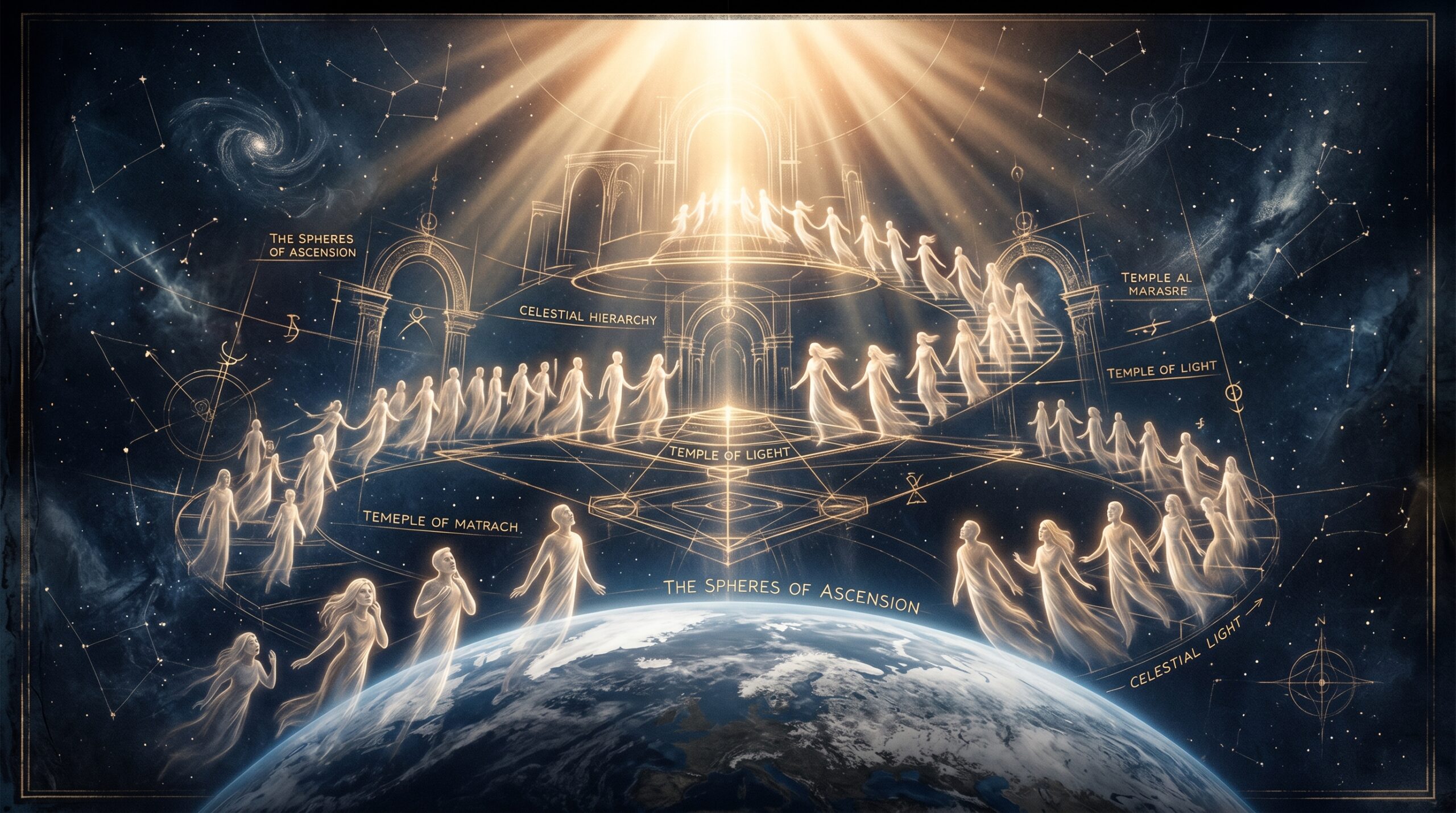
    A single hand-drawn sketch, shared on social media by a man named Yusuff Shakur, has spread across Reddit, X, and news outlets faster than almost any recent paranormal or near-death account. The drawing allegedly captures what Shakur saw during a near-death experience — a layered architecture above Earth, with figures positioned at different levels — and it has ignited a firestorm of debate. For people who have spent years following NDE research and consciousness studies, the image reads like a visual echo of claims that have surfaced for decades: that there is a structured reality waiting just beyond the visible world. For skeptics, it is an imaginative exercise that went viral because the internet rewards striking images over cautious ones. Either way, the drawing is now everywhere, and the people who argue about it are not backing down.

    What the Drawing Actually Shows

    The sketch depicts a vertically stacked structure with Earth positioned at the base. Above it, Shakur drew multiple tiers or layers — each one populated with human-like figures. The arrangement suggests a kind of cosmic geography, where different levels of reality or consciousness coexist above the physical world. Shakur reportedly said he drew the image because words were not enough to describe what he experienced. Instead of narrating his account, he put pencil to paper and tried to recreate the architecture of what he witnessed.

    The raw simplicity of the sketch is part of why it has resonated. It does not look like a polished piece of art or a diagram produced by a graphic designer. It looks like someone trying to communicate something they genuinely struggled to articulate — the kind of thing people expect to see from an authentic experience, not a calculated fabrication.

    Why Believers Think This Matches Something Old

    People who study near-death experiences and altered states of consciousness have noticed that Shakur’s drawing is not entirely new in its shape. The idea of layered realities stacked above the physical world appears in dozens of traditions. Dante’s cosmology placed multiple spheres above Earth. Kabbalistic trees of life map different levels of existence. Vedic and Buddhist cosmologies describe planes of being that interpenetrate the one we inhabit. Even modern NDE accounts frequently mention encountering structured realms — some describe cities of light, others describe tiered landscapes or ascending corridors.

    What makes Shakur’s sketch notable is that it appeared not from a scholar or a historian but from someone who says he was pulled beyond ordinary perception and tried to draw what he found. The parallels to older cosmologies do not prove anything. But for people inside the consciousness and NDE communities, those parallels feel like a pattern that is hard to dismiss.

    The third-man phenomenon, where isolated explorers encounter a guiding presence, shares a similar energy. In those accounts too, people report perceptions that ordinary explanations struggle to address — and the more stories accumulate, the harder it becomes to write them all off as coincidence.

    Why the Sketch Went Viral Now

    The post exploded on r/HighStrangeness, where it earned more than 5,192 points and nearly 800 comments. From there it spread to r/StrangeEarth and r/Christianity, where the reactions split sharply. Some readers found the drawing unsettling, even ominous. Others saw it as confirmation of what they had suspected all along — that consciousness survives death and that the structure of reality looks nothing like what science currently maps.

    Mainstream outlets picked it up quickly. Complex ran the story on X (formerly Twitter). The Times of India published a feature. Multiple Reddit communities debated it in real time. The speed of this spread owes a lot to the algorithm-friendly nature of a striking image, but it also reflects a broader cultural moment. In April and May 2026, multiple pastors reported being privately briefed by military intelligence to prepare congregations for UFO disclosure, and the line between spiritual and non-human realities has never felt more blurred. People are already asking big questions about the nature of existence, and a drawing that claims to map the structure of the afterlife lands in the middle of that conversation.

    The spiritual dimension of the government insider UFO community has been moving toward exactly this kind of territory for years. The idea that non-human intelligences exist has always carried theological baggage, and Shakur’s sketch feeds directly into that undercurrent.

    What the Drawing Does Not Prove

    The sketch is striking, but it is not evidence in any scientific sense. There is no way to verify what Shakur experienced, and there is no way to confirm that the drawing corresponds to any objective structure beyond ordinary perception. The parallels to older cosmologies could reflect Shakur’s own exposure to those ideas, consciously or unconsciously. Near-death experiences are notoriously difficult to study, and researchers remain divided over what they actually reveal about consciousness.

    An Oxford physicist has recently argued that consciousness might perceive hidden dimensions, a claim that adds academic credibility to the conversation without confirming any particular account. The broader conversation about whether consciousness is more than brain chemistry remains open, with serious researchers working on both sides.

    What Remains Open

    Yusuff Shakur’s drawing is not proof of anything. But it is also not meaningless. It entered the cultural conversation at a moment when people are already questioning the nature of reality, and it struck a nerve precisely because it visualized something that thousands of people feel but cannot articulate. Whether it represents a genuine glimpse of a structured afterlife, an unconscious synthesis of ideas Shakur absorbed over time, or simply a compelling piece of art that captured the public imagination at the right moment — the drawing refuses to be ignored. And for a community that has built its worldview on claims that defy easy explanation, that refusal is exactly the point.

  • John Reeves’ Alaska Boneyard UAP Footage: Hidden 1970s Film Resurfaces With Impossible Craft

    John Reeves’ Alaska Boneyard UAP Footage: Hidden 1970s Film Resurfaces With Impossible Craft

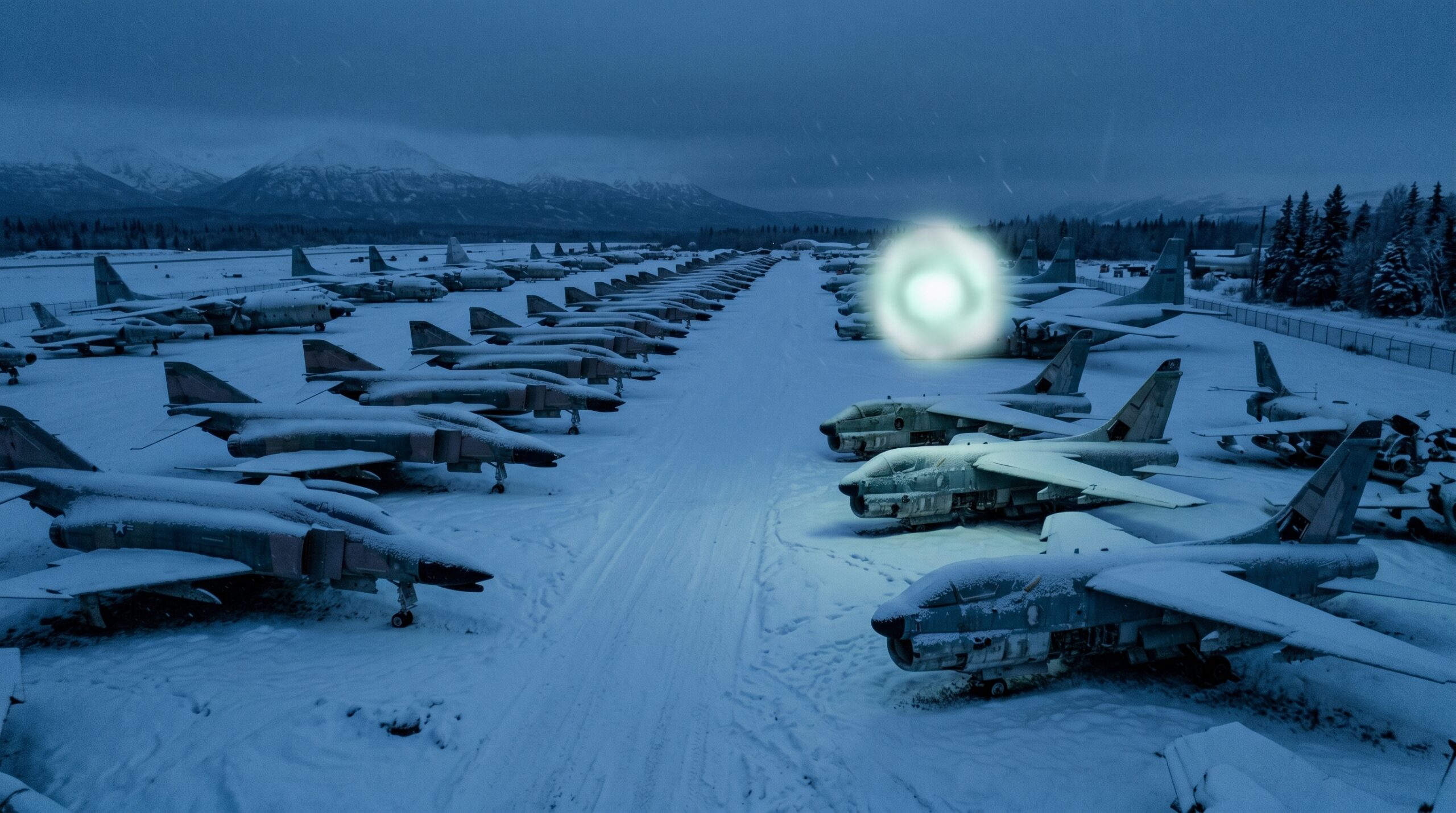
    In the back corner of a military aircraft boneyard at Elmendorf Air Force Base in Alaska, former Air National Guard member John Reeves discovered something that should not have been there: a reel of 1970s film showing an unidentified craft moving in ways that defy conventional explanation. The footage, stored among decommissioned hardware that the military had long since abandoned to the cold, carries the kind of visual evidence that believers have been chasing for years — and the kind that official channels have consistently said does not exist. It earned more than 1,300 points on r/UFOs in a matter of days and has now become one of the most discussed pieces of visual UAP evidence to surface from a military-adjacent source in recent memory. For people who believe that the government has been sitting on UAP evidence for decades, John Reeves’ boneyard discovery lands like a confirmation: the material was always there. It was just waiting for someone with the right clearance and the right timing to find it.

    What the Footage Shows

    The tape dates to the 1970s, an era of active UAP encounters that included the famous Tehran intercept of 1976 and the disappearance of Frederick Valentich off the Australian coast in 1978. The Alaska footage reportedly captures a craft moving with characteristics that standard aviation cannot explain — sudden accelerations, right-angle turns, and flight patterns that do not produce visible exhaust or generate the kind of sonic disturbance expected from conventional aircraft. The craft itself appears structured, metallic, and purpose-built, nothing like a natural atmospheric phenomenon.

    What makes the footage significant is not just what it depicts but where it was found. A military boneyard is not a civilian archive. It is a controlled facility where the military stores, processes, and dismantles equipment it no longer needs. Film stored in that environment suggests that someone inside the military apparatus was tracking these events and documenting them on film, with the expectation that the record would outlast whatever operational need prompted the recording.

    How John Reeves Came Across the Tape

    John Reeves served in the Alaska Air National Guard, giving him the kind of installation access that most civilians do not have. According to accounts shared across UAP communities and discussed extensively on r/UFOs, Reeves encountered the footage during routine work related to decommissioned material at the base. The circumstances of the discovery — finding a reel of UAP-related film among discarded military hardware — feed directly into the narrative that UAP evidence has been systematically lost, abandoned, or buried in government facilities across the country.

    The broader pattern is consistent. From the Chuck Clark Area 51 footage that surfaced from another veteran’s collection to the mass-witness UAP encounters that military personnel have documented in recent years, the story keeps returning to the same theme: the evidence exists, but it is scattered across military installations, personal collections, and discarded files that no one in authority thought was important enough to preserve.

    The 1970s Were Not a Quiet Decade for UAP

    The timing of this footage matters. The 1970s were one of the most active decades in modern UAP history. In 1976, Iranian F-4 Phantom jets tracked and attempted to intercept a massive luminous object over Tehran — and their weapons systems reportedly failed when they tried to lock on. In 1978, Australian pilot Frederick Valentich reported being followed by a metallic object before his final transmission cut out over the Bass Strait. In 1979, the Trans-en-Provence incident in France became one of the few UAP cases where physical trace evidence was collected and analyzed by government investigators.

    If Reeves’ footage is genuinely from that era, it places Alaska among the sites of significant UAP activity during a period when military encounters were being quietly documented. The question is whether the footage represents an ongoing Alaska UAP pattern — the Northwest Territories driller UFO sighting showed that northern regions continue to produce high-strangeness encounters — or whether a specific event in Alaska in the 1970s was documented by the military and then quietly stored away.

    What Cannot Yet Be Confirmed

    The footage has been shared and discussed but has not been independently verified by scientific or government authorities. Reeves’ account of the discovery is credible but has not been corroborated by a second independent source within the military chain of command. The film itself has not been subjected to forensic dating of a kind that would definitively prove its 1970s origin — though the visual quality, grain structure, and recording artifacts are consistent with material from that era.

    The Air Force has not commented on the footage or on Reeves’ claim that it was stored in an Elmendorf boneyard. Without official acknowledgment, the tape remains in the same category as a growing body of military-adjacent UAP evidence that believers consider compelling and skeptics consider insufficient for proof.

    What Remains

    John Reeves’ boneyard discovery adds another layer to a conversation that will not be settled until the government changes its posture toward UAP evidence. Whether that footage will be enough to shift the debate depends not on the image itself — which can be analyzed, doubted, and disputed from any angle — but on the cumulative weight of all the similar discoveries coming from military-adjacent sources. One tape stored in a cold storage boneyard in Alaska is not proof. Ten tapes from ten different installations might be something else entirely.

  • Rendlesham Forest Binary Code 2026: “We Returned to Warn” and What It Might Mean

    Rendlesham Forest Binary Code 2026: “We Returned to Warn” and What It Might Mean

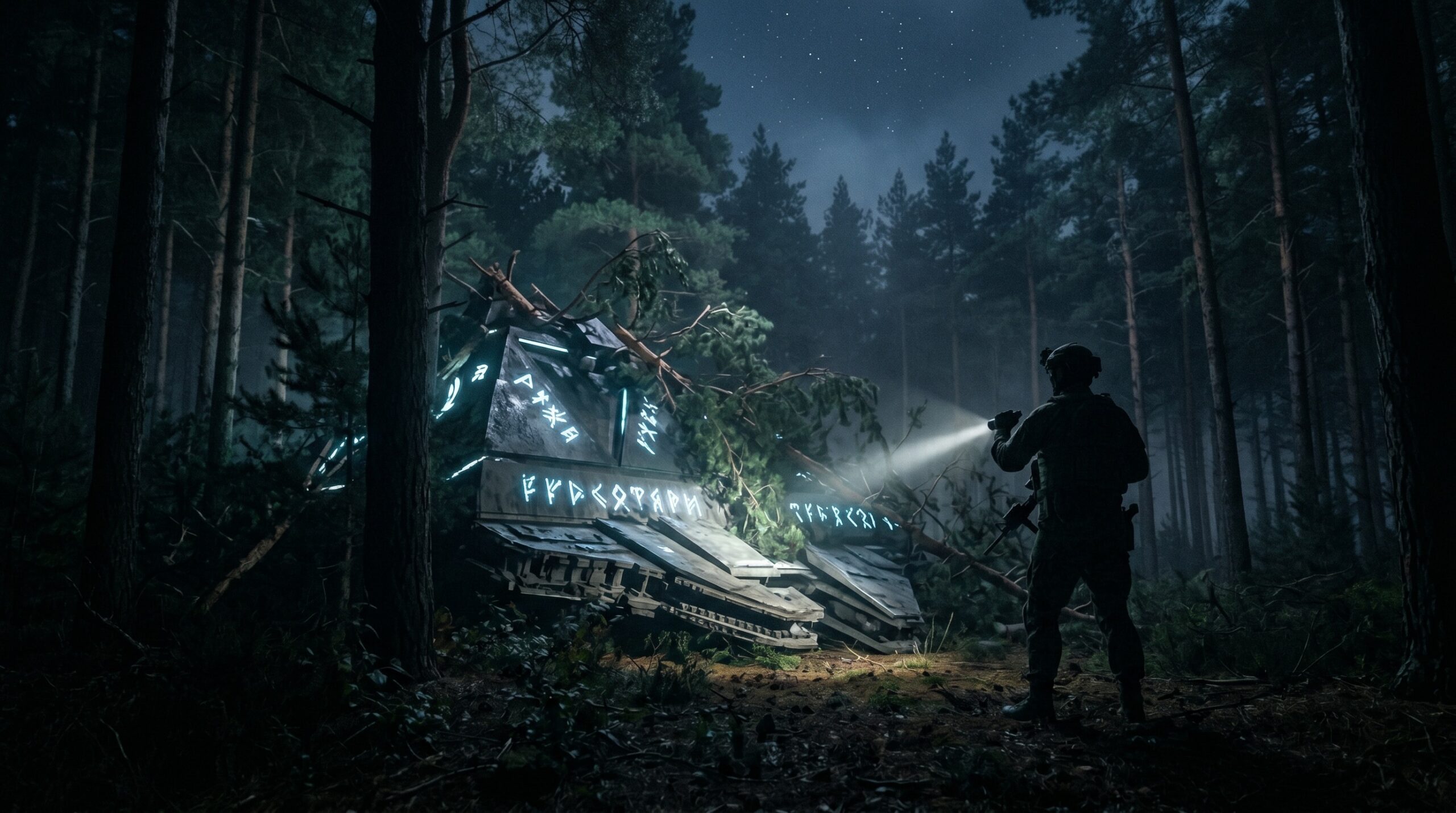
    The night watch stepped into Rendlesham Forest expecting a downed aircraft. What Sergeant Jim Penniston encountered instead was a triangular craft resting between the pines, its metallic surface inscribed with geometric symbols that pulsed in low light. He walked up to it. He placed his hand on its surface. And then, he says, binary code began pouring into his mind — not through his eyes or ears but through something else entirely, something that felt like knowing without being told.

    That was December 27, 1980. Three nights of the Rendlesham Forest incident had already placed it among the most rigorously documented UFO encounters in military history. Multiple witnesses. Cross-base corroboration. Physical evidence. An official memo filed by the deputy base security chief on the ground with a tape recorder running. But Penniston’s claim — the telepathic binary download — carried the incident into a territory that made even the skeptics pause.

    Because he wrote the code down. He decoded it. And the message was this: “EXPLORATION OF HUMANITY CONTINUOUS BEYOND 8100.” And beneath that: “WE RETURNED TO WARN.”

    The Three Nights of Rendlesham

    The incident began on December 26, 1980, at RAF Bentwaters and RAF Woodbridge — twin Air Force bases in Suffolk, England. Security personnel reported unusual lights descending into the forest adjacent to the base perimeter. What followed was a three-night sequence of sightings, sounds, and physical phenomena that generated the most substantial official documentation of any UFO encounter involving US military personnel on allied soil.

    Multiple airmen saw the lights. Different people, different positions, different vantage points. On the second night, Penniston and others entered the forest to investigate. Penniston claimed to have encountered a landed craft — triangular, dark metallic, roughly three meters across at its base — resting on three legs among the trees.

    WION described the decoded message and Penniston’s account of the binary transmission. The Rendlesham encounter shares DNA with other military UFO files that surfaced over the decades as one of the most extraordinary claims in the entire Rendlesham case file.

    The third night — December 28 — produced the most famous surviving evidence. Deputy Base Security Chief Lt. Col. Charles Halt grabbed a tape recorder and led a patrol into the forest. The recording captured his real-time observations of the lights moving through the canopy and above the bases. The Halt memo was eventually released through FOIA and it remains one of the most compelling official documents in UAP history because it was filed by a career Air Force officer, not a civilian enthusiast.

    The Binary Code

    Penniston’s claim is separate from Halt’s memo but equally compelling for those who study the case. He said that during his close contact with the landed craft, he experienced a telepathic data transmission — sequences of ones and zeros that he later transcribed, decoded into ASCII, and published.

    The decoded text reads, in part:

    • “EXPLORATION OF HUMANITY CONTINUOUS BEYOND 8100”
    • “WE RETURNED TO WARN”

    The second phrase is the one that has people unable to stop thinking about the case 45 years later.

    What warning? Warning about what? And who is “we”?

    Penniston interpreted the message as a warning about humanity’s trajectory — that the intelligence behind the craft had revisited Earth multiple times and was delivering an urgent, if cryptic, caution about the direction the species was heading. The “beyond 8100” fragment is deliberately vague — it could reference a date, a coordinate, a cycle, or a classification. Nobody has produced a definitive reading of it.

    The binary code has been analyzed by people who are not Penniston. Some confirm the ASCII decoding produces the quoted text. Others argue that the binary sequences are flexible enough to produce meaningful text through selective interpretation patterns. The debate itself is part of what keeps the case alive.

    Why This Is Resurging in 2026

    The Rendlesham Forest binary code hit r/HighStrangeness in early 2026 and immediately captured 773 engaged upvotes across a thread that dove deep into the decoded message and its implications. A new generation of UAP-curious readers discovered the case at precisely the moment when the broader disclosure conversation is reaching its highest energy.

    The case resonates for reasons that go beyond the binary. Rendlesham is one of the few military encounters with on-the-ground documentation. It is not a single blurry photo or a cockpit video — it is multiple witnesses, a taped recording, an official memo, physical marks on trees and soil, and now, a message. Whether you accept every element of the case at face value or not, it occupies a space that is difficult for skeptics to dismiss wholesale and impossible for believers to ignore.

    The warning message lands differently in 2026 than it did in 1980. In the 1980s, it was a Cold War curiosity. Today — with Congress discussing classified UAP videos, with Trump promising UFO file releases, with the disclosure conversation moving from congressional hearings to mainstream television — a warning from a non-human intelligence about humanity’s trajectory sounds less like folklore and more like something that people are actually preparing to hear.

    What the Files Actually Confirm

    The Halt memo is real. It is dated January 13, 1981. It was filed through official Air Force channels. It describes lights over the base, radiation readings elevated at the alleged landing site, and physical impressions in the ground. It was declassified through FOIA in the 1990s and remains a publicly accessible document.

    Multiple witnesses corroborated seeing the lights. The witnesses had different roles, different locations, and different reasons to be in the forest on those nights. Their accounts are not identical — which makes them more credible, not less, since genuine independent observations rarely align perfectly.

    Radiation readings at the alleged landing site showed levels approximately one-tenth of a milliroentgen above background. That is a tiny elevation. It is measurable. It is also small enough that environmental variation could account for it. But it was measured by base personnel at the specific location where a craft allegedly rested.

    What cannot be independently verified from the public record is Penniston’s binary code. Nobody else claimed to receive a telepathic data transmission that night. The binary exists because Penniston wrote it down and shared it later. His credibility as the primary close-contact witness in the case is solid. The binary message alone is the part of the case that pushes beyond documented evidence into personal testimony.

    The Warning Within the Narrative

    “We returned to warn” works on two levels. On the surface, it is a dramatic phrase from an unverified personal account — the kind of thing that could be confabulated after decades of thinking about a strange encounter. But embedded inside it is something that resonates with the current disclosure moment in a way that is hard to separate from the substance of the case itself.

    If the entities behind the Rendlesham encounter were delivering a warning — much like the questions raised by the Bluegill Triple Prime UFO shootdown — about nuclear escalation — about nuclear escalation in 1980, about environmental collapse, about military readiness and non-human technology and the direction human civilization is heading — then the warning is still active. It is still relevant. It still has not been received by the people it was presumably meant for.

    Whether you view the binary code as a genuine transmission, an artifact of a psychologically intense experience, or a later construction built from memory and imagination, the question it poses survives every level of analysis: what would it mean if the warning was real?

    What Is Actually Known

    The Rendlesham Forest incident of December 1980 involved multiple witnesses from two US Air Force bases in England. Lt. Col. Charles Halt recorded his observations on tape and filed an official memo describing lights, radiation, and ground impressions at the alleged contact site. Sgt. Jim Penniston claims close contact with a landed triangular craft and a telepathic binary message that decoded to “EXPLORATION OF HUMANITY CONTINUOUS BEYOND 8100” and “WE RETURNED TO WARN.” The Halt memo is an official government document. The binary code is personal testimony.

    What is not known is whether Penniston’s binary download was a genuine non-human communication, a psychological response to an extraordinary nighttime encounter, or a reconstruction built years after the event. What is known is that the incident happened, and what the witnesses saw and heard and recorded is documented well enough that no official explanation has ever fully accounted for it.

    The message — if it is a message — waits for the people who are ready to hear it.

  • Third Man Syndrome: Why Explorers in Extreme Isolation Keep Encountering an Invisible Presence

    Third Man Syndrome: Why Explorers in Extreme Isolation Keep Encountering an Invisible Presence

    The first time you hear about it, it sounds like a ghost story

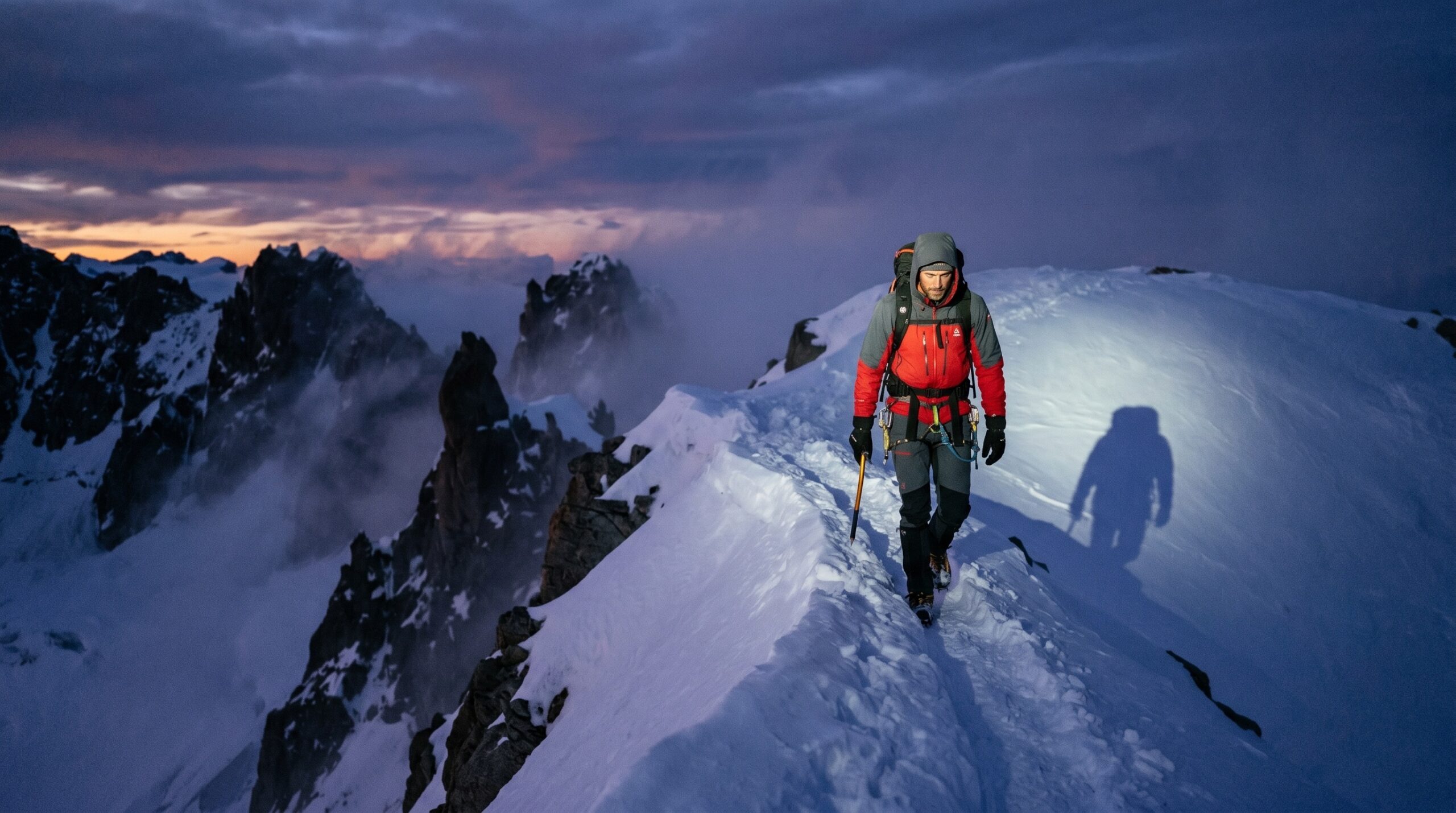
    You are alone on a mountain face where no living thing has any right to survive. The wind carries temperatures that freeze moisture from the air before it becomes snow. Your fingers, wrapped in triple layers of insulated gloves, stopped feeling anything useful hours ago. Behind you, two climbing partners lie motionless in a crevasse you could not pull them from. Ahead, the summit vanishes into a white wall that offers no horizon, no reference, no promise that there is anything above you except thinner air and deeper cold.

    And then you sense someone walking beside you.

    You do not see them at first. It begins as a pressure — the unmistakable sense of another presence occupying the same space, matching your rhythm, keeping pace step for step. When you turn your head, there is nothing there. Just the slope. Just the spindrift. But the presence does not leave. It stays with you through the next pitch, through the fixed rope that snaps under your weight, through the whiteout that swallows every landmark you thought you knew. And then, almost imperceptibly, it begins to guide you.

    Left here, it seems to suggest. Take the ridge. Not the gully. This way.

    You follow. Hours later, you stumble into a research station you had no map coordinates for. The scientists stationed there tell you nobody should have survived the route you just walked. You try to explain about the figure that stayed with you, the one that pointed you toward the only navigable line through a section of mountain that had killed four climbers the season before. They exchange glances. They have heard this story before — not from you, but from others who came down from the death zone carrying the exact same impossibility on their shoulders.

    This is Third Man Syndrome. It has a name now, but the people who actually experienced it knew it as something far older and far less comfortable than a clinical label. They knew it as a presence. A guardian. A companion that appears only when you have run out of every other reason to keep moving — and somehow gives you one more.

    The phenomenon traces its literary name to T.S. Eliot’s “The Waste Land,” where he described a figure walking behind a traveler through a desolate landscape: “Who is the third who walks always beside you?” When Ernest Shackleton led his desperate crossing of South Georgia ice fields in 1916 to rescue his stranded crew, he reported sensing a fourth presence joining the three men making the traverse. Four people walking across the glacier, he wrote, when only three were actually there. Shackleton, a man whose reputation was built on pragmatism, did not explain the figure away. He recorded it as fact — as real to him as the rope in his hands.

    Since then, the accounts have multiplied across every environment humans have ventured into alone and nearly died.

    The accounts that all agree on the same invisible companion

    What makes Third Man Syndrome compelling is not the volume of stories, but how consistently they agree on details that no single narrative should share. The presence never appears in ordinary circumstances. You will not meet it on a weekend hike or a routine patrol. It arrives at the extreme edge of human endurance: on the descent from K2 when oxygen bottles have run dry; in the Arctic during a blizzard that has erased the difference between ground and sky; in desert crossings where dehydration has pushed the body past the point where rational navigation is possible.

    The accounts cluster around a recognizable pattern, and investigators who have spent years collecting them have assembled a picture of remarkable consistency. Nearly everyone who reports the experience describes an initial phase of sensing rather than seeing. The presence announces itself as a feeling of proximity before it takes any visual form. It is protective, directive, almost always calm in circumstances where the person experiencing it is anything but.

    Mountain climbers describe being gently steered away from dangerous terrain. One survivor on Nanga Parbat reported that the presence tugged his pack when he attempted to descend a couloir that he later learned had collapsed hours earlier. Arctic explorers describe the presence as a voiceless guide that seems to know the landscape better than they do, pointing toward ridges, away from crevasse fields, toward shelter the conscious mind had failed to register.

    The common thread across every account is agency. This is not described as a passive hallucination — the kind of perceptual noise the brain might generate under stress. The presence acts. It guides. It corrects. And in more cases than most people realize, it saves the life of the person who can feel it walking beside them.

    There is a quality to these accounts that resonates beyond the mountaineering and survival communities. When investigators looked into the Al Qasimi Palace mystery and found accounts of unseen entities guiding disoriented visitors through corridors, the structural similarities to Third Man reports were impossible to ignore: presences appearing during acute disorientation, offering certainty when the conscious mind had lost all confidence. These accounts emerge from entirely separate cultural contexts, yet the experience maps onto the same template.

    You can feel something about extreme states of consciousness tearing holes in our ordinary understanding of what survives contact with reality. And the Third Man walks through those holes.

    What science calls the Sentinel Factor

    Psychologists and neuroscientists have built explanatory frameworks around this phenomenon, and they have given it a name that keeps the discussion within comfortable boundaries: the Sentinel Factor.

    The Sentinel Factor describes what happens when the human brain is pushed into prolonged isolation, sensory deprivation, physical exhaustion, and acute threat. Oxygen deprivation at altitude alters neural firing patterns in temporal regions associated with mystical experiences and feelings of unseen presence. The brain, deprived of reliable external input, constructs internal models to fill gaps — a process called predictive processing that generates percepts indistinguishable from actual sensory data.

    Add extreme fatigue and the stress hormone cascade that accompanies genuine survival situations, and the brain’s capacity to separate internal imagery from external reality degrades. The result is a “sensed presence.” Not a hallucination in the clinical sense — the person typically understands nothing is physically there — but a feeling that is entirely real.

    There is substantial survival psychology research on the Sentinel Factor documenting how the brain in extremis deploys what appears to be a psychological partitioning strategy. One part of the mind enters survival mode — hyper-focused, calculating, relentless. Another detaches and constructs a supervisory presence that can offer guidance without emotional contamination of panic. The Sentinel, in this framing, is the mind’s own wisdom externalized into a form the conscious self can actually listen to.

    John Geiger assembled decades of survivor testimony in his landmark work The Third Man Factor, cataloging hundreds of cases that fit this pattern with eerie precision.

    The explanation is compelling. It accounts for the protective quality — of course the presence feels like a guide, because it is the part of your brain that still knows the way when the panicked part has lost its bearings. It explains the timing. It explains why people survive situations they statistically should not.

    And yet something refuses to fit neatly into the framework.

    The presence sometimes knows things the individual does not. Climbers have been steered away from avalanche zones they had no way of assessing. A solo sailor in the Southern Ocean reported that the presence woke her from exhaustion-induced sleep minutes before a rogue wave broke over the bow. In at least one documented case, a climber descending in whiteout was guided to a supply cache placed by a team he had no knowledge of and no way to detect.

    There is a deeper question here, and it reaches into territory that makes comfortable science uncomfortable. If the brain can fabricate a supervisory intelligence under stress — one that feels separate, speaks without words, and sometimes possesses knowledge the waking mind does not — what does that tell us about the architecture of consciousness when it is functioning normally?

    Some researchers have gone further, proposing that the mind’s relationship with perception is far more porous than conventional neuroscience assumes. An Oxford physicist’s theory of consciousness suggests extreme states may not be generating artificial experiences but stripping away filters that normally prevent us from perceiving more of what is already there. If that is even partially true, the Third Man may not be a hallucination at all. It may be a glimpse of something always present.

    Why the explanation does not cover everything

    The Sentinel Factor is the best scientific explanation available, and it genuinely accounts for a significant portion of what people report. But there is a residue in these accounts that neurological mapping has not dissolved.

    Consider the timing. The presence almost never appears early in an ordeal. It arrives precisely when the individual has exhausted every strategy, every calculation, every memory of training, and found nothing left. It is as if something waits until you have reached the absolute end of yourself before stepping forward. That is not what a stress response typically does. Stress responses escalate with the threat, not after it has already won.

    Consider the cross-cultural consistency. Third Man experiences have been reported by climbers on Himalayan peaks, sailors in the Southern Ocean, astronauts during extended solo missions, desert traversers, and polar expeditioners — people sharing no cultural framework, no mythology, no expectation that a presence should appear during survival. If this were cultural conditioning, it should be confined to traditions with guardian spirit concepts. Instead, it appears wherever conditions demand it.

    The resemblance to other unexplained phenomena is difficult to ignore. People who survive Third Man encounters describe the experience using language nearly identical to accounts from hospice nurses describing end-of-life visions — a sense of profound calm, of being attended by something benevolent, of encountering intelligence that exists outside ordinary boundaries. Both types of experience occur at the boundary of what conscious perception can sustain, in states where the architecture of awareness is failing.

    When researchers examine the nature of consciousness and final moments in near-death experience accounts, a pattern emerges: intelligence present without visibility, protective without intrusion, knowledgeable without speech. The Third Man may be the survival-state equivalent of whatever people encounter at the edge of death — the same presence, appearing under different conditions.

    There is a growing community of people discussing these experiences online, and one recent r/Unexplained thread sparked serious conversation among readers who approached the accounts with skepticism and left with more questions than answers. The discussion included reports of presences during solo wilderness trips, during medical emergencies, during moments when people felt the boundary between themselves and something else dissolve entirely.

    What all of this adds up to depends on what you are willing to consider.

    If you approach Third Man Syndrome as a purely neurological event, the Sentinel Factor provides satisfying answers. The brain does create supervisory presences under stress. Predictive processing generates percepts indistinguishable from reality. This is documented, measurable, reproducible.

    But if you allow the possibility that these experiences point toward something the current framework cannot fully explain, the accounts carry weight that resists dismissal. The timing that feels almost intentional. The cross-cultural convergence. The knowledge the presence sometimes demonstrates. The calm it brings rather than the terror you would expect from pure neurological malfunction.

    The Third Man may be the mind talking to itself in a voice it can finally hear. Or it may be something else — something that walks beside us in our most isolated moments, and has been doing so for as long as humans ventured beyond the safety of firelight into unknown territory. The people who have encountered it rarely argue about which explanation is correct. They simply know something was there, something brought them home, and afterward nothing they believed about solitude felt the same.

    What that something actually is — a survival mechanism, a consciousness anomaly, a presence genuinely separate from the mind that perceives it — may be a question each person answers differently. But the accounts keep coming, and they all agree on one thing: at the far edge of endurance, alone in a place no one should survive, they were not alone at all.

  • The Al Qasimi Palace Jinn Mystery: Why a $130 Million Mansion Was Abandoned Overnight

    The Al Qasimi Palace Jinn Mystery: Why a $130 Million Mansion Was Abandoned Overnight

    The servants did not pack their bags. They ran.

    In the arid hills outside Ras Al Khaimah, the Al Qasimi Palace still stands like a mirage that refused to vanish—marble columns crumbling under salt wind, Swarovski chandeliers swinging in empty ballrooms, and a fleet of luxury cars rusting in the courtyard. The family who built it as a $130 million monument to opulence left so abruptly that dinner plates remained on the table, closets still held tailored silk robes, and the keys to a Rolls-Royce Silver Shadow sat on a kitchen counter gathering dust. Officially, the story stopped there. But in the surrounding villages, whispers traveled faster than any press release. They spoke of jinn.

    Not ghosts. Not superstition. Jinn—intelligent, unseen beings recognized in Islamic theology long before Hollywood invented the poltergeist. According to locals who still refuse to approach the palace after sunset, something ancient and territorial had decided the Qasimi family had built too close, dug too deep, or simply claimed what was never meant to be owned. Within weeks of the sudden evacuation, construction workers hired to seal the property reportedly heard footsteps in corridors where no human walked. Security cameras placed by subsequent caretakers allegedly captured doors slamming with force that shattered their frames. One watchman, interviewed anonymously by Gulf paranormal investigators, claimed he saw a figure in traditional Emirati dress standing on the main balcony at 3:00 a.m.—a balcony that had collapsed the previous year.

    The palace was never merely a residence. Its architecture blended ancient Egyptian motifs with Islamic geometric patterns and subterranean chambers that extended far beneath the foundation plans filed with the municipality. Some researchers who have studied the property from satellite imagery note that the underground levels form a shape disturbingly similar to older temples found in the region—structures predating Islam by millennia. If the Qasimis accidentally built atop a site with older significance, the theory goes, they may have provoked guardians that do not recognize modern deeds of ownership. Islamic theological texts on jinn describe them as territorial beings capable of displacing human occupants from land they claim.

    What the Watchmen Saw

    By 2012, the palace had cycled through four different security firms. Each company terminated its contract early. The common thread in their exit interviews was not pay or working conditions—it was the third floor.

    Multiple guards described identical phenomena: a pervasive feeling of being observed in the east wing, electronic equipment failing simultaneously at 3:33 a.m., and the sound of heavy furniture dragging across marble above rooms that were definitively empty. One firm installed motion detectors throughout the corridor network. According to leaked maintenance logs, the sensors triggered 200–400 activations per night in a building with no occupants, no animals, and no accessible entry points. The pattern was not random. The activations moved sequentially, as if something was patrolling the halls on a route.

    A former supervisor told regional journalists that his team captured audio of a voice speaking classical Arabic—a dialect none of the guards recognized until a linguist identified it as rooted in pre-Islamic Nabataean pronunciation. The recording, which circulated briefly on Middle Eastern paranormal forums before vanishing, allegedly contained a single repeated phrase: “This threshold is older than your God.”

    The Jinn Framework

    Western paranormal enthusiasts often default to ghostly explanations, but the Arabian Peninsula has a far older conceptual vocabulary. Jinn are described in the Quran as beings created from “smokeless fire,” possessing free will, intelligence, and territorial instincts. Unlike ghosts—residual echoes of the dead—jinn are considered living entities with agency, capable of jealousy, rage, and protection of sacred spaces.

    Scholars of Islamic esotericism note that the Ras Al Khaimah region sits on trade routes active since the Bronze Age, corridors where incense, copper, and ritual artifacts moved between Mesopotamia and the Indus Valley. Local folklore holds that certain hills are “inhabited,” not empty, and that construction without proper acknowledgment can provoke retaliation. In this context, the Al Qasimi Palace is not an anomalous haunting but a predictable outcome within a cosmology that treats land as occupied by multiple orders of beings.

    The Official Narrative

    The Qasimi family has never publicly addressed the paranormal claims. Through representatives, they maintain that the palace was vacated for undisclosed financial reasons following the 2008 market contraction. Real estate analysts point out that Ras Al Khaimah’s luxury property sector did suffer significant losses during that period, and that abandoning a trophy asset—while extreme—is not unprecedented.

    However, the financial explanation struggles against certain details. The family left behind art collections conservatively valued in the millions. They abandoned vehicles rather than shipping them. They did not sell the property, lease it, or demolish it—they simply stopped returning, stopped answering questions, and stopped paying the local utilities, which were eventually disconnected by the municipality in 2010. A bankruptcy-driven exit typically involves asset liquidation. This looked like evacuation.

    Global Parallels

    The Al Qasimi case belongs to a category of high-value abandonments that resist neat accounting. In India, the Bhangarh Fort carries a legally enforced sunset curfew due to persistent phenomena that have made overnight stays impossible for centuries. In Romania, the Baciu Forest has driven experienced researchers to psychological breakdown. These locations share a common feature: they were not abandoned because of economic downturn, but because human presence became untenable.

    What distinguishes the Al Qasimi Palace is its scale of luxury. Haunted houses are typically decaying Victorian structures or remote cabins. A $130 million palace with imported marble, gold-plated fixtures, and underground temples suggests that whatever prompted the departure was powerful enough to override the most potent human motivator: wealth.

    What Remains

    Today, the palace stands in controlled decay. Local authorities have sealed the main entrances, but satellite photography shows fresh disturbances in the desert around the subterranean wings—excavation marks that do not match any permitted archaeological or construction activity. Drone operators who have flown over the property report GPS interference localized specifically above the central dome, a phenomenon documented in video but never explained by geologists.

    The surrounding communities have integrated the palace into their oral tradition. Parents warn children away from the perimeter fence. Taxi drivers refuse fares that end at the palace gates after dark. The structure has become a landmark not of wealth, but of boundary—a physical reminder that certain territories remain ungovernable by money, law, or modernity.

    Skeptics note that abandonment often breeds legend, and that economic trauma can be mythologized into supernatural narrative by communities seeking symbolic explanations for inequality. The Qasimi family’s silence, while consistent with private grief or legal strategy, has also created a vacuum that folklore naturally fills. Without access to the property’s interior, investigators cannot verify the motion logs, the audio recording, or the collapsed balcony apparition. Documented cases of abandoned luxury properties frequently attract paranormal attribution within months of vacancy.

    Yet the guards who quit keep quitting. The sensors keep triggering. And in the villages below the palace, where the call to prayer echoes across hills older than recorded history, the answer to what happened inside those marble halls has never changed. The jinn were there before the foundation was poured. They will be there when the last column falls.

  • Stonehenge AI Scan: Has Artificial Intelligence Finally Solved the 5,000-Year Mystery?

    Stonehenge AI Scan: Has Artificial Intelligence Finally Solved the 5,000-Year Mystery?

    The machine saw what five millennia of human eyes had missed.

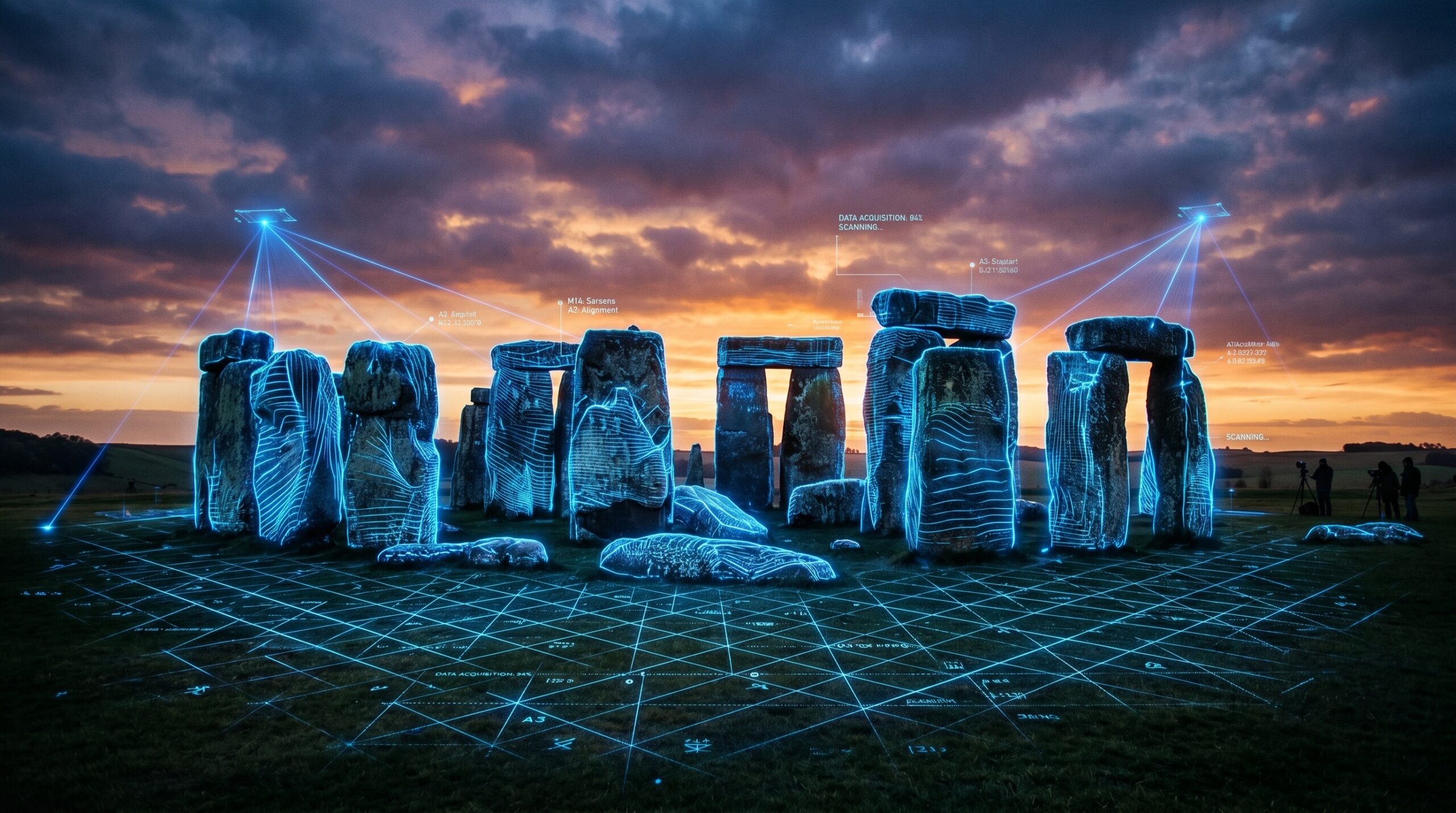
    In February 2026, a joint team from the University of Birmingham and the Ludwig Maximilian University of Munich deployed a new synthetic-aperture radar array beneath the Stonehenge monument, feeding raw geophysical data into a neural network trained on archaeological pattern recognition. The goal was modest: refine existing maps of buried lintels and postholes. The result was anything but. The AI identified a subterranean chamber system extending radially from the monument’s center, arranged in geometric ratios that do not appear in any known Neolithic architectural tradition. The chambers are lined with material that returns radar signatures inconsistent with local sarsen stone or chalk bedrock. And at the deepest mapped point, forty feet below the altar stone, the scan detected a void shaped like a perfect sphere.

    The preliminary paper, leaked to the journal Antiquity before peer review, has triggered an earthquake in multiple disciplines. Archaeologists are arguing about Neolithic engineering capabilities. Physicists are debating whether the radar anomalies represent natural geological formations misread by overtrained algorithms. And in the corners of the Internet where ancient-mystery enthusiasts gather, a more radical theory is gaining traction: that Stonehenge was never merely a temple, and that the AI has accidentally mapped the control architecture of something far older than the standing stones.

    What the Scan Revealed

    Traditional ground-penetrating radar has mapped Stonehenge’s surroundings since the 1980s, revealing the broader landscape of Durrington Walls, the Avenue, and the Cursus. Those surveys produced linear maps—foundations, ditches, burial pits. The 2026 AI-assisted survey produced something different: a three-dimensional model showing twelve radial tunnels extending from a central cylindrical chamber beneath the monument’s horseshoe arrangement. The tunnels average six feet in height and terminate at points that correspond precisely to the positions of the outer sarsen circle.

    The alignment is mathematically exact. Independent geometer Dr. Helena Voss, consulting on the project, calculated that the tunnel endpoints form a dodecagon whose internal angles match the geodetic ratios found in certain Nazca line complexes—a correspondence that Voss describes as “either impossible or deeply uncomfortable.” The Nazca lines and Stonehenge were constructed by cultures with no known contact, separated by oceans and six thousand miles. Shared mathematical architecture at this precision suggests either convergent genius on a superhuman scale, or a common source of knowledge that predates both civilizations. English Heritage, which manages the Stonehenge site, has not commented publicly on the AI findings pending peer review of the research.

    The most controversial finding concerns the material lining the tunnel walls. Spectral analysis of radar returns indicates a crystalline structure with uniform density, unlike the fractured chalk and flint of the surrounding Salisbury Plain. The AI classified this material as “anomalous” with 94% confidence. Human reviewers have been unable to suggest a geological process that would produce a forty-foot band of uniform crystal beneath a Neolithic monument.

    The Sphere

    At the lowest mapped depth, the AI identified a spherical void approximately twelve feet in diameter, centered beneath the altar stone. The void is not a natural cave. Its surface returns radar as smoother than any known geological formation, with curvature variance below 2 millimeters. To the project’s imaging specialists, it looks manufactured.

    The sphere’s position is symbolically loaded. The altar stone, a five-ton block of green micaceous sandstone imported from Wales, has long been interpreted as the ritual heart of the monument. If the sphere sits directly beneath it, the implication is that the stone was placed as a cap or marker rather than as an independent altar. Some researchers have revived theories that Stonehenge functioned as an energy focal point—a concept dismissed by mainstream archaeology for decades but persistent in alternative literature.

    Dr. Marcus Chen, the project’s lead data scientist, has been cautious in public statements. “The AI detects pattern and anomaly,” he told The Guardian. “It does not interpret intent. The spherical void could be a collapsed cavern, a glacial feature, or a post-Neolithic excavation that backfilled uniformly. We need core samples before we claim anything extraordinary.” Privately, however, team members have described the consistency of the findings as “deeply weird.” The same AI architecture, trained on identical datasets, has been deployed at over two hundred archaeological sites across Europe. It has never produced a false positive of this magnitude.

    Competing Interpretations

    The mainstream archaeological response has emphasized patience. Stonehenge has been the subject of fantastical claims since the twelfth century, when Geoffrey of Monmouth attributed its construction to Merlin. The scientific consensus holds that the monument was built between 3000 and 2000 BCE by successive Neolithic and Bronze Age communities, primarily as a ceremonial and astronomical site. The new findings, while unexpected, do not automatically require rewriting that narrative.

    Dr. Alison Sheridan, a leading Neolithic specialist, has proposed that the radial tunnels represent drainage channels or foundation reinforcements for a timber phase of the monument that later decayed. The “crystalline” radar signature, she suggests, could be compacted silica deposited by millennia of groundwater flow through chalk fissures. The spherical void might be a solutional chamber formed by acidic water action on buried limestone. A 2021 Nature study on Stonehenge’s geological setting established that local groundwater chemistry is capable of producing unusual mineral deposits, though none on the scale detected by the AI survey.

    These explanations are geologically plausible but face a common challenge: none explain the mathematical precision. Drainage channels follow topography, not dodecagonal geometry. Silica deposition is irregular. Solutional chambers are rarely spherical and never with surface variance below 2 millimeters. The mainstream position requires accepting multiple independent natural processes, each operating at the extreme edge of its known range, converging by chance beneath one of the world’s most studied monuments.

    The Ancient Technology Hypothesis

    Alternative researchers have been less restrained. The discovery has revitalized interest in Göbekli Tepe, the Turkish complex that predates Stonehenge by six thousand years and displays similarly inexplicable engineering. If both sites contain subterranean architecture that exceeds their apparent technological level, the question becomes whether they represent isolated flukes or fragments of a lost technological tradition.

    Engineer and author Christopher Dunn has long argued that ancient monuments display evidence of precision machining impossible with known Bronze Age tools. The Stonehenge sphere, with its near-perfect curvature, fits Dunn’s thesis. If the void contains a manufactured object rather than empty space, it would constitute the strongest physical evidence yet for advanced pre-Ice-Age civilization.

    More speculative theorists have drawn connections to global mythology. Hindu texts describe vymanika shastra—flying machines powered by mercury vortex engines whose schematics include spherical reaction chambers. Sumerian accounts reference the me—divine objects of power buried beneath sacred sites. These parallels are generally dismissed by academics as selective reading, but they have gained traction in public discourse precisely because the official narrative now contains a hole shaped like a sphere.

    The AI Question

    Beyond the archaeological implications, the Stonehenge scan has raised epistemological questions about AI-assisted science. The neural network that identified the anomalies was trained on thousands of validated archaeological features, but its confidence metrics are not fully explainable. When the AI marks a formation as “anomalous,” it cannot always articulate why in terms human geophysicists recognize. The project team has described the model’s behavior as “pattern recognition beyond human perceptual thresholds”—a capability that produces genuine discoveries but also genuine confusion.

    Critics argue that over-reliance on black-box algorithms risks generating a new category of pseudoscientific artifact: the AI phantom. If a neural network trained on European megaliths finds “impossible” geometry at Stonehenge, the anomaly may reside in the training data rather than the ground. The project’s response—that independent manual review confirmed the radar raw data before AI processing—has not fully silenced these concerns.

    What is clear is that the technology has opened a door. Core sampling at the tunnel locations is scheduled for summer 2026, subject to approval by English Heritage. If the samples confirm crystalline lining or manufactured surfaces, the discovery will force a reassessment of Neolithic capability regardless of theoretical framework. If they reveal natural formations, the AI will have produced its most expensive false positive in archaeological history.

    The Weight of Waiting

    Stonehenge has always been a mirror. Each age projects its own anxieties onto the stones: medieval Christians saw a monument to pagan sacrifice, Romantics saw sublime connection to nature, twentieth-century archaeologists saw seasonal calendars, and twenty-first-century technologists now see the possibility of buried machinery. The AI scan has not resolved these projections. It has intensified them.

    For believers in lost civilizations, the findings validate decades of marginal research. For defenders of orthodox chronology, they represent a test of scientific patience against sensationalism. For the broader public, they offer a rare moment of genuine uncertainty at a site long since strip-mined for mystery tourism.

    The sphere waits forty feet down. The altar stone has stood above it for four thousand years. Whether the void contains a machine, a tomb, or merely the hollow laughter of geology, its existence changes something fundamental about the monument: Stonehenge is not a surface. It is a roof. And whatever was built below it may finally matter as much as what was raised above.

  • Oregon Bigfoot Rock Thrown at Truck: Why the Forest-Road Story Feels Like a Warning

    Oregon Bigfoot Rock Thrown at Truck: Why the Forest-Road Story Feels Like a Warning

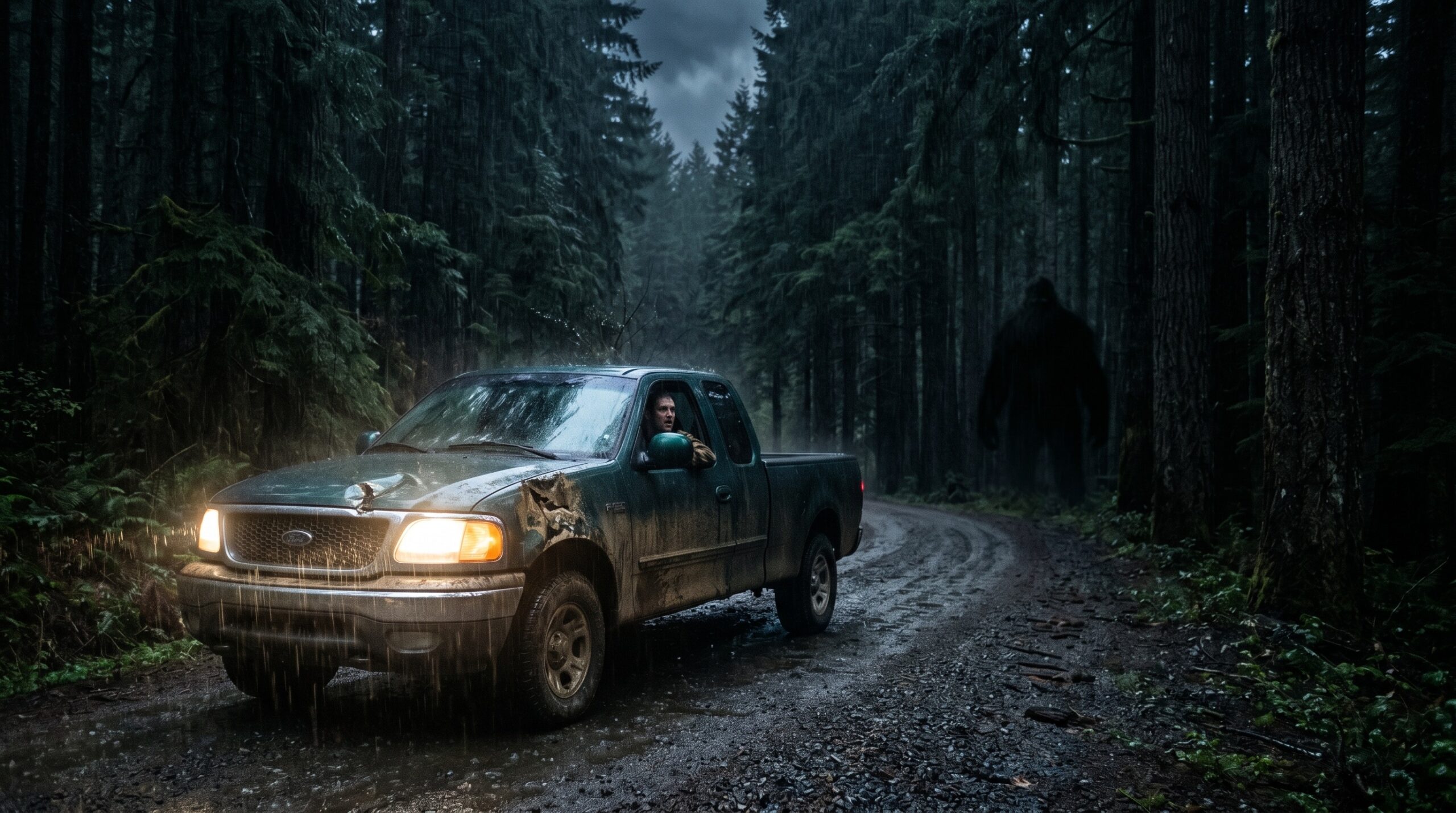
    Some stories do not arrive like normal news. They crawl in through a grainy clip, a half-panicked Reddit post, a search result that feels too fresh to be folklore, and suddenly Oregon Bigfoot rock thrown truck is not just a phrase on a screen — it is a door cracked open in the wall of ordinary reality.

    That is why this story is moving now. The fresh signal is not a laboratory announcement or a police file; it is the collision of social chatter, search interest, and a believer community already trained to notice patterns before institutions acknowledge them. A current source trail includes the r/Bigfoot report about a rock thrown at a truck in Oregon, corroborating search visibility through NorthWestBigfoot on April 2026 Pacific Northwest report patterns, and wider background from Popular Mechanics on the FBI Bigfoot file. None of that proves the strangest version of the claim. It explains why people are leaning closer.

    For Unexplained readers, Oregon Bigfoot rock thrown truck also fits a larger map: Ohio Bigfoot flap, the Giant of Kandahar, Oklahoma mystery-animal attack. The details change — a creature, a stone, a church warning, a forest road — but the emotional charge is the same. Something old seems to be pushing through a modern feed.

    The oldest Bigfoot signal is not a footprint

    The first thing believers notice is not the evidence package. It is the atmosphere. Oregon Bigfoot rock thrown truck carries the feeling of a message received from the edge: a report that sounds small until you imagine being there, alone, when the ordinary world stops behaving normally.

    That is the reason the story survives the first skeptical shrug. A strange post can be dismissed in seconds, but a vivid image keeps working on the mind after the tab closes. The shape in the yard, the sound in the trees, the stone that should not fit, the prophecy language that suddenly feels public — these are not just claims. They are scenes.

    Why thrown rocks scare believers more than photos

    What makes the current wave sticky is specificity. The internet is full of generic mystery bait, but concrete details give believers something to hold: a place, a date, a witness, a source, a visual, a named tradition. Those details become hooks. People argue over them, remix them, search for them, and compare them against older cases.

    A good unexplained story does not need everyone to believe. It only needs enough people to feel that the official category is too small. Once that happens, the story starts behaving less like content and more like a signal flare.

    How the Oregon report fits the Pacific Northwest pattern

    Skeptics have a simpler framework. They see social traction, old folklore, misread context, suggestive imagery, and the human hunger for patterns. In many cases, that caution is warranted. Viral mystery culture rewards speed, emotion, and repetition long before it rewards verification.

    But skepticism does not erase the cultural question. Why this story, and why now? Why does Oregon Bigfoot rock thrown truck keep finding an audience at the exact moment people feel that institutions, science, churches, and media are all leaving something unsaid? That is the layer where the mystery keeps breathing.

    What can and cannot be verified

    The most grounded reading is this: the current discussion around Oregon Bigfoot rock thrown truck is real, the sources show a live curiosity signal, and the strongest versions of the claim remain unconfirmed. The available material supports an article about why the story is spreading, what believers think they see in it, and why the unresolved pieces keep pulling people back.

    That may sound like a narrow conclusion, but it is exactly where many unexplained stories live. Not proven, not empty, not finished. The facts set the boundary. The feeling presses against it. Whether Oregon Bigfoot rock thrown truck becomes another internet flare-up or a lasting chapter in the unexplained archive depends on what surfaces next — and on whether readers decide the official explanation is large enough to hold what they sense in the dark.

    FAQ

    What is Oregon Bigfoot rock thrown truck?

    Oregon Bigfoot rock thrown truck is the search phrase now gathering attention around this specific unexplained topic, combining a fresh online signal with an older mystery tradition or belief system.

    Why are people talking about it now?

    People are talking because Reddit, search results, and adjacent Instagram mystery tags are all feeding attention into the same lane. That is a trend signal, not proof.

    Is Oregon Bigfoot rock thrown truck confirmed?

    No public source trail confirms the most dramatic interpretation. The story is best read as a believer-first mystery with an evidence gap that still matters.

    Why does it fit Unexplained.co?

    It sits at the crossroads of folklore, internet signal, spiritual anxiety, and unresolved evidence — exactly where modern unexplained culture keeps producing its most persistent stories.

  • Ohio School TikTok Skinwalker: The Viral Video That Has Everyone Asking What Was Walking Outside That School at Night?

    Ohio School TikTok Skinwalker: The Viral Video That Has Everyone Asking What Was Walking Outside That School at Night?

    Something was moving in the dark outside that Ohio school—and someone caught it on camera. When a viral TikTok surfaced in February 2026, it didn’t take long for the internet to reach a verdict: skinwalker. Within weeks, millions had seen the footage, forums were ablaze, and even mainstream outlets were asking the same unsettling question. What exactly was walking near that school at night? iHorror on TikTok skinwalker hysteria is one of the main outside reports driving that part of the discussion.

    The video, posted anonymously to TikTok in mid-February, appears to capture grainy CCTV footage from the exterior of a school building somewhere in Ohio. The timestamp reads like a punch to the gut: 3:47 AM. In the footage, a figure moves across the frame with a gait that several viewers described as “fundamentally wrong”—too tall, too thin, moving in a way that seemed to defy normal human locomotion. The poster’s caption, since deleted in a wave of attention, reportedly read: “Something is wrong in our town.”

    Within days, the video had accumulated several million views. By the time TikTok’s algorithm finished with it, the conversation had shifted from “creepy video” to something far more specific—and far more disturbing. TikTok skinwalker videos is one of the main outside reports driving that part of the discussion.

    The TikTok That Started It All

    The original TikTok video was uploaded with minimal context, which only amplified the mystery. A dark parking lot. A school building silhouetted against a moonlit sky. And then—that movement. The figure enters the frame from the left side, walking with long, deliberate strides toward the right edge before disappearing behind a structure. At no point does the figure turn, look at the camera, or break its stride. It simply passes through, as if it knows exactly where it’s going.

    What makes the footage particularly unsettling isn’t just the figure itself—it’s the way the figure moves. In the grainy night-vision resolution, legs appear to bend at angles that don’t quite match typical human locomotion. The proportions seem off: the torso too long, the limbs too angular. Someone watching it reported feeling a visceral sense of unease they couldn’t explain.

    “They know,” one commenter wrote beneath the reshared video. “They know exactly where they’re going. That’s what makes it so wrong.”

    The video gained traction on TikTok through a series of duets and stitches—other creators reacting to the footage, adding their own commentary, sometimes their own theories. Within two weeks, the original post had been viewed an estimated eight million times across multiple shares. The account that posted it went private, then deleted entirely. The same vacuum of context that surrounded the Oklahoma mystery animal attack—where an attacker was never identified despite injuries and DNA evidence—also applies here: anonymity amplifies both fear and credibility in equal measure.

    The Spread to Twitter and Mainstream

    By late March, the video had migrated to Twitter, where it found an entirely new audience. The transition from TikTok to Twitter is a pattern often seen with viral content—the TikTok audience tends to be younger, more meme-literate, while Twitter draws a crowd more inclined toward longer analysis and debate. This video seemed to bridge that gap, spawning threads that analyzed every frame, every pixel, every possible mundane explanation.

    One particularly viral thread garnered over two million views, breaking down the footage frame by frame and concluding—reluctantly—that nothing in the video suggested a human figure. Another user compiled comparisons with known skinwalker sightings, creating what became a reference post for the emerging discourse.

    Mainstream outlets began covering the phenomenon in early April. iHorror’s April 2026 piece, titled “TikTok’s Skinwalker Obsession Has Gone Full CCTV Hysteria,” documented the spread and attempted to contextualize why this particular video had resonated so deeply. Local Ohio news stations ran segments. National mystery-focused publications picked up the story. The pattern was familiar to anyone who’s watched viral paranormal content unfold before—but this time felt different.

    Why? Part of it has to do with the setting. A school. At night. The implications alone are enough to generate anxiety. But beyond that, the video’s ambiguity meant that no one could definitively say what they were looking at. That uncertainty is precisely what keeps these conversations burning.

    Why the “Skinwalker” Label Matters

    The word “skinwalker” carries weight. It isn’t a term that internet culture invented or diluted—it comes from Navajo mythology, describing a practitioner of witchcraft who has the ability to shapeshift into animals, particularly wolves, coyotes, and other creatures. In the traditional understanding, a skinwalker is never merely an animal in disguise. It retains something fundamentally inhuman—the way it moves, the way it watches, the wrongness that radiates from it even in animal form.

    When viewers described the Ohio school figure as moving with a “wrong” gait, they were invoking this exact cultural memory. The figure didn’t walk like a person pretending to be something else. It moved like something that had never been a person at all—something wearing a shape that only approximated humanity. This distinction matters enormously to those who study the skinwalker phenomenon.

    The comparison to other footage intensified the speculation. When the Alberta valley Bigfoot footage surfaced, viewers immediately drew parallels—not to Bigfoot, but to the same category of encounter. The uncanny, the unverifiable, the deeply unsettling footage that defies easy categorization. These videos don’t prove anything, but they share something important: the feeling they produce is real, even if the explanation is uncertain.

    Believers in the skinwalker concept have a framework for understanding this footage. They would argue that the figure’s behavior—walking purposefully past the school at 3:47 AM, never breaking stride, never acknowledging the camera—fits a pattern. Skinwalkers, in the folklore, are said to be drawn to places of significance, to circle and observe. The school, in this reading, isn’t just a random location. It’s a gathering point for young people, for potential victims, for something the entity might view as prey or territory.

    The skeptic’s counter-argument—that the label is applied too broadly, that any dark unclear footage gets labeled “skinwalker” now—has merit. Internet paranormal culture does have a tendency to over-apply dramatic terminology. But the response from believers is equally valid: when you see something that genuinely unsettles you, you reach for the language that most precisely captures that feeling. For many viewers, “skinwalker” was the only phrase that fit.

    What the Video Actually Shows

    It’s worth being clear about what the video does and doesn’t show.

    The footage is grainy, captured on what appears to be a standard school security camera operating in low-light or night-vision mode. The figure that crosses the frame is visible only as a dark silhouette against a lighter background. At no point does the footage clearly reveal a face, hands, or any of the details that would allow for confident identification.

    Could it be a person? Yes. A maintenance worker, a security guard, a teenager sneaking out to meet friends. The school is a location where humans have every reason to be present, even at 3:47 AM. A person walking normally, even purposefully, could produce something like this if the footage were degraded enough by the camera quality.

    Could it be an animal? A deer caught in the camera’s field of view might create strange elongated shapes in night vision. The proportions that seem “wrong” to human eyes might simply be an animal’s legs and body rendered poorly by low-resolution equipment.

    Could it be a衣架—a clothing rack, a decorative structure, something that caught the wind or the camera’s glitch in a way that produced a moving silhouette? Some users have floated this possibility, though it doesn’t account for the consistent movement across multiple frames.

    The honest assessment is this: the video does not contain enough information to definitively identify what it shows. The ambiguity is genuine, not manufactured. The figure could be human. It could be animal. It could be something else entirely. The footage doesn’t prove anything—and that’s precisely what keeps the conversation alive.

    Video analysis communities have made various attempts to enhance the footage, to pull details from the grain, to compare pixel patterns. Some analyses have suggested the figure’s height exceeds normal human parameters. Others have noted that the movement pattern doesn’t match typical human walking gait under careful frame-by-frame review. None of these analyses are conclusive, but together they build a picture of genuine ambiguity—footage that resists easy explanation.

    Why This Story Won’t Fade

    The Ohio school skinwalker video is not going to disappear from the cultural conversation, and there are structural reasons for that.

    Platform algorithms are designed to amplify content that generates strong emotional responses. Mystery. Unease. Fear. The video produces all three in viewers who encounter it unprepared. When content performs well by these metrics, platforms reward it with more distribution. The result is a self-reinforcing cycle: more people see it, more people discuss it, more people create derivative content about it.

    But beyond the algorithmic mechanics, there’s something else at work. The skinwalker concept is tied to real cultural folklore—real enough that the Navajo Nation has historically asked that outsiders not engage with or sensationalize skinwalker stories. When a video like this goes viral, it brings that folklore into mainstream conversation in a way that feels both thrilling and disrespectful, depending on your perspective.

    This pattern of viral paranormal content isn’t new, but each iteration seems to generate more intensity than the last. Something about our current cultural moment—the isolation of recent years, the erosion of trust in institutions, the sense that the world might contain more than we were taught—makes us hungry for mystery. We want there to be something beyond the mundane. We want the dark to hold secrets. The Loch Ness Monster sightings that continue to arrive every year—including the first 2026 report from the Caledonian Canal in March—demonstrate that this appetite for cryptid mystery isn’t fading.

    And so the debate continues, months later, still unresolved. The video sits on servers, archived and reshared, watched by new audiences who find it through different pathways each time. Forums continue to analyze it. Skeptics continue to propose mundane explanations. Believers continue to feel, in their bones, that something was out there that night.

    Something was out there that night. That much, at least, the footage does show.

    Frequently Asked Questions

    What is a skinwalker?

    A skinwalker is a figure from Navajo mythology—specifically from the tradition of the Navajo people (Diné). In the traditional understanding, a skinwalker is a person who has gained supernatural powers through witchcraft and can shapeshift into animals, most commonly wolves, coyotes, foxes, and crows. The term is often used more broadly in paranormal culture to describe any entity that appears to mimic human or animal form while possessing something fundamentally “wrong” or otherworldly.

    Was the Ohio school video verified?

    The video has not been officially verified by any authority. The school has not publicly confirmed or denied the footage’s authenticity, and the original poster’s account has been deleted. Attempts by journalists and researchers to identify the school or confirm the video’s origins have not produced definitive results.

    What do skeptics say about the video?

    Skeptics have proposed several mundane explanations: the figure could be a person walking normally, an animal rendered indistinguishably by low-quality footage, or an inanimate object caught in a way that produced a moving silhouette. Video quality limitations—CCTV grain, night-vision distortion—make it impossible to clearly identify details that would allow for definitive explanation either way.

    Why did this video go so viral?

    The video’s virality is attributed to several factors: the inherently unsettling setting (a school at night), the genuine ambiguity of the footage (which resists easy debunking), the emotional response it generates in viewers, and the role of platform algorithms in amplifying mystery and shock content. The spread from TikTok to Twitter to mainstream outlets followed a pattern commonly seen with viral paranormal content.

    Has this happened before with other videos?

    Yes. The skinwalker phenomenon has produced numerous viral videos over the years, from dashcam footage to security camera captures. The pattern of a grainy, ambiguous video generating massive online discussion and debate is well-established in paranormal internet culture. Each new video adds to the corpus of footage that believers point to when making their case.

  • David Wilcock Death: Why the UFO Writer’s Final Hours Are Already Turning Into Myth

    David Wilcock Death: Why the UFO Writer’s Final Hours Are Already Turning Into Myth

    Some deaths hit the internet like news. Others arrive like an omen. That is what the David Wilcock death story felt like inside UFO and paranormal circles this week: not a quiet obituary, but a shockwave moving through livestreams, Telegram channels, grief posts, and the old half-spiritual, half-conspiratorial language Wilcock helped popularize for years.

    The immediate answer is that David Wilcock is being widely reported as dead, and the reason the story is spreading so fast is that he occupied a strange, powerful place in modern high-strangeness culture: part UFO commentator, part metaphysical performer, part end-times interpreter. A fast-moving Reddit thread announcing the report to UFO audiences, early mainstream pickup from Hindustan Times on the Boulder-area death probe, and even the bare-bones biographical record at Wikipedia’s profile of Wilcock have all fed the same reaction: believers are not just mourning a media figure, they are trying to decode the timing.

    That reaction makes sense once you understand what Wilcock represented. He belonged to the same ecosystem that keeps stories like Amy Eskridge’s last text messages, Jeremy Corbell’s “Sleeping Dog” trailer, and the Steven Garcia missing-person case circulating long after ordinary news cycles should have buried them. In that world, a death never stays only a death for very long.

    Why the news hit the UFO world like a ritual alarm

    Wilcock spent years speaking to audiences already primed to read hidden meaning into timing, symbols, institutions, and sudden reversals. When a figure like that dies, the community reaction follows an almost liturgical pattern: shock first, then tribute, then suspicion, then story-building. Every fragment gets treated like a shard from something bigger.

    That is why the first wave of posts did not sound like conventional celebrity mourning. They sounded feverish, almost apocalyptic. People were not only asking what happened. They were asking what it meant, who benefits from the timing, and whether the loss fits a darker pattern inside a culture already obsessed with suppression, disclosure, and spiritual warfare.

    Why Wilcock mattered to believers in hidden-history media

    For believers, Wilcock was never just another commentator. He was part of the bridge between old New Age metaphysics and modern disclosure culture. He talked like someone trying to weave ET contact, secret power structures, ascension language, and intelligence intrigue into one continuous fabric. You did not have to agree with him to feel the force of that role.

    That role matters now because it changes the emotional shape of the story. If an ordinary podcaster dies, the internet grieves and moves on. If someone long associated with prophecy-coded interpretations of current events dies suddenly, the reaction mutates. Followers start reading the event the same way they once read his broadcasts: as a signal wrapped inside a public incident.

    How online grief turned into suspicion within hours

    The suspicion arrived almost immediately because UFO culture has spent the last two weeks marinating in stories about dead scientists, missing insiders, unreleased videos, and names pulled from the shadows. In that atmosphere, even unrelated tragedies get absorbed into the same imaginative machinery.

    That does not make the suspicion factual. It explains why it was predictable. A community already living inside the emotional weather of hidden wars and suppressed truths was always going to interpret Wilcock’s reported death through that lens. The mood came preloaded.

    What is actually known so far

    This is where the fog has to thin.

    As of now, the strongest public point is that Wilcock’s death is being widely reported and actively discussed across both mainstream and fringe channels. Public reports have described an investigation, but they do not establish a broader conspiracy or prove the event belongs in the same category as the disclosure-linked cases believers keep invoking. The online reaction is real. The mythology forming around it is real. The leap from grief and timing to hidden-cause certainty is still a leap.

    That unresolved gap is why the story will keep growing. Wilcock spent years teaching audiences how to read events symbolically. In death, he is being read that way himself. Whether this becomes a memorial, a cautionary tale, or another sealed room in UFO culture will depend on what confirmed facts arrive next — and on how badly believers want the ending to mean more than the public record can yet support.

  • Mary Reeser and Spontaneous Human Combustion: Why the Ashes Still Disturb People

    Mary Reeser and Spontaneous Human Combustion: Why the Ashes Still Disturb People

    Most fires spread like panic. The Mary Reeser spontaneous human combustion case terrifies people because the fire scene looked selective, almost disciplined, as if the blaze knew exactly where to stay. A woman in a chair, a room not wholly consumed, and remains so reduced that the story immediately escaped ordinary language and entered the dark folklore of human bodies igniting from within.

    The direct answer is that Mary Reeser was a Florida woman whose 1951 death became one of the most famous spontaneous human combustion cases after investigators found her remains burned to an extreme degree inside her apartment. The case is resurfacing because discussion threads such as recent Reddit retellings of the scene, reference pages like the documented Mary Reeser case summary, and local-history reviews such as St. Petersburg’s revisit of the mystery keep introducing the file to people who cannot believe what the room looked like. The case does not prove bodies burst into flame by themselves. It does show why people keep wondering whether this one somehow did.

    The horror lies in the contrast. If the whole apartment had vanished, the story would feel tragic but ordinary. Instead, the fire seemed to choose its center and stop there.

    Why the Mary Reeser case still feels forbidden

    Certain mysteries feel like they are trespassing on rules we rely on to feel safe. Fire is supposed to spread outward. Bodies are supposed to burn the same way furniture burns. Rooms are supposed to tell one coherent story after disaster. Reeser’s apartment has always felt like it told two stories at once.

    That is why the case keeps resurfacing beside other unsettling investigations like the Philip Experiment, the Cincinnati magic mirror, and Antoine’s ghost photo. They all produce the same reader reaction: not simple belief, not simple skepticism, but a brief shiver that reality may have rules we only understand until something humiliates them.

    What was found in the apartment

    Mary Reeser was found in or near a chair inside her St. Petersburg apartment after a fire that seemed shockingly localized compared with the destruction of her body. Reports emphasized how little of the room appeared fully consumed compared with the condition of the remains. That imbalance became the myth engine. Once people heard “body turned to ash, room mostly still there,” the phrase spontaneous human combustion was practically unavoidable.

    Even stripped of exaggeration, the scene remains powerful. A domestic room is supposed to be intimate, even mundane. When that ordinary space becomes the stage for a death that looks chemically impossible to the casual eye, the mind rushes in to supply forbidden explanations.

    Why spontaneous human combustion became the story

    The label stuck because it compressed the nightmare into three words. It suggested the terror came from inside, not outside. That is what makes the case so enduring. A cigarette, a dropped match, or a nearby heat source is frightening. A body becoming its own ignition source is existentially worse.

    The Mary Reeser case arrived at exactly the kind of crossroads where rumor thrives: enough forensic strangeness to ignite the imagination, not enough immediate public clarity to calm it, and a visual aftermath dramatic enough to survive decades of retelling. Once a case enters that territory, it no longer belongs only to investigators. It belongs to culture.

    What investigators believed happened

    The leading grounded explanation has long centered on a more ordinary fire source combined with the so-called wick effect, in which clothing and body fat can allow a body to burn for a long period in a concentrated way while nearby surroundings escape the kind of full-room inferno people expect. That theory does not make the case pleasant. It makes it physically grim rather than supernatural.

    But it also explains why the Reeser file never truly closes in the public imagination. The scientific explanation is plausible, yet the scene remains deeply counterintuitive. Fire behaving in a concentrated, almost surgical way still feels uncanny even when physics is offered as the answer. Maybe this was a tragic, comprehensible combustion event made monstrous by appearances. Or maybe it endures because, even after the lab language arrives, the room still looks like something happened there that the human nervous system was never meant to see calmly.