Category: Strange History

  • Lafferty Brothers Mormon Cult Murders: Why the Case Still Feels Like Prophecy Gone Feral

    Lafferty Brothers Mormon Cult Murders: Why the Case Still Feels Like Prophecy Gone Feral

    Some cult stories disturb people because of what a leader did. The Lafferty brothers story is worse than that. It disturbs people because it feels like revelation itself turned rabid inside an ordinary family and walked straight into a house with a knife. There is no monster costume here, no desert compound mythology grand enough to create emotional distance. Just the terrifying idea that once private prophecy becomes absolute, blood can start to look like obedience.

    That is why the case is surging through cult-watch communities again. It is being revisited not just as true crime, but as a warning about what happens when certainty hardens into command. The same audiences that locked onto Samuel Bateman’s false-prophet world and still return to Heaven’s Gate as an afterlife cult relic are now dragging the Lafferty story back into daylight.

    What grips people is not merely the violence. It is the atmosphere around it — a world where religious language becomes private code, where family rebellion becomes cosmic war, and where a man can persuade himself that murder is not murder if heaven signed the order. That is also why the case sits so close to other cult nightmares, from charismatic spiritual movements that still unnerve outsiders to modern documentary-driven resurgences that turn old crimes into fresh acts of cultural panic.

    Why the Lafferty brothers are back in the feed

    The immediate trigger is social recirculation. Reddit cult communities and history accounts have been resurfacing the case, often presenting it as one of the bleakest examples of prophecy mutating into family annihilation. The algorithmic afterlife of the story is powerful because it already has everything the internet amplifies: religion, extremism, murder, secrecy, and a wider culture still trying to understand Mormon fundamentalist splinter worlds.

    Most readers who arrive through that route quickly hit the same reference points: the legal background in State v. Lafferty, the broader cultural framework around Under the Banner of Heaven, and the wider context of Mormon fundamentalism. Those sources do not make the case less chilling. They make it more legible.

    What happened in the murders

    The essential facts are horrifyingly clear. In 1984, brothers Dan and Ron Lafferty murdered Brenda Lafferty and her infant daughter, Erica, in Utah. The killings were tied to extremist religious beliefs and to the brothers’ conviction that they had received divine revelation demanding the deaths.

    That is the point where the story stops being merely bizarre and becomes spiritually radioactive. The murders were not framed by the perpetrators as ordinary revenge or rage. They were placed inside a private sacred logic. Once that happens, the crime becomes more frightening because it no longer obeys normal human restraint. It believes itself justified beyond appeal.

    How revelation language became a weapon

    This is why the Lafferty case still matters. It shows how violent certainty can hide inside language that sounds holy from the outside. The words revelation, commandment, purification, obedience — once detached from accountability — can become tools of psychological and moral isolation. The brothers did not need a giant organization around them in order to become dangerous. They needed a worldview in which contradiction itself looked evil.

    That is also why the case continues to fascinate cult-watchers. It sits at the edge between organized high-control religion and freelance apocalyptic certainty. It is not just about a church or a sect. It is about what happens when revelation becomes self-authenticating and no outside reality check is allowed to survive.

    Why the case still haunts cult-watchers

    Because it feels replicable. The details are specific, but the mechanism is universal: grievance, purity, cosmic mission, a shrinking circle of trusted voices, and then a moral inversion so severe that cruelty starts to feel like righteousness. That pattern is not ancient. It is not safely buried. It keeps reappearing in new forms, which is why old cases like this keep being rediscovered whenever modern cult anxiety spikes.

    The Lafferty story also lingers because it ruins the comforting idea that extremism always looks theatrical from the outside. Sometimes it looks domestic. Sometimes it uses scripture instead of slogans. Sometimes it grows inside a family before the wider world even realizes what it is becoming.

    What the historical record clearly establishes

    The grounded record is solid on the central facts. The Lafferty murders were real, the victims were Brenda Lafferty and her infant daughter, and the case involved extremist religious beliefs tied to Mormon fundamentalist ideology. The brothers’ acts were not part of the FLDS organization itself, though the story is often discussed alongside broader Mormon-fundamentalist and polygamist movements because of overlapping theological terrain and social atmosphere.

    What matters most is that the case does not need embellishment. The true record is already grim enough. The social-media revival is real, and the case continues to resonate because it captures something people fear but struggle to name: the moment belief stops being a guide and becomes a weapon.

    That is why the Lafferty brothers still feel dangerous in the cultural imagination. Not because the mystery is unresolved, but because the mechanism is painfully clear. Prophecy, once severed from reality and restraint, can become its own private permission slip to do the unthinkable — and that possibility never stays safely in the past for long.

  • Unexplained History Featured by Million Podcasts Among the Best Historical Mysteries Podcasts

    Unexplained History Featured by Million Podcasts Among the Best Historical Mysteries Podcasts

    Some shows tell you what happened.  Unexplained History has always been more interested in the colder question that lingers after the record closes: what if the most important part of the story is the part history never managed to pin down?

    That is why this latest recognition matters. Million Podcasts has featured Unexplained History in its historical mysteries podcast rankings, putting the show in front of a wider audience of listeners who actively seek out vanished people, cursed objects, buried anomalies, lost evidence, and the strange corners where official history starts to fray.

    For listeners who already know the show, that recognition feels earned. Unexplained History was built for the exact kind of person who hears about a missing expedition, a forbidden relic, or a whisper-haunted archive and immediately wants to go deeper. It does not approach the past like a museum label. It approaches it like a sealed room.

    Why this recognition matters

    The historical mysteries space is crowded now. There are thousands of podcasts competing for attention, and most of them never break out beyond their existing audience. So when a discovery platform devoted to podcast rankings shines a light on a show, it matters for two reasons at once: it brings in new listeners, and it confirms that the show has built real authority inside its niche.

    That is the key part here. This is not random praise floating around social media. According to the outreach email sent to us by Million Podcasts founder Vineet Agarwal, Unexplained History was recognized by their panel as one of the standout historical mysteries podcasts on the web. For a show devoted to history’s eeriest unresolved questions, that is a meaningful signal that the work is landing exactly where it should.

    And if you have spent any time inside the wider Unexplained universe, that fit is obvious. The audience that reads pieces like The Great Seal Bug, disappears into old-world thresholds like Rome’s Porta Magica, or gets hooked by archival oddities such as the Texas poisonous meteorite story is the same audience that understands what Unexplained History does so well in audio form: it turns the past into an active rabbit hole.

    What Million Podcasts actually told us

    In the email we received, they wrote that Unexplained History had been recognized by the Million Podcasts panel as one of the Top 10 Historical Mysteries Podcasts on the web and invited us to share the news on our site.

    That message matters because it shows the recognition was not accidental or purely algorithmic. It was framed as a selection worth celebrating and sharing — a sign that the show is resonating beyond its own core audience.

    At the same time, it is worth being precise about what readers can see publicly right now. The current live Million Podcasts page is published here: Million Podcasts’ historical mysteries rankings. On the live page today, the list is presented as Best 30 Historical Mysteries Podcasts in the US, and Unexplained History currently appears in that broader ranking at No. 18.

    That discrepancy does not erase the recognition. If anything, it underlines the larger point: Unexplained History is being singled out by a dedicated podcast-ranking platform as one of the strongest shows in the historical mysteries space, whether you come to it through the outreach email or the public ranking page itself.

    Why Unexplained History fits this category so perfectly

    The category matters because Unexplained History has never just been a “history podcast” in the classroom sense. Its real territory is the haunted edge of the historical record — the point where documents exist, but certainty does not. That is where the show gets its power.

    Million Podcasts’ own page describes Unexplained History as a journey through “the shadows of the past,” uncovering the secrets behind history’s strangest events. That is exactly the right phrase. The show works because it understands that mystery is not something you bolt onto the past after the fact. Mystery is already there, waiting in the gaps.

    From baffling disappearances to enigmatic artifacts, from strange incidents buried in forgotten records to events that still seem to resist a clean explanation, the show speaks to listeners who do not want the past flattened into trivia. They want texture. They want tension. They want the unsettling feeling that the archive may be telling only half the story.

    That is also why the wider Unexplained ecosystem matters here. The same instinct that drives listeners toward Unexplained History is visible across the site itself — in stories about symbolic espionage, occult doorways, and impossible-looking historical anomalies, but also in bigger media reflections like our look at the history of mystery broadcasting and talk radio. The audience is not only looking for one spooky fact. It is looking for a worldview in which history still has hidden chambers.

    More than a ranking, a useful signal

    Rankings can be shallow. Anyone who spends enough time online knows that. But the useful part of a ranking is not the number alone. It is what the number tells new listeners to do next.

    In this case, the signal is clear: if you are the kind of listener drawn to historical mysteries podcasts, Unexplained History belongs on your radar.

    That matters because strong discovery still shapes what grows. A recommendation page can expose the show to listeners who might never have found it otherwise. It can also reaffirm something longtime listeners already sensed — that Unexplained History is not just another entry in a crowded feed. It occupies a very specific lane, one built around careful storytelling, mood, research, and the irresistible pull of unresolved historical questions.

    Million Podcasts says its rankings weigh factors including reviews, ratings, monthly listeners, activeness, subject expertise, and authority within the niche. Whether readers focus on the outreach language or the live page format, the takeaway is the same: Unexplained History is now being surfaced publicly as a serious name in this category.

    The bigger moment for the Unexplained brand

    This recognition also lands at the right time for the wider Unexplained world.

    The Unexplained audience does not stop at one format. It moves between podcasts, exclusive articles, deep-dive historical features, and the site’s expanding archive of mysteries, anomalies, and atmospheric investigations. That matters because the best kind of recognition is the kind that opens a door. Someone may discover Unexplained History through Million Podcasts, then end up deeper inside the Unexplained catalogue — following the thread from an episode into an article, from an article into another vanished case, and from there into a much larger obsession.

    That is exactly how mystery brands grow when they are healthy. Not through one viral hit, but through compounding trust. A listener hears one episode, feels the atmosphere, recognizes the care in the storytelling, and stays. Then they want more.

    Where to listen — and why we’re grateful

    If you want to see the ranking for yourself, you can visit Million Podcasts’ live historical mysteries list. And if you want to support the show directly, Million Podcasts’ listing also points listeners toward the official Unexplained History support page.

    However people arrive, we are grateful to everyone who has helped push Unexplained History outward — the listeners who keep returning each week, the people who share episodes, and the readers who turn one mystery into ten.

    Because in the end, that is what this recognition is really about. Not just a number on a page, but proof that stories about the strange, unresolved, and half-buried corners of the past still find their audience.

    And that audience is growing.

  • The Texas Poisonous Meteorite of 1891: Why This Weird Newspaper Story Still Lingers

    The Texas Poisonous Meteorite of 1891: Why This Weird Newspaper Story Still Lingers

    Some old newspaper stories do not come back as history. They come back like contamination.

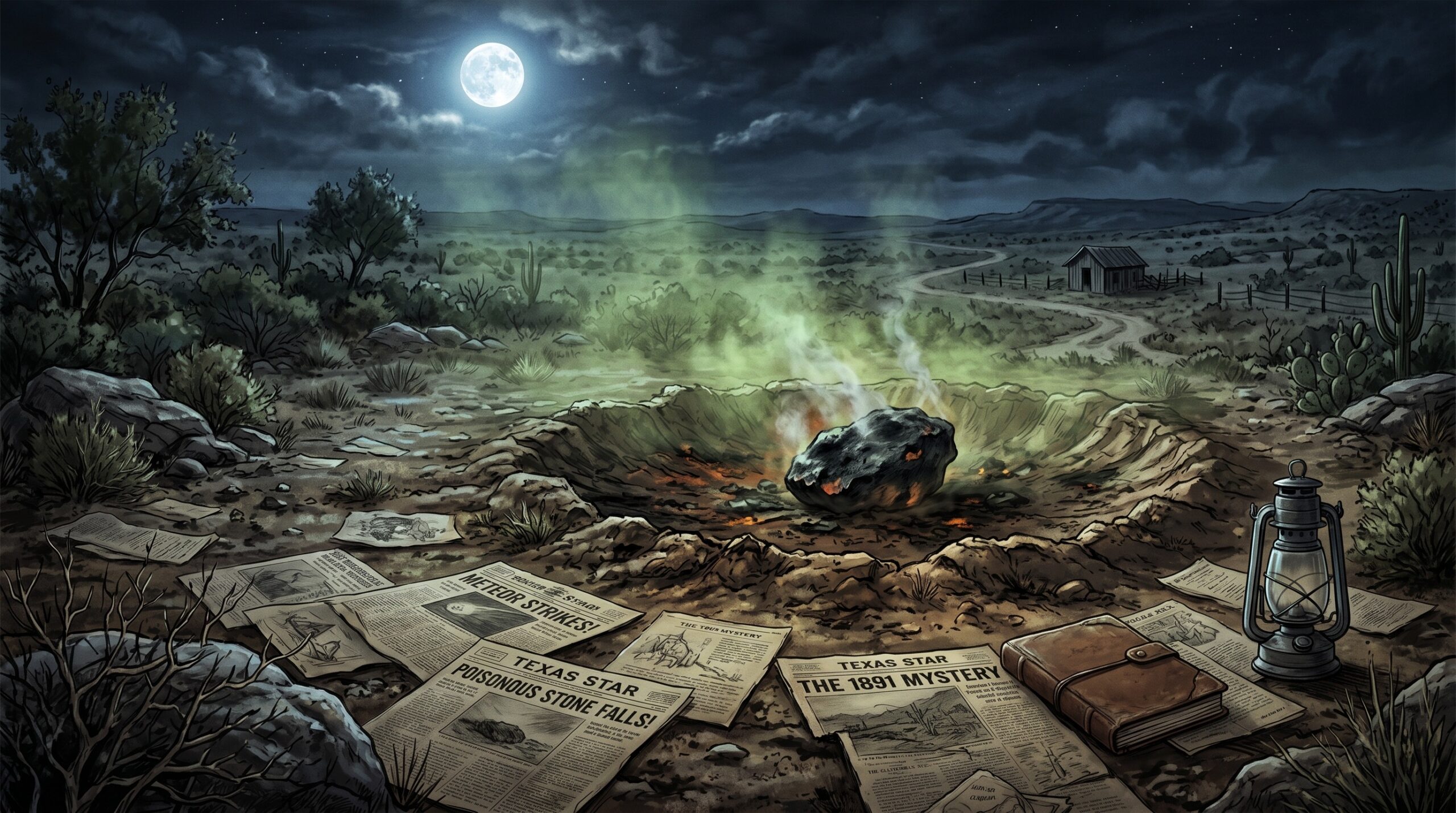
    That is the feeling around the Texas poisonous meteorite of 1891, a bizarre clipping-era story that still resurfaces in StrangeEarth threads, weird-history posts, and the parts of the internet that live for lost American anomalies. The hook is almost too perfect: somewhere in nineteenth-century Texas, according to the surviving report, a meteorite or fallen stone was said to have produced poisonous effects. Not merely a fiery object from the sky. Something worse. Something that seemed to make proximity itself feel dangerous.

    The phrase “poisonous meteorite” is exactly the kind of language that refuses to die. It compresses three fears into one image: the unknown sky, the strange stone, and the invisible threat. It sounds like frontier folklore, but it also sounds weirdly modern, as if the object were not just celestial but contaminated — a space-borne hazard dropped into the landscape before anyone had the tools to explain it cleanly.

    That is why the story keeps returning. It is not only the claim that attracts people. It is the texture of the claim. An old Texas newspaper tale. A fallen object from above. Illness, toxicity, or some noxious effect attached to it. Then the maddening afterimage familiar to anyone who chases archive-born mysteries: the story seems to survive mainly through newspaper circulation and later retellings rather than through a neat modern chain of evidence. In other words, the clipping is real enough to haunt people, but not clean enough to close.

    Why “poisonous meteorite” still sounds like buried American weirdness

    Meteorites already carry an old supernatural charge even when they are entirely real.

    A stone from the sky falls, burns, breaks, hisses, or lands hot and unfamiliar, and people immediately read more into it than geology alone. That reaction is ancient and understandable. Meteorites arrive as interruptions. They do not belong to the normal order of fields, roads, livestock, and weather. They arrive from elsewhere, often violently, and are discovered before anyone has fully decided what they mean. Modern context from the Texas State Historical Association’s meteorites overview and recent Live Science reporting on Texas meteor falls shows how easily a single sky-stone event can lodge itself in local memory even today.

    Now add the adjective poisonous.

    That one word turns a meteorite from a marvel into a threat. It suggests fumes, residue, hidden chemistry, or an object whose danger is not obvious at first touch. It makes the story feel less like a simple “stone from the sky” report and more like a close encounter with something physically wrong. For modern readers, that is irresistible. It feels like the kind of clipping that slipped through from a stranger version of America — one where cosmic debris did not just inspire awe, but left people genuinely afraid to go near it.

    That is also why the tale plays so well in Reddit and StrangeEarth-style circulation. A screenshot of an old report with a phrase like “poisonous meteorite” does half the work by itself. The story arrives already compressed into a shareable mystery: did a meteorite really poison people in Texas in 1891, and if so, why is no one talking about it now?

    What the 1891 Texas report actually claimed

    Here the distinction matters.

    What survives most clearly is not a modern scientific case file. It is the claim itself as preserved through newspaper-era circulation. The old story, in broad terms, describes a meteorite or fallen stone in Texas that was reportedly associated with poisonous or noxious effects. Depending on how later retellings paraphrase it, the emphasis falls on sickness, harmful emanations, or a dangerous reaction linked to the object.

    That much is the center of the mystery.

    What is harder to recover now is everything a modern reader immediately wants next: the exact specimen, the reliable witness chain, the medical descriptions, the chemical analysis, the later follow-up, the museum record, the settled historical verdict. Those are precisely the pieces that seem thin, scattered, or lost in the passage from original report to reprint culture to modern internet rediscovery.

    So the safest and most accurate way to hold the story is this: an 1891 Texas newspaper report said there was a poisonous meteorite. That is the claim. The claim itself is historically interesting. But the surviving evidentiary chain behind it appears much weaker than the phrase that made it memorable.

    That gap is not a disappointment. It is the whole atmosphere of the thing. The story survives in the form weird archive stories often do — vivid enough to circulate, incomplete enough to remain charged.

    Why a toxic space rock felt believable in the late nineteenth century

    To modern readers, the idea of a poisonous meteorite can sound either delightfully pulp-like or immediately suspect. But in the nineteenth century, the emotional conditions were different.

    Meteorites were already objects of fascination, fear, and scientific curiosity. A fresh fall could carry heat, unfamiliar smell, scorched earth, strange mineral appearance, and the raw theatrical fact that something had just crossed the sky and entered local reality. Even without any true toxic mechanism, that is exactly the kind of event that invites exaggerated descriptions. Witnesses are startled. Reporters sharpen the language. Communities add reaction and rumor almost instantly.

    Texas matters here too.

    The state already carries a deep imaginative association with open sky, distance, and frontier-scale oddity. In the newspaper age, Texas stories could travel with a built-in flavor of remoteness and rough immediacy. A bizarre local report did not need much embellishment to become national odd-news material once copy editors realized it had the right ingredients. A meteorite was already interesting. A poisonous meteorite was irresistible.

    There is also a broader historical point worth keeping in view. Nineteenth-century newspaper culture was fast, hungry, and often happy to pass along dramatic items before anyone had imposed modern standards of verification. That does not mean every strange report was false. It means strangeness itself had circulation value. A story could travel far because it sounded extraordinary, not because later investigators had locked every detail down.

    How the story actually survived: newspaper circulation more than evidence

    This is probably the most important part of the Texas poisonous meteorite story, because it explains why it still feels half-real and half-untouchable.

    Many old anomalies survive not through preserved specimens or careful scientific archiving, but through newspapers copying newspapers. One striking item appears in print, gets summarized elsewhere, is trimmed by another editor, reworded by a third, and then decades later is rediscovered as if it were a direct window into the event itself. Sometimes that chain preserves a real occurrence. Sometimes it preserves mostly the life of the story.

    The poisonous meteorite tale appears to belong to that difficult category.

    What keeps it alive is not a beautifully documented chain from 1891 Texas to a modern laboratory drawer. What keeps it alive is the persistence of the report. It remains visible because old newspaper weirdness is unusually hard to kill once it lodges in print. A clipping can outlive the witnesses, the stone, the local memory, and even the original context that would have told us how seriously to take it.

    That is one reason the story feels so potent in weird-history circles now. Readers are not just encountering an event. They are encountering an event already turned into relic-text. It comes to us with the compression, distortion, and haunted durability of archived newsprint.

    Why StrangeEarth and weird-history readers keep reviving it

    The modern internet did not create this story. It created the perfect habitat for it.

    A resurfaced newspaper oddity does especially well online when it offers one unforgettable phrase and a mystery that cannot be resolved in a single reply. “Poisonous meteorite” is almost engineered for that environment. It sounds scientific and folkloric at the same time. It invites instant speculation: radiation, toxins, sulfurous fumes, contaminated minerals, hoaxing, frontier hysteria, cosmic contamination. Everyone can project a theory onto it.

    That projection is part of the pleasure.

    For believer-first audiences, the story reads like evidence that older newspapers preserved a layer of reality later history flattened out. Maybe strange things really were reported more openly before institutions learned how to categorize them away. Maybe local papers captured moments that never made it into official science. Maybe the archive still contains thousands of similar anomalies waiting to be noticed.

    Even readers who stay cautious can feel the pull. The Texas poisonous meteorite of 1891 does not need to be fully proven to be fascinating. It only needs to suggest that the past was more disorderly, more porous, and more chemically or cosmically uncanny than the cleaned-up modern version.

    That is why it keeps resurfacing in StrangeEarth-style circulation rather than disappearing after one wave of attention. The story is short, memorable, and permanently unfinished. Online, unfinished stories age very well.

    What we can actually say with confidence now

    This is where the mood has to narrow.

    Texas absolutely belongs in real meteorite history. The state has a genuine connection to meteorite finds, falls, geological interest, and a long tradition of public fascination with stones from the sky. More broadly, meteorites themselves are of course real physical objects, and unusual public reactions to fresh falls are historically unsurprising. That wider context is solid.

    What is not solid in the same way is the strongest version of the 1891 poisonous meteorite claim.

    What we appear to have, based on the surviving signal that keeps resurfacing, is an old newspaper story and the afterlife of that story in retellings. What we do not appear to have is a clean, modern evidentiary package proving that a specific Texas meteorite in 1891 was documented, preserved, chemically verified as hazardous, and traced through a reliable chain of reporting and analysis. The article survives much more clearly than the case.

    That does not mean nothing happened. It means the recoverable record is narrower than the viral phrasing. The reported sickness could have been exaggerated, misunderstood, wrongly linked to the stone, caused by something mundane in the local environment, or amplified by the newspaper economy’s appetite for marvels. It could also reflect a genuine encounter with some unpleasant material or fumes that witnesses associated with the fall. The point is not to force an answer we do not have.

    The point is to distinguish the layers. There was a story. The story traveled. The clean proof did not travel with it.

    Why the Texas poisonous meteorite still lingers

    And yet it lingers because that missing proof does not weaken the atmosphere. It deepens it.

    The Texas poisonous meteorite of 1891 survives in the exact zone where unexplained history thrives: somewhere between report, folklore, and fragmentary reality. It is strange enough to feel worth remembering, but incomplete enough that no final authority has drained it of tension. Readers are left holding the same object the newspapers handed down — not the stone itself, but the charged idea of it.

    A meteorite is already a message from elsewhere. A poisonous meteorite is a message with menace attached.

    That is why the story still circulates. Not because we possess a perfect case, but because we possess a perfect relic of uncertainty: an old Texas claim that feels too weird to forget and too thinly documented to settle. More than a century later, the clipping still does what the best buried anomalies do. It makes the past feel unfinished, and it leaves just enough danger in the wording to suggest that whatever fell from the sky in 1891 may have left behind something more durable than evidence — a story no one has quite managed to neutralize.

  • The Great Seal Bug: The Soviet Gift That Listened for Seven Years

    The Great Seal Bug: The Soviet Gift That Listened for Seven Years

    Imagine accepting a diplomatic gift so ceremonial, so patriotic, and so outwardly harmless that it ends up hanging on the wall like pure symbolism — only to learn years later that the symbol itself had been listening.

    That is why the Great Seal Bug never really dies. It does not feel like ordinary espionage history. It feels like a parable about power, trust, and humiliation staged with almost supernatural precision: a carved wooden U.S. Great Seal, reportedly presented in 1945 by Soviet schoolchildren to the American side in Moscow, hanging in a place of honor while a concealed listening device sat inside it for years. Not in a lamp. Not in a phone. Not in some obviously suspicious gadget. In the emblem.

    For conspiracy-minded readers, that detail alone is enough to send the story straight into the permanent archive of things the public was never supposed to forget. The most unnerving spy devices are not the futuristic ones. They are the ones hidden inside objects everybody already accepts. And in this case, the object was not just accepted. It was respected.

    That is part of why the case keeps resurfacing in Reddit and StrangeEarth-style feeds now. Every few months it returns in the same tone of disbelief: wait, this one was actually real? A lot of viral “hidden history” stories collapse the second you look at them closely. This one does not. The core version holds up. The gift was real. The hidden device was real. And the device was unusual enough that even decades later it still sounds like science fiction smuggled into a piece of Cold War furniture.

    The gift that should have meant friendship

    The opening image is almost too neat. World War II had just ended. The United States and the Soviet Union were moving through that brief, unstable zone between alliance and open distrust. Into that atmosphere came a carved wooden representation of the Great Seal of the United States, presented as a gesture of goodwill from Soviet children.

    That is exactly the kind of object nobody wants to treat with suspicion. It is sentimental, symbolic, and politically useful. You display it because rejecting it would seem rude, paranoid, or diplomatically tone-deaf. Which is precisely what makes the story feel so perfect in retrospect. If you wanted to hide a listening device in plain sight, you could hardly ask for a better disguise than a patriotic object your target would proudly hang up themselves.

    This is where the case stops feeling like ordinary spy craft and starts feeling almost mythic. A national emblem is transformed into an ear. Hospitality becomes access. Ceremony becomes penetration. Even before anyone gets into frequencies, resonant chambers, or surveillance tradecraft, the image does most of the work on its own.

    The modern internet loves that kind of symbolic inversion. It is the same reason hidden-room stories, ritual objects, and institutional cover-up narratives travel so fast: people do not just react to the event. They react to the shape of it. And the shape of the Great Seal Bug story is nearly unbeatable.

    Why the Great Seal Bug still feels unreal

    Most espionage cases sound technical before they sound disturbing. This one works in the opposite order.

    What people remember first is not the engineering but the insult. The Soviets did not merely place a bug somewhere in an office. According to the widely repeated and well-documented account, they turned a prestigious gift into a silent access point inside the American diplomatic space in Moscow. That makes the story feel bigger than a normal surveillance success. It becomes a psychological victory.

    It also plays directly into one of the oldest conspiracy intuitions: if you can be watched through the object you trust most, then the game is already rigged. Hidden surveillance is frightening. Hidden surveillance embedded inside a revered symbol is something else. It suggests that the strongest defenses can be bypassed through pride, ritual, and assumption.

    That is why the story still lands in the age of smart speakers, compromised routers, hidden cameras, and ambient-device paranoia. The technical world has changed completely, but the emotional lesson has not. The most effective listening tool is often the one that never announces itself as technology at all.

    What “The Thing” actually was

    The hidden device inside the seal became known as “The Thing,” and one reason it still fascinates historians, spy enthusiasts, and conspiracy audiences is that it was not a simple battery-powered bug in the way many people imagine.

    In broad terms, the device is usually described in reference sources such as the CIA’s museum material, the International Spy Museum, Wikipedia, and other explainers as a passive listening device. That passive design is the whole magic trick.

    Instead of sitting there constantly powered like a conventional transmitter, the device worked by being energized from outside. A radio signal could be directed at it, and the hidden component would resonate and reflect back an audio-modulated signal carrying room sound. In plain English, that meant it did not need its own obvious onboard power source in the ordinary way many bug hunters expected. No battery to die quickly. No simple steady emission to make detection easy. No ordinary-looking electronics package announcing itself from the wall.

    That is one reason the Great Seal Bug became such a famous espionage artifact. It represented a leap in concealment as much as a trick in listening. The brilliance was not just that it heard. The brilliance was that it waited.

    For readers who know the name Léon Theremin from electronic music history, this is also one of those strange Cold War crossovers that seems scripted by a novelist. The device is commonly associated with Soviet innovation in that orbit, which only adds to the eerie aura around the case. But even without leaning too hard on personalities, the essential point is clear: this was not a cartoon spy bug. It was a technically elegant solution designed to be hard to find.

    How it stayed hidden for so long

    The most unsettling part of the story is not that the bug existed. It is that it reportedly remained undiscovered for years.

    Public summaries generally place the gift in 1945 and the discovery in 1952, which is where the famous “seven years” framing comes from. That span matters because it tells you immediately why the case became legendary. If a hidden device survives a week, that is a breach. If it survives years inside a diplomatic environment, it becomes a warning.

    The passive design helps explain why. Traditional bug-detection logic of the era often focused on finding devices that were actively transmitting or obviously powered. A passive resonant device was a different kind of problem. It could sit quietly until externally illuminated. That made it much easier to miss.

    The concealment choice mattered too. People inspect suspicious objects. They inspect new electronics. They inspect odd wiring. They are much less likely to suspect the carved national emblem hanging where it belongs. The seal was not just cover. It was social camouflage.

    There is a temptation in online retellings to turn that long concealment into a library of specific captured secrets, dramatic intercepted conversations, or decisive intelligence coups. That is where caution matters. The broad public record supports the existence of the device and its years-long concealment. It does not give internet storytellers unlimited license to claim every whispered diplomatic exchange in that room was definitely harvested and weaponized in some fully documented way. The disturbing part is already there without embellishment: the access existed.

    Why this became conspiracy catnip

    The Great Seal Bug survives online because it satisfies both believers in institutional manipulation and ordinary readers who simply love impossible true stories.

    It confirms one of the deepest fears in modern political culture: that surveillance does not only happen through force. It happens through gifts, aesthetics, trust, and environments designed to lower your guard. It also flatters a certain worldview that says official spaces are never as secure as they look, and that adversaries are often years ahead in methods the public only learns about after the damage is done.

    That makes the case endlessly reusable. To a Cold War history audience, it is a landmark in tradecraft. To conspiracy readers, it feels like proof of concept for the broader idea that public reality is always being stage-managed behind decorative surfaces. To today’s surveillance-anxious reader, it feels like an analog ancestor of the fear that every harmless object is now a potential microphone.

    In that sense, the Great Seal Bug is not just old spy lore. It is a template. It shows why the phrase “hidden in plain sight” became such a durable way of understanding power.

    If you like stories where the real world already behaves like occult symbolism, this one sits naturally beside the Soviet unease around Kola Superdeep’s most enduring legend or the Cold War dread that still clings to the Dyatlov Pass mystery. Different subject, same underlying shock: an object is doing more than it appears to do.

    What is firmly documented, and what the internet tends to inflate

    Here the grounded framing matters.

    The core case is not internet fantasy. Reference trails through CIA material, the International Spy Museum, encyclopedia entries, and mainstream explainers all support the essential outline: in 1945, a carved wooden Great Seal was given to the American side in Moscow; a concealed passive listening device was hidden inside it; the object remained on display for years; and the device was discovered in 1952.

    That is already enough to make the case historic.

    What deserves more caution are the amplified online versions. Some retellings slide too confidently from “bugged object” to “we know exactly which conversations were captured and how they altered world events.” Others add dramatic color that sounds satisfying but is not consistently supported by the public record. The best way to preserve the power of this story is not to decorate it further. It is to let the documented facts do their work.

    And the documented facts are plenty strange. A passive Soviet eavesdropping device hidden in a carved American emblem and left in place for years is not an almost-story. It is an actual one.

    The bottom line

    The Great Seal Bug keeps coming back because it violates something deeper than security procedure. It violates the human instinct that symbols are supposed to stabilize reality.

    A national seal is meant to represent authority, legitimacy, and identity. In this case, it also concealed vulnerability. That reversal is what gives the story its unusual staying power. It is not merely that the Soviets planted a listening device. It is that they appear to have turned the symbol of American presence into a channel of access.

    So yes, the reason the story feels like conspiracy bait is obvious. It has all the ingredients: Cold War secrecy, delayed discovery, elegant hidden technology, a ceremonial object, and years of undetected exposure. But this is one of those cases where the grounded version is already powerful enough. You do not need to inflate it into fantasy. The truth is that one of the most famous listening devices in espionage history was allegedly hidden inside a gift so symbolic that almost nobody would have wanted to question it.

    That is why the Great Seal Bug still works on people. It is not only a spy story. It is a story about how the most dangerous intrusions are often the ones that arrive carved, polished, smiling, and ready to hang on the wall.

  • Serapeum of Saqqara Mystery: Why the Giant Stone Boxes Haunt People

    Serapeum of Saqqara Mystery: Why the Giant Stone Boxes Haunt People

    What if the reason the Serapeum of Saqqara keeps going viral is that deep down people know those giant stone boxes are not supposed to look like that? Hidden underground, carved from massive stone, polished into dark geometric forms that seem almost too exact for the ancient world, the boxes hit the mind like a glitch in history. They do not just inspire curiosity. They produce suspicion.

    For believers, the Serapeum is not merely an archaeological site. It is one of those places where the official explanation sounds almost complete but never quite satisfies the eye. The boxes are too enormous, too refined, too eerily modern in their lines and surfaces. The moment people see them, especially in the low light of the underground galleries, a question forms almost automatically: if ancient Egypt was capable of this, then what else did it know that has been lost, misdescribed, or quietly fenced off by academic caution?

    That is why the mystery never dies. A wave of posts calling the site “impossible,” “machine-perfect,” or “100-ton precision beyond science” keeps finding fresh audiences because the visual shock is real. Travel explainers such as this Serapeum of Saqqara background guide keep the site in circulation, and once the viewer is shocked, the story writes itself. The Serapeum starts to feel like a hidden chamber of forbidden engineering, the kind of place that belongs in the same imaginative territory as Second Sphinx Under Giza and other ancient-Egypt mysteries that make people wonder whether the official map of the past is flatter than the truth.

    Why the boxes hit so hard

    The raw scale is only part of it. Plenty of ancient monuments are huge. What unsettles people here is the combination of weight and finish.

    These are not rough boulders or broken ruins. They look intentional in a very modern-seeming way: flat planes, severe edges, heavy lids, polished interiors, dark stone that catches light with an almost industrial elegance. The boxes do not merely feel ancient. They feel precise. That is what hooks people.

    And once that word enters the conversation — precision — the entire site changes character. It stops being “an old burial complex” and becomes “evidence of a capability problem.” Believers do not just ask who made the boxes. They ask how, with what methods, and why the result still looks so difficult to explain in ordinary terms. That is the same emotional mechanism behind Do Ancient Stone Chambers in the British Isles Really Resonate at 110 Hz? — the moment when an old site seems to hint at technical knowledge that feels out of place.

    The rabbit hole hidden under Saqqara

    Once you step into the believer reading, the Serapeum becomes much more than a funerary site.

    Why are the boxes so massive if their purpose was straightforward? Why underground? Why do the interiors look so finished? Why do so many viewers feel that the craftsmanship crosses a line from impressive into unnerving? And why does every explanation seem to lean on broad civilizational capability while leaving the practical shock of the objects themselves untouched?

    That is where the rabbit hole begins. Some people see lost machining knowledge. Others imagine a forgotten high civilization whose work was inherited by dynastic Egypt. Others suspect the boxes may have served a function different from the one textbooks emphasize. Still others do not commit to a specific theory at all — they simply feel that the site does not emotionally behave like a solved problem.

    That feeling matters more than skeptics often admit. Mystery culture survives because certain objects keep resisting psychological closure. The Serapeum boxes do exactly that. They sit there like finished statements from a vanished intelligence, whether human or not, and the modern mind keeps circling them because they do not look like the rough primitive fantasy people were taught to expect from antiquity.

    Why believers keep coming back to the precision claim

    The internet version of the Serapeum is built on one core conviction: these boxes look too exact to be shrugged off as ordinary ancient stonework.

    That claim can be overstated, but its emotional force is obvious. People are reacting to the surfaces with their own eyes. They are reacting to corners that seem too clean, to interiors that seem too smooth, to the sheer labor implied by placing these objects in underground chambers. Once those visual impressions take hold, the idea of lost tools or lost methods stops sounding wild. It starts sounding intuitive.

    That is why alternative-history advocates do so well with this site. They do not need to prove every step of their theory. They only need to keep attention fixed on the physical improbability people feel in their gut. If the object looks impossible, then the imagination opens. And once it opens, it becomes easy to connect the Serapeum with the larger constellation of ancient enigmas, hidden chambers, forbidden archaeology, and the suspicion that whole chapters of human capability have been flattened into safer narratives. It naturally sits beside stories like Ancient Demon Traps in Mesopotamia, where ritual objects and buried spaces seem to preserve a worldview that still feels only half translated.

    Why the official explanation never fully calms people down

    Archaeology does provide a coherent framework: the Serapeum is tied to the Apis bull cult within the wider sacred and funerary landscape of Saqqara. That context is real, and it matters. Standard references like Britannica’s Saqqara overview place the site firmly inside that broader Egyptian setting.

    But context does not erase astonishment. In fact, for many people it barely touches the central emotional problem. Saying the boxes are part of an ancient cultic tradition does not answer the visceral question the site creates: how were these specific objects quarried, moved, lowered, shaped, finished, and fitted with such authority in a dark underground setting?

    That is why the debate never resolves cleanly online. One side keeps saying, “There is context.” The other keeps replying, “Look at the boxes.” Both are addressing different levels of the experience. The first explains the site historically. The second is still staring at the objects as physical challenges.

    And that physical challenge is exactly why sites like this keep crossing into conspiracy and paranormal territory. If the ancient world could do more than we casually assume, then maybe history has more buried discontinuities than institutions are comfortable admitting.

    What the credible facts actually support

    Here is the firmer ground. The Serapeum of Saqqara is a real archaeological complex in Egypt associated with the Apis bull cult, and the giant stone sarcophagi there are genuinely enormous, visually striking, and technically impressive. The site’s context within the wider Saqqara necropolis is well established. So this is not an invented mystery.

    What is not established is the strongest leap often made online: that the boxes therefore prove lost super-technology, non-Egyptian builders, or impossible machine-shop precision beyond known ancient capability. The polished appearance and immense scale are real, but many viral claims go beyond publicly demonstrated measurements and beyond what the existing evidence can securely prove. Even broad public summaries like Wikipedia’s Saqqara overview make clear how much wider historical context surrounds the site than the viral mystery captions usually admit. In other words, the wonder is justified; the most extreme conclusions are still interpretive.

    That leaves the Serapeum in the exact place where great mysteries live longest. Believers can say the boxes remain psychologically and technically unsettling for good reason, and that mainstream explanations still feel incomplete at the level that matters most to ordinary viewers. Skeptics can say astonishing craftsmanship is not the same thing as impossible craftsmanship. For now, the evidence supports a site that is truly extraordinary, historically grounded, and still capable of making people question how much of the ancient world has really been explained — which is precisely why the Serapeum keeps haunting people centuries later.

  • Do Ancient Stone Chambers in the British Isles Really Resonate at 110 Hz?

    Do Ancient Stone Chambers in the British Isles Really Resonate at 110 Hz?

    A striking claim has been ricocheting across Reddit, Instagram, and ancient-mystery corners of the internet: prehistoric stone chambers across the British Isles were allegedly built to resonate at 110 Hz, and that low frequency may have altered the human brain by dampening areas linked to language or ordinary conscious thought. It is an irresistible idea. It sounds scientific, mystical, and ancient all at once.

    The problem is that the viral version is much cleaner than the evidence behind it. There is real research into the acoustics of prehistoric monuments. There are well-known passage tombs and stone chambers in Britain and Ireland that seem to produce unusual sonic effects. And there have been discussions, in both archaeoacoustics and adjacent popular writing, about resonances in the rough neighborhood of 110 Hz. But the sweeping claim now circulating online—that a Princeton team proved ancient builders across the British Isles intentionally tuned these spaces to 110 Hz in order to suppress the brain’s language centers—is, at best, an aggressive compression of scattered ideas and, at worst, a dramatic retelling that outruns its sources.

    For related context, see Rome’s Porta Magica: The Alchemical Door That Still Stands and Second Sphinx Under Giza? What the Claim Says, What the Scans Show, and What Remains Unproven.

    Why is everyone talking about it now? Because it recently found the perfect modern delivery system. A high-performing Reddit post in r/HighStrangeness packaged the story into a single vivid sentence. That kind of claim then spreads fast through short-form video and image platforms already primed for megaliths, lost knowledge, and cinematic drone shots of ancient stonework. Once the number 110 Hz enters the story, it gives the whole thing the feel of hidden technical knowledge rather than folklore.

    So what does the evidence actually show? The honest answer is more interesting, and more uncertain, than the meme. Some prehistoric chambers seem to have distinctive low-frequency resonances. Some researchers think sound may have mattered more in ancient ritual architecture than archaeology once assumed. But the leap from “this stone space has notable acoustics” to “prehistoric engineers built a brain-altering sonic machine” remains unproven.

    What the viral claim actually says

    The online version usually arrives as a tidy bundle of assertions. A team—often described as being from Princeton—supposedly measured 5,000-year-old stone chambers across the British Isles and found that many of them resonate at 110 Hz. That frequency is then linked to EEG studies suggesting that droning sound around 110 Hz can suppress or interfere with brain activity associated with language processing. The implied conclusion is not subtle: ancient people understood how to alter consciousness through architecture and sound.

    It is a powerful story partly because each component sounds just plausible enough to carry the others. Stone chambers are real. Acoustic measurements are real. EEG research is real. Ancient ritual use is plausible. Put together in one sentence, they feel like a solved mystery.

    But that is exactly where caution is needed. Viral claims often splice together ideas that did not come from the same study, the same discipline, or even the same standard of evidence. A measured resonance at one monument is not automatically evidence for a region-wide design principle. A modern laboratory observation about how a tone affects subjects under controlled conditions is not direct proof of prehistoric intention. And a social-media caption that says “researchers found” may be compressing years of speculative interpretation into the language of settled fact.

    Why this story spread so easily

    This is almost tailor-made for the current internet. Reddit loves claims that feel like suppressed knowledge rediscovered through academic research. Instagram and Reels reward images of weathered stones, interior chambers, shafts of light, and voiceover scripts that can move from archaeology to altered consciousness in under thirty seconds. Hashtags around ancient mysteries and megaliths already support a thriving visual culture, so a story like this does not need to build an audience from scratch. It drops into one that already exists.

    The claim also benefits from a neat numerical hook. “110 Hz” feels specific in a way that “some low-frequency resonances in some chambers” does not. A precise number gives internet stories a false sense of laboratory certainty. Even readers who know little about acoustics can intuitively feel that a measured frequency must mean something exact and intentional.

    And then there is the consciousness angle. If the claim were only that certain stone chambers echo in interesting ways, it would remain a niche archaeology story. Add the possibility of altered states, silenced language centers, or ritual trance, and it becomes instantly shareable. The internet is full of stories that start as sensory observations and end as theories about hidden human potential.

    What archaeoacoustics actually studies

    Before dismissing the whole subject, it is worth stating clearly that archaeoacoustics is a real field of inquiry. Broadly speaking, it asks how sound behaves in ancient places and whether those sonic properties mattered to the people who built and used them. That can include caves, tombs, temples, amphitheaters, stone circles, and other ritual or ceremonial spaces.

    The basic idea is sensible. Human beings do not experience architecture only with their eyes. In enclosed or semi-enclosed ritual spaces, sound can shape emotion, memory, movement, authority, and group behavior. A chamber that amplifies drumming, chanting, or certain vocal ranges may feel very different from one that swallows sound. If a monument was used for ceremony, burial, performance, or repeated gatherings, acoustics are not a trivial detail.

    At the same time, archaeoacoustics is not a magic key. Ancient spaces can have striking sound properties for many reasons, including geometry, size, stone surfaces, and accident. Researchers may agree that a chamber resonates without agreeing on what that meant culturally. The field can reveal meaningful sensory possibilities without proving why builders made the choices they did.

    Which sites are usually pulled into the 110 Hz story

    A few monuments come up again and again in popular retellings. Newgrange in Ireland is probably the most famous. The great passage tomb is already culturally magnetic because of its age, engineering, and winter-solstice alignment. Add unusual sound behavior inside a stone passage and chamber, and it becomes the perfect candidate for larger theories.

    Loughcrew, another Irish complex of passage tombs, also appears often in these conversations. Its ritual landscape, deep antiquity, and enclosed stone spaces make it easy to fold into a broader acoustic narrative. Wayland’s Smithy in England, though very different in its specifics, is another monument repeatedly cited in online discussions about resonant prehistoric chambers.

    There are also wider references to chambered cairns, passage graves, and megalithic structures across Britain and Ireland. This is where the story begins to stretch. These monuments were built across different places, periods, and local traditions. They are not acoustically interchangeable. Even when they share broad architectural categories, that does not mean they all produce the same resonant behavior, let alone at one exact frequency.

    That distinction matters because the viral claim often treats “ancient stone chambers in the British Isles” as if they were one coordinated technological class. Archaeologically, that is already a simplification. Acoustically, it is even harder to defend without careful site-by-site measurement.

    Where the 110 Hz idea seems to come from

    The most responsible way to put it is this: some discussions of prehistoric stone spaces point to low-frequency resonances in the rough range that internet retellings later round to 110 Hz. Once that number enters circulation, it takes on a life of its own. A resonance near 95 Hz, 105 Hz, or 114 Hz can become “110 Hz” in summary. A frequency observed at one site can become a feature of many sites. A possible pattern can become an intentional design code.

    This is a familiar process in online mystery culture. Broad ranges collapse into clean numbers. Tentative observations harden into repeatable laws. The number becomes the story.

    That does not mean the low-frequency observations are meaningless. Enclosed stone chambers can indeed emphasize certain frequencies. Low frequencies are especially important in ritual theories because they overlap with drumming, deep male vocalization, and the kind of sustained tones that can make a space feel physically active rather than merely echoing. If a chamber consistently reinforces a low tone, that could have affected the experience of ceremony inside it.

    For outside reporting and background, start with The Reddit post that pushed the 110 Hz chamber claim viral and A background essay on 110 Hz claims in ancient chambers.

    But “could have affected experience” is a long way from “was designed at exactly 110 Hz to alter the brain.” The internet tends to erase the distance between those claims.

    What about the supposed brain effects?

    This is where the story becomes most vulnerable to overstatement. The repeated online claim is that sound around 110 Hz can produce measurable effects in EEG readings, sometimes framed as reduced activity in language-related regions or a shift away from normal verbal processing. In internet retellings, that quickly becomes “110 Hz switches off the brain’s language center,” which is a much stronger and much less careful statement.

    Even if one assumes there are intriguing modern studies involving droning tones, rhythmic sound, or altered neural patterns, several cautions follow immediately.

    First, a laboratory result is not the same thing as a stone chamber result. A controlled audio exposure in a modern study is not equivalent to whatever sound levels, durations, performers, and audiences existed in prehistoric ritual settings.

    Second, neural correlation does not automatically equal mystical transformation. Human brains respond to rhythm, repetition, darkness, expectation, and group ritual in all kinds of measurable ways. That is interesting, but it does not mean researchers have demonstrated a prehistoric consciousness technology.

    Third, the chain of evidence is incomplete. To make the strongest viral claim work, you would need to show not only that a particular chamber resonates near a particular frequency, but that prehistoric people reliably excited that frequency in use, that the effect on listeners was consistent, and that the builders intentionally designed for that outcome. That is a very high bar. The internet version usually skips from the first step to the last.

    The mention of a Princeton team is also worth treating carefully. In viral stories, university names often function as trust signals, whether or not readers ever see the original paper, methods, or scope of the research. Without clear sourcing, the institutional label can become part of the mythmaking.

    What scholars and skeptics would likely say

    A skeptical response does not need to deny that ancient monuments can sound extraordinary. In fact, many scholars would probably agree that sound is an underappreciated part of how these spaces worked. A dark chamber that hums, amplifies a chant, or reinforces a drumbeat could feel powerful without any paranormal explanation.

    The skepticism enters when acoustics are asked to carry more than they can bear. Stone spaces resonate because enclosed spaces often resonate. Humans interpret sensation through expectation. A ritual setting full of darkness, echo, burial associations, and social tension can produce awe without requiring hidden lost science.

    There is also a selection problem. The chambers most often discussed are the ones that already feel uncanny, monumental, or acoustically interesting. That can create the impression of a grand pattern while ignoring the many sites that do not fit the narrative nearly as well.

    And then there is the ordinary issue of replication. Extraordinary historical claims should rest on transparent measurements, clearly identified sites, repeatable methods, and careful separation between data and interpretation. “Some monuments exhibit low-frequency resonances” is a claim scholars can investigate. “Ancient builders across the British Isles intentionally engineered 110 Hz brain suppression” is much harder to support from the publicly circulated evidence.

    What remains genuinely intriguing

    If the internet version is inflated, the underlying subject is still fascinating. Ancient ritual architecture was probably more multisensory than many modern visitors realize. We tend to approach these monuments as visual ruins in daylight. Their original users may have encountered them in darkness, torchlight, winter cold, seasonal gatherings, processions, and carefully staged sound.

    That changes the question. Maybe the most important point is not whether builders encoded one exact frequency, but whether they noticed that certain chambers made voices, drums, or drones feel unusually strong. If they did, they may have valued those effects. A chamber that turns a chant into a bodily experience does not need to “turn off language centers” to matter socially or spiritually.

    It is also possible that acoustics helped produce states of awe, disorientation, solemnity, or collective focus. Ritual power does not require supernatural technology. It can emerge from architecture, expectation, and repeated performance. In that sense, archaeoacoustics may genuinely deepen our picture of prehistoric ceremonial life, even if the most viral claim collapses under scrutiny.

    The bottom line

    The viral 110 Hz story is built around a real and worthwhile subject, but the version spreading online is too neat. There is real archaeoacoustics research. There are real prehistoric chambers in Britain and Ireland with notable acoustic properties. There are good reasons to think sound may have mattered in how some of these monuments were used.

    What the evidence does not currently justify is the strongest package now making the rounds: that monuments across the British Isles were uniformly tuned to exactly 110 Hz, that a Princeton-led effort established this as a broad archaeological fact, and that the effect amounts to demonstrated ancient brain engineering.

    A third useful reference is Patreon essay discussing Malta’s Hypogeum and related archaeoacoustic ideas.

    The more credible conclusion is both narrower and more compelling. Some ancient stone spaces may well have been chosen, shaped, or valued in part because of how they sounded. Low-frequency resonance could have contributed to ritual experience in ways archaeology is only beginning to take seriously. But the jump from acoustic intrigue to consciousness-altering technology is still a jump.

    Readers who want to continue can also explore Ancient Demon Traps in Mesopotamia? The Bowls Buried Beneath the House.

    In other words, there may be a real mystery here—but it is the subtler one. Not whether prehistoric builders secretly mastered a single magic frequency, but whether they understood something most modern visitors overlook: that stone, space, voice, and vibration can change the human experience of a place even when the explanation remains entirely human.

  • Rome’s Porta Magica: The Alchemical Door That Still Stands

    Rome’s Porta Magica: The Alchemical Door That Still Stands

    Rome’s Porta Magica is real. You can point to it, photograph it, and study the inscriptions carved into its stone. What is less certain is the larger legend that has grown around it: that this doorway preserves the secret of alchemical transmutation, or that it was created after a mysterious adept vanished from a Roman villa leaving behind gold and a coded manuscript.

    That mixture of hard fact and unstable story is exactly why people keep returning to it. Right now the Porta Magica is circulating again through occult-focused Reddit posts and the wider social-media ecosystem that loves objects balancing history, secrecy, and visual strangeness. The doorway offers all three at once. It is not an invented internet myth. It is a surviving 17th-century monument. But the strongest claims attached to it remain disputed, symbolic, or impossible to verify cleanly from the historical record.

    For related context, see Antoine’s Restaurant Ghost Photo: What the Viral New Orleans Images Really Show and Ancient Demon Traps in Mesopotamia? The Bowls Buried Beneath the House.

    What the evidence shows is compelling enough on its own: the Porta Magica, also called the Magic Portal or Alchemical Door, is the best-known surviving remnant of the Villa Palombara in Rome, a property associated with the nobleman Massimiliano Palombara and with the serious alchemical culture of baroque Europe. Its inscriptions are real. Its symbolism is deliberate. Its reputation as a threshold to hidden knowledge is historical. Whether it ever encoded a practical secret for making gold is another matter entirely.

    What exactly is the Porta Magica?

    The Porta Magica is a stone doorway from the former Villa Palombara, once located on Rome’s Esquiline Hill. The villa itself is gone. The portal survived, was preserved, and today stands as one of the strangest small monuments in the city: not a grand church façade or triumphal arch, but a single doorframe covered with inscriptions, symbols, and the lingering suggestion that it once guarded more than a garden wall.

    That matters because modern retellings often make the object sound older, vaguer, or more fantastical than it really is. The Porta Magica is not an ancient Roman ruin from imperial antiquity, and it is not some unexplained monolith of unknown origin. It belongs to the late 17th century, usually dated to around 1680, and to a very specific intellectual world: one in which aristocrats, experimenters, mystics, and learned eccentrics could pursue alchemy as a serious mix of natural philosophy, spiritual metaphor, and elite obsession.

    Even without the legend, the portal is unusual. A doorway is normally one of the most functional things in architecture. This one seems designed to advertise secrecy. Its surface is dense with inscriptions and esoteric signs. It looks less like a decorative feature than like a statement: entry here is not merely physical. Something about this threshold concerns transformation.

    Why people are talking about it again now

    The Porta Magica has the exact shape of a modern viral mystery. It is visually striking, easy to summarize in a sentence, and attached to a promise of hidden knowledge. Recent attention has been driven by strong engagement in occult-focused online spaces, including Reddit discussion that treated the “Magic Portal” as one of those rare cases where the eerie object in the image is not fictional but undeniably there.

    The broader social context helps too. Occult imagery travels easily now, especially when it crosses over with historical travel imagery and short-form video culture. A ruined abbey can feel atmospheric. A skull-lined church can feel macabre. But a real Roman doorway allegedly tied to alchemists and secret formulas has a sharper hook. It invites viewers to imagine that the code is still waiting in plain sight.

    That does not mean anything new has been discovered. The current wave is better understood as renewed attention, not new evidence. The monument is old. The fascination is contemporary.

    Who built it, and why?

    The portal is tied to Massimiliano Palombara, Marquis of Pietraforte, the owner of Villa Palombara. He is the central historical figure behind the site’s reputation. Palombara is generally remembered not simply as a Roman nobleman, but as one with serious interests in alchemy and related esoteric ideas. In other words, the alchemical association is not a modern fantasy pasted onto an ordinary building after the fact. It belongs to the monument’s historical setting.

    That said, historians are firmer on some points than others. Palombara’s interest in alchemical thought is well established in broad terms. The exact motive behind the portal’s inscriptions is less certain. Was it a personal statement of belief? A monument to a particular alchemical event or text? A kind of encoded philosophical program? Possibly some combination of all three.

    The broader context matters here. In the 17th century, alchemy was not merely the laughable pursuit that later caricatures make it seem. It sat at the edge of several serious pursuits at once: chemistry before modern chemistry, spiritual speculation before modern psychology, and elite intellectual networking before scientific disciplines hardened into their present forms. An educated nobleman could take alchemical symbolism seriously without imagining himself to be living in pure fantasy.

    That is one reason the portal still resonates. It comes from a period when matter and meaning had not yet fully split apart. To study metals, planets, sacred names, and hidden correspondences could still feel like part of the same search.

    The vanished alchemist legend

    The most famous story attached to the Porta Magica is also the hardest to verify. In later retellings, a mysterious alchemist or adept came to Villa Palombara, often described as a stranger with unusual knowledge. He wandered the grounds in search of a special herb or substance, succeeded in performing some kind of transmutation, and then vanished—sometimes overnight, sometimes under suspiciously miraculous circumstances. What he left behind, according to the legend, was a trace of gold and a cryptic set of notes or formulas. Those formulas, unable to be fully understood, were carved into the portal.

    It is an almost perfect legend because it solves several emotional needs at once. It explains why the inscriptions exist. It flatters the idea that the secret was once genuinely within reach. And it preserves the mystery by ensuring the final key is missing.

    Some later traditions identify the mysterious figure with Francesco Giuseppe Borri, an adventurer, healer, and occult claimant whose life was dramatic enough to attract legend on its own. Borri is often drawn into discussions of the portal because he fits the role so well: learned, controversial, mobile, and immersed in the same world of alchemical aspiration. But “fits the role” is not the same thing as “historically proven.” The connection is widely repeated, not equally secure in every detail.

    This is the point where many modern tellings stop being careful. The legend may preserve echoes of real relationships, real conversations, or real texts circulating in Palombara’s milieu. It may also have been expanded and polished by later writers who understood exactly how irresistible the story was. Historians can describe the tradition. They cannot simply certify the vanished alchemist episode as straightforward fact.

    What historians can actually verify

    Several things about the Porta Magica are solid.

    First, the monument itself is genuine. There is no question that the doorway exists, belongs to the late 17th century, and is tied to the former Villa Palombara.

    Second, its association with alchemical culture is real. This is not an arbitrary modern label based on a spooky appearance. The inscriptions and symbols are part of a recognizable esoteric and alchemical vocabulary.

    Third, Massimiliano Palombara’s interest in these matters is historically plausible and central, not incidental. The site makes sense within his known intellectual reputation.

    Beyond that, certainty begins to thin out. Historians cannot verify that anyone at the villa successfully made gold. They cannot prove that the portal records a single dramatic night of revelation. They cannot offer one universally accepted translation that unlocks the doorway like a solved puzzle box.

    That is frustrating if you want a clean verdict. It is also what makes the object unusually honest as a historical mystery. There is enough evidence to anchor the story firmly in reality, but not enough to flatten every symbol into certainty.

    For outside reporting and background, start with Wanted in Rome on the Magic Door of Piazza Vittorio and Wikipedia overview of Porta Alchemica.

    What the symbols are believed to say

    The portal’s inscriptions are one reason it has never faded into being merely a curious old doorway. They invite reading, but not easy reading. Scholars and enthusiasts have long linked them to alchemical formulas, hermetic thought, and the symbolic language of transformation. The monument includes esoteric phrases and signs that seem to point toward the purification of matter, the union of opposites, and the progression through the classic alchemical stages or correspondences.

    One frequently noted feature is the use of symbols associated with the seven planetary metals: the old system that linked metals, planets, and cosmic order in a single symbolic framework. That alone places the doorway inside a worldview where matter was not inert stuff but part of a larger web of correspondences. Lead, gold, Mercury, Saturn, the sun, the moon: these were not isolated categories. They were pieces of a meaningful pattern.

    Another commonly mentioned feature is the presence of Hebrew elements and cryptic formulas, which lend the portal part of its charged atmosphere. To a modern viewer, this can look like random occult decoration. It is more accurate to say the monument appears to gather several respected languages of hidden wisdom into one stone surface: Latinized maxims, alchemical ciphers, planetary signs, and sacred-script prestige.

    But caution matters. The internet loves monuments that can be presented as “still undeciphered,” as if experts have no idea what they are looking at. That is too simple. Parts of the portal’s symbolism are interpretable. Its broad alchemical context is well understood. What remains difficult is not whether the symbols mean anything, but whether they amount to one practical recipe, one philosophical statement, one commemorative gesture, or several layers at once.

    In other words, the portal is not unreadable. It is overread.

    Why alchemy matters here

    To understand why the Porta Magica still feels powerful, it helps to set aside the cartoon version of alchemy. Yes, alchemists sought transmutation. Yes, the dream of turning lesser metals into gold was part of the tradition. But alchemy was also a language for purification, perfection, hidden order, and the possibility that nature concealed processes not yet understood.

    That makes a doorway an almost ideal alchemical monument. A threshold is where one state becomes another: outside to inside, ignorance to knowledge, impurity to refinement, seeker to initiate. The portal does not merely display alchemical ideas. It performs them architecturally. It asks the viewer to stand before a boundary and imagine that crossing it might alter what one is.

    This is part of what separates the Porta Magica from many other occult-adjacent artifacts. It is not just inscribed. It is a threshold. The symbolism does not float abstractly. It is attached to the physical act of passage.

    Whether Palombara intended that effect in a philosophical sense, a ritual one, or simply as a cultivated expression of elite esoteric identity, the result is the same: the monument feels like condensed alchemy, a whole worldview narrowed into a frame of stone.

    Why the doorway still feels uncanny

    The Porta Magica remains uncanny because it resists two flattening moves at once.

    The first is skepticism’s easy move: to dismiss it as nothing more than decorative eccentricity. That does not work, because the monument is too specific, too intentional, and too rooted in a real culture of alchemical thought.

    The second is credulity’s easy move: to declare it proof that a secret order cracked the code of nature and left the answer in public view. That does not work either, because the historical record is too fragmentary and the symbolism too layered for such certainty.

    So the portal lives in a narrow, durable space between those extremes. It is not fake. It is not solved. It is not an ordinary ruin. It is not evidence of supernatural power. It is a real artifact from a moment in history when people of status and education could dedicate serious attention to hidden correspondences in matter, language, and the cosmos.

    It also carries the melancholy of survival. The villa is gone. The world that produced the door has largely vanished with it. What remains is a stone threshold detached from its original setting, still dense with signs that imply a system larger than what we can now reconstruct. There is something inherently eerie about an object that survives more completely than the worldview required to read it.

    Are modern retellings exaggerating the story?

    Often, yes. The most common exaggerations are familiar.

    One is to describe the Porta Magica as if it were an ancient Roman portal from classical antiquity. It is not. Its strangeness belongs to baroque Rome, not imperial Rome.

    Another is to present the vanished-alchemist story as cleanly documented fact. It is not. It is best understood as a persistent legend attached to a historical site and a historically plausible alchemical circle.

    A third is to imply that the doorway proves alchemists succeeded in producing gold. That goes well beyond the evidence.

    And yet reducing the portal to “just a legend” misses the point too. The monument matters precisely because it shows that alchemy was not a fringe fantasy happening nowhere. It left marks in stone. It shaped patronage, architecture, symbolism, and reputation. The object is evidence of belief, ambition, and intellectual seriousness, even if it is not evidence that lead ever became gold.

    The real threshold

    The Porta Magica does not need to be a supernatural portal to be one of the most suggestive unexplained monuments in Rome. Its mystery is stronger than that. It stands at the threshold between what history can document and what human beings are always tempted to imagine beyond the document: the missing recipe, the vanished teacher, the night when the experiment worked.

    A third useful reference is NanoInnovation feature on Porta Magica’s alchemical history.

    The safest conclusion is also the most interesting one. Rome’s Alchemical Door is a real 17th-century monument, almost certainly created within a serious culture of alchemical and hermetic thought. The legend of the stranger who left behind gold and coded wisdom may preserve something of that world, but it cannot be verified in the dramatic form now repeated online. The inscriptions are meaningful, though not neatly reducible to a single solved message.

    Readers who want to continue can also explore Do Ancient Stone Chambers in the British Isles Really Resonate at 110 Hz?.

    That is why the monument still exerts such force. It offers a physical object where modern people expect only rumor. A real doorway survives. Real symbols remain on its surface. The promise attached to it—that nature has a hidden grammar, that transformation has a key, that a threshold can still separate the initiated from everyone else—has never entirely disappeared. The Porta Magica keeps that promise suspended in stone: visible, historical, and just out of reach.

  • Kola Superdeep ‘Screams From Hell’: The Hoax and the Real Discoveries Beneath the Earth

    Kola Superdeep ‘Screams From Hell’: The Hoax and the Real Discoveries Beneath the Earth

    No, the Kola Superdeep Borehole did not capture literal screams from hell. The famous story about Soviet scientists drilling so deep they recorded the cries of the damned is a hoax—or, at minimum, a legend built from invented details, theatrical audio, and years of sensational retelling rather than credible scientific evidence.

    What keeps the tale alive is that the real project was already dramatic before folklore ever touched it. On the Kola Peninsula in Russia, Soviet researchers spent years drilling deeper into Earth’s crust than anyone had before. They pushed past 12 kilometers into heat and pressure that strained both machinery and expectation. They found temperatures higher than predicted, deep rock behaving in surprising ways, and evidence that complicated older assumptions about the crust. The myth is false. The setting that produced it was extraordinary.

    For more context on the broader mystery, see Second Sphinx Under Giza? What the Claim Says, What the Scans Show, and What Remains Unproven and Ancient Demon Traps in Mesopotamia? The Bowls Buried Beneath the House.

    What the “screams from hell” story actually claims

    The familiar version has the shape of a campfire story told with laboratory equipment. Soviet scientists drill into the Earth, lower microphones or sensitive instruments into the shaft, and hear human screams rising from below. In some versions they have broken into a hidden chamber of torment. In others, the researchers panic, the project is shut down, and officials scramble to suppress the truth.

    The story spread through sermons, paranormal books, tabloids, radio shows, chain emails, and later online videos and social-media retellings. It was often paired with a supposed recording presented as proof.

    That recording is one of the clearest signs the tale is not real. Investigations and repeated debunkings have linked the audio to fabricated or repurposed sound material used for dramatic effect, not to a documented experiment at Kola. The legend survives because it is vivid and easy to repeat, not because the evidence behind it is strong.

    What the Kola Superdeep Borehole really was

    The Kola Superdeep Borehole was not a mining project and not a literal attempt to drill into hell or even into Earth’s mantle. It was a Soviet scientific drilling effort that began in 1970 near the border with Norway. Its purpose was to study the continental crust at depths no one had reached before.

    Instead of carving out a giant pit, researchers drilled a narrow borehole downward in stages, using specialized equipment to collect samples and data from an environment of extreme pressure and heat. The deepest branch, SG-3, reached 12,262 meters—about 40,230 feet—in 1989. That remains the depth record for a man-made borehole.

    The number sounds almost unreal, but on a planetary scale it is still tiny: a deep scratch in the crust, not a breach into some hidden underworld. That contrast helps explain why the project has been so widely misunderstood. “Deepest hole on Earth” sounds apocalyptic. The actual science was narrower, more technical, and no less impressive.

    Where the hell story came from

    The broad path of the hoax is fairly well known, even if individual versions differ. A major source was a sensational account that circulated in religious media in the late 1980s and early 1990s. The story often invoked unnamed Finnish or Norwegian sources, vague Soviet testimony, and supposed confirmation of biblical imagery. None of it held up under scrutiny.

    The tale spread because it fused several powerful themes into one neat package: Cold War secrecy, fear of forbidden science, literalist religion, and the ancient image of a descent into the underworld. The details shifted from telling to telling, which is usually a sign of folklore rather than reporting. Depth measurements changed. Scientists’ reactions changed. In some versions there were demons; in others, only the voices.

    There was no stable, well-documented incident at the center. There was a rumor designed—almost perfectly—to travel.

    What scientists really found underground

    If the hoax promised horror, the actual findings offered something stranger and more enduring: a glimpse of how unfamiliar the deep crust becomes once ordinary human intuition gives out.

    One of the biggest surprises was temperature. Scientists expected intense heat at great depth, but the borehole became even hotter than many had predicted. By around 12 kilometers down, temperatures reached roughly 180 degrees Celsius. That was far beyond what the team had hoped to manage easily with the drilling technology of the time. At those temperatures, rock became harder to handle and drilling became far more difficult, helping bring the project to an end.

    Researchers also found that the deep crust did not behave exactly as some standard models had suggested. Rather than presenting itself as a cleanly layered, easily predictable structure, the rock environment proved more fractured and complex, shaped by pressure, fluids, and heat over immense spans of time.

    Another striking finding involved water. Scientists found evidence of water deep in the crust—not as underground caverns full of free-flowing liquid, but as water bound within minerals and released under extreme conditions. That challenged simpler ideas about how dry the deep crust should be.

    They also identified microscopic fossils of ancient marine plankton in rocks several kilometers down. That did not mean life was somehow thriving at those depths. It meant rocks formed from ancient seabed sediments had, over geologic time, been buried far deeper than many people would intuitively imagine. Even so, it is easy to see why the detail felt uncanny to the public. Fossils buried miles beneath the surface sound almost mythic, even when the explanation is entirely geological.

    Readers who want to compare this story with outside reporting can start with Wikipedia on the Kola Superdeep Borehole and Britannica on the Kola Peninsula.

    Why the real discoveries still felt eerie

    The Kola project has always carried an uncanny edge because deep drilling lies far outside normal human experience. We know what caves feel like. We know what mountains look like. Very few people can picture a narrow shaft dropping more than 12 kilometers through hot, compressed rock in complete darkness.

    That imaginative gap leaves room for older language to rush in: abyss, underworld, forbidden depth, gates of hell. Those metaphors are ancient. Kola simply gave them a modern industrial setting of steel, cables, drilling mud, and Soviet machinery.

    This is why saying “the story is false” never quite kills it. The project still feels as if it touched a zone beyond ordinary human belonging—not because it found the supernatural, but because it revealed how alien the deep Earth already is.

    Why the project actually stopped

    The end of the borehole did not require a paranormal explanation. The real reasons were technical, environmental, and political.

    As temperatures climbed and the rock became more difficult to manage, drilling grew increasingly punishing. At the same time, the Soviet Union was nearing collapse, and economic support for expensive research projects was eroding. Work slowed, and the site was eventually abandoned in the 1990s.

    So there was no dramatic cover-up needed. The project stopped because the drilling conditions were brutal and the state that funded the effort was coming apart.

    What scholars and skeptics say about the legend

    Skeptics have been blunt for years: there is no credible evidence that the Kola project recorded screams from hell. The story fails basic tests of sourcing, consistency, and documentation. It rests on anecdote, recycled rumor, and theatrical audio—not on published scientific records or trustworthy eyewitness reporting.

    From the perspective of folklore and media history, the tale behaves exactly like a modern legend. It takes a real place, adds supernatural stakes, and compresses the result into something that can be retold in a single breath. It also flatters the audience with the feeling of access to forbidden knowledge supposedly hidden by authorities.

    That does not mean the people who repeat it are foolish. It means the story is effective. Durable myths usually survive because they express deeper anxieties and desires: fear of punishment, fear of scientific arrogance, fascination with what lies beneath us, and the hope that modern technology might accidentally confirm ancient beliefs.

    What remains uncertain

    There is still room for uncertainty in the Kola story, but not in the supernatural sense. Geologists continue to debate details of deep crustal interpretation, and the Kola data remains part of a larger effort to understand how Earth’s outer layers behave under extreme conditions. Deep geology is technically demanding, and not every implication is simple.

    But the central sensational claim is not genuinely open. There is no serious scientific uncertainty about whether Kola recorded hellish screams. No credible evidence supports that story.

    The real uncertainty lies in the Earth itself: how heat, fluids, stress, and mineral change interact over immense depths and timescales. Those questions are slower, harder, and less cinematic than the hoax. They are also real.

    The bottom line

    The “screams from hell” story keeps resurfacing because it attaches the supernatural to a genuine scientific landmark. If the borehole were fictional, the story would collapse much faster. Because the place is real, the myth has a permanent anchor.

    But the truth is more interesting than the legend gives it credit for. The Kola Superdeep Borehole did not uncover the voices of the damned. It revealed a planet hotter, wetter, and more geologically complicated than many earlier models had assumed.

    If you want to keep going, Doomsday Clock at 85 Seconds to Midnight: What the Warning Really Means expands the picture from another angle.

    That is why the real story deserves to outlast the hoax. It is a record of human curiosity pushed to an extreme: scientists drilling deeper than anyone had before, discovering that the crust was harsher and less predictable than expected, and finally running up against the limits of technology, money, and environment. In the end, Kola did not prove that hell is real. It showed how quickly the Earth itself becomes strange once we go deep enough.

  • Second Sphinx Under Giza? What the Claim Says, What the Scans Show, and What Remains Unproven

    Second Sphinx Under Giza? What the Claim Says, What the Scans Show, and What Remains Unproven

    The idea of a second Sphinx hidden beneath the Giza Plateau has all the ingredients of a durable modern myth: one of the world’s most famous ancient sites, hints of buried chambers, suggestive scans, and the possibility that something enormous has been sitting just out of sight for centuries. But no confirmed archaeological discovery has shown that a second Sphinx lies beneath Giza. For now, the claim remains an interpretation, not an established find.

    That does not make the subject trivial. Giza is exactly the kind of place where genuine uncertainty and grand imagination have always coexisted. The plateau is ancient, complex, and still capable of surprising researchers. Remote-sensing tools add another layer to that mystery, offering glimpses below the surface without immediately telling us what those glimpses mean. In the space between data and conclusion, speculation thrives.

    For more context on the broader mystery, see Ancient Demon Traps in Mesopotamia? The Bowls Buried Beneath the House and Kola Superdeep ‘Screams From Hell’: The Hoax and the Real Discoveries Beneath the Earth.

    So the real story is not simply whether a second Sphinx exists. It is how the claim arose, what the scans can and cannot show, why the theory keeps returning, and what kind of evidence would be needed before archaeologists could treat it as more than an alluring possibility.

    Why the theory keeps resurfacing

    The theory endures because it feels intuitively plausible. Monumental architecture often leans on symmetry. Sacred landscapes are full of paired features, mirrored alignments, and guardian figures arranged with deliberate balance. Once people see the Great Sphinx as a lone sentinel on one of history’s most symbolically charged plateaus, it is a short imaginative step to ask whether it once had a counterpart.

    Ancient Egyptian architecture gives that instinct some cultural grounding. Pairing, alignment, and ceremonial order mattered deeply in Egyptian design. Processional routes could be lined with sphinxes, and monuments often formed parts of larger symbolic arrangements rather than standing as isolated statements in stone.

    But that is also where the theory’s strongest intuitive appeal outruns the evidence. The fact that paired symbolism existed in ancient Egypt does not show that Giza specifically concealed, or once featured, another Great Sphinx-scale monument. It explains why the idea sounds plausible. It does not prove that the idea is true.

    What people usually mean when they cite “new scans”

    When headlines or social posts claim that scans have revealed a second Sphinx under Giza, they are almost never describing a clean underground image of a buried statue. More often, they are referring to subsurface anomalies: density shifts, unusual reflections, void-like signatures, geometric-looking shapes, or patterns that some interpreters think appear artificial.

    Those anomalies can be worth attention. Methods such as ground-penetrating radar, seismic analysis, electrical resistivity, and satellite-based remote sensing are useful archaeological tools. They can identify areas that may deserve closer study and sometimes reveal hidden features that would otherwise remain invisible.

    But they are not magical X-rays. These methods do not simply produce a labeled picture of what lies underground. The data must be processed, contextualized, and interpreted. Local geology matters. Bedrock irregularities matter. Depth, calibration, interference, and methodology matter. So do the expectations of the people studying the data.

    That is where the leap often happens. An anomaly becomes a chamber. A chamber becomes a structure. A structure becomes a monument. Before long, a buried Sphinx is being discussed as though the statue itself had already been photographed underground.

    Why Giza attracts theories like this

    Few places invite hidden-structure theories the way Giza does. The reason is obvious the moment the plateau comes into view. The pyramids and the Great Sphinx are not modest ruins. They are among the most famous and most symbolically overloaded monuments on Earth. Their scale alone makes the surrounding landscape feel unfinished in the public imagination, as though more must be waiting below the surface.

    That feeling has been reinforced for generations by a mix of serious investigation, alternative history, esoteric speculation, and popular culture. Giza has been cast again and again as a place of lost chambers, buried records, secret passageways, forgotten sciences, and withheld discoveries. In that atmosphere, even a minor anomaly can acquire a dramatic afterlife.

    A small void becomes a hidden hall. A disputed feature becomes evidence of suppression. A pattern that might have several explanations becomes, in retelling, proof of something extraordinary. Giza’s fame does not create the data, but it strongly shapes how the data is received.

    What archaeologists would need to see

    For mainstream archaeology to treat the buried-second-Sphinx idea as more than speculation, the evidence would need to move well beyond suggestive scans and dramatic interpretation.

    First, the methods would need to be clear and transparent. What instrument was used? At what resolution and depth? How was the data processed? What possible distortions, noise, or geological complications were accounted for?

    Second, the findings would need replication. One intriguing result is not enough for a claim of this scale. Independent teams using comparable or better tools would need to identify the same feature.

    Third, the anomaly would have to be interpreted within the real context of the plateau. Giza is not an untouched blank canvas. It contains cut bedrock, cavities, quarry marks, trenches, restoration work, later interventions, and a long history of excavation and modification. Any unusual signal has to be distinguished from all of that.

    Finally, if permissions and conservation ethics allowed it, some form of targeted physical investigation would usually be needed. Archaeology does not confirm buried monuments through excitement alone. It confirms them through converging evidence.

    Readers who want to compare this story with outside reporting can start with Wikipedia on the Great Sphinx of Giza and Coverage of the recent buried second Sphinx claim.

    Until that happens, the second-Sphinx idea remains an intriguing possibility to some, an overreach to others, and unverified speculation to everyone else.

    Is there historical evidence for a paired Sphinx at Giza?

    This is where the distinction between cultural logic and direct proof matters most. It is true that paired guardians and symmetrical planning existed in Egyptian architecture. It is also true that Giza is a vast ceremonial and funerary landscape shaped by quarrying, redesign, restoration, and layers of later interpretation.

    What is not publicly established is a historical record or archaeological finding showing that a second Great Sphinx-scale monument once stood nearby and was later buried or lost. The theory often borrows force from broader ideas about Egyptian symbolism, or from legends of hidden halls and forgotten structures, but those are not the same thing as evidence for this specific claim.

    Some fringe accounts fold the second-Sphinx theory into much larger stories about lost civilizations or concealed records beneath Giza. Those narratives are culturally influential and undeniably fascinating, but they are not accepted archaeological proof. They tell us more about the modern imagination surrounding Egypt than they do, by themselves, about what lies under the plateau.

    What believers, skeptics, and archaeologists each see

    People drawn to the second-Sphinx theory often argue that Giza is not fully understood, that official institutions can be too cautious or too slow to pursue unconventional leads, and that remote-sensing anomalies deserve more serious attention than they usually receive. Some also believe the plateau is older or more architecturally complex than standard chronologies allow.

    Skeptics answer that the pattern is already familiar. In their view, ambiguous data gets publicized before careful review, symbolic reasoning gets mistaken for measurement, and unresolved questions are recast as evidence of suppression. To them, the second-Sphinx claim looks less like a hidden discovery and more like wonder outrunning proof.

    Professional archaeologists generally occupy a narrower middle ground. They do not need to deny that undiscovered features may exist. Ancient sites often do hold surprises, and noninvasive methods can reveal important structures. But they insist on a basic distinction that is easy to lose online: anomalies are not monuments, interpretations are not discoveries, and possibility is not confirmation.

    It is not the most dramatic position. It is usually the most defensible one.

    Why scan-based stories spread so quickly

    Stories like this travel quickly because they fuse old and new forms of mystery. On one side is ancient Egypt, already surrounded by awe, symbolism, and centuries of speculation. On the other is modern technology, which seems to promise a glimpse beneath the surface without the delay and caution of excavation.

    That combination is powerful. A colorful map, a suspicious shape, and a few scientific terms can create the impression that a breakthrough is already in hand. Once those images begin circulating without full context, interpretation races ahead. People do not need technical expertise to feel that a feature “looks artificial” or that a world-famous site “must be hiding more.”

    Remote sensing is especially vulnerable to this because its outputs are rarely self-explanatory to non-specialists. The mystery lives not just in the underground data, but in the gap between what experts can responsibly say and what the public hopes the images reveal.

    What remains genuinely possible

    It would be a mistake to swing too far in the other direction and insist that nothing of interest lies below Giza. Ancient landscapes of this scale often contain features that are still unexplored, misunderstood, or only partly documented. New tools really can reveal voids, shafts, walls, quarry zones, and other buried elements worth further study.

    So the careful position is not that there is nothing there. It is that there is no confirmed evidence, at least publicly available, that what lies there is a second Sphinx.

    The underground features hinted at in scans could be geological. They could be man-made but unrelated to any sphinx. They could reflect construction activity, quarrying, drainage, later reuse, or other aspects of the plateau’s long history. They could also, in some cases, point toward genuinely surprising discoveries. What they do not currently amount to is a verified buried twin to the Great Sphinx.

    The real fascination is the uncertainty

    A confirmed second Sphinx would be one of the most extraordinary archaeological discoveries of the century. That possibility alone helps keep the theory alive. But the scale of the hypothetical discovery should not be confused with the strength of the present evidence.

    Right now, the evidence points to ambiguity: intriguing anomalies, contested interpretations, and a public eager for a dramatic revelation at one of history’s most myth-laden sites. That may be less sensational than the legend, but it is still a compelling story. It is a story about how wonder gathers around famous places, how new tools can sharpen mystery as much as they resolve it, and how difficult it is to separate possibility from proof when the setting itself seems built to invite both.

    If you want to keep going, Heaven’s Gate Website Still Online? The 1997 Cult Site That Never Went Away expands the picture from another angle.

    For now, that is where the matter stands. The second Sphinx under Giza remains an intriguing theory, a recurring rumor, and an unresolved question—not a confirmed discovery.

  • Mythical Norse Artifacts Discovered in Viking Graves Confirm Icelandic Sagas

    Mythical Norse Artifacts Discovered in Viking Graves Confirm Icelandic Sagas

    Archaeologists excavating Viking graves have made a striking discovery: artifacts that appear to be physical representations of objects described in Norse mythology and Icelandic sagas. What once looked like ordinary grave goods may actually have been objects the Norse considered powerful, symbolic, and perhaps even mythically real.

    The finding adds a new layer to one of the oldest debates in Viking studies: where does legend end and lived belief begin? For centuries, texts like the Poetic Edda, the Prose Edda, and the Icelandic sagas have been treated as mixtures of history, religion, folklore, and literary embellishment. But discoveries like this suggest the Vikings may have carried the world of myth directly into burial ritual.

    What Archaeologists Found in Viking Graves

    According to Ancient Pages, archaeologists studying grave goods from Viking burials identified objects that may correspond to mythic items known from Norse sources. These were not necessarily the literal weapons of gods, but physical items whose design, placement, or symbolic role closely echoes the legendary objects found in saga literature.

    That matters because Viking burials were never random. Grave goods reflected status, identity, social role, and beliefs about the afterlife. If specific objects were intentionally chosen because they resembled items from Norse myth, then the people placing them in graves may have seen saga-world symbolism as materially important.

    Why This Discovery Matters

    The discovery is significant for several reasons:

    • It blurs the line between myth and reality: the Norse may not have treated their myths as distant stories, but as living parts of the world around them.
    • It strengthens saga credibility: Icelandic and Norse texts have repeatedly gained support from archaeology, even when scholars first treated them with skepticism.
    • It changes how we interpret grave goods: seemingly simple artifacts may carry mythological meaning that has been overlooked.
    • It deepens our picture of Viking belief: mythology may have shaped not just storytelling, but burial customs, identity, and ideas of power.

    As reference material on Norse mythology makes clear, objects in these traditions were rarely just objects. Weapons, amulets, rings, and crafted items often carried divine association, symbolic force, or links to fate and heroic memory.

    When Sagas and Archaeology Overlap

    This is far from the first time archaeology has pushed scholars to take saga traditions more seriously. Norse texts once viewed as semi-legendary have gained support through real-world discoveries ranging from settlement patterns to travel routes to the confirmed Viking presence in North America at L’Anse aux Meadows.

    In other words, saga literature is not simply fantasy. It preserves cultural memory, worldview, and in some cases historical realities later confirmed by excavation. That does not mean every supernatural claim in Norse literature is literally true — but it does mean archaeologists must be careful not to dismiss symbolic material too quickly.

    What the Vikings May Have Believed

    The most fascinating part of the new discovery is what it says about the Viking mind. The Norse did not divide religion, myth, and daily life in the same way modern people often do. Gods, omens, fate, magic, heroic ancestors, and sacred objects all existed within one connected worldview.

    If an object from a grave echoes an item described in myth, the point may not have been imitation for its own sake. It may have been an attempt to send the dead into the afterlife with power, protection, prestige, or symbolic continuity with heroic and divine models.

    This possibility aligns with wider research in Viking archaeology and belief, including studies of ritual burial, amuletic objects, and symbolic grave placement. As Oxford University Press commentary on Viking archaeology has noted, new excavations repeatedly force scholars to revise older, simpler models of the Viking Age.

    Buried Myth, Living Tradition

    For modern readers, the most provocative implication is this: the Norse may not have seen mythology as separate from reality. Their stories were not just told around fires. They shaped objects, burials, status, memory, and perhaps even the way people prepared for death.

    The result is a richer and stranger picture of Viking civilization. These were not people merely remembering legends. They may have been living inside them.

    For more unexplained archaeology, read our coverage of Israel’s ‘Stonehenge of the East’ and the newly discovered related sites, AI uncovering 303 new Nazca geoglyphs in Peru, and Bronze Age artifacts made from meteoritic iron.

    This article was created using Media Blaster – Your content production specialist. Visit www.mediablaster.io for more information.