Category: True Crime

  • Why Every Generation Reopens the Door to the Ouija Board

    Why Every Generation Reopens the Door to the Ouija Board

    The Ouija board has spent more than a century doing something almost no other occult object has managed to do. It moves effortlessly between worlds. One moment it is sold as a game, a novelty, a curiosity, something to pass around at a sleepover or pull off a shelf at Halloween. The next, it is treated as a threshold object, a ritual device, a portal, a mistake waiting to happen. Few tools in modern folk occultism carry that much contradictory power. Fewer still keep surviving each new wave of skepticism, parody, and pop-cultural overexposure without losing their charge.

    That is exactly why the Ouija board keeps coming back, and why it never stays dead for long in the public imagination. It is trending again in 2026 for a reason. Younger audiences rediscover it through paranormal podcasts, short-form horror clips, reactivated urban legends, and retellings of old possession or haunting cases. Each generation believes it is encountering the board fresh. In reality, it is inheriting a ritual object already loaded with stories, warnings, dare culture, religious panic, and the seductive possibility that ordinary people might be able to contact something just beyond the visible world.

    This is what makes the Ouija board more than an evergreen spooky topic. It is one of the clearest examples of how an occult object can function as a cultural mirror. The board reflects what an era fears, what it wants to believe, and how it negotiates the line between play and danger. Readers who have followed the deeper history of occult practice or watched how stories like the Witch Farm case continue to shape modern haunting culture will recognize the pattern immediately. The Ouija board is not powerful because everyone agrees on what it is. It is powerful because nobody agrees, and that uncertainty itself becomes part of the ritual.

    The Ouija board lives in the unstable space between toy, ritual, and taboo

    The most important thing to understand about the Ouija board is that its power is inseparable from its ambiguity. A tarot deck usually enters the room as a divination tool. A grimoire arrives carrying the weight of hidden knowledge. A Ouija board can arrive in a shopping bag, a closet, a thrift store haul, or a joke gift, and still change the emotional temperature of a room immediately. That instability is part of its enduring force. People do not only react to what the board is supposed to do. They react to what it should never have been allowed to become.

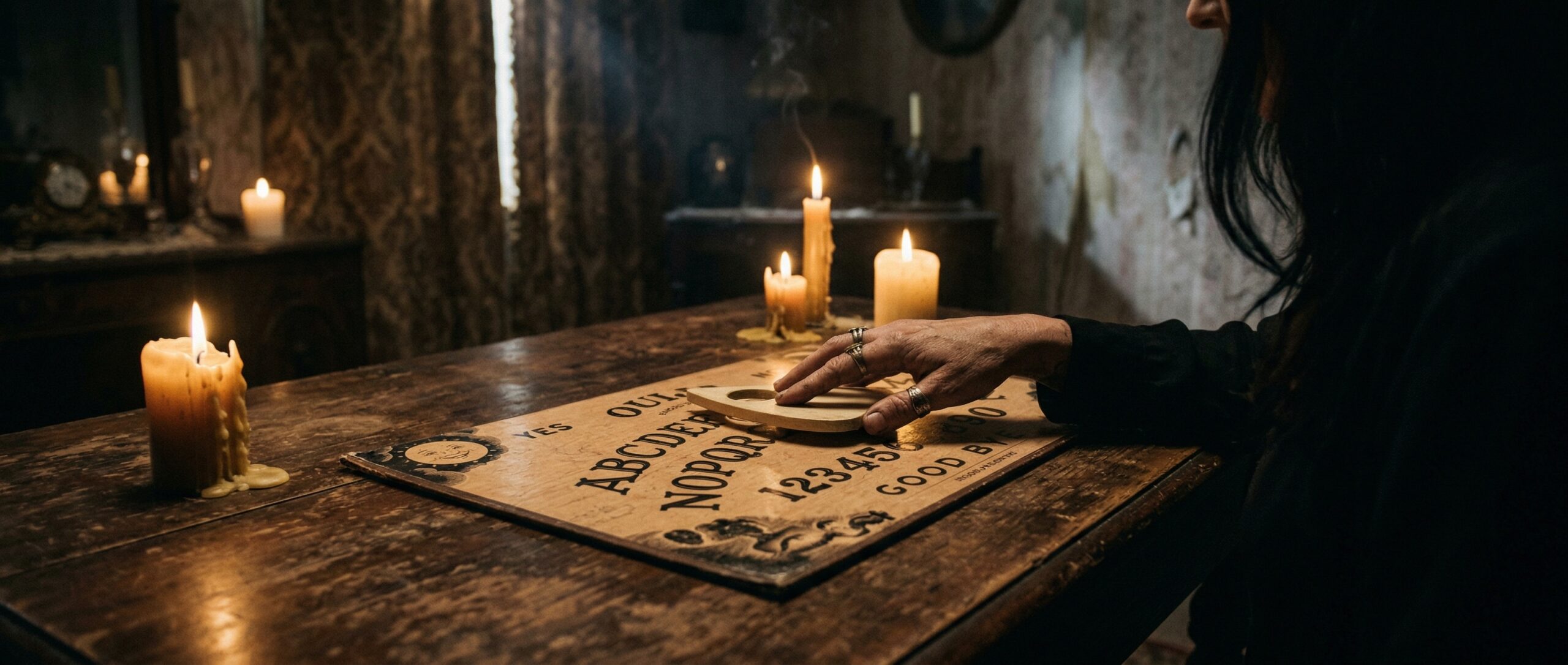
    At a basic level, the board is simple: letters, numbers, yes, no, goodbye, and a planchette that appears to move beneath participants’ fingers. But culturally it is anything but simple. It sits at the point where entertainment, ritual, folk belief, spiritual experimentation, and dare culture all overlap. That is why it unsettles people who do not believe in it and fascinates people who do. It asks a dangerous-seeming question in the easiest possible form: what if communication with the unseen required almost no expertise at all?

    This is also why the board feels different from many other occult tools. It democratizes contact. It does not ask for years of ceremonial study, rare texts, or complex symbolic systems. It invites beginners. It invites mockery. It invites bad faith. And then, because it is associated with movement that appears to happen under the users’ own hands, it turns even skepticism into participation. The board does not merely get used. It stages an experience, and that experience is what people carry away.

    The board emerged from nineteenth-century spiritualism, not ancient occult tradition

    For all its reputation as an ancient or timeless forbidden device, the Ouija board is a relatively modern product. Its roots lie in the spiritualist movement of the nineteenth century, when séances, spirit communication, automatic writing, table-turning, and mediumship became wildly popular in the United States and Europe. The board emerged from that same environment: a moment when mass grief, religious uncertainty, pseudoscientific curiosity, and fascination with unseen intelligence were all feeding into new forms of ritual contact.

    Historians of occultism have long noted that spiritualism was revolutionary partly because it made the supernatural feel procedural. Contact was no longer reserved for saints, magicians, prophets, or village cunning folk. It could be attempted in parlors by ordinary middle-class participants. The Ouija board fit perfectly into that democratized landscape. As Smithsonian Magazine has documented, the board’s commercial history is tied to both spiritualist culture and patent-era entrepreneurship, which means it was never only a sacred instrument. It was also a commodity.

    That strange dual identity never went away. The board was born at the intersection of belief and marketing, sincerity and performance. That is one reason it remains so hard to pin down. Unlike older ritual tools whose authority comes from antiquity, the Ouija board derives authority from modern repetition. It becomes powerful because generation after generation keeps reenchanting it.

    Every generation rediscovers the Ouija board because it offers danger without complexity

    There are many occult tools more elaborate than the Ouija board and many traditions more intellectually rich. Yet few have the same recurring mass appeal. That is because the board solves a cultural problem elegantly. It gives people an immediate, participatory brush with forbidden possibility without requiring much study. No initiatory structure, no memorized correspondences, no difficult ritual language. Just a board, a question, and the suggestion that something might answer back.

    That simplicity makes the board unusually adaptable. Teenagers can approach it as a dare. Horror fans can approach it as a genre artifact. occult-curious audiences can approach it as a beginner’s ritual technology. Skeptics can approach it as a test of whether anything unusual really happens. The same object serves all of them. That flexibility helps explain why the board keeps reviving across media cycles. It is endlessly reusable because it can absorb whatever a generation already fears.

    In 2026, the board’s revival fits especially neatly into platform culture. It performs well in short clips. It produces stories quickly. It invites reenactment. It turns uncertainty into narrative immediately. Whether a session is presented as real spirit contact, ironic experimentation, or post-midnight horror content almost does not matter. The board’s structure does the work. It gives any recording or retelling a built-in arc: question, movement, dread, interpretation.

    The board became a fear object because stories gave it a personality of its own

    The Ouija board did not become feared only because people used it. It became feared because stories gathered around it faster than around most other occult devices. Tales of the board rarely remain procedural. They become narrative almost at once. Someone asked the wrong question. Something followed them home. The planchette sped up. A name appeared that should not have appeared. The goodbye was ignored. A participant changed afterward. Even when these stories are secondhand, embellished, or impossible to verify, they create the sense that the board has preferences, moods, and consequences.

    That is a key part of the board’s folkloric power. It stops behaving like an instrument and starts behaving like a character. People speak of it as though it can invite, mislead, deceive, or punish. That narrative shift changes how users approach it. The board becomes less like a neutral device and more like a threshold with agency. Folklore scholars have often shown that objects gain cultural force when they are embedded in cautionary storytelling, and the Ouija board may be one of the clearest modern examples of that rule.

    Once that happens, every use session becomes haunted by prior stories. Participants do not begin from zero. They begin from layers of warning. That is why even a motionless session can feel charged. The board carries its archive into the room with it.

    Religious warning culture helped turn the board into a forbidden threshold

    No account of the Ouija board’s modern reputation would be complete without acknowledging the role of religious panic and moral warning culture. Across multiple Christian traditions, especially in the twentieth century, the board was treated not as harmless superstition but as an active invitation to deception, oppression, or demonic influence. Parents, pastors, and religious pamphleteers did not merely say the board was silly. They often said it was spiritually dangerous.

    That distinction mattered enormously. Once religious authority framed the board as forbidden, the board’s cultural charge intensified. A thing condemned so strongly acquires mystique automatically. The warning itself becomes advertisement. This is one reason the Ouija board has remained more potent in popular imagination than many other mass-market occult objects. It was repeatedly named as the one object that could open the wrong door in an ordinary home.

    That language still lingers even among people who no longer belong to the religious environments that spread it. Many modern users approach the board with inherited rules they cannot fully source: never use it alone, never mock it, never forget to say goodbye, never ask who will die, never burn it casually, never trust what comes through. These rules may vary, but together they form a shadow liturgy around the board. The object survives partly because the taboo does.

    Psychology offers one explanation, but it does not dissolve the experience for participants

    The most widely cited skeptical explanation for Ouija movement is the ideomotor effect, the phenomenon in which people make small physical movements unconsciously while sincerely feeling that they are not controlling them. Psychological research has long used this concept to explain dowsing, facilitated movement, and spirit-board sessions. From that perspective, the planchette moves because participants move it without consciously deciding to do so. The board becomes a mirror for expectation, suggestion, group dynamics, and hidden intention.

    That explanation is persuasive, and for many cases it is likely sufficient. But it does not fully erase the board’s power at the level where most people actually experience it. If anything, it complicates it. The unsettling part is not only the possibility that spirits are real. It is the possibility that people can reveal things to themselves without realizing they are doing it. The board remains eerie under either reading. It either mediates something beyond the self, or it stages the return of something buried within the self. For many users, neither option feels especially safe.

    This is why skeptical explanations often fail to end the fascination. They answer mechanism, but not meaning. They explain movement, but not why the room felt different, why certain answers landed so hard, or why the session seemed to expose hidden emotional currents in everyone touching the planchette. The board survives skepticism because skepticism does not entirely flatten what the experience feels like to the people inside it.

    Horror media kept the Ouija board culturally alive even when belief changed

    Even when direct belief in spirit communication became less common, the Ouija board never really left the cultural bloodstream. Horror cinema, paperback occult sensationalism, television hauntings, creepypasta logic, and later internet folklore all kept feeding the board new life. It became one of the few ritual objects that could be recognized instantly across generations, whether as a sincere danger, a camp icon, or a horror shortcut that needed almost no explanation.

    That media afterlife matters because it means many people meet the board first through narrative before they ever encounter the object physically. They know what it signifies before they know its history. It means haunted contact, opened doors, and consequences that outlast the session. That symbolic condensation is incredibly efficient. Very few occult objects carry such a complete emotional script in public culture.

    The board also adapts unusually well to retelling. A séance with layered ceremonial symbolism is harder to compress into a viral story. A spirit board session that spells out a name and ends badly can travel anywhere. It works in horror films, podcast episodes, TikTok reenactments, and whispered personal testimony. That portability has helped the Ouija board outlast changing belief systems and changing media forms alike.

    Younger audiences keep returning because the board feels participatory and dangerously simple

    The current revival makes sense partly because younger paranormal audiences are drawn to experiences that are interactive, aesthetic, and socially performable. The Ouija board does all three. It is visual. It is tactile. It can be staged easily. It produces suspense without special effects. Most importantly, it lets participants become part of the story immediately. In a culture saturated with spectatorship, that is a powerful selling point.

    The board also fits the broader return of folk ritual aesthetics. Many younger audiences are interested in candles, divination, haunted objects, ancestral practices, liminal spaces, and atmospheric tools that feel old even when their current usage is highly mediated through the internet. The Ouija board sits comfortably in that ecosystem, especially because it already carries a reputation for danger. It allows users to flirt with the occult while feeling that they are not merely performing a lifestyle trend. They are risking something.

    That risk may be symbolic, psychological, or theatrical, but it feels real enough to matter. The board survives because it makes the unseen feel participatory. It turns haunting into a format people can touch.

    The board still matters because it dramatizes the human desire to test the unseen

    Strip away the toy branding, the horror clichés, the demonic warnings, and the skeptical rebuttals, and the Ouija board still returns us to a very old human impulse. We want to know whether the boundary is permeable. We want to know whether the dead answer, whether hidden intelligences notice us, whether ordinary rooms can become charged, whether meaning can arrive through simple material forms. The board does not create that desire. It concentrates it.

    That is why the object endures. It stages one of the oldest religious and paranormal questions in an almost offensively accessible way. It says: sit down, ask, wait, see what moves. That is both ridiculous and profound. It is ridiculous because the format is so commercially ordinary. It is profound because the emotional stakes people attach to the answer remain enormous.

    In that sense, the Ouija board is not just a spooky artifact. It is a recurring machine for producing uncertainty. That uncertainty can be dismissed, feared, ritualized, or aestheticized, but it rarely stays inert. The board continues to matter because it turns invisible questions into visible motion.

    The Ouija revival fits a wider return to ritual objects, haunted folklore, and intimate occult fear

    Seen in a wider context, the 2026 return of Ouija conversation is part of a larger cultural pattern. Old ritual tools keep resurfacing because they promise intimacy with the forbidden. Not abstract conspiracy, not distant mythology, but something close enough to hold in your hands. That is also why audiences continue to respond to haunted-location narratives, witchcraft revivals, spirit-communication stories, and classic possession lore. The scale is domestic. The risk is personal. The danger comes into the room.

    This is where the board connects to unexplained.co’s wider territory. It belongs alongside investigations into occult history, haunted houses, folk ritual, and the repeated ways modern audiences reinvent old fears in new media environments. It also helps explain why some objects outlive debunking. They are too symbolically useful to disappear. The Ouija board remains one of the purest examples of that survival mechanism in modern occult culture.

    The board was never just a board. It was a script, a dare, a threshold, a market product, a séance machine, a warning label, and a portable haunting myth. That is why every generation eventually picks it up again. Not because the mystery was solved, but because it never really stopped asking to be touched.

    Frequently Asked Questions

    Why does the Ouija board still scare people so much?

    Because it sits between game, ritual, and taboo, and because generations of ghost stories, religious warnings, and horror media have taught people to see it as a tool that might open the wrong kind of door.

    Was the Ouija board originally an occult object?

    It emerged from nineteenth-century spiritualist culture rather than ancient occult tradition, which means it has always carried a mixed identity as both commercial product and spirit-contact device.

    What is the skeptical explanation for Ouija board movement?

    The most common explanation is the ideomotor effect, in which people move the planchette unconsciously while sincerely feeling that they are not controlling it.

    Why does the Ouija board keep returning in pop culture?

    Because it is visually recognizable, easy to dramatize, and perfectly suited to stories about haunting, possession, forbidden contact, and private fear.

    Why are younger audiences interested in the Ouija board again?

    It feels interactive, aesthetic, and risky in a way that fits modern paranormal media culture, especially for audiences drawn to ritual objects, haunted folklore, and participatory occult experiences.

    This article was created using Media Blaster – Your content production specialist. Visit www.mediablaster.io for more information.

  • Amy Bradley Mystery: New Leads Resurface

    Amy Bradley Mystery: New Leads Resurface

    The long-running disappearance of Amy Bradley is back in circulation after reports of new investigative movement tied to the 1998 cruise-ship case. Bradley, 23, vanished during a Royal Caribbean trip with her family while the ship was nearing Curaçao. Nearly three decades later, the case remains one of the most discussed disappearance mysteries on the internet. According to Fox News, the story is gaining attention well beyond its original niche.

    The new wave comes from comments by filmmaker Ari Mark, whose Netflix docuseries *Amy Bradley Is Missing* revived public attention in 2025. According to reports, two people with alleged trafficking ties have been questioned by the FBI, while additional leads include claims that Bradley may have given birth after her disappearance and that a 2023 website IP hit may have come from a public computer inside a Caribbean casino.

    That is why this story matters. It is not just about the headline claim itself, but about the way uncertainty, symbolism, and public appetite for hidden meaning keep turning partial information into a larger mystery event.

    What This Story Actually Says

    This is trending because unresolved disappearances sit right on the edge of true crime, conspiracy, and paranormal-style mystery culture. Amy Bradley is especially potent because the setting feels cinematic: a person vanishes from a cruise ship without a definitive explanation. Additional framing from Hollywood Reporter update referenced by Fox helps explain why the claim is traveling.

    • Fox News and other outlets are amplifying updates sourced from Ari Mark and *The Hollywood Reporter*.
    • The reported developments include:
    • FBI questioning of two people of interest tied to trafficking,
    • a lead suggesting Bradley may have had a child after vanishing,
    • follow-up around a 2023 website access originating from a Caribbean casino.

    Why This Topic Spreads So Easily

    Stories like this spread because they land at the intersection of real-world uncertainty and symbolic interpretation. Once a subject carries enough emotional charge, audiences do not just ask whether it is true. They ask what it means.

    The long-running disappearance of Amy Bradley is back in circulation after reports of new investigative movement tied to the 1998 cruise-ship case. Bradley, 23, vanished during a Royal Caribbean trip with her family while the ship was nearing Curaçao. Nearly three decades later, the case remains one of the most discussed disappearance mysteries on the internet.

    What the Evidence Actually Supports

    The strongest evidence in stories like this is often narrower than the online reaction suggests. That is why it is important to separate direct reporting, contextual interpretation, speculation, and audience mythmaking rather than treating them as one unified thing.

    Coverage and reporting relevant to this topic include:

    What Skeptics or Mainstream Experts Would Say

    The strongest skeptical response is usually that ambiguity gets inflated faster than evidence does. That does not make the story worthless. It means the audience should be careful not to mistake symbolic power for proof.

    In many of these cases, the most likely explanation is still the least dramatic one that fits the known facts. But because emotionally satisfying explanations travel farther than cautious ones, the mystery version often spreads first and hardest.

    Why This Story Still Matters

    For unexplained-content audiences, the Amy Bradley case behaves like a modern legend. There is no supernatural claim required. The mystery itself carries the same emotional mechanics:
    – isolation in a liminal setting,
    – fragmentary sightings,
    – suspicious leads,
    – a long trail of “what if” theories,
    – a family still searching.

    It matters editorially because this case shows how streaming documentaries can function like paranormal revivals: they resurrect cold mysteries, generate new witnesses and tips, and transform old cases into participatory internet investigations.

    There is also a cautionary angle. Cases like this attract speculation fast, and the newest leads are still unverified in any conclusive sense. That tension between hope and hype is part of the story.

    The Bigger Unexplained Pattern

    For unexplained coverage, the deeper value is often cultural rather than evidentiary. These stories reveal what people fear, what they hope, what they distrust, and how quickly they build meaning around incomplete information.

    That is exactly why the newer SEO/GEO standard works better than the old short-form template. It is designed to answer the headline question, ground the reader in what is actually known, include stronger context, and still explain why the story has such emotional force.

    Readers interested in the broader pattern should also see The Pentagon UFO Report and What It Still Can’t Explain, which connects this story to a larger unexplained.co theme.

    Final Assessment

    The real significance of stories like this is often not that they prove an extraordinary claim, but that they show how extraordinary interpretations take shape. In other words, the mystery is not only in the event. It is also in the reaction.

    Frequently Asked Questions

    What is this story about?

    The long-running disappearance of Amy Bradley is back in circulation after reports of new investigative movement tied to the 1998 cruise-ship case. Bradley, 23, vanished during a Royal Caribbean trip with her family while the ship was nearing Curaçao. Nearly three decades later, the case remains one of the most discussed disappearance mysteries on the internet.

    Why is this getting attention now?

    For unexplained-content audiences, the Amy Bradley case behaves like a modern legend. There is no supernatural claim required. The mystery itself carries the same emotional mechanics:
    – isolation in a liminal setting,
    – fragmentary sightings,
    – suspicious leads,
    – a long trail of “what if” theories,
    – a family still searching.

    Is Amy Bradley Mystery: New Leads Resurface proven?

    No. These articles are written to separate what is verified, what is claimed, and what remains uncertain. Mystery does not automatically equal proof.

    What should readers focus on?

    Focus on the evidence, the source quality, the skeptical or conventional explanations, and why the story still resonates even when certainty is missing.

    Related Articles

    This article was created using Media Blaster – Your content production specialist. Visit www.mediablaster.io for more information.
  • Two Missing Now: The Wright-Patterson Connection Deepens

    Two Missing Now: The Wright-Patterson Connection Deepens

    The mystery of missing Air Force General William Neil McCasland just got a lot stranger. Now, his former co-worker has also vanished — and the connection to UFO research is drawing new attention.

    Just when the story about missing retired U.S. Air Force Major General William Neil McCasland couldn’t get much stranger, another twist pops up. It turns out his former colleague, Monica Reza, also vanished under mysterious circumstances — and the connection to government UFO research is now making headlines.

    The Two Missing

    William Neil McCasland

    • Last seen: February 27, 2026, at his New Mexico home
    • Former commander of Wright-Patterson Air Force Base (the legendary UFO hub)
    • Briefly worked with Tom DeLonge’s To The Stars Academy after retirement
    • Left his phone, glasses, and wearable devices at home before vanishing
    • Wallet, red backpack, and .38 caliber revolver still unaccounted for

    Monica Reza

    • Last seen: Nine months ago (approximately June 2025)
    • Was hiking in the Angeles National Forest with a companion
    • Aerospace engineer who worked on developing a special metal for rockets
    • Part of a U.S. government project overseen by McCasland

    The Connection

    According to Brobible, Monica Reza was an aerospace engineer who worked on developing a special metal for rockets as part of a U.S. government project — one that was overseen by McCasland.

    The 2016 WikiLeaks release described McCasland as a key adviser on several UFO-related projects. Both individuals have direct links to Wright-Patterson Air Force Base — the base that’s been at the center of every major UFO conspiracy theory since Roswell.

    As The Express reports, the case has been described by at least one expert as a “grave national security crisis.”

    The Timeline

    • June 2025: Monica Reza last seen hiking in Angeles National Forest
    • February 27, 2026: McCasland last seen at his New Mexico home
    • Early March 2026: McCasland disappears; UFO connection noted
    • March 15, 2026: Trump announces UFO disclosure directive
    • March 17-18, 2026: Sheriff addresses UFO theories
    • March 19, 2026: News breaks that Reza also vanished

    The Official Response

    The FBI is involved in the investigation. The sheriff is “setting aside” UFO theories but leaving the door open — famously saying “just because it’s crazy doesn’t mean it’s not true.”

    McCasland’s wife says he “does not have any special knowledge about the ET bodies and debris from Roswell.”

    But the second disappearance adds a new layer that the official narrative has to address.

    Why This Matters

    Two is a pattern, one is an anomaly

    With one missing general connected to UFO research, you could argue it’s a personal matter. Two people from the same government research circle vanishing? That’s harder to explain away.

    The Wright-Patterson factor

    Both McCasland and Reza have direct links to Wright-Patterson — the base at the center of every major UFO conspiracy since Roswell. The base housed Project Blue Book, the official Air Force UFO investigation that ran from 1952-1969.

    The timing

    This is happening now, in the midst of:

    • Trump’s disclosure announcement
    • The aliens.gov domain registration
    • Increasing UFO/UAP media coverage

    The Theories

    “They’re being silenced”

    Both know too much; something happened.

    “They went underground”

    They’re hiding until disclosure happens.

    “It is what it seems”

    Two unrelated disappearances, coincidental timing.

    “The conspiracy is real”

    This proves something is being hidden.

    What’s Next

    • Will more connections emerge?
    • Is there a third or fourth person in the network who’s also missing?
    • Will the FBI expand the investigation?
    • How will the UFO community react?

    One thing is clear: what started as a single missing persons case has evolved into something much more complex. Two people with connections to UFO research — both linked to the most secretive Air Force base in America — have vanished. That’s not a coincidence many can easily dismiss.

    Read more on NewsNation.

  • Glowing Eyes, Screams, and a Sunken BMW: The Hidden Data

    Glowing Eyes, Screams, and a Sunken BMW: The Hidden Data

    Key Takeaways

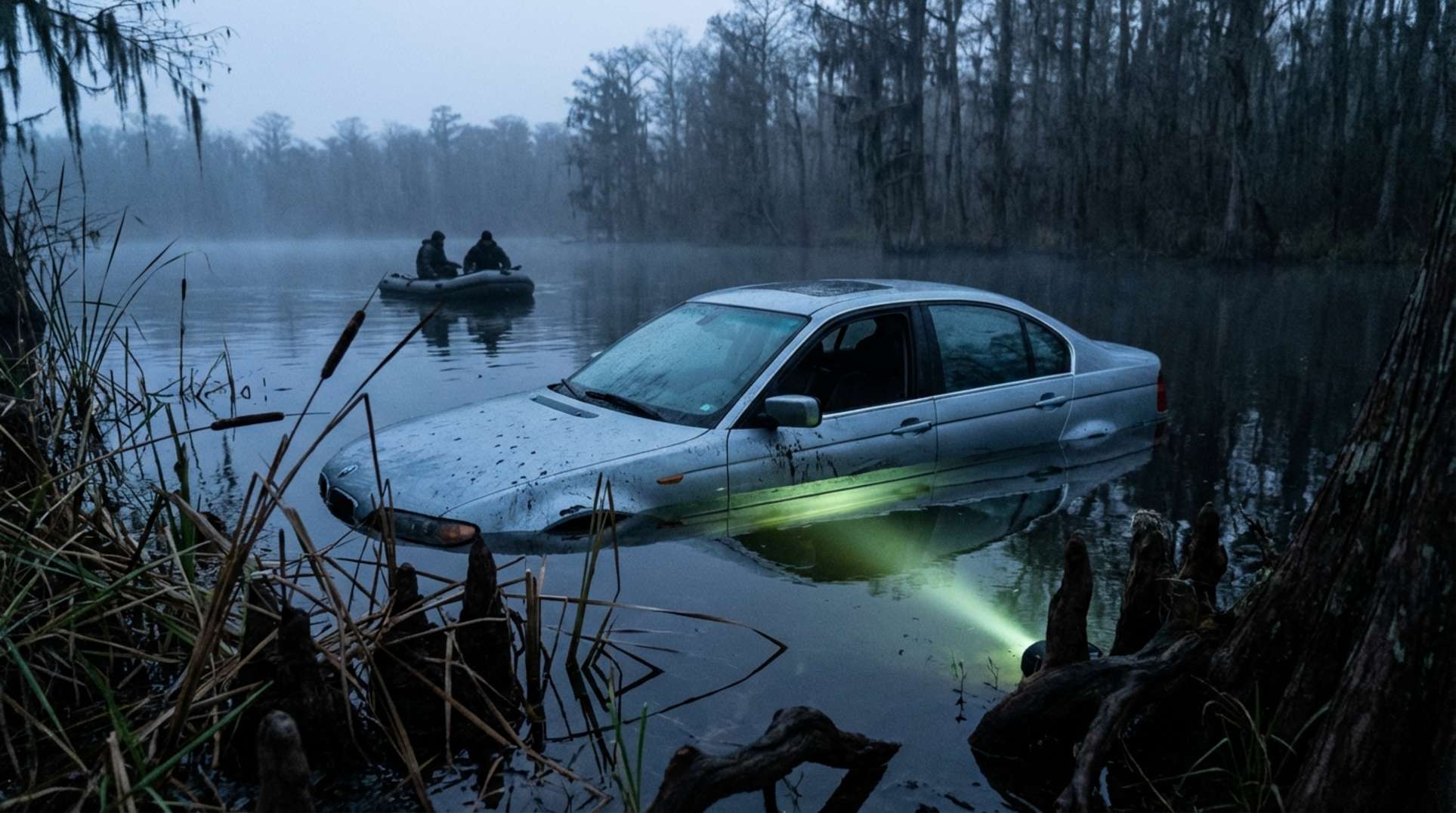
    • Independent divers used sonar and an underwater drone to find a submerged silver BMW in Rocky Bluff Swamp, with family members viewing images before official recovery.
    • The Sumter County coroner confirmed human remains inside the BMW belonged to Tommy Brailey, missing since August 2017, as reported in news on January 1–2, 2025.
    • Trail-camera and camping clips show ambiguous silhouettes, cloaked figures, glowing eyes, and piercing night sounds, shared widely on YouTube, Reddit, and trail-cam sites, though many lack provenance.
    • Wildlife experts note that foxes and other canids make high-pitched screams, often mistaken for human sounds, peaking in winter months like December to February.
    • Unresolved aspects include missing original files and metadata for several trail-cam clips, no public forensic audio analysis for snowstorm sounds, and undocumented physical claims like prints or vehicle tampering without chain-of-custody or official reports.

    Under the First Light: An Opening Vibe

    Snow blankets the Arizona desert, rare and sharp, muffling footsteps while amplifying distant cries that cut through the storm. In the Amazon’s thick dark, river water laps against the bank as glowing eyes trace slow circles around a fishing camp, forcing retreat to a tent where the night stretches long under unseen scrutiny. Remote spots in the UK and Colorado echo this unease—campers sense eyes on them, lights sweep the trees, dogs bristle and whine. These are places where the camera stands sentinel, capturing what the eye might miss, in swamps choked with murky water or parking lots edged by silent woods.

    What Witnesses and Analysts Report

    Property owners and campers share stories that pull you in, details stacking up without easy dismissal. A trail camera on private land caught heavy-cloaked figures slipping through the woods near a cabin, night after night for three days straight—they ignored the lens, then simply vanished. In Michigan, another cam snapped a thin, long-limbed shape with eyes that seemed to glow, sparking talk among online groups of dogman sightings, skinwalkers, or just a glitch in the infrared.

    Rob Outdoor, camping solo in the UK, described a persistent feeling of being watched, something peering into his van, even targeted honks that rattled his nerves enough to pack up and go. Over in Colorado’s Rubido Canyon, Kelly recounted his dog staying on high alert, massive trees arranged in unnatural patterns, a glimpse of a spindly creature, rain-slicked vehicle tampering, and odd handprints or footprints left behind.

    In Brazil’s Amazon, Amaroso and his friend set up for night fishing only to spot two glowing eyes orbiting their camp, driving them into the tent for a sleepless vigil. Meanwhile, independent divers in the swamp deployed sonar from boats and an underwater drone, spotting the sunken BMW and sharing images with the family before officials stepped in—hobbyist investigators piecing together what others overlooked.

    Timelines, Tracks, and Hard Data

    Facts anchor these accounts, some rock-solid from official sources, others hanging on witness words alone. Tommy Brailey vanished in August 2017; his submerged vehicle and remains surfaced in reports from January 1–2, 2025, identified by the Sumter County coroner using dental records. Independent teams scanned with sonar and drones, leading to official recovery—sourced from outlets like WIS and WLTX Street Squad.

    Wildlife data backs up some sounds: fox and canid screams peak December to February, mimicking human cries per expert sources. Trail-cam clips spread on YouTube, Reddit, and TrailCamValley, but many miss original metadata or provenance.

    To chase verification, push for full-resolution videos, EXIF data, and SD card images—hand them to a neutral forensic lab for optical and audio breakdowns.

    Event Details Source/Verification
    Tommy Brailey Case Last seen Aug 2017; vehicle/remains found Jan 1–2, 2025; ID via coroner and dental records Sumter County Coroner’s Office; independent sonar/drone discovery led to recovery (WIS, WLTX)
    Wildlife Sounds Fox/canid screams peak Dec–Feb, sound human-like Wildlife expert documentation
    Trail-Cam Clips Shared on YouTube, Reddit, TrailCamValley Many lack metadata/provenance; anecdotal circulation

    Official Story vs. What the Data Suggests

    Authorities close the book on some parts cleanly: Sumter County’s coroner office stands by the ID of Tommy Brailey’s remains in the BMW, treating the recovery as settled fact. Yet community voices highlight how family and indie divers got there first with sonar and drone shots, passing images to relatives before the pros arrived—sparking questions on who verifies what in civilian searches.

    Experts lean toward wildlife for the screams, citing fox vocalizations or echoes in the environment, while trail-cam oddities get chalked up to blur, IR glitches, or trespassers. Still, those cloaked figures repeating nights without flinching at the camera, then gone, don’t fit neatly. Rubido Canyon’s tampering and prints lack official logs or chain-of-custody, leaving gaps.

    No spectrograms out there for the Arizona audio, no raw metadata for key clips, no re-enactments to test theories—skepticism cuts both ways, urging balance over quick judgments.

    Open Threads: What We Still Don’t Know

    Plenty of loose ends beg for follow-up. For those cloaked-figure and long-limbed clips, did anyone preserve the original files, metadata, timestamps, or SD cards for outside checks? The Arizona snowstorm sounds—has spectrogram work or acoustic modeling ruled out wind, ice, or temps as culprits?

    Could we recreate the blurry shapes and glowing eyes using local critters, IR camera settings, or posed humans at the same spot? In Rubido Canyon, where are the scaled photos, casts, soil samples, or filed reports on those handprints and tampering?

    On the search side, how common is it for indie sonar and drone crews to beat officials to submerged vehicles, and what rules govern sharing pics with families or cops? Digging into these could tighten the narrative.

    What It All Might Mean

    These threads weave loss and lingering fear—Tommy Brailey’s family finally gets answers through determined divers, a real mercy in the murk. Campers face nights that shift from routine to raw unease, reminders of how thin the line feels out there.

    Solid ground holds for the recovery and wildlife sounds, with fox cries, eye-shine, and camera quirks explaining much. But unverified images and claims push for stronger habits: chase original files, run spectrograms, team up on forensics, and honor cultural stories like skinwalker lore without twisting them.

    It’s about sharpening our tools, not shutting down the search—patterns emerge when we document right.

    Frequently Asked Questions

    Yes, independent divers located a silver BMW in Rocky Bluff Swamp using sonar and an underwater drone, sharing images with the family before official recovery. The Sumter County coroner confirmed the remains inside as Tommy Brailey, missing since August 2017, via dental records, as reported in early January 2025 news.

    Wildlife experts point to foxes and other canids producing high-pitched screams that mimic human sounds, especially in winter. Glowing eyes could stem from animal eye-shine or camera infrared reflections, though some clips and witness reports remain unresolved without forensic analysis.

    Many clips circulate on YouTube and Reddit but lack original metadata or provenance, making verification tough. Cloaked figures and long-limbed silhouettes spark speculation, but without chain-of-custody or lab analysis, they stay in the anecdotal realm.

    Law enforcement accepted the recovery and coroner’s identification as official. However, independent divers found the vehicle first, raising questions about civilian roles in searches and protocols for sharing evidence.

    Elements like the cloaked figures’ behavior, sudden disappearances, vehicle tampering, and handprints lack documented evidence or official reports. No public audio forensics exist for sounds, and many clips miss metadata, leaving room for further investigation.

  • Marked in Ohio: Drug Trap or Ritual Experiment?

    Marked in Ohio: Drug Trap or Ritual Experiment?

    Key Takeaways

    • Witnesses describe waking disoriented in an abandoned house, surrounded by passed-out partygoers marked with a recurring symbol—a triangle crossed by an X with a hook at the bottom. The host, Mullen, was overheard saying, ‘I brought them. Please, I brought them. I marked them.’ (Timestamps from the account: awakening 7:11–8:10; symbol reveal 25:50–27:20).
    • Attendees report taking ‘wellness shots’ that a friend, Jake, later identified as containing ‘Molly’; another friend, Lola, allegedly went berserk with a knife after the shots, followed by cloaked figures cutting the power, causing the crowd to scatter, with the narrator left behind (27:30–32:20).
    • Verifiable context includes documented party shootings and high overdose risks in Ohio (e.g., AP reports, NBC); public-health data shows widespread adulteration of party drugs like MDMA with fentanyl and other substances (CDC, peer-reviewed studies).
    • Unresolved: No matching police press release, 911 record, or hospital/toxicology report found in initial searches to corroborate the full story (Research Dossier searches yielded no direct match).
    • Practical concern: If shots were adulterated, harm-reduction tools like fentanyl test strips and naloxone are key, though FTS have limits and toxicology data isn’t public yet.

    A Quiet House, A Strange Awakening

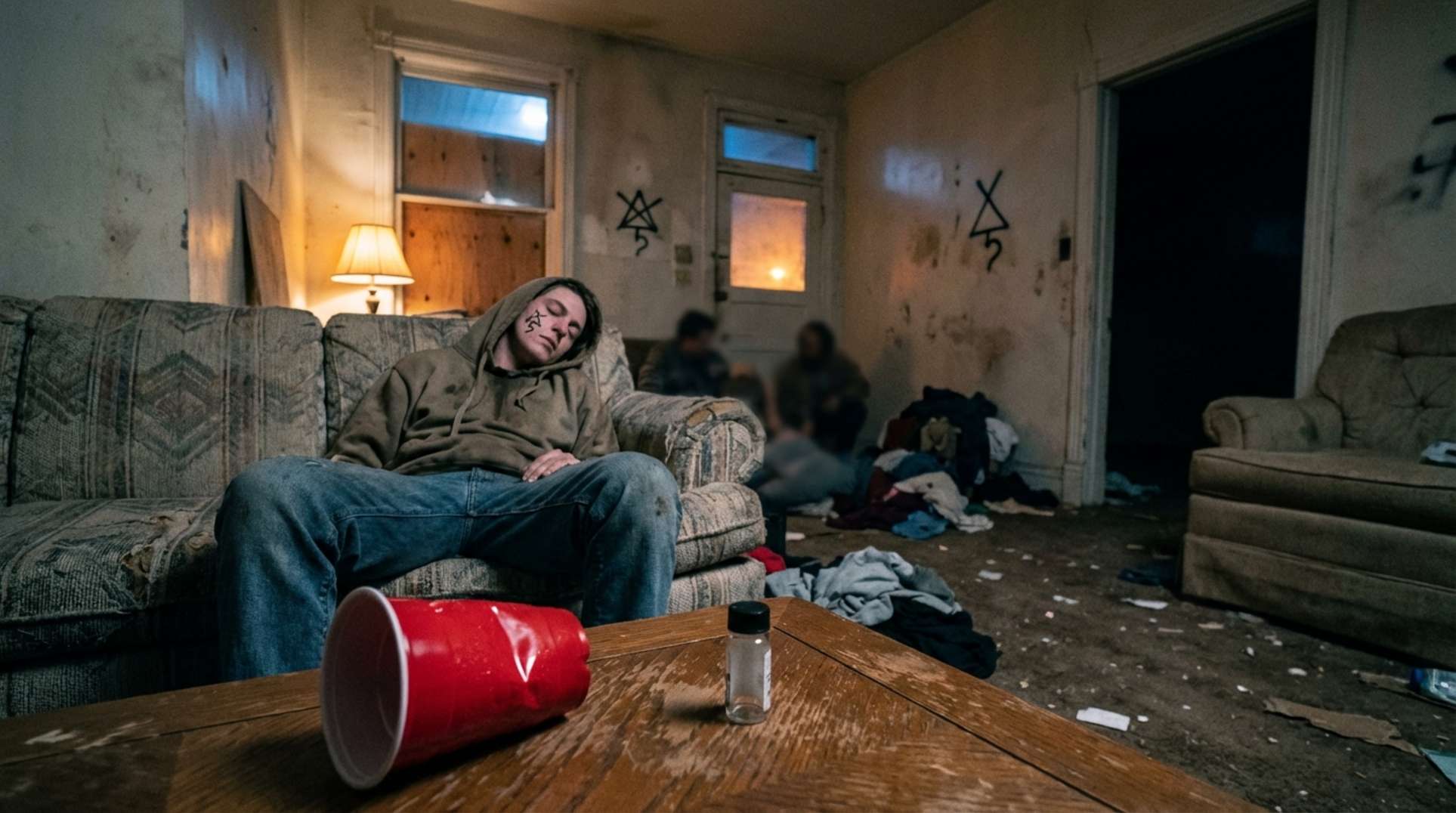
    The clock ticks past midnight in a rundown Ohio neighborhood. Houses stand empty, windows boarded, streets shadowed. Inside one such place, the narrator stirs, head throbbing, memories blurred. The house feels abandoned, silence broken only by shallow breaths from bodies slumped on floors and couches. Confusion builds to dread.

    Passed-out guests lie scattered. At first, the markings on their faces seem like party fun—marker doodles or face paint. Then details sharpen: a child’s leg visible among the forms, twisting the scene into something grotesque. The air hangs heavy with unspoken wrongness.

    Outside, the area echoes that decay—decrepit buildings, a sense of lawlessness. During the later chase, it feels like a criminal’s paradise, shadows deepening the fear. These impressions shape what comes next: claims of cloaked figures, symbols etched everywhere. Eyewitness mood matters here; it’s the frame through which the night unfolds.

    What Witnesses and Analysts Report

    Witness accounts paint a chilling sequence. The narrator wakes alone, spots the marked partygoers, overhears Mullen’s desperate plea: ‘I brought them… I marked them.’ A chase ensues with Mullen, leading to symbols carved into trees, spray-painted on walls, arranged from rocks in the neighborhood. Back at Jake’s apartment, the narrator discovers the same mark on their own face.

    Key players: Mullen as host, Jake who handed out the shots and later called them ‘Molly,’ Lola who reportedly snapped, attacking Mullen with a knife post-shot. The symbol—a triangle with an X through it and a hook below—repeats in these reports.

    Online communities echo similar tales: memory gaps, marked victims, cloaked intruders, recurring symbols. Threads mix real emergencies with misreads and fiction. Harm-reduction voices urge caution with ‘wellness shots’ posing as MDMA; testing and naloxone are standard advice amid adulteration risks.

    We hear you—these stories resonate because they’ve happened before, in fragments, across reports. Witnesses deserve space to share without judgment.

    Timelines, Tracks, and Hard Data

    Let’s map what we can pin down. Ohio’s seen its share of party violence and overdoses. An example: a June 3, 2024, party shooting reported by AP (AP link)—context for regional risks, not direct proof here.

    Public-health backing: Ohio’s 2023 Unintentional Drug Overdose Annual Report details trends (Ohio report link); CDC notes ~69% of 2023 U.S. overdose deaths involved synthetic opioids (CDC fast stats).

    Adulteration evidence: Studies show MDMA often laced with fentanyl (PubMed link; MMWR link).

    Symbol searches: Reddit threads catalog triangle glyphs; ADL notes historical extremist symbols (links; links)—meanings ambiguous.

    Missing: No matches in Columbus press releases (link) or Cleveland.com crime pages (link).

    Claim Source/Link Status
    Party violence in Ohio AP report (link) Verified (contextual)
    Overdose trends Ohio 2023 Report (link); CDC (link) Verified
    Drug adulteration PubMed/PMC studies (link); MMWR (link) Verified
    Symbol motifs Reddit/ADL (links; links) Partially verified (ambiguous)
    Police/911 records for event Columbus releases (link); Cleveland.com (link) No public record

    Official Story vs. What the Data Suggests

    Agencies like the CDC push overdose prevention, highlighting fentanyl test strips’ limits and evolving illicit supplies (CDC guidance; Ohio reports link).

    Data aligns with witness fears: Research confirms party drugs mixed with opioids heighten risks, matching the ‘shots’ reactions described.

    Silence on specifics: No public records confirm cloaked figures, power cuts, or face markings—absence noted in police and utility logs.

    Alternatives float in communities: Could be graffiti tags, hobo codes, intoxication panic, or staging. Each predicts different evidence—tags might show in vandalism reports, panic in mismatched memories. Absence isn’t disproof, but it demands more scrutiny. Push for toxicology, outage logs, eyewitness checks to clarify.

    Evidence Missing and Smart Next Steps

    Key gaps: Police reports naming Mullen or the event; 911 logs; hospital/toxicology for attendees; utility records of power cuts; social-media posts with symbols or scenes.

    FOIA targets: Local police incident reports, county EMS logs, redacted ER admissions, utility outage data. Researcher can run neighborhood/video searches.

    Toxicology could reveal MDMA, cathinones, or fentanyl—shifting explanations. Lab confirmation beats FTS limits.

    For symbols: Check Nextdoor/Facebook for posts, public works vandalism reports; compare photos to registries. Consult graffiti experts or marking anthropologists.

    Focus on safety: Share harm-reduction tips, warn on unverified claims, source witnesses respectfully.

    What It All Might Mean

    Solid ground: The account details unconscious guests and a repeating symbol; Ohio’s drug adulteration trends make tainted shots believable; no records yet back the wilder parts like cloaked intruders or deliberate markings.

    Big questions: Symbol origins, the ‘I marked them’ plea, attendee toxicology, blackout records or group involvement.

    Why track this? It highlights real dangers—bad drugs, gathering vulnerabilities, symbols fueling fear. Even if details shift, patterns like these matter to those watching the edges. Flag verified vs. unverified, cite resources, chase FOIAs and videos for clarity.

    Frequently Asked Questions

    The witness narrative describes a disorienting night with marked partygoers, adulterated shots, and cloaked figures, but no public records like police reports or toxicology confirm the full story yet. Parts align with verified Ohio overdose and party violence trends, making some elements plausible.

    Public-health data from CDC and Ohio reports back the risk of adulterated drugs like MDMA laced with fentanyl. Symbol motifs appear in online threads and registries, but no official records corroborate cloaked figures, power cuts, or the host’s statements.

    No matching police press releases, 911 logs, or hospital reports have surfaced in searches. Agencies like the CDC emphasize overdose prevention and adulteration risks, which support parts of the narrative, but silence on specifics leaves room for further investigation.

    Use harm-reduction tools like fentanyl test strips and naloxone for suspect drugs, though testing has limits. Report incidents to authorities and seek toxicology if involved; communities recommend verifying substances before use.

    The triangle with an X and hook appears in witness reports as carvings, paintings, and rock arrangements, echoing motifs in online threads and historical symbols. Provenance remains unclear—could be graffiti, codes, or something else; further checks on local reports are needed.

  • Jack O’Sullivan: Why The CCTV Still Doesn’t Add Up

    Jack O’Sullivan: Why The CCTV Still Doesn’t Add Up

    Key Takeaways

    • The strongest evidence points to Jack’s last confirmed sighting at 03:13 on March 2, 2024, as he walked from a car park onto the green below the Plimsoll Swing Bridge in Cumberland Basin, with extensive police searches—including over 100 hours of CCTV review and 200+ hours of dive operations—yielding no trace of him, his clothing, or possessions.
    • Phone and location data remain hotly contested: authorities claim the phone never left the Hotwells/Cumberland Basin area based on RF enquiries, while family-accessed EE data and community analysis suggest possible activity as late as 06:44, raising questions about chain-of-custody and full disclosure.
    • The single clearest mystery is how Jack vanished without any physical evidence emerging from such thorough searches, compounded by unresolved discrepancies in CCTV retention, phone logs, and potential later movements that challenge the official timeline.

    A Silent Night by the Basin

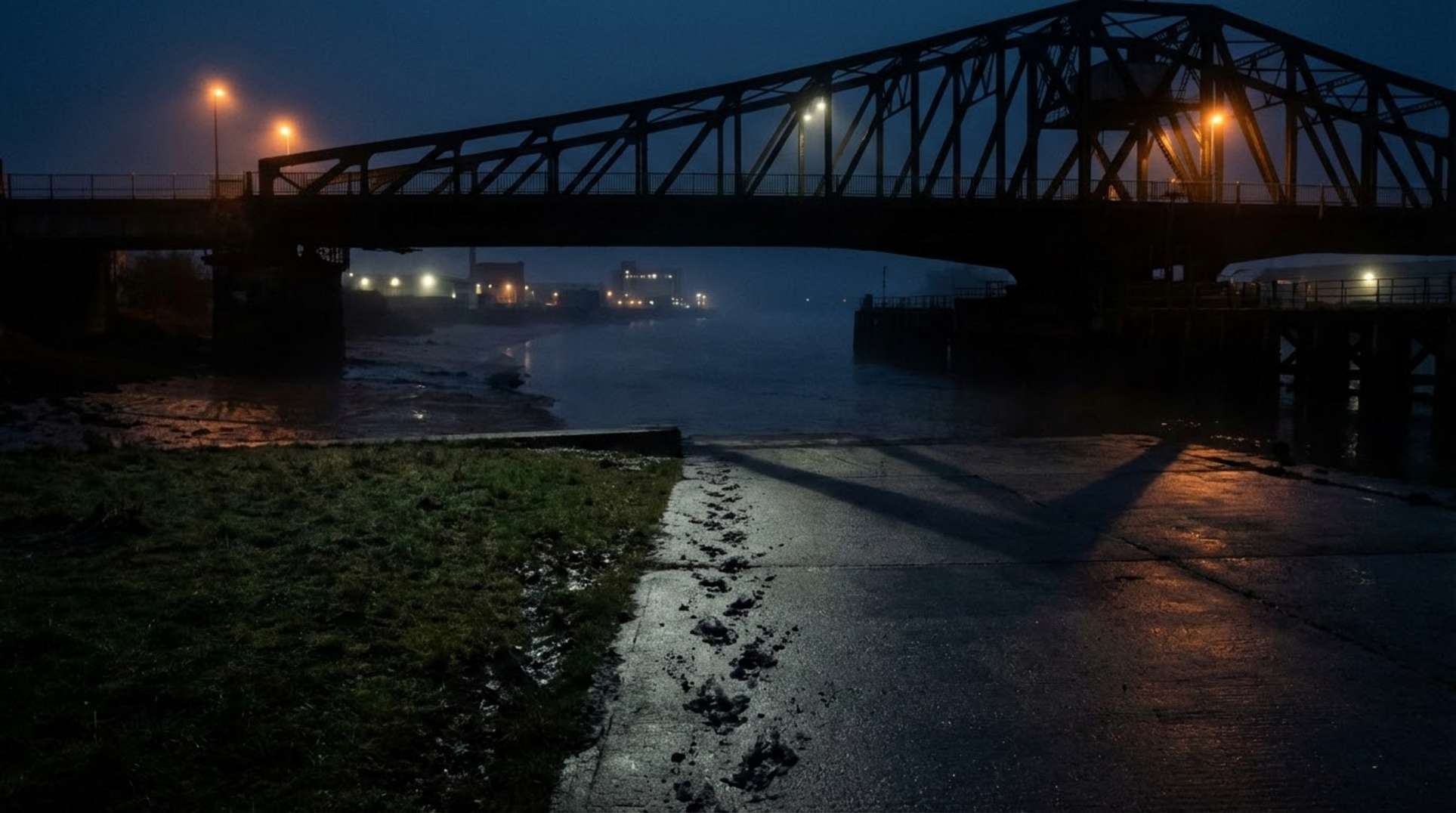
    The early hours of March 2, 2024, gripped Bristol’s Hotwells district in a biting cold. Jack O’Sullivan, 22 or 23, had spent the evening out on March 1 before joining a house party. What started as casual vibes soured with a minor altercation. He stepped out alone into the freezing night, heading toward the Cumberland Basin.

    Picture it: the tidal Avon River laps against slipways and channels, marine traffic hums faintly in the dark. The Plimsoll Swing Bridge looms overhead, casting long shadows. Disoriented, perhaps chilled to the bone, Jack navigates this treacherous harbor edge—slippery surfaces, unpredictable currents, all under a moonless sky. One wrong step here feels like stepping into oblivion.

    What Witnesses and Analysts Report

    Family members and independent reviewers have pored over footage, identifying what they believe are additional sightings of Jack around 03:25, 03:38, and 03:40—extending beyond the police’s confirmed 03:13 timestamp, as detailed in family statements and Guardian reports.

    The O’Sullivans launched the FindJack campaign, complete with a website, independent searches, rewards, private investigators, and formal complaints against police handling of CCTV retention, according to findjackosullivan.co.uk, Bristol Post, and The Guardian.

    Online communities on Reddit, SolveTheCase, and local Facebook groups compile timelines and theories respectfully. Discussions often circle back to a potential water accident, debates over phone pings and RF data, or third-party involvement, with groups sharing appeals and analyzing possible sightings.

    Police have highlighted specific witnesses in appeals, like taxi drivers and a dog-walker in a green padded jacket with a black dog wearing a red collar, seen on CCTV. They’ve urged the public to submit dashcam footage, as reported by BBC and Wales Online.

    Timelines, Tracks, and Hard Data

    Police statements pin the last confirmed sighting at 03:13 near the Plimsoll Swing Bridge. They assert the phone stayed in the Hotwells/Cumberland Basin area, backed by RF and phone-location enquiries, per Avon & Somerset Police and BBC reports.

    Searches were exhaustive: over 100 hours of CCTV reviewed, plus dive operations totaling more than 200 hours from Avonmouth to Conham, involving land, drone, and specialist teams, as noted in police updates and media from BBC and ITV.

    Phone details spark debate—family received some EE data, and press like Bristol Post report activity until about 06:44, though police haven’t publicly confirmed this. Clarification requires carrier logs and metadata.

    CCTV retention issues persist; family reviewers claim key footage wasn’t preserved, leading to complaints highlighted in The Guardian and local press.

    Metric Value Source
    Last confirmed sighting 03:13 Avon & Somerset Police
    Phone last reported network activity c.06:44 Press/EE (contested)
    Dive search hours 200+ Media/Police
    CCTV hours reviewed 100+ Avon & Somerset Police

    For verification, check Avon & Somerset Police statements, BBC timelines, ITV and Guardian articles, the FindJack site, and Bristol Post reports.

    Official Story vs. What the Data Suggests

    Avon & Somerset Police describe their investigation as active and open-minded, sticking to the 03:13 last sighting and searches guided by RF data showing the phone remained stationary in the area. Legal and data-protection rules limit what they share publicly, per their statements and BBC coverage.

    Yet family and community analysts counter that additional CCTV frames suggest Jack was alive post-03:13. EE data provided to the family hints at later activity, prompting calls for full RF tower-sector logs and CCTV retention records, as voiced in family statements, The Guardian, and Bristol Post.

    No physical trace despite massive dives fuels skepticism of a simple water fatality; later phone pings could imply movement or device interaction, needing carrier metadata to parse. Ruling out third parties requires more witness accounts or footage.

    Resolving this demands anonymized RF logs with timestamps and chain-of-custody, EE’s take on the 06:44 event, a complete CCTV catalogue, and hydrological models assessing recovery odds in those tides.

    What It All Might Mean

    At its core, the facts hold: Jack’s last confirmed presence was at 03:13 by the bridge, and no amount of searching has uncovered a shred of evidence.

    Questions linger on phone custody, RF interpretations, timeline mismatches between police and family CCTV spots, the absence of any recovery, and potential outside involvement.

    Watch for independent RF log reviews, CCTV retention audits, forensic hydrology studies, or fresh witness tips. These could shift everything.

    Cases like this endure because they test trust—in data handling, family updates, and agency transparency. When answers stay locked away, the mystery only grows.

    Frequently Asked Questions

    Jack was last confirmed seen at 03:13 on March 2, 2024, walking onto the green below the Plimsoll Swing Bridge in Bristol’s Cumberland Basin after leaving a house party in Hotwells. He had been out the previous night and left following a minor altercation.

    Avon & Somerset Police maintain the investigation is active and open-minded, with the phone never leaving the Hotwells area based on RF data. They’ve conducted extensive searches, including over 100 hours of CCTV review and 200+ hours of dives, but found no trace.

    Family reviewers identify additional CCTV sightings after 03:13 and point to EE data suggesting phone activity until 06:44, conflicting with police claims. They’ve complained about CCTV retention gaps and lack of full RF log sharing, fueling alternative theories.

    Key gaps include detailed RF tower-sector logs with chain-of-custody, clarification on the 06:44 phone event from EE, a full CCTV retention catalogue, and hydrological modeling of the basin’s tides. These could clarify phone movements and recovery odds.

    No physical trace of Jack, his clothing, or possessions has been recovered despite massive search efforts. This absence, amid contested phone data and CCTV, keeps the case open and debated in community forums.

  • Calls From the Dead: Chatsworth, Organs, BEK Myths

    Calls From the Dead: Chatsworth, Organs, BEK Myths

    Key Takeaways

    • Chatsworth train collision on September 12, 2008: A head-on crash between Metrolink and Union Pacific trains killed 25 people. The NTSB blamed engineer distraction from texting and pushed for Positive Train Control safety tech.
    • Family claims in Chatsworth: Relatives said they got about 35 calls from victim Charles E. Peck’s phone in the hours after the wreck. Investigators never publicly confirmed finding Peck’s handset, leaving telecom angles unexplained.
    • Three patterns under the lens: Repeated calls from the dead, organ recipients picking up donor traits through ‘cellular memory,’ and Black-Eyed Children encounters—starting from 1990s internet posts, with plenty of stories but slim hard proof.

    Night Calls, A New Heart, and Children at the Window

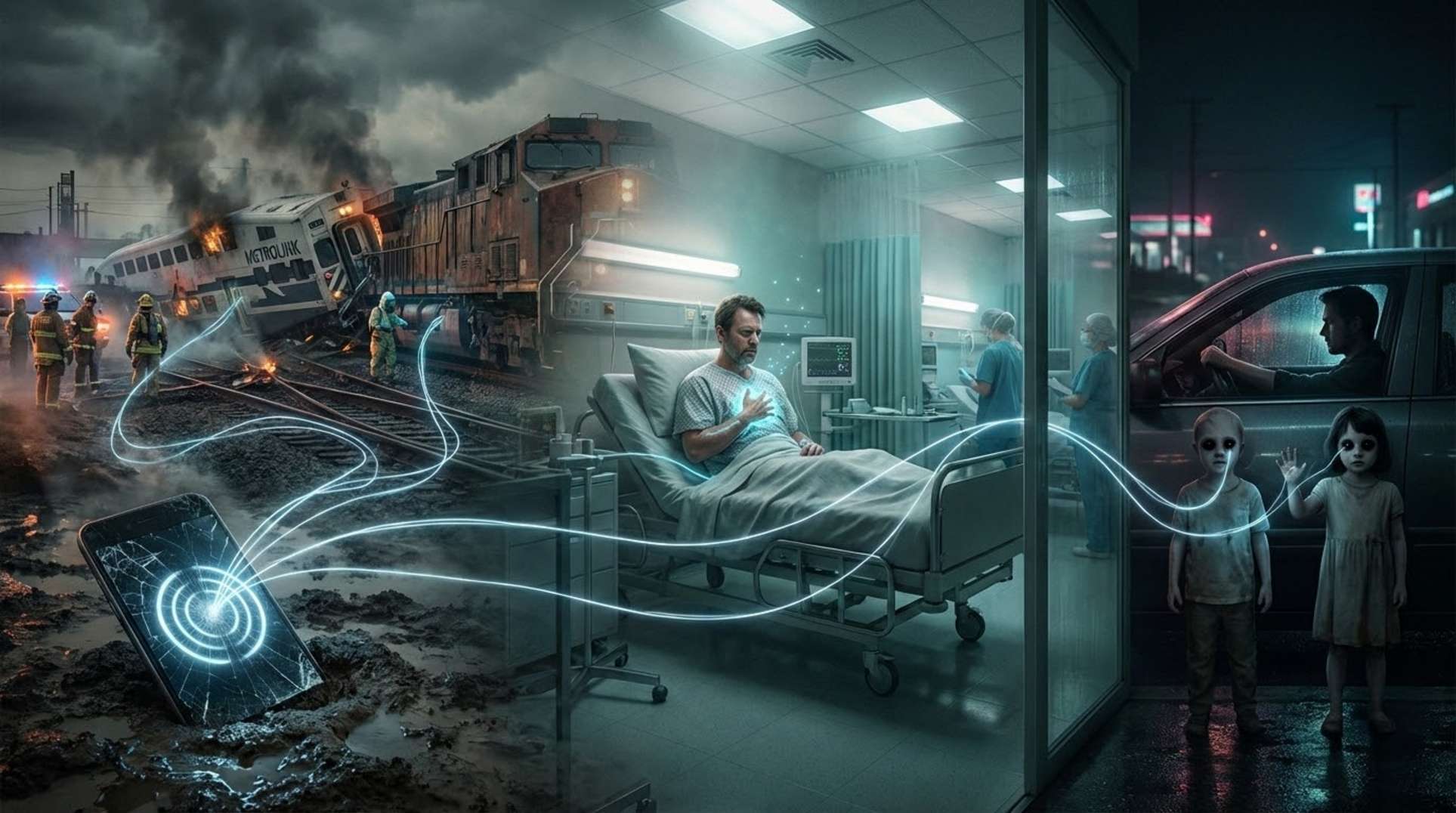
    Picture this: Dawn breaks over twisted metal and diesel fumes at the Chatsworth rail yard on September 12, 2008. Rescue crews sift wreckage while a phone—somewhere—keeps ringing families with calls from the dead. Cut to a hospital ward, sterile and hushed, where a new heart beats in rhythm. The patient wakes with cravings that aren’t their own, echoes of a life they never lived. Then, a dark road at midnight. A driver idles, uneasy, as two small figures tap the window. Their eyes: solid black. They ask to come in, their voices flat, insistent.

    These scenes aren’t fiction. In Chatsworth, families reported around 35 calls from Charles Peck’s number while search teams combed the site. Transplant stories circulate in the press—like a 2008 case where a heart recipient later died just like his donor—though they’re anecdotes, not lab results. Black-Eyed Children tales trace back to Brian Bethel’s mid-1990s posts: kids with pitch-black eyes, begging for entry, stirring dread.

    What Witnesses and Analysts Report

    Families in the Chatsworth case described dozens of calls—around 35 over 11 to 12 hours—from Peck’s phone after the crash. Press outlets and fact-checkers like Snopes have rounded up their testimonies. It’s a pattern that shows up in other death-related stories, collected in paranormal archives.

    Black-Eyed Children witnesses often share similar details: encounters at night, at doors or car windows. The kids demand permission to enter or a ride, speaking in monotones. Dread hits hard, and their eyes lack any white—just black voids. Forums, Reddit threads, and podcasts are full of these accounts, building a shared lore.

    Organ recipients sometimes talk about shifts: new food likes, changed habits, even handwriting tweaks. Media spots highlight wild coincidences, like a recipient marrying the donor’s widow or mirroring their death. These pop up in popular stories and transplant circles, though verification varies.

    Community voices add layers—some BEK witnesses go silent after ‘letting them in,’ fueling speculation. Transplant anecdotes persist despite spotty backing, and calls-from-the-dead reports keep surfacing, treated seriously by those who’ve lived them.

    Timelines, Tracks, and Hard Data

    The NTSB’s final report on Chatsworth (RAR-10/01) pins the September 12, 2008, collision on engineer distraction—texting while on duty. It led to 25 deaths and calls for tech fixes. You can pull the PDF straight from their site.

    Family reports peg about 35 calls from Peck’s phone post-crash, as noted in Snopes summaries. But no public word on recovering the handset—that’s a key gap.

    Black-Eyed Children kicked off with Brian Bethel’s 1990s forum posts, spreading via online horror spots. Atlas Obscura and Snopes track how it grew into modern folklore.

    On transplants, peer-reviewed pieces from PubMed (2019, 2020, 2024) touch on ‘cellular memory’—recipients adopting donor traits. They call it speculative, needing more study. Press like Fox News and the Evening Standard in 2008 shared a case of a heart recipient’s eerie parallels to his donor’s life and death.

    Date Event Verifiable Source Unresolved Evidence
    Sept 12, 2008 Chatsworth collision NTSB Report RAR-10/01 Handset not publicly confirmed recovered
    Mid-1990s BEK origin posts Brian Bethel forums, Atlas Obscura No independent physical verification
    2008 Heart recipient anecdote Fox News, Evening Standard Anecdotal, not peer-reviewed

    Official Story vs. What the Data Suggests

    The NTSB stands firm on Chatsworth: engineer texting caused it, backed by recorder data and signals. That’s the hard line from the agency.

    But telecom quirks—like auto-redials or network glitches—could explain those calls. Without the handset confirmed, forensic answers stay out of reach.

    In transplant circles, doctors see recipient changes as real reports but chalk them up to psychology or meds. Ideas like neural tissue carrying memories? Still guesses, not proven.

    Folklorists view Black-Eyed Children as urban legends, born online and spread socially—no need for supernatural proof.

    Witnesses push back, saying their experiences don’t fit neat boxes. Families feel those calls were more than glitches; recipients sense deeper connections. We present both sides, respecting the raw accounts while eyeing the evidence gaps.

    The Open Questions Investigators Should Keep on the Table

    For calls like Chatsworth, dig into carrier records and network logs. Check if the handset or SIM turned up for analysis. Model how a lost device might trigger repeated calls via retries.

    Transplant work needs solid cases: match donor details blindly, track changes over time. Rule out meds, surgery effects, or grief before chasing biology.

    With BEKs, chart reports by time, place, and online buzz. Hunt police files or extra witnesses. Interview ‘let-in’ claimants carefully, minding trauma.

    Run the odds: How rare is a recipient dying like their donor in a big population? Base rates help spot true anomalies.

    Reporters, shield sources facing threats or pain. Scrutinize claims without hype or outright rejection—test the support, honor the stories.

    What It All Might Mean

    We know Chatsworth’s tragedy is real, with NTSB’s cause nailed down. Calls after deaths, recipient shifts, and BEK tales form patterns people swear by, rooted in traceable origins.

    What’s unclear: Can missing phones log those calls? Does biology pass on memories? Any hard proof for BEKs beyond stories?

    These accounts highlight grief’s pull, tech’s weird traces, and how tales grow from coincidence. They matter for those chasing anomalies—showing where evidence meets the unknown. If you’re diving deeper, I can pull NTSB docs, studies, or interview guides—just say the word.

    Frequently Asked Questions

    On September 12, 2008, a Metrolink train collided head-on with a Union Pacific freight train, killing 25 people. The NTSB report attributed it to the engineer being distracted by texting.

    Relatives reported about 35 calls from victim Charles Peck’s phone after the crash, over 11-12 hours. However, investigators never publicly confirmed recovering the handset, leaving room for telecom explanations like network glitches.

    Accounts started with Brian Bethel’s mid-1990s posts and spread online, describing kids with solid black eyes demanding entry and causing dread. They’re consistent in folklore but lack independent verification, often seen as urban legends.

    Recipients report changes like new cravings or behaviors, termed ‘cellular memory’ in speculative literature. Peer-reviewed sources treat it as anecdotal, possibly psychosocial, with no proven biological mechanism, though media anecdotes highlight striking coincidences.

    For Chatsworth, the NTSB focused on human error and safety tech, not addressing calls directly. Transplant experts view changes as subjective, not mechanistic. BEKs are dismissed by fact-checkers as folklore without physical proof.

  • Isdal Woman: Inside Norway’s Unsolved Fire Mystery

    Isdal Woman: Inside Norway’s Unsolved Fire Mystery

    Key Takeaways

    • A burned, unidentified adult woman was found in Isdalen near Bergen on 29 November 1970 (Police case 134/70).
    • Autopsy concluded death involved carbon-monoxide poisoning plus large doses of phenobarbital; soot in lungs indicates she was breathing during the fire.
    • Investigative reopenings since 2016 produced isotope maps pointing toward parts of southern Germany/eastern France, new leads from media, but no confirmed identification and key questions about suicide versus homicide remain unresolved.

    November in Ice Valley: Cold Winds, Silent Trails

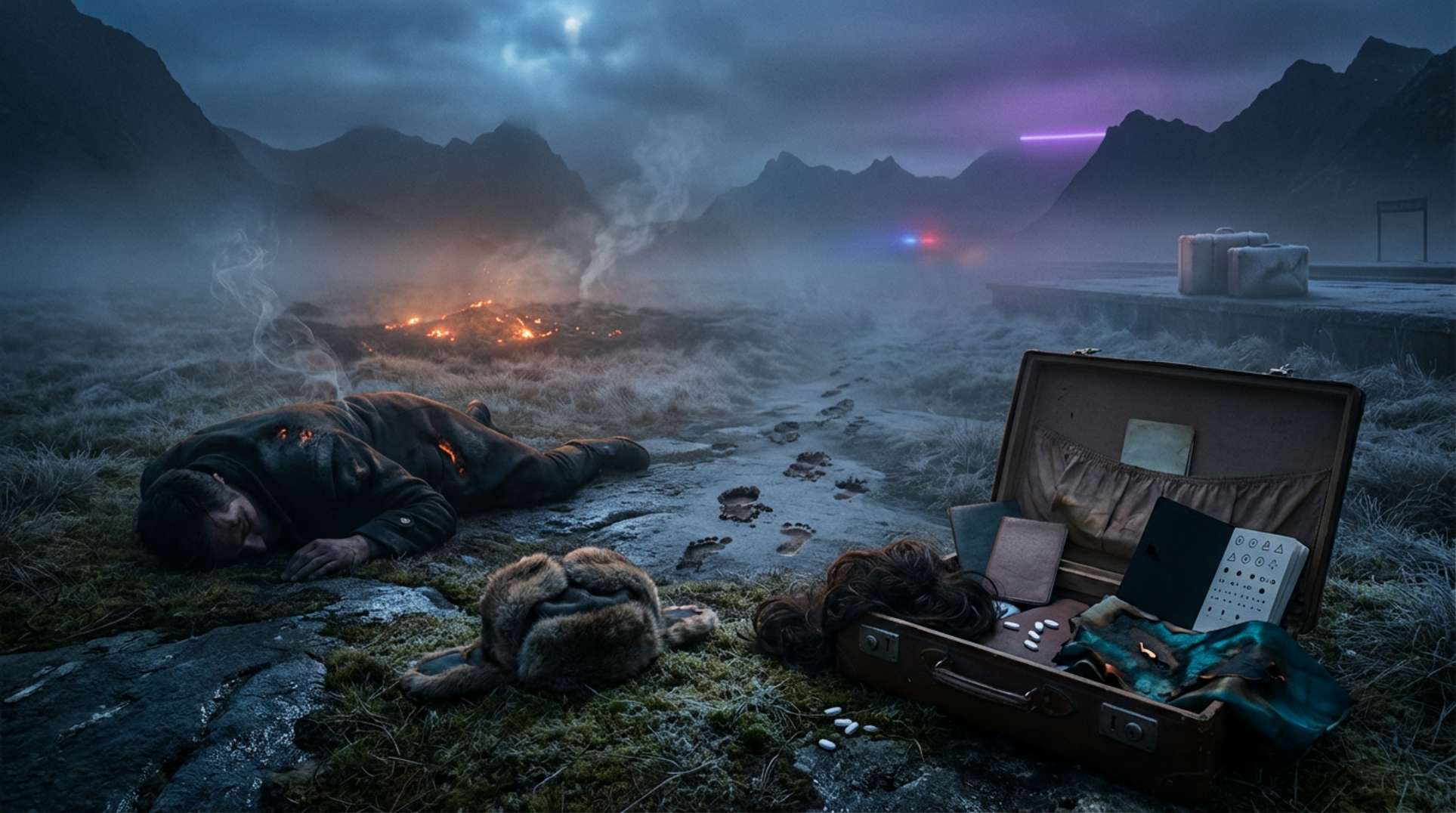
    The foothills of Ulriken rose stark against a gray November sky in 1970. Fog clung to the tundra, muting the early winter light. A hiker and his daughters stumbled upon a charred body in Isdalen, a spot locals called Dødsdalen—Valley of Death. The name alone stirred old superstitions, framing the scene in whispers of fate. Burned clothing scattered nearby, a fur hat among the remnants, and traces of petrol hinted at something deliberate. This anonymous death in such a remote, unforgiving place gripped Norway’s imagination, blending isolation with unspoken threats.

    What Witnesses and Analysts Report

    Hotel staff across Norway remembered her clearly—a foreign woman, well-dressed, who switched rooms often and paid in cash. She spoke English, French, and some German, leaving a trail of fleeting impressions. Police traced two suitcases at Bergen railway station to her, uncovering a coded notepad among her things. The initial witnesses, the hiker and his daughters, described the shocking find in 1970 reports. Years later, post-2005 accounts emerged: sightings of the woman with escorting men, though these memories carry debated reliability due to time’s passage.

    Independent researchers and online communities dug deeper, cross-referencing details. The ‘Death in Ice Valley’ podcast sparked fresh tips, building on archival leads and public calls for information. Overlaps appear in the consistent reports of her evasive behavior, but contradictions arise in the later witness claims, which some analysts flag as potentially influenced by media hype.

    Timelines, Tracks, and Hard Evidence

    The case anchors on solid forensics and documents. Discovery hit on 29 November 1970 in Isdalen, foothills of Ulriken near Bergen—logged as police case 134/70. Autopsy at Gades Institutt pinned the cause to carbon-monoxide poisoning mixed with phenobarbital incapacitation. Soot in her lungs proved she was alive amid the flames. Toxicology showed 50–70 Fenemal (phenobarbital) pills in her stomach, with about a dozen more beside the body.

    Recovered items included multiple passports under aliases, wigs, unlabelled clothing, foreign currency hidden in linings, and a coded notepad—all with ID marks scraped off. Two suitcases surfaced at Bergen railway station; NRK later found an overlooked rucksack. Isotope analysis of her teeth—strontium and oxygen—mapped likely origins to southern Germany or eastern France, though probabilistic, not certain.

    Reopening in 2016 brought archived tissue to light, with Kripos teaming up for modern tests and Interpol alerts. Burial occurred 5 February 1971 in Møllendal cemetery, an unmarked zinc coffin, noted as Catholic from her hotel forms using saints’ names.

    Date/Event Key Evidence
    29 Nov 1970: Discovery Burned body in Isdalen; clothing with petrol traces
    Autopsy (Gades Institutt) CO poisoning, phenobarbital (50–70 pills in stomach), soot in lungs
    Items Recovered Passports/aliases, wigs, coded notepad, suitcases at station
    2016 Reopening Isotope maps (S. Germany/E. France), DNA tests
    5 Feb 1971: Burial Unmarked zinc coffin, Møllendal cemetery

    Official Narrative vs. Emerging Patterns

    Bergen police wrapped it as probable suicide in 1970, citing the sleeping pills and carbon-monoxide results from Gades Institutt. That stance held on strong autopsy data, but assumptions filled gaps—like no deep probe into her aliases. Kripos reopened in 2016, pushing new Interpol notices and isotope/DNA work, yet they haven’t confirmed an ID, leaving the suicide label in play.

    Alternative views push back. Some see straightforward suicide via massive phenobarbital intake. Others suggest accidental overdose, then burning to erase traces. Homicide theories point to poisoning followed by fire, backed by accelerant on clothing. Intelligence angles linger, tied to her multiple identities, coded notebook, and travel patterns—possibly linking to Cold War ops.

    Evidence gaps fuel this: shaky chain-of-custody for items, partial notebook decoding, and potential classified files on area military tests or agency contacts. Witnesses and researchers highlight these discrepancies, contrasting official closure with persistent anomalies.

    Next Steps, Leads, and Lingering Forensics

    To push forward, target key records. Contact Kripos for modern case files, DNA, and isotope reports. Pull original autopsy files from Gades Institutt and case 134/70 from Bergen police archives. Check Møllendal cemetery logs, Swiss Federal Archives, and European hotel registries linked by the notebook.

    For forensics, re-test tissue for autosomal DNA and match mtDNA to databases. Reassess pill dissolution timing—was it instantly incapacitating? Run modern accelerant tests on preserved clothing.

    Document leads include notepad copies/translations, passport issuance records, and rail manifests for the suitcases. For outreach, refine Interpol notices with isotope data and cross-check tips against German/French hotel logs.

    What This Case Echoes

    The evidence holds firm: an unidentified woman perished in November 1970 from phenobarbital overdose and fire exposure, using false identities across Europe. Questions persist—who was she? Did the pills kill her alone, or was the fire a cover? Who issued those passports, and did intelligence threads cross her path?

    This matters. It spotlights 1970s forensic limits and institutional blind spots that lock in mysteries. Above all, it humanizes an unnamed death, pulling at those who chase hidden truths—historians, journalists, and us.

    Frequently Asked Questions

    The autopsy determined a combination of carbon-monoxide poisoning from the fire and incapacitation by a large dose of phenobarbital. Soot in her lungs showed she was breathing during the blaze. Roughly 50–70 pills were found in her stomach, with more nearby.

    No confirmed identification yet. Isotope analysis points to origins in southern Germany or eastern France, but it’s probabilistic. Reopenings since 2016, including DNA tests and Interpol notices, have generated leads but no match.

    Official 1970 reports leaned toward suicide based on the pills and fire. Alternatives include homicide, with poisoning and burning, or intelligence involvement given her aliases and coded notebook. Gaps like partial decoding and accelerant traces keep debates open.

    Items included multiple passports under aliases, wigs, unlabelled clothing, foreign currency in linings, and a coded notepad. Two suitcases were traced to Bergen station, and a rucksack was later found. Many items had identifiers removed.

    It highlights limits of past forensics and institutional gaps that sustain mysteries. The case humanizes an anonymous death and touches on broader themes like Cold War secrets and public trust in investigations. New leads from media and researchers keep it alive.

  • Mike Marcum’s Time Machine: What the Records Reveal

    Mike Marcum’s Time Machine: What the Records Reveal

    Key Takeaways

    • Mike “Madman” Marcum appeared on Coast to Coast AM in 1995, claiming he was building a time machine with large Jacob’s-ladder and Tesla-style experiments, as documented on the show’s page.
    • Local police arrested Marcum in January 1995 for stealing transformers from a St. Joseph Light & Power facility, with contemporary regional reports confirming the theft and arrest on January 29, 1995, as referenced in Fox2 St. Louis summaries.
    • Open questions linger: We need primary arrest and court records, no engineering schematics or test logs have surfaced publicly, and stories about Marcum’s later whereabouts vary across sources.

    The Night the Garage Filled with Lightning

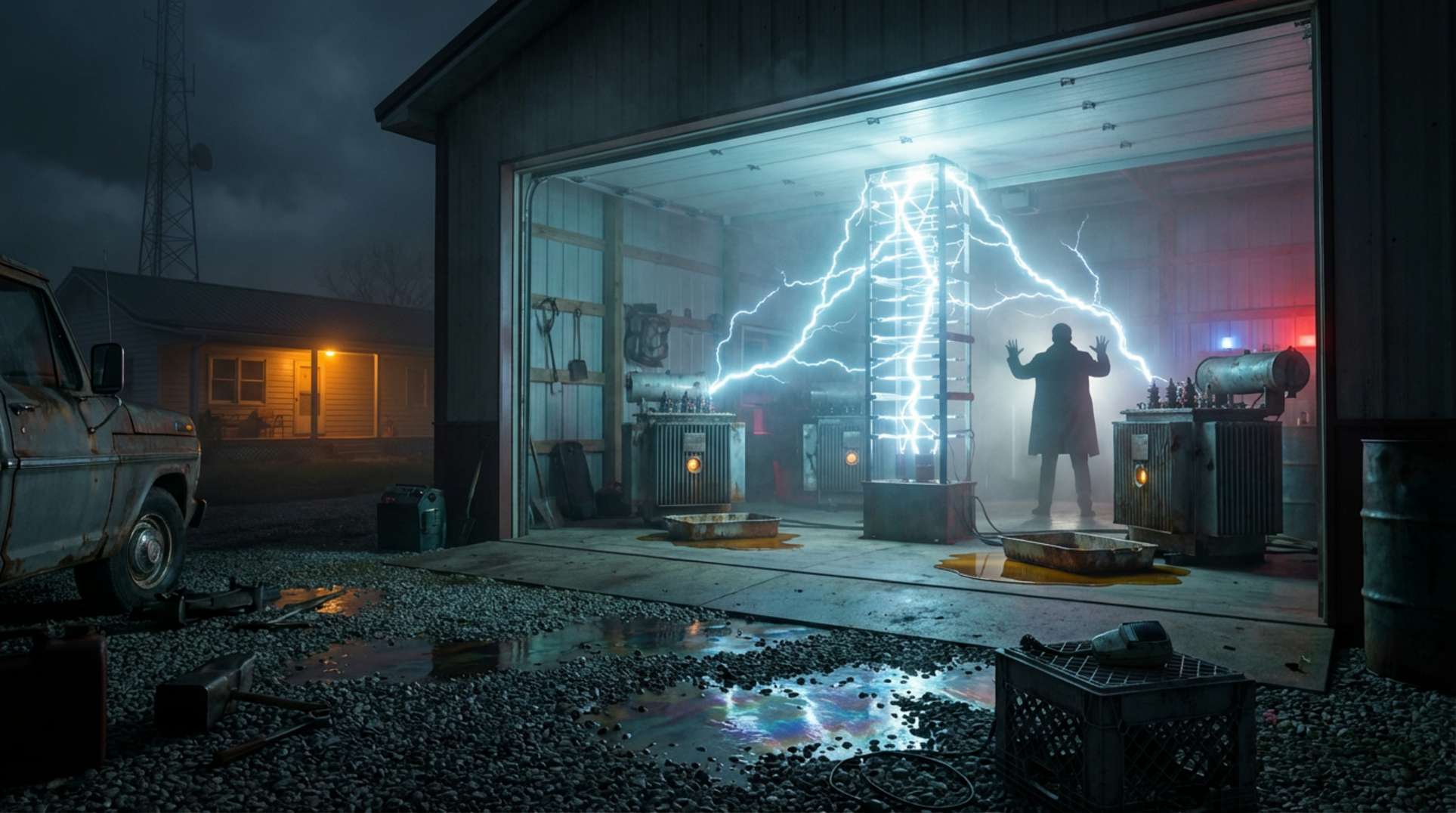
    Picture rural northwest Missouri in the mid-1990s. Stanberry, Gentry County—a quiet spot where the nights stretch long and the air carries the hum of distant farms. Then comes a call to Art Bell’s Coast to Coast AM in 1995. A man named Mike Marcum dials in, talking about his backyard experiments. His garage isn’t just a workspace; it’s alive with arcs of electricity, Jacob’s ladders climbing the air, and heavy transformers humming like captured thunder.

    The scent of transformer oil hangs thick. Containers of it sit in rooms around his house, according to local accounts. On air, Marcum describes pushing boundaries with these setups, drawing power in ways that spark curiosity nationwide. Listeners tune in, gripped. Some even reach out afterward—offering parts, cash, technical tips. What started as a private pursuit turns into something bigger, a ripple in the community of those watching the skies and questioning the official line.

    What Witnesses and Researchers Report

    Marcum laid it out plainly on Coast to Coast AM. He spoke of Jacob’s ladder arcs sparking high, rotating magnetic fields in play, and massive transformers fueling the whole thing. Audio from the show captures his words directly—no filters, just his account of the experiments.

    Local police and press added their pieces. Officers found those heavy transformers in his home, tied to a theft from the St. Joseph Light & Power facility. Contemporary newspaper reports detailed the arrest, painting a picture of equipment hauled into a residential space. Eyewitnesses from the area echoed this, describing the setup as ambitious, even reckless.

    Over time, the story grew. Later interviews and calls supposedly from Marcum surfaced in fringe circles. Internet forums and sites retold it, sometimes adding layers—disappearances, deeper tech specs. The New York Times even touched on the buzz in a 1996 piece. In our community, views split. Some see Marcum as an earnest tinkerer gone astray. Others question if it was all a ploy for attention. A few hold out for something truly anomalous, piecing together reports that official channels overlook.

    Timelines, Tracks, and Hard Data

    Let’s map this out with what we can verify. The timeline starts in 1995 with Marcum’s Coast to Coast AM appearance, pulling national eyes to his claims. By late January—specifically January 29, as cited in local reports—he’s arrested in Gentry County for taking transformers from St. Joseph Light & Power in King City, Missouri. Accounts mention six units, each over 300 pounds, with oil containers found at his place.

    Secondary sources say he served around 60 days in jail, followed by probation or a suspended sentence. But that’s repeated lore—we need the originals to confirm. The New York Times magazine ran a feature on December 8, 1996, framing the story in broader media terms. Fox2 St. Louis later summarized the local press coverage.

    To dig deeper, file requests for Gentry County arrest and court dockets. Pull archived pages from the St. Joseph News-Press or Kansas City Star. Secure Coast to Coast AM audio or transcripts from station logs. Check missing-person databases and state records for his later status. Interview anyone still around—reporters, officers, listeners who might have seen the site.

    Date Source Claim Made Documentary Status
    1995 Coast to Coast AM Marcum describes building a time machine with Jacob’s ladders and transformers Archived audio/show listing
    Jan. 29, 1995 Local press/Fox2 St. Louis summaries Arrest for transformer theft from St. Joseph Light & Power Secondary summaries; needs primary newspaper pages
    Dec. 8, 1996 New York Times magazine Discussion of the phenomenon and media attention Archived article
    Post-1995 Fringe sites/forums Later calls, disappearance rumors Secondary retellings; no primary docs

    Official Story vs. What the Data Suggests

    The official line is straightforward: theft of transformers leads to an arrest. Law enforcement records and regional press from the time back this up—transformers gone from a power facility, found in Marcum’s home. Mainstream outlets like the New York Times and local TV treated the legal side as fact, while framing his time-machine talk as colorful, unproven folklore.

    Yet community investigators see more. They point to Marcum’s on-air details, later alleged calls, and rumors of him vanishing. These fill in blanks the officials ignore, suggesting experiments that might have crossed into the unknown. Physics experts, per sources like the Stanford Encyclopedia of Philosophy, demand hard evidence for time travel—reproducible tests, not just claims. The official records nail the theft but sidestep any tech validation.

    Here’s the rub: The arrest fits a simple crime story. But the gaps—missing schematics, inconsistent later tales—leave room for speculation. Neither side fully explains it all. Official docs anchor the theft, yet they don’t debunk what Marcum might have been chasing.

    What It All Might Mean

    We know this much: Marcum went on Coast to Coast AM in 1995 with bold claims. Police arrested him for stealing transformers, and local papers reported it. Those are the solid anchors.

    But the record stops short. No schematics, no test logs, no verified demos to prove a working time machine. His sentence—said to be 60 days plus probation—needs court files to confirm. Questions hang: What really powered those arcs? Did he disappear, or just fade out?

    Next steps? Chase those Gentry County records, grab the original news clips, pull the radio audio. Talk to old-timers—reporters, cops, listeners who dropped by. Bring in an electrical engineer to weigh the setup’s potential. This tale blends DIY grit, media hype, and folklore’s pull. It’s a reminder: When claims clash with paperwork, the truth often hides in the shadows. What do you make of it?

    Frequently Asked Questions

    The arrest was for stealing transformers from a power facility in January 1995, as documented in local press and police reports. Marcum claimed on Coast to Coast AM that he was using them for time-machine experiments, but the charges focused on the theft itself.

    His descriptions on the 1995 radio show detail Jacob’s ladders, magnetic fields, and transformers, with audio available from Coast to Coast AM. However, no engineering schematics, test logs, or independent verifications have been produced publicly, leaving the claims unproven.

    Coast to Coast listeners offered parts and advice, turning it into a public phenomenon. Mainstream media like the New York Times in 1996 covered it as folkloric, while fringe communities expanded on rumors of disappearances and experiments.

    Secondary sources report he served about 60 days in jail with probation, but this needs primary court confirmation. Stories about his later whereabouts vary, with some rumors of disappearance, though no verified records clarify his status.

    Request Gentry County court records, archived local newspapers, and Coast to Coast AM audio. Interviews with surviving locals or experts could shed light, and checking missing-person databases might address disappearance rumors.

  • Isaac Kappy’s Death: Suicide, Cover-Up, or Both?

    Isaac Kappy’s Death: Suicide, Cover-Up, or Both?

    Key Takeaways

    • Isaac Benjamin Kappy died on or about May 13, 2019; troopers were called at 7:26 a.m. to I-40 eastbound at Transwestern Road (milepost 185) near Bellemont, AZ (sources: Deadline, People, NBC).
    • Arizona Department of Public Safety reported Kappy ‘forced himself off’ the Transwestern Road bridge onto I-40 and was struck by a passing vehicle; authorities investigated the incident as a suicide (sources: ADPS quoted in People/NBC/Deadline).
    • Independent researchers and community investigators (not official agencies) have published collected materials—alleged ME/toxicology files, witness statements, scene photos—and raise unresolved questions about document provenance, timeline details, and chain-of-custody.

    A Quiet Highway at Dawn

    The sun was just breaking over the Arizona desert that morning, casting long shadows across the empty stretch of I-40 near Bellemont. It was around 7:26 a.m. on May 13, 2019, when troopers got the call to the Transwestern Road overpass at milepost 185. The air hung cool and still, the kind of quiet broken only by the distant hum of tires on asphalt. Then came the chaos: a figure on the bridge, a struggle, a fall. Passersby on the interstate below witnessed the sudden violence, their vehicles screeching to halts amid the dust and debris. Two teenagers reportedly pulled over and tried to hold him back, but it wasn’t enough. The pickup truck that struck him kept rolling for a moment, its driver likely stunned in the early light.

    What Witnesses and Analysts Report

    Those closest to the scene paint a vivid picture. Two teenagers stopped their vehicle and attempted to restrain Kappy on the bridge before he went over the edge, as detailed in early reports from People and IMDB news. Their actions suggest a desperate bid to prevent what happened next. Beyond that immediate account, independent investigators have stepped in, piecing together more layers. Podcasts like The Phoenix Enigma and episodes from Shaun Attwood feature interviews with witnesses and on-site reconstructions. They’ve shared scene visits, alleged documents, and photos that challenge the surface story.

    Online, the discussion widens. Community forums in the truth-seeking spaces link Kappy’s earlier public allegations against Hollywood figures to possible motives. These narratives circulate among researchers who question the official line, though they differ from verified law-enforcement findings. We see firsthand claims from those teenagers standing apart from the interpretive frames built later by analysts. Sources vary—some eyewitness details hold steady, while motive theories spark debate. It’s a mosaic where personal accounts meet broader speculation, and we respect the effort to connect those dots.

    Timelines, Tracks, and Hard Data

    Let’s lay out the facts we can pin down. The incident hit on May 13, 2019, with Arizona Department of Public Safety troopers called at 7:26 a.m. The spot: Transwestern Road overpass over I-40 eastbound, near Bellemont, AZ, at milepost 185. ADPS spokesman Bart Graves put it plainly—the subject ‘forced himself off’ the bridge, then got struck by a passing vehicle. It’s investigated as a suicide, echoed across outlets like People, NBC, and Deadline.

    Witnesses add texture: those two teenagers tried to intervene before the fall, and a pickup reportedly hit Kappy on the roadway below. Independent files surface too, hosted on sites like The Phoenix Enigma—alleged sheriff and DPS reports, scene photos, and purported toxicology and autopsy PDFs. Their provenance is debated, but they form part of the record researchers chase.

    Date Time Location (milepost) Reported action Witnesses Source (link)
    May 13, 2019 7:26 a.m. I-40 eastbound, milepost 185 Troopers called to scene N/A People/NBC/Deadline
    May 13, 2019 Around 7:26 a.m. Transwestern Road overpass Kappy forces himself off bridge, struck by vehicle Two teenagers attempted restraint ADPS quoted in People/IMDB
    May 13, 2019 Post-incident Scene at milepost 185 Collection of alleged documents and photos Independent researchers The Phoenix Enigma links

    Official Story vs. What the Records and Researchers Suggest

    The institutional view is straightforward. ADPS and Coconino County officials investigated it as a suicide, closing the case per reports in People, Deadline, and NBC. Mainstream outlets quote them directly, emphasizing the finality. No authenticated medical examiner PDFs turn up on official county sites, according to dossier checks.

    Yet independent researchers push back. They’ve posted what they call official photos, dispatch and police reports, and toxicology PDFs, arguing for inconsistencies in timelines and evidence handling. These materials raise doubts about completeness—witness statements, forensic details. Fact-checkers like PolitiFact point out that murder claims lack proof against the official statements, highlighting the speculative side. It’s a clear split: agencies say it’s settled, while field investigators spot gaps in autopsy provenance, statement fullness, and chain-of-custody for things like dashcam footage. We weigh both sides, noting where the tension lies.

    Unanswered Questions That Keep the Case Open

    Several threads dangle, worth pulling. Has the Coconino County Medical Examiner publicly released authenticated autopsy and toxicology PDFs? If yes, where are the originals hosted? That’s a lead—file a records request there.

    Were full witness statements, especially from those two teenagers, released completely? Check for discrepancies between press accounts and the investigative packets from independent sources. Call the county for clarification.

    Is there a documented chain-of-custody for dashcam or patrol footage? Published vehicle reconstructions or timestamps could clarify the sequence, including the striking vehicle’s speed and position. Pursue ADPS for those details.

    Finally, do formal law-enforcement or prosecutorial records corroborate or contradict the items posted by independents—like dispatch logs or evidence receipts? Public-records requests to ADPS or Coconino County could uncover that. These aren’t wild hunches; they’re procedural steps to chase the truth.

    What It All Might Mean

    At the core, we have solid facts: the date, time, and location of May 13, 2019, at 7:26 a.m. on I-40 near Bellemont. ADPS says Kappy forced himself off the bridge, got hit, and it’s a suicide—backed by mainstream sources. That’s the verified spine.

    Contested pieces linger, like the authenticity of those Coconino ME and toxicology PDFs from independent sites, or the fullness of witness statements and timelines. These matter because Kappy’s public accusations against Hollywood ignited motive theories, keeping the conversation alive in our communities. Unresolved questions fuel different explanations, even as fact-checkers stress unproven elements.

    It shows how gaps in the record can amplify doubts. For those digging deeper, start with public-records requests to ADPS and Coconino County. Share what you find in the forums—let’s build on the patterns together.

    Frequently Asked Questions

    According to official reports, Isaac Kappy forced himself off the Transwestern Road bridge onto I-40 eastbound near Bellemont, AZ, at milepost 185, and was struck by a passing vehicle. Troopers were called at 7:26 a.m., and two teenagers reportedly tried to restrain him before the fall. The incident was investigated as a suicide by the Arizona Department of Public Safety.

    Officials from ADPS and Coconino County maintain it was a suicide and closed the case, as reported in mainstream outlets. Independent researchers, however, point to alleged documents like toxicology reports and scene photos, arguing inconsistencies in timelines and evidence handling. They question document provenance and suggest gaps in witness statements and forensic details.

    Online discussions in truth communities link Kappy’s public accusations against Hollywood figures to possible motives for foul play. These narratives keep interest alive, though fact-checkers note such claims remain unproven against official findings. The contested materials from researchers fuel these theories by highlighting unresolved procedural questions.

    Key questions include whether authenticated autopsy and toxicology reports from Coconino County are publicly available, if full witness statements show discrepancies, and if there’s a chain-of-custody for dashcam footage or vehicle reconstructions. These could be pursued through public-records requests to ADPS or the county. They keep the case open for many in the community.