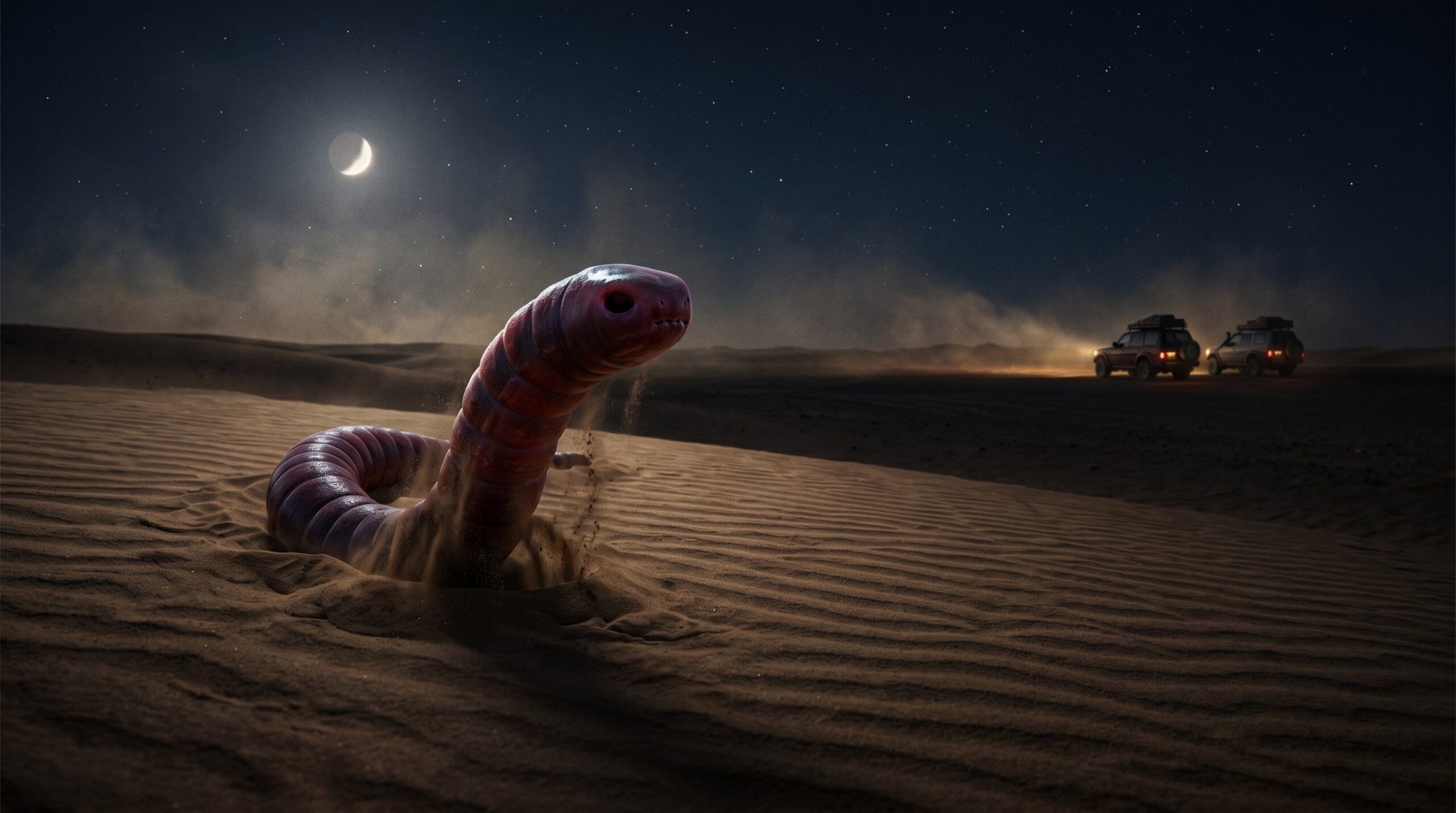
There are cryptids you can imagine spotting at the edge of a forest. Then there is the Mongolian death worm, a thing people describe as if the desert itself grew fangs. Thick, red, subterranean, and supposedly capable of killing from a distance, the creature survives in the imagination because it does not feel like an animal story. It feels like a punishment story tied to a landscape so empty that anything hidden beneath it starts to feel plausible.
The direct answer is that the Mongolian death worm, often linked to the name olgoi-khorkhoi, is a famous cryptid from the Gobi Desert said to live under the sand and kill animals or people with venom, electricity, or both depending on the telling. The legend is circulating again because cryptid audiences on Reddit are actively re-arguing the case in threads like this recent Cryptozoology debate, reference sources such as updated death-worm case files, and broader explainers like the modern history of the hunt for the creature keep bringing it back for new readers. That is not proof of an undiscovered predator. It is proof that the legend still has bite.
What gives the creature such staying power is that it is not majestic. It is ugly, buried, and close to the ground. That makes it feel older than myth and meaner than folklore.
Why the death worm still crawls through modern cryptid culture
The death worm has everything a durable cryptid needs: a vivid local name, a merciless environment, horrifying powers, and just enough expedition lore to keep the story half-attached to investigation. Unlike Bigfoot, it does not need charisma. Unlike lake monsters, it does not need spectacle. It only needs the suspicion that the desert is large enough to keep one brutal secret.
Descriptions vary, but the death worm is usually imagined as a thick, red, wormlike or sausage-shaped animal living beneath desert sand. Some accounts say it can spit venom. Others say it kills through electrical discharge. In the most memorable versions, the attack happens so fast the victim barely has time to understand what rose beneath the surface.
That elasticity has helped the legend survive. If the details never harden completely, the creature can keep evolving with each new retelling. A nomadic terror becomes a pulp-monster. A pulp-monster becomes a cryptozoology obsession. The emotional core stays the same: something hostile moves under the sand where human eyes fail.
Why the Gobi makes believers hesitate before dismissing it
The Gobi does important work for the legend. A story like this set in suburbia would collapse instantly. Set in one of the world’s harshest and most sparsely populated regions, it gains room to breathe. Believers do not need to prove the worm. They only need to point to distance, difficulty, and how little of any desert is truly watched.
That is why the death worm remains irresistible to a certain type of reader. It turns geography into an accomplice. The desert does not just host the creature. It protects the idea of it.
What the evidence still does not give us
For all its power as legend, the Mongolian death worm remains unverified. No accepted specimen, no confirmed footage, and no scientific documentation have closed the case in favor of a real unknown species. Investigators and writers have collected anecdotes, but anecdotes are not zoology.
Still, the legend is not nothing. It preserves how a region imagines danger, concealment, and what the land might still withhold. Maybe the death worm is only folklore sharpened by desert fear. Maybe it is a cryptid that modern evidence has never caught. Either way, a creature said to wait beneath the Gobi like a buried weapon is never going to vanish completely. Some stories are too well adapted to the terrain.
Some UFO stories hover in the sky. The unnerving ones go into the water. That is why the Kuwait white orb ocean UFO story keeps resurfacing. A bright object over dark sea, a descent into the water, a reappearance, and the old suspicion that whatever is watching this planet may be using the oceans as cover.
The direct answer is that the Kuwait white orb story revolves around claims that lawmakers or witnesses were shown footage of a white orb moving into and back out of the ocean off Kuwait, and the case keeps regaining traction whenever underwater UAP talk surges. The story’s modern life is being sustained by reports such as Sky News on the orb discussed in a congressional context, broader framing from Popular Mechanics on underwater UFO concerns, and ongoing rediscovery through community threads like the recurring Reddit debate about the alleged clip. That still leaves major gaps in what the public can independently verify. It also explains why the story will not die.
The ocean changes everything. A light in the sky suggests distance. A light going into the sea suggests infrastructure, concealment, and somewhere to disappear to.
Why the Kuwait orb keeps coming back
Ocean-UFO stories carry a heavier charge than ordinary sightings because they imply durability. If something can move through the air and then treat the sea like an open doorway, believers do not imagine a random anomaly. They imagine a system.
That is the emotional engine driving the Kuwait story. It is not just a clip of a strange light. It is a myth of access. The orb appears to slip between domains most of us already treat as sealed off from ordinary human scrutiny. That instantly makes it feel more advanced, more secretive, and more threatening than a conventional light-in-the-sky report.
The strongest reason the Kuwait case has lasted is that it is not merely a random social clip. It became attached to the more serious language of hearings, briefings, and official awareness. Once a story crosses into that territory, even indirectly, it gains a different sort of gravity online.
For believers, congressional mention acts like a credibility amplifier even when the public still lacks the full underlying evidence. The phrase “shown to Congress” has enormous myth-making power. It implies there is always one more room, one more screen, one more closed briefing where the real version of the story lives.
That dynamic helps explain why the alleged Kuwait footage never really disappears. Every new round of disclosure talk brings it back because it sits at the intersection of two irresistible ideas: secret video and underwater access.
Why ocean UFO stories hit harder than sky sightings
People already accept that the oceans are one of the last places on Earth where enormous things can remain hidden. Add the UFO question to that landscape and the imagination runs almost automatically. Deep water means darkness, military traffic, incomplete mapping, and long traditions of sailors and pilots reporting things that do not behave correctly.
So when a story like Kuwait enters the feed, believers do not hear it as one weird object. They hear it as confirmation that the real mystery was always below the surface. The orb is fascinating, but what it implies is the real hook: if something can enter the ocean cleanly and leave it again, then the water itself stops being background and becomes possible territory.
What remains missing from the case
The Kuwait white orb story is emotionally powerful, but the public record is still thin. There is no universally accepted, high-resolution, independently authenticated release that settles the footage once and for all. Much of the story’s force comes from secondhand description, fragmented circulation, and the prestige effect of congressional association rather than from a fully open evidentiary file.
That does not erase the case. It simply defines its current status. The orb remains one of those disclosure-era stories that lives in the gap between rumor and proof. For believers, that gap is not a weakness. It is part of the fascination. An object dropping into black water and rising out again is already the kind of image that colonizes the imagination. Add secrecy, officials, and ocean depth to it, and the clip becomes almost impossible for the modern UFO culture to let go of.
Some hauntings are frightening because something appears in the room. The musallat jinn phenomenon is frightening because it suggests something has chosen the room, chosen the body, and may not be leaving.
That is why the word musallat lands so hard online. Across TikTok clips, horror explainers, possession threads, and comment sections full of people swapping family warnings, the term is used to describe a jinn attachment defined not by one sudden shock but by obsession, oppression, and relentless proximity. In plain search terms, the musallat jinn phenomenon is the internet’s name for stories in which a jinn is believed to latch onto a person, household, or sleep state in a way that feels invasive, personal, and spiritually dangerous.
And once you step into that rabbit hole, the story escalates fast. The fear is not just that a jinn exists. It is that it can fix its attention on someone. That it can follow. That what begins as dread, nightmares, paralysis, whispers, sexual menace, or irrational panic might not be random at all, but the first sign that the boundary has already been crossed.
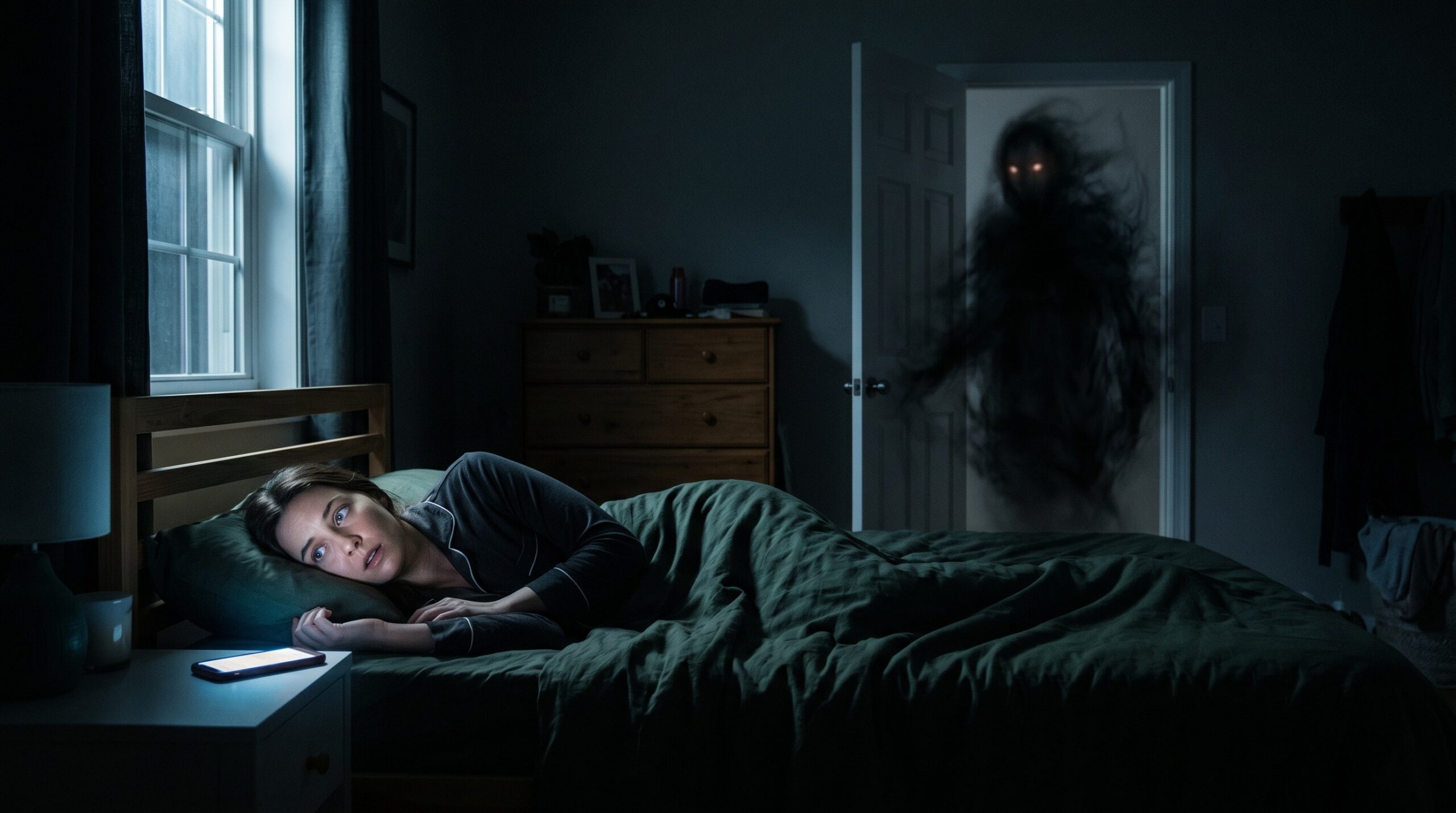
This is the part believers and doom-scrollers alike find hard to shake. A ghost story can feel local. A demon story can feel theatrical. Musallat stories feel intimate. They are about being singled out. They carry the ancient horror of possession but filter it through modern habits of isolation: the sleepless bedroom, the phone screen glowing at 3 a.m., the viral clip with thousands of comments insisting, with unnerving certainty, that they have seen this pattern before.
What people mean when they say musallat
The term does not circulate online as a tidy academic category. It circulates as a warning.
When people invoke musallat in internet discussion, they usually mean a hostile or obsessive spiritual attachment, often involving a jinn understood to be pressing in on a person’s life, mind, sleep, relationships, or body. The emphasis is not merely “there is a jinn.” The emphasis is “this presence is targeting someone and wearing them down.” That distinction matters, because it explains why the phrase carries more panic than ordinary supernatural talk.
Within wider jinn lore, the category of dangerous or rebellious entities is already familiar. Readers trying to map the older cosmology often end up at references on figures like the ifrit in Britannica, where the jinn world appears not as a single flat concept but as a layered field of volatile beings, moral ambiguity, and spiritual threat. Musallat stories plug directly into that worldview. They are rarely told as neutral encounters. They are told as escalating pressure.
That is one reason the phenomenon thrives online. The internet loves labels that feel both ancient and freshly dangerous. “Musallat” sounds specific, heavy, and inherited. It arrives with the authority of tradition, but it also behaves perfectly in a short-form horror ecosystem where people want a word that instantly turns vague terror into a named pattern.
Why the internet cannot stop spreading it
The musallat jinn phenomenon was almost built for algorithmic fear.
A short clip can do the first half of the job. Someone whispers that they woke unable to move. Someone else shows a hallway, a dark doorway, a distorted face, or a half-heard sound from another room. Then the comments take over: This is jinn.This is attachment.This is musallat.Do not answer if it calls your name.Do not sleep without protection. The result is a folklore engine that runs in real time.
TikTok’s own explainer-style content on what a jinn entity is helps show how the concept gets flattened and recirculated for mass audiences, while viral fear clips like “it’s a jinn guys run” demonstrate the much rougher version: panic first, lore second, certainty everywhere. Together they create the modern life of the story.
That online life is not trivial. It changes the emotional scale. In a village, a possession rumor might belong to one family line, one healer, one local event. Online, the same pattern appears global. A teenager in London, a student in Karachi, a horror fan in Texas, and an insomniac in Jakarta can all stare at the same clip and feel they are looking at the same invisible category. The internet turns regional spiritual language into shared nocturnal infrastructure.
The effect resembles what happens with old protective traditions and occult objects that survive because people still want a barrier between themselves and unseen attack. That instinct is why stories about ancient demon traps in Mesopotamia or the charged symbolism of Ottoman talismanic shirts still resonate now. Different cultures, different artifacts, same stubborn human impulse: if the unseen can reach in, then surely some ritual can push back.
Why musallat feels worse than a normal haunting
Most modern paranormal content teaches viewers to fear the moment of manifestation: the shadow in the corner, the door moving, the figure caught on camera. Musallat stories push the terror deeper. They are about occupation.
That shift is everything.
An ordinary ghost tale gives the listener distance. The entity may appear, but it is still “over there.” Musallat narratives close that distance until the horror becomes bodily and routine. The signs people list are often intensely personal: pressure on the chest, erotic dreams, compulsive fear, hearing a name called, a crushing sense of being watched while half-awake, sudden aversion to prayer, fractured sleep, or the feeling that one’s will is being eroded by repetition. Whether those experiences are interpreted as spiritual, neurological, psychological, or all three at once, the narrative form is stronger because it invades the private mechanics of selfhood.
This is also why musallat stories merge so easily with sleep-paralysis lore. Few experiences feel more like supernatural assault than waking inside your own body and finding it unresponsive. A piece like this discussion of jinn imagery during sleep paralysis and REM states shows how readily these experiences are framed through spiritual language when the event itself already feels invasive, hyper-real, and impossible to dismiss in the moment. The body freezes; the imagination does not.
For believer-first audiences, that overlap does not reduce the fear. It can intensify it. The possibility that certain altered states are precisely where a hostile presence presses closest only makes the old warnings feel more relevant.
The occult aesthetic of being singled out
There is another reason the musallat jinn phenomenon keeps growing: it offers an explanation for dread that feels larger than stress but more personal than abstract evil.
A lot of online horror now is about systems — simulations, liminal spaces, cursed media, surveillance, hidden programs. Musallat is more primitive and more intimate than that. It says the danger is not in the system. The danger is in the attention. Something has noticed you.
That is why the stories often blur into rules, cautions, and tiny domestic rituals. Keep certain verses close. Avoid certain places. Do not sleep in a state of spiritual neglect. Do not respond to voices in empty rooms. Do not treat recurring dreams as meaningless. Even for people who do not fully believe, these story-fragments have force because they offer a script for moments that otherwise feel shapeless.
The same emotional architecture appears in older magical spaces like Rome’s alchemical Porta Magica, where symbols seem to promise access and protection at once. What makes musallat different is that it strips away the monument and leaves only the exposed person. The battlefield is the bedroom, the mirror, the night terror, the marriage, the mind.
That is modern enough to go viral and old enough to feel inherited.
Why these stories spread even among people who are not sure they believe
The internet is full of people who say they are skeptical right before admitting they still will not watch certain clips alone.
Musallat survives in that territory because it is emotionally legible even to outsiders. You do not need to know the full theology of jinn to understand the dread of persistent unseen attention. You do not need a formal doctrine of possession to understand why repeated sleep terror, sexual menace in dreams, abrupt personality change, or a house soaked in tension can start to feel narratively connected.
In that sense, musallat functions less like a niche term and more like a sticky interpretive frame. It gathers scattered experiences under one name. Once a name exists, more people notice the pattern. Once more people notice the pattern, the name acquires even more authority. That is how internet folklore hardens.
It also helps that the story lives at the intersection of ancient cosmology and digital intimacy. The same feeds that deliver beauty tutorials and football clips also deliver whispered exorcism stories and midnight testimonies. That collision makes the old fear feel current. The musallat jinn phenomenon is not archived belief. It is live belief, performed and reinforced in public.
Even communities centered on totally different mysteries understand the attraction of that kind of ongoing, immersive narrative. The appeal is not far from why the still-active spectacle of the Heaven’s Gate website remaining online continues to disturb people: the feeling that a belief system did not end when modernity told it to end.
The grounded view, and why it still does not fully kill the story
A grounded reading of the musallat jinn phenomenon has to admit several layers at once.
First, jinn belief is part of a serious and long-standing religious and cultural framework, not just a meme factory for internet horror. Second, many of the experiences now folded into musallat talk — especially night terror, chest pressure, sensed presence, and waking immobilization — overlap strongly with known sleep phenomena, stress states, trauma responses, and the frightening cognitive spillover of REM disturbance. Third, once a person is immersed in a spiritually charged interpretive community, ambiguous experiences can become easier to read as attachment, obsession, or attack.
None of that erases the force of the phenomenon. It explains why the stories remain persuasive.
The musallat jinn phenomenon spreads because it gives terrifying experiences a shape, a villain, and a logic. For some people, that logic feels spiritually true. For others, it is a folklore vessel carrying sleep terror, grief, anxiety, and inherited fear in a language vivid enough to survive translation onto social media. Either way, the pattern is real in the only sense viral mysteries need in order to endure: people keep experiencing something, naming it, and warning each other.
And that may be why musallat stories remain harder to dismiss than generic internet horror. They do not just offer a jump scare. They offer an interpretation of vulnerability itself. Maybe the source is spiritual. Maybe it is neurological. Maybe the most disturbing cases live in the unstable territory where belief, bodily experience, and old warnings overlap. What keeps the story alive is that, in the dark hours when people feel watched, chosen, or pinned in place, that distinction can stop feeling theoretical very quickly.
Some old newspaper stories do not come back as history. They come back like contamination.
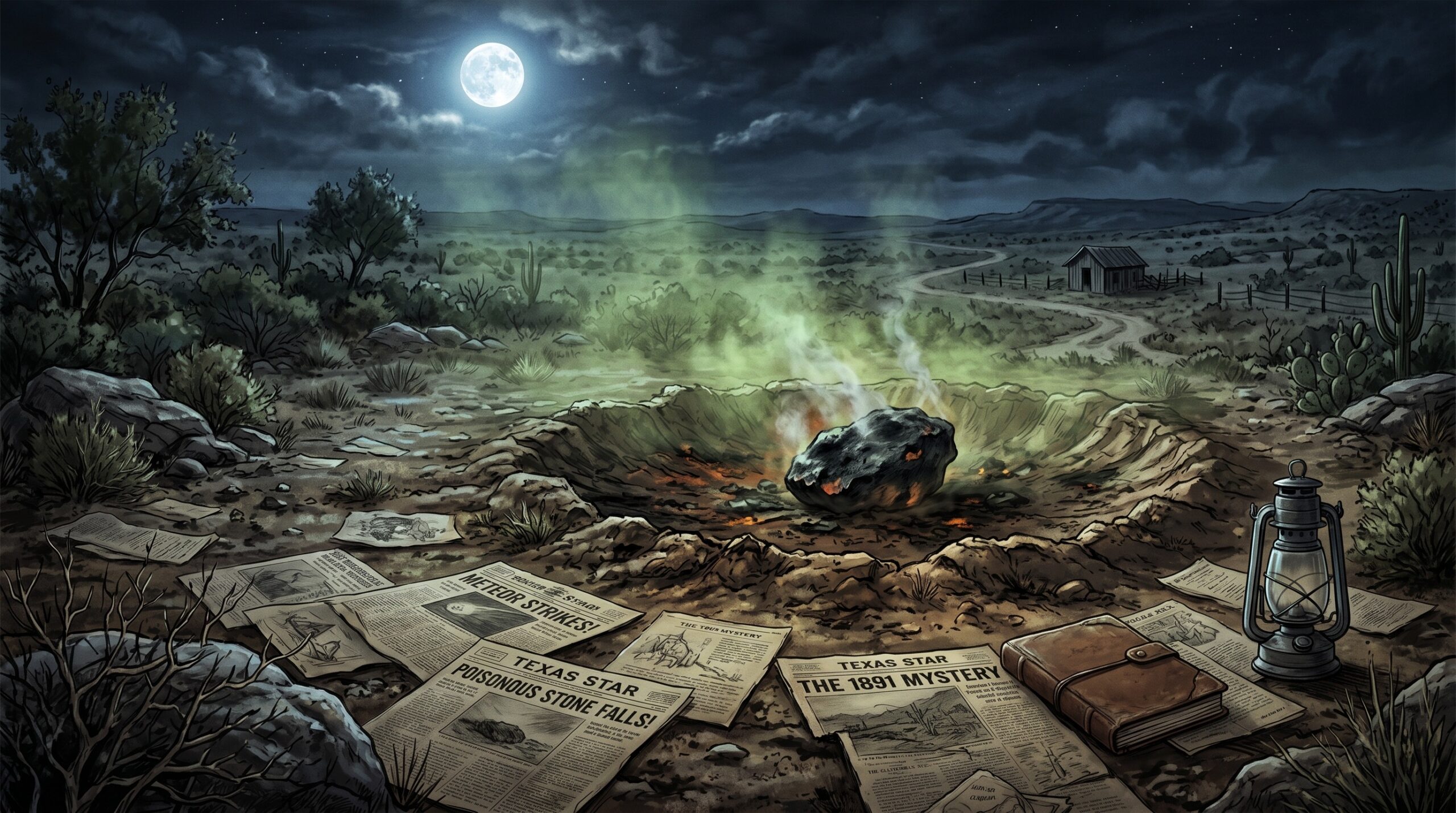
That is the feeling around the Texas poisonous meteorite of 1891, a bizarre clipping-era story that still resurfaces in StrangeEarth threads, weird-history posts, and the parts of the internet that live for lost American anomalies. The hook is almost too perfect: somewhere in nineteenth-century Texas, according to the surviving report, a meteorite or fallen stone was said to have produced poisonous effects. Not merely a fiery object from the sky. Something worse. Something that seemed to make proximity itself feel dangerous.
The phrase “poisonous meteorite” is exactly the kind of language that refuses to die. It compresses three fears into one image: the unknown sky, the strange stone, and the invisible threat. It sounds like frontier folklore, but it also sounds weirdly modern, as if the object were not just celestial but contaminated — a space-borne hazard dropped into the landscape before anyone had the tools to explain it cleanly.
That is why the story keeps returning. It is not only the claim that attracts people. It is the texture of the claim. An old Texas newspaper tale. A fallen object from above. Illness, toxicity, or some noxious effect attached to it. Then the maddening afterimage familiar to anyone who chases archive-born mysteries: the story seems to survive mainly through newspaper circulation and later retellings rather than through a neat modern chain of evidence. In other words, the clipping is real enough to haunt people, but not clean enough to close.
Why “poisonous meteorite” still sounds like buried American weirdness
Meteorites already carry an old supernatural charge even when they are entirely real.
A stone from the sky falls, burns, breaks, hisses, or lands hot and unfamiliar, and people immediately read more into it than geology alone. That reaction is ancient and understandable. Meteorites arrive as interruptions. They do not belong to the normal order of fields, roads, livestock, and weather. They arrive from elsewhere, often violently, and are discovered before anyone has fully decided what they mean. Modern context from the Texas State Historical Association’s meteorites overview and recent Live Science reporting on Texas meteor falls shows how easily a single sky-stone event can lodge itself in local memory even today.
Now add the adjective poisonous.
That one word turns a meteorite from a marvel into a threat. It suggests fumes, residue, hidden chemistry, or an object whose danger is not obvious at first touch. It makes the story feel less like a simple “stone from the sky” report and more like a close encounter with something physically wrong. For modern readers, that is irresistible. It feels like the kind of clipping that slipped through from a stranger version of America — one where cosmic debris did not just inspire awe, but left people genuinely afraid to go near it.
That is also why the tale plays so well in Reddit and StrangeEarth-style circulation. A screenshot of an old report with a phrase like “poisonous meteorite” does half the work by itself. The story arrives already compressed into a shareable mystery: did a meteorite really poison people in Texas in 1891, and if so, why is no one talking about it now?
What the 1891 Texas report actually claimed
Here the distinction matters.
What survives most clearly is not a modern scientific case file. It is the claim itself as preserved through newspaper-era circulation. The old story, in broad terms, describes a meteorite or fallen stone in Texas that was reportedly associated with poisonous or noxious effects. Depending on how later retellings paraphrase it, the emphasis falls on sickness, harmful emanations, or a dangerous reaction linked to the object.
That much is the center of the mystery.
What is harder to recover now is everything a modern reader immediately wants next: the exact specimen, the reliable witness chain, the medical descriptions, the chemical analysis, the later follow-up, the museum record, the settled historical verdict. Those are precisely the pieces that seem thin, scattered, or lost in the passage from original report to reprint culture to modern internet rediscovery.
So the safest and most accurate way to hold the story is this: an 1891 Texas newspaper report said there was a poisonous meteorite. That is the claim. The claim itself is historically interesting. But the surviving evidentiary chain behind it appears much weaker than the phrase that made it memorable.
That gap is not a disappointment. It is the whole atmosphere of the thing. The story survives in the form weird archive stories often do — vivid enough to circulate, incomplete enough to remain charged.
Why a toxic space rock felt believable in the late nineteenth century
To modern readers, the idea of a poisonous meteorite can sound either delightfully pulp-like or immediately suspect. But in the nineteenth century, the emotional conditions were different.
Meteorites were already objects of fascination, fear, and scientific curiosity. A fresh fall could carry heat, unfamiliar smell, scorched earth, strange mineral appearance, and the raw theatrical fact that something had just crossed the sky and entered local reality. Even without any true toxic mechanism, that is exactly the kind of event that invites exaggerated descriptions. Witnesses are startled. Reporters sharpen the language. Communities add reaction and rumor almost instantly.
Texas matters here too.
The state already carries a deep imaginative association with open sky, distance, and frontier-scale oddity. In the newspaper age, Texas stories could travel with a built-in flavor of remoteness and rough immediacy. A bizarre local report did not need much embellishment to become national odd-news material once copy editors realized it had the right ingredients. A meteorite was already interesting. A poisonous meteorite was irresistible.
There is also a broader historical point worth keeping in view. Nineteenth-century newspaper culture was fast, hungry, and often happy to pass along dramatic items before anyone had imposed modern standards of verification. That does not mean every strange report was false. It means strangeness itself had circulation value. A story could travel far because it sounded extraordinary, not because later investigators had locked every detail down.
How the story actually survived: newspaper circulation more than evidence
This is probably the most important part of the Texas poisonous meteorite story, because it explains why it still feels half-real and half-untouchable.
Many old anomalies survive not through preserved specimens or careful scientific archiving, but through newspapers copying newspapers. One striking item appears in print, gets summarized elsewhere, is trimmed by another editor, reworded by a third, and then decades later is rediscovered as if it were a direct window into the event itself. Sometimes that chain preserves a real occurrence. Sometimes it preserves mostly the life of the story.
The poisonous meteorite tale appears to belong to that difficult category.
What keeps it alive is not a beautifully documented chain from 1891 Texas to a modern laboratory drawer. What keeps it alive is the persistence of the report. It remains visible because old newspaper weirdness is unusually hard to kill once it lodges in print. A clipping can outlive the witnesses, the stone, the local memory, and even the original context that would have told us how seriously to take it.
That is one reason the story feels so potent in weird-history circles now. Readers are not just encountering an event. They are encountering an event already turned into relic-text. It comes to us with the compression, distortion, and haunted durability of archived newsprint.
Why StrangeEarth and weird-history readers keep reviving it
The modern internet did not create this story. It created the perfect habitat for it.
A resurfaced newspaper oddity does especially well online when it offers one unforgettable phrase and a mystery that cannot be resolved in a single reply. “Poisonous meteorite” is almost engineered for that environment. It sounds scientific and folkloric at the same time. It invites instant speculation: radiation, toxins, sulfurous fumes, contaminated minerals, hoaxing, frontier hysteria, cosmic contamination. Everyone can project a theory onto it.
That projection is part of the pleasure.
For believer-first audiences, the story reads like evidence that older newspapers preserved a layer of reality later history flattened out. Maybe strange things really were reported more openly before institutions learned how to categorize them away. Maybe local papers captured moments that never made it into official science. Maybe the archive still contains thousands of similar anomalies waiting to be noticed.
Even readers who stay cautious can feel the pull. The Texas poisonous meteorite of 1891 does not need to be fully proven to be fascinating. It only needs to suggest that the past was more disorderly, more porous, and more chemically or cosmically uncanny than the cleaned-up modern version.
That is why it keeps resurfacing in StrangeEarth-style circulation rather than disappearing after one wave of attention. The story is short, memorable, and permanently unfinished. Online, unfinished stories age very well.
What we can actually say with confidence now
This is where the mood has to narrow.
Texas absolutely belongs in real meteorite history. The state has a genuine connection to meteorite finds, falls, geological interest, and a long tradition of public fascination with stones from the sky. More broadly, meteorites themselves are of course real physical objects, and unusual public reactions to fresh falls are historically unsurprising. That wider context is solid.
What is not solid in the same way is the strongest version of the 1891 poisonous meteorite claim.
What we appear to have, based on the surviving signal that keeps resurfacing, is an old newspaper story and the afterlife of that story in retellings. What we do not appear to have is a clean, modern evidentiary package proving that a specific Texas meteorite in 1891 was documented, preserved, chemically verified as hazardous, and traced through a reliable chain of reporting and analysis. The article survives much more clearly than the case.
That does not mean nothing happened. It means the recoverable record is narrower than the viral phrasing. The reported sickness could have been exaggerated, misunderstood, wrongly linked to the stone, caused by something mundane in the local environment, or amplified by the newspaper economy’s appetite for marvels. It could also reflect a genuine encounter with some unpleasant material or fumes that witnesses associated with the fall. The point is not to force an answer we do not have.
The point is to distinguish the layers. There was a story. The story traveled. The clean proof did not travel with it.
Why the Texas poisonous meteorite still lingers
And yet it lingers because that missing proof does not weaken the atmosphere. It deepens it.
The Texas poisonous meteorite of 1891 survives in the exact zone where unexplained history thrives: somewhere between report, folklore, and fragmentary reality. It is strange enough to feel worth remembering, but incomplete enough that no final authority has drained it of tension. Readers are left holding the same object the newspapers handed down — not the stone itself, but the charged idea of it.
A meteorite is already a message from elsewhere. A poisonous meteorite is a message with menace attached.
That is why the story still circulates. Not because we possess a perfect case, but because we possess a perfect relic of uncertainty: an old Texas claim that feels too weird to forget and too thinly documented to settle. More than a century later, the clipping still does what the best buried anomalies do. It makes the past feel unfinished, and it leaves just enough danger in the wording to suggest that whatever fell from the sky in 1891 may have left behind something more durable than evidence — a story no one has quite managed to neutralize.
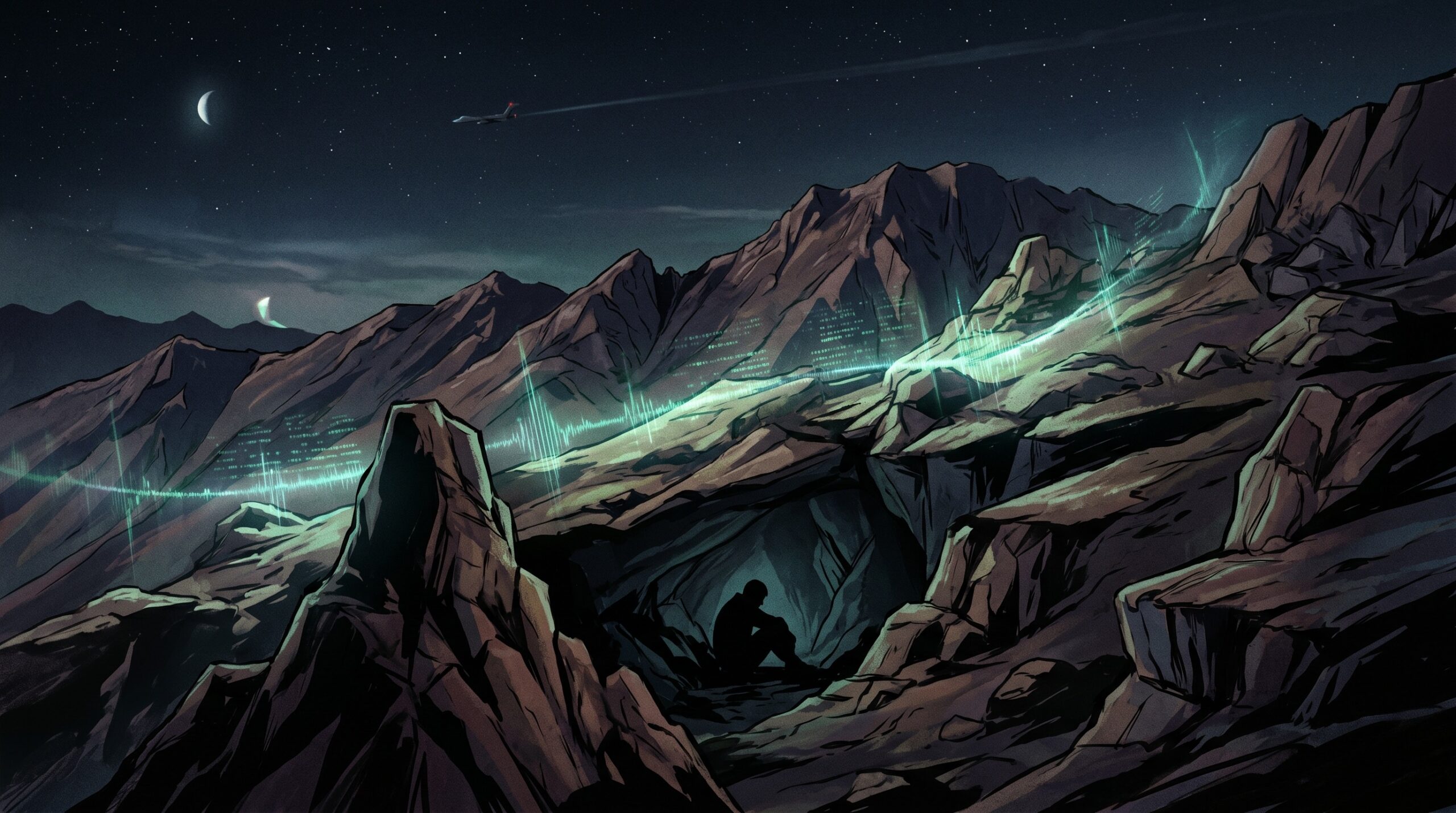
What if one of the strangest names to surface in recent military-tech chatter was not attached to a weapon, but to a rescue? That is the charge running through conspiracy and UFO-heavy corners of the internet after reports and news summaries suggested a secretive tool called Ghost Murmur may have helped locate a downed American airman in Iran, allegedly by detecting a heartbeat. The phrase does not sound like ordinary military jargon. It sounds like something smuggled out of a whistleblower thread at three in the morning.
That is exactly why the story detonated online. A pilot-down rescue in Iran is already the kind of scenario that arrives with instant tension. Add a codename like Ghost Murmur, add the suggestion of standoff sensing that can somehow find a living body by its biological signature, and the whole thing stops feeling like a normal defense story. It starts feeling like the public may have briefly brushed up against the edge of a classified capabilities world that normally stays hidden behind euphemism, acronyms, and silence.
For a certain audience, the rabbit hole opened immediately because Ghost Murmur was not just weird. It was familiar. On Reddit, especially in UFO-adjacent communities, users quickly connected the name to the infamous 2023 4chan whistleblower lore, where “Ghost Murmur” circulated as the sort of eerie, half-credible, half-mythic term that believers file away and never forget. A notable r/aliens discussion about that whistleblower material, with roughly 1,600-plus score, gave the term an afterlife long before this Iran rescue angle appeared. So when the name surfaced again beside claims about heartbeat-detection and an American airman, many readers felt the same jolt: either the internet had accidentally guessed a real black-world tool, or the mythology had started bleeding into the headlines.
Why the Iran rescue claim feels so explosive
There are military stories that sound serious, and then there are military stories that sound like they should not be public at all.
This one sits in the second category. Coverage and search-result summaries from outlets including The Independent, Newsweek, NDTV, Daily Mail, and Scientific American helped push the story into broader view by circling the same irresistible center: a rescue in Iran, a supposedly downed American airman, and claims involving unusual heartbeat-detection capability. Even before readers sort out what any one report specifically confirmed, the shape of the story is enough to trigger speculation. It implies precision. It implies reach. It implies that somebody may possess a way of sensing a human presence under conditions where ordinary search methods would struggle.
That is why the phrase “heartbeat detection” hits harder than a colder, more technical description would. Heartbeat is intimate language. It turns a system into almost a supernatural listener, something that can reach through terrain, distance, concealment, or chaos and isolate the fragile sign that a person is still alive. “Ghost Murmur” is the perfect codename for a capability like that because it sounds less like machinery than like an invisible whisper hunter.
Believers do not hear a mundane rescue sensor when they read that. They hear proof that the classified world is far ahead of the public one. They hear another reminder that the military may operate with layers of sensing technology ordinary people only encounter as rumors, scattered patents, or anonymous-board testimony.
Why UFO audiences think they heard this before
The real accelerant here is not the rescue itself. It is the overlap with existing internet lore.
The 2023 4chan whistleblower story became one of those strange modern myth objects: too detailed to forget, too unstable to trust, and too imaginative to stay contained. In UFO and conspiracy communities, the thread lingered because it offered readers exactly what they wanted from anonymous disclosure culture — hidden programs, insider tone, specific-sounding language, and just enough texture to feel dangerous. Terms mentioned there did not fade. They became seeds.
Ghost Murmur was one of those seeds.
So when a similar name appeared in circulation around a real-world rescue story, the effect was immediate. Online, people began treating the overlap as more than coincidence. Some saw vindication. Some saw contamination. Others simply saw the most thrilling possibility of all: that a piece of fringe whistleblower lore had described an actual capability before mainstream audiences ever heard of it.
That kind of echo is powerful because it compresses two very different credibility systems into one emotional moment. News reports carry institutional weight. Anonymous threads carry mythic weight. When the same eerie term seems to appear in both environments, believers experience it as a bridge between the visible world and the hidden one.
“Ghost Murmur” is also one of those names that almost refuses to stay neutral. It sounds engineered to haunt the imagination. If a classified system really existed to detect life signatures in difficult environments, many readers think, would it not sound exactly like this? A dry technical label might have passed quietly. Ghost Murmur invites obsession.
The codename is doing half the work
Black-program mythology has always thrived on naming.
A codename can make a claim feel more real than a paragraph of explanation. That is not because names prove anything. It is because names suggest infrastructure. They imply procurement, briefings, compartmentalization, operators, budgets, deployment histories. A weirdly elegant codename feels like evidence of a hidden bureaucracy.
Ghost Murmur is especially potent because it seems to describe the capability and dramatize it at the same time. Ghost suggests the nearly invisible person being sought, or the unseen way the system operates. Murmur suggests a body signal so faint it would normally be lost. Put together, the phrase sounds like a machine designed to hear life where no human rescuer could.
That is the point where military-tech speculation and UFO culture start to merge. Readers who already suspect there are sensor suites, propulsion systems, and retrieval capabilities far beyond the public inventory hear this story as another leak from the same sealed world. They do not necessarily leap straight to aliens. But they do leap to hidden technology, and once that leap happens the surrounding discourse begins to fill in the rest: special access programs, buried breakthroughs, whispered tools with names too poetic to be fake.
In that sense, the Iran airman rescue story became bigger than itself almost instantly. It was no longer only a rescue anecdote. It became a referendum on whether extraordinary capabilities occasionally slip into view through side comments, partial reports, and oddly memorable codenames.
Why the story spread beyond defense-news readers
Most people do not spend their day tracking rescue technology. They do spend their day noticing stories that feel like they should unlock a larger secret.
That is why this traveled. The geopolitical setting gave it stakes. The rescue angle gave it emotion. The heartbeat-detection claim gave it wonder. And the Ghost Murmur name gave it myth.
Once those pieces clicked together, the story was perfectly built for modern circulation. News-oriented readers could frame it as a remarkable special-operations or defense-technology story. Conspiracy readers could frame it as evidence that classified sensing systems have outpaced public understanding by years. UFO audiences could frame it as one more case where fringe rumor seems to rhyme a little too neatly with the visible world.
There is also a deeper reason the story resonates right now. A lot of people already believe the public lives downstream from technologies that are revealed slowly, selectively, and only when institutions can no longer avoid acknowledging them. They have seen enough drone stories, AI leaps, surveillance disclosures, and military-capability surprises to feel primed for the next impossible-sounding device to turn out not to be impossible after all. Ghost Murmur slips neatly into that emotional template.
“A rescue tool that sounds fake is often the most believable kind of secret,” is the sort of sentence this story makes people want to say out loud. It captures the mood perfectly. If the technology were ordinary, it would not need a name like that. If it were extraordinary, of course the public would hear about it only in fragments.
Where the public record stops
Here is where the atmosphere has to give way to calibration.
What is being claimed is dramatic but still narrow: that a system called Ghost Murmur was allegedly involved in locating a downed American airman in Iran, and that reporting around the case included language suggesting heartbeat detection or similarly advanced sensing. That is the core of the intrigue. It is enough to make the story fascinating.
What has not been independently established in the public record, at least from the source signals driving the conversation, is much broader. The public does not have clear, technical documentation explaining what Ghost Murmur is, how it works, what conditions it can operate in, how far its reach extends, whether the codename was used consistently across reports, or whether the online 4chan-era use of the term referred to the same thing at all. The viral overlap is real. The proof of identity is not.
That distinction matters. Advanced sensing technologies do exist in principle. Militaries and researchers have long pursued ways to detect human presence through indirect signals, environmental disturbances, radar-like methods, and biometric traces. But that general plausibility is not the same as confirmation of this exact capability, this exact rescue scenario, or this exact lore-rich codename.
What remains unverified — and why people will keep talking anyway
The strongest version of the online story goes something like this: a fringe whistleblower thread named a hidden tool years ago, that same tool just surfaced in connection with a real rescue in Iran, and the public has now accidentally glimpsed a capability that sounds nearly supernatural. It is a gripping narrative. It may even contain a kernel of something real.
But several key pieces remain unverified. It is not publicly settled that Ghost Murmur is a formally identified system rather than a circulating label. It is not publicly settled that the heartbeat-detection claim describes literal operational capability rather than loose or sensationalized framing. And it is not publicly settled that the term’s appearance in UFO-adjacent internet lore and in rescue-related reporting points to one and the same technology.
That does not kill the mystery. It explains the mystery. Stories like this survive because they occupy the sweet spot between imaginable and unbelievable. They sound too cinematic to be routine, yet not so impossible that readers can dismiss them outright. The result is a modern legend with just enough real-world scaffolding to feel dangerous.
For now, Ghost Murmur remains exactly where the internet likes its best hidden-tech stories: half in the news, half in the myth. The claim is compelling. The resonance with older whistleblower lore is real. The underlying capability may be plausible in broad outline. But the larger, cleaner conclusion — that the public has identified a verified secret system straight out of conspiracy folklore — still has not been proved.
And that unresolved gap is why the story will keep breathing. In the online imagination, Ghost Murmur is no longer just a rumored rescue tool. It is the sound of a hidden world briefly making itself heard.
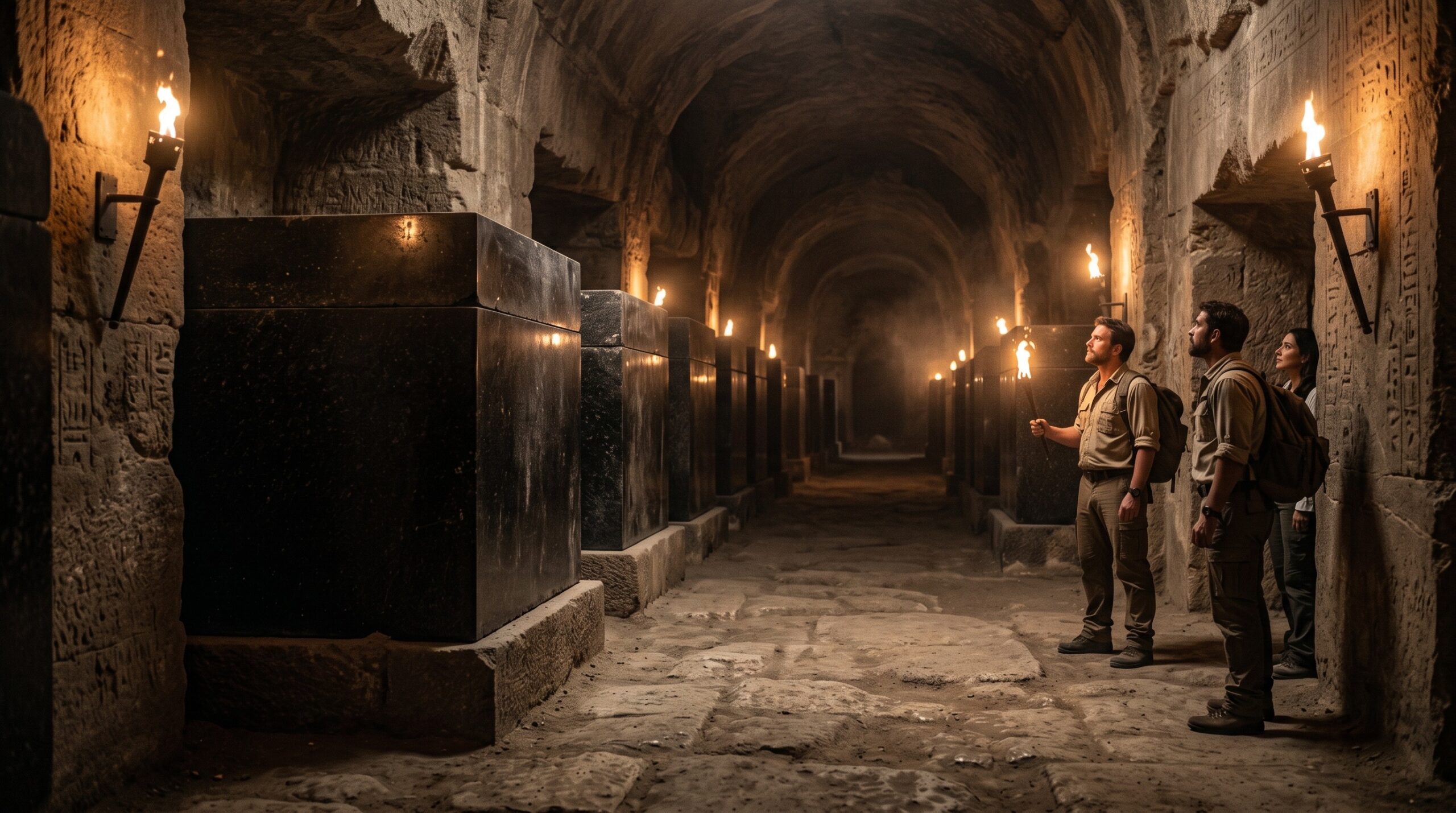
What if the reason the Serapeum of Saqqara keeps going viral is that deep down people know those giant stone boxes are not supposed to look like that? Hidden underground, carved from massive stone, polished into dark geometric forms that seem almost too exact for the ancient world, the boxes hit the mind like a glitch in history. They do not just inspire curiosity. They produce suspicion.
For believers, the Serapeum is not merely an archaeological site. It is one of those places where the official explanation sounds almost complete but never quite satisfies the eye. The boxes are too enormous, too refined, too eerily modern in their lines and surfaces. The moment people see them, especially in the low light of the underground galleries, a question forms almost automatically: if ancient Egypt was capable of this, then what else did it know that has been lost, misdescribed, or quietly fenced off by academic caution?
That is why the mystery never dies. A wave of posts calling the site “impossible,” “machine-perfect,” or “100-ton precision beyond science” keeps finding fresh audiences because the visual shock is real. Travel explainers such as this Serapeum of Saqqara background guide keep the site in circulation, and once the viewer is shocked, the story writes itself. The Serapeum starts to feel like a hidden chamber of forbidden engineering, the kind of place that belongs in the same imaginative territory as Second Sphinx Under Giza and other ancient-Egypt mysteries that make people wonder whether the official map of the past is flatter than the truth.
Why the boxes hit so hard
The raw scale is only part of it. Plenty of ancient monuments are huge. What unsettles people here is the combination of weight and finish.
These are not rough boulders or broken ruins. They look intentional in a very modern-seeming way: flat planes, severe edges, heavy lids, polished interiors, dark stone that catches light with an almost industrial elegance. The boxes do not merely feel ancient. They feel precise. That is what hooks people.
And once that word enters the conversation — precision — the entire site changes character. It stops being “an old burial complex” and becomes “evidence of a capability problem.” Believers do not just ask who made the boxes. They ask how, with what methods, and why the result still looks so difficult to explain in ordinary terms. That is the same emotional mechanism behind Do Ancient Stone Chambers in the British Isles Really Resonate at 110 Hz? — the moment when an old site seems to hint at technical knowledge that feels out of place.
The rabbit hole hidden under Saqqara
Once you step into the believer reading, the Serapeum becomes much more than a funerary site.
Why are the boxes so massive if their purpose was straightforward? Why underground? Why do the interiors look so finished? Why do so many viewers feel that the craftsmanship crosses a line from impressive into unnerving? And why does every explanation seem to lean on broad civilizational capability while leaving the practical shock of the objects themselves untouched?
That is where the rabbit hole begins. Some people see lost machining knowledge. Others imagine a forgotten high civilization whose work was inherited by dynastic Egypt. Others suspect the boxes may have served a function different from the one textbooks emphasize. Still others do not commit to a specific theory at all — they simply feel that the site does not emotionally behave like a solved problem.
That feeling matters more than skeptics often admit. Mystery culture survives because certain objects keep resisting psychological closure. The Serapeum boxes do exactly that. They sit there like finished statements from a vanished intelligence, whether human or not, and the modern mind keeps circling them because they do not look like the rough primitive fantasy people were taught to expect from antiquity.
Why believers keep coming back to the precision claim
The internet version of the Serapeum is built on one core conviction: these boxes look too exact to be shrugged off as ordinary ancient stonework.
That claim can be overstated, but its emotional force is obvious. People are reacting to the surfaces with their own eyes. They are reacting to corners that seem too clean, to interiors that seem too smooth, to the sheer labor implied by placing these objects in underground chambers. Once those visual impressions take hold, the idea of lost tools or lost methods stops sounding wild. It starts sounding intuitive.
That is why alternative-history advocates do so well with this site. They do not need to prove every step of their theory. They only need to keep attention fixed on the physical improbability people feel in their gut. If the object looks impossible, then the imagination opens. And once it opens, it becomes easy to connect the Serapeum with the larger constellation of ancient enigmas, hidden chambers, forbidden archaeology, and the suspicion that whole chapters of human capability have been flattened into safer narratives. It naturally sits beside stories like Ancient Demon Traps in Mesopotamia, where ritual objects and buried spaces seem to preserve a worldview that still feels only half translated.
Why the official explanation never fully calms people down
Archaeology does provide a coherent framework: the Serapeum is tied to the Apis bull cult within the wider sacred and funerary landscape of Saqqara. That context is real, and it matters. Standard references like Britannica’s Saqqara overview place the site firmly inside that broader Egyptian setting.
But context does not erase astonishment. In fact, for many people it barely touches the central emotional problem. Saying the boxes are part of an ancient cultic tradition does not answer the visceral question the site creates: how were these specific objects quarried, moved, lowered, shaped, finished, and fitted with such authority in a dark underground setting?
That is why the debate never resolves cleanly online. One side keeps saying, “There is context.” The other keeps replying, “Look at the boxes.” Both are addressing different levels of the experience. The first explains the site historically. The second is still staring at the objects as physical challenges.
And that physical challenge is exactly why sites like this keep crossing into conspiracy and paranormal territory. If the ancient world could do more than we casually assume, then maybe history has more buried discontinuities than institutions are comfortable admitting.
What the credible facts actually support
Here is the firmer ground. The Serapeum of Saqqara is a real archaeological complex in Egypt associated with the Apis bull cult, and the giant stone sarcophagi there are genuinely enormous, visually striking, and technically impressive. The site’s context within the wider Saqqara necropolis is well established. So this is not an invented mystery.
What is not established is the strongest leap often made online: that the boxes therefore prove lost super-technology, non-Egyptian builders, or impossible machine-shop precision beyond known ancient capability. The polished appearance and immense scale are real, but many viral claims go beyond publicly demonstrated measurements and beyond what the existing evidence can securely prove. Even broad public summaries like Wikipedia’s Saqqara overview make clear how much wider historical context surrounds the site than the viral mystery captions usually admit. In other words, the wonder is justified; the most extreme conclusions are still interpretive.
That leaves the Serapeum in the exact place where great mysteries live longest. Believers can say the boxes remain psychologically and technically unsettling for good reason, and that mainstream explanations still feel incomplete at the level that matters most to ordinary viewers. Skeptics can say astonishing craftsmanship is not the same thing as impossible craftsmanship. For now, the evidence supports a site that is truly extraordinary, historically grounded, and still capable of making people question how much of the ancient world has really been explained — which is precisely why the Serapeum keeps haunting people centuries later.
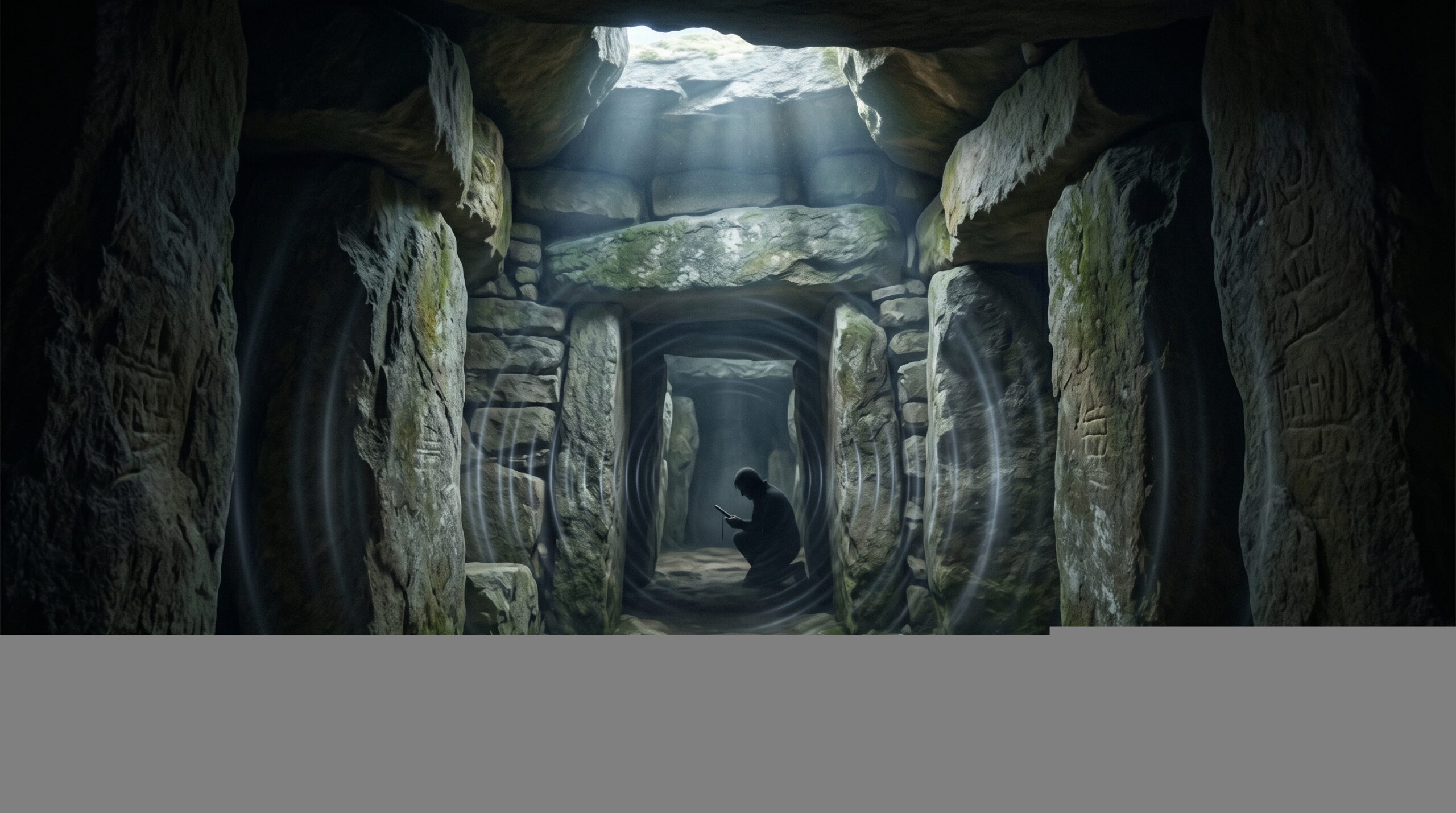
A striking claim has been ricocheting across Reddit, Instagram, and ancient-mystery corners of the internet: prehistoric stone chambers across the British Isles were allegedly built to resonate at 110 Hz, and that low frequency may have altered the human brain by dampening areas linked to language or ordinary conscious thought. It is an irresistible idea. It sounds scientific, mystical, and ancient all at once.
The problem is that the viral version is much cleaner than the evidence behind it. There is real research into the acoustics of prehistoric monuments. There are well-known passage tombs and stone chambers in Britain and Ireland that seem to produce unusual sonic effects. And there have been discussions, in both archaeoacoustics and adjacent popular writing, about resonances in the rough neighborhood of 110 Hz. But the sweeping claim now circulating online—that a Princeton team proved ancient builders across the British Isles intentionally tuned these spaces to 110 Hz in order to suppress the brain’s language centers—is, at best, an aggressive compression of scattered ideas and, at worst, a dramatic retelling that outruns its sources.
Why is everyone talking about it now? Because it recently found the perfect modern delivery system. A high-performing Reddit post in r/HighStrangeness packaged the story into a single vivid sentence. That kind of claim then spreads fast through short-form video and image platforms already primed for megaliths, lost knowledge, and cinematic drone shots of ancient stonework. Once the number 110 Hz enters the story, it gives the whole thing the feel of hidden technical knowledge rather than folklore.
So what does the evidence actually show? The honest answer is more interesting, and more uncertain, than the meme. Some prehistoric chambers seem to have distinctive low-frequency resonances. Some researchers think sound may have mattered more in ancient ritual architecture than archaeology once assumed. But the leap from “this stone space has notable acoustics” to “prehistoric engineers built a brain-altering sonic machine” remains unproven.
What the viral claim actually says
The online version usually arrives as a tidy bundle of assertions. A team—often described as being from Princeton—supposedly measured 5,000-year-old stone chambers across the British Isles and found that many of them resonate at 110 Hz. That frequency is then linked to EEG studies suggesting that droning sound around 110 Hz can suppress or interfere with brain activity associated with language processing. The implied conclusion is not subtle: ancient people understood how to alter consciousness through architecture and sound.
It is a powerful story partly because each component sounds just plausible enough to carry the others. Stone chambers are real. Acoustic measurements are real. EEG research is real. Ancient ritual use is plausible. Put together in one sentence, they feel like a solved mystery.
But that is exactly where caution is needed. Viral claims often splice together ideas that did not come from the same study, the same discipline, or even the same standard of evidence. A measured resonance at one monument is not automatically evidence for a region-wide design principle. A modern laboratory observation about how a tone affects subjects under controlled conditions is not direct proof of prehistoric intention. And a social-media caption that says “researchers found” may be compressing years of speculative interpretation into the language of settled fact.
Why this story spread so easily
This is almost tailor-made for the current internet. Reddit loves claims that feel like suppressed knowledge rediscovered through academic research. Instagram and Reels reward images of weathered stones, interior chambers, shafts of light, and voiceover scripts that can move from archaeology to altered consciousness in under thirty seconds. Hashtags around ancient mysteries and megaliths already support a thriving visual culture, so a story like this does not need to build an audience from scratch. It drops into one that already exists.
The claim also benefits from a neat numerical hook. “110 Hz” feels specific in a way that “some low-frequency resonances in some chambers” does not. A precise number gives internet stories a false sense of laboratory certainty. Even readers who know little about acoustics can intuitively feel that a measured frequency must mean something exact and intentional.
And then there is the consciousness angle. If the claim were only that certain stone chambers echo in interesting ways, it would remain a niche archaeology story. Add the possibility of altered states, silenced language centers, or ritual trance, and it becomes instantly shareable. The internet is full of stories that start as sensory observations and end as theories about hidden human potential.
What archaeoacoustics actually studies
Before dismissing the whole subject, it is worth stating clearly that archaeoacoustics is a real field of inquiry. Broadly speaking, it asks how sound behaves in ancient places and whether those sonic properties mattered to the people who built and used them. That can include caves, tombs, temples, amphitheaters, stone circles, and other ritual or ceremonial spaces.
The basic idea is sensible. Human beings do not experience architecture only with their eyes. In enclosed or semi-enclosed ritual spaces, sound can shape emotion, memory, movement, authority, and group behavior. A chamber that amplifies drumming, chanting, or certain vocal ranges may feel very different from one that swallows sound. If a monument was used for ceremony, burial, performance, or repeated gatherings, acoustics are not a trivial detail.
At the same time, archaeoacoustics is not a magic key. Ancient spaces can have striking sound properties for many reasons, including geometry, size, stone surfaces, and accident. Researchers may agree that a chamber resonates without agreeing on what that meant culturally. The field can reveal meaningful sensory possibilities without proving why builders made the choices they did.
Which sites are usually pulled into the 110 Hz story
A few monuments come up again and again in popular retellings. Newgrange in Ireland is probably the most famous. The great passage tomb is already culturally magnetic because of its age, engineering, and winter-solstice alignment. Add unusual sound behavior inside a stone passage and chamber, and it becomes the perfect candidate for larger theories.
Loughcrew, another Irish complex of passage tombs, also appears often in these conversations. Its ritual landscape, deep antiquity, and enclosed stone spaces make it easy to fold into a broader acoustic narrative. Wayland’s Smithy in England, though very different in its specifics, is another monument repeatedly cited in online discussions about resonant prehistoric chambers.
There are also wider references to chambered cairns, passage graves, and megalithic structures across Britain and Ireland. This is where the story begins to stretch. These monuments were built across different places, periods, and local traditions. They are not acoustically interchangeable. Even when they share broad architectural categories, that does not mean they all produce the same resonant behavior, let alone at one exact frequency.
That distinction matters because the viral claim often treats “ancient stone chambers in the British Isles” as if they were one coordinated technological class. Archaeologically, that is already a simplification. Acoustically, it is even harder to defend without careful site-by-site measurement.
Where the 110 Hz idea seems to come from
The most responsible way to put it is this: some discussions of prehistoric stone spaces point to low-frequency resonances in the rough range that internet retellings later round to 110 Hz. Once that number enters circulation, it takes on a life of its own. A resonance near 95 Hz, 105 Hz, or 114 Hz can become “110 Hz” in summary. A frequency observed at one site can become a feature of many sites. A possible pattern can become an intentional design code.
This is a familiar process in online mystery culture. Broad ranges collapse into clean numbers. Tentative observations harden into repeatable laws. The number becomes the story.
That does not mean the low-frequency observations are meaningless. Enclosed stone chambers can indeed emphasize certain frequencies. Low frequencies are especially important in ritual theories because they overlap with drumming, deep male vocalization, and the kind of sustained tones that can make a space feel physically active rather than merely echoing. If a chamber consistently reinforces a low tone, that could have affected the experience of ceremony inside it.
But “could have affected experience” is a long way from “was designed at exactly 110 Hz to alter the brain.” The internet tends to erase the distance between those claims.
What about the supposed brain effects?
This is where the story becomes most vulnerable to overstatement. The repeated online claim is that sound around 110 Hz can produce measurable effects in EEG readings, sometimes framed as reduced activity in language-related regions or a shift away from normal verbal processing. In internet retellings, that quickly becomes “110 Hz switches off the brain’s language center,” which is a much stronger and much less careful statement.
Even if one assumes there are intriguing modern studies involving droning tones, rhythmic sound, or altered neural patterns, several cautions follow immediately.
First, a laboratory result is not the same thing as a stone chamber result. A controlled audio exposure in a modern study is not equivalent to whatever sound levels, durations, performers, and audiences existed in prehistoric ritual settings.
Second, neural correlation does not automatically equal mystical transformation. Human brains respond to rhythm, repetition, darkness, expectation, and group ritual in all kinds of measurable ways. That is interesting, but it does not mean researchers have demonstrated a prehistoric consciousness technology.
Third, the chain of evidence is incomplete. To make the strongest viral claim work, you would need to show not only that a particular chamber resonates near a particular frequency, but that prehistoric people reliably excited that frequency in use, that the effect on listeners was consistent, and that the builders intentionally designed for that outcome. That is a very high bar. The internet version usually skips from the first step to the last.
The mention of a Princeton team is also worth treating carefully. In viral stories, university names often function as trust signals, whether or not readers ever see the original paper, methods, or scope of the research. Without clear sourcing, the institutional label can become part of the mythmaking.
What scholars and skeptics would likely say
A skeptical response does not need to deny that ancient monuments can sound extraordinary. In fact, many scholars would probably agree that sound is an underappreciated part of how these spaces worked. A dark chamber that hums, amplifies a chant, or reinforces a drumbeat could feel powerful without any paranormal explanation.
The skepticism enters when acoustics are asked to carry more than they can bear. Stone spaces resonate because enclosed spaces often resonate. Humans interpret sensation through expectation. A ritual setting full of darkness, echo, burial associations, and social tension can produce awe without requiring hidden lost science.
There is also a selection problem. The chambers most often discussed are the ones that already feel uncanny, monumental, or acoustically interesting. That can create the impression of a grand pattern while ignoring the many sites that do not fit the narrative nearly as well.
And then there is the ordinary issue of replication. Extraordinary historical claims should rest on transparent measurements, clearly identified sites, repeatable methods, and careful separation between data and interpretation. “Some monuments exhibit low-frequency resonances” is a claim scholars can investigate. “Ancient builders across the British Isles intentionally engineered 110 Hz brain suppression” is much harder to support from the publicly circulated evidence.
What remains genuinely intriguing
If the internet version is inflated, the underlying subject is still fascinating. Ancient ritual architecture was probably more multisensory than many modern visitors realize. We tend to approach these monuments as visual ruins in daylight. Their original users may have encountered them in darkness, torchlight, winter cold, seasonal gatherings, processions, and carefully staged sound.
That changes the question. Maybe the most important point is not whether builders encoded one exact frequency, but whether they noticed that certain chambers made voices, drums, or drones feel unusually strong. If they did, they may have valued those effects. A chamber that turns a chant into a bodily experience does not need to “turn off language centers” to matter socially or spiritually.
It is also possible that acoustics helped produce states of awe, disorientation, solemnity, or collective focus. Ritual power does not require supernatural technology. It can emerge from architecture, expectation, and repeated performance. In that sense, archaeoacoustics may genuinely deepen our picture of prehistoric ceremonial life, even if the most viral claim collapses under scrutiny.
The bottom line
The viral 110 Hz story is built around a real and worthwhile subject, but the version spreading online is too neat. There is real archaeoacoustics research. There are real prehistoric chambers in Britain and Ireland with notable acoustic properties. There are good reasons to think sound may have mattered in how some of these monuments were used.
What the evidence does not currently justify is the strongest package now making the rounds: that monuments across the British Isles were uniformly tuned to exactly 110 Hz, that a Princeton-led effort established this as a broad archaeological fact, and that the effect amounts to demonstrated ancient brain engineering.
The more credible conclusion is both narrower and more compelling. Some ancient stone spaces may well have been chosen, shaped, or valued in part because of how they sounded. Low-frequency resonance could have contributed to ritual experience in ways archaeology is only beginning to take seriously. But the jump from acoustic intrigue to consciousness-altering technology is still a jump.
In other words, there may be a real mystery here—but it is the subtler one. Not whether prehistoric builders secretly mastered a single magic frequency, but whether they understood something most modern visitors overlook: that stone, space, voice, and vibration can change the human experience of a place even when the explanation remains entirely human.
A video said to show drillers in Canada’s Northwest Territories watching a strange bright object over a remote site has become one of the week’s most discussed UFO clips. The basic claim is easy to understand: on April 6, 2026, workers at a northern drilling location reportedly filmed a bright light hovering silently in the night sky. That is the story people are sharing. What the evidence supports, at least for now, is narrower. There appears to be a real circulating clip tied to a real reported sighting. What it does not provide on its own is proof of an extraordinary craft, let alone anything extraterrestrial.
That distinction matters because this is exactly the kind of video that thrives online. It has a remote setting, a group of seemingly matter-of-fact witnesses, a dark open sky, and a single visual element bright enough to feel dramatic while remaining vague enough to invite projection. People are talking about it now partly because it surged on Reddit, where a post in r/UFOs rose to the top of the week with more than 6,500 upvotes, and partly because short-form social media is already saturated with “orb,” “light,” and “skywatch” clips. In that environment, a video does not need to be conclusive to become culturally large. It only needs to feel like it might be.
So what does the evidence actually show? In public, the case still looks like a reported sighting built around a short video of a bright light in a remote night sky. That can be genuinely interesting. It can also be consistent with more ordinary explanations. Without a precise location, exact time, original file, metadata, and checks against aircraft, drones, satellites, and visible celestial objects, the honest conclusion is simple: this is a compelling sighting, not a solved mystery.
What reportedly happened at the drill site?
The version of the story spreading online is broadly consistent across reposts. Workers at a drill site in the Northwest Territories, far from major city light pollution, noticed an unusually bright object in the sky and began filming. The object is described as hovering or holding position over the landscape, and viewers have seized on the claim that it appeared silent.
Those details are enough to make the clip memorable, but they are also exactly the kind of details that need careful handling. “Hovering,” for example, may describe what the object seemed to do from the witnesses’ point of view. It does not necessarily mean the object was literally fixed in space. Distant aircraft seen head-on can appear motionless for surprising stretches of time. A bright star or planet low in the sky can seem strangely planted in place, especially when there are few nearby visual references. Even a drone, depending on distance and wind, can hold position in a way that looks uncannily deliberate.
The same goes for silence. A phone video often records less environmental sound than people assume. Distance swallows audio. Wind noise and automatic phone processing flatten what is actually there. A viewer may come away with the impression that the object made no sound at all when the truth is simply that the microphone captured almost nothing useful.
At this stage, the public case appears to rest on a short clip, social retellings, and the credibility people assign to the setting and the workers involved. That is enough to discuss seriously. It is not enough to identify the object with confidence.
Why this clip spread so fast
A sighting like this lands in a media ecosystem designed to reward ambiguity. One reason the Northwest Territories video took off is that it hit a particularly receptive audience at the right moment. On Reddit, especially in r/UFOs, the clip had all the ingredients of a high-engagement post: fresh footage, a remote location, blue-collar witnesses, and no immediate clean explanation attached to it. Once a post breaks out there, it often moves quickly into YouTube reaction videos, recap channels, and stitched commentary.
That second layer matters. YouTube explainers are not just repeating the sighting; they are converting it into a narrative. A short uncertain clip becomes a “case.” Viewers are offered freeze-frames, zoom-ins, and speculation about what the object “seems” to be doing. Sometimes that process surfaces useful questions. Just as often, it gives weak evidence a stronger aura than it deserves.
Then there is the wider visual culture around UFO content. Instagram and short-form video platforms already host enormous amounts of material tagged with terms like #ufo, #ufosighting, and #skywatch. The result is not just demand for new sightings but a familiar way of seeing them. Many viewers now encounter bright lights in the sky through a ready-made interpretive frame: this could be an orb, a silent craft, an unexplained watcher over the landscape. By the time a new clip reaches them, the story template is already in place.
None of this means the Northwest Territories sighting is false or manufactured. It means virality explains popularity, not accuracy. A video can become one of the week’s most talked-about UFO clips long before anyone knows what it shows.
What is actually visible in the footage?
The most useful question is also the least glamorous one: what can a careful viewer honestly say is on screen?
Based on the descriptions circulating publicly, the clip shows a bright object or light against a dark sky over a remote northern location. It appears luminous enough to stand out sharply from the background. It is said to remain in roughly the same area of the sky long enough for the witnesses to comment on it and for the moment to feel unusual.
That is already more limited than many viral captions suggest. A bright light is not the same thing as a visible structured craft. Unless the video clearly shows shape, edges, surface detail, or movement inconsistent with conventional objects, a viewer is mostly interpreting brightness, position, and apparent steadiness. Night footage is especially poor at resolving distance and form. Exposure settings can enlarge light sources, wash out detail, and create the impression that a simple point of light has mass or contour.
There are other missing pieces too. We do not know the full unedited duration of the event. We do not know the zoom level used by the camera, which matters because digital zoom can distort how stable or intense an object appears. We do not know the witnesses’ exact viewing direction, the elevation angle of the object, the local weather conditions, or whether the object later moved in a way the public clip does not include.
Those absences do not make the sighting meaningless. They simply set limits. What is visible may be unusual. What is provable from the circulated footage is still modest.
Why the Northwest Territories setting matters
The location is a major part of why the clip feels persuasive. A drill site in Canada’s Northwest Territories evokes remoteness, hard weather, open space, and a sky with far less urban light pollution than most people ever experience. To many viewers, that setting implies a cleaner look at whatever was there. If workers in a place like that say a light looked wrong, people are inclined to take the reaction seriously.
There is some logic to that. Darker skies can reveal objects that would be lost over a city. Workers in remote industrial settings may spend long periods outdoors at night and may be familiar with local aircraft patterns, weather, and the ordinary look of the sky around them. That can make a report more interesting.
But remoteness cuts both ways. The fewer visual reference points a viewer has, the harder it becomes to judge scale, speed, altitude, and distance. A light that seems low may be high. A light that seems close may be very far away. A light that appears to hover over a site may actually sit along a distant line of sight with little visible motion relative to the observer.
Northern conditions add another layer. Cold air, haze, ice crystals, and other atmospheric factors can affect how lights behave visually. Bright celestial objects near the horizon may shimmer, flare, or seem enlarged. Aircraft lights can look stranger than they would over a city where context is easier to read. In other words, the setting strengthens the clip’s mood while also making interpretation harder.
What ordinary explanations might fit a remote-night-sky sighting?
There is no single ordinary explanation that can be confirmed from the public record so far. But several familiar possibilities fit the broad outline better than many viewers may realize.
One is an aircraft seen at an unusual angle. A plane approaching from a distance, especially at night, can appear nearly stationary while its forward-facing lights remain bright. Helicopters can also seem to hang in place from some vantage points, particularly if the observer lacks nearby references for motion or altitude.
Another possibility is a drone. People often associate drones with cities, events, or hobby use, but they can appear in remote areas too. Industrial work sites, nearby camps, contractors, or recreational users can all introduce drone activity. Depending on the model, distance, and wind, a drone can present exactly the qualities that spark UFO interpretations: a bright concentrated light, strange hovering behavior, and uncertain scale.
A third possibility is a bright celestial object, especially if local atmospheric conditions distorted its appearance. Planets and stars do not usually satisfy witnesses once an event feels dramatic, but they account for more reports than many people like to admit. Under the right conditions, a bright object low in the sky can look startlingly anomalous, particularly on a phone camera that overexposes the point of light.
Then there are atmospheric and optical effects. Ice crystals, haze, phone-camera exposure, digital zoom, and compression artifacts can all make a light look larger, more active, or more mysterious than it did in person. None of those explanations are as emotionally satisfying as a true unknown. They are still important because they happen often.
To be clear, “ordinary explanation” is not the same as “case closed.” It simply means there are plausible conventional options on the table, and the public evidence is not strong enough to rule them out.
How sightings like this are usually evaluated
One useful corrective comes from the way serious investigators, journalists, and even mainstream reporting on UFO/UAP cases tend to approach these incidents. The process is usually less cinematic than people expect.
The first questions are basic: How many witnesses were there? Did they describe the event independently? What was the exact time? Where exactly were they standing? In which direction were they looking? Was the original video preserved, or are analysts working from reposted copies? Can metadata be checked? Are there flight records, known helicopter routes, satellite passes, drone restrictions, or astronomy data that line up with the sighting?
That is the unromantic core of UFO evaluation. It is also why so many cases remain unresolved in the weak sense rather than the strong one. “Unresolved” often means not that the object displayed impossible behavior, but that the available evidence is too thin to identify it conclusively.
Broad public discussions of UFO reports increasingly emphasize this same point. A sighting becomes more persuasive when multiple independent witnesses agree on key details, when the original media file is available, when the timeline is precise, and when ordinary explanations have been checked against actual conditions rather than just dismissed in the abstract. A short viral clip usually fails several of those tests at once.
That does not make the witnesses foolish or dishonest. It means the standards for turning a strange moment into a durable case are higher than social media usually allows.
Why online audiences treat clips like this as stronger evidence than they are
Part of the appeal is social, not just visual. A remote drill crew feels like a credible set of witnesses because viewers imagine practical people with little reason to invent a spectacle. That impression may be fair. It may also be doing too much work. Sincere witnesses can still misread what they are seeing, especially at night and at distance.
Night footage itself also changes how people think. Darkness removes clutter and therefore removes explanation. A bright isolated object on a black background looks cleaner, more deliberate, and more uncanny than it might in daylight. Silence intensifies that reaction, even though silence in a clip may tell us more about the recording device than the object.
Then the crowd steps in. Once thousands of viewers begin repeating that the object “hovered over the rig” or “made no sound,” those phrases harden into facts whether or not the clip alone proves them. Internet audiences do not just watch footage. They co-author its meaning. The story becomes a shared act of interpretation, and shared interpretation can feel a lot like confirmation.
That is one reason these videos are so difficult to discuss well. By the time careful questions arrive, the cultural version of the sighting is already bigger than the raw evidence.
What remains unknown
The most important facts are still missing. We do not have a complete public accounting of the exact location, orientation, duration, weather conditions, or camera settings. We do not know whether multiple workers provided detailed matching statements beyond the immediate excitement of the moment. We do not know whether the original file is available for review or whether most people are analyzing copies of copies.
We also do not know whether anyone has checked the sighting systematically against flight activity, local helicopter traffic, drone possibilities, satellite visibility, or bright celestial objects present at that date and time. And crucially, we do not know whether the object did anything in the full event that would clearly separate it from those ordinary possibilities—rapid acceleration, abrupt directional changes, impossible maneuvering, or behavior preserved in a way others can verify.
Without that information, the case remains in a familiar middle category: interesting, possibly unusual, but fundamentally underdocumented.
The bottom line
The Northwest Territories drillers UFO sighting is worth paying attention to for one reason above all: it captures how modern UFO stories actually work. A real reported event, a visually striking but limited clip, a remote setting that feels inherently credible, and an online audience ready to turn ambiguity into momentum.
The balanced reading is not that nothing happened. Something clearly prompted witnesses to film and react. Nor is the balanced reading that the video proves a genuine anomaly beyond known technology or ordinary misidentification. The evidence in public does not support that leap.
For now, the strongest conclusion is the least dramatic one. A group of workers in a remote part of northern Canada appears to have seen a bright object they found unusual. The clip is compelling because it preserves that moment of uncertainty. But uncertainty is exactly what it preserves. Until stronger context appears, this should be treated as a reported sighting—intriguing, unresolved, and much less definitive than the internet version of the story makes it seem.
The idea of a second Sphinx hidden beneath the Giza Plateau has all the ingredients of a durable modern myth: one of the world’s most famous ancient sites, hints of buried chambers, suggestive scans, and the possibility that something enormous has been sitting just out of sight for centuries. But no confirmed archaeological discovery has shown that a second Sphinx lies beneath Giza. For now, the claim remains an interpretation, not an established find.
That does not make the subject trivial. Giza is exactly the kind of place where genuine uncertainty and grand imagination have always coexisted. The plateau is ancient, complex, and still capable of surprising researchers. Remote-sensing tools add another layer to that mystery, offering glimpses below the surface without immediately telling us what those glimpses mean. In the space between data and conclusion, speculation thrives.
So the real story is not simply whether a second Sphinx exists. It is how the claim arose, what the scans can and cannot show, why the theory keeps returning, and what kind of evidence would be needed before archaeologists could treat it as more than an alluring possibility.
Why the theory keeps resurfacing
The theory endures because it feels intuitively plausible. Monumental architecture often leans on symmetry. Sacred landscapes are full of paired features, mirrored alignments, and guardian figures arranged with deliberate balance. Once people see the Great Sphinx as a lone sentinel on one of history’s most symbolically charged plateaus, it is a short imaginative step to ask whether it once had a counterpart.
Ancient Egyptian architecture gives that instinct some cultural grounding. Pairing, alignment, and ceremonial order mattered deeply in Egyptian design. Processional routes could be lined with sphinxes, and monuments often formed parts of larger symbolic arrangements rather than standing as isolated statements in stone.
But that is also where the theory’s strongest intuitive appeal outruns the evidence. The fact that paired symbolism existed in ancient Egypt does not show that Giza specifically concealed, or once featured, another Great Sphinx-scale monument. It explains why the idea sounds plausible. It does not prove that the idea is true.
What people usually mean when they cite “new scans”
When headlines or social posts claim that scans have revealed a second Sphinx under Giza, they are almost never describing a clean underground image of a buried statue. More often, they are referring to subsurface anomalies: density shifts, unusual reflections, void-like signatures, geometric-looking shapes, or patterns that some interpreters think appear artificial.
Those anomalies can be worth attention. Methods such as ground-penetrating radar, seismic analysis, electrical resistivity, and satellite-based remote sensing are useful archaeological tools. They can identify areas that may deserve closer study and sometimes reveal hidden features that would otherwise remain invisible.
But they are not magical X-rays. These methods do not simply produce a labeled picture of what lies underground. The data must be processed, contextualized, and interpreted. Local geology matters. Bedrock irregularities matter. Depth, calibration, interference, and methodology matter. So do the expectations of the people studying the data.
That is where the leap often happens. An anomaly becomes a chamber. A chamber becomes a structure. A structure becomes a monument. Before long, a buried Sphinx is being discussed as though the statue itself had already been photographed underground.
Why Giza attracts theories like this
Few places invite hidden-structure theories the way Giza does. The reason is obvious the moment the plateau comes into view. The pyramids and the Great Sphinx are not modest ruins. They are among the most famous and most symbolically overloaded monuments on Earth. Their scale alone makes the surrounding landscape feel unfinished in the public imagination, as though more must be waiting below the surface.
That feeling has been reinforced for generations by a mix of serious investigation, alternative history, esoteric speculation, and popular culture. Giza has been cast again and again as a place of lost chambers, buried records, secret passageways, forgotten sciences, and withheld discoveries. In that atmosphere, even a minor anomaly can acquire a dramatic afterlife.
A small void becomes a hidden hall. A disputed feature becomes evidence of suppression. A pattern that might have several explanations becomes, in retelling, proof of something extraordinary. Giza’s fame does not create the data, but it strongly shapes how the data is received.
What archaeologists would need to see
For mainstream archaeology to treat the buried-second-Sphinx idea as more than speculation, the evidence would need to move well beyond suggestive scans and dramatic interpretation.
First, the methods would need to be clear and transparent. What instrument was used? At what resolution and depth? How was the data processed? What possible distortions, noise, or geological complications were accounted for?
Second, the findings would need replication. One intriguing result is not enough for a claim of this scale. Independent teams using comparable or better tools would need to identify the same feature.
Third, the anomaly would have to be interpreted within the real context of the plateau. Giza is not an untouched blank canvas. It contains cut bedrock, cavities, quarry marks, trenches, restoration work, later interventions, and a long history of excavation and modification. Any unusual signal has to be distinguished from all of that.
Finally, if permissions and conservation ethics allowed it, some form of targeted physical investigation would usually be needed. Archaeology does not confirm buried monuments through excitement alone. It confirms them through converging evidence.
Until that happens, the second-Sphinx idea remains an intriguing possibility to some, an overreach to others, and unverified speculation to everyone else.
Is there historical evidence for a paired Sphinx at Giza?
This is where the distinction between cultural logic and direct proof matters most. It is true that paired guardians and symmetrical planning existed in Egyptian architecture. It is also true that Giza is a vast ceremonial and funerary landscape shaped by quarrying, redesign, restoration, and layers of later interpretation.
What is not publicly established is a historical record or archaeological finding showing that a second Great Sphinx-scale monument once stood nearby and was later buried or lost. The theory often borrows force from broader ideas about Egyptian symbolism, or from legends of hidden halls and forgotten structures, but those are not the same thing as evidence for this specific claim.
Some fringe accounts fold the second-Sphinx theory into much larger stories about lost civilizations or concealed records beneath Giza. Those narratives are culturally influential and undeniably fascinating, but they are not accepted archaeological proof. They tell us more about the modern imagination surrounding Egypt than they do, by themselves, about what lies under the plateau.
What believers, skeptics, and archaeologists each see
People drawn to the second-Sphinx theory often argue that Giza is not fully understood, that official institutions can be too cautious or too slow to pursue unconventional leads, and that remote-sensing anomalies deserve more serious attention than they usually receive. Some also believe the plateau is older or more architecturally complex than standard chronologies allow.
Skeptics answer that the pattern is already familiar. In their view, ambiguous data gets publicized before careful review, symbolic reasoning gets mistaken for measurement, and unresolved questions are recast as evidence of suppression. To them, the second-Sphinx claim looks less like a hidden discovery and more like wonder outrunning proof.
Professional archaeologists generally occupy a narrower middle ground. They do not need to deny that undiscovered features may exist. Ancient sites often do hold surprises, and noninvasive methods can reveal important structures. But they insist on a basic distinction that is easy to lose online: anomalies are not monuments, interpretations are not discoveries, and possibility is not confirmation.
It is not the most dramatic position. It is usually the most defensible one.
Why scan-based stories spread so quickly
Stories like this travel quickly because they fuse old and new forms of mystery. On one side is ancient Egypt, already surrounded by awe, symbolism, and centuries of speculation. On the other is modern technology, which seems to promise a glimpse beneath the surface without the delay and caution of excavation.
That combination is powerful. A colorful map, a suspicious shape, and a few scientific terms can create the impression that a breakthrough is already in hand. Once those images begin circulating without full context, interpretation races ahead. People do not need technical expertise to feel that a feature “looks artificial” or that a world-famous site “must be hiding more.”
Remote sensing is especially vulnerable to this because its outputs are rarely self-explanatory to non-specialists. The mystery lives not just in the underground data, but in the gap between what experts can responsibly say and what the public hopes the images reveal.
What remains genuinely possible
It would be a mistake to swing too far in the other direction and insist that nothing of interest lies below Giza. Ancient landscapes of this scale often contain features that are still unexplored, misunderstood, or only partly documented. New tools really can reveal voids, shafts, walls, quarry zones, and other buried elements worth further study.
So the careful position is not that there is nothing there. It is that there is no confirmed evidence, at least publicly available, that what lies there is a second Sphinx.
The underground features hinted at in scans could be geological. They could be man-made but unrelated to any sphinx. They could reflect construction activity, quarrying, drainage, later reuse, or other aspects of the plateau’s long history. They could also, in some cases, point toward genuinely surprising discoveries. What they do not currently amount to is a verified buried twin to the Great Sphinx.
The real fascination is the uncertainty
A confirmed second Sphinx would be one of the most extraordinary archaeological discoveries of the century. That possibility alone helps keep the theory alive. But the scale of the hypothetical discovery should not be confused with the strength of the present evidence.
Right now, the evidence points to ambiguity: intriguing anomalies, contested interpretations, and a public eager for a dramatic revelation at one of history’s most myth-laden sites. That may be less sensational than the legend, but it is still a compelling story. It is a story about how wonder gathers around famous places, how new tools can sharpen mystery as much as they resolve it, and how difficult it is to separate possibility from proof when the setting itself seems built to invite both.
For now, that is where the matter stands. The second Sphinx under Giza remains an intriguing theory, a recurring rumor, and an unresolved question—not a confirmed discovery.
The phrase “James Clapper UFO retrieval program” sounds like the title of a settled scandal. It is not. What exists in public is a tangle of allegations, inferences, and repeated claims suggesting that Clapper, because of his senior intelligence roles, may have been connected in some way to hidden knowledge, oversight, or secrecy surrounding unidentified aerial phenomena and possible retrieval efforts. That is a serious idea. It is also one that remains unproven.
Part of what gives the story its charge is the name itself. Clapper is not a fringe figure pulled from the margins of UFO lore. He is a recognizable former intelligence official whose career is closely associated, in the public imagination, with secrecy, surveillance, and the machinery of national security. Once a name like that enters the UFO conversation, the story changes tone. It begins to feel less like rumor and more like a possible buried chapter of modern state history.
That is exactly why the evidence has to be handled carefully. A high-profile name can make a claim feel more solid than it is. So the real question is not whether people are making the allegation. They plainly are. The real question is what, precisely, they are alleging, what public evidence supports it, and where the story still dissolves into inference.
What is actually being alleged?
In its broadest form, the allegation is that Clapper was somehow linked to hidden structures of information, oversight, or control related to UFO or UAP retrieval claims. Depending on the source, that can mean very different things. In some tellings, the claim is direct and dramatic, implying knowledge of concealed programs involving recovered craft. In others, it is far looser, suggesting only institutional proximity, access, or awareness because of his place inside the intelligence world.
That difference is not minor. It is the difference between a specific accusation and a suggestive narrative.
Public discussion often flattens those distinctions. A complicated claim about bureaucratic overlap or possible awareness gets compressed into a phrase that sounds far more concrete than the underlying material. By the time it reaches social media posts, video clips, or aggregated summaries, readers may be encountering a version of the story much stronger than the original source justified.
So before anything else, it helps to strip the phrase down to its essentials. Most of the time, “James Clapper UFO retrieval program” is not the name of a documented program. It is shorthand for a broader suspicion that senior intelligence figures may have been closer to alleged UAP secrecy than the public understands.
Why Clapper’s name carries so much weight
A story like this could circulate for years in niche corners of UFO culture without drawing much notice if it involved only unnamed officials. Clapper changes that. His public career gives the allegation a sharp outline even when the evidence remains blurred.
That is partly psychological. People naturally assume that someone who reached the top of the intelligence bureaucracy would have unusual access to hidden information. Sometimes that assumption may be fair. Intelligence systems are built on compartmentalization, and senior officials can be positioned near highly sensitive material. But proximity is not the same thing as documented involvement, and rank alone cannot carry a claim this large.
Still, the symbolic force is undeniable. A rumor tied to an anonymous source feels abstract. A rumor tied to a former Director of National Intelligence feels consequential. It invites readers to imagine secure briefings, classified files, closed-door oversight, and decades of concealed knowledge. That leap in atmosphere is part of why the allegation keeps resurfacing.
Why other names keep appearing around the story
The conversation often grows more confusing when additional names surface with little explanation. O’Sullivan is one example that appears in some retellings. For readers new to the subject, that can make the story seem richer and more intricate, as if a deeper network has already been mapped.
But this is exactly where UFO narratives tend to expand by association. One person worked in intelligence. Another had ties to national security. A third made a provocative claim. A fourth source then connected them more aggressively than the evidence allowed. Over time, a chain of proximity starts to look like proof of structure.
That does not mean every connection is empty. It means each one has to be tested on its own terms. Is the connection direct? Is it documented? Is it firsthand? Or is it mostly suggestive, drawing force from the wider atmosphere of secrecy around the subject?
Those questions matter because an allegation can grow more elaborate without becoming more reliable.
What believers think this points to
For people inclined to take the claim seriously, Clapper is not really the whole story. He is a signpost. In that view, the true subject is a hidden system: long-running, compartmentalized, and managed through intelligence and defense structures insulated from normal public scrutiny.
Within that framework, retrieval stories are not treated as sensational extras. They are treated as the center of the mystery. Hearings, declassified videos, and whistleblower testimony are seen as the visible edge of a much larger concealed history. From that perspective, a figure like Clapper matters because he represents the kind of institutional location where sensitive knowledge might converge.
That reading has obvious emotional and political power. It moves the UFO story away from distant lights and strange sightings and toward a more grounded, more dramatic question: who knew what, and who controlled access to it?
Even people who are skeptical of extraterrestrial claims sometimes find that broader question plausible. Governments do classify unusual information. They do compartmentalize. They do protect sensitive programs. That background reality is one reason retrieval allegations can feel credible to some readers even when the public evidence is thin.
What skeptics say is still missing
Skeptics tend to focus less on the atmosphere of plausibility and more on the structure of proof. Their questions are simple, but they cut to the heart of the matter.
Is that source firsthand, secondhand, or speculative?
Are there documents that can be independently examined?
Do the timelines align with known roles, agencies, and events?
Is Clapper named directly, or has later commentary strengthened the implication beyond what the source said?
Are multiple independent sources pointing to the same conclusion, or is the story being recycled through repetition?
These questions often expose how unstable high-profile allegations can be. A source may speak vaguely about intelligence awareness. A later retelling may add a famous name. Another retelling may harden that suggestion into an apparent fact. By the time the story has passed through podcasts, posts, clips, and summaries, what began as inference can look, to an uncareful reader, like established reporting.
That is why skeptics insist on keeping the burden of proof high. The more consequential the allegation, the less room there is for symbolic association to do the work of evidence.
Why the phrase “retrieval program” has such force
Few phrases in UFO culture carry more narrative weight than “retrieval program.” It suggests something far more tangible than a witness report or an unexplained radar track. A retrieval program implies objects, personnel, budgets, security protocols, contractors, oversight mechanisms, and a hidden chain of command. It turns mystery into bureaucracy.
That is part of what makes the Clapper allegation so potent. If readers hear not just that unexplained things were seen, but that recovered materials may have been managed in secret by people near the summit of the intelligence system, the entire subject suddenly sounds less speculative and more historical.
But the same feature that makes the phrase compelling also makes it dangerous. It is easy for a concept this vivid to outrun the evidence supporting it.
What would count as meaningful evidence?
If this story is ever going to move beyond a contested allegation, it will not happen because the phrase keeps circulating. It will happen because stronger evidence appears.
That would likely include some combination of the following:
primary documents with verifiable provenance
direct, on-the-record testimony from participants with firsthand knowledge
records showing formal funding, tasking, or oversight structures
multiple independent sources whose accounts align in substance and timeline
clear evidence that the allegation concerns a real program or effort rather than a narrative assembled from separate fragments
Without that kind of support, the public remains in a familiar gray zone: enough suggestion to keep the story alive, not enough hard material to settle it.
Why the story keeps returning
The allegation persists because it speaks to a broader cultural mood. Many people already suspect that the UAP issue is, in part, a story about secrecy, compartmentalization, and selective disclosure. A figure like Clapper fits neatly into that frame. His name gives the idea institutional gravity.
It also returns in an era of uneven trust. In that climate, a claim does not need to be airtight to spread. It only needs to feel plausible enough, dramatic enough, and close enough to power to invite another round of attention. Once that happens, repetition starts doing its own kind of work. A story mentioned often enough begins to seem established even when no decisive new evidence has emerged.
That is one of the defining tensions of the modern UFO conversation. Public curiosity is real. So is the temptation to mistake circulation for confirmation.
What remains uncertain
At the moment, the uncertainty is not about whether the allegation exists. It does. The uncertainty is about what the available public material actually demonstrates.
It is still unclear whether the claim points to direct involvement, indirect institutional proximity, or a much looser attempt to attach a famous intelligence figure to an already popular secrecy narrative. It is also unclear how much of the story rests on original reporting and how much has been built through interpretation layered atop earlier interpretation.
That ambiguity is not a reason to ignore the topic. If anything, it is the reason to approach it carefully. Stories that sit at the border of rumor, inference, and possible revelation are often the most fascinating—and the easiest to distort.
The bottom line
The James Clapper UFO retrieval program allegation endures because it brings together two subjects that almost automatically generate attention: elite intelligence power and the enduring suspicion that governments know more about unexplained phenomena than they admit. That combination gives the story a dramatic pull few ordinary UFO rumors can match.
But drama is not proof. Based on what is publicly available, there is still not enough to treat the allegation as established fact. The strongest responsible conclusion is narrower than believers want and more interesting than outright dismissal: a serious claim is circulating, it may point toward a meaningful question about secrecy and institutional knowledge, and it has not yet been supported with the level of evidence needed to resolve it.
For now, that is where the matter stands. The allegation is real as an allegation. Whether the underlying connection can be demonstrated is still the unanswered part of the story.