Author: Art Grindstone

  • Peter Thiel’s Antichrist Lectures in Rome: The Tech Billionaire Bringing Apocalyptic Ideas to the Vatican’s Doorstep

    Peter Thiel’s Antichrist Lectures in Rome: The Tech Billionaire Bringing Apocalyptic Ideas to the Vatican’s Doorstep

    A tech billionaire known for co-founding PayPal and Palantir is holding a closed-door lecture series on the Antichrist just steps from the Vatican — and Catholic institutions want nothing to do with it.

    One of the hottest tickets in Rome these days is not a papal audience or a gallery opening — it’s a four-lecture series on the Antichrist being given by Silicon Valley billionaire Peter Thiel. And it has sparked a controversy that is reverberating through the Catholic Church.

    The Event

    The invitation-only conference began on Sunday, March 15th, and runs through Wednesday, March 18th. The event brings the tech billionaire and early supporter of former President Donald Trump to the heart of Rome — just steps from the Vatican — to explore what he sees as the Biblical prophecy of the Antichrist.

    According to PBS News, the lectures were originally rumored to be held at the Pontifical University of St. Thomas Aquinas, known as the Angelicum — a Dominican university in Rome most famous today as the place where the current Pope, Robert Prevost (Pope Leo XIV), wrote his canon law doctoral thesis.

    Catholic Institutions Back Away

    When Italian media began reporting on secret Antichrist lectures at the pope’s old university, the Angelicum quickly posted a statement on its website:

    “We would like to clarify that this event is not organized by the University, will not take place at the Angelicum, and is not part of any of our institutional initiatives.”

    The Catholic University of America also distanced itself from the event. “The Catholic University of America is not sponsoring or hosting an event featuring Peter Thiel this month in Rome,” a university spokesperson told AP. “The Cluny Project is an independent initiative incubated at the university.”

    According to announcements for the event, the lectures were “jointly organized” by the Vincenzo Gioberti Cultural Association in Italy and the Cluny Institute at CUA.

    Thiel’s Fascination with the Apocalyptic

    This is not Thiel’s first time exploring these themes. He gave a similar four-part lecture series in San Francisco last September. In a November essay in the Catholic magazine First Things, Thiel mused:

    “Christians debated these prophecies for millennia. Who was the Antichrist? When would he arrive? What would he preach?”

    As Fortune reports, in Thiel’s interpretation, the Biblical Antichrist figure prophesied to oppose Jesus Christ might emerge as a reassuring actor who exerts control by promising safety and an end to the “existential risk” of technological development.

    Thiel is known to be deeply interested in apocalyptic concepts — the Antichrist and Armageddon — and speaks of them in terms of the existential choices facing humanity today.

    What He’ll Discuss

    According to invitations for the event, Thiel’s lectures will “be anchored on science and technology, and will comment on the theology, history, literature and politics of the Antichrist.”

    Religious thinkers Thiel will draw upon include:

    • René Girard
    • Francis Bacon
    • Jonathan Swift
    • Carl Schmitt
    • John Henry Newman

    The Controversy

    Thiel’s presence in Rome has not gone over well with everyone. As The Independent reports, Thiel has previously attacked Pope Leo XIV as a “woke American pope” — adding another layer of controversy to his visit.

    The tech billionaire is also a co-founder of Palantir, the data-mining company that has been assisting the Trump administration’s migrant deportation crackdown. He was an early donor to Vice President JD Vance’s political career.

    The lectures remain closed to the public, but the controversy they have generated is anything but. As the world watches, a tech billionaire known for his apocalyptic worldview has brought his warnings about the Antichrist to the doorstep of the Catholic Church — and the Church wants no part of it.

    Read more about the controversy on Reuters.

  • Chris Bledsoe’s Easter 2026 Prophecy: The Star Regulus, The Sphinx, and Something Magic

    Chris Bledsoe’s Easter 2026 Prophecy: The Star Regulus, The Sphinx, and Something Magic

    A North Carolina experiencer claims a celestial alignment on Easter 2026 will bring either the return of Christ, the Lady, or a new age of knowledge. Here’s what we know about the prophecy.

    In the world of UFO lore and experiencer accounts, few names generate as much buzz — and controversy — as Chris Bledsoe. The North Carolina man claims to have been visited by extraterrestrial beings and a mysterious feminine entity known as “The Lady” for decades. Now, Bledsoe says something significant is coming on Easter 2026. And the date coincides with a rare celestial alignment.

    The Origins: Easter 2012

    The story begins on Easter Eve, 2012. Bledsoe describes feeling overwhelming sadness and depression, reaching a breaking point. He looked to the sky and told the ETs they had ruined his life — he was done.

    But that night would change everything.

    On Easter Sunday, April 8th, 2012, at 3 a.m., Bledsoe was awakened by a voice in his bedroom. A being led him outside and gifted him with what he describes as a “furry tube critter.” Later that morning, he was introduced to The Lady — a beings he describes as “the most beautiful woman you ever saw.”

    According to Bledsoe, The Lady told him: “You know who I am, don’t you? This is your burden, you must bear it. You are going to tell this story and if you do, I will help you. I’ll always be with you and from this point forward we will allow you to film our presence and share us with others.”

    The Prophecy: What Happens on Easter 2026?

    According to Bledsoe, The Lady delivered a message about a coming celestial alignment. He describes her saying:

    “When the star of Regulus — she called it a ‘red star’ (though it appears blue) — turns red on the horizon, in front of the gaze of the Sphinx, before daylight… something magic is going to happen.”

    The prophecy centers on Regulus, the brightest star in the constellation Leo. Bledsoe claims that when Regulus aligns with the Sphinx just before dawn on Easter 2026, a new knowledge will enter the world — or something even more dramatic.

    On the Shawn Ryan Show, Bledsoe was asked directly what would happen. After a pause, he said: “What’s gonna happen, I don’t know. It’s possible that it’s the return of…” Ryan interjected: “Christ?” Bledsoe replied: “Yeah, or the Lady, and whole heavenly host living with us… Jesus… That’s the first time I’ve ever said that in my life, publicly.”

    The Celestial Alignment: Fact or Fiction?

    Astronomers and astrology enthusiasts have been trying to pin down the exact date of this alignment. According to analysis on Reddit, the alignment of Regulus rising between the paws of the Sphinx appears to occur around March 20, 2026 — close to Easter.

    Easter 2026 falls on April 5th, 2026. The timing has sparked debate about whether Bledsoe’s prophecy refers to the astronomical event itself or something more spiritual.

    The Dark Warning: A Battle Between Forces

    Bledsoe’s son, Chris Jr., has also become a spokesperson for his father’s experiences. According to Junior, The Lady explained that there is a “dark force” scripting end-times prophecy through the Book of Revelation to bring about Armageddon.

    “She said there is this evil alien threat that would be the grand deception,” Junior explained. “She said that Chris has to tell his story and that if he doesn’t, then blood would be on his hands if something bad does happen.”

    This dual narrative — of impending transformation AND potential destruction — runs through Bledsoe’s accounts. The Lady, he says, is fighting against entities trying to “snuff out God” and wipe out humanity.

    Skepticism and Criticism

    As with all prophecy, skepticism abounds. Critics point out that:

    • Bledsoe’s accounts have evolved over time through regression therapy and multiple interviews
    • The exact dates and details shift between telling
    • The celestial alignment is a recurring astronomical event, not a one-time cosmic occurrence
    • No government or institutional source has confirmed any of Bledsoe’s claims

    One YouTube video titled “Easter 2026 Prophecy of Chris Bledsoe is Provably False” attempts to debunk the claims using astronomical data.

    What Does Bledsoe Actually Say Will Happen?

    Perhaps surprisingly, Bledsoe himself has been vague. When pressed for details, his answer is consistently: “I don’t know.”

    “Something magic is going to happen on Easter 2026,” he has said. “What it is, I don’t know.”

    In this way, the prophecy is almost unfalsifiable. If something notable happens on Easter 2026 — a celestial event, a political revelation, or simply an interesting alignment — it can be claimed as fulfillment. If nothing happens, the prophecy can be quietly forgotten.

    The Waiting Game

    As Easter 2026 approaches (April 5th, 2026), interest in Bledsoe’s prophecy continues to grow. Whether it comes to pass, is quietly walk back, or is forgotten entirely, the story reflects a deeper cultural appetite for cosmic significance — for signs that something beyond our ordinary reality is at work.

    As Bledsoe himself might say: we’ll have to wait and see what magic — if anything — happens on that Easter morning.

    Read more about the prophecy analysis on Metabunk.

  • The Clone Age: How AI Broke Our Ability to Recognize Famous People

    The Clone Age: How AI Broke Our Ability to Recognize Famous People

    From Jim Carrey to Benjamin Netanyahu, conspiracy theorists are claiming celebrities and politicians are being replaced by clones. The driving force? AI has made it impossible to trust what we see.

    It started with a man accepting an award in Paris. In late February 2026, Jim Carrey made his first public appearance in years at the César Awards, receiving an honorary award. It should have been a celebration of a legendary career. Instead, social media exploded with a new conspiracy theory: the man on that red carpet was not the real Jim Carrey.

    He was a clone.

    How It Started: The Jim Carrey Incident

    On February 27, 2026, Jim Carrey appeared at the César Awards in Paris to receive an honorary award. It was his first public appearance in years. Within hours, fans and conspiracy theorists were claiming the man in the photos wasn’t the real Carrey. They pointed to his eyes, his stature, his “different” look. Theories ranged from “body double” to outright “clone.”

    Three catalysts fueled the fire:

    • A drag artist’s joke taken seriously: Alexis Stone, a famous drag impersonator, posted on Instagram claiming he had impersonated Carrey at the event. The post went viral — but it was a joke that got taken seriously.
    • Old footage resurfaced: A clip from a 1994 Letterman appearance where Carrey joked about using “decoys” to fool paparazzi was dug up and treated as evidence.
    • AI image generation: Midjourney and Sora had been generating hyper-realistic celebrity images for months. People assumed any weird-looking photo must be AI-generated.

    The César Awards organizer told The Guardian that Carrey had “worked on his speech in French for months” — clear evidence it was really him. Carrey’s publicist issued a statement confirming his identity. Carrey himself addressed the controversy. None of it mattered.

    As The Guardian‘s Dave Schilling put it: “The Jim Carrey clone conspiracy is absurd. Of course people believe it. These days, I can’t blame them for endless skepticism.”

    The Spread: Selena Gomez, Netanyahu, and Beyond

    The Carrey incident opened the floodgates. Suddenly, clone theories spread to other celebrities:

    • Selena Gomez: Conspiracy theorists claimed she’d been replaced by a clone due to “changed behavior and appearance” — her alleged weight loss, different demeanor, and “weird” social media posts meant it wasn’t the real her.
    • Benjamin Netanyahu: The now-infamous “six finger” video sparked claims the Israeli PM was dead, cloned, or AI-generated. The video showed what appeared to be six fingers on his hand — an obvious AI glitch to some, proof of a cover-up to others.

    The internet has dubbed the phenomenon “The Clone Age” — a play on “The Matrix.” Unlike the sci-fi film, though, there is no red pill to reveal the truth. There is only increasingly sophisticated AI.

    Why Now? The AI Factor Has Changed Everything

    This isn’t just regular celebrity gossip. Something has fundamentally changed in the way we consume and trust visual information:

    1. Deepfake saturation — AI-generated videos of celebrities doing and saying things they never did are everywhere. Crypto scams alone have used celebrity deepfakes at massive scale. Meta just sued Brazilian and Chinese advertisers over this.

    2. The uncanny valley crossed — AI images have become indistinguishable from real photos. When everything could be fake, everything is fake to conspiracy-minded thinkers.

    3. Trust collapse — In a post-COVID, post-election misinformation world, trust in institutions (including red carpets and award shows) is at an all-time low. “They’re hiding the real person” fits a broader pattern of institutional distrust.

    4. The “proof” is visual — Unlike other conspiracies that require you to believe in shadowy organizations, this one lets people point at a photo and say “look — it’s wrong.”

    The Deeper Question: What Is Identity?

    This trend touches something deeper than celebrity gossip:

    • What is identity if appearance can be copied perfectly?
    • If we can’t trust our eyes, what can we trust?
    • Are we approaching a world where “proof of life” becomes a legal requirement for public figures?

    Gayle King and Tom Hanks are among the celebrities who have publicly denounced AI-generated videos of them. As Today.com reports, the trend has reached a point where distinguishing reality from fabrication requires active effort.

    The conspiracy theories may be absurd. But in a world where AI can generate photorealistic images of anyone doing anything, the line between “real” and “generated” has become impossibly thin. And that uncertainty is where these theories thrive.

    Welcome to The Clone Age. No one is safe. No one is sure who — or what — they’re looking at.

    Read more about how the Carrey conspiracy spiraled on The Hollywood Reporter.

  • The Black Knight Satellite: Nikola Tesla and the 120-Year-Old Mystery

    The Black Knight Satellite: Nikola Tesla and the 120-Year-Old Mystery

    For over a century, conspiracy theorists have claimed an ancient alien satellite has been orbiting Earth. It starts with Nikola Tesla and his mysterious signals from Colorado Springs.

    It is one of the most enduring mysteries in the realm of unexplained phenomena: a supposed alien spacecraft that has been orbiting Earth for thousands of years, watching humanity evolve from the dawn of civilization. This is the story of the Black Knight Satellite — and how it all began with Nikola Tesla.

    It Started With Tesla

    The origins of the Black Knight Satellite conspiracy theory trace back to 1899, when Nikola Tesla was working in his laboratory in Colorado Springs. While conducting experiments with his highly sensitive wireless radio receiver, Tesla received a series of unexpected electrical signals that he described as a series of numeric codes.

    It was a series of three signals — one, two, three, Tesla later wrote. I was so struck by the regularity of them that I concluded that they must have originated from intelligent beings.

    Tesla initially believed the signals came from Mars. But decades later, conspiracy theorists would reinterpret his discovery as the first communication from the Black Knight Satellite — an extraterrestrial craft that had been silently orbiting Earth for millennia.

    As Space.com reports, believers often point to Tesla’s 1899 experiments as the earliest evidence of the Black Knight, arguing that the inventor unwitting intercepted transmissions from an alien source.

    The Long Delayed Echoes

    More evidence for the theory emerged in 1927, when Norwegian engineer Jørgen Hals made a startling discovery. While conducting experiments in radio transmission, Hals picked up a series of signal echoes that came back three seconds after his transmissions had ended. These became known as Long Delayed Echoes (LDEs).

    While scientists have since proposed natural explanations for LDEs — such as ionospheric reflection — conspiracy theorists have suggested these echoes could be confirmation of an artificial object in orbit reflecting radio signals back to Earth.

    The 1954 Mystery

    In 1954, The New York Times published a claim by UFO researcher Donald Keyhoe that a Pentagon source had confirmed the existence of two natural satellites orbiting Earth. The article caused a sensation, though the Pentagon quickly denied the claim.

    Some theorists connected this to the growing Black Knight narrative, suggesting these satellites were the mysterious object they had been seeking.

    The NASA Photograph

    The most famous piece of evidence for the Black Knight came in 1998, when NASA published a photograph taken by the Space Shuttle mission STS-88. The image showed a mysterious dark object in orbit — something that looked distinctly artificial.

    Conspiracy theorists declared it proof positive: the Black Knight Satellite, finally captured on camera after thousands of years in orbit.

    But there was a problem. NASA stated the object was merely a thermal blanket that had been lost during a previous shuttle mission — space debris, not an alien spacecraft. As All That’s Interesting reports, NASA maintains that any photographic proof merely depicts space junk.

    What Experts Say

    Despite the compelling narrative, the scientific community remains unconvinced. The theory relies on reinterpretation of historical events, misidentification of space debris, and speculation about government cover-ups.

    Tesla’s signals, most scientists believe, were likely natural radio interference — perhaps from distant celestial sources, but not from an artificial satellite. The 1998 photograph has been explained as space debris. The evidence, such as it is, amounts to a collection of coincidences and misunderstandings stitched together into a compelling narrative.

    Yet the theory persists. In 2017, conspiracy theorists claimed the Illuminati had shot down a UFO, declaring it the Black Knight Satellite that had been orbiting Earth for more than 13,000 years until leaders of the secret society took action. It was only the latest chapter in a story that has now spanned over 120 years.

    The Enduring Appeal

    What makes the Black Knight Satellite theory so enduring? Perhaps it is the idea that we are being watched — that something has been silently orbiting our planet since the Stone Age, waiting for humanity to develop the technology to notice it.

    Or perhaps it is the way the theory weaves together real historical figures like Tesla with modern mysteries, creating a narrative that spans centuries.

    Whether the Black Knight Satellite is real or merely a product of human pattern-seeking and imagination, it remains one of the most fascinating stories in the world of unexplained phenomena — a mystery that began with a genius and his radio, and shows no signs of being solved anytime soon.

    Learn more about the science behind the signals on IFLScience.

  • Global UFO Surge: Canada Reports 1,000+ Sightings, Mysterious Orbs Spotted Over NYC

    Global UFO Surge: Canada Reports 1,000+ Sightings, Mysterious Orbs Spotted Over NYC

    From the frozen skies of Canada to the lights of Manhattan, unidentified aerial phenomena are being reported at unprecedented rates. Is something changing in our skies?

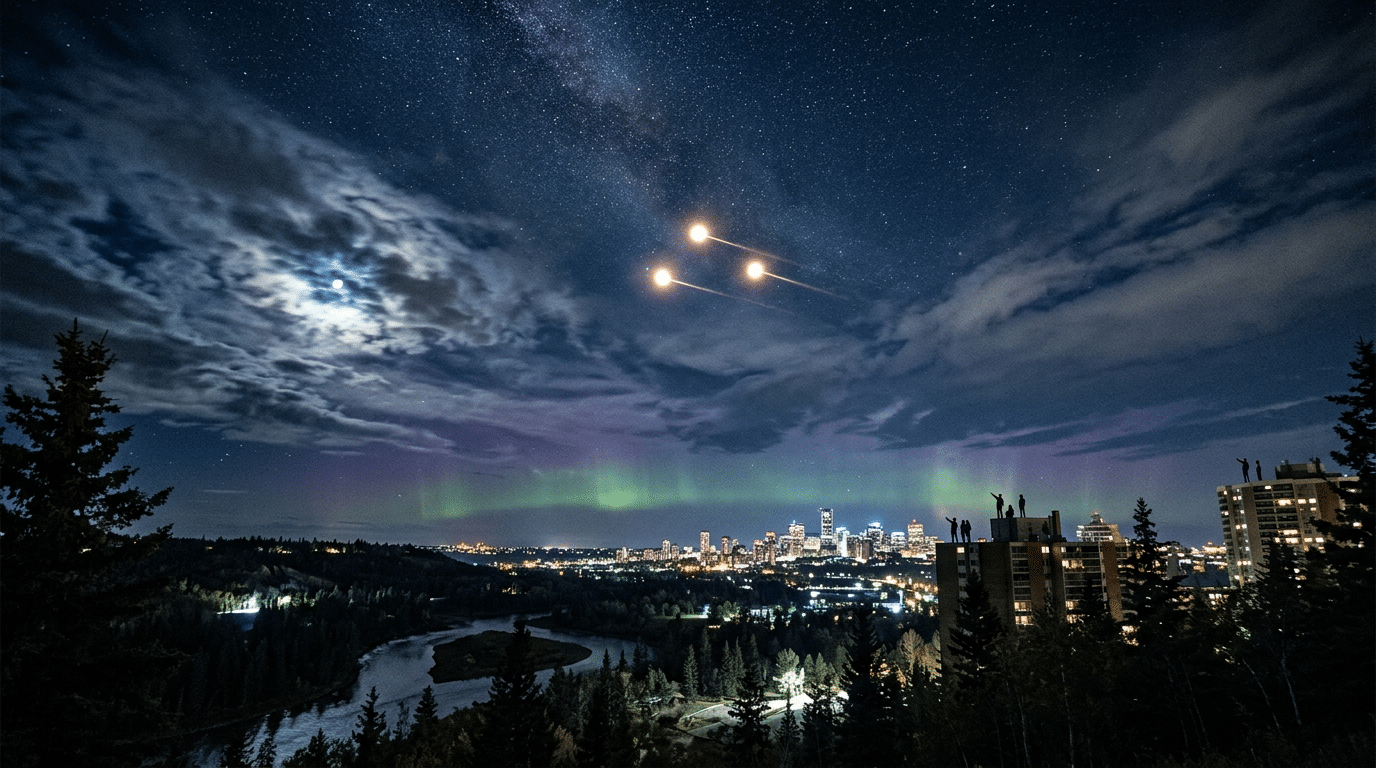
    Something is happening above us. Across North America, reports of unidentified flying objects are surging to levels not seen in years. In Canada, more than 1,000 UFO sightings were reported in 2025. In New York City, witnesses are capturing strange luminous orbs flying in triangular formations over Queens. The question on everyone is mind: what is going on?

    Canada: 1,000+ Sightings in a Single Year

    The 2025 edition of the Canadian UFO Survey, released this week, documents 1,052 UFO reports across Canada — the highest number since the COVID-19 pandemic and a significant jump from 1,008 in 2024 and just 570 in 2023.

    “The number of reports in a given area is related to population, of course we get more reports from Ontario, Quebec and B.C., but there are some irregularities,” said Chris Rutkowski, research coordinator for the Canadian UFO Survey. “For example, Manitoba and Newfoundland had significant increases in UFO numbers, whereas in Alberta and B.C. we saw decreases in numbers. Why? We are really not sure, but it really proves that there is more to the UFO phenomenon that bears more understanding.”

    Ontario led the pack with 30 per cent of total reports, Quebec claimed about 20 per cent, B.C. had 13.5 per cent and Alberta had roughly 11 per cent. Out of all 2025 reports, only 3.42 per cent were classified as “unexplained.”

    Rutkowski also noted that one in ten Canadians believe they have seen a UFO. “It cuts across all demographics, and all areas of Canada,” he said. “If you have seen a UFO, you are definitely in very good company.”

    The peak year for Canadian UFO reports remains 2012, with 1,982 sightings since the survey began in 1989. But the recent surge has researchers taking notice.

    “Over the past few years and certainly after the pandemic, after that point people started taking a renewed interest and I would imagine some of that renewed interest came from some objects flying in the sky,” Rutkowski explained.

    NYC: Triangle Orbs “Chasing” Over Queens

    While Canadians were documenting their sightings, residents of New York City were looking up at something unusual of their own. A Reddit user in Queens captured footage of three mysterious, luminous orbs flying in an erratic, triangular formation over the city on March 8th.

    The user, Charlie Correa, said the objects appeared to be “chasing each other” before he began recording the 18-second clip at approximately 8:30 p.m. The footage shows three faint, luminous orbs traveling across the night sky in a mostly triangular formation.

    While some have speculated the orbs could be drones, birds, or other mundane explanations, the Federal Aviation Administration (FAA) acknowledged that it documents UAP (Unidentified Aerial Phenomena) sightings reported by pilots, though the agency declined to comment on this specific incident.

    UFO sightings have been on the rise in New York, with 66 reported in the first half of 2025 alone.

    What Is Driving the Surge?

    The increase in sightings coincides with a broader cultural and political shift toward taking UFOs seriously. Recent congressional hearings, government whistleblowers, and high-profile figures like Steven Spielberg speaking out have all contributed to a new openness about the topic.

    Most sightings, according to researchers, have mundane explanations — aircraft, planes, satellites, planets, and other conventional objects that are misidentified. But a small percentage remain unexplained, and it is those cases that continue to captivate the public imagination.

    As Rutkowski put it: “There certainly is a concern about people being a little watchful and wondering what is going on up there.”

    Whether the surge reflects more objects in the sky, more eyes watching, or a combination of both, one thing is clear: the skies are getting more attention than ever before.

    Read more about the Canadian UFO Survey on CTV News.

  • Does HAARP Control the Weather? The Conspiracy That Will Not Die

    Does HAARP Control the Weather? The Conspiracy That Will Not Die

    The High Frequency Active Auroral Research Program has been blamed for hurricanes, earthquakes, and even snowstorms. But what does the science actually say?

    It happens every time a major weather event strikes. The phone rings at the HAARP facility in Alaska. Emails flood in. Social media explodes with the same recurring accusation: the U.S. government is weaponizing the ionosphere to control the weather.

    It happened after Hurricane Helene. It happened after Hurricane Melissa. It happened when a snowstorm hit Iowa during the 2024 caucuses, with far-right influencer Laura Loomer suggesting HAARP created the blizzard to dampen voter turnout. Most recently, when geomagnetic storms caused aurora sightings as far south as Texas late last year, Facebook filled with posts claiming these lights were not natural—manufactured by scientists at HAARP for sinister purposes.

    The theory has persisted for decades, despite repeated debunking by scientists, government agencies, and the facility itself.

    What Actually Is HAARP?

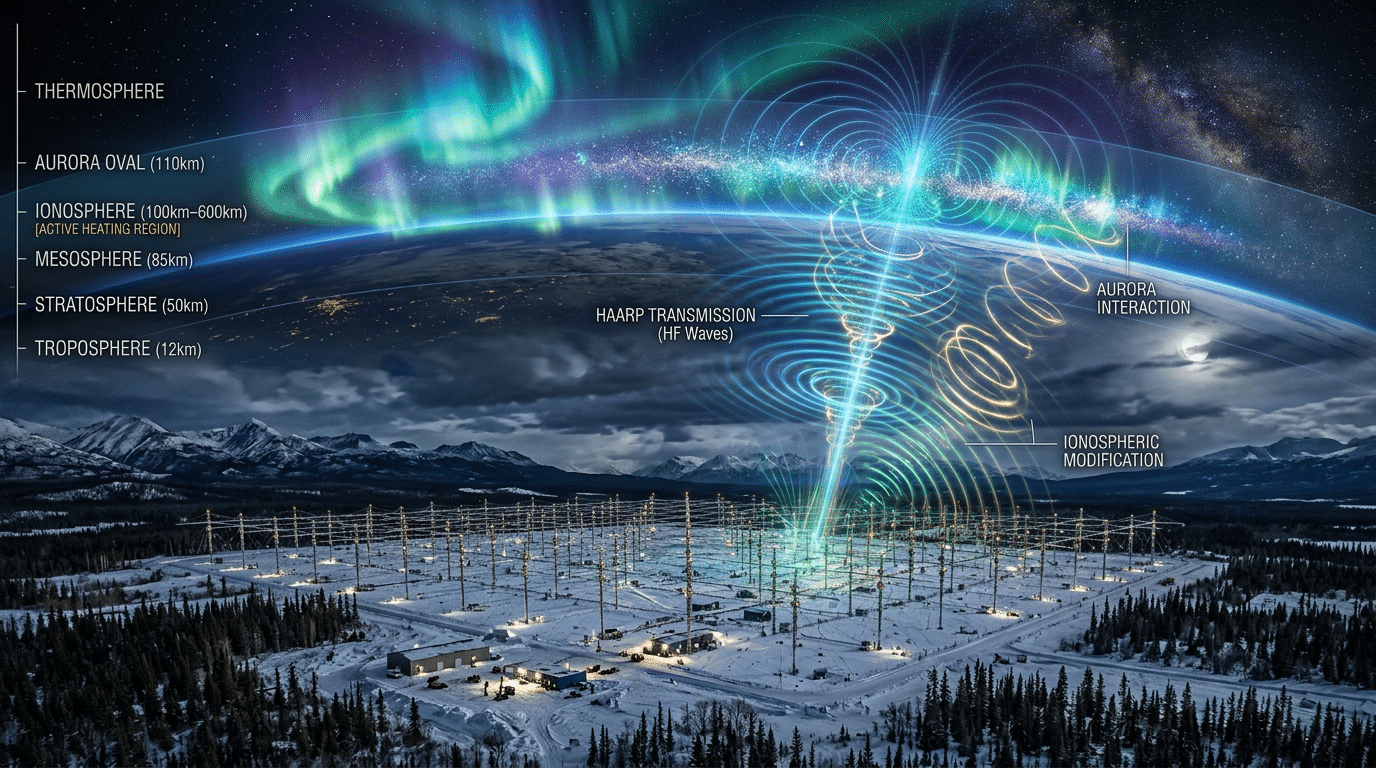
    HAARP stands for the High-frequency Active Auroral Research Program. Located in Gakona, Alaska, it is owned by the University of Alaska Fairbanks and was originally built by the U.S. military for $290 million.

    The facility consists of an array of 180 transmitters, each sitting atop a 72-foot-tall post, arranged in a grid surrounded by Alaskan wilderness. It is, essentially, the world is most powerful ionospheric heater—a high-powered radio transmitter that transmits signals into the ionosphere, the part of the upper atmosphere that begins about 30 miles above Earth is surface.

    These transmissions temporarily “heat” or excite the ionosphere. The original military goals were modest: the Navy wanted to develop new forms of long-range communication, and the Air Force wanted to study “killer” electrons that sometimes damage satellites.

    “The most succinct way to summarize what HAARP now studies is ‘the effects that the ionosphere has on signals, on radio-wave propagation,” David Hysell, an engineering professor at Cornell who has conducted experiments at the facility, told The Atlantic.

    That is not particularly exciting. But it is also not a weather weapon.

    The Science: Why HAARP Cannot Control the Weather

    The fundamental problem with the conspiracy theory is one of physics.

    “Claims that ionospheric heaters such as HAARP can modulate the weather are being pushed by people who have no understanding whatsoever of the physics involved in atmospheric circulation and weather systems,” Professor Brian Ward from RMIT University said.

    The ionosphere that HAARP studies begins at about 30 miles above Earth is surface. Weather—the formation of clouds, hurricanes, tornadoes, and storms—occurs in the troposphere, the lowest layer of Earth is atmosphere, extending only about 7 to 12 miles up.

    The energy from HAARP is simply too weak and too localized to affect the troposphere where weather is created. As the National Oceanic and Atmospheric Administration (NOAA) states plainly: “HAARP is a small National Science Foundation-funded facility in Gakona, Alaska, that conducts research on the ionosphere [30 to 600 miles above Earth]. Neither HAARP nor any other human-made system is capable of modifying the weather.”

    Stanford University professor Umran Inan told Popular Science that weather-control conspiracy theories were “completely uninformed,” explaining that “there is absolutely nothing we can do to disturb the Earth is weather systems.”

    To put it another way: HAARP is like shining a flashlight at the moon and expecting it to change the tides.

    What HAARP Has Been Falsely Blamed For

    Despite the scientific impossibility, the conspiracy theory refuses to die. A 2024 study published in Nature found that HAARP was the subject of more than one million conspiracism-inflected posts on Twitter from January 2022 to March 2023, primarily in the aftermath of natural disasters.

    The list of false attributions includes:

    • Hurricanes – Every major hurricane sparks fresh accusations. Hurricane Helene (2024) and Hurricane Melissa (2025) were both falsely blamed on HAARP.
    • Earthquakes – Venezuelan President Hugo Chávez famously linked HAARP to the 2010 Haiti earthquake.
    • Snowstorms – The Iowa caucus blizzard of 2024 was accused of being manufactured to suppress Trump voter turnout.
    • Aurora borealis – Social media regularly claims HAARP creates or manipulates the northern lights.
    • Even caribou – One academic paper from the Journal of the Society for the Study of the Cryptozool (yes, really) documented concerns about backward-walking caribou near the facility.

    Why Does This Conspiracy Persist?

    Jessica Matthews, HAARP is current director and an Air Force veteran, has spent years trying to combat misinformation about the facility. The university has held open houses, posted public information pages, and even produced irreverent merchandise. Nothing seems to work.

    “If left to myself, I wouldn’t say anything,” Matthews told The Atlantic. “But that is not the right answer.”

    The persistence of the conspiracy likely stems from several factors: the facility is remote and mysterious-looking, the science is genuinely complex, and there is a deep-seated distrust of government institutions. When natural disasters strike, people look for explanations—and some find it easier to believe in secret weapons than in the chaos of climate and physics.

    As for the people who actually work at HAARP? They are just doing ionospheric science, trying to understand how radio waves behave in the upper atmosphere. The guy pouring beer in Anchorage put it most succinctly: “They just do the aurora.”

    Nothing more. Nothing sinister. Just science.

    Learn more about HAARP is research at their official website.

  • Steven Spielberg Breaks Silence at SXSW: We Are Not Alone on Earth Right Now

    Steven Spielberg Breaks Silence at SXSW: We Are Not Alone on Earth Right Now

    The legendary filmmaker opens up about aliens, his new UFO thriller Disclosure Day, and why he believes humanity is on the verge of something historic.

    At 79 years old, Steven Spielberg has spent decades transporting audiences to other worlds. But during a keynote conversation at SXSW in Austin this weekend, the director made it clear he is no longer interested in fiction when it comes to one particular topic.

    “I don’t know any more than any of you do, but I have a very strong suspicion that we are not alone here on Earth right now — and I made a movie about that,” Spielberg told the audience during a live interview with podcaster Sean Fennessey.

    The moment was electric. Here was the man who defined the modern alien encounter with Close Encounters of the Third Kind (1977) and E.T. (1982) — films that shaped how generations think about extraterrestrial life — now standing in front of a live audience, making what sounded remarkably like a confession.

    “The Big Question Is: Are We Alone Now?”

    Spielberg’s comments come amid a seismic shift in how the topic of UFOs — now officially termed UAPs (Unidentified Aerial Phenomena) — is discussed in mainstream circles. The filmmaker acknowledged being “reinvigorated” into making his first UFO movie since Close Encounters by two major catalysts: The New York Times2017 exposé on a secret government program tracking UFOs, and the recent congressional hearings featuring government whistleblowers.

    “The big question is: Are we alone now?” Spielberg said. “And have we been alone over the last 80 years? Have we been alone over the last few thousand years?”

    He also addressed former President Barack Obama’s recent viral comment confirming aliens are “real.” Spielberg’s reaction? Pure, unfiltered enthusiasm for his upcoming project.

    “Oh, my God, this is so great for Disclosure Day!” he recalled thinking. “And two days later, he stepped it back to say what he believed was life in the cosmos — which, of course, everybody should believe in. Because no one should ever think that we are the only intelligent civilization in the entire universe.”

    A Director Who’s Never Seen a UFO

    Perhaps most striking: Spielberg admitted he’s never experienced a close encounter himself — despite making an entire career exploring the concept.

    “I made a movie called Close Encounters of the Third Kind — I haven’t even had a close encounter of the first or second kind!” he joked. “Why haven’t I seen anything? Half of my friends have seen UFOs or UAPs. Where’s the justice of that?”

    Despite his apparent frustration, the director expressed no fear about the possibility of alien contact. “I’m not afraid of any aliens,” he said. “I have no fears about that whatsoever.”

    However, he acknowledged that widespread disclosure could cause serious societal disruption. “Our movie does take into consideration that social dislocation that could occur. If it was announced there is interaction [with aliens] that has been going on for decades, it’s going to cause a disruption in a lot of belief systems. But I don’t think it is a lethal disruption at all.”

    Disclosure Day: The Film Arrives

    The upcoming Disclosure Day — starring Emily Blunt, Josh O’Connor, and Colin Firth — chronicles what happens when humanity receives undeniable proof that we are not alone. The film opens June 12 and represents one of several high-profile projects currently exploring UFO lore seriously, riding the wave of recent government hearings and media reports on UAPs.

    According to The Hollywood Reporter, the film has resulted in some confusion online given a documentary last year titled Age of Disclosure, which interviewed former government officials about UAPs, with some wondering if Spielberg’s fictional movie is part of a larger conspiratorial effort on the topic.

    Spielberg reflected on how far the conversation has come since he first tried to make Close Encounters. “Nobody would let me make Close Encounters because it was on the fringes of science and mythology,” he recalled. “When I said, ‘I want to make a UFO movie,’ everybody thought, ‘You want to make a movie about The National Enquirer?’”

    Now, nearly five decades later, the director is finally being taken seriously on a topic he’s spent his entire career exploring — both in fiction, and apparently, in life.

    Disclosure Day opens in theaters June 12, 2026. Read more about the film on Deadline.

  • Planetary Parade 2026: Cosmic Shift or Optical Trick?

    Planetary Parade 2026: Cosmic Shift or Optical Trick?

    Key Takeaways

    • On February 28, 2026, six planets—Mercury, Venus, Jupiter, Saturn, Uranus, and Neptune—aligned in a visual parade across the western sky, observable with varying clarity by hemisphere; some like Neptune need telescopes, while others shine bright to the naked eye.
    • Official sources from NASA, USGS, and mainstream outlets stress that these alignments are purely line-of-sight events with no significant gravitational or tidal impact on Earth, far outmatched by the Moon and Sun; claims of major geophysical disruptions lack backing from consensus science.
    • Community voices, including influencer Stefan Burns and online forums, describe this as an energetic ‘choicepoint’ linked to heightened dreams, physical sensations, and possible solar or Earth shifts; these accounts are personal and widespread but rely on anecdotes without replicated, data-driven proof of cause.

    A Quiet Parade Under a February Sky

    The evening of February 28, 2026, draws near. In the western sky, a rare alignment unfolds—six planets stretching across the horizon like sentinels in the dusk. Observers in the Northern Hemisphere might catch the full sweep if skies are clear, while those farther south adjust for a tilted view. The air hums with anticipation among those who’ve marked their calendars, binoculars at the ready. Whispers of something more than astronomy circulate: a convergence that could stir unseen forces. Earlier that month, on February 16, Saturn and Neptune met in their final conjunction of a triple series, fueling weeks of speculation. For the parade itself, Mercury gleams low, Venus blazes bright, Jupiter holds steady, Saturn glows at magnitude around 1.0, Uranus demands dark skies, and faint Neptune—magnitude 7.7 to 7.8—calls for a scope. The scene feels charged, a mix of celestial mechanics and human expectation hanging in the chill air.

    What Witnesses and Analysts Report

    Across forums and social threads, reports pile up. People describe dreams turning vivid, almost prophetic, disrupting sleep patterns in the lead-up to the alignment. Others mention bodily sensations—tingles, pressures, a sense of energy surging through them. Synchronicities appear too, like chance encounters or ideas aligning perfectly. Influencers like Stefan Burns tie these to geophysics, framing the parade as a ‘choicepoint’ where planetary positions intersect with solar activity, potentially sparking shifts in consciousness or even Earth’s magnetic field. His videos and posts gather communities who share similar stories, calling it a moment for collective awakening. Skeptics in the comments push back, asking for solid data over feelings. Still, the accounts persist, timestamped and raw, painting a picture of something felt but not yet measured.

    Timelines, Tracks, and Hard Data

    Let’s pin down the facts. The Saturn-Neptune conjunction hit on February 16, 2026, verified by sources like Star Walk and The Planetary Society. Then came the multi-planet parade on February 28, involving Mercury, Venus, Jupiter, Saturn, Uranus, and Neptune—some visible unaided, others needing optics under dark skies. NASA and the National Space Science Data Center state clearly: these are visual alignments, with planets too distant for notable gravitational pull on Earth. The USGS echoes this for tides and quakes, noting only the Moon and Sun matter significantly; other planets add negligible effects. A 2021 paper by Awadh explores possible links between configurations and earthquakes, but it’s preliminary and debated. Mainstream coverage from BBC Sky at Night, Space.com, Smithsonian, and The Guardian treats it as an astronomical spectacle, warning against overhyping causation.

    Fact Date Planets Involved Data/Source
    Saturn-Neptune Conjunction 16 February 2026 Saturn, Neptune Star Walk, Planetary Society
    Multi-Planet Parade 28 February 2026 Mercury, Venus, Jupiter, Saturn, Uranus, Neptune The Guardian, Space.com
    Institutional Stance on Effects Ongoing All aligned planets NASA/NSSDC, USGS
    Exploratory Hypothesis 2021 Various configurations Awadh (2021) paper

    Official Story vs. What the Data Suggests

    Agencies like NASA maintain the line: alignments are optical illusions from our viewpoint, with gravity too weak to budge Earth’s tides or tectonics. USGS adds that while Moon-Sun interactions might nudge shallow quakes slightly, planets don’t factor in. Community takes differ. Some point to alignments syncing with seismic upticks or geomagnetic storms, citing papers like Awadh’s 2021 work as hints of connection. Influencers argue for heliospheric ties—solar winds and planetary positions amplifying effects on Earth. Yet the evidence splits: mainstream datasets from earthquake logs and solar records show no strong correlations without cherry-picking. Subjective experiences, though—those dreams and sensations—could stem from expectation alone, spreading through networks. The gap persists: hard data leans official, but anomalies and feelings keep questions alive.

    What It All Might Mean

    The parade on February 28, 2026, stands as a confirmed sky event, just like the February 16 Saturn-Neptune meetup. Science from institutions dismisses big physical impacts. But subtler threads—heliospheric links or group psychology—remain unproven, worth probing. To sort it out, we’d need datasets spanning 30 days before and after: earthquake catalogs, geomagnetic Kp/Dst indices, solar flare logs, even Schumann resonance if accessible. Run cross-correlations with pre-set methods to check for patterns. Next steps? Compile that data for open analysis. Reach out to Stefan Burns for his timestamps and predictions, then balance with a USGS seismologist and a heliophysicist. The choicepoint narrative might hold clues—or it might reveal how shared stories shape our reality.

    Frequently Asked Questions

    The multi-planet parade was most visible on February 28, 2026, in the western sky, with visibility varying by hemisphere. It followed the Saturn-Neptune conjunction on February 16, 2026.

    NASA and USGS state that planetary alignments are visual events with negligible gravitational or tidal effects on Earth, overshadowed by the Moon and Sun. They caution against linking them to geophysical changes without evidence.

    Community reports include increased dream intensity, disrupted sleep, energetic bodily sensations, and synchronicities. Influencers like Stefan Burns connect these to a ‘choicepoint’ for energetic shifts, though these are anecdotal.

    Mainstream data shows no significant ties, but exploratory papers like Awadh’s 2021 work suggest possible connections that need more testing. Community claims often rely on coincidences without replicated studies.

    Assemble datasets from earthquake catalogs, geomagnetic indices, and solar activity around the event dates, then run pre-registered analyses. Interviews with experts and influencers could clarify testable claims.

  • MKULTRA Mind Control: What the CIA Files Still Hide

    MKULTRA Mind Control: What the CIA Files Still Hide

    Key Takeaways

    • What happened: From 1953, the CIA ran Project MKULTRA, a vast behavioral modification effort that funded around 149 subprojects involving universities, hospitals, and clinics.
    • What evidence shows: Declassified CIA documents, congressional reports from the Rockefeller Commission and the Church Committee (1975–76), and survivor testimony confirm non-consensual experiments with LSD dosing, hypnosis, sensory deprivation, prolonged drug-induced sleep, and abusive electroshock treatments.
    • What remains uncertain: Major internal records were destroyed in 1973 by order of DCI Richard Helms, leaving questions about how many people were harmed, the full scope of contractor and institution involvement, and whether any meaningful mind-control technology was achieved.

    A Quiet Room, A Drink, and Cold War Shadows

    Picture this: November 1953. A government scientist named Frank Olson sits in a dimly lit room with colleagues, sipping a drink that’s been spiked with LSD without his knowledge. The air is thick with secrecy, the walls echoing the paranoia of the era. This was the Cold War—nuclear arms races, the Red Scare, fears of Soviet brainwashing techniques pushing the U.S. to extremes. Experiments unfolded in sterile hospital wards, university labs, and hidden safe houses. Subjects endured casual dosing, prolonged confinement, or ‘depatterning’ sessions that blurred the line between science and cruelty. The urgency felt real, but the human toll? That’s where the shadows deepen.

    What Witnesses and Analysts Report

    Survivors from sites like the Allan Memorial Institute describe lives shattered: persistent memory loss, personality shifts, erased skills, and Trauma that lingers decades later. Families stepped up, too—the Olson family, for instance, fought for answers after Frank’s covert LSD dosing led to his fatal fall from a New York hotel window on November 28, 1953. Their persistence, along with other testimonies, fueled the Rockefeller Commission and Church Committee inquiries in 1975–76. Independent voices like journalists John Marks and Stephen Kinzer have pieced together the puzzle, concluding that while MKULTRA backed unethical experiments, proof of reliable mind control is thin. And in our circles, you’ve heard the fringe takes—telepathy, remote viewing, even ‘ethereal bindings’—born from anecdotes and those yawning gaps in the record.

    Timelines, Tracks, and Hard Data

    The story unfolds in stark dates and figures, pieced from what’s left after the purges. Project MKULTRA kicked off in 1953 under CIA auspices, spearheaded by figures like Sydney Gottlieb. By 1973, Director Richard Helms ordered most files destroyed, hobbling later probes. Exposure came in 1975 with the Rockefeller Commission, followed by the Senate’s Church Committee hearings into 1976, which slammed the ethical lapses. Scale? Surviving docs point to 149 subprojects, roping in dozens of colleges (44 by one count), hospitals (12), and prisons. Key players: Dr. D. Ewen Cameron at McGill’s Allan Memorial Institute (Subproject 68), funded with about $69,000 through fronts from 1957–1964; George Hunter White running safe houses for dosing ops. Experiments cataloged include LSD on unwitting subjects, hypnosis, sensory deprivation, drug-induced comas, depatterning, and intense ECT. The Olson family got a $750,000 settlement in 1975. Primary docs? Hit the CIA FOIA Reading Room for declassified PDFs on MKULTRA—cite those subproject IDs for traction.

    Date Event Source
    1953 Project MKULTRA initiated by the CIA Declassified CIA documents
    November 28, 1953 Frank Olson’s death after covert LSD dosing Family testimony and investigations
    1973 Destruction of most MKULTRA files ordered by Richard Helms Congressional reports
    1975 Rockefeller Commission inquiry Public records
    1975–76 Church Committee hearings and reports Senate documents

    Official Story vs. What the Documents and People Suggest

    The CIA admits MKULTRA happened, has coughed up declassified files via FOIA, and owns the 1973 document bonfire. Their Inspector General flagged the unethical mess, and later statements echo that. Congress, through the Rockefeller and Church probes, blasted the non-consensual tests and noted how shredded records blocked a full reckoning. Implicated spots like universities and hospitals offer spotty acknowledgments—some defend, few fully own the methods. But survivors and families see it as targeted abuse with scars that endure; those missing files stoke suspicions of deeper cover-ups. Historians call it a ethical horror show with scant scientific wins—no solid operational mind control. In our community, the secrecy around psychic angles—like ties to later remote-viewing efforts—fuels theories, even if docs show more interest than proof.

    Open Questions and What to Watch Next

    What got torched in 1973? Could contractor stashes or foreign archives hold overlooked pieces? How many unwitting subjects suffered dosing or worse, and how many harms tie directly back? Did MKULTRA bleed into psychic programs like Stargate, masked under different labels? The Olson case still nags—who dosed him, why, and could fresh forensics flip the script? On redress: Which outfits owe survivors real access, apologies, or payouts, especially cross-border like at McGill? Dig in with FOIA hits to the CIA Reading Room—grab that MKULTRA PDF set and subproject IDs. Scan Senate hearings and Olson family archives for raw quotes. Keep eyes peeled; patterns emerge in the gaps.

    What It All Might Mean

    MKULTRA stands as a documented fact: CIA-funded from 1953, exposed in the ’70s, riddled with abusive experiments on the unwitting. The 1973 purge ensures we’ll never know the full scale or results, breeding rightful doubt. It forced changes in research ethics, eroded trust in power structures, and lingers in stories that mix hard truth with wild speculation. Think of Frank Olson’s fall on November 28, 1953, or a patient’s vanished memories—what else vanished with those files?

    Frequently Asked Questions

    MKULTRA was a real CIA program starting in 1953, confirmed by declassified documents and congressional reports like the Church Committee findings. It funded 149 subprojects involving non-consensual experiments on behavior modification.

    Declassified CIA files, survivor testimonies, and inquiries from the Rockefeller Commission and Church Committee detail experiments like LSD dosing, hypnosis, and electroshock without consent. Families like the Olsons provided key accounts that prompted public scrutiny.

    The CIA acknowledged the program and released some documents via FOIA, while admitting files were destroyed in 1973. Congressional committees condemned the ethical violations, and some families received settlements, like the Olsons’ $750,000 in 1975.

    Independent researchers find limited evidence that MKULTRA produced reliable mind-control techniques. The program’s secrecy and destroyed records leave room for speculation, including fringe ideas about psychic elements, but surviving data shows more failures than breakthroughs.

    Key uncertainties include the full scale of harm, what was lost in the 1973 document destruction, and potential overlaps with later psychic research programs. Cases like Frank Olson’s death continue to spark debate over hidden details.

    Start with FOIA requests to the CIA Reading Room for MKULTRA documents and subproject details. Review Senate hearing transcripts and archives from families like the Olsons for primary sources.

  • Piri Reis Map: Antarctica, Hoax Map or Lost History?

    Piri Reis Map: Antarctica, Hoax Map or Lost History?

    Key Takeaways

    • What seems to have happened: In 1513, Ottoman admiral Piri Reis compiled a world chart from more than twenty earlier maps, including one from Christopher Columbus. A fragment of this chart was rediscovered in 1929 at the Topkapı Palace library, showing Atlantic coasts and a mysterious southern landmass open to interpretation.
    • What the evidence supports: Institutional analyses from UNESCO, the Library of Congress, and scholars like Gregory McIntosh view it as a sophisticated portolan compilation. Conventional explanations—distorted projections, Terra Australis traditions, and copying errors—better account for the southern outline than extraordinary theories.
    • What remains unresolved: The exact sources and origins of many charts Piri used are lost to time. Projection choices fuel debates, and ideas like Hapgood’s Antarctic overlays persist in public discussions despite scholarly pushback.

    A Fragment That Whispers of Lost Shores

    Picture the dim halls of Istanbul’s Topkapı Palace in late 1929. Scholars sift through forgotten stacks, cataloging the remnants of an empire. One pulls out a weathered sheet of parchment, its inks faded but alive with rhumb lines and coastal curves. This is no ordinary relic—it’s a piece of a map from 1513, drawn by Ottoman admiral Piri Reis amid the churn of Mediterranean seas and the Age of Discovery.

    Flash back to that era: sails snap in the wind, explorers chase horizons, and knowledge flows from captured charts and whispered reports. The surviving fragment, roughly one-third of the original, measures about 87 by 63 centimeters. It’s a portolan chart, practical for navigators yet adorned with notes and details that hint at broader worlds.

    What Witnesses and Analysts Report

    In alternative research circles, the map sparks intense discussion. Many see the southern landmass as evidence of an ice-free Antarctica, perhaps mapped by ancient civilizations or with outside help. These interpretations point to contours that seem to match subglacial bedrock, far beyond what 16th-century sailors should have known.

    Charles Hapgood brought this to wider attention in his 1966 book, Maps of the Ancient Sea Kings, arguing for lost knowledge preserved in the chart. Figures like Graham Hancock have built on it, fueling documentaries and online videos. Community members share digital overlays, re-projections, and forum debates, highlighting selective matches to modern surveys.

    Historians and independent investigators offer varied takes. Some note Hapgood’s claimed correspondence with Air Force cartographers, discussing resemblances to seismic data—these letters remain a point of contention. Witnesses in the field argue the map compiles forgotten voyages, while analysts stress the need to respect all perspectives without quick dismissal.

    Timelines, Tracks, and Hard Data

    The facts anchor this story. Piri Reis inscribed the map in 1513, compiling it from over twenty sources, including a chart from Columbus. Rediscovered in 1929 during cataloging at Topkapı Palace by scholars like Gustav Adolf Deissmann, the fragment now resides there, recognized by UNESCO as a key Ottoman artifact.

    It’s a portolan-style chart with rhumb lines and marginal notes, emphasizing coasts. Gregory McIntosh’s 2000 analysis underscores its compilation from earlier works. Hapgood’s 1966 book pushed alternative views, referencing mid-20th-century Antarctic surveys like the NBSAE from 1949–1952, though mainstream sources question those links.

    Key Data Point Details
    Map Date 1513 AD (Piri Reis inscription)
    Rediscovery 1929 at Topkapı Palace
    Dimensions ~87 x 63 cm
    Surviving Fraction Roughly one-third
    Claimed Sources More than twenty charts, including Columbus
    Hapgood Book 1966
    Antarctic Survey NBSAE, 1949–1952

    Official Story vs. What the Data Suggests

    Institutions like UNESCO and the Library of Congress describe the map as a 1513 Ottoman work drawing from Mediterranean and Atlantic sources. Academic cartographers, including McIntosh, attribute the southern landmass to projection distortions, traditional Terra Australis depictions, and errors in copying—straightforward reasons grounded in historical mapping practices.

    Geophysicists add that paleoclimate data rules out an ice-free Antarctica in recent prehistory, rejecting Hapgood’s crustal displacement theory. Yet community interpretations diverge, using overlays that align features persuasively but risk bias in projection choices and scale.

    Both sides agree on the map’s value as an early compilation of global knowledge. The tension lies in anomalies: where officials see convention, researchers spot patterns hinting at more. Methods matter—overlays can mislead if not rigorous, but they keep the debate alive.

    What It All Might Mean

    The core holds firm: Piri Reis crafted a remarkable 1513 chart from diverse, now-lost sources. Scholarship leans toward everyday cartographic quirks explaining the oddities, not ancient secrets.

    Questions linger. What were those exact source maps? How much stems from projection versus error? Might lost Iberian charts hold unexpected details? And do seismic profile matches stand up under strict testing?

    This resonates because it’s fragmentary, inviting imagination. It bridges verified history and the unknown, drawing those who question official lines. Dig deeper: hunt archives for source clues, run transparent projections, talk to historians and proponents. The patterns might reveal more than we think.

    Frequently Asked Questions

    The Piri Reis map is a 1513 Ottoman chart compiled by admiral Piri Reis from over twenty sources, including one from Columbus. Only a fragment survives, showing Atlantic coasts and a southern landmass that sparks debate.

    Alternative researchers like Charles Hapgood argue it depicts an ice-free Antarctic coastline, using overlays to match modern surveys. Mainstream scholars explain it through conventional cartographic errors and projections, not extraordinary knowledge.

    UNESCO and the Library of Congress treat it as a sophisticated 1513 compilation from earlier charts. They favor explanations like distorted projections and Terra Australis traditions over claims of lost civilizations.

    Its fragmentary nature and anomalies invite interpretation, fueling discussions between official views and alternative theories. Open questions about sources and projections keep curiosity alive in communities tracking unexplained history.

    Proponents use digital overlays and re-projections to align the southern landmass with Antarctic features, referencing Hapgood’s book and claimed Air Force correspondence. These methods show visual matches but face criticism for potential bias.