Author: Art Grindstone

  • Ancient Astronaut Claims Are Surging Again: Why Real Archaeology Keeps Getting Repackaged as Alien Evidence

    Ancient Astronaut Claims Are Surging Again: Why Real Archaeology Keeps Getting Repackaged as Alien Evidence

    The latest wave of ancient astronaut content is not being driven by a single discovery. It is being driven by a familiar online formula: take a real archaeological update, strip away its scientific context, and recast it as evidence that extraterrestrials once shaped human civilization. That formula is working again in April 2026, and it says as much about internet culture as it does about the enduring pull of ancient alien mythology.

    If you want the direct answer, here it is: there is no new mainstream archaeological evidence proving ancient astronauts visited Earth. What is happening instead is a fresh burst of viral reinterpretation, where legitimate finds, dating updates, and museum discoveries are being folded into a pre-existing story that many audiences already want to believe.

    That matters because real archaeology already offers enough wonder on its own. Research published through institutions like the Archaeological Institute of America and reporting aggregated by ScienceDaily’s archaeology coverage show how often legitimate discoveries are richer, stranger, and more human than viral alien retellings suggest.

    What This Story Actually Says

    Across late March and early April 2026, fringe creators and YouTube channels have been circulating new posts about so-called ancient astronaut evidence. The pattern is highly recognizable: a real discovery is announced or revisited, an unusual artifact or chronology detail is isolated, and then the explanation is stretched toward alien intervention.

    The underlying source material is often mundane by scientific standards. It might involve a revised excavation date, a misunderstood symbolic image, or an archaeological press release framed far beyond what researchers actually said. But once the item is edited into a short-form clip or dramatic thumbnail, the claim becomes less about evidence and more about narrative momentum.

    That distinction matters. The online version of the story is usually not “archaeologists found proof of extraterrestrials,” but rather “why aren’t experts admitting what this clearly means?” That framing turns uncertainty into suspicion and turns specialist caution into alleged suppression.

    Why Ancient Astronaut Content Spreads So Easily

    The ancient astronaut theory has always been built for virality. It offers a clean, dramatic explanation for complex historical questions. It replaces slow scholarship with a cinematic answer: ancient people did incredible things, therefore something non-human must have helped them.

    That logic spreads especially well online because it rewards pattern recognition over context. A carved figure, a strange alignment, or an engineering achievement can be presented as a mystery in seconds. The harder work—reading excavation reports, cultural histories, and peer-reviewed interpretations—does not travel nearly as fast.

    It also benefits from familiarity. Audiences have been trained by decades of television, documentaries, and internet culture to read archaeological ambiguity as a clue pointing toward aliens. Once that interpretive lens is in place, almost any surprising historical detail can be turned into “evidence.”

    What the Evidence Actually Supports

    The strongest evidence here supports something much less sensational: ancient societies were technically skilled, symbolically sophisticated, and often more capable than modern mythmakers give them credit for. Mainstream archaeology does not need extraterrestrials to explain architecture, ritual systems, trade networks, astronomy, or symbolic art.

    That does not mean every historical puzzle is solved. Archaeology is full of open questions, contested timelines, and evolving interpretations. But an open question is not the same thing as proof of alien contact. In practice, the ancient astronaut frame usually enters the conversation after the evidence, not before it. It is applied to material that already exists rather than discovered through rigorous investigation.

    Readers who want a grounded approach should pay attention to what archaeologists actually claim, how a find was documented, whether a sensational interpretation appeared only after the story hit social media, and whether the strongest version of the evidence really requires a non-human explanation. Good starting points include the public resources of Smithsonian history reporting and the more technical archive at Archaeology magazine.

    What Skeptics and Archaeologists Would Say

    Mainstream experts tend to push back on ancient astronaut claims for two reasons. First, the claims usually rely on selective reading. A dramatic detail is amplified while the surrounding cultural and technical context is ignored. Second, the theory often underestimates ancient people themselves, implying they could not have built, designed, or understood complex systems without outside intervention.

    That criticism is not just academic nitpicking. It goes to the heart of why many archaeologists find the ancient alien frame so frustrating. It can erase indigenous knowledge, flatten cultural complexity, and replace real human achievement with a pseudo-mythology dressed up as contrarian truth.

    There is also a media literacy problem here. Once an artifact is labeled “impossible” or “unexplained” in a viral clip, the burden shifts unfairly onto experts to debunk an interpretation that was never well-supported in the first place.

    Why This Story Still Matters in 2026

    The current surge matters because it shows how easily real science can be repackaged into speculative content ecosystems. When audiences are primed for cover-up narratives, even careful archaeological reporting can become raw material for conspiracy-minded storytelling.

    It also matters because the ancient astronaut myth is a gateway theory. It does not stay confined to archaeology. It often overlaps with broader claims about hidden histories, suppressed technology, elite secrecy, and institutional deception. In other words, it is part of a larger belief environment, not just a quirky theory about the past.

    For unexplained coverage, that makes it a valuable subject. The bigger question is not simply whether people believe in ancient aliens. It is why this frame continues to outperform more evidence-based explanations whenever a visually compelling discovery appears online.

    The Bigger Pattern Behind the Ancient Alien Revival

    What keeps this story alive is not proof. It is interpretive hunger. Audiences want a version of history that feels hidden, forbidden, and bigger than the official one. Ancient astronaut content satisfies that appetite while borrowing legitimacy from genuine archaeology.

    That is why these revivals keep happening in cycles. New artifacts are not required. A fresh clip, a dramatic voiceover, or a decontextualized quote can restart the entire machine. The result is a cultural loop in which scholarship generates wonder, social media reframes wonder as suspicion, and suspicion gets monetized as revelation.

    Final Assessment

    The April 2026 ancient astronaut surge does not reveal new proof of extraterrestrial contact. It reveals how durable the ancient alien narrative remains when real archaeology is fed into a high-speed attention economy. The strongest takeaway is not that experts are hiding alien evidence. It is that ambiguity still sells better than context, and that history becomes easiest to distort when wonder is stripped away from the people who actually created it.

    Frequently Asked Questions

    Is there any new proof of ancient astronauts in April 2026?

    No. The current surge is being driven by reinterpretations of real archaeological stories, not by new mainstream evidence proving extraterrestrial contact.

    Why do ancient alien claims keep going viral?

    Because they offer dramatic, easy-to-share explanations for complex historical questions and perform extremely well in visual, short-form media environments.

    What do archaeologists usually object to?

    They object to selective use of evidence, loss of cultural context, and the implication that ancient civilizations could not achieve remarkable things without non-human help.

    Why does this matter beyond archaeology?

    Because ancient astronaut content often feeds larger conspiracy ecosystems built around hidden history, elite secrecy, and distrust of mainstream institutions.

    Related Articles

    This article was created using Media Blaster – Your content production specialist. Visit www.mediablaster.io for more information.

  • April 2026 Prophecy Claims Are Everywhere: How Prediction Culture Turns Anxiety Into Authority

    April 2026 Prophecy Claims Are Everywhere: How Prediction Culture Turns Anxiety Into Authority

    April 2026 prophecy chatter is spreading for the same reason prophecy waves always spread: a volatile news cycle, a ready-made online belief community, and creators who know how to frame uncertainty as confirmation. What looks like a sudden eruption of psychic forecasts is really a feedback loop where fear, algorithms, and monetized certainty all reinforce one another.

    Here is the core answer. There is no verified evidence that April 2026 is uniquely destined for cosmic or geopolitical upheaval. What exists is a surge of prediction content from psychics, remote viewers, and prophecy channels tying current anxieties to older narratives, then presenting those narratives as if unfolding events are validating them in real time.

    That distinction matters because prophecy culture rarely succeeds by being precise. It succeeds by being adaptable. A vague forecast can be stretched around almost any development, and once audiences begin watching current events through that lens, nearly every headline starts to feel like evidence. Broader reporting on online extremity and belief dynamics from outlets like Pew Research Center and analysis of digital amplification patterns at Brookings help explain why these narratives find such fertile ground.

    What This Story Actually Says

    Across fringe forums, prophecy channels, and social media communities, creators have been circulating claims that April 2026 would bring major world events, spiritual turning points, or disclosure-level revelations. Some of these claims are being connected to UFO narratives, while others are framed through broader religious, psychic, or end-times language.

    What makes this surge notable is not one single prophecy, but the way multiple subcultures are converging around the same month. Remote-viewing communities, online psychics, and apocalypse-focused creators are all packaging contemporary uncertainty as if it were foreseen. That creates the impression of confirmation even when the actual predictions are broad, recycled, or contradictory.

    This also helps explain why familiar names and older claims keep getting pulled back into circulation. Once an audience believes a forecaster was “right once,” later statements are treated as heightened warning signals rather than as new claims that still need evidence.

    Why Prophecy Content Spreads So Easily

    Prediction content thrives when the audience already feels unstable. Political turbulence, disclosure chatter, economic stress, and online fear loops create exactly the emotional environment in which prophecy narratives gain traction. People do not just want information in those moments. They want orientation.

    Prophecy creators offer something mainstream reporting cannot: certainty. Even when that certainty is artificial, it feels useful. It turns a messy present into a pattern and gives followers the sense that someone is already reading the map.

    Algorithms amplify this dynamic because emotionally charged, high-stakes content outperforms calm analysis. A claim that a psychic foresaw upheaval or that a remote viewer predicted major events in April is inherently more clickable than a measured explanation of coincidence, selective memory, or narrative reframing.

    What the Evidence Actually Supports

    The evidence here supports the existence of a powerful online prediction culture, not the truth of any specific prophecy. What can be observed directly is the distribution mechanism: repeated posting, mutual amplification between creators, audience reinforcement, and strategic linking of broad predictions to unfolding events.

    In practice, most viral prophecy claims are difficult to falsify because they are framed elastically. They use emotionally loaded but open-ended language, and they often gain strength after events occur, when followers retrospectively fit headlines into an earlier statement.

    That is why the key evidence question is not “did someone make a prediction?” but “was the prediction specific, dated, testable, and documented before the event?” Without those standards, prophecy culture becomes a machine for generating perceived hits while quietly discarding misses. Media literacy work from groups like The News Literacy Project and broader misinformation research at First Draft remain useful frameworks for judging these claims more critically.

    What Skeptics and Former Believers Would Say

    Skeptics would argue that prophecy communities are often better at narrative maintenance than prediction. They reinterpret misses, narrow their claims after the fact, and borrow significance from unrelated events. Former believers often describe the same dynamic more personally: they were drawn in by certainty, then kept in place by community pressure and the emotional cost of admitting a prediction failed.

    There is also a monetization layer that deserves attention. Paid memberships, donation funnels, private groups, and exclusive briefings can all turn prophecy into a business model. When attention becomes income, there is a built-in incentive to keep the next warning cycle alive.

    That does not mean every person sharing predictions is acting cynically. But it does mean audiences should distinguish between spiritual expression, speculative interpretation, and a system that rewards escalating fear.

    Why This Story Matters Right Now

    The April 2026 prophecy wave matters because these narratives can affect real behavior. People do not consume them passively. They make emotional, social, and sometimes financial decisions based on what they think is coming. In extreme cases, prophecy ecosystems can fuel panic, isolation, compulsive doomscrolling, or harmful group dynamics.

    It also matters because prophecy content increasingly overlaps with UFO and disclosure culture. Once those worlds merge, political developments, government secrecy, spiritual warfare, and cosmic expectation all get folded into the same story universe. That makes the content feel larger, more urgent, and harder for followers to step back from critically.

    The Bigger Pattern Behind Prediction Surges

    The deeper pattern here is that prophecy communities are highly adaptive. They do not need certainty to function. They need momentum. A predicted month, a symbolic date, or a charged news event can provide enough narrative fuel to restart the cycle again and again.

    That is why the most important question is not whether one forecast comes true. It is why broad, emotionally resonant prediction systems remain so persuasive when precise accuracy is so rare. The answer usually lies in psychology, community identity, and the comfort of feeling that chaos is secretly organized.

    Final Assessment

    The April 2026 prophecy surge is best understood as a media and belief phenomenon rather than as evidence of verified foresight. It shows how quickly uncertainty can be reframed as validation when audiences, creators, and algorithms are all pointing in the same direction. The real story is not that prophecy has been proven. It is that in anxious moments, prediction culture can make itself feel uncannily right even when the underlying evidence stays weak.

    Frequently Asked Questions

    Are April 2026 prophecy claims verified?

    No. What is verifiable is the spread of prediction content and the way online communities are amplifying it, not proof that any specific prophecy is true.

    Why do prediction channels gain traction during tense periods?

    Because they offer certainty, meaning, and emotional orientation when mainstream events feel chaotic or difficult to interpret.

    How can readers judge a prophecy claim fairly?

    Check whether it was clearly documented before the event, whether it was specific and testable, and whether failed predictions are being ignored or reinterpreted.

    Why does this overlap with UFO culture?

    Because both spaces are drawn to hidden meaning, elite secrecy, revelation narratives, and the idea that major truth is about to break into public view.

    Related Articles

    This article was created using Media Blaster – Your content production specialist. Visit www.mediablaster.io for more information.

  • Bioluminescent “Humanoid” Sea Clips Explained: Why Viral Ocean Mysteries Keep Outrunning Marine Science

    Bioluminescent “Humanoid” Sea Clips Explained: Why Viral Ocean Mysteries Keep Outrunning Marine Science

    Viral “bioluminescent humanoid” clips are effective because they combine two things the internet loves: ocean mystery and visual ambiguity. A glowing shape near dark water can look uncanny in seconds, especially once edits, slow motion, and suggestive captions push viewers toward one interpretation. But the evidence points toward a much more familiar explanation: natural bioluminescence, optical distortion, and social-media framing doing the heavy lifting.

    The short answer is simple. There is no verified evidence that these clips show glowing humanoid entities. What is actually happening is that real marine light phenomena—such as glowing plankton, algae, and other bioluminescent organisms—are being edited, miscaptioned, or narratively framed to look like something far stranger than they are.

    That makes this a useful story for unexplained audiences, because it shows how a compelling mystery image can outrun context almost immediately. The video looks weird first. The explanation arrives later, if it arrives at all. Background science from NOAA and marine explainers from MBARI make clear that bioluminescence can already appear otherworldly without requiring a supernatural reading.

    What This Story Actually Says

    In early April 2026, a cluster of viral posts began circulating footage described as “bioluminescent humanoids” seen in or near coastal waters. The clips typically show glowing shapes, trails, or partial forms against dark backgrounds, then rely on text overlays or dramatic voiceovers to guide viewers toward a paranormal reading.

    The visual material itself is not necessarily fake in the simplest sense. In many cases, the underlying glow can come from real bioluminescent phenomena. What changes the meaning is the edit. Slow-motion treatment, cropped framing, overlays, and high-emotion captions can all shift the viewer’s perception from “interesting marine light effect” to “possible unknown entity.”

    That distinction is crucial because it means many of these clips work by reinterpreting real footage rather than fabricating every element from scratch. The strangeness is often real. The conclusion is where the distortion begins.

    Why Ocean Mystery Content Spreads So Easily

    The ocean is one of the easiest places to project mystery. Most viewers are not experts in marine life, underwater optics, or low-light video artifacts. That knowledge gap gives unusual footage enormous narrative power.

    Bioluminescence is especially vulnerable to sensational framing because it is already visually unreal. Blue glow in dark water looks supernatural before any explanation is added. Once creators pair that imagery with claims about humanoid forms, hidden species, or unexplained sightings, the content becomes instantly shareable.

    There is also a built-in credibility effect. Because the glow is real, the paranormal interpretation feels more plausible than a purely fabricated clip might. Viewers can see that something unusual is happening. The leap is in assuming that unusual automatically means unknown or non-human.

    What the Evidence Actually Supports

    The strongest evidence supports known marine and visual explanations. Bioluminescent algae, plankton blooms, disturbed microorganisms, deep-sea organisms, and reflective light conditions can all produce eerie moving forms, especially in low-resolution or compressed footage. Add camera shake, darkness, and selective editing, and the result can look astonishingly creature-like.

    Photographers, marine biologists, and science communicators have repeatedly pointed out that human perception is especially vulnerable in low-light scenes. We impose pattern on moving light. We search for symmetry. We read partial shapes as bodies. In a social feed, where viewers are primed for revelation, that tendency becomes even stronger.

    So the evidence does not point to glowing humanoid entities. It points to a collision between natural marine phenomena and narrative packaging. Readers who want a stronger grounding can compare public-facing resources from NOAA Ocean Service and broader marine science reporting from KQED Science.

    What Skeptics and Marine Experts Would Say

    Mainstream experts would emphasize that extraordinary marine claims need chain-of-custody evidence, location context, high-quality source files, and species-level analysis where possible. Viral clips almost never provide that. They arrive detached from place, time, and verifiable documentation.

    Skeptics would also note that ocean content has long been fertile territory for hoaxes, misidentifications, and amplified folklore. The combination of darkness, distance, water distortion, and biological unfamiliarity makes the sea one of the easiest environments in which to misread what is visible.

    That does not make the footage worthless. It makes it incomplete. And incomplete evidence is exactly the kind that social platforms are built to overinterpret.

    Why This Story Still Matters

    This matters because false ocean mysteries can erode trust in real marine science while training audiences to prefer mythic interpretations over grounded ones. It also matters because the same attention mechanics that boost paranormal claims can bury expert correction just as quickly.

    For unexplained media, this is fertile territory when handled well. The smarter story is not “the debunk killed the mystery.” It is that the mystery became popular because natural phenomena can be genuinely beautiful, visually shocking, and easy to misunderstand.

    That approach preserves wonder without rewarding misinformation. It respects the emotional power of the footage while still separating what is visible from what is merely being suggested.

    The Bigger Pattern Behind Viral Sea Myths

    Bioluminescent humanoid clips fit a broader digital pattern: authentic visual strangeness gets pulled into sensational storytelling because ambiguity performs better than explanation. The sea becomes a blank screen onto which viewers project monsters, hidden beings, or lost truths.

    That pattern will keep repeating because it works. Every new glowing beach, strange underwater clip, or unclear night video offers another opportunity for the same cycle—wonder, speculation, virality, and only later, context.

    Final Assessment

    The viral “bioluminescent humanoid” wave says more about attention culture than about unknown ocean entities. What viewers are mostly seeing is real bioluminescence reframed through editing, suggestion, and the internet’s appetite for mystery. The deeper lesson is not that marine science has explained away wonder. It is that wonder becomes easiest to exploit when viewers are shown the glow before they are given the context.

    Frequently Asked Questions

    Are bioluminescent humanoid clips real?

    The glow in many clips may be real, but there is no verified evidence that the videos show actual humanoid entities. Natural marine light effects are the stronger explanation.

    Why do these videos look so convincing?

    Because bioluminescence already looks uncanny, and editing choices like cropping, slow motion, and dramatic captions can make natural shapes appear creature-like.

    What should viewers look for before believing a clip?

    Check for original source files, exact location, recording context, expert review, and whether the footage has been edited or stripped of important background information.

    Does debunking remove the mystery?

    Not necessarily. Real bioluminescence is fascinating on its own. The point is to preserve wonder without confusing natural phenomena with unsupported claims.

    Related Articles

    This article was created using Media Blaster – Your content production specialist. Visit www.mediablaster.io for more information.

  • On Air: The History of Disclosure Talk Radio and How UFO Belief Learned to Broadcast Itself

    On Air: The History of Disclosure Talk Radio and How UFO Belief Learned to Broadcast Itself

    Long before UFO disclosure became a social-media ecosystem, a congressional talking point, or a streaming-content genre, it lived in a far more intimate medium: late-night radio. If you want to understand the emotional history of modern disclosure culture, you have to understand what happened when anomalous claims, whistleblower lore, government suspicion, and cosmic speculation first went On Air. The history of Disclosure Talk Radio is not just a media story. It is the story of how belief communities formed, how UFO testimony gained cultural structure, and how millions of listeners learned to hear secrecy itself as evidence.

    That is the central truth this article explores. Disclosure Talk Radio did not merely report on UFO culture — it helped create the grammar of modern disclosure. It trained audiences to expect hidden files, buried witnesses, redacted truths, insider leaks, military silence, and a coming moment when the official story would collapse under its own contradictions.

    In that sense, UFO disclosure was not born on podcasts or YouTube. It was born in the dark, over AM signals, under pseudonymous calls, in restless overnight hours when the line between journalism, folklore, confession, and performance was often impossible to separate.

    What Is Disclosure Talk Radio?

    Disclosure Talk Radio refers to the long tradition of radio programs, call-in shows, independent broadcasts, and later internet-radio hybrids devoted to UFOs, government secrecy, alien contact, military cover-up claims, and the broader idea that the public is being denied the truth about non-human intelligence.

    At its core, Disclosure Talk Radio is less a strict genre than a recurring communications model. It usually combines:

    • insider testimony or alleged insider testimony
    • host-guided interpretation
    • listener participation
    • high trust in first-person narrative
    • deep suspicion of official institutions
    • a recurring promise that revelation is near

    That structure matters because it shaped the emotional operating system of modern disclosure culture. The host was not just an interviewer. The host often acted as translator, validator, priest, gatekeeper, and community architect all at once.

    Why Radio Became the Natural Home of UFO Disclosure

    Radio was uniquely suited to UFO disclosure for reasons that are easy to miss now. Unlike television, it did not require visual proof. Unlike newspapers, it was conversational and immediate. Unlike academic forums, it welcomed ambiguity. And unlike later algorithm-driven platforms, it created a slower but more intimate form of audience trust.

    That mattered enormously for a subject like UFO disclosure, where visual evidence was often blurry, official confirmation was sparse, and witness testimony carried much of the emotional weight. Radio let people hear hesitation, fear, conviction, and personality in a way print never could.

    More importantly, radio made secrecy feel personal. When someone called in claiming they had seen something impossible, worked in a hidden facility, or knew someone in the military who had been silenced, listeners were not just receiving information. They were participating in an unfolding social drama.

    That participatory intimacy is one reason disclosure culture took root so deeply in radio before it fully migrated online.

    The Prehistory: Flying Saucers, Contactees, and Broadcast Curiosity

    The roots of Disclosure Talk Radio can be traced back to the first great UFO wave of the late 1940s and early 1950s, when flying-saucer sightings, military investigations, and contactee movements began entering public consciousness. Mainstream radio covered some of this material, but often as novelty, sensationalism, or strange-news content rather than as an organized counter-public sphere.

    Still, those early years mattered because they established several patterns that would later define the genre:

    • the tension between official explanation and public suspicion
    • the appeal of direct witness accounts
    • the sense that radio could host material mainstream institutions treated cautiously
    • the fascination with messages from beyond government control

    Contactee-era figures such as George Adamski and others benefited from the broader communications environment of the time, but the true maturation of disclosure radio would come later, once late-night call-in culture became central to American broadcasting.

    The Late-Night Revolution: Why the Overnight Hours Mattered

    The overnight radio slot proved to be the perfect incubator for disclosure media. At night, ordinary rules soften. Audiences are smaller, weirder, lonelier, and often more emotionally open. The listener at 2:00 a.m. is not the same listener as the commuter at 8:00 a.m.

    This is critical to understanding how disclosure culture formed. UFO talk did not simply succeed because the subject was fascinating. It succeeded because the listening environment encouraged a different relationship to uncertainty. Night radio rewards the unresolved. It invites voices that would sound absurd in brighter contexts to become strangely plausible in darkness.

    That is why so much of the disclosure tradition feels inseparable from atmosphere. The medium did not merely distribute the message. It altered the psychological conditions under which the message was received.

    Art Bell and the On Air Disclosure Imagination

    No serious history of Disclosure Talk Radio can avoid the central role of Art Bell. Through Coast to Coast AM and related projects, Bell became one of the most important broadcasters in the history of paranormal and fringe media. He did not invent UFO radio, but he refined its most powerful form.

    Bell’s genius was not simply that he gave UFO topics airtime. It was that he made the entire act of going On Air feel like crossing into a different epistemic zone — one where government insiders, abductees, ex-military figures, prophets, conspiracy theorists, and ordinary callers all occupied the same acoustic stage.

    That flattening of status mattered. A scientist, a truck driver, and an alleged Area 51 employee could all sound equally compelling at 1:30 in the morning if the atmosphere was right.

    Bell’s format rewarded several key disclosure dynamics:

    • first-person testimony over institutional certainty
    • live calls that felt too raw to be fabricated
    • the constant possibility of an “insider breakthrough”
    • emotional plausibility outranking formal verification

    This is one reason Bell still looms over the subject. He turned disclosure from a topic into a feeling.

    The Caller as Witness, Prophet, and Leak Channel

    One of the most underappreciated features of Disclosure Talk Radio is the role of the caller. In mainstream media, callers are often treated as filler or public reaction. In UFO radio, callers became evidence channels.

    They might report lights in the sky, military family stories, childhood abduction memories, insider rumors, or local incidents never covered in newspapers. The call-in format gave disclosure culture an ever-renewing bloodstream of low-verification but high-emotional-intensity material.

    This had two major consequences.

    First, it democratized UFO disclosure. You did not need access to classified files to enter the conversation. You only needed a voice and a story.

    Second, it made the disclosure narrative structurally impossible to close. Every new caller could reopen the mystery.

    That is one reason radio mattered so much. It did not merely circulate claims. It institutionalized endless testimony.

    Government Secrecy as a Recurring Character

    One of the defining traits of Disclosure Talk Radio is that government secrecy became more than a topic. It became a recurring character in the narrative. Even when specific evidence was weak, secrecy itself functioned as a stabilizing force for belief.

    If no proof existed, that could mean it was hidden. If witnesses contradicted one another, that could mean compartmentalization. If media ignored a case, that could mean suppression. If a caller sounded unstable, that could mean trauma or intimidation. The framework was self-reinforcing.

    This is not merely irrationality. It is a coherent media logic. Once an audience accepts that institutions systematically conceal the truth, every gap in the public record can be reinterpreted as indirect confirmation.

    Disclosure Talk Radio helped normalize that reasoning pattern long before it became mainstream internet behavior.

    From UFOs to Disclosure: A Shift in Framing

    Another important development in the history of Disclosure Talk Radio is the shift from simply asking “Are UFOs real?” to asking “When will the truth finally be admitted?” That shift is subtle but foundational.

    The older UFO question is observational. The disclosure question is political.

    Once the framing changed, radio shows were no longer just discussing strange objects or weird encounters. They were discussing files, agencies, whistleblowers, buried technology, crash retrieval, recovered bodies, and institutional lying. The conversation moved from anomaly to suppression.

    That rhetorical evolution is one of radio’s biggest contributions to modern UFO culture. It turned the phenomenon into an information-war story.

    How Disclosure Talk Radio Built a Community, Not Just an Audience

    The most powerful disclosure shows did not merely gather listeners. They built communities. Regular callers became recognizable. Hosts developed trusted styles. Recurring guests formed a semi-stable cast of interpreters. Listeners learned what counted as a plausible case, what language to use, and what names to track.

    This matters because community formation is what turns isolated interest into a movement. Radio did not just broadcast ideas. It taught people how to belong inside a worldview.

    That community logic later migrated almost seamlessly into internet forums, podcasts, YouTube shows, X threads, Discord servers, and livestream ecosystems. In many ways, modern disclosure media is structurally just Disclosure Talk Radio with visual supplements and faster feedback loops.

    The Rise of Internet Radio and the Fragmentation of the Field

    As terrestrial radio declined in cultural centrality and internet broadcasting became easier, Disclosure Talk Radio fragmented into countless smaller ecosystems. This brought gains and losses.

    On one hand, niche hosts could serve hyper-specific audiences. Abduction-focused shows, whistleblower-heavy shows, technical-UFO-analysis shows, spiritual-contact shows, and conspiracy-geopolitics hybrids all flourished.

    On the other hand, the field lost some of the shared mass-cultural gravity that figures like Art Bell once provided. The old model had gatekeepers. The new one had scale without coherence.

    That fragmentation is one reason disclosure culture now feels both larger and less stable. More people are talking, but fewer institutions hold the conversation together.

    Why Joe Rogan, Podcasts, and YouTube Still Owe a Debt to Radio

    Modern long-form disclosure media often gets associated with podcasts and streaming platforms, but much of its DNA comes directly from radio. The endless-form interview. The insider witness. The patient host. The flattening of expert and non-expert into one long conversational zone. The willingness to let speculation breathe without immediate resolution. All of that was honed on radio.

    Even shows that appear visually sophisticated are often still operating on radio logic. The host invites a guest with controversial or extraordinary claims, lets them build a world in real time, and allows the audience to participate in credibility assessment through tone, confidence, and narrative consistency as much as through documentation.

    That is pure Disclosure Talk Radio inheritance.

    The Emotional Power of Being On Air

    The phrase On Air matters here for more than branding. To go on air is to cross into public risk. In disclosure culture, that crossing often carries moral weight. Witnesses are seen as brave for speaking. Hosts are seen as brave for giving them a platform. Broadcasting itself becomes a ritual of revelation.

    This is one reason disclosure stories are often framed in terms of courage, retaliation, and consequence. Once a person goes on air with a secret, they are no longer merely talking. They are testifying.

    That ritual dimension is part of what makes disclosure media so compelling. The microphone becomes a threshold object.

    Why Disclosure Talk Radio Still Matters in 2026

    In 2026, Disclosure Talk Radio still matters because the cultural infrastructure it created never really disappeared. It simply distributed itself across newer platforms. The language of suppressed truth, whistleblower testimony, hidden craft, recovered materials, and almost-imminent revelation remains central to how millions of people understand the UFO subject.

    And radio helped build that language.

    For readers interested in how those same patterns continue today, there are clear echoes in The Mellon Leak, in Eric Burlison’s secret-UFO-video comments, and in our Bob Lazar and Joe Rogan article. The platforms evolve, but the disclosure format remains strikingly familiar.

    Final Assessment

    The history of Disclosure Talk Radio is the history of how UFO belief learned to scale emotionally before it scaled digitally. It created a public acoustic space where secrecy sounded plausible, witness testimony felt sacred, and unresolved claims became stronger through repetition rather than weaker.

    That legacy still defines the modern disclosure era. The language changed. The platforms changed. The clips got shorter and the audiences got more fragmented. But the basic cultural script — the sense that the truth is just barely being kept off the public record, and that someone brave enough might finally go On Air and tell it — remains intact.

    In that sense, Disclosure Talk Radio was never just broadcasting the UFO mystery. It was teaching listeners how to inhabit it.

    Frequently Asked Questions

    What is Disclosure Talk Radio?

    Disclosure Talk Radio refers to radio and radio-like broadcast formats centered on UFO secrecy, government cover-up claims, whistleblower testimony, alien contact, and the broader idea that official institutions are hiding the truth.

    Why was radio so important to UFO disclosure culture?

    Radio was ideal for UFO disclosure because it rewarded voice, testimony, suspense, and ambiguity. It allowed strange or controversial claims to feel intimate and emotionally persuasive even when visual proof was limited.

    Who was the most important host in Disclosure Talk Radio history?

    Art Bell is often seen as the central figure because he helped turn late-night paranormal radio into a mass-cultural space where UFO disclosure claims could thrive.

    How did Disclosure Talk Radio influence modern podcasts and UFO media?

    Many modern UFO podcasts, livestreams, and long-form interview shows inherited radio’s structure: insider testimony, long conversation, audience participation, and a constant tension between evidence and atmosphere.

    Why does the phrase “On Air” matter in disclosure culture?

    Because going on air carries symbolic weight. In disclosure culture, speaking publicly is often framed as an act of risk, revelation, and testimony against institutional secrecy.

    Related Articles:

    This article was created using Media Blaster – Your content production specialist. Visit www.mediablaster.io for more information.

  • Hollywood, Aliens, and the Disclosure Narrative

    Hollywood, Aliens, and the Disclosure Narrative

    A fresh AP piece argues that Hollywood has spent decades shaping the public imagination around extraterrestrials, and that those fictional narratives are now colliding with renewed government-file release demands. The article ties older cinema like *The Day the Earth Stood Still*, *Close Encounters*, *E.T.*, *Predator*, and *Signs* to today’s disclosure climate, where official secrecy and entertainment mythology bleed into each other. According to AP News, the story is gaining attention well beyond its original niche.

    This is not a new leak story. It’s a culture story. But culture stories often travel farther than document dumps because they tell people how to interpret the moment.

    That is why this story matters. It is not just about the headline claim itself, but about the way uncertainty, symbolism, and public appetite for hidden meaning keep turning partial information into a larger mystery event.

    What This Story Actually Says

    In other words, the topic trending today is not just “aliens,” but **how belief is manufactured, softened, and normalized by movies before governments ever speak**. Additional framing from Related AP context on file-release pressure helps explain why the claim is traveling.

    • AP says Hollywood effectively trained audiences to think in alien archetypes long before any modern UAP hearing.
    • The story links that narrative tradition to President Trump’s February 2026 call for secret extraterrestrial/UFO-related files to be released.
    • It also references Barack Obama’s recent alien-related comments and the 2025 documentary *The Age of Disclosure*.
    • Steven Spielberg’s upcoming film **Disclosure Day** is presented as a major pop-culture bridge between entertainment and current public obsession.

    Why This Topic Spreads So Easily

    Stories like this spread because they land at the intersection of real-world uncertainty and symbolic interpretation. Once a subject carries enough emotional charge, audiences do not just ask whether it is true. They ask what it means.

    A fresh AP piece argues that Hollywood has spent decades shaping the public imagination around extraterrestrials, and that those fictional narratives are now colliding with renewed government-file release demands. The article ties older cinema like *The Day the Earth Stood Still*, *Close Encounters*, *E.T.*, *Predator*, and *Signs* to today’s disclosure climate, where official secrecy and entertainment mythology bleed into each other.

    What the Evidence Actually Supports

    The strongest evidence in stories like this is often narrower than the online reaction suggests. That is why it is important to separate direct reporting, contextual interpretation, speculation, and audience mythmaking rather than treating them as one unified thing.

    Coverage and reporting relevant to this topic include:

    What Skeptics or Mainstream Experts Would Say

    The strongest skeptical response is usually that ambiguity gets inflated faster than evidence does. That does not make the story worthless. It means the audience should be careful not to mistake symbolic power for proof.

    In many of these cases, the most likely explanation is still the least dramatic one that fits the known facts. But because emotionally satisfying explanations travel farther than cautious ones, the mystery version often spreads first and hardest.

    Why This Story Still Matters

    This matters because the unexplained niche often focuses on evidence while ignoring narrative conditioning. AP’s angle flips that: what if the biggest disclosure story isn’t hidden hardware, but the decades-long cultural preparation that made people ready to accept extraordinary claims?

    That’s catnip for unexplained audiences because it supports multiple interpretations at once:
    – believers can say Hollywood was soft-launching reality;
    – skeptics can say movies created the interpretive lens people now impose on ambiguous events;
    – conspiracy audiences can say entertainment and state secrecy have been dancing together the whole time.

    It also gives The Unexplained Company a broad, high-engagement frame that isn’t dependent on proving any one UFO clip is real. It’s about the myth-making ecosystem.

    The Bigger Unexplained Pattern

    For unexplained coverage, the deeper value is often cultural rather than evidentiary. These stories reveal what people fear, what they hope, what they distrust, and how quickly they build meaning around incomplete information.

    That is exactly why the newer SEO/GEO standard works better than the old short-form template. It is designed to answer the headline question, ground the reader in what is actually known, include stronger context, and still explain why the story has such emotional force.

    Readers interested in the broader pattern should also see The Mellon Leak: High-Def Satellite UFO Images That Could Change Everything, which connects this story to a larger unexplained.co theme.

    Final Assessment

    The real significance of stories like this is often not that they prove an extraordinary claim, but that they show how extraordinary interpretations take shape. In other words, the mystery is not only in the event. It is also in the reaction.

    Frequently Asked Questions

    What is this story about?

    A fresh AP piece argues that Hollywood has spent decades shaping the public imagination around extraterrestrials, and that those fictional narratives are now colliding with renewed government-file release demands. The article ties older cinema like *The Day the Earth Stood Still*, *Close Encounters*, *E.T.*, *Predator*, and *Signs* to today’s disclosure climate, where official secrecy and entertainment mythology bleed into each other.

    Why is this getting attention now?

    This matters because the unexplained niche often focuses on evidence while ignoring narrative conditioning. AP’s angle flips that: what if the biggest disclosure story isn’t hidden hardware, but the decades-long cultural preparation that made people ready to accept extraordinary claims?

    Is Hollywood, Aliens, and the Disclosure Narrative proven?

    No. These articles are written to separate what is verified, what is claimed, and what remains uncertain. Mystery does not automatically equal proof.

    What should readers focus on?

    Focus on the evidence, the source quality, the skeptical or conventional explanations, and why the story still resonates even when certainty is missing.

    Related Articles

    This article was created using Media Blaster – Your content production specialist. Visit www.mediablaster.io for more information.

  • Westall UFO Mystery

    Westall UFO Mystery

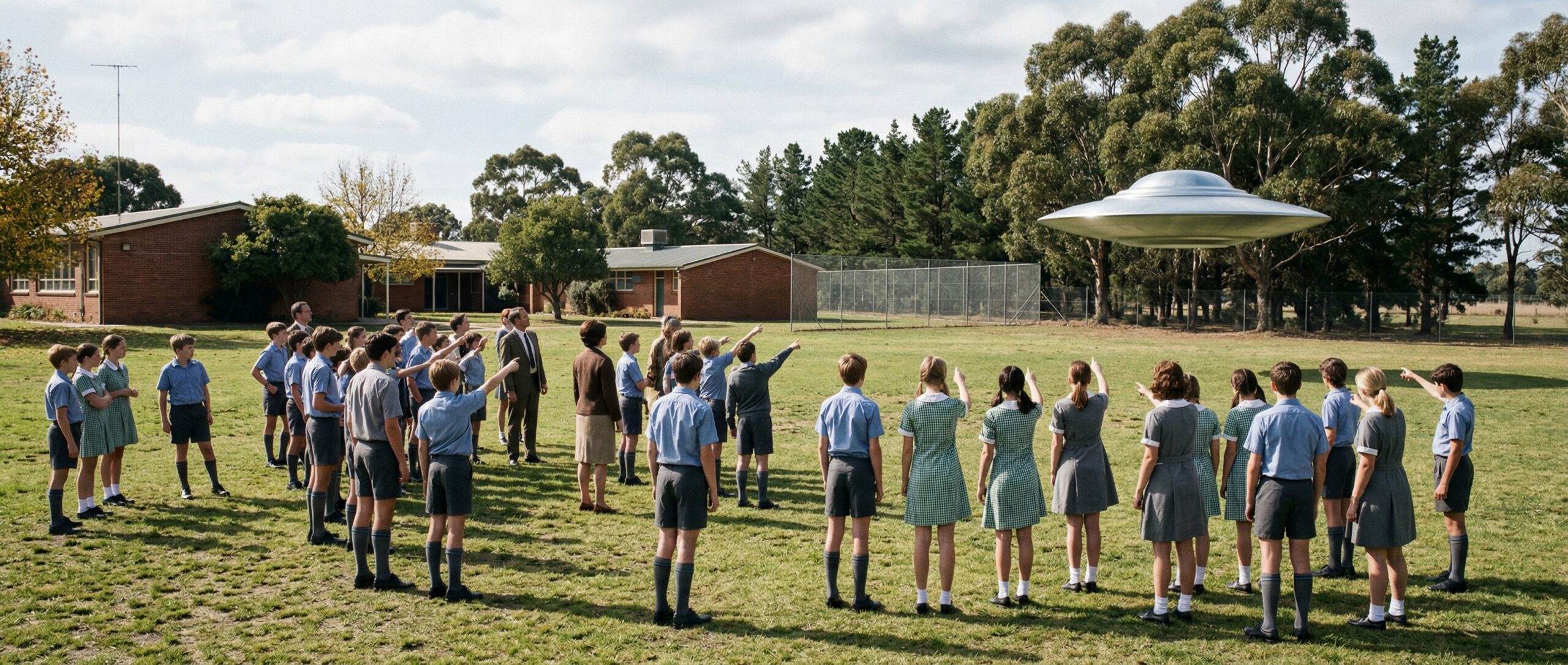
    A classic UFO case is back in the spotlight ahead of the 60th anniversary of the Westall incident, one of the most famous mass-sighting cases in Australia. ABC’s *Australian Story* is airing a new episode on April 6, 2026 focused on the event, which erupted on April 6, 1966 when more than 100 students and staff at schools in Westall, a suburb of Melbourne, reportedly saw strange objects maneuvering in the daytime sky. According to ABC News / Australian Story, the story is gaining attention well beyond its original niche.

    The new angle is not a brand-new sighting but a major media revival: surviving witnesses are now older adults, and the program promises fresh first-hand testimony plus a revisit of the competing explanations that have followed the case for six decades.

    That is why this story matters. It is not just about the headline claim itself, but about the way uncertainty, symbolism, and public appetite for hidden meaning keep turning partial information into a larger mystery event.

    What This Story Actually Says

    This is trending because it sits at the intersection of three things that perform well online:
    1. legacy mystery nostalgia,
    2. credible-seeming mass eyewitness testimony,
    3. the broader 2026 disclosure/UFO culture wave. Additional framing from TV Tonight listing helps explain why the claim is traveling.

    • ABC is promoting a new *Australian Story* episode titled **The Westall UFO Mystery**.
    • The network frames Westall as the **largest mass UFO sighting in Australian history**.
    • The episode leans on **new witness accounts** and a retrospective lens: what people saw, how authorities responded, and why the story never really went away.
    • Timing matters: anniversary coverage often acts like oxygen for dormant mysteries, and Westall is exactly the kind of unresolved, witness-heavy case that social media loves to revive.

    Why This Topic Spreads So Easily

    Stories like this spread because they land at the intersection of real-world uncertainty and symbolic interpretation. Once a subject carries enough emotional charge, audiences do not just ask whether it is true. They ask what it means.

    A classic UFO case is back in the spotlight ahead of the 60th anniversary of the Westall incident, one of the most famous mass-sighting cases in Australia. ABC’s *Australian Story* is airing a new episode on April 6, 2026 focused on the event, which erupted on April 6, 1966 when more than 100 students and staff at schools in Westall, a suburb of Melbourne, reportedly saw strange objects maneuvering in the daytime sky.

    What the Evidence Actually Supports

    The strongest evidence in stories like this is often narrower than the online reaction suggests. That is why it is important to separate direct reporting, contextual interpretation, speculation, and audience mythmaking rather than treating them as one unified thing.

    Coverage and reporting relevant to this topic include:

    What Skeptics or Mainstream Experts Would Say

    The strongest skeptical response is usually that ambiguity gets inflated faster than evidence does. That does not make the story worthless. It means the audience should be careful not to mistake symbolic power for proof.

    In many of these cases, the most likely explanation is still the least dramatic one that fits the known facts. But because emotionally satisfying explanations travel farther than cautious ones, the mystery version often spreads first and hardest.

    Why This Story Still Matters

    Westall matters because it is one of the rare UFO stories with a scale large enough to survive generations. A lone witness can be dismissed. A schoolyard full of witnesses creates a more durable legend.

    For unexplained-content audiences, the case checks every box:
    – daylight sighting,
    – many witnesses,
    – alleged official interest,
    – decades of speculation,
    – no consensus explanation.

    It also fits the current mood. UFO discourse in 2026 is being fueled not just by politicians and alleged leaks, but by the resurfacing of older cases that believers argue were ignored, minimized, or buried. Westall gives creators a way to talk about modern disclosure anxiety through a historical event that feels cinematic and emotionally human.

    There is also a useful editorial tension here: was Westall a genuine anomalous event, a misunderstood military/aviation incident, a social contagion event, or some combination? That ambiguity is what keeps it alive.

    The Bigger Unexplained Pattern

    For unexplained coverage, the deeper value is often cultural rather than evidentiary. These stories reveal what people fear, what they hope, what they distrust, and how quickly they build meaning around incomplete information.

    That is exactly why the newer SEO/GEO standard works better than the old short-form template. It is designed to answer the headline question, ground the reader in what is actually known, include stronger context, and still explain why the story has such emotional force.

    Readers interested in the broader pattern should also see The Mellon Leak: High-Def Satellite UFO Images That Could Change Everything, which connects this story to a larger unexplained.co theme.

    Final Assessment

    The real significance of stories like this is often not that they prove an extraordinary claim, but that they show how extraordinary interpretations take shape. In other words, the mystery is not only in the event. It is also in the reaction.

    Frequently Asked Questions

    What is this story about?

    A classic UFO case is back in the spotlight ahead of the 60th anniversary of the Westall incident, one of the most famous mass-sighting cases in Australia. ABC’s *Australian Story* is airing a new episode on April 6, 2026 focused on the event, which erupted on April 6, 1966 when more than 100 students and staff at schools in Westall, a suburb of Melbourne, reportedly saw strange objects maneuvering in the daytime sky.

    Why is this getting attention now?

    Westall matters because it is one of the rare UFO stories with a scale large enough to survive generations. A lone witness can be dismissed. A schoolyard full of witnesses creates a more durable legend.

    Is Westall UFO Mystery proven?

    No. These articles are written to separate what is verified, what is claimed, and what remains uncertain. Mystery does not automatically equal proof.

    What should readers focus on?

    Focus on the evidence, the source quality, the skeptical or conventional explanations, and why the story still resonates even when certainty is missing.

    Related Articles

    This article was created using Media Blaster – Your content production specialist. Visit www.mediablaster.io for more information.

  • Bigfooters and Scientific Inquiry

    Bigfooters and Scientific Inquiry

    A BBC feature spotlighting sociological research into Bigfoot hunters is giving the Sasquatch conversation a fresh 2026 angle. Instead of asking “Is Bigfoot real?” the story asks a more interesting question: what kind of people build their lives around searching for a creature science has never confirmed? According to BBC News, the story is gaining attention well beyond its original niche.

    Researchers interviewed more than 160 Bigfoot hunters over three years for the book *Bigfooters and Scientific Inquiry*. The result is a serious look at belief, fieldwork, masculinity, anti-elitism, technology, and the desire to “re-enchant” a disenchanted world.

    That is why this story matters. It is not just about the headline claim itself, but about the way uncertainty, symbolism, and public appetite for hidden meaning keep turning partial information into a larger mystery event.

    What This Story Actually Says

    What makes this trend notable is the shift from monster coverage to **belief-community coverage**. Media is increasingly treating Bigfoot less as a jump-scare topic and more as a living American folk ecosystem. Additional framing from BBC version helps explain why the claim is traveling.

    • BBC is amplifying the study as a human-interest and culture story.
    • The article describes a serious subculture of dedicated investigators using drones, infrared cameras, audio recorders, footprint casting tools, and homebrew DNA testing kits.
    • It outlines two broad Bigfoot belief camps:
    • **Apers**: Bigfoot is an unknown primate.
    • **Woo-Woos**: Bigfoot is interdimensional, paranormal, or alien-adjacent.

    Why This Topic Spreads So Easily

    Stories like this spread because they land at the intersection of real-world uncertainty and symbolic interpretation. Once a subject carries enough emotional charge, audiences do not just ask whether it is true. They ask what it means.

    A BBC feature spotlighting sociological research into Bigfoot hunters is giving the Sasquatch conversation a fresh 2026 angle. Instead of asking “Is Bigfoot real?” the story asks a more interesting question: what kind of people build their lives around searching for a creature science has never confirmed?

    What the Evidence Actually Supports

    The strongest evidence in stories like this is often narrower than the online reaction suggests. That is why it is important to separate direct reporting, contextual interpretation, speculation, and audience mythmaking rather than treating them as one unified thing.

    Coverage and reporting relevant to this topic include:

    What Skeptics or Mainstream Experts Would Say

    The strongest skeptical response is usually that ambiguity gets inflated faster than evidence does. That does not make the story worthless. It means the audience should be careful not to mistake symbolic power for proof.

    In many of these cases, the most likely explanation is still the least dramatic one that fits the known facts. But because emotionally satisfying explanations travel farther than cautious ones, the mystery version often spreads first and hardest.

    Why This Story Still Matters

    This matters because it reframes cryptid culture as a social force rather than just a curiosity. Bigfoot hunters are not just meme fodder in this telling; they are amateur researchers, pilgrims, hobbyists, and counter-establishment knowledge seekers.

    That framing opens up richer content territory:
    – Why are people still searching in an age of satellites and smartphones?
    – Why do ambiguous traces remain more compelling than conclusive proof?
    – Is Bigfoot belief a protest against expert culture, or a parallel form of grassroots inquiry?

    There is also a bigger unexplained-theme takeaway here: a lot of paranormal culture survives because it gives people meaning, community, and adventure. The hunt itself may be the real phenomenon.

    The Bigger Unexplained Pattern

    For unexplained coverage, the deeper value is often cultural rather than evidentiary. These stories reveal what people fear, what they hope, what they distrust, and how quickly they build meaning around incomplete information.

    That is exactly why the newer SEO/GEO standard works better than the old short-form template. It is designed to answer the headline question, ground the reader in what is actually known, include stronger context, and still explain why the story has such emotional force.

    Readers interested in the broader pattern should also see Nessie Returns: Fresh Sightings Revive the Loch Ness Monster Mystery, which connects this story to a larger unexplained.co theme.

    Final Assessment

    The real significance of stories like this is often not that they prove an extraordinary claim, but that they show how extraordinary interpretations take shape. In other words, the mystery is not only in the event. It is also in the reaction.

    Frequently Asked Questions

    What is this story about?

    A BBC feature spotlighting sociological research into Bigfoot hunters is giving the Sasquatch conversation a fresh 2026 angle. Instead of asking “Is Bigfoot real?” the story asks a more interesting question: what kind of people build their lives around searching for a creature science has never confirmed?

    Why is this getting attention now?

    This matters because it reframes cryptid culture as a social force rather than just a curiosity. Bigfoot hunters are not just meme fodder in this telling; they are amateur researchers, pilgrims, hobbyists, and counter-establishment knowledge seekers.

    Is Bigfooters and Scientific Inquiry proven?

    No. These articles are written to separate what is verified, what is claimed, and what remains uncertain. Mystery does not automatically equal proof.

    What should readers focus on?

    Focus on the evidence, the source quality, the skeptical or conventional explanations, and why the story still resonates even when certainty is missing.

    Related Articles

    This article was created using Media Blaster – Your content production specialist. Visit www.mediablaster.io for more information.

  • Amy Bradley Mystery: New Leads Resurface

    Amy Bradley Mystery: New Leads Resurface

    The long-running disappearance of Amy Bradley is back in circulation after reports of new investigative movement tied to the 1998 cruise-ship case. Bradley, 23, vanished during a Royal Caribbean trip with her family while the ship was nearing Curaçao. Nearly three decades later, the case remains one of the most discussed disappearance mysteries on the internet. According to Fox News, the story is gaining attention well beyond its original niche.

    The new wave comes from comments by filmmaker Ari Mark, whose Netflix docuseries *Amy Bradley Is Missing* revived public attention in 2025. According to reports, two people with alleged trafficking ties have been questioned by the FBI, while additional leads include claims that Bradley may have given birth after her disappearance and that a 2023 website IP hit may have come from a public computer inside a Caribbean casino.

    That is why this story matters. It is not just about the headline claim itself, but about the way uncertainty, symbolism, and public appetite for hidden meaning keep turning partial information into a larger mystery event.

    What This Story Actually Says

    This is trending because unresolved disappearances sit right on the edge of true crime, conspiracy, and paranormal-style mystery culture. Amy Bradley is especially potent because the setting feels cinematic: a person vanishes from a cruise ship without a definitive explanation. Additional framing from Hollywood Reporter update referenced by Fox helps explain why the claim is traveling.

    • Fox News and other outlets are amplifying updates sourced from Ari Mark and *The Hollywood Reporter*.
    • The reported developments include:
    • FBI questioning of two people of interest tied to trafficking,
    • a lead suggesting Bradley may have had a child after vanishing,
    • follow-up around a 2023 website access originating from a Caribbean casino.

    Why This Topic Spreads So Easily

    Stories like this spread because they land at the intersection of real-world uncertainty and symbolic interpretation. Once a subject carries enough emotional charge, audiences do not just ask whether it is true. They ask what it means.

    The long-running disappearance of Amy Bradley is back in circulation after reports of new investigative movement tied to the 1998 cruise-ship case. Bradley, 23, vanished during a Royal Caribbean trip with her family while the ship was nearing Curaçao. Nearly three decades later, the case remains one of the most discussed disappearance mysteries on the internet.

    What the Evidence Actually Supports

    The strongest evidence in stories like this is often narrower than the online reaction suggests. That is why it is important to separate direct reporting, contextual interpretation, speculation, and audience mythmaking rather than treating them as one unified thing.

    Coverage and reporting relevant to this topic include:

    What Skeptics or Mainstream Experts Would Say

    The strongest skeptical response is usually that ambiguity gets inflated faster than evidence does. That does not make the story worthless. It means the audience should be careful not to mistake symbolic power for proof.

    In many of these cases, the most likely explanation is still the least dramatic one that fits the known facts. But because emotionally satisfying explanations travel farther than cautious ones, the mystery version often spreads first and hardest.

    Why This Story Still Matters

    For unexplained-content audiences, the Amy Bradley case behaves like a modern legend. There is no supernatural claim required. The mystery itself carries the same emotional mechanics:
    – isolation in a liminal setting,
    – fragmentary sightings,
    – suspicious leads,
    – a long trail of “what if” theories,
    – a family still searching.

    It matters editorially because this case shows how streaming documentaries can function like paranormal revivals: they resurrect cold mysteries, generate new witnesses and tips, and transform old cases into participatory internet investigations.

    There is also a cautionary angle. Cases like this attract speculation fast, and the newest leads are still unverified in any conclusive sense. That tension between hope and hype is part of the story.

    The Bigger Unexplained Pattern

    For unexplained coverage, the deeper value is often cultural rather than evidentiary. These stories reveal what people fear, what they hope, what they distrust, and how quickly they build meaning around incomplete information.

    That is exactly why the newer SEO/GEO standard works better than the old short-form template. It is designed to answer the headline question, ground the reader in what is actually known, include stronger context, and still explain why the story has such emotional force.

    Readers interested in the broader pattern should also see The Pentagon UFO Report and What It Still Can’t Explain, which connects this story to a larger unexplained.co theme.

    Final Assessment

    The real significance of stories like this is often not that they prove an extraordinary claim, but that they show how extraordinary interpretations take shape. In other words, the mystery is not only in the event. It is also in the reaction.

    Frequently Asked Questions

    What is this story about?

    The long-running disappearance of Amy Bradley is back in circulation after reports of new investigative movement tied to the 1998 cruise-ship case. Bradley, 23, vanished during a Royal Caribbean trip with her family while the ship was nearing Curaçao. Nearly three decades later, the case remains one of the most discussed disappearance mysteries on the internet.

    Why is this getting attention now?

    For unexplained-content audiences, the Amy Bradley case behaves like a modern legend. There is no supernatural claim required. The mystery itself carries the same emotional mechanics:
    – isolation in a liminal setting,
    – fragmentary sightings,
    – suspicious leads,
    – a long trail of “what if” theories,
    – a family still searching.

    Is Amy Bradley Mystery: New Leads Resurface proven?

    No. These articles are written to separate what is verified, what is claimed, and what remains uncertain. Mystery does not automatically equal proof.

    What should readers focus on?

    Focus on the evidence, the source quality, the skeptical or conventional explanations, and why the story still resonates even when certainty is missing.

    Related Articles

    This article was created using Media Blaster – Your content production specialist. Visit www.mediablaster.io for more information.

  • American UFO Saga: Reality and Fiction

    American UFO Saga: Reality and Fiction

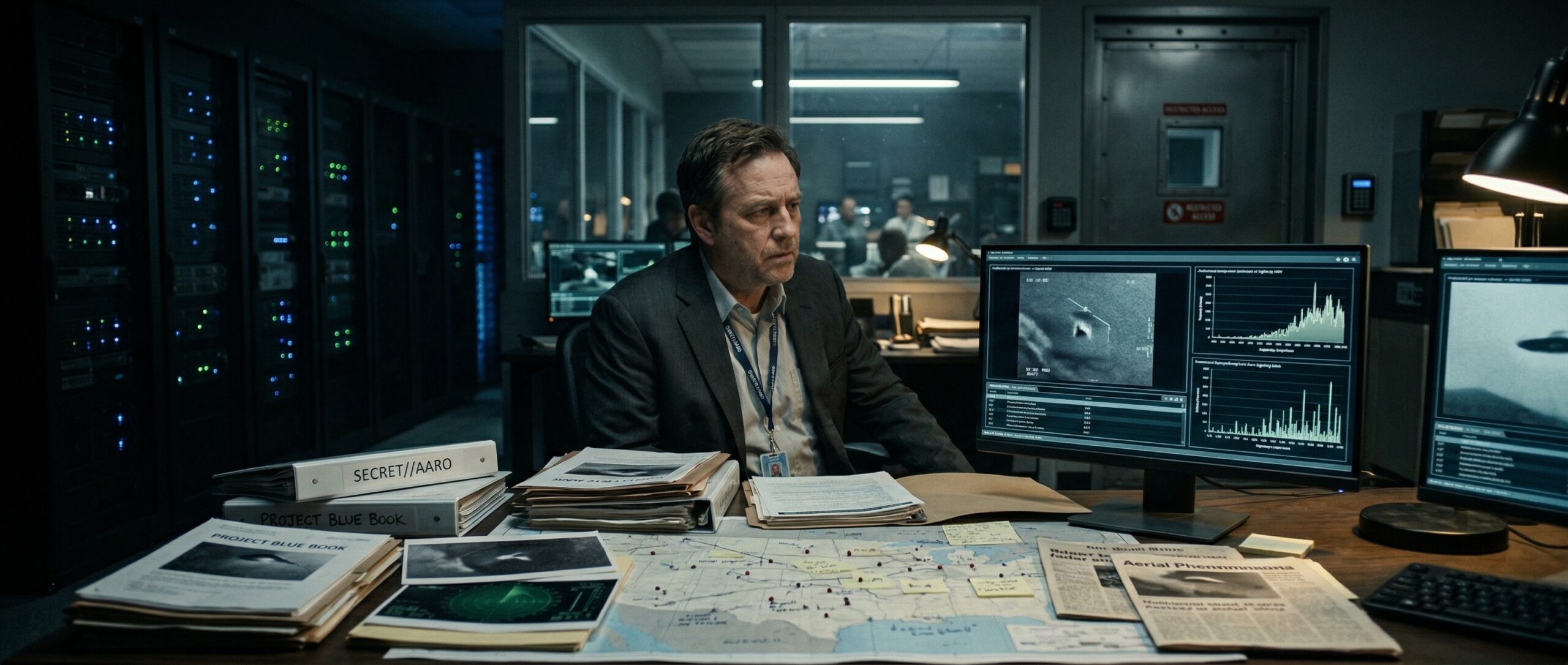
    AP has published a timely explainer tracing nearly a century of UFO history across sightings, government investigations, military videos, congressional hearings, and pop culture. On paper, it is a straight timeline. In practice, it is a signal that UFOs have again become mainstream-news material rather than tabloid leftovers. According to AP News, the story is gaining attention well beyond its original niche.

    The piece runs through the familiar canon: Kenneth Arnold in 1947, Roswell, Project Sign and Blue Book, the Washington D.C. flap, Area 51 mythology, the Phoenix Lights, leaked Navy videos, AARO, NASA’s UAP study, and David Grusch-style allegations of concealment. That timeline is now being reframed for a 2026 audience living through renewed official disclosure pressure.

    That is why this story matters. It is not just about the headline claim itself, but about the way uncertainty, symbolism, and public appetite for hidden meaning keep turning partial information into a larger mystery event.

    What This Story Actually Says

    The hidden story here is less about any single revelation and more about **institutional legitimization**. Once AP treats UFO history as a serious recurring American narrative, it signals that the topic is no longer confined to conspiracy culture. Additional framing from U.S. News reprint helps explain why the claim is traveling.

    • AP is packaging UFO history as a national cultural timeline, not a fringe sidebar.
    • The article connects older landmark cases to the modern UAP era, where military footage, congressional hearings, and Pentagon offices have normalized the subject.
    • This kind of wire-service summary tends to spread widely because local newsrooms, aggregators, and broadcasters can reuse the framing.

    Why This Topic Spreads So Easily

    Stories like this spread because they land at the intersection of real-world uncertainty and symbolic interpretation. Once a subject carries enough emotional charge, audiences do not just ask whether it is true. They ask what it means.

    AP has published a timely explainer tracing nearly a century of UFO history across sightings, government investigations, military videos, congressional hearings, and pop culture. On paper, it is a straight timeline. In practice, it is a signal that UFOs have again become mainstream-news material rather than tabloid leftovers.

    What the Evidence Actually Supports

    The strongest evidence in stories like this is often narrower than the online reaction suggests. That is why it is important to separate direct reporting, contextual interpretation, speculation, and audience mythmaking rather than treating them as one unified thing.

    Coverage and reporting relevant to this topic include:

    What Skeptics or Mainstream Experts Would Say

    The strongest skeptical response is usually that ambiguity gets inflated faster than evidence does. That does not make the story worthless. It means the audience should be careful not to mistake symbolic power for proof.

    In many of these cases, the most likely explanation is still the least dramatic one that fits the known facts. But because emotionally satisfying explanations travel farther than cautious ones, the mystery version often spreads first and hardest.

    Why This Story Still Matters

    This matters because the unexplained niche increasingly thrives on moments when the mainstream adopts its vocabulary. AP isn’t confirming aliens. But it is doing something almost as powerful for attention economics: placing UFOs inside official American history.

    That shift has downstream effects:
    – audiences who would ignore fringe blogs may now click a mainstream explainer;
    – creators get a peg for anniversary and reaction content;
    – disclosure advocates can argue the culture has moved from ridicule to normalization.

    It’s also an important editorial opportunity. The AP framework shows how UFO belief persists through a feedback loop of:
    1. genuine unexplained incidents,
    2. government secrecy,
    3. Hollywood imagery,
    4. public speculation,
    5. later recontextualization.

    That loop is arguably the real American UFO story.

    The Bigger Unexplained Pattern

    For unexplained coverage, the deeper value is often cultural rather than evidentiary. These stories reveal what people fear, what they hope, what they distrust, and how quickly they build meaning around incomplete information.

    That is exactly why the newer SEO/GEO standard works better than the old short-form template. It is designed to answer the headline question, ground the reader in what is actually known, include stronger context, and still explain why the story has such emotional force.

    Readers interested in the broader pattern should also see The Mellon Leak: High-Def Satellite UFO Images That Could Change Everything, which connects this story to a larger unexplained.co theme.

    Final Assessment

    The real significance of stories like this is often not that they prove an extraordinary claim, but that they show how extraordinary interpretations take shape. In other words, the mystery is not only in the event. It is also in the reaction.

    Frequently Asked Questions

    What is this story about?

    AP has published a timely explainer tracing nearly a century of UFO history across sightings, government investigations, military videos, congressional hearings, and pop culture. On paper, it is a straight timeline. In practice, it is a signal that UFOs have again become mainstream-news material rather than tabloid leftovers.

    Why is this getting attention now?

    This matters because the unexplained niche increasingly thrives on moments when the mainstream adopts its vocabulary. AP isn’t confirming aliens. But it is doing something almost as powerful for attention economics: placing UFOs inside official American history.

    Is American UFO Saga: Reality and Fiction proven?

    No. These articles are written to separate what is verified, what is claimed, and what remains uncertain. Mystery does not automatically equal proof.

    What should readers focus on?

    Focus on the evidence, the source quality, the skeptical or conventional explanations, and why the story still resonates even when certainty is missing.

    Related Articles

    This article was created using Media Blaster – Your content production specialist. Visit www.mediablaster.io for more information.

  • Menga Dolmen Medieval Reuse Mystery: Why Ancient Sacred Sites Keep Refusing to Stay in the Past

    Menga Dolmen Medieval Reuse Mystery: Why Ancient Sacred Sites Keep Refusing to Stay in the Past

    A new archaeology story out of southern Spain is drawing attention because it carries the precise kind of symbolic charge that mystery audiences instantly recognize: a 5,000-year-old megalithic monument appears to have been reused for burial in the medieval period. The site is the Menga dolmen in Antequera, one of Europe’s most significant prehistoric structures. What is newly energizing the story is the discovery that people were still placing bodies in relation to this monument thousands of years after its original construction.

    That matters because the Menga dolmen was never just an old tomb. It was a monumental sacred structure embedded in landscape, memory, and symbolism. When later communities deliberately reuse a place like that, the act raises a larger question: what kind of meaning can survive across millennia?

    What the Menga Dolmen Story Actually Says

    The current wave of coverage centers on research showing that two individuals were buried at the entrance of the Menga dolmen during the medieval era, long after the monument’s Neolithic origins. The burial positions reportedly align with the monument’s internal axis, which suggests intentionality rather than random intrusion or simple convenience.

    That detail is the key to why the story matters. It implies not merely that the monument remained physically accessible, but that it may still have carried symbolic or ritual significance many centuries after the culture that built it had vanished.

    This kind of long-duration sacred reuse is archaeologically fascinating because it reveals how monumental places can remain active in human imagination even when their original meanings are no longer fully known.

    Why Ancient Monuments Keep Being Reused

    There is a strong tendency in modern audiences to think of prehistoric monuments as sealed-off relics belonging entirely to the distant past. In reality, many ancient sites have long afterlives. They get revisited, repurposed, reinterpreted, Christianized, mythologized, feared, protected, or absorbed into later ritual systems.

    The Menga dolmen fits that wider pattern. A monument this large and symbolically charged does not simply disappear from cultural memory. Even if the original builders’ intentions are forgotten, the site itself keeps exerting gravity.

    That is one reason stories like this feel so potent. They hint that landscapes remember, even when societies change.

    Why the Medieval Burials Matter So Much

    The burials are important because they suggest a relationship rather than an accident. When bodies are placed in meaningful alignment with a monument’s architecture, archaeologists naturally begin asking whether the people involved saw the site as sacred, ancestral, protective, prestigious, or spiritually powerful in some transformed way.

    The answer may not be fully recoverable. But the act itself still tells us something profound: later communities did not treat the dolmen as irrelevant stone. They treated it as a place that still mattered.

    That is where mystery culture immediately leans in. If meaning survived, what kind of meaning was it?

    What the Genetic and Chronological Details Add

    Reporting around the new study also highlights radiocarbon dating that places the burials between roughly the 8th and 11th centuries CE, along with degraded DNA evidence from one individual suggesting a complex ancestry profile with European, North African, and Levantine connections.

    Those details matter because they anchor the story in the real historical complexity of medieval Iberia. This was not an isolated cultural zone. It was a region shaped by movement, layered identities, religious transitions, and political contestation. In that context, the reuse of a prehistoric monument becomes even more interesting, because it may reflect a society already comfortable inhabiting multiple historical and symbolic worlds at once.

    The monument’s second life, in other words, is happening inside a period of cultural mixing rather than cultural simplicity.

    What Skeptics and Archaeologists Would Say

    Serious archaeologists would caution against turning every act of monument reuse into mystical continuity. A later burial at an ancient site does not automatically prove that specific Neolithic beliefs survived intact into the medieval period. Symbolic reuse can happen for many reasons: territorial prestige, local legend, perceived sanctity, practical landmarking, social status, or transformed spiritual meaning.

    That caution matters. The most responsible interpretation is not that medieval people secretly preserved the exact original cult of the dolmen, but that they recognized the place as meaningful enough to reuse deliberately.

    Even that more restrained conclusion is still extraordinary in cultural terms.

    Why This Story Resonates Beyond Archaeology

    For The Unexplained Company, the power of the Menga dolmen story lies in what it reveals about sacred persistence. Some places do not stop mattering simply because the civilization that built them is gone. They remain active as containers for new meanings, new rites, and new identities.

    This is one of the deepest recurring themes in ancient-mystery culture. Monuments are not inert. They accumulate symbolic afterlives.

    That is also why stories like this spread beyond archaeology into hidden-history and mystery audiences. People are less interested in the technical fact of reuse than in the emotional implication that a place can stay spiritually alive across thousands of years.

    How This Fits the Larger Hidden-History Pattern

    The Menga dolmen story fits with the same wider pattern we have seen in our Great Pyramid corridor coverage, our article on the second Sphinx claim, and our feature on AI-discovered megalithic analogues. The common thread is not “ancient aliens” or easy conspiracy. It is the recognition that old monuments continue to generate new meaning because they were built to outlast ordinary historical scales.

    That durability changes how people relate to them. Each era does not encounter the monument fresh. It encounters it already heavy with previous interpretation.

    Final Assessment

    The Menga dolmen medieval reuse mystery is compelling because it shows how ancient monuments can remain culturally active long after their original builders are gone. The medieval burials do not prove supernatural continuity or preserved Neolithic doctrine, but they do suggest that the dolmen retained enough symbolic power to shape human behavior across an astonishing span of time.

    That is more than an archaeological footnote. It is a reminder that some places never fully become “the past.”

    Frequently Asked Questions

    What is the Menga dolmen?

    The Menga dolmen is a major Neolithic megalithic monument in Antequera, Spain, known for its size, age, and ritual significance.

    What is new about the current research?

    The key finding is that two medieval-era burials were placed at the monument in a way that appears deliberate, suggesting symbolic reuse of the site thousands of years after it was built.

    Does this prove ancient beliefs survived unchanged?

    No. It shows that the monument likely retained meaning, but it does not prove medieval communities preserved the exact original Neolithic religious system.

    Why does this story attract mystery audiences?

    Because it suggests that certain ancient monuments remain symbolically alive across vast stretches of time, which feeds questions about sacred continuity, memory, and lost meanings.

    Related Articles:

    This article was created using Media Blaster – Your content production specialist. Visit www.mediablaster.io for more information.