Category: Ancient Civilizations

  • Exploring the Mysteries: A Deep Dive into Occult Practices

    Exploring the Mysteries: A Deep Dive into Occult Practices

    Occult practices have fascinated people for centuries, shrouded in mystery and often misunderstood. This article explores the ancient origins, secret societies, symbolism, modern misconceptions, risks, and the path to mastering these enigmatic traditions. By delving into these topics, we aim to shed light on the true nature of occult practices and their significance throughout history.

    Key Takeaways

    • Occult practices have roots in ancient civilizations like Egypt, Greece, and Persia.
    • Secret societies have historically safeguarded and passed down occult knowledge through rigorous initiation rites.
    • Symbols play a crucial role in occult rituals, serving as powerful tools for spiritual transformation.
    • Modern misconceptions and media portrayals often distort the true essence of occult practices.
    • Practicing occult rituals requires dedication, ethical considerations, and proper guidance to avoid potential risks.

    Ancient Origins of Occult Practices

    Egyptian Mysticism

    Egyptian mysticism is one of the earliest forms of occult practices. The ancient Egyptians believed in a complex system of gods and goddesses, and their rituals were designed to connect with these divine beings. Priests and priestesses played a crucial role in performing these rituals, which often involved elaborate ceremonies and the use of sacred symbols.

    Greek Esoteric Traditions

    Greek esoteric traditions were heavily influenced by the philosophical teachings of figures like Pythagoras and Plato. These traditions focused on the pursuit of higher knowledge and spiritual enlightenment. The mysteries of Eleusis, for example, were secretive rites that promised initiates a deeper understanding of the universe and their place within it.

    Persian Magi

    The Persian Magi were a group of priests in ancient Persia who practiced a form of occultism that combined elements of astrology, alchemy, and magic. They were highly respected and often served as advisors to kings. Their practices were aimed at understanding the cosmic forces and using this knowledge to influence the material world.

    Unveiling these practices reveals the intricate tapestry of mystical traditions woven through time. Such rituals involve precise actions and symbols to attune the practitioner to cosmic forces, fostering a deeper bond with the divine.

    Guardians of Hidden Knowledge

    The Role of Secret Societies

    Throughout history, secret societies have played a crucial role in preserving and transmitting occult knowledge. These groups, often shrouded in mystery, have safeguarded ancient wisdom and ensured that only those deemed worthy could access it. Their secrecy was essential to prevent misuse and maintain the purity of the teachings.

    Initiation Rites

    Initiation rites are a fundamental aspect of many occult traditions. These ceremonies mark the transition from an outsider to an insider, granting the initiate access to hidden knowledge. The process is often rigorous, involving tests of character and commitment. Only those who successfully navigate these trials are deemed ready to receive the sacred teachings.

    Passing Down the Wisdom

    The transmission of occult knowledge is a delicate process. It requires a mentor who has mastered the teachings and a student who is ready to learn. This relationship is built on trust and respect, ensuring that the wisdom is passed down accurately and responsibly. The mentor guides the student through the complexities of the practices, helping them to unlock their full potential.

    Symbolism in Occult Rituals

    The Power of Symbols

    Symbols are the heart of occult rituals. They are not just pictures but powerful tools that hold deep spiritual meanings. Each symbol has a special purpose and is meant to bring out certain energies, helping the practitioner connect with higher realms. Mastering these symbols is key to making the rituals work.

    Interpreting Esoteric Symbols

    Understanding the language of symbols is crucial for mastering occult rituals. This language goes beyond regular communication, offering a unique way to connect with the divine and reach higher states of mind. Practitioners need to dive deep into the meanings of these symbols to use them fully.

    Symbolic Transformation

    Using symbols in occult rituals leads to deep personal and spiritual change. This process is like an inner transformation, changing the practitioner’s mind and aligning them with cosmic forces. This change happens slowly and needs continuous practice and strong dedication.

    Engaging with symbols in rituals can lead to profound personal growth and spiritual awakening.

    Modern Misunderstandings of Occult Practices

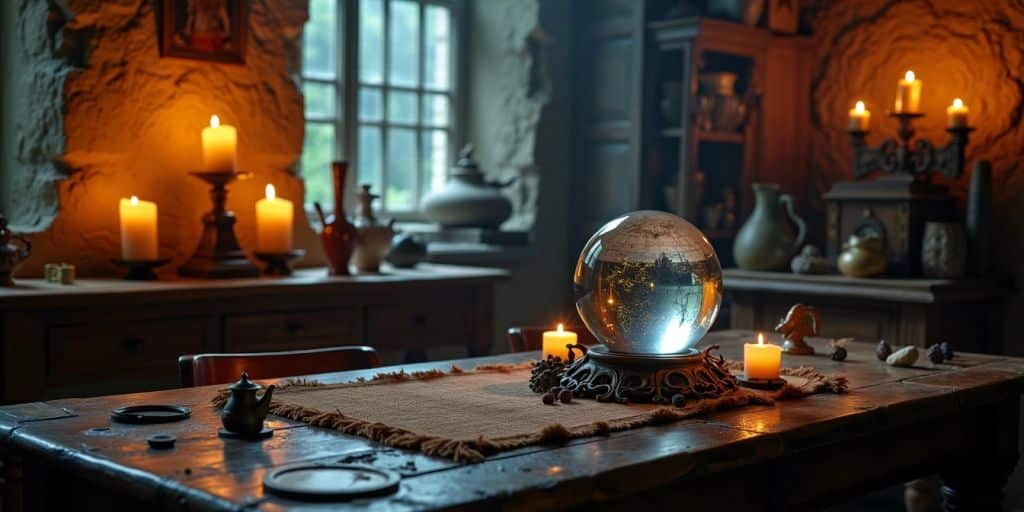
    Dim room with candles, crystal ball, and ancient books.

    Distorted Teachings

    In today’s world, many esoteric teachings have been twisted from their original forms. This distortion often leads to confusion and misinterpretation. True practitioners understand that these rituals are profound spiritual exercises requiring deep commitment and knowledge.

    Media Influence

    The media often portrays occult practices in a sensationalized manner, focusing on the mysterious and ancient practices of black magic. This portrayal can create fear and misunderstanding among the general public. It’s important to differentiate between media representations and the true essence of these practices.

    True vs. False Practices

    Not all practices labeled as "occult" are genuine. Some are mere fabrications or misunderstandings of the true traditions. Authentic occult practices are rooted in ancient wisdom and require a meticulous journey of preparation and continuous practice. Practitioners must be discerning and seek authentic guidance to avoid falling into the trap of false practices.

    Understanding the true nature of occult practices requires dedication and a willingness to look beyond popular misconceptions. Seek knowledge from reputable sources and remain committed to ethical integrity.

    The Risks and Ethical Considerations

    Psychological Dangers

    Engaging in occult practices can pose significant psychological risks. The intense energies and altered states of consciousness involved can lead to mental and emotional instability. Without proper guidance, individuals may find themselves overwhelmed, highlighting the need for experienced mentors.

    Ethical Boundaries

    Ethics play a crucial role in the realm of occult practices. Practitioners must adhere to strict ethical standards to avoid causing harm. This includes respecting the sanctity of rituals, maintaining secrecy, and using the knowledge for constructive purposes. Ethical boundaries ensure that the practices remain safe and beneficial.

    Responsible Practice

    Responsible practice is essential in the world of the occult. Practitioners should seek authentic guidance and training to navigate these complex traditions safely. This involves continuous learning and a commitment to ethical integrity. By doing so, they can avoid the pitfalls of distorted teachings and ensure their practices are both safe and effective.

    The Path to Mastery in Occult Practices

    Dim room with artifacts and candles.

    Dedication and Discipline

    Mastering occult practices requires unwavering dedication and discipline. Practitioners must commit to continuous learning and self-improvement. This journey is not for the faint-hearted; it demands a steadfast focus and a willingness to delve deep into the mysteries of the occult.

    Finding a Mentor

    A mentor can be invaluable on this path. They provide guidance, share their wisdom, and help navigate the complexities of occult practices. Finding a mentor who resonates with your spiritual goals can significantly enhance your journey.

    Continuous Learning

    The study of occult practices is a lifelong endeavor. Practitioners must remain open to new knowledge and experiences. Engaging with various texts, attending workshops, and participating in discussions with fellow seekers are all essential for continuous growth.

    The path to mastery in occult practices is a profound journey that requires dedication, guidance, and a commitment to lifelong learning.

    Embarking on the journey to master occult practices can be both thrilling and challenging. To truly excel, you need the right resources and guidance. At Aftermath Media, we offer a treasure trove of exclusive content, educational tools, and live events designed to help you unlock your full potential. Don’t miss out on this opportunity to deepen your understanding and skills. Visit our website today and start your path to mastery!

    Conclusion

    Exploring the mysteries of occult practices has taken us on a journey through ancient traditions, symbolic rituals, and the hidden knowledge guarded by a select few. These practices, while often misunderstood, offer a path to deeper spiritual understanding and personal transformation. However, they come with risks that require careful consideration and responsible practice. For those truly committed to this path, seeking guidance from reputable sources is essential. As we conclude this exploration, may the wisdom of the ages guide you safely on your spiritual journey, illuminating the hidden truths and unlocking the mysteries that lie within.

    Frequently Asked Questions

    What are occult practices?

    Occult practices are rituals and ceremonies aimed at connecting with higher powers and achieving spiritual growth. They often use symbols and specific actions to achieve these goals.

    Why is knowledge about occult practices often kept secret?

    This knowledge is kept secret to prevent misuse and misunderstanding. Only those who show true dedication through rigorous initiation are given access to these teachings.

    How do symbols play a role in occult rituals?

    Symbols in occult rituals act as powerful tools to convey spiritual truths. They help practitioners connect with higher realms and undergo personal and spiritual transformation.

    What are the risks of practicing occult rituals?

    Practicing occult rituals without proper guidance can lead to psychological risks, misuse of power, and ethical issues. It’s important to approach these practices with caution and under expert supervision.

    Where can I learn more about occult practices and traditions?

    You can learn more about occult practices and traditions by joining reputable Mystery Schools or organizations like the Hermetic Academy, which offer structured training and resources.

    What is the importance of ethical considerations in occult practices?

    Ethical considerations are crucial in occult practices to avoid harm. Practitioners must follow strict ethical standards, respect the rituals’ sanctity, and use the knowledge for positive purposes.
  • Unearthing the Hidden History: Secrets of the Past Revealed

    Unearthing the Hidden History: Secrets of the Past Revealed

    History is full of secrets waiting to be discovered. From ancient civilizations to modern cities, and even within our own families, the past holds many mysteries. This article explores how we uncover these hidden histories through archaeology, technology, and personal stories.

    Key Takeaways

    • Ancient civilizations have many secrets that are still being uncovered today.
    • Modern cities often hide layers of history beneath their streets.
    • DNA testing can reveal surprising family secrets.
    • Plants and nature can help us understand historical events.
    • Storytelling is a powerful tool for uncovering and sharing hidden histories.

    Ancient Civilizations and Their Hidden Histories

    Lost Cities and Forgotten Empires

    Throughout history, many ancient civilizations have risen and fallen, leaving behind lost cities and forgotten empires. These places, once bustling with life, now lie buried under layers of earth, waiting to be rediscovered. From the legendary city of Atlantis to the mysterious ruins of Machu Picchu, these ancient sites offer a glimpse into the past and the lives of those who once inhabited them.

    Archaeological Discoveries That Changed Our Understanding

    Archaeology has played a crucial role in uncovering the secrets of ancient civilizations. Some discoveries have completely changed our understanding of history. For example, the unearthing of the Rosetta Stone allowed us to decode Egyptian hieroglyphs, opening up a wealth of knowledge about ancient Egypt. Similarly, the discovery of the Dead Sea Scrolls provided new insights into early Jewish and Christian practices.

    The Role of Technology in Unearthing Ancient Secrets

    Modern technology has revolutionized the field of archaeology. Tools like ground-penetrating radar and satellite imagery have made it possible to locate and excavate ancient sites with unprecedented accuracy. These advancements have led to the discovery of previously unknown civilizations and have helped archaeologists piece together the history of ancient peoples in ways that were once thought impossible.

    The Secrets Buried Beneath Modern Cities

    Modern city with ancient ruins beneath.

    Urban Archaeology: Digging Through Time

    Urban archaeology is like a time machine, letting us peek into the past hidden beneath our feet. Cities are built layer upon layer, with each generation leaving its mark. When archaeologists dig in modern cities, they often find artifacts from different eras stacked on top of each other. This helps us understand how people lived, worked, and built their communities over time.

    Hidden Layers of History in Major Metropolises

    Major cities around the world are treasure troves of history. For example, in New York City, construction projects often uncover relics from the past. From old pottery to ancient foundations, these finds tell stories of the city’s evolution. In London, the layers of history are so dense that digging a new subway line can reveal Roman roads, medieval structures, and Victorian artifacts all in one go.

    Case Studies: Surprising Finds Under Our Feet

    • New York City: During the construction of the World Trade Center, workers found a ship from the 18th century buried in the ground. This discovery gave insights into the city’s maritime history.
    • Rome: While building a new metro line, workers uncovered a 2,000-year-old military barracks. This find provided a glimpse into the life of Roman soldiers.
    • Paris: Renovations at the Louvre revealed medieval moats and walls, showing the city’s defensive past.

    The strange fate of steel from 9/11 reminds us that even recent history can hold mysteries. The steel from the World Trade Center has been repurposed in various ways, each piece carrying emotional and historical weight.

    Urban archaeology not only uncovers physical artifacts but also helps us connect with the stories and lives of those who came before us. It’s a fascinating way to understand the continuous thread of human history.

    Uncovering Family Secrets Through DNA Testing

    The Rise of Genetic Genealogy

    Genetic genealogy has become a popular way for people to learn about their family history. By using DNA tests, individuals can uncover hidden family secrets that were once thought to be lost forever. This method has helped many people find long-lost relatives and understand their heritage better.

    Personal Stories of Hidden Histories Revealed

    Many people have shared their personal stories of discovering family secrets through DNA testing. For example, one woman found out that the man who raised her was not her biological father. This revelation led her on a journey to piece together her true family history. These stories show the emotional impact and the importance of understanding one’s roots.

    Ethical Considerations and Privacy Concerns

    While DNA testing can reveal important information, it also raises ethical and privacy concerns. People must consider the potential consequences of uncovering family secrets. It’s important to think about how this information might affect relationships and personal identity. Balancing the quest for knowledge with respect for privacy is crucial in the realm of genetic genealogy.

    Discovering hidden family secrets through DNA testing can be both exciting and challenging. It opens up new possibilities for understanding our past but also requires careful consideration of the ethical implications.

    Nature’s Role in Preserving Hidden Histories

    Botanical Clues to Historical Mysteries

    Plants can be more than just beautiful; they can also be historical detectives. For example, certain plants found in an area can tell us about the past climate and soil conditions. This helps scientists understand how ancient people lived and what they ate. Sometimes, seeds and pollen trapped in layers of earth reveal what kinds of crops were grown long ago.

    The Intersection of Ecology and Archaeology

    Ecology and archaeology often work together to uncover secrets of the past. By studying the natural environment, archaeologists can find clues about how ancient civilizations interacted with their surroundings. For instance, the new forest has a unique history; from royal hunting ground to Napoleonic ship building, salt making to World War Two airfields. This kind of information helps us understand the daily lives and survival strategies of ancient people.

    Case Studies: Plants as Historical Records

    Plants have been used in many fascinating case studies to uncover hidden histories. For example, the discovery of ancient grape seeds in Italy helped researchers learn about early wine production. In another case, the study of tree rings has provided insights into climate changes that affected ancient civilizations. These examples show how plants can serve as living records of our past.

    The Power of Storytelling in Revealing Hidden Histories

    Ancient archaeological site with artifacts

    Oral Traditions and Their Historical Significance

    Oral traditions have been a cornerstone in preserving histories that might otherwise be lost. These stories, passed down through generations, offer unique insights into the lives and cultures of ancient peoples. When we don’t teach accurate American history in the classroom, we empower the systems that divide and exploit us all. Oral histories can fill in the gaps left by written records, providing a more complete picture of the past.

    Literature as a Tool for Uncovering the Past

    Books and written narratives have the power to reveal hidden histories. Authors often delve into forgotten or overlooked events, bringing them to light for modern readers. This form of storytelling can make history accessible and engaging, allowing people to connect with the past on a personal level.

    The Impact of Personal Narratives on Historical Understanding

    Personal stories can transform our understanding of history. These narratives offer a human perspective that is often missing from traditional historical accounts. By sharing their experiences, individuals can highlight the emotional and social aspects of historical events, making them more relatable and impactful.

    Storytelling is not just about recounting events; it’s about connecting with the past and understanding its relevance to our present and future. Through stories, we can uncover hidden truths and gain a deeper appreciation for the complexities of history.

    Technological Advances in Uncovering Hidden Histories

    The Use of Ground-Penetrating Radar

    Ground-penetrating radar (GPR) has become a game-changer in archaeology. This technology allows scientists to see beneath the surface without digging. GPR helps locate buried structures, artifacts, and even ancient roads. It’s like having X-ray vision for the ground. This tool has been crucial in finding hidden layers of history in places we thought we knew well.

    Digital Reconstruction of Historical Sites

    Digital reconstruction uses computer models to recreate historical sites. This can be done using old maps, photos, and even written descriptions. These digital models help us understand what ancient cities and buildings looked like. They also allow us to explore these places virtually, making history more accessible to everyone.

    The Future of Archaeological Technology

    The future of archaeology looks bright with new technologies on the horizon. Drones, for example, can survey large areas quickly and provide detailed aerial views. 3D printing can create exact replicas of artifacts, making it easier to study them without causing damage. As technology advances, we will continue to uncover the secrets of the past in ways we never thought possible.

    Technology is not just changing how we find historical artifacts; it’s changing how we understand them. With each new tool, we get a clearer picture of our history and the people who came before us.

    Technology is making it easier than ever to uncover hidden histories. From advanced research tools to digital archives, we’re now able to explore the past in ways we never thought possible. Want to dive deeper? Visit our website to learn more and start your journey today!

    Conclusion

    As we dig into the layers of our past, we uncover stories that shape who we are today. The hidden histories we find can be surprising, sometimes even shocking, but they help us understand our roots and our place in the world. By exploring these secrets, we learn more about our families, our cultures, and ourselves. It’s like tending a garden; with care and patience, we can see the beauty that grows from even the most unexpected places. In the end, unearthing these stories brings us closer to the truth and to each other.

    Frequently Asked Questions

    What are some examples of lost cities and forgotten empires?

    Some examples include the city of Atlantis, the Mayan city of Tikal, and the ancient city of Pompeii.

    How has technology helped in uncovering ancient secrets?

    Technology like ground-penetrating radar and digital reconstruction has helped archaeologists find and study ancient sites without digging.

    What is urban archaeology?

    Urban archaeology is the study of past human life and culture by digging in modern cities to find artifacts and structures buried over time.

    How can DNA testing uncover family secrets?

    DNA testing can reveal unexpected family relationships and ancestry, helping people learn more about their biological roots.

    What role do plants play in preserving history?

    Plants can act as historical records, with their growth patterns and locations providing clues about past human activities and environmental conditions.

    Why is storytelling important in understanding history?

    Storytelling helps pass down knowledge and experiences from generation to generation, making it easier to understand and connect with the past.

  • Exploring the Intriguing World of Urban Legends: Truths and Myths Unveiled

    Exploring the Intriguing World of Urban Legends: Truths and Myths Unveiled

    Urban legends are fascinating stories that capture our imaginations and send chills down our spines. These tales, often passed down through generations, mix truth and fiction in a way that makes us question reality. From spooky creatures to mysterious disappearances, urban legends reflect our deepest fears and cultural beliefs. This article dives into the origins, variations, and impacts of these captivating stories, revealing the thin line between fact and myth.

    Key Takeaways

    • Urban legends often originate from real events but get twisted over time, blending truth with fiction.
    • Different cultures have their own unique urban legends, which reflect their values and fears.
    • Famous urban legends like the Vanishing Hitchhiker and the Loch Ness Monster show how these stories can vary across regions.
    • Urban legends can influence our emotions and behaviors, often causing fear and anxiety.
    • In the digital age, urban legends spread faster and evolve quickly, leading to new myths and stories.

    The Origins of Urban Legends

    Foggy alleyway at night with eerie shadows

    Historical Context and Evolution

    Urban legends have been around for a long time, evolving from ancient myths and folklore. The term urban legend started to appear in folklore studies in the mid-20th century. These stories often seem too good to be true and are passed down through generations, changing slightly each time they are told.

    Cultural Significance Across Regions

    Urban legends are not just local tales; they have cultural significance across different regions. These stories reflect the values, fears, and beliefs of the communities that tell them. For example, a legend popular in one country might have a different version in another, showing how these tales adapt to fit local cultures.

    Common Themes and Motifs

    Many urban legends share common themes and motifs. These often include elements of fear, mystery, and the supernatural. Some popular themes are haunted places, mysterious creatures, and unexplained phenomena. These recurring motifs help to make the stories more relatable and memorable.

    Famous Urban Legends and Their Variations

    Misty urban alleyway at night with eerie shadows.

    Urban legends have a unique way of capturing our imaginations and sending shivers down our spines. Whether you dismiss urban legends as children’s lore or believe they’re based on fact, these tales will send a shiver up your spine. Here, we explore some of the most famous urban legends and their variations across different cultures and regions.

    Psychological Impact of Urban Legends

    Fear and Anxiety

    Urban legends often tap into our deepest fears, creating a sense of unease and dread. These stories can make us wary of everyday situations, like driving alone at night or staying in an unfamiliar place. The fear generated by these tales can be intense, sometimes leading to anxiety and stress.

    Social Influence and Peer Pressure

    Urban legends spread quickly through social circles, often fueled by peer pressure. People share these stories to fit in or to seem knowledgeable. This social aspect can make the legends more believable and harder to debunk. The influence of friends and family can make it challenging to question the validity of these tales.

    Memory and Perception

    Our memories and perceptions can be easily influenced by urban legends. When we hear a story repeatedly, it can start to feel real, even if it’s not. This phenomenon is known as the "illusory truth effect." Over time, the line between fact and fiction blurs, making it difficult to separate reality from myth.

    Urban legends have a unique way of embedding themselves into our collective psyche, often blurring the line between reality and fiction.

    Debunking Urban Legends: Fact vs. Fiction

    Urban legends have a way of capturing our imaginations, but how much of what we hear is actually true? In this section, we will explore the methods used to separate fact from fiction and reveal the truth behind some of the most famous urban legends.

    Urban Legends in Popular Culture

    Urban legends have found a significant place in popular culture, influencing various forms of media and entertainment. These tales, often rooted in folklore, have been adapted and reimagined to captivate modern audiences.

    Movies and TV Shows

    Urban legends have been a rich source of inspiration for filmmakers and TV producers. Many horror movies and thriller series draw from these eerie tales to create suspense and fear. For instance, the legend of the Vanishing Hitchhiker has been featured in numerous films, highlighting its enduring appeal.

    Literature and Comics

    Books and comics have also embraced urban legends, weaving them into their narratives to add a layer of mystery and intrigue. Authors often explore these stories to delve into the human psyche and societal fears. Graphic novels, in particular, use vivid illustrations to bring these legends to life.

    Video Games and Online Communities

    The gaming world has not been left behind. Games like ‘Urban Myth Dissolution Center’ allow players to explore and solve mysteries based on urban legends. Online communities and forums are also abuzz with discussions and theories about these tales, keeping the legends alive in the digital age.

    Urban legends continue to evolve, adapting to new forms of media and technology, ensuring their place in popular culture for generations to come.

    The Future of Urban Legends

    Digital Age and Viral Stories

    In today’s world, urban legends spread faster than ever thanks to the internet. Social media platforms and online forums allow these stories to go viral within hours. This rapid spread can make even the most unbelievable tales seem real. People share these stories, adding their own twists, which makes them even more intriguing.

    Globalization and Cultural Exchange

    Urban legends are no longer confined to one region or culture. With globalization, these stories travel across borders, blending elements from different cultures. This exchange creates new, hybrid legends that are even more fascinating. For example, a story that starts in Japan might pick up elements from American folklore as it spreads.

    Potential New Legends

    As technology advances, new types of urban legends are likely to emerge. Stories about artificial intelligence, virtual reality, and other cutting-edge technologies could become the urban legends of tomorrow. These new legends will reflect our modern fears and anxieties, just as older legends did in their time.

    The future of urban legends is both exciting and unpredictable. As our world changes, so too will the stories we tell, blending truth and fiction in ways that captivate and intrigue us.

    Urban legends are evolving, and their future is more exciting than ever. As technology advances, these stories are finding new ways to captivate and thrill us. Want to dive deeper into the world of urban legends? Visit our website for exclusive content and insights that you won’t find anywhere else. Join us and be part of the adventure!

    Conclusion

    Urban legends have a special place in our hearts and minds. They blend fear, curiosity, and culture, making us question what we know and believe. These stories, whether about haunted places or mysterious creatures, have been told and retold, shaping our communities and our understanding of the world. While some legends are based on real events, others are pure fiction, but all of them teach us something about human nature and our need for storytelling. As we continue to explore these tales, we uncover not just the myths themselves, but also the truths about our own fears and imaginations. So, next time you hear an urban legend, remember that it’s more than just a story—it’s a glimpse into the human experience.

    Frequently Asked Questions

    What are urban legends?

    Urban legends are stories or myths that are passed down through generations. They often involve mysterious, spooky, or supernatural events and are usually told as true, even though they might not be.

    Why do people believe in urban legends?

    People believe in urban legends because they are often thrilling and play on common fears and anxieties. They are also passed down by trusted sources like friends or family, which makes them seem more believable.

    How do urban legends spread?

    Urban legends spread through word of mouth, social media, and other forms of communication. They often change slightly with each retelling, which helps them to adapt and survive over time.

    Can urban legends be based on real events?

    Yes, some urban legends are inspired by real events or have a grain of truth in them. However, they are usually exaggerated or altered to make the story more interesting or frightening.

    What is the purpose of urban legends?

    Urban legends often serve as cautionary tales, warning people about dangers or teaching moral lessons. They also provide entertainment and a way for people to bond over shared stories.

    How can you tell if an urban legend is true?

    It’s often hard to tell if an urban legend is true. Checking reliable sources, looking for evidence, and considering if the story has been exaggerated can help you determine its truthfulness.

  • Unraveling the Truth Behind Mysterious Disappearances: What We Know and What Remains Unknown

    Unraveling the Truth Behind Mysterious Disappearances: What We Know and What Remains Unknown

    Throughout history, mysterious disappearances have puzzled and fascinated people around the world. These baffling cases, where individuals vanish without a trace, leave behind a trail of unanswered questions and theories. From historical enigmas to modern-day mysteries, the search for truth continues to captivate our imaginations. This article delves into some of the most perplexing disappearances, exploring what we know and what remains unknown.

    Key Takeaways

    • Mysterious disappearances have occurred throughout history and continue to happen today.
    • Many cases, such as those of Amelia Earhart and Malaysia Airlines Flight MH370, remain unsolved.
    • Theories about these disappearances range from abductions to supernatural explanations.
    • Investigative challenges include lack of evidence, unreliable witnesses, and technological limitations.
    • The emotional impact on families and the role of media are significant aspects of these cases.

    Historical Cases of Mysterious Disappearances

    The Vanishing of Amelia Earhart

    Amelia Earhart, a famous aviator, disappeared on July 2, 1937, while attempting to fly around the world. Despite extensive searches, no trace of her or her plane was ever found. Her disappearance remains one of the most enduring mysteries in history. Many theories have been proposed, but none have been proven.

    The Disappearance of the Roanoke Colony

    In 1587, over 100 settlers established the Roanoke Colony in what is now North Carolina. When a supply ship returned three years later, the entire colony had vanished without a trace. The only clue was the word "CROATOAN" carved into a tree. The fate of the settlers is still unknown, making it one of the most famous lists of people who disappeared.

    The Mary Celeste Mystery

    The Mary Celeste was found adrift in the Atlantic Ocean in 1872, with its crew missing. The ship was in good condition, and there were no signs of a struggle. The fate of the crew remains a mystery, and the case has puzzled investigators for over a century.

    Modern-Day Unsolved Disappearances

    The Case of Madeleine McCann

    In 2007, three-year-old Madeleine McCann vanished from her family’s vacation apartment in Praia da Luz, Portugal. Despite extensive searches and numerous theories, her disappearance remains unsolved. The case has drawn global attention, with many speculating about what might have happened to her.

    The Vanishing of Malaysia Airlines Flight MH370

    In 2014, Malaysia Airlines Flight MH370 disappeared while flying from Kuala Lumpur to Beijing. The plane, carrying 239 passengers and crew, lost contact with air traffic control and was never found. The lack of physical evidence has made it one of the most baffling aviation mysteries in history.

    The Disappearance of Lars Mittank

    Lars Mittank, a young German tourist, disappeared in 2014 while on vacation in Bulgaria. After exhibiting strange behavior and expressing fear for his safety, he was last seen running out of Varna Airport. His whereabouts remain unknown, and his case continues to puzzle investigators.

    Theories and Speculations

    Foggy forest with dense trees and mist

    Abduction Hypotheses

    One of the most common theories in mysterious disappearances is abduction. This can range from criminal kidnappings to more outlandish ideas like alien abductions. The lack of physical evidence often fuels these theories, making them hard to prove or disprove.

    Voluntary Disappearances

    In some cases, individuals may choose to disappear voluntarily. This could be due to personal reasons such as escaping debt, starting a new life, or avoiding legal issues. While this theory can explain some cases, it often leaves families and investigators searching for answers.

    Supernatural Explanations

    Some people believe that supernatural forces are at play in certain disappearances. These theories include everything from ghostly interventions to dimensional shifts. While these ideas are fascinating, they are usually the hardest to substantiate with concrete evidence.

    The baffling nature of these disappearances challenges our notions of what is possible and reminds us of the ever-present mysteries that surround us. They serve as a reminder of how much we still don’t know about the world, despite our advances in technology and understanding.

    Investigative Challenges

    Investigating mysterious disappearances is fraught with numerous challenges that can hinder the search for truth. These obstacles often leave families in limbo and communities searching for answers.

    Lack of Physical Evidence

    One of the most significant hurdles in solving these cases is the lack of physical evidence. Without concrete clues, it becomes incredibly difficult to piece together what happened. Over time, evidence can degrade or be lost entirely, making it even harder to solve these mysteries.

    Witness Reliability Issues

    Witnesses play a crucial role in investigations, but their reliability can be a major issue. Memories can fade, and details can become distorted over time. This makes it challenging for investigators to get accurate information, which is essential for solving these cases.

    Technological Limitations

    While technology has advanced, there are still limitations that can impede investigations. For instance, older cases may not have benefited from modern forensic techniques, and some areas may lack the technological infrastructure needed to conduct thorough investigations. Despite these limitations, the relentless pursuit of the elusive truth pushes investigators to explore alternative angles and consider factors that may have been overlooked.

    The search for truth in these vanishing mysteries is far from over. While the absence of clues may seem insurmountable, hope persists, for history has shown that even the most baffling disappearances can eventually be solved.

    The Psychological Impact on Families

    When a loved one goes missing, the emotional and psychological toll on families is immense. The uncertainty and lack of closure can lead to prolonged grief and unresolved trauma. Families often find themselves in a relentless pursuit of answers, holding onto hope despite the passage of time.

    Emotional Toll on Loved Ones

    The sudden disappearance of a family member leaves an irreplaceable void. The emotional strain can manifest in various ways, including anxiety, depression, and a constant state of worry. The unresolved nature of these cases means that families are often stuck in a cycle of hope and despair.

    The Search for Closure

    Closure is a crucial aspect for families dealing with mysterious disappearances. Without concrete answers, they struggle to move forward. Many families continue to seek answers, employing private investigators or turning to media outlets to keep the case in the public eye. The search for closure becomes a central part of their lives.

    Community Support and Awareness

    Communities play a vital role in supporting families of the missing. Local groups and organizations often rally together to provide emotional and practical support. Awareness campaigns and community events help keep the memory of the missing alive and can sometimes lead to new information or tips that aid in the investigation.

    The search for answers in baffling disappearances is a testament to the resilience of the human spirit. It reflects our collective commitment to justice and our unwavering determination to bring closure to those affected by these unexplained mysteries.

    The Role of Media in Mysterious Disappearances

    Foggy forest with a mysterious figure

    Media Coverage and Public Interest

    Media plays a crucial role in bringing attention to mysterious disappearances. When a case is widely covered, it often leads to increased public interest and awareness. This can result in more tips and leads for investigators. However, not all cases receive the same level of attention, which can impact the progress of the investigation.

    Impact on Investigations

    The media can both help and hinder investigations. On one hand, extensive coverage can generate new leads and keep the public informed. On the other hand, it can also spread misinformation and create pressure on law enforcement to solve the case quickly, sometimes leading to mistakes.

    Ethical Considerations

    There are ethical concerns when it comes to media coverage of disappearances. It’s important to respect the privacy of the families involved and avoid sensationalizing the tragedy. Responsible reporting should focus on facts and avoid speculation, ensuring that the dignity of those affected is maintained.

    Efforts to Solve Cold Cases

    Advancements in Forensic Science

    Breakthroughs in forensic technology have breathed new life into cold cases. Enhanced crime scene analysis and advanced DNA profiling techniques are now pivotal in uncovering the truth. These advancements allow investigators to revisit old evidence with fresh eyes, often leading to new leads and insights.

    Collaborative Investigations

    The collaboration between law enforcement agencies, forensic experts, and the public is crucial. DNA databases, online communities, and public awareness campaigns have helped generate leads and accelerate investigations. This teamwork bridges the gap between past and present, making it easier to solve long-standing mysteries.

    Public Involvement and Tips

    Public engagement plays a vital role in solving cold cases. Amateur sleuth networks and public tip lines have become invaluable resources. Increased public awareness and involvement can lead to the discovery of new evidence or witnesses, providing hope for families yearning for answers.

    The relentless pursuit of the elusive truth pushes investigators to explore alternative angles and consider factors that may have been overlooked. These passionate efforts aim to uncover the missing puzzle pieces that could unlock the secrets behind these cold cases, shedding light on the circumstances surrounding these unexplained disappearances.

    Many cold cases remain unsolved, but with the right resources, we can make a difference. Visit our website to explore how you can contribute to solving these mysteries. Together, we can bring justice to those who have been waiting for answers.

    Conclusion

    In the end, the world of mysterious disappearances continues to baffle and intrigue us. These cases leave a lasting mark on families and communities, as the search for answers goes on. By digging into these puzzling vanishings, we aim to shine a light on a topic that keeps us curious and eager for closure. The journey to uncover the truth is far from over, but with determination and teamwork, we hold onto hope that one day, the mysteries will be solved.

    Frequently Asked Questions

    What are mysterious disappearances?

    Mysterious disappearances happen when people vanish without leaving any clues behind. These puzzling events often leave investigators and families searching for answers.

    Can you name some famous unsolved missing person cases?

    Yes, there are many famous unsolved cases. Some well-known ones include the disappearance of Amelia Earhart, Jimmy Hoffa, and Madeleine McCann. These cases continue to intrigue the public and remain open investigations.

    What makes a disappearance mysterious?

    A disappearance is considered mysterious when there’s no clear reason or evidence explaining why the person went missing. These cases often have no witnesses, physical clues, or obvious motives, making them very puzzling.

    Are there cases where people go missing without a trace?

    Yes, many cases involve people who disappear without leaving any trace. This makes it very hard for investigators to find out what happened to them.

    Why do some disappearances remain unsolved for so long?

    Some disappearances stay unsolved because of a lack of evidence, unreliable witnesses, or technological limits. Over time, clues can disappear, making it even harder to solve these cases.

    How do families cope with the disappearance of a loved one?

    Families often experience a lot of emotional pain and stress when a loved one disappears. They search for closure and rely on community support and awareness to cope with their loss.

  • Exploring the Unknown: A Deep Dive into Paranormal Investigations

    Exploring the Unknown: A Deep Dive into Paranormal Investigations

    Paranormal investigations have always fascinated people. From ancient folklore to the latest technology, our curiosity about the unknown has only grown. This article takes you through the history, types, methods, and famous cases of paranormal investigations. Whether you’re a skeptic or a believer, there’s something intriguing about exploring the mysteries that lie beyond our understanding.

    Key Takeaways

    • Paranormal investigations have a rich history, evolving from ancient myths to modern scientific methods.
    • Different types of paranormal phenomena include ghosts, cryptids, and UFOs.
    • Investigators use both scientific tools and spiritual techniques to study these phenomena.
    • Famous cases like the Amityville Horror and the Roswell Incident have captivated public interest for decades.
    • Technology plays a crucial role in modern paranormal investigations, from recording devices to data analysis.

    The History and Evolution of Paranormal Investigations

    Investigators exploring a dark, foggy building.

    Early Accounts and Folklore

    Paranormal investigations have roots that stretch back to ancient times. Early accounts of unexplained phenomena can be found in folklore and religious texts from various cultures. These stories often involved spirits, gods, and other supernatural beings. People used rituals and ceremonies to communicate with or ward off these entities.

    Modern Techniques and Equipment

    The field of paranormal investigations has evolved significantly over the years. Today, investigators use a variety of modern techniques and equipment to explore the unknown. Tools like EMF meters, thermal cameras, and digital voice recorders are commonly used to detect and document paranormal activity. These advancements have made it possible to gather more reliable data and analyze it scientifically.

    Influential Figures in the Field

    Several individuals have made significant contributions to the field of paranormal investigations. Figures like Ed and Lorraine Warren, who investigated famous cases like the Amityville Horror, have become household names. Their work has inspired many to take an interest in the paranormal and pursue it as a serious field of study.

    The evolution of paranormal investigations highlights the intersection of science and the paranormal, emphasizing the importance of technology in understanding unexplained phenomena.

    Types of Paranormal Phenomena Explored

    Ghosts and Hauntings

    Ghosts and hauntings are among the most commonly reported paranormal phenomena. Many people claim to have seen or felt the presence of spirits in old houses, graveyards, and other spooky places. These experiences often include strange noises, cold spots, and even apparitions. Some believe these spirits are the souls of the dead, while others think they might be echoes of past events.

    Cryptids and Mythical Creatures

    Cryptids are mysterious animals that some people believe exist, even though there’s no scientific proof. Examples include Bigfoot, the Loch Ness Monster, and the Chupacabra. These creatures often appear in folklore and are a big part of local legends. People who study cryptids, called cryptozoologists, often go on expeditions to find evidence of these elusive beings.

    UFOs and Extraterrestrial Encounters

    UFOs, or Unidentified Flying Objects, have fascinated people for decades. Many believe these strange lights and objects in the sky are evidence of extraterrestrial life. Reports of UFO sightings often include detailed descriptions of the objects’ shapes, movements, and even encounters with alien beings. Some of the most famous UFO cases, like the Roswell Incident, have become legendary in the field of paranormal investigations.

    Methodologies in Paranormal Investigations

    Investigators exploring a dark, misty forest at night.

    Scientific Approaches

    Scientific methods in paranormal investigations aim to gather credible evidence. Investigators use tools like EMF meters, thermal cameras, and digital recorders to detect anomalies. They follow strict protocols to ensure data accuracy and repeatability.

    Spiritual and Psychic Methods

    Spiritual and psychic methods involve mediums and psychics who claim to communicate with spirits. These investigators rely on their intuition and spiritual practices to uncover paranormal activity. While controversial, these methods are popular in many investigations.

    Ethical Considerations

    Ethics play a crucial role in paranormal investigations. Investigators must respect the privacy and beliefs of those involved. They should avoid causing harm or fear and always seek permission before entering private properties.

    Balancing scientific rigor with ethical responsibility is key to a successful investigation.

    Case Studies of Famous Paranormal Investigations

    The Amityville Horror

    The Amityville Horror is one of the most well-known paranormal cases. In 1974, the Lutz family moved into a house in Amityville, New York, where a gruesome murder had taken place. They reported terrifying experiences, including strange noises, foul odors, and ghostly apparitions. The case gained massive media attention and inspired books and movies, but many skeptics question the authenticity of the Lutz family’s claims.

    The Enfield Poltergeist

    In the late 1970s, the Hodgson family in Enfield, England, experienced what they believed to be poltergeist activity. Furniture moved on its own, and strange voices were heard. Paranormal investigators, including Maurice Grosse and Guy Lyon Playfair, documented the events. Despite extensive evidence, some believe the incidents were a hoax, while others remain convinced of their paranormal nature.

    The Roswell Incident

    The Roswell Incident is perhaps the most famous UFO case. In 1947, something crashed near Roswell, New Mexico. The military initially reported it as a "flying disc," but later claimed it was a weather balloon. This incident sparked numerous conspiracy theories about extraterrestrial encounters and government cover-ups. To this day, Roswell remains a focal point for UFO enthusiasts and skeptics alike.

    The Role of Technology in Paranormal Investigations

    Ghost Hunting Gadgets

    In the world of paranormal investigations, technology plays a crucial role. From EMF meters to thermal cameras, ghost hunters use a variety of gadgets to detect and document paranormal activity. These tools help investigators gather evidence that might otherwise go unnoticed. For instance, the precise ghost tracker allows users to find ghosts and paranormal activity, making sense of their ghost hunting experiences.

    Audio and Visual Recording

    Capturing audio and visual evidence is another key aspect of paranormal investigations. Digital voice recorders, night vision cameras, and even smartphones are commonly used to record potential paranormal phenomena. These recordings can then be analyzed for any unusual sounds or images that might indicate the presence of the supernatural.

    Data Analysis and Interpretation

    Once the data is collected, the next step is to analyze and interpret it. This involves reviewing audio and visual recordings, as well as any other data collected during the investigation. Software tools can help enhance and clarify recordings, making it easier to identify any anomalies. The goal is to find patterns or evidence that support the presence of paranormal activity.

    Technology has revolutionized the field of paranormal investigations, providing tools and methods that make it easier to detect and document the unknown.

    Skepticism and Criticism in Paranormal Investigations

    Common Skeptical Arguments

    Skeptics often argue that paranormal events lack scientific evidence. They believe that many reported phenomena can be explained by natural causes, such as psychological factors or environmental influences. For instance, some skeptics point out that ghost sightings could be due to sleep paralysis or hallucinations.

    Debunking Myths and Hoaxes

    Many myths and hoaxes have been debunked over the years. Skeptics have shown that some famous paranormal cases were actually elaborate pranks or misunderstandings. For example, the infamous Amityville Horror was later revealed to be a hoax created for financial gain.

    Balancing Belief and Evidence

    Balancing belief and evidence is crucial in paranormal investigations. While some investigators rely on personal experiences and anecdotal evidence, others emphasize the importance of scientific methods and empirical data. It’s essential to approach each case with an open mind, but also with a critical eye to avoid being misled by false claims.

    In the world of paranormal investigations, it’s important to question everything and seek out the truth, no matter how elusive it may be.

    Building a Career in Paranormal Investigations

    Educational Background and Training

    To become a paranormal investigator, you don’t need a specific degree, but having a background in fields like psychology, history, or even engineering can be helpful. Many aspiring investigators take a paranormal investigator certification course to learn the basics. These courses often cover how to use ghost hunting equipment, interview witnesses, and analyze evidence.

    Networking and Community Involvement

    Building connections in the paranormal community is crucial. Attend conferences, join local paranormal groups, and participate in online forums. Networking can lead to mentorship opportunities and collaborations on investigations. Being active in the community also helps you stay updated on the latest techniques and findings.

    Challenges and Rewards

    A career in paranormal investigations comes with its own set of challenges. Skepticism from the public and the scientific community can be discouraging. However, the rewards, such as uncovering unexplained phenomena and helping people understand their experiences, make it worthwhile. Balancing belief and evidence is key to gaining credibility in this field.

    Are you fascinated by the unknown and eager to build a career in paranormal investigations? Dive into a world of mysteries and uncover hidden truths with our extensive resources. Visit our website to explore our premium content, educational tools, and live events designed to help you succeed.

    Conclusion

    As we wrap up our deep dive into the world of paranormal investigations, it’s clear that the unknown continues to captivate and mystify us. From ghostly encounters to unexplained phenomena, the stories and experiences shared by investigators and enthusiasts alike remind us that there is still so much we don’t understand. Whether you’re a skeptic or a believer, exploring the paranormal invites us to keep an open mind and to question the boundaries of our reality. So, keep your curiosity alive, and who knows? Maybe one day you’ll uncover a mystery of your own.

    Frequently Asked Questions

    What is a paranormal investigation?

    A paranormal investigation is when people try to find out if ghosts, UFOs, or other strange things are real. They use special tools and methods to look for evidence.

    What kind of equipment is used in paranormal investigations?

    Investigators use tools like EMF meters to detect electromagnetic fields, digital voice recorders to capture sounds, and infrared cameras to see in the dark.

    Are paranormal investigations dangerous?

    Most of the time, paranormal investigations are safe. However, they can be spooky and sometimes emotionally intense. It’s important to be careful and respectful.

    Can anyone become a paranormal investigator?

    Yes, anyone can become a paranormal investigator. It’s helpful to learn about the tools and methods used, and to join a community of other investigators for support and advice.

    What is the most famous paranormal investigation?

    One of the most famous investigations is the Amityville Horror, where a family reported strange and scary events in their house. It has been the subject of books and movies.

    Do paranormal investigators always find evidence?

    No, investigators do not always find evidence. Sometimes, they can’t prove that anything paranormal happened. But the search for answers is what makes it exciting.

  • Exploring the Fascinating World of Supernatural Events: What Lies Beyond Our Understanding?

    Exploring the Fascinating World of Supernatural Events: What Lies Beyond Our Understanding?

    The world is full of strange and mysterious events that challenge our understanding. From unexplained phenomena to ancient myths, supernatural events have always fascinated people. This article dives into various aspects of the supernatural, exploring incidents and experiences that defy logic and scientific explanation. Whether you’re a skeptic or a believer, the journey through these intriguing stories will leave you questioning the nature of reality itself.

    Key Takeaways

    • Spontaneous human combustion remains a baffling mystery with no clear explanation.
    • Near-death experiences often share common elements like bright lights and out-of-body sensations.
    • Mediums claim to communicate with the dead, and some cases have shown surprising accuracy.
    • Ancient myths and legends often include supernatural elements that challenge conventional explanations.
    • Modern technology is being used in paranormal investigations, but many phenomena remain unexplained.

    Unexplained Phenomena That Defy Logic

    Spontaneous Human Combustion Cases

    One of the most baffling mysteries is spontaneous human combustion (SHC). In these rare cases, people seem to burst into flames without any clear source of ignition. While some skeptics suggest an external fire source, the specific burn patterns and lack of any such source make SHC a puzzling phenomenon.

    Poltergeist Activities Documented

    Poltergeist activities are another unexplained phenomenon. These events involve objects moving or being thrown by invisible forces. Although some cases have been exposed as hoaxes, many remain unexplained. Often, these occurrences happen in the presence of multiple witnesses and have even been documented by paranormal investigators.

    Mysterious Disappearances and Reappearances

    There are numerous reports of people vanishing without a trace, only to reappear later under mysterious circumstances. These cases defy logical explanations and leave both experts and the public scratching their heads. Some of these disappearances occur in well-known areas like the Bermuda Triangle, adding to their mystique.

    The Enigma of Near-Death Experiences

    Common Elements in NDEs

    Near-death experiences (NDEs) are among the most fascinating and well-documented supernatural events. Many people who have come close to death report similar experiences. These often include seeing a bright light, meeting deceased loved ones, or having an out-of-body experience. These common elements make NDEs a subject of great interest and study.

    Scientific Studies on NDEs

    Researchers and medical professionals have conducted numerous studies on NDEs. Some studies suggest that these experiences might indicate that consciousness can continue after death. However, the scientific community remains divided, with some experts arguing that NDEs are simply the result of brain activity during traumatic events.

    Personal Accounts and Testimonies

    Personal stories and testimonies about NDEs add a human element to this mysterious phenomenon. Many individuals describe their experiences as life-changing, often leading to a new outlook on life and death. These accounts are compelling and continue to intrigue both believers and skeptics alike.

    The ongoing debates and mysteries surrounding NDEs challenge our understanding of life and death, emphasizing the profound and often life-changing nature of these experiences.

    Mediumship and Communication with the Deceased

    Historical Cases of Mediumship

    Mediums, individuals who claim to communicate with the spirits of the deceased, have been a subject of both fascination and skepticism for centuries. Historical cases of mediumship often involve séances, where groups of people gather to attempt to contact spirits. Some of these cases have been thoroughly investigated, revealing startling accuracy and specific information that the medium could not have possibly known beforehand. Though many charlatans exist, some cases suggest that genuine mediumship might exist.

    Scientific Scrutiny of Mediums

    The scientific community has long been interested in studying mediums and their claims. Researchers have employed various methods to test the validity of mediumship, including controlled experiments and statistical analysis. While some studies have found evidence supporting the abilities of certain mediums, others have debunked their claims as mere tricks or coincidences. The debate continues, with some scientists advocating for more rigorous testing and others dismissing mediumship as pseudoscience.

    Modern-Day Mediums and Their Practices

    Today, mediums continue to practice their craft, often using tools like tarot cards, spirit boxes, and EVP (Electronic Voice Phenomenon) devices to communicate with the deceased. Many modern-day mediums offer their services to the public, conducting private readings and public demonstrations. Despite the skepticism surrounding their abilities, mediums remain popular, with many people seeking their help to connect with lost loved ones or gain insight into their lives.

    The practice of mediumship, whether viewed as a genuine ability or a clever illusion, continues to captivate and intrigue people around the world.

    Ancient Myths and Historical Accounts of Supernatural Events

    Supernatural Beliefs in Ancient Civilizations

    Supernatural beliefs have been a part of human history for centuries. Ancient civilizations often had stories of gods, celestial beings, and unexplained events. These myths and legends were not just tales but were deeply rooted in their culture and daily life. For example, in ancient Egypt, people believed that the dead could interact with the living. Similarly, Greek and Roman myths were filled with spirits, evil forces, and deities that could control human destinies.

    Mythical Creatures and Their Origins

    Many ancient myths include creatures that defy logic. From dragons to unicorns, these mythical beings were often seen as symbols of power or protection. The origins of these creatures can be traced back to the need to explain the unknown. For instance, the dragon, a common figure in many cultures, might have originated from the discovery of dinosaur fossils.

    Historical Events with Supernatural Interpretations

    Throughout history, many events have been given supernatural explanations. Natural disasters, wars, and even personal tragedies were often seen as the work of higher powers or supernatural forces. These interpretations provided a way for people to make sense of the chaos around them. While some of these stories might be symbolic, others argue that they could be based on real encounters with supernatural forces.

    The creation myths in these ancient religions are insane, highlighting the transition from chaos to order and the influence of divine beings. These narratives reflect cultural identities and address fundamental existential questions, offering insights into humanity’s quest for meaning in a complex universe.

    Modern Investigations into Paranormal Activities

    Technological Tools in Paranormal Research

    Modern paranormal investigations use a variety of sophisticated tools to capture evidence of supernatural events. These include electromagnetic field detectors, thermal imaging cameras, and spirit boxes. Each tool serves a unique purpose, from detecting unseen energies to capturing potential communications from spirits.

    Famous Paranormal Investigations

    Several investigations have gained fame due to their intriguing findings. The Enfield Poltergeist case and the Amityville Horror are among the most well-known. These cases often involve multiple witnesses and extensive documentation, making them subjects of ongoing debate and interest.

    Challenges in Proving Paranormal Phenomena

    Despite the advanced tools and famous cases, proving the existence of paranormal phenomena remains challenging. Skeptics argue that many findings can be explained by natural causes or human error. The lack of consistent, replicable evidence makes it difficult to draw definitive conclusions.

    The quest to understand the paranormal is a blend of science and mystery, pushing the boundaries of what we know and inviting us to ponder the unknown.

    Cultural Perspectives on Supernatural Events

    People sharing stories around a campfire at night.

    Supernatural Beliefs Around the World

    Different cultures have unique supernatural beliefs that reflect their values and history. For example, in Japan, people believe in yūrei, which are ghosts that can haunt the living. In Latin America, there’s the legend of La Llorona, a ghostly woman who cries for her lost children. These stories show how societies explain the unknown and deal with their fears.

    Rituals and Practices to Ward Off Spirits

    Many cultures have rituals to protect themselves from spirits. Some people use talismans, while others perform ceremonies. For instance, in some African traditions, people use dances and songs to keep spirits away. These practices are not just about fear; they also bring communities together and keep traditions alive.

    Cultural Impact of Supernatural Stories

    Supernatural stories can have a big impact on culture. They can influence art, literature, and even daily life. For example, many movies and books are based on supernatural themes. These stories can also teach lessons and pass down important values from one generation to the next.

    Exploring how different cultures view the supernatural helps us understand not just the world around us, but also ourselves. It shows that while our beliefs may differ, the human experience of trying to make sense of the unknown is universal.

    The Role of Cognitive Science in Understanding Supernatural Experiences

    Foggy forest with ethereal lights at twilight

    Pattern Recognition and Supernatural Perception

    Cognitive science reveals that our brains are wired to recognize patterns, even when none exist. This phenomenon, known as pareidolia, can lead us to see faces in clouds or hear hidden messages in music. Our brain’s tendency to find patterns can make us perceive supernatural phenomena in ambiguous situations, like mistaking a shadow for a ghost.

    Psychological Explanations for Paranormal Beliefs

    Many paranormal beliefs can be explained by psychological factors. For instance, the human brain often tries to make sense of the unknown by filling in gaps with familiar concepts. This can lead to the creation of ghost stories or other supernatural explanations. Cognitive biases, such as confirmation bias, also play a role in reinforcing these beliefs.

    Case Studies in Cognitive Science and the Supernatural

    Researchers have conducted various case studies to understand how cognitive processes influence supernatural experiences. These studies often involve controlled experiments where participants are exposed to ambiguous stimuli and asked to interpret them. The results show that people are more likely to perceive supernatural elements when they are primed with related concepts or when they are in a heightened emotional state.

    Understanding how our brain functions can help demystify many supernatural experiences. This knowledge doesn’t take away the excitement but adds a layer of appreciation for the complexities of the human mind.

    Cognitive science helps us understand why people have supernatural experiences. It looks at how our brains work and why we might see or feel things that aren’t really there. Want to learn more about this fascinating topic? Visit our website for more insights and start your journey today!

    Conclusion

    The world of supernatural events is full of mysteries that continue to baffle and intrigue us. From unexplained phenomena like spontaneous human combustion to the eerie experiences of near-death survivors, these events challenge what we think we know about reality. While science often seeks to find logical explanations, there are still many occurrences that remain beyond our understanding. Whether it’s the precise details shared by mediums or the ancient myths that have stood the test of time, the supernatural invites us to keep questioning and exploring. By staying curious and open-minded, we can appreciate the wonder and complexity of these extraordinary experiences, even if we don’t have all the answers.

    Frequently Asked Questions

    What is spontaneous human combustion?

    Spontaneous human combustion is a rare phenomenon where a person appears to catch fire without any external source of ignition. Some believe it’s due to an unknown chemical reaction in the body, but it remains a mystery.

    What are poltergeists?

    Poltergeists are believed to be mischievous spirits that cause physical disturbances, like moving objects or making loud noises. Some cases have been debunked, but others remain unexplained.

    What happens during a near-death experience?

    During a near-death experience, people often report seeing a bright light, feeling a sense of peace, or encountering deceased loved ones. These experiences are still not fully understood by scientists.

    Can mediums really talk to the dead?

    Mediums claim to communicate with the spirits of the deceased. While some cases have shown surprising accuracy, many remain skeptical and believe it’s a result of cold reading or other tricks.

    What are some ancient myths about supernatural events?

    Ancient myths often include stories of gods, spirits, and magical creatures. These myths reflect the beliefs and values of different cultures and sometimes describe events that seem to defy natural explanations.

    How do paranormal investigators study supernatural events?

    Paranormal investigators use tools like EMF detectors and thermal cameras to study supernatural events. They look for evidence of unexplained phenomena, but proving the existence of such events remains challenging.

  • Unveiling the Truth: The Rise and Impact of Shadow Governments

    Unveiling the Truth: The Rise and Impact of Shadow Governments

    Shadow governments are secret groups that many believe control world events from behind the scenes. These groups use their power to influence politics, economics, and society without the public knowing. This article will explore the history, methods, and effects of shadow governments, and discuss what can be done to bring their actions to light.

    Key Takeaways

    • Shadow governments have existed throughout history, evolving significantly during the Cold War and continuing to influence modern times.
    • These groups use various methods to maintain control, including surveillance, media manipulation, and leveraging political and economic power.
    • Key players in shadow governments often include intelligence agencies, global elites, secret societies, and corporate interests.
    • The existence and actions of shadow governments can undermine democracy and erode public trust in political institutions.
    • Raising awareness through government transparency, investigative journalism, and public education is essential to counteract the influence of shadow governments.

    Historical Roots of Shadow Governments

    Early Examples in History

    Shadow governments have been around for a long time. In ancient Rome, powerful families often controlled the Senate from behind the scenes. Similarly, in medieval Europe, the Catholic Church held significant sway over kings and queens. These early examples show that hidden power structures are not a new phenomenon.

    Evolution Through the Cold War

    The Cold War era saw the rise of intelligence agencies like the CIA and KGB. These organizations often operated outside the bounds of traditional government oversight. They engaged in covert operations, espionage, and even political assassinations. This period marked a significant evolution in the mechanisms of shadow governments.

    Modern-Day Manifestations

    Today, shadow governments are more sophisticated. They use technology for surveillance and data collection, manipulate media narratives, and exert political and economic leverage. These modern-day manifestations are more complex but follow the same basic principles of hidden control and influence.

    The history of shadow governments reveals a persistent pattern of hidden power that continues to shape our world today.

    Mechanisms of Control and Influence

    Surveillance and Data Collection

    Governments use surveillance and data collection to keep an eye on their citizens. They gather information from various sources like phone calls, emails, and social media. This helps them monitor activities and predict potential threats. Some governments even use advanced technologies like AI to make their surveillance more effective and less noticeable.

    Media Manipulation

    Media manipulation is another tool used by shadow governments. They control the news and information that people see. This can be done by spreading false stories or by paying influencers to promote certain ideas. For example, during elections, influencers might be paid to spread false information about candidates. This can change how people vote and think.

    Political and Economic Leverage

    Shadow governments also use political and economic leverage to control and influence. They might use their power to make laws that benefit them or to harm their opponents. They can also use economic pressure, like controlling jobs or resources, to get what they want. This kind of control can make it hard for regular people to trust their government.

    Innovations in the AI field have allowed governments to carry out more precise censorship that is less detectable, minimizing public backlash and reducing the political cost to those in power.

    Key Players in Shadow Governments

    Silhouettes in suits around table with world map.

    Intelligence Agencies

    Intelligence agencies are often seen as the backbone of shadow governments. These organizations operate in secrecy, gathering information and conducting covert operations. Their influence extends beyond national borders, affecting global politics and security. Agencies like the CIA and MI6 have been accused of acting outside the authority of elected officials, shaping foreign policy through hidden means.

    Global Elite and Secret Societies

    The global elite, including influential business leaders and political figures, are believed to be key players in shadow governments. These individuals often operate through secret societies, such as the Bilderberg Group or the Trilateral Commission. They wield significant power, controlling technology, finance, and international law. Their actions are invisible to the public, leading to fears of an unseen authority.

    Corporate Interests

    Large corporations also play a crucial role in shadow governments. They use their economic power to influence political decisions and policies. Through lobbying and funding political campaigns, corporations can shape legislation to favor their interests. This economic leverage allows them to operate behind the scenes, impacting both domestic and international affairs.

    The idea of a shadow government often stems from the belief that these key players operate without accountability, making decisions that affect millions without public knowledge.

    Impact on Democracy and Public Trust

    Erosion of Democratic Institutions

    Shadow governments can undermine democratic institutions by operating outside the bounds of public accountability. This hidden influence can lead to a lack of transparency and weaken the foundations of democracy. When people feel that their elected officials are not the ones truly in control, it can erode trust in the entire system.

    Public Perception and Misinformation

    The rise of shadow governments often goes hand-in-hand with the spread of misinformation. Disinformation campaigns, sometimes aided by advanced technologies like AI, can distort public perception and create a climate of distrust. This manipulation of information can make it difficult for citizens to discern the truth, further damaging public trust.

    Case Studies of Political Interference

    There have been numerous instances where shadow governments have interfered in political processes. These cases often involve covert operations, manipulation of media, and economic leverage to sway political outcomes. Such interference not only disrupts the democratic process but also diminishes the public’s faith in fair and free elections.

    The presence of shadow governments can lead to a significant decline in public trust, as people begin to question the legitimacy of their political representation.

    Conspiracy Theories and Public Perception

    Popular Conspiracy Theories

    Conspiracy theories have been around for a long time, but some have gained more attention than others. The idea of a deep state is one such theory. Many people believe that a hidden group of powerful individuals secretly controls the government. This belief has been fueled by events like the assassination of President Kennedy and the Watergate scandal. These events made people more suspicious of the government and more likely to believe in hidden powers.

    Role of Social Media

    Social media plays a big role in spreading conspiracy theories. Platforms like Facebook and Twitter allow people to share their ideas with a large audience quickly. This can make conspiracy theories seem more believable because they are repeated so often. Social media also creates echo chambers where people only see information that supports their existing beliefs. This makes it harder for them to see other points of view.

    Psychological Impact on Society

    Believing in conspiracy theories can have a big impact on how people see the world. It can make them more distrustful of the government and other institutions. This distrust can lead to a breakdown in social cohesion, making it harder for people to work together. The psychology behind belief in unexplained phenomena shows that people are more likely to believe in conspiracy theories when they feel uncertain or anxious. This can create a cycle where fear and suspicion feed into each other, making the belief in conspiracy theories even stronger.

    The psychology behind belief in unexplained phenomena shows that people are more likely to believe in conspiracy theories when they feel uncertain or anxious.

    Countermeasures and Public Awareness

    Shadowy figure behind a globe

    Government Transparency Initiatives

    Governments around the world are taking steps to increase transparency and combat the influence of shadow governments. For example, the administration of US President Joseph Biden issued an executive order in March 2023, barring federal agencies from using commercial spyware that poses a threat to national security or counterintelligence. This move aims to protect human rights and prevent foreign governments from targeting Americans. Additionally, 11 democracies, including the United States and several European countries, have agreed to limit the use of spyware at home and improve information-sharing with industry and civil society.

    Role of Investigative Journalism

    Investigative journalism plays a crucial role in uncovering the activities of shadow governments. Journalists work tirelessly to expose hidden agendas and bring them to public attention. Their efforts help to hold powerful entities accountable and ensure that the public is informed about the actions of their governments. Improved intelligence and counter-intelligence measures are vital to identifying and stopping these covert operations.

    Public Education and Advocacy

    Public education and advocacy are essential in raising awareness about the existence and impact of shadow governments. Educational programs and campaigns can help people understand the mechanisms of control and influence used by these entities. Advocacy groups work to promote transparency and push for reforms that can reduce the power of shadow governments. By staying informed and engaged, the public can play a significant role in countering these hidden forces.

    Public awareness and education are key to combating the influence of shadow governments. When people are informed, they can take action to demand transparency and accountability from their leaders.

    Future of Shadow Governments

    Technological Advancements

    The future of shadow governments will be heavily influenced by technological advancements. Innovations in artificial intelligence (AI) and data analytics will allow these entities to operate with even greater precision and secrecy. Governments may use AI to enhance surveillance, making it harder for the public to detect their activities. This could lead to more sophisticated methods of control and influence.

    Potential for Reform

    Despite the growing power of shadow governments, there is also a potential for reform. Increased public awareness and advocacy can push for greater transparency and accountability. Governments might be forced to adopt new policies that limit the influence of these hidden entities. However, achieving meaningful reform will require sustained effort from both citizens and policymakers.

    Global Implications

    The rise of shadow governments has significant global implications. As these entities gain more power, they can affect international relations and global stability. Countries with strong shadow governments may exert undue influence on weaker nations, leading to imbalances in power and resources. This could result in increased tensions and conflicts on a global scale.

    The future of shadow governments is uncertain, but one thing is clear: their impact on society will be profound and far-reaching.

    The future of shadow governments is a topic that sparks curiosity and debate. As we delve into the unknown, it’s essential to stay informed and engaged. For more in-depth articles and exclusive content on this and other intriguing subjects, visit our website. Join us on this journey of discovery and uncover the hidden truths that shape our world.

    Conclusion

    In the end, the idea of shadow governments and deep states isn’t just a wild theory. It’s a reflection of real fears and doubts people have about who really holds power. From secret CIA missions to the rise of global elites, these hidden forces shape our world in ways we often don’t see. As we uncover more about these shadowy operations, it’s clear that staying informed and questioning what we hear is more important than ever. Only by shining a light on these dark corners can we hope to understand and maybe even change the systems that control our lives.

    Frequently Asked Questions

    What is a shadow government?

    A shadow government is a hidden power structure that operates behind the scenes, often without the knowledge of the general public. It can influence or control political, economic, and social policies without being officially recognized.

    How did shadow governments start?

    Shadow governments have been around for a long time. They started with early secret societies and evolved through the Cold War, where covert operations and intelligence agencies gained more power. Today, they manifest in various forms, including corporate and elite networks.

    What methods do shadow governments use to control people?

    Shadow governments use several methods to control and influence people. These include surveillance and data collection, media manipulation, and leveraging political and economic power. They aim to shape public opinion and policy without direct accountability.

    Who are the main players in shadow governments?

    The main players in shadow governments often include intelligence agencies, global elites, secret societies, and large corporations. These groups work together to maintain their influence and control over various aspects of society.

    How do shadow governments affect democracy?

    Shadow governments can erode democratic institutions by operating outside the bounds of public accountability. They can create mistrust among the public, spread misinformation, and interfere in political processes to serve their interests.

    What can be done to counter shadow governments?

    To counter shadow governments, efforts should focus on government transparency, investigative journalism, and public education. Raising awareness and advocating for open and accountable governance can help reduce the influence of these hidden power structures.

  • Unveiling The Truth Behind Yankee Lore: Ancient Stone Mysteries Of New England

    Unveiling The Truth Behind Yankee Lore: Ancient Stone Mysteries Of New England

    In New England, a rich tapestry of history intertwines with myths known as "Yankee Lore." These tales, often accepted as truth, paint a picture of early settlers and their interactions with the land and its original inhabitants. However, a deeper exploration reveals a more complex narrative.

    Key Takeaways

    • Yankee Lore often misrepresents Indigenous contributions.
    • Indigenous peoples built with stone over 4,000 years ago.
    • The concept of a "pristine wilderness" is a myth.
    • Cultural inertia makes it hard to challenge established narratives.

    The Myth Of The Pristine Wilderness

    Many believe that European settlers arrived in a pristine wilderness, untouched by human hands. This narrative suggests that Indigenous peoples were merely nomadic hunter-gatherers, living in harmony with nature. However, this is a misrepresentation. Scholars like William Cronon and Charles C. Mann argue that Indigenous peoples actively managed the land through practices like controlled burning and agriculture.

    The Reality Of Indigenous Stonework

    Contrary to popular belief, Indigenous peoples in New England have been constructing stone structures for over 4,000 years. The oldest documented stone wall in Massachusetts was discovered in 1980, yet it took decades for this information to reach the public. Why the delay? It seems that acknowledging Indigenous stonework challenges the established Yankee Lore.

    Cultural Inertia And Its Impact

    Yankee Lore creates a cultural inertia that makes it difficult to change perceptions. Even archaeologists have been influenced by these narratives. The idea that "Indians around here didn’t build with stone" is a widely held assumption, despite evidence to the contrary. This inertia can lead to a reluctance to accept new findings that contradict long-held beliefs.

    The Role Of Fire In Indigenous Land Management

    Tim MacSweeney, a ceremonial stone landscape researcher, suggests that Indigenous peoples used stone fire breaks to manage agricultural fires. This practice indicates a sophisticated understanding of land management, further challenging the notion that Indigenous peoples were passive inhabitants of the land.

    The Consequences Of Colonization

    The arrival of Europeans drastically altered the landscape. Diseases brought by settlers decimated Indigenous populations, leading to the abandonment of villages and agricultural fields. This demographic collapse contributed to the myth of a pristine wilderness, as the land began to grow wild without its Indigenous caretakers.

    The Erasure Of Indigenous History

    Yankee Lore often skips over significant historical events, such as the wars fought between Indigenous peoples and European settlers. This selective storytelling allows for the erasure of Indigenous contributions and experiences. The narrative jumps from the Pilgrims’ landing to the American Revolution, glossing over 150 years of history.

    The Need For A New Perspective

    As researchers continue to explore the ancient stonework of New England, it becomes clear that we must unlearn some of the Yankee Lore that has shaped our understanding. The evidence suggests a blended landscape, where Indigenous stonework coexists with later European constructions. Recognizing this complexity is essential for a more accurate portrayal of history.

    Conclusion

    The ancient stone mysteries of New England reveal a rich history that challenges the established narratives of Yankee Lore. By acknowledging the contributions of Indigenous peoples and their sophisticated land management practices, we can gain a deeper understanding of the region’s past. It’s time to look beyond the myths and embrace the truth of our shared history.

  • Real Underground Cities You Didn’t Know Exist

    Real Underground Cities You Didn’t Know Exist

    Underneath our feet lies a hidden world, teeming with life, history, and innovation. From ancient civilizations to modern urban planning, underground cities have served various purposes throughout human history. As climate change intensifies, these subterranean spaces may become more relevant than ever. Let’s explore the fascinating underground cities that exist today.

    Key Takeaways

    • Underground living has historical roots and modern applications.
    • Various types of underground spaces include ancient cities, homeless communities, and retail hubs.
    • Future urban planning may increasingly incorporate underground designs.

    Ancient Underground Cities

    Many ancient underground cities were built for protection and survival. They often served as shelters during times of war or persecution.

    1. Derinkuyu, Turkey
    2. Napoli Sotterranea, Italy
    3. Guanajuato, Mexico
    4. Moose Jaw, Canada

    Homeless Communities

    In modern times, underground spaces have become homes for those facing hardship.

    • Las Vegas: Approximately 1,500 people live in the 600 miles of tunnels beneath the city.
    • New York City: Over 2,000 individuals reside in forgotten subway sections, often facing challenges like addiction and mental illness.

    Retail and Workspace

    Not all underground spaces are grim. Some are vibrant hubs of commerce and entertainment.

    1. Shibuya Subnade, Tokyo
    2. Reso, Montreal
    3. Ainola, Helsinki

    Incorporated Underground Cities

    Some cities are entirely or predominantly underground, designed for long-term habitation.

    1. Coober Pedy, Australia
    2. Beijing Underground City

    Underground Cities of the Future

    As urban planners look to the future, underground designs are becoming more innovative.

    1. Earthscraper, Mexico City
    2. The Lowline, New York City
    3. Singapore’s Underground Science City

    Conclusion

    The underground world is rich with history, community, and potential. As we face increasing challenges from climate change and urbanization, these hidden spaces may offer solutions for sustainable living. Whether for shelter, commerce, or recreation, underground cities are a testament to human resilience and creativity.

    Explore these fascinating places and consider how they might shape our future.

  • The Life and Death of a Neanderthal: Unraveling the Story of Shanidar 1

    The Life and Death of a Neanderthal: Unraveling the Story of Shanidar 1

    Roughly 50,000 years ago, Shanidar 1, affectionately known as Nandy, walked the Earth. His life was marked by hardship, resilience, and a deep connection to his community. This blog post explores the fascinating details of his existence, from childhood struggles to the injuries he endured, and the possible circumstances surrounding his death.

    Key Takeaways

    • Nandy’s childhood was likely filled with challenges, including malnutrition and illness.
    • Evidence suggests Neanderthals practiced cannibalism during desperate times.
    • Nandy suffered multiple severe injuries but lived a long life, indicating strong community support.
    • Neanderthals had a diverse diet, including fruits and small game, and displayed advanced tool-making skills.
    • Shanidar cave burials suggest Neanderthals engaged in complex mortuary practices.

    The Challenges of Childhood

    For all great apes, including Neanderthals, childhood is a time of learning and exploration, but also vulnerability. Nandy’s early years were likely fraught with challenges. Living as a nomadic hunter-gatherer during the Pleistocene, he faced the harsh realities of food scarcity and environmental stress. Stress lines found in his teeth indicate periods of malnutrition or illness, possibly due to a particularly harsh winter.

    Cannibalism: A Grim Reality

    The remains of Neanderthals found at Moula-Guercy, dating back around 100,000 years, reveal a grim aspect of their existence. Evidence of cannibalism was clear, with bones showing signs of butchering and disarticulation. While cannibalism was not a daily occurrence, it raises the question: did Nandy ever face such dire circumstances?

    Family Life and Play

    Despite the hardships, life was not entirely bleak. Around 80,000 years ago, a Neanderthal family left behind footprints and tools on the beaches of Normandy. The majority of these prints belonged to children, suggesting a vibrant family life filled with play and exploration. These small traces of life give us a glimpse into the joys and challenges of Neanderthal childhood.

    Learning to Survive

    As Nandy grew, he had to learn essential survival skills. He would have practiced knapping to create stone tools and learned to process game and cook meat. Evidence from Cova Negra in Spain shows that Neanderthals were adept at catching small prey, indicating that children like Nandy may have been involved in these activities from a young age.

    A Life of Pain and Resilience

    Nandy’s life was marked by severe injuries. He suffered a debilitating injury to his right arm, which healed in a withered state, suggesting he lost his forearm. Additionally, he endured a skull fracture that likely left him blind in one eye, along with other injuries that caused him to walk with a limp. Despite these challenges, he survived into his 40s, indicating strong community support and care.

    The Role of Community

    Nandy’s survival through such injuries suggests that he was not alone. His community likely provided him with food and care, showcasing the Neanderthals’ capacity for compassion and support. This aspect of their society highlights their humanity, as they cared for one another in times of need.

    Diet and Resourcefulness

    Neanderthals were not picky eaters. They required a high caloric intake, possibly needing up to 7,000 calories a day in cold climates. Nandy’s diet likely included a mix of wild goats, fruits, and even insects. The discovery of plant remains in the teeth of another Neanderthal from Shanidar cave indicates that they gathered and consumed a variety of foods, showcasing their adaptability.

    Advanced Tool-Making Skills

    Neanderthals displayed remarkable ingenuity in tool-making. They used beeswax mixed with resin to create effective spear points and crafted various tools for hunting and gathering. Evidence of wooden artifacts, though rare, suggests they had a sophisticated understanding of their environment and the materials available to them.

    Mortuary Practices and Symbolism

    The burial practices of Neanderthals have sparked much debate. Shanidar cave is known for its burials, with evidence suggesting that Neanderthals engaged in complex mortuary behaviors. Recent discoveries indicate that they may have placed organic materials, possibly flowers, around the deceased, hinting at a level of symbolic thinking and care for their dead.

    The End of Nandy’s Journey

    Nandy’s life came to an unfortunate end, possibly due to a cave-in at Shanidar cave. Despite surviving numerous injuries, he may have been crushed by the very rocks that sheltered him. The evidence of burial practices suggests that his community likely honored him in death, just as they cared for him in life.

    Conclusion

    The story of Shanidar 1, or Nandy, offers a profound insight into the lives of Neanderthals. His experiences reflect the challenges, resilience, and humanity of a group often misunderstood. As we continue to uncover the past, we gain a deeper appreciation for these ancient relatives and their complex lives.